Sheldon Glashow – Photo gallery

Sheldon Glashow (right) shaking hands with co-recipient Steven Weinberg after the news of their Nobel Prize, October 1979.
Photo credit: HUV 2380.1. Harvard University Archives.

Sheldon Glashow at the Nobel Banquet in the Stockholm City Hall, 10 December 2017.
© Nobel Media AB 2017, photo: Alexander Mahmoud
Abdus Salam – Curriculum Vitae
Date of birth: 29 January, 1926
Place of birth: Jhang, Pakistan
| Educational Career | |
| Government College, Jhang and Lahore (1938-1946) | M.A. (Punjab University) |
| Foundation Scholar, St. John’s College, Cambridge (1946- 1949) | B.A. Honours Double first in Mathematics (Wrangler) and Physics |
| Cavendish Laboratory, Cambridge (1952) | Ph.D. in Theoretical Physics |
| Awarded Smith’s Prize by the University of Cambridge for “the most outstanding pre-doctoral contribution to Physics” (1950) | |
| D.Sc. Honoris Causa | |
| Punjab University, Lahore (1957) | |
| University of Edinburgh (1971) | |
| Punjab University, Lahore (Pakistan) (1957) | |
| University of Edinburgh (UK) (1971) | |
| University of Trieste (Italy) (1979) | |
| University of Islamabad (Pakistan) (1979) | |
| Universidad Nacional de Ingenieria, Lima (Peru) (1980) | |
| University of San Marcos, Lima (Peru) (1980) | |
| National University of San Antonio Abad, Cuzco (Peru) (1980) | |
| Universidad Simon Bolivar, Caracas (Venezuela) (1980) | |
| University of Wroclow (Poland) (1980) | |
| Yarmouk University (Jordan) (1980) | |
| University of Istanbul (Turkey) (1980) | |
| Guru Nanak Dev University, Amritsar (India) (1981) | |
| Muslim University, Aligarh (India) (1981) | |
| Hindu University, Banaras (India) (1981) | |
| University of Chittagong (Bangladesh) (1981) | |
| University of Bristol (UK) (1981) | |
| University of Maiduguri (Nigeria) (1981) | |
| University of the Philippines, Quezon City (Philippines) (1982) | |
| University of Khartoum (Sudan) (1983) | |
| Universidad Complutense de Madrid (Spain) (1983) | |
| City College, City University of New York (USA) (1984) | |
| University of Nairobi (Kenya) (1984) | |
| Universidad Nacional de Cuyo (Argentina) (1985) | |
| Universidad Nacional de la Plata (Argentina) (1985) | |
| University of Cambridge (UK) (1985) | |
| University of Göteborg (Sweden) (1985) | |
| Kliment Ohridski University of Sofia (Bulgaria) (1986) | |
| University of Glasgow (UK) (1986) | |
| University of Science and Technology, Hefei (China) (1986) | |
| The City University, London (UK) (1986) | |
| Panjab University, Chandigarh (India) (1987) | |
| Medicina Alternativa, Colombo (Sri Lanka) (1987) | |
| National University of Benin, Cotonou (Benin) (1987) | |
| University of Exeter (UK) (1987) | |
| University of Gent (Belgium) (1988) | |
| “Creation” International Association of Scientists and Intelligentsia (USSR) (1989) | |
| Bendel State University, Ekpoma (Nigeria) (1990) | |
| University of Ghana (Ghana) (1990) | |
| University of Warwick (UK) (1991) | |
| University of Dakar (Senegal) (1991) | |
| University of Tucuman (Argentina) (1991) | |
| University of Lagos (Nigeria) (1992) | |
| Awards | |
| Hopkins Prize (Cambridge University) for “the most outstanding contribution to Physics during 1957-1958” | |
| Adams Prize (Cambridge University) (1958) | |
| First recipient of Maxwell Medal and Award (Physical Society, London) (1961) | |
| Hughes Medal (Royal Society, London) (1964) | |
| Atoms for Peace Medal and Award (Atoms for Peace Foundation) (1968) | |
| J. Robert Oppenheimer Memorial Medal and Prize (University of Miami) (1971) | |
| Guthrie Medal and Prize (1976) | |
| Matteuci Medal (Accademia Nazionale dei Lincei, Rome) (1978) | |
| John Torrence Tate Medal (American Institute of Physics) (1978) | |
| Royal Medal (Royal Society, London) (1978) | |
| Einstein Medal (UNESCO, Paris) (1979) | |
| Shri R.D. Birla Award (India Physics Association) (1979) | |
| Josef Stefan Medal (Josef Stefan Institute, Ljubljana) (1980) | |
| Gold Medal for Outstanding Contributions to Physics (Czechoslovak Academy of Sciences, Prague) (1981) | |
| Lomonosov Gold Medal (USSR Academy of Sciences) (1983) | |
| Copley Medal (Royal Society, London) (1990) | |
| Appointments | |
| Professor, Government College and Punjab University, Lahore (1951- 1954) | |
| Elected Fellow St. John’s College, Cambridge (1951-1956) | |
| Member, Institute of Advanced Study, Princeton (1951) | |
| Lecturer, Cambridge University (1954-1956) | |
| Professor of Theoretical Physics, London University, Imperial College, London, since 1957 | |
| Director, International Centre for Theoretical Physics, Trieste, since 1964 | |
| Elected (First) Fellow of the Royal Society, London, from Pakistan (1959) | |
| Elected, Foreign Member of the Royal Swedish Academy of Sciences (1970) | |
| Elected, Foreign Member of the American Academy of Arts and Sciences (1971) | |
| Elected, Foreign Member, USSR Academy of Sciences (1971) | |
| Elected, Honorary Fellow St. John’s College, Cambridge (1971) | |
| Elected, Foreign Associate, USA National Academy of Sciences (Washington) (1979) | |
| Elected, Foreign Member, Accademia Nazionale dei Lincei (Rome) (1979) | |
| Elected, Foreign Member, Accademia Tiberina (Rome) (1979) | |
| Elected, Foreign Member, Iraqi Academy (Baghdad) (1979) | |
| Elected, Honorary Fellow, Tata Institute of Fundamental Research (Bombay) (1979) | |
| Elected, Honorary Member, Korean Physics Society (Seoul) (1979) | |
| Elected, Foreign Member, Academy of the Kingdom of Morocco (Rabat) (1980) | |
| Elected, Foreign Member, Accademia Nazionale delle Scienze dei XL (Rome) (1980) | |
| Elected, Member, European Academy of Science, Arts and Humanities (Paris) (1980) | |
| Elected, Associate Member, Josef Stefan Institute (Ljubljana) (1980) | |
| Elected, Foreign Fellow, Indian National Science Academy (New Delhi) (1980) | |
| Elected, Fellow, Bangladesh Academy of Sciences (Dhaka) (1980) | |
| Elected, Member, Pontifical Academy of Sciences (Vatican City) (1981) | |
| Elected, Corresponding Member, Portuguese Academy of Sciences (Lisbon) (1981) | |
| Founding Member, Third World Academy of Sciences (1983) | |
| Elected, Corresponding Member, Yugoslav Academy of Sciences and Arts (Zagreb) (1983) | |
| Elected, Honorary Fellow, Ghana Academy of Arts and Sciences (1984) | |
| Elected, Honorary Member, Polish Academy of Sciences (1985) | |
| Elected, Corresponding Member, Academia de Ciencias Medicas, Fisicas y Naturales de Guatemala (1986) | |
| Elected, Fellow, Pakistan Academy of Medical Sciences (1987) | |
| Elected, Honorary Fellow, Indian Academy of Sciences (Bangalore) (1988) | |
| Elected, Distinguished International Fellow of Sigma Xi (1988) | |
| Elected, Honorary Member, Brazilian Mathematical Society (1989) | |
| Elected, Honorary Member, National Academy of Exact, Physical and Natural Sciences, Argentina (1989) | |
| Elected, Honorary Member, Hungarian Academy of Sciences (1990) | |
| Elected, Member, Academia Europaea (1990) | |
| Orders and other Distinctions | |
| Order of Andres Bello (Venezuela) (1980) | |
| Order of Istiqlal (Jordan) (1980) | |
| Cavaliere di Gran Croce dell’Ordine al Merito della Repubblica Italiana (1980) | |
| Honorary Knight Commander of the Order of the British Empire (1989) | |
| Awards for contributions towards peace and promotion of international scientific collaboration | |
| Atoms for Peace Medal and Award (Atoms for Peace Foundation) (1968) | |
| Peace Medal (Charles University, Prague) (1981) | |
| Premio Umberto Biancomano (Italy) (1986) | |
| Dayemi International Peace Award (Bangladesh) (1986) | |
| First Edinburgh Medal and Prize (Scotland) (1988) | |
| “Genoa” International Development of Peoples Prize (Italy) (1988) | |
| Catalunya International Prize (Spain) (1990) | |
| United Nations Assignments | |
| Scientific Secretary, Geneva Conferences on Peaceful Uses of Atomic Energy (1955 and 1958) | |
| Member, United Nations Advisory Committee on Science and Technology (1964-1975) | |
| Member, United Nations Panel and Foundation Committee for the United Nations University (1970-1973) | |
| Chairman, United Nations Advisory Committee on Science and Technology (1971-1972) | |
| Member, Scientific Council, SIPRI, Stockholm International Peace Research Institute (1970) | |
| Vice President, International Union of Pure and Applied Physics (1972-1978) |
|
| Pakistan Assignments | |
| Member, Atomic Energy Commission, Pakistan (1958-1974) | |
| Adviser, Education Commission, Pakistan (1959) | |
| Member, Scientific Commission, Pakistan (1959) | |
| Chief Scientific Adviser, President of Pakistan (1961-1974) | |
| President, Pakistan Association for Advancement of Science (1961-1962) | |
| Chairman, Pakistan Space and Upper Atmosphere Committee (1961-1964) | |
| Governor from Pakistan to the International Atomic Energy Agency(1962-1963) | |
| Member, National Science Council, Pakistan (1963-1975) | |
| Member, Board of Pakistan Science Foundation (1973-1977) | |
| Pakistani Awards | |
| Sitara-i-Pakistan (S.Pk.) | |
| Pride of Performance Medal and Award (1959) | |
This CV was written at the time of the award and later published in the book series Les Prix Nobel/Nobel Lectures. The information is sometimes updated with an addendum submitted by the Laureate. To cite this document, always state the source as shown above.
Abdus Salam died on November 21, 1996.
Sheldon Glashow – Nobel Lecture
Nobel Lecture, December 8, 1979
Towards a Unified Theory – Threads in a Tapestry
Read the Nobel Lecture
Pdf 59 kB
Abdus Salam – Nobel Lecture
Nobel Lecture, December 8, 1979
Gauge Unification of Fundamental Forces
Read the Nobel Lecture
Pdf 1.16 MB
Steven Weinberg – Interview
Interview transcript
Welcome to Stockholm, and to this Nobel interview, Professor Steven Weinberg. I have talked to some of your colleagues here, and everybody says that you’re the one to blame, or the one that brought light to the community of physicists when you wrote your book on cosmology in the early 1970s, called Gravitation and Cosmology. So how did you get interested in cosmology?
Steven Weinberg: I don’t really think there is anyone who isn’t interested in cosmology. If you go out and night and look at the stars it’s inevitable that you wonder what all this is. For me, it was a fantastic discovery when I was a young professor, just beginning, that there was a mathematical theory that could be applied to the whole universe. It had been worked out in the 1920s and the 1930s, and the theory of the whole universe was something I had to learn about, so I taught courses at Berkeley on the subject. Gradually I learned enough so that I wanted to put it all together in a book of my own, looking at things in my own way.
You are, and you were then also, a professor in physics …
Steven Weinberg: Yes, I’ve always been a professor of physics at Berkeley and then MIT, Harvard, and now in Texas.
How come you came into this field, into physics?
Steven Weinberg: It started with chemistry. When I was young I had a cousin who had been given a chemistry set. This is a toy, with chemicals, and test tubes that you play with, and he lost interest in it. He went into professional boxing. Perhaps he should have stayed in science, but anyway, the chemistry set came down to me, and I loved it, especially that beautiful wooden box that it came in. I loved playing with chemicals, and learned a little chemistry, of course. You always learn a little bit when you play with these things. I learned that all chemicals behave the way they do because of atoms, and then I wanted to learn about atoms. That was difficult because there was apparently a mysterious theory called quantum mechanics that had been developed in the 1920s. I read popular books by people like George Gamow and James Jeans, and I got very excited, not because I began to understand it, but because it seemed incomprehensible. And I thought if someone …
And still is, I would say.
Steven Weinberg: If someone could understand this you would have a hold on nature, you would be in possession of knowledge that would allow you to understand the deepest workings of nature. I had to learn about this, and I then wanted to participate in the creation of this knowledge. At a certain point there was a particular event that happened to me that was important. I was in a public library in New York where I grew up and borrowing some books about history or novels or something, and I saw on a table a book called Heat. A book about heat, a prosaic subject and not perhaps very exciting to a young teenage person, but the book was open and there was a symbol in the book that looked like this, and I had no idea what this meant, but I knew it was a symbol that was used in advanced mathematics. I didn’t understand the mathematics but I recognised it, and it suddenly occurred to me that advanced mathematics is used to understand something as elementary as heat. It gave me a sense of the power of mathematics, to understand everything in the world. Later on, I found out that this is called an integral sign and I learned what it was, but at the time it was just a magic symbol for me, but it showed that by manipulating mathematical symbols you could say something about the real world. Not just atoms, but also something just ordinary like heat.
Yes, so you became a theoretician.
Steven Weinberg: That’s right, I was always a theoretical physicist. I always wanted to be theoretical physicist, although I started with a chemistry set, I’ve never been any good at experiments. These days you’re either a theorist or an experimentalist. I don’t think, at least in the kind of physics I’m interested in, no-one is both. I could never be an experimental physicist. I’m only good at theory. If that.
Yes. But coming back to cosmology, in the 1970s, as you say, it could fascinate a lot of people, but this was not the subject for a scientist.
Steven Weinberg: It had begun to be in about 1965. I think the great breakthrough was the discovery of a faint radiation that fills the universe. It’s called the three degree radiation, because it’s the kind of radiation that would be emitted by a body that was at a temperature of just three degrees above absolute zero. This was radiation left over from a time when the universe was a few hundred thousand years old, and it was the first tangible evidence that there was a time in the history of the universe when it was very different from now, when there were no stars or galaxies, when the universe was just filled with a cold soup of matter and a faint whisper of radiation. Not so, it’s cold now, the radiation, it was not cold then. At this time the temperature was about three thousand degrees. But this was a great breakthrough in 1965 and it was trying to understand the implications of this from the period from 1965 until 1972 when I wrote my book, that was my main preoccupation.
You have also written a popular science book on cosmology called The First Three Minutes, which made cosmology maybe more comprehensible for the general public. This was more than 20 years ago. What has changed since then?
Steven Weinberg: The field has grown so much. I think this is a golden age now for cosmology. There are observations of not only that there is a radio background, this three degree radiation, but there are faint ripples in it that give evidence of conditions when the universe was a few hundred thousand years old, and our knowledge is getting more and more detailed. Also, there is now much more evidence about how the universe is expanding. It seems that the expansion at first was speeding up, then slowing down and now it’s beginning to speed up again. We have a theory inflation that describes what happened at the very earliest times, which we didn’t have when I wrote my text book, or when I wrote The First Three Minutes. It’s been a very exciting time for cosmology. Much more exciting in the last decade at any rate than in my own field of elementary particle physics.
What would you regard as the most important observation or evidence for the big bang cosmology?
Steven Weinberg: Of course the expansion of the universe. We’ve had that evidence since 1930 or thereabouts. The fact that all the galaxies in the universe are rushing away from each other. This at times has been questioned as an interpretation of the observations, but I think it is more and more solid that the universe in this sense is expanding. Now we know much more about the rate of the expansion and how it’s speeding up and slowing down. That’s the most important evidence, but there is lots of other evidence. For example, the abundance of the elements. Most elements are produced in stars, and that doesn’t have so much to do with cosmology, but the lightest elements, about five or six isotopes of the lightest elements, were produced in the first three minutes and astrophysicists can calculate the abundance of these elements and compare it with what’s observed in the oldest stars. It agrees really marvellously well. That’s a real triumph, I think, of theoretical science.
There’re lots of observations in astronomy and astrophysics but your contribution was also to make people, elementary particle physicists, interested in cosmology. There was an input from …
Steven Weinberg: I hope so. Some people have told me that. Yes. But in the same way that I became interested in it, yes.
What do you consider the greatest contribution that you made to these theorists, or to science?
Steven Weinberg: It’s not in astrophysics or cosmology. I’ve written some papers in cosmology but they’re not of the first importance. My main work has been in the theory of elementary particles, and particularly in the unification of two of the forces of nature, the weak force which causes particles of one type to turn into particles of another type, and the electromagnetic force, which people are familiar with, which is responsible for electricity flowing through wires or for magnets attracting pieces of metal. It turns out that these are both aspects of the same underlying force which now has become called the electroweak force.
These were two of the four forces of nature?
Steven Weinberg: Yes. I’ve also worked on the third force, the strong force. In fact, my work on the electroweak force grew out of my work on the strong force which is the force that holds quarks together inside the particles inside the nucleus of the atom. In that work, I had developed certain mathematical ideas that go by the name of broken symmetry, and shown how the … Well, I had not originated the idea of broken symmetry but I showed how it could be used to understand features of the strong force. Then it occurred to me suddenly, in 1967, that similar mathematical ideas would apply to the weak force and would allow us to unify it with the electromagnetic force in a very satisfactory theory. Other people, of course, have worked on the strong force and the electroweak force, and out of the work of many physicists came in the 1970s a theory of all the forces of nature, except for gravitation, known as the standard model.
This is the one that you have been awarded the Nobel Prize for?
Steven Weinberg: The Nobel Prize came for the contribution to the electroweak force. Not for the strong force, where I was not, as far as the strong force is concerned I made contributions which I think were important, but not of the most important contributions.
I see. There is still this force lacking in the theory.
Steven Weinberg: Yes, this force. Gravity, that pulls us all down to the earth.
When this is put into the theory then you will get the theory of everything?
Steven Weinberg: I don’t like to use the word ‘theory of everything’ because when this is accomplished it will not solve the problems of understanding the mind or curing cancer or …
Not everything.
Steven Weinberg: … or even solving all the problems of physics. We still won’t understand physical problems like the way turbulent fluid behaves, but it will be the fundamental theory that underlies all other theories. I like to call it the final theory rather than the theory of everything because it will end a certain historical progression toward deeper and deeper theories. Now, I think that that will happen, as you say, when gravity is unified with the other forces, but perhaps not. Perhaps we will then discover new things that require further work. We don’t know what is the crucial problem. That’s something that sometimes isn’t understood. Sometimes people outside of physics think well, there is a problem and if you solve that problem then you will have the answer to everything. But very often you don’t know what is the right problem, what is the important problem, until you’re close to solving it.
I see.
Steven Weinberg: But right now it does look, as you say, that the crucial problem is to bring gravity together with the other forces.
You have no idea when this final theory can be here?
Steven Weinberg: Some time between tomorrow and the next century. It could be tomorrow.
Just all of a sudden?
Steven Weinberg: Some very bright undergraduate may come up with a theory tomorrow, and send it out by email, and it may turn out to be the theory, and we will all recognise it.
You will? This is my question …
Steven Weinberg: I think so, yes.
You will recognise it?
Steven Weinberg: I think so. It’s probably going to be a theory that deals with structures much smaller than the elementary particles that we know today, and we may not be able to study these structures experimentally, but if there really is a successful theory, one of the things it will do will be to explain the things we already know experimentally. We already know the masses and the electric charges of all the particles in the standard model. It’s about 18 numbers, they just have been taken from observation. If the final theory correctly accounts for these 18 numbers, if it tells us why one particle, the muon, is 210 times heavier than the electron, for instance, which is now just a fact that we observe in nature, a mysterious fact. If it explains this fact, and other similar facts, then we will identify that as the correct theory. As I say, it could happen tomorrow, but frankly I doubt it. I think it’s going to be the work of several decades, at least.
Coming back to cosmology. There is especially one statement in your book on cosmology, the popular one, The First Three Minutes, that was cited and also discussed very often. You wrote “the more the universe seems comprehensible, the more it also seems pointless”. Can you elaborate a little on that?
Steven Weinberg: That’s not the last sentence in the book. If you look at the book then there’s another paragraph that follows that, that explains what I meant, although perhaps I didn’t explain it very well. What I meant in that statement is that there is no point to be discovered in nature itself. There is no cosmic plan for us. We are not actors in a drama that has been written with us playing the starring role. There are laws, we are discovering those laws, but they’re impersonal, they’re cold. We are the result of billions of years of accidents that have led to us, governed by laws of nature that have no care for us. But then after saying that, I went on and said that if there is no point in nature, we can make a point for ourselves. We can find things to cherish that we value. We can love each other, we can create things that are beautiful, and also one of the things that some of us find to give point to our lives is to learn about nature. It’s not an entirely happy view of human life. I think it’s a tragic view, but that’s not new to physicists. A tragic view of life has been expressed by so many poets, that we are here without purpose, trying to identify something to care about. Even when we find the final laws of nature we won’t know why those are the correct laws of nature. But, although, for example, Shakespeare very often expresses a tragic view of life: “golden lads and girls all must, like chimney sweepers come to dust”. Our tragedy is a little different from his, from the heroes of Shakespeare’s plays. For Lear and Othello, the tragedy is in Shakespeare’s script, and what I like to say is that our tragedy is that there is no script.
Or we don’t know it.
Steven Weinberg: We don’t know it, and I could be wrong about this, of course. We’re not certain about anything. But the more and more we understand about nature, we find no sign of a script written for us, and we have to write the script ourselves. If we’re in the position of actors in a tragic drama, it’s a drama we’re improvising as we go along.
This is a really fascinating topic, but I’m afraid we have to conclude now. Thank you very much for this interview.
Steven Weinberg: Thank you.
Did you find any typos in this text? We would appreciate your assistance in identifying any errors and to let us know. Thank you for taking the time to report the errors by sending us an e-mail.
Abdus Salam – Banquet speech
Abdus Salam’s speech at the Nobel Banquet, December 10, 1979
Your Majesties, Excellencies, Ladies and Gentlemen,
On behalf of my colleagues, Professor Glashow and Weinberg, I thank the Nobel Foundation and the Royal Academy of Sciences for the great honour and the courtesies extended to us, including the courtesy to me of being addressed in my language Urdu.

Pakistan is deeply indebted to you for this.
The creation of Physics is the shared heritage of all mankind. East and West, North and South have equally participated in it. In the Holy Book of Islam, Allah says
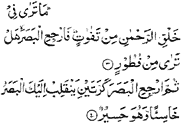 |
“Thou seest not, in the creation of the All-merciful any imperfection, Return thy gaze, seest thou any fissure. Then Return thy gaze, again and again. Thy gaze, Comes back to thee dazzled, aweary.”
This in effect is, the faith of all physicists; the deeper we seek, the more is our wonder excited, the more is the dazzlement for our gaze.
I am saying this, not only to remind those here tonight of this, but also for those in the Third World, who feel they have lost out in the pursuit of scientific knowledge, for lack of opportunity and resource.
Alfred Nobel stipulated that no distinction of race or colour will determine who received of his generosity. On this occasion, let me say this to those, whom God has given His Bounty. Let us strive to provide equal opportunities to all so that they can engage in the creation of Physics and science for the benefit of all mankind. This would exactly be in the spirit of Alfred Nobel and the ideals which permeated his life. Bless You!
Steven Weinberg – Nobel Lecture
Nobel Lecture, December 8, 1979
Conceptual Foundations of the Unified Theory of Weak and Electromagnetic Interactions
Read the Nobel Lecture
Pdf 76 kB
Abdus Salam – Photo gallery
Abdus Salam and HM Queen Silvia of Sweden at the Nobel Banquet in the Stockholm City Hall, Sweden, on 10 December 1979.
Copyright © Svensk Reportagetjänst 1979
Photo: Ulf Blumenberg
Portrait of Abdus Salam, 1986. Photo: ICTP Photo Archives
Abdus Salam reading a newspaper, 1983. Photo: ICTP Photo Archives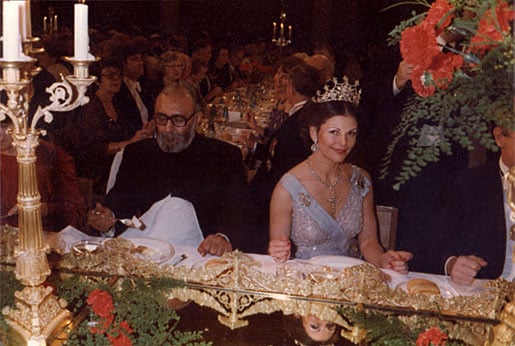


Steven Weinberg – Photo gallery
Steven Weinberg standing before a celebratory Harvard class after the news of his Nobel Prize in Physics, October 1979. Photo credit: HUV 2380.1. Harvard University Archives.
Steven Weinberg shaking hands with co-recipient Sheldon Glashow after the news of their Nobel Prize, October 1979. Photo credit: HUV 2380.1. Harvard University Archives.
Queen Beatrix of the Netherlands receives Nobel Laureates: Nobel Laureate in Chemistry 1980 Paul Berg, Nobel Laureate in Physiology or Medicine 1974 Christian de Duve, Nobel Laureate in Physics 1979 Steven Weinberg, Queen Beatrix, Nobel Laureate in Chemistry 1967 Manfred Eigen and Nobel Laureate in Physics 1981 Nicolaas Bloembergen. Photo taken on 31 August 1983.
Source: Dutch National Archives. CC BY-SA 3.0 nl via Wikimedia Commons
Photo: Rob C. Croes/Anefo
![Queen Beatrix of the Netherlands receives Nobel Laureates. [CC BY-SA 3.0 nl (http://creativecommons.org/licenses/by-sa/3.0/nl/deed.en)], via Wikimedia Commons](https://www.nobelprize.org/images/queen-beatrix-and-nobel-laureates-1983-3354-landscape-medium-gallery.jpg)
Abdus Salam – Other resources
Links to other sites
On Abdus Salam from the International Centre for Theoretical Physics
‘Abdus Salam and His International Influences’ from DOE R&D Accomplishments