Perspectives: Life through a lens
As Ernst Ruska discovered, having an ingenious idea like the electron microscope can occur in the blink of an eye, but overcoming the finer details to create a successfully working instrument can take years.
Two incredible circles closed for Ernst Ruska in December 1986, at the age of 80. The first was that Ruska was finally receiving the Nobel Prize in Physics for his key role in developing the electron microscope several decades earlier. The second was that his dinner partner at the Nobel Banquet was Queen Silvia of Sweden, and they had more to talk about than just his scientific achievements – as a child Ruska used to play with the Queen’s father, Walther Sommerlath, in their hometown Heidelberg.
Sommerlath wasn’t the only playmate Ruska had in Heidelberg. Ruska also yearned to play with optical instruments, in particular the big Zeiss microscope that his father kept in his study. However, Ernst and his six siblings were strictly forbidden to touch the microscope, in case they damaged the lens or samples. Like all children told not to touch anything, this only made Ruska more eager to use the microscope, more so when his father, a passionate botanist and mineralogist, found the time to show his children magnified objects with the instrument. Ruska also had access to the telescopes in the observatory on Königstuhl, the hill overlooking Heidelberg. His uncle Max was in charge of the observatory and Ruska would visit him from time to time to see the telescopes in action.
Fascinated by hands-on-science rather than by theory, Ruska wanted to study engineering at a Technical High School, much to the dismay of his father, who regarded this as an inferior educational path for the son of a professor of the history of sciences. But Ruska stuck firmly to his course, went to Munich to specialize in electrical engineering, and then moved to Berlin.
In Berlin, Ruska worked on high-voltage techniques and electrical plants under the guidance of Adolf Matthias. At the end of the summer term in 1928, Matthias announced his plan to set up a small team to develop a high-performance cathode ray oscilloscope that could measure the voltages of very fast electrical processes in power stations and on open-air high-voltage transmission lines. Ruska jumped at the chance and became the youngest member of the team, headed by Max Knoll who would become an important and inspiring colleague.
In a cathode-ray oscilloscope, a heated metal plate, the cathode, shoots out a wide beam of electrons, and these are focused to form a dot, or writing spot, on a fluorescent screen. The more defined one could make the writing spot, by tweaking either the diameter or intensity of the dot, the better, so the team were looking to improve ways in which to sharpen the focus of the electron beams.
Ruska discovered that engineers had been using short coils carrying an electric current to concentrate electron beams for around two decades. But while he was scanning the scientific literature, he was amazed by a recently published paper in the journal Archives Elektrotechnik by a professor from Jena University called Hans Busch. Busch suggested that the magnetic field generated in the short coil of a cathode ray tube made charged electron particles behave in the same way that light does when it passes through a convex glass lens, such as the type of lens found in Ruska’s father’s microscope.
Light microscopes use two lenses to allow us to see what is normally invisible to the naked eye. As its name suggests the first lens, the objective, or object lens, receives the light rays from the illuminated object under scrutiny to produce a real image. This real image is magnified and viewed through the second lens, called the ocular. Together these two lenses can magnify objects to up to 1,000 times their size.
The idea that electrons could behave like light rays fascinated Ruska. Unfortunately, Busch’s theory was just that, a theory. Busch never tested his hypothesis, apparently abandoning it after comparing it with contradictory, older data from his lab. But Ruska thought that if a coil of the type that Busch described really did resemble a lens, then he should be able to obtain images from it – by using magnetic fields to converge electron rays and focus on a target.
Slow Success
In his graduate years, Ruska submitted a research thesis in May 1929, in which he calculated and tested the imaging properties of a magnetic coil. Using the coil, he gained the first recorded electron-optical images – of the anode aperture of the cathode-ray tube.
From here to the first electron microscope, however, was no straightforward task. After a failed approach to create a cheaper version of this experiment as part of his diploma thesis in 1930, Ruska returned to the original idea of using short coils as lenses. In an analogy to the light microscope Ruska built a tube with two short magnetic coils in a row. Although the apparatus could only magnify objects a modest 15 times, it was the first proof that magnified images could be obtained by electron beams and magnetic fields.
But there was a big drawback: the electrons emitted a huge amount of heat, enough to destroy the objects the apparatus was setting out to view. What use was creating images of such modest magnification, if even the hardiest metals were burnt to cinders, wondered Ruska.
Guided by Knoll, and supported by his fellow colleague Bodo von Borries, he set out to build a more efficient microscope. In the back of their minds they all knew that convincing people about the virtue of this new instrument would rely on meeting, and even surpassing the power and capabilities of the light microscope. The answer to this would involve a meeting of old and new theories about light.
The light microscope’s ability to be an extension of the human eye had stunned scientists since the end of the 16th century. However, there are limits to what can be seen, and these were finally explained and defined by the physicist Ernst Abbe in 1872. Abbe was hired by the company that had made Ruska’s father’s microscope, Carl Zeiss, to put the development of microscopes on a solid scientific ground. This was more difficult than he had anticipated, and, after some initial setbacks, he worked out a theory of how images are formed.
In short, Abbe found that the bigger the aperture, in other words, the angle through which the object lens of the microscope can accept light, and the lower the wavelength, the better the microscope can distinguish individual details within an object. But to reach what seems a simple conclusion required a deep understanding of the way light behaves in a microscope, and this could be described in terms of classical knowledge of the physics of light waves. The light waves that pass through the object under investigation in the microscope are diffracted and are therefore subject to interference on their way to the object lens. The greater the number of diffracted waves that reach the object lens, the better resolved the microscopic image is.
As creating an image depends on light being diffracted, Abbe could describe and define why light microscopes can’t see objects below a certain size. Diffraction occurs when light is allowed to pass through the spaces in an object, much like the way in which water waves pass through the spaces in between reeds. If a gap is smaller than the wavelength of light the waves cannot pass through, and therefore diffraction can’t occur. According to Abbe’s calculations on the wavelength of light, this meant the size limit in a light microscope would be about 0.5 micrometres, and so the magnification factor could not be much more than 1,000.
To see anything smaller would therefore require another form of energy that has a shorter wavelength. A solution would lie in a new, upcoming field in physics: quantum mechanics. In 1924, the French physicist Louis de Broglie devised a groundbreaking theory on materials that at first glance would appear to have little or no interest to engineers. de Broglie proposed the revolutionary thought that minute particles, such as electrons, could also behave like waves.
At first, de Broglie’s idea chilled Ruska to the bone. He feared that “even at the electron microscope the resolution should be limited again by a wavelength.” Imagine Ruska’s relief when he applied the equation de Broglie had devised to calculate wavelengths, and discovered that his electron waves would be at least an order of magnitude smaller than light waves. In theory, electrons should be able to see smaller objects than light.
Cap in Hand
In practice, though, constructing the first electron microscope with a larger magnification than a light microscope would require all of Ruska’s engineering skills. The trick was to get the design of the coil right. The shape of the coil needed to be able to compress the magnetic field to a tiny area running through the middle of the coil. This way the focal length could be kept as short as possible, which is a prerequisite for high magnification.
For this purpose, Ruska and von Borries constructed the so-called “pole shoe lens”, which is a coil encapsulated by iron with a narrow gap in the middle to help compress the magnetic field. This special lens was patented in 1932 and is still used in all magnetic electron microscopes today, and with it Ruska built an electron microscope in late 1933 that had a magnification factor of 12,000.
Despite this success, Ruska couldn’t convince industry to invest in the production of his electron microscope. The problem of overheating specimens had not yet been overcome. Ruska had discovered a partial solution to this in that very thin samples could be resolved by electrons through diffraction only, and not absorption, which means less heat is emitted.
However, this wasn’t enough to convince a sceptical industry to part with their money. “Who are the potential customers of such a device?” they would ask themselves. The obvious answer was biologists, but what did Ruska’s microscope do to biological specimens? The vacuum tube dehydrated them, the electrons damaged them, and the heat that was generated burnt them.
A familiar face, however, was convinced that biologists could study living cells under this microscope. Helmut Ruska, the inventor’s younger brother, who was now a medical doctor, was sure the microscope would work, but only if improvements were made. He managed to convince his former medical professor, Richard Siebeck, director of the medical clinic at the Charité Hospital in Berlin, that his brother’s invention was worth investing time and effort into.
In an advisory opinion to the industry, dated 2 October 2 1936, and three years after the completion of the prototype electron microscope, Siebeck described how Ruska’s electron microscope could be of immense value to him, as it could advance research into the causes of disease, particularly infectious agents that couldn’t be seen with a light microscope, such as those that cause smallpox, chickenpox, measles, mumps and influenza. “Success seems to me so close, that I am ready and willing to advise on medical research work and to collaborate by making available the resources of my institute,” wrote Siebeck.
This assessment was the carrot that helped convince industry to take on the economic and technical risks and invest in developing electron microscopes. In 1937, Siemens began developing Ruska’s microscope, and the first serially produced “Siemens Super Microscope” was delivered to the laboratories of I. G. Farben in Frankfurt-Höchst in late 1939.
The contributions of several researchers turned the initial concept of a microscope into a workable idea. But during the early days of his studies Ruska stood alone in his belief that an electron microscope could be developed. Not that the doubters hampered Ruska, in fact he would later view it as a benefit. “The doubt of the others has the advantage of leaving the field uncrowded,” he said in his Nobel Banquet speech. “Mostly, this is understood only much later, in the beginning one is very disappointed.”
Bibliography
Ernst Ruska website. http://ernst.ruska.de
Kruger, D. H., Schneck, P. & Gelderblom, H. R. Helmut Ruska and the visualisation of viruses. Lancet 355, 1713–1717 (2000).
Microscope. Encyclopaedia Britannica Online (2007). http://www.britannica.com/eb/article-9108723
Robinson, A. L. Electron microscope inventors share Nobel Physics Prize. Science 234, 821–822 (1986).
Ruska, Ernst: The development of the electron microscope and of electron microscopy. Nobel Lecture, December 8, 1986.
Urban, Knut (President of German Physical Society): Ansprache zur Einweihung des Ernst Ruska-Baus der Technischen Universität Berlin, November 24, 2005 http://www.dpg-physik.de
Speed read: Beyond the realm of our senses
The concept that matter is made up of tiny atoms has been proposed for millennia, but we rely on our five senses to provide the ultimate truth. The 1986 Nobel Prize for Physics rewarded two radical leaps in microscope technology that finally allowed us to witness life at the atomic level.
The light microscope, invented in the 17th century, provided scientists with the first extension of the human eye, but observing anything in greater detail is limited by the wavelength of light. In the same way that large ocean waves are not affected significantly by small objects, it is impossible for visible light to produce an image of objects such as proteins and atoms that are smaller than its wavelength.
The development of the electron microscope opened up this previously hidden world. The electron microscope works on the principle that a short coil carrying an electric current can deflect electrons in the same way that a lens deflects light. Ernst Ruska heard about this theory, then a daring hypothesis, when he was an engineering student in 1928. Within just five years he designed and built the first electron microscope, using two coils as magnetic lenses for electrons. As electrons have a much smaller wavelength than light, this microscope could see details many times smaller than is possible with a light microscope.
Almost 50 years later, Gerd Binnig and Heinrich Rohrer succeeded in designing the scanning tunneling microscope, in which a remarkably fine stylus scans a surface and its vertical movement is used to create a topographical map of the surface at the atomic level. Generating faithful images relies on keeping the stylus at a fixed distance from the surface, which Binnig and Rohrer solved using the so-called tunneling effect, in which a current flows between the needle tip and the surface only if they are close enough together. Thanks to their advances, crystal surfaces, DNA molecules and viruses could be visualized, opening up new vistas to life around us.
Ernst Ruska – Nobel Lecture
Nobel Lecture, December 8, 1986
The Development of the Electron Microscope and of Electron Microscopy
Read the Nobel Lecture
Pdf 1.83 MB
Ernst Ruska – Banquet speech
Ernst Ruska’s speech at the Nobel Banquet, December 10, 1986
Your Majesties, Your Royal Highnesses, Ladies and Gentlemen,
As the oldest of the Physics Laureates of this year, the pleasant task fell on me to express our deep-felt gratitude towards the Nobel Committee for the high honour bestowed upon our scientific work. Our work, although differing in details, is linked by the aim of increasing and improving ideas of the structure of matter. Our scientific careers and the ways of reaching our now rewarded results have, of course, been very different. Partly this is due to the different working circumstances then as compared to today.
In my lecture two days ago I have already evoked some of my personal experiences. Here, I only want to emphasize my impression that the scanning tunnel electron microscopy of Gerd Binnig and Heinrich Rohrer has obviously been accepted much faster by scientific colleagues than electron microscopy fifty years ago. Another considerable difference is that I had not intended to revolutionize electron microscopy. I was engaged as an engineer in the technical development of the cathode ray oscillograph. Dealing with a secondary problem of this work – the concentration coil for the electron beam – I encountered the possibility of imaging with electron rays.
My colleagues Binnig and Rohrer set their task themselves from the beginning. What is truly amazing about their idea and its successful realization is that they advanced, with purely mechanical means, down to atomic dimensions. I can well imagine that many of their colleagues were sceptical of such an idea in the beginning, and I can only congratulate them for convincing the doubters so quickly with their success.
In electron microscopy, the difficulties took considerably more time to surmount, and therefore the doubters held the field for a longer period. I can, however, also confirm from my own experience the observation of my colleagues that the doubt of the others has the advantage of leaving the field uncrowded. Mostly, this is understood only much later, in the beginning one is very disappointed.
A Nobel prize automatically implies the recognition of the workers in the Laureate’s field. I think that I do not only speak for myself but also for our colleagues when I thank the Committee for awarding our effort to elucidate the fine structure of matter. Most Laureates have been accompanied on their way to success by interested and diligent assistants who are not in the limelight today. Our sincere gratitude should therefore include these collaborators.
We are very happy to experience these festive days in Stockholm and to enjoy the well-known Swedish hospitality. In conclusion, I would like to express my sincere wish that peace be with the Swedish people and their Royal Family as for all mankind.
Heinrich Rohrer – Photo gallery

Heinrich Rohrer at the interview in Stockholm, 9 April 2008.
Copyright © Nobel Media AB 2008
Photo: Merci Olsson
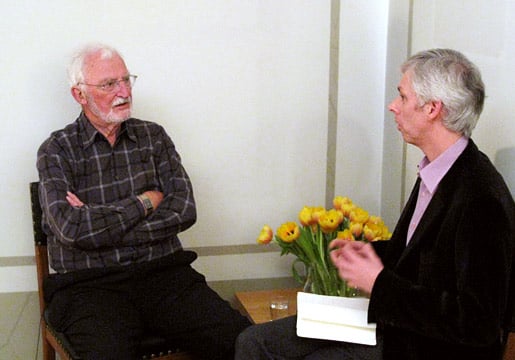
Heinrich Rohrer (left) at the interview in Stockholm, 9 April 2008. The interviewer is Adam Smith, Editor-in-Chief of Nobelprize.org.
Copyright © Nobel Media AB 2008
Photo: Merci Olsson
Gerd Binnig – Nobel Lecture
Nobel Lecture, December 8, 1986
Scanning Tunneling Microscopy – From Birth to Adolescence
Read the Nobel Lecture
Pdf 829 kB
Heinrich Rohrer – Nobel Lecture
Nobel Lecture, December 8, 1986
Scanning Tunneling Microscopy – From Birth to Adolescence
Read the Nobel Lecture
Pdf 829 kB
Heinrich Rohrer – Other resources
Links to other sites
On Heinrich Rohrer from National High Magnetic Field Laboratory
Gerd Binnig – Other resources
Links to other sites
On Gerd Binnig from National High Magnetic Field Laboratory
On Gerd Binning from American Institute of Physics
Heinrich Rohrer – Interview
Interview transcript
Heinrich Rohrer, welcome to Stockholm and to this interview with Nobelprize.org. You were awarded the 1986 Nobel Prize in Physics together with Ernst Ruska and Gerd Binnig for your joint work in developing microscopy. And in particular you and Gerd Binnig received the prize for your design of the scanning tunnelling microscope. Now this is a device that enables us to look at the surface of objects at the atomic scale, by means of a probe which skims over the surface and records variations in the topography below it with minute current fluctuations. What did this device enable us to see for the first time that we hadn’t seen before?
Heinrich Rohrer: As you say surface structures in a different way. I mean you had some ideas about certain surface structures, but you never saw it in, so to speak, in real space. So it’s just like if you would trace a surface with your finger, you see. So you see it in real space and then of course … actually you see the electrons on the surface. It’s electronic wave functions and so you also can see certain properties. You can test the hardness of a surface.
Right.
Heinrich Rohrer: But then of course in the same way you also can take atoms. The principle is the same as if you take your fingers and you play around with small balls. And the fingers, if you take nano things, the small balls can be atoms and it’s exactly the same thing. You can take an atom, you can put it somewhere else, or you can take your fingers and glide over the surface and feel the surface, feel the bumps and so on. So with the same fingers you can do two jobs. You can change it, or you can feel it, you see.
You can detect it, or you can move it around. You can play with it.
Heinrich Rohrer: Yes.
Right. And in those early days of using it, what were the first surprises that came up? Because as you said, you sort of had an idea and then you could actually see. What surprises turned up?
Heinrich Rohrer: I think the first surprise was that we really could do it with atomic resolution, you see. Actually that you can do it with atomic resolution that’s inherent in the approach we took. But we didn’t expect it that it could make such fine fingers. But then every point of a needle ends up with one atom. And this very atom at the end that’s then your finger, you see, and that’s this atom, it has the size of an atom and so you can feel other atoms. And that was a pleasant surprise that you could do it relatively easy.
On the subject of being able to do it, it seems unimaginably complex to make such a thing because you are talking about atoms almost in contact with other atoms, there must be no vibration. You are talking about a probe which is, as you say, one atom thick at its tip. The mind boggles. How did you have the confidence to even imagine that one could do such a thing, to make such an instrument?
 … I think in science you need luck …
Heinrich Rohrer: Let’s say we didn’t see any obstacle which could not be overcome. And of course there were quite a few fortuitous developments in the whole thing, but somehow luck was on our side. But I think in science you need luck, you see. And if you don’t have the luck in a specific case, then you do something different. You might have luck in something else. So, you see it was less difficult finally than everybody thought. That’s why everybody thought you could not do it and that’s why nobody did it.
And that’s, I would say, a crucial thing in science. You see, everything is new because other people think you cannot do it, or because other people do not appreciate that it could become important. And we live of novelty in science, so whenever you do something new, you have to overcome certain beliefs that this cannot be done, that it is not interesting and so on.
It’s interesting to ask why you and Gerd Binnig believed that you could do it, that other people were bounded by the limitations of what they thought they could do. You two felt that there were no obstacles, there was nothing insurmountable. You use a phrase in your autobiography that you wrote when you received the Nobel Prize, that you’d lost your respect for angstroms. And that’s a lovely phrase, an angstrom being ten to the minus ten metres.
Heinrich Rohrer: Ok, I did in my PHD thesis, I did work where I worked let’s say with angstrom dimensions just mechanically.
So you weren’t scared of the size?
Heinrich Rohrer: And you see this worked. And so in principle at that time I knew you can measure angstroms, you see, mechanically, more or less mechanically. So why shouldn’t you be able to do it in this way. I mea,n in retrospect it’s always easy.
Yes.
Heinrich Rohrer: Or let’s put it this way, when I give lectures to the public, I always have a little bit of problem. I tell them: Listen, if I explain you now what we did in terms, that you don’t understand it, you go home and still wonder what it is I do. And if I explain it to you in terms that you understand it, then you ask yourself what for something such simple you get the Nobel Prizes. In any case it worked out nicely.
Yes indeed. There’s another phrase you use, you talk about the light heartedness of your approach. You approach things with perhaps less seriousness. I don’t know, maybe that’s not the right word. It was less momentous to do what you were doing than other people might have felt it was about to be.
… we had the freedom to make mistakes …Heinrich Rohrer: Yes, ok, I think both Gerd Binnig and I we are not the types who how would you say, would hang themselves because of a failure. And the second thing is at the IBM laboratory, we had really the freedom of doing things and especially that’s how Gerd always explained it, we had the freedom to make mistakes. And so I think that’s something very important. And unfortunately, this freedom for scientists gets more and more lost you see. All the agencies, everybody’s looking at scientists, but they should be able to make mistakes, then they can correct it you see. Otherwise you just do the common things. You don’t dare to do something beyond what everybody else thinks.
It’s hard to describe the scientist as a productive unit which is going to make this contribution in this time. I’d like to talk a little bit about the IBM research labs and the environment then because that’s quite an unusual environment. This is a research institute where people are free to pursue projects.
Heinrich Rohrer: Not everybody.
OK.
Heinrich Rohrer: But the physicists were free yes.
Oh really? So the physicists are treated a little bit differently there?
Heinrich Rohrer: Yes, you see people who work on technology, I think that’s usually a joint effort of many people whereas the physics are … we did this type of physics where everybody could do his own project on his own, maybe with some help of a technician or of a post doc or of a PHD student. Whereas in technology you have to make concentrated efforts towards something and there of course a certain freedom gets lost. You still, even in technology you have the freedom to solve a problem your way, you see. But it naturally sits in a certain framework whereas in the physics everybody had to come up with his own idea what he was going to do.
It was obviously an environment that suited you well. You joined in 1963 and stayed there for the whole of your career pretty much.
Heinrich Rohrer: That’s correct. It’s a pleasant atmosphere. I mean you had to work hard. You had to show something. You see, you had to perform. Let’s put it this way, you had to perform. I mean if you took too long time to get something out which could be published in a reasonable paper, or if you did not get the recognition of the scientific community for too long a time. And then I think it really would have got a little bit less present and I think that happens with certain people even in the IBM lab in Zurich. But we were in the fortunate situation that things worked and so, you know.
And you changed field a few times along the way? How did you make the decisions about which fields to pursue? Was that IBM directed or were they just your?
Heinrich Rohrer: No, that’s all the research of member are responsible for their own field and finding their own topics, you see. They are their own, how do you say?
Masters.
Heinrich Rohrer: They have to make their own work you see. So I was working on a set of problems before and I thought somehow I came as far as I could go without learning completely new things; that’s in critical phenomena. And that was a very interesting topic and it was more or less at the top of the interest. And so by making everything smaller, inhomogenities plays a more important role.
So if you have an oxide which has a few holes then the conduction of electricity through this oxide is maybe a little bit larger. Now if you have 100 holes, then you have the same type if you make another batch of oxide, you might have 98 holes. And then maybe the conductivity will be different simply by two percent. So the fluctuation from piece to piece is still small. But if you make things smaller and smaller then you might have batches where you just have two or three holes, you see. Now maybe this one has two holes and this one has three holes and this one has one hole, so then the holes effect a conductivity most, so then in one case you would have a tremendous conductivity and in the other case you would have a conductivity which is two times less or something like that. And that is how the fluctuations from piece to piece which cannot be tolerated in miniaturisation. And so that’s an idea to work along these lines and nobody did it really in IBM and it was an important problem. Now in this case it was inhomogeneity of /- – -/ oxide, but you can have many different ways where inhomogeneities play an important role and the smaller something becomes the more the role of the inhomogeneity can get the disasters you see.
Right, well I want to return to the theme of miniaturisation in general a little later, but thinking about the decades at the IBM research labs where you moved through various fields and changed. Do you think that as well as being, wanting to move on because you had reached the pinnacle of success in a particular field, there was also an element of feeling that as a newcomer, but an experienced newcomer to another field, you could make a significant contribution fast?
Heinrich Rohrer: I think that’s generally true and unfortunately we do not practise that. You see, if you look at Nobel Prize work, that’s very often done at a young age.
In physics particularly.
Heinrich Rohrer: In physics, but even in other things too.
Yes, it’s true.
… young people are not yet biased in their minds …Heinrich Rohrer: And that’s simply because young people are not yet biased in their minds. They are not completely taken by their expert opinions. And you see expert opinions have a difficulty to go beyond of what they know. And so that’s a new start in a new field. You are from the point of view of scientist. You certainly are 20 years younger because in the new field you are not yet biased. And you look at certain things a little bit more relaxed and a little bit more open and I think that’s important and unfortunately this type of how do you say rich humanisation if that’s a word of the mind is not taking place among scientists.
You see the scientists do not get enough help, enough encouragement to change their field from time to time because the pressure is too high or is to perform something. And once you start in a new field you are a nobody to start with, you see. You have to make your way back again, but if you have a little bit of self confidence and you think you are as good as you would like to be then you make it.
So that seems to me to be a question; is it that the expert becomes so sort of enamoured of the ways that they are thinking about things that they can’t think in new ways, or is it that there’s just no pressure to think about new ways because already they’re already the expert and you’re not a nobody, you’re a somebody. If you move into a new field as you say suddenly you have to make your mark. It’s just the pressure of people’s expectation.
Heinrich Rohrer: I think the ones who change, change because of themselves and not because of external pressure.
Yes.
Heinrich Rohrer: Whereas I would say an expert in a field he feels, I would say, even more pressure because he has to stay in the field. He is in this let’s say narrow way of thinking and there he has to perform. So getting out into something else might not be necessarily more difficult you see.
Whatever the case it’s obviously a very fortunate circumstance that you found yourself within IBM where they would allow you to make such jumps. Presumably you didn’t have to go through a sort of grant proposal type.
Heinrich Rohrer: No, they were happy.
Yes they encouraged it, yes.
Heinrich Rohrer: Ok, they were happy that I did something else not because I was not performing in that thing, but that was a little bit closer to the IBM interests than what I did before, you see. But I think generally if somebody tells them ‘Listen, I would like to do something different’, they are very open and receptive to something like that.
That’s wonderfully foresighted.
Heinrich Rohrer: Oh sure.
I suppose it brings us to the question of mentorship a bit. Presumably there are people running the lab who have been guiding lights for you at least in making it an environment in which one can make this sort of jump.
Heinrich Rohrer: I would say …
Or is it very much self guided?
Heinrich Rohrer: No that’s simply self guided. Ok, I mean of course you need maybe some different resources, but you see if you had a reasonable record then I think everybody’s smart enough to say ‘Listen, if this guy was a reasonable record, if he wants to do something now, something different, you should let him do such’, you see.
Right.
Heinrich Rohrer: Because it was my risk.
Does that dictate your own attitude to mentorship when students come to work with you or young people, is that how you treat them?
Heinrich Rohrer: Yes.
So, I’d like to talk a little bit about the relationship, the partnership with Gerd Binnig. He came to your lab at the beginning of the project to develop STM and it was obviously extremely fruitful. How did that work? He was your employee …
And I found I was fortunate enough to find Gerd Binnig …Heinrich Rohrer: No, you see he was not my employee. Ok, I was his manager. But there we take a little bit of a different attitude. I had the opportunity, or I had the opportunity to get something for this type of problems for the inhomogeneity problem. And I found I was fortunate enough to find Gerd Binnig and then we started discussing and he liked it and that’s why he came. And then I think in many case, he was the technical crucial figure in the whole development, you see. And we discussed everything. I mean, he is the most creative guy I know. And I think in many ways we were very good complements you see, and he was much younger than me but I think we found a very good relationship.
Did you recognise it immediately? Was it apparent from the beginning that it was just the perfect partnership?
Heinrich Rohrer: No, because I think he recognised it earlier than me, but you see I’m older so I’m a little bit more maybe conservative in many respects. But I think it simply worked out. And that was the first team really in physics to my knowledge. That was the first time two guys got together and did something.
From the IBM labs, right?
Heinrich Rohrer: Yes, from our IBM lab. And the second team that was Bednorz and Müller who got the Nobel Prize.
In 1987 the year after you, yes.
Heinrich Rohrer: These were the two teams you see that are quite interesting.
These were golden days in Zurich yes. Yes, because your team had started slightly ahead of Bednorz and Müller.
Heinrich Rohrer: Yes, Gerd Binnig came end of ’78 and then we discussed it and out of this discussion came the STM and then the first two years Gerd first worked maybe half time and he did other things. And I just discussed and I did mostly other things and we had Christoph Gerber, he was a technician at that time and he worked full time. He was my technician, but then he didn’t work with me anymore. He worked on this problem, you see.
You see it’s maybe not always easy to start something new, but it’s getting more difficult if you have to devote your own resources. You see, a lot of people want to do something new, but always tell you first what you need for doing something new because they don’t really want to give up what they have, you see. And this step for me it was clear, ok, that’s now the new area so Christoph Gerber is working now on this thing and no longer being my technician.
Lovely clarity of vision. They weren’t totally easy years developing STM. There was quite a lot of opposition; people disbelieved that you were getting the results that you said you were getting.
Heinrich Rohrer: No, I wouldn’t say opposition. I mean opposition, we didn’t listen.
Ok.
… too many are failures in technology where people expose them too early …Heinrich Rohrer: Ok, and we did not make advertisement for it and I think that was something very important. I mean, the management knew that we were doing something new, different, but we never had to expose ourselves to the management with the new thing. We still carried on certain old experiments from before and they were successful enough that we could present ourselves as still good scientists with the old work and that’s why the new work … we didn’t expose ourselves with the new work you see. That’s very important that you do not expose yourself with something new because then you have to start to make promises you see sooner or later. And so too many are failures in technology where people expose them too early and maybe started to tell things which were a little bit exaggerated, or turned out to be exaggerated. And then you came into a mode where promises and reality started to diverge more.
I suppose to a certain extent one might even say that that was the case with Bednorz and Müller, superconductive ceramics, because the promises there were enormous.
Heinrich Rohrer: Yes, but they never talked about it and they never exposed themselves before it worked, you see.
Yes. So that’s internal exposure, but then there’s also external exposure, the point at which you start telling the world in general what you’re doing.
Heinrich Rohrer: But that’s only when it worked. And then still a lot of people were very sceptical.
That’s right, yes.
Heinrich Rohrer: But ok, that was their problem, not our problem.
That’s a wonderful devil may care attitude.
Heinrich Rohrer: Yes, I think that really that was their problem. We knew what we were doing that was real and if people thought that you cannot do it even if you could do it, that I think that’s their problem not our problem.
And in 1986, basically the technique had been proved and very rapidly you were awarded the Nobel Prize on the back of lots of other prizes as well. Did that change everything very radically for you, or did life continue just pretty much the same?
Heinrich Rohrer: I think the recognition we got already before, I mean let’s say the recognition in the scientific community, the esteem, then of course a Nobel Prize, that’s maybe a discontinuity in the whole thing … but surely changed a few things. I mean ok, you are then a Nobel Laureate and that’s already a bit different, how do you say?
Extra elevation.
Heinrich Rohrer: Yes, that’s true, but on the other hand I mean you haven’t been something different. You didn’t become somebody different. You were the same person with the same physics knowledge, everything. And I think we also could behave this way and so that made life easier for us and for everybody around us.
And STM was one of the sort of building blocks of what I suppose one might call the nanoscience revolution. It opened up a whole new area to view and I’d like to ask you a little bit about the word I used there, revolution, because nanoscience is seen as a revolution. Is that a correct term? Is it changing the way we look at the world?
So I would hate to say the nanorevolution. It has to have a little bit more substance …Heinrich Rohrer: I think the revolution has to have a little bit more than just to scale. It’s true that it was getting to a smaller and smaller scale, that was always the beginning of a revolution. I mean, from exploring the world since Columbus you see, that was the world scale and then came the industrial revolution that was the micro scale to let’s say down to the micrometre as a precision scale. And then came the IT revolution, the information technology revolution and that was in the scale of micrometre. But you see it wasn’t the micro revolution. It was really the information technology revolution. And the other one was the industrial revolution. So I would hate to say the nanorevolution. It has to have a little bit more substance. I have my expectations what could happen, but I don’t have a word for it, you see.
So now for nano just getting smaller alone does not make the revolution. I mean also for the microtechnology you had to have a transistor which really changed in the way you could do things. And I think also on the nanotechnology you have to have a few more ideas, the way you will approach new things. We know a little bit what could be the end of it, but how to do it we don’t know yet.
Is one point that having reached the nano scale, the atomic scale, we’ve really reached the limits of miniaturisation? We can’t really go smaller.
Heinrich Rohrer: I would guess so. Yes. And so that’s I think you hit the point, you see. And we are already very close. We have covered of the miniaturisation over the last 50 years. We have covered two thirds, or three quarters. And there is just a little bit to go, the difficult bit to the nano. So just getting smaller is not all. You see I think nano has to offer a little bit different things such as being smaller in order to become a revolution. And I think nano offers really completely new prospects in many ways.
Would you care to speculate a little bit?
Heinrich Rohrer: Let’s say the properties are very much different on the nano scales than they are on the micro scale and on the macro scale. The ways we can do things are also different. You entered really very closely the area of quantum mechanics you see, that’s the domain of atoms and molecules. And then you can think about how do you work. So far we’ve made things smaller by miniaturisation. Now when you talk about atoms and molecules, you will think in terms of building up something from the very small and there are many ways, just take molecular recognition. We would like to be able to recognise other molecules by a specific molecule just like nature does it you see. And I think we see that we can do that.
And so I would say the great merit of the STM is not just being able to make this fantastic pictures and so on, but I think the great merit is really that we take now atoms and molecules and small structures of molecules. We take them as an addressable individual. We know this is this atom; we want to do something with this atom, with this molecule. And it’s not like in chemistry and biology where all these things are anonymous members of some statistical ensemble, you see. And I think that opens the perspective of a new way of handling matter and doing things with matter.
Absolutely, at one level the nano science perhaps began in physics, but it now is a very interdisciplinary subject. It is a subject. People want to define it as a subject, but it has to be interdisciplinary because it’s involving all these.
Heinrich Rohrer: Sure.
And biology and chemistry, although they have been based on statistical ensembles, come down eventually.
Heinrich Rohrer: On the atom scale and on the molecule scale you do not have disciplines. Ok, the disciplines emerged when you go to larger and larger things. Take 300 years ago, or 400, you didn’t talk about physics or whatever it is. And then afterwards you had the disciplines and now we are moving back to the original way, the nanotechnology, and so the disciplines merge again, you see. So I think it’s naturally development.
That’s a nice drawing to a close of things. I’d just like to ask one last question which is based around the idea of moving fields. Obviously, you’ve been successful in moving from field to field. What do you think, is it possible to answer, nanoscience would require now in terms of an influx of new people? Are there people who you would like to see move into the field of studying properties at the atomic level?
Heinrich Rohrer: The young people and I think they do it.
Right.
Heinrich Rohrer: That was a meeting. You see, that was also an interesting aspect when we started with the whole thing when the STM came out, you see it was mainly young people. There weren’t many established ones you see. The surfer scientist, the established surfer scientist, they stayed surfer scientists. They didn’t go into the STM, only later. But now it’s quite interesting to see when you go to a meeting. I was at the last meeting, a big meeting that was the conference in Basel in 2005 and I was very pleasantly surprised by the young people, you see. There were so many young people, young guys with their enthusiasm and in particular a lot of young women, who get involved in nanoscience and not just in the biological place, biological area, they get involved in real hard let’s say mechanical engineering, or electrical engineering in context with nanoscience. I think that for me is a very encouraging sign when also young women get really enthusiastic about something. I think it’s in good hands.
That’s a very nice place to stop. Thank you very much indeed for speaking to us Heinrich Rohrer and enjoy the rest of your stay in Stockholm. Thank you.
Did you find any typos in this text? We would appreciate your assistance in identifying any errors and to let us know. Thank you for taking the time to report the errors by sending us an e-mail.