Illustrated information
A presentation of the Nobel Prize in Physics 1988, based on material from the 1988 Physics Nobel poster from the Royal Academy of Sciences.
The Royal Swedish Academy of Sciences has awarded this year’s Nobel Prize in Physics to
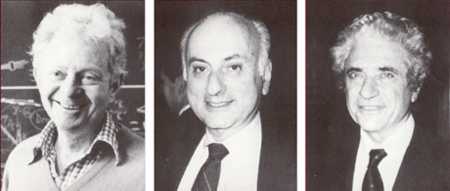
Leon M. Lederman
Fermi National Accelerator Laboratory,
Batavia, Illinois, USA
Melvin Schwartz
Digital Pathways Inc.,
Mountain View, California, USA
Jack Steinberger
CERN,
Geneva, Switzerland
for the neutrino beam method and the demonstration of the doublet structure of the leptons through the discovery of the muon neutrino.
The hunt for the muon neutrino
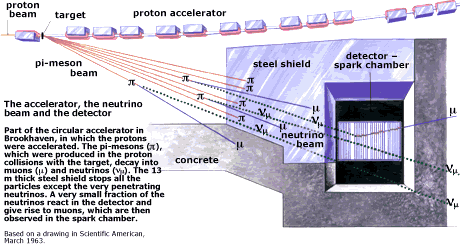
In order to understand how the weak force works and to explore the possible existence of two neutrinos, it was necessary to study neutrino interactions at high energies. Leon Lederman, Melvin Schwartz and Jack Steinberger were working to achieve a sufficiently intense neutrino beam for several years. This neutrino beam was produced in several steps:
– Protons were accelerated to an energy of 15 GeV (1 GeV = 109 eV) in the Brookhaven accelerator AGS (Alternating Gradient Synchrotron) on Long Island, USA.
– The intense proton beam was directed onto a target of beryllium. In each collision a handful of particles were produced, mainly pi-mesons.
– The many pi-meson decays resulted in a collimated beam of muons and neutrinos.
– The neutrinos, the muons and the surviving pi-mesons crashed into a 13 m thick steel shield, which stopped all particles except the neutrinos.
The steel shield, which was made of armour plates from scrapped warships, was essential for the experiment. All particles, except the neutrinos, had to be prevented from reaching the detector, as they could give rise to a large number of particle reactions and completely swamp the incredibly few neutrino reactions. The pi-mesons, which interact through the strong force, were stopped after less than half a metre of armour plates, while the muons, which interact mainly through the electromagnetic force, penetrated much further. The steel shield, which had a weight of about 2000 tons, was dimensioned to stop the penetrating muons.
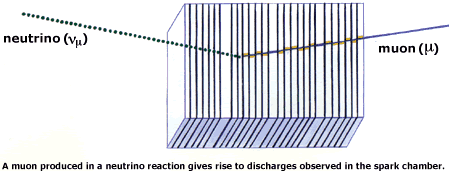
For the neutrinos to have a fair chance to interact, i.e. collide, the detector had to be massive. Furthermore, the charged particles produced in the collision had to be detected. Leon Lederman, Melvin Schwartz and Jack Steinberger studied different types of detectors before they decided, in 1960, to construct a 10 ton spark chamber. The detector was divided into 90 plates of aluminium, each an inch thick. The spaces between the plates were filled with neon gas.
As neutrino interactions are very rare, the background from other processes was disturbing, particularly the background caused by the penetrating muons from the cosmic radiation. The background was reduced by keeping the experiment active only during the short pulses, 3 microseconds, when the accelerator delivered particles. During the 8 month experiment period they accumulated data for 25 days, but because of the short pulses, the efficient time for the detector was only 6 seconds.
Each neutrino pulse contained 107 neutrinos. During the experiment a total of 1014 neutrinos went through the detector during the six seconds it was active. When a reaction took place, a high voltage was applied to the spark chamber and a discharge occurred where the produced charged particles had passed. The sparks were photographed and gave a picture of the particles’ path through the detector. A total of 51 neutrino interactions were registered with a muon observed in the spark chamber. These results showed that the neutrinos, produced together with muons, give rise to muons, not electrons.
The muon neutrino was discovered!
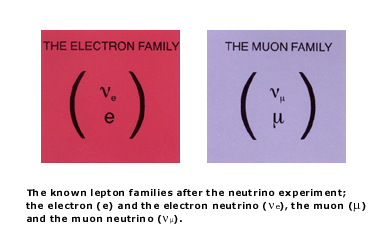
The experiment of the Nobel Prize winners not only showed that the muon and the muon neutrino form a pair, it also showed that the other two leptons, the electron and the electron neutrino, form a pair. The grouping in pairs of elementary particles is fundamental in particle physics and became even more significant after the establishment of the so called standard model.
Several experiments have since been carried out both in the USA and Europe in order to study the innermost structure of matter and to further explore the weak force.
The neutrino
The neutrino is the most elusive of the known elementary particles. It has no electric charge and, as far as we know, no rest mass. The neutrino hardly interacts with matter at all. It can go through lead with a thickness of 10 000 billion kilometres (one light year) without interacting. The neutrino interacts with matter only through the weak force.
In 1930 the Austrian, Wolfgang Pauli (Nobel Prize 1945) suggested a new type of particle, the neutrino. Many of those who heard of the new particle received the news with a certain scepticism.
A few years later, Enrico Fermi, Italy (Nobel Prize 1938) developed the theory for the weak force. Fermi called Pauli’s particle the small, neutral particle – the neutrino.
In 1956 Frederick Reines and Clyde Cowan, USA, performed an experiment demonstrating the existence of the neutrino.
The weak force
Fermi’s description of the weak force was incomplete. According to his theory the probability for a reaction at very high energies could exceed 1, which is impossible. It was therefore important to study the weak force at high energies, but the problem was how! It was possible to produce beams of particles with high energy, but these particles either interacted electromagnetically or strongly. As both the electromagnetic and the strong force dominate over the weak force the latter will not be noticeable in the competition. It was in November 1959 after a discussion during coffee-break at Colombia University that Melvin Schwartz got the idea:
One should use neutrinos!
The neutrinos would come from the decays of pi-mesons. The question was whether neutrinos produced together with muons could give rise to both electrons and muons or exclusively muons.
The hunt for the muon neutrino had started!
The four forces
There are four fundamental forces acting in nature: the gravitational force, the electromagnetic force, the strong and the weak force. If one compares the strength of the different forces, setting the gravitational force at 1, the proportion becomes:
| the gravitational force | 1 |
| the weak force | 1031 |
| the electromagnetic force | 1036 |
| the strong force | 1038 |
The gravitational force acts on macroscopic objects like man, the earth, the sun, but because of its minute strength it is completely uninteresting for elementary particles. The electromagnetic force is 100 000 times stronger than the weak force and the strong force is 10 million times stronger than the weak force. The weak force acts between all particles (except the photon which is the carrier of the electromagnetic force) and results in the decay of many different particles. In order to exclusively study the effect of the weak force, it is necessary that the other two, completely dominating forces, are not active. The electromagnetic force acts between charged particles. The strong force acts between hadrons, a group of particles constructed of quarks.
The best way to study the weak force is with the help of the neutrino.
Leptons and quarks
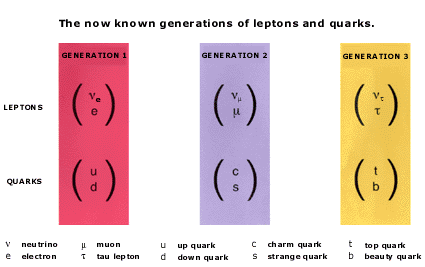
Matter is composed of two types of particles, leptons and hadrons. The hadrons are constructed of quarks, while the leptons do not seem to be constructed of other constituents. As the experiment of the Nobel Prize winners so convincingly showed, the leptons are grouped in pairs. This grouping into pairs also occurs for the quarks. According to the generally accepted model in particle physics, the standard model, the number of lepton pairs and quark pairs should be the same. A lepton pair and a quark pair are said to form a generation. The most elementary constituents of matter form three generations. Out of the six quarks and six leptons, the top quark and the tau neutrino have not yet been discovered, but particle physicists would be very surprised if they did not exist. Up to now the standard model describes very well how the forces between leptons and quarks act. Time will show whether there are more than three generations in the world of particles.
Further reading
The Royal Swedish Academy of Sciences, Information about the Nobel Prize in Physics 1988 (press release).
L. Lederman, The two-neutrino experiment, Scientific American, March 1963, page 60.
New Scientist, 29 October 1988, page 30.
Discovery of two kinds of neutrinos. Adventures in experimental physics, editor Bogdan Maglich, Oct 1972, page 81.
Credits and References for the 1988 Physics Nobel Poster
Published by:
The Royal Swedish Academy of Sciences©
Information Department
Box 50005
S-104 05 Stockholm, Sweden, Tel. +46-(0)8-15 04 30
Editor:
Dr Erik Johansson
Department of Physics,
Stockholm University
Vanadisvägen 9, S-113 46 Stockholm, Sweden
Illustrator:
Karin Feltzin,
Stockholm, Sweden
Web Adapted Version:
Nobelprize.org
Every effort has been made by the publisher to credit organizations and individuals with regard to the supply of photographs and illustrations. The publishers apologize for any omissions which will be corrected in future editions.
Leon M. Lederman – Nobel Lecture
Nobel Lecture, December 8, 1988
Observations in Particle Physics from Two Neutrinos to the Standard Model
Read the Nobel Lecture
Pdf 411 kB
Melvin Schwartz – Nobel Lecture
Nobel Lecture, December 8, 1988
The First High Energy Neutrino Experiment
Read the Nobel Lecture
Pdf 384 kB
Jack Steinberger – Nobel Lecture
Nobel Lecture, December 8, 1988
Experiments with High-Energy Neutrino Beams
Read the Nobel Lecture
Pdf 569 kB
Leon M. Lederman – Other resources
Links to other sites
Lederman Science Center at Fermilab
‘Leon Lederman, the K-meson, the Muon Neutrino, and the Bottom Quark’ from DOE R&D Accomplishments
On Leon Lederman from American Institute of Physics
Leon M. Lederman – Banquet speech
Leon M. Lederman’s speech at the Nobel Banquet, December 10, 1988
Your Majesties, Your Royal Highnesses, Ladies and Gentlemen,
My colleagues Melvin Schwartz and Jack Steinberger join me to express our feelings of pleasure and gratitude for the decision to award us the 1988 Nobel Prize for Physics, thus making us experts on the Brazilian debt, women’s fashions and social security. We are also agreed that we owe much to many others, and I would like to mention Professor T. D. Lee, our Columbia colleague, for his guidance and inspiration. I would also like to cite the late Isidore I. Rabi and the department he built at Columbia University in the 1950’s and 60’s: surely one of the greatest assemblages of physicists ever collected. With six laureates it was ordained that others of us might be infected.
We also acknowledge our co-workers on the experiment, all of whom are with us today: Gordon Danby of Brookhaven Laboratory, Jean-Marc Gaillard of CERN/Orsay, Konstantin Goulianos of Rockefeller University and Nariman Mistry of Cornell.
We are honored for research which is today referred to as the “Two Neutrino Experiment”. How does one make this research comprehensible to ordinary people? In fact “The Two Neutrinos” sounds like an Italian dance team. How can we have our colleagues in chemistry, medicine, and especially in literature share with us, not the cleverness of our research, but the beauty of the intellectual edifice, of which our experiment is but one brick? This is a dilemma and an anguish for all scientists because the public understanding of science is no longer a luxury of cultural engagement, but it is an essential requirement for survival in our increasingly technological age: In this context, I believe this Nobel Ceremony with its awesome tradition and pomp has as one of its most important benefits; the public attention it draws to science and its practitioners.
Today, twenty-six years after the “Two Neutrino Experiment”, the subject of particle physics with its modest goal of understanding the universe, dances with excitement and anticipations. Stephen Hawking in his best selling book, A BRIEF HISTORY OF TIME writes:
“If we do discover a complete theory, it should in time be understandable in broad principle by everyone; not just a few scientists. Then we shall all, philosophers, scientists and just ordinary people, be able to take part in the discussion of the question of why it is that we and the universe exist: if we find the answer to that, it would be the ultimate triumph of human reason – for then we would know the mind of God.”
Jack Steinberger – Interview
Jack Steinberger – Other resources
Links to other sites
On Jack Steinberger from the Lindau Mediatheque
‘Jack Steinberger and the Muon-Neutrino’ from DOE R&D Accomplishments
Melvin Schwartz – Other resources
Links to other sites
‘Melvin Schwartz and the Discovery of the Muon Neutrino’ from DOE R&D Accomplishments
Melvin Schwartz – Photo gallery
Melvin Schwartz receiving his Nobel Prize from H.M. King Carl XVI Gustaf of Sweden at Konserthuset Stockholm on 10 December 1988. Photo from the Lars Åström archive
Leon M. Lederman, Melvin Schwartz and Jack Steinberger at the Nobel Prize award ceremony in Stockholm, Sweden on 10 December 1988. Photo from the Lars Åström archive
Melvin Schwartz at the Nobel Prize banquet, 10 December 1988. Photo from the Lars Åström archive
Melvin Schwartz during Nobel Week in Stockholm, Sweden, December 1988. Nobel Foundation. Photo: Lars Åström
Physics laureates Melvin Schwartz, Jack Steinberger and Leon M. Lederman, chemistry laureates Robert Huber, Hartmut Michel and Johann Deisenhofer during Nobel Week in Stockholm, Sweden, December 1988. Nobel Foundation. Photo: Lars Åström
The 1988 laureates assembled at the Swedish Academy, 1988. Back row from left: medicine laureate George H. Hitchings, chemistry laureate Johann Deisenhofer, medicine laureate Sir James W. Black, physics laureate Jack Steinberger, chemistry laureate Robert Huber, physics laureate Melvin Schwartz, chemistry laureate Hartmut Michel and physics laureate Leon M. Lederman. Seated are from left: laureate in economic sciences Maurice Allais, medicine laureate Gertrude B. Elion and Umm Kulthoum Mahfouz, daughter of literature laureate Naguib Mahfouz. Photo from the Lars Åström archive
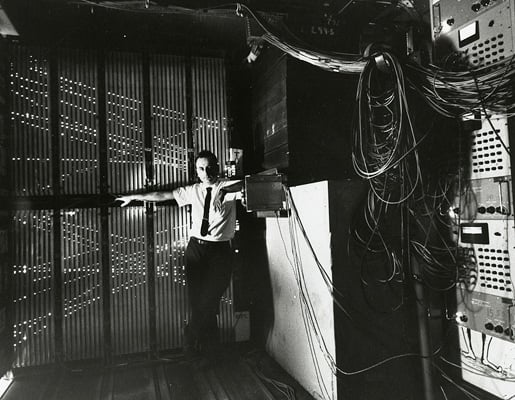
Melvin Schwartz in front of the spark chamber used to conduct his Nobel Prize awarded research.
Photo: Courtesy of Brookhaven National Laboratory
Nobel Laureates in Physics assembled at Brookhaven National Laboratory in August 1996 (left to right): 1957 Laureate Tsung-Dao Lee, 1988 Laureates Leon Lederman, Melvin Schwartz and Jack Steinberger, and 1976 Laureate Samuel Ting.
Photo: Courtesy of Brookhaven National Laboratory