Norman F. Ramsey – Photo gallery

Norman F. Ramsey receiving his Nobel Prize from His Majesty King Carl XVI Gustaf of Sweden at the Stockholm Concert Hall, 10 December 1989.
Photo from the Lars Åström archive

Laureates assembled at the Nobel Prize award ceremony in the Stockholm Concert Hall on 10 December 1989: Physics laureates Norman F. Ramsey, Hans G. Dehmelt and Wolfgang Paul, chemistry laureates Sidney Altman and Thomas R. Cech, medicine laureates J. Michael Bishop and Harold E. Varmus, literature laureate Camilo José Cela and economic sciences laureate Trygve Haavelmo.
Photo from the Lars Åström archive

Norman F. Ramsey and Princess Lilian of Sweden proceed into the Blue Hall of the Stockholm City Hall for the Nobel Banquet, 10 December 1989.
Photo from the Lars Åström archive

Princess Lilian of Sweden and physics laureate Norman F. Ramsey at the Nobel Prize banquet, 10 December 1989.
Photo from the Lars Åström archive

Physics laureates Norman F. Ramsey and Hans G. Dehmelt photographed during Nobel Week in Stockholm, December 1989.
Photo from the Lars Åström archive

Nine of the ten Nobel Prize laureates of 1989 assembled at the Swedish Academy in Stockholm in December 1989. Back row: J. Michael Bishop, Sidney Altman, Harold E. Varmus, Thomas R. Cech, Wolfgang Paul and Hans G. Dehmelt. Front row: Norman F. Ramsey, Camilo José Cela and Trygve Haavelmo.
Photo from the Lars Åström archive
Hans G. Dehmelt – Photo gallery

Hans G. Dehmelt receiving his Nobel Prize from H.M. King Carl XVI Gustaf of Sweden at the Stockholm Concert Hall on 10 December 1989.
Photo from the Lars Åström archive
Laureates assembled at the Nobel Prize award ceremony in the Stockholm Concert Hall on 10 December 1989: Physics laureates Norman F. Ramsey, Hans G. Dehmelt and Wolfgang Paul, chemistry laureates Sidney Altman and Thomas R. Cech, medicine laureates J. Michael Bishop and Harold E. Varmus, literature laureate Camilo José Cela and economic sciences laureate Trygve Haavelmo.
Photo from the Lars Åström archive

Hans G. Dehmelt takes to the dance floor at the Nobel Banquet on 10 December 1989.
Photo from the Lars Åström archive

Hans G. Dehmelt photographed during Nobel Week in Stockholm, December 1989.
Nobel Foundation. Photo: Lars Åström
Physics laureates Norman F. Ramsey and Hans G. Dehmelt photographed during Nobel Week in Stockholm, December 1989.
Photo from the Lars Åström archive
Nine of the ten Nobel Prize laureates of 1989 assembled at the Swedish Academy in Stockholm in December 1989. Back row: J. Michael Bishop, Sidney Altman, Harold E. Varmus, Thomas R. Cech, Wolfgang Paul and Hans G. Dehmelt. Front row: Norman F. Ramsey, Camilo José Cela and Trygve Haavelmo.
Photo from the Lars Åström archive
Wolfgang Paul – Photo gallery

Wolfgang Paul receiving his Nobel Prize from H.M. King Carl XVI Gustaf of Sweden at the Stockholm Concert Hall on 10 December 1989.
Photo from the Lars Åström archive
Laureates assembled at the Nobel Prize award ceremony in the Stockholm Concert Hall on 10 December 1989: Physics laureates Norman F. Ramsey, Hans G. Dehmelt and Wolfgang Paul, chemistry laureates Sidney Altman and Thomas R. Cech, medicine laureates J. Michael Bishop and Harold E. Varmus, literature laureate Camilo José Cela and economic sciences laureate Trygve Haavelmo.
Photo from the Lars Åström archive

Physics laureate Wolfgang Paul examining his Nobel Prize medal during his visit to the Nobel Foundation in December 1989.
Photo from the Lars Åström archive
Nine of the ten Nobel Prize laureates of 1989 assembled at the Swedish Academy in Stockholm in December 1989. Back row: J. Michael Bishop, Sidney Altman, Harold E. Varmus, Thomas R. Cech, Wolfgang Paul and Hans G. Dehmelt. Front row: Norman F. Ramsey, Camilo José Cela and Trygve Haavelmo.
Photo from the Lars Åström archive

Portrait of Wolfgang Paul.
Photo from the Lars Åström archive
Norman F. Ramsey – Nobel Lecture
Nobel Lecture, December 8, 1989
Experiments with Separated Oscillatory Fields and Hydrogen Masers
Read the Nobel Lecture
Pdf 283 kB
Hans G. Dehmelt – Other resources
Links to other sites
Hans Dehmelt’s page at University of Washington
“After the Prize”. An interview with Hans G. Dehmelt from University of Washington
Obituary from the Washington Post
Hans G. Dehmelt – Facts
Hans G. Dehmelt – Biographical
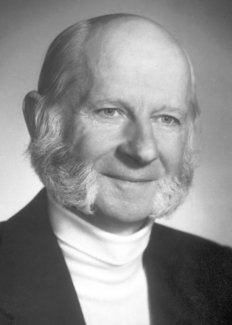
My father, Georg, had studied law at the Universität Berlin for some years, and in the first World War had been an artillery officer. He was of a philosophical bend of mind and a man of independent opinions. In the depth of the depression he just managed to make a living in real estate. When the family fortunes had shrunk to ownership of a heavily mortgaged apartment building located in an overwhelmingly Communist part of Berlin, it seemed reasonable to move into one of the apartments ourselves as nobody paid any rent. Cannons were deployed on the streets on occasion and the class war had entered the class rooms. After a few bloody noses administered by a burly repeater, I shifted my interests from roaming the streets more towards playing with rudimentary radio receivers and noisy and smelly experiments in my mother’s kitchen. In the spring of 1933 my mother, a very energetic lady, saw to it that, at the age of ten, I entered the Gymnasium zum Grauen Kloster, the oldest Latin school in Berlin, which counted Bismarck amongst its Alumni. This involved a stiff entrance examination and I was admitted on a scholarship. My father at that time expressed the opinion that I probably would be happier as a plumber. However, he apparently didn’t quite believe this himself. Thus, in years before, he had bought me an erector set and books on the lives of famous inventors and Greek mythology, and when I was ill he had given me the encyclopedia to read. I supplemented the school curriculum with do-it-yourself radio projects until I had hardly any time left for my class work. Only tutoring from my father rescued me from disaster. Reading popular radio books deepened my interest in physics. While physics was taught at the Kloster only in the later grades, in the public library I read books with titles such as “Umsturz im Weltbild der Physik” and learned about the Balmer series and Bohr’s energy levels of the hydrogen atom. My teachers at the Kloster were excellent, I remember in particular Dr. Richter, who taught Latin and Greek, and Dr. Splettstoesser, who taught biology and physics. Richter liked to expand on the classical works, which we were reading in class. I spent most of the ample breaks in related intense discussions with a group of classmates, Heppke, Hubner, Landau and Leiser while others engaged in boxing matches. Splettstoesser was a working scientist who spent Summers as a visitor with a marine biology institute on the Adriatic. I jumped a term and graduated in the spring of 1940.
Having received a notice from the draft board, I found it wise to volunteer for the anti-aircraft artillery and a motorized unit. I was not able to serve as a radio man but was assigned to a gun crew and never rose above the rank of senior private. Sent to relieve the German armies at Stalingrad, my battery was extremely lucky to escape the encirclement. A few months later I was even more lucky to be ordered back to Germany to study physics under an army program at the Universität Breslau in 1943. After one year of study, I was sent to the Western Front and captured in the Battle of the Bulge. I spent a year in an American prisoner of war camp in France and was released early in 1946. Supporting myself with the repair and barter of prewar radios, I took up my study of physics again at the Universität Göttingen. Here I attended lectures by Pohl, Richard Becker, Hans Kopfermann and Werner Heisenberg; Max v. Laue and Max Planck attended the physics colloquia. At the funeral of Planck I was chosen to be one of the pall bearers. At the university, I greatly enjoyed repeating the Frank-Hertz experiment, the Millikan oil drop, Zeemann effect, Hull’s magnetron, Langmuir’s plasma tube and other classic modern physics experiments in an excellent laboratory class run by Wolfgang Paul. In one of his Electricity & Magnetism classes Becker drew a dot on the blackboard and declared “Here is an electron…” Having heard in another class that the wave function of an electron at rest spreads out over all of space, and having read about ion trapping in radio tubes in my teens set me to wonder how one might realize Becker’s localization feat in the laboratory. However, that had to wait a while. In 1948, in Kopfermann’s Institute, which was heavily oriented towards hyperfine structure studies, I completed an experimental Diplom-Arbeit (master’s thesis) on a Thomson mass spectrograph under Peter Brix. The results were published in “Die photographischen Wirkungen mittelschneller Protonen II,” the first paper of which I was a (co)author. Soon thereafter, I began work on my doctoral thesis under Hubert Kruger in the same Institute. Well prepared by a series of excellent Institute seminars on the NMR work of Bloch and of Purcell, we were able to successfully compete with workers at Harvard University. In 1949 we discovered Nuclear Quadrupole Resonance and reported it in our paper “Kernquadrupolfrequenzen in festem Dichloraethylen.” My doctoral thesis had the title “Kernquadrupolfrequenzen in kristallinen Jodverbindungen.” This work led to an invitation to join Walter Gordy’s well known microwave laboratory at Duke University as postdoctoral associate.
At Duke I had the pleasure of making the acquaintance of James Frank, Fritz London, Lothar Nordheim and Hertha Sponer. I advised Hugh Robinson, a graduate student of Gordy’s in an NQR experiment, did my own research and also contributed some NMR expertise to an experiment by Bill Fairbank and Gordy on spin statistics in 3He/4He mixtures, gaining some very useful low temperature experience in this brief collaboration. Through Gordy’s and Nordheim’s good offices I was able to receive a visiting assistant professor appointment at the University of Washington with a charge to advise Edwin Uehling’s students during his sabbatical and to do independent research. I had built my first electron impact tube during a brief interlude in 1955 in George Volkoffs laboratory at the University of British Columbia. Prior to that I had attempted a paramagnetic resonance experiment on free atoms in Gottingen and succeeded in doing so at Duke. During seminars at Göttingen on the magnetic resonance techniques of Rabi and of Kastler, it had occurred to me that because of the analogy between an atom and a radio dipole antenna, (a), alignment of the atom should show up in its optical absorption cross section, and (b), electron impact should produce aligned excited atoms. I put these two ideas to good use in 1956 in Seattle in an experiment entitled “Paramagnetic Resonance Reorientation of Atoms and Ions Aligned by Electron Impact.” In this paper I first pointed out the usefulness of ion trapping for high resolution spectroscopy and mentioned the 1923 Kingdon trap as a suitable device. This work also brought me into close contact with spin exchange between electron and target atom, which gave me the idea for my 1958 experiment “Spin Resonance of Free Electrons Polarized by Exchange Collisions.” However, first I had to learn how to produce polarized atoms, which could then transfer their orientation to trapped electrons. Falling back on buffer gas techniques developed in my 1955 Duke paper “Atomic Phosphorus Paramagnetic Resonance Experiment,” I quickly demonstrated in my 1956 Seattle paper “Slow Spin Relaxation of Optically Polarized Sodium Atoms” how to efficiently produce and monitor a polarized atom cloud. Trapping the electrons in a neutralizing ion cloud slowly diffusing in the buffer gas, I was able to carry out the spin resonance experiment. My optical transmission monitoring scheme proved also very useful in the development of rubidium vapor magnetometers and frequency standards by Earl Bell and Arnold Bloom at Varian Associates, in which I acted as a consultant. The rubidium frequency standard is still the least expensive, smallest and most widely used commercial atomic frequency standard. The thesis “Experimental Upper Limit for the Permanent Electric Dipole Moment of Rb85 by Optical Pumping Techniques” of my first graduate student, Earl Ensberg, also made use of these novel optical pumping schemes and was finished in 1962. These early results were improved orders of magnitude by my doctoral student Philip Ekstrom in his 1971 thesis “Search for Differential Linear Stark Shift in Cs133 and Rb85 Using Atomic Light Modulation Oscillators.”
I was not satisfied with the plasma trapping scheme used for the electrons and asked my student, Keith Jefferts, to study ion trapping in an electron beam traversing a field free vacuum space between two grids. Also, I began to focus on the magnetron/Penning discharge geometry, which, in the Penning ion gauge, had caught my interest already at Göttingen and at Duke. In their 1955 cyclotron resonance work on photoelectrons in vacuum Franken and Liebes had reported undesirable frequency shifts caused by accidental electron trapping. Their analysis made me realize that in a pure electric quadrupole field the shift would not depend on the location of the electron in the trap. This is an important advantage over many other traps that I decided to exploit. A magnetron trap of this type had been briefly discussed in J.R. Pierce’s 1949 book, and I developed a simple description of the axial, magnetron, and cyclotron motions of an electron in it. With the help of the expert glassblower of the Department, Jake Jonson, I built my first high vacuum magnetron trap in 1959 and was soon able to trap electrons for about 10 sec and to detect axial, magnetron and cyclotron resonances. About the same time, my Göttinger colleague, Otto Osberghaus, sent me a research report on the Paul rf ion cage. This trap had very desirable properties for atomic ions and it did not require a magnetic field. Therefore, I asked my student, Fouad Major, to experiment with a simplified cylindrical version of such a trap in the hope that it might be useful in hfs resonance experiments on hydrogenic helium ions. The early results were very encouraging and Jefferts also switched to the Paul trap. In 1962, Jefferts and Major both finished their Doctoral Theses entitled respectively “Alignment of Trapped H2+ Molecular Ions by Selective Photodissociation” and “The Orientation of Electrodynamically Contained He4 Ions.” As a continuation of the latter, a new postdoc, Norval Fortson, Major and I published the 1966 paper “Ultrahigh Resolution DF=0 ± 13He+ HFS Spectra by an Ion Storage-Exchange Collision Technique.” My own attempts to detect the polarization of the electrons acquired from a polarized beam of alkali atoms in my Penning (magnetron) trap, described in a 1961 research report to the NSF “Spin Resonance of Free Electrons,” were not so quickly successful. However in this work I was much impressed by seeing the beam of sodium atoms traversing my glass apparatus in the reflected light from a sodium vapor street lamp adapted as illuminating light source. Only a later concerted effort by Gräff and Werth at Bonn, reinforced by Major and Fortson, as visitors, made a similar spin resonance experiment work in 1968.
In the 1966 paper with Fortson and Major, I also proposed to develop an infrared laser based on ions in an rf trap. To this end my student, David Church, completed a thesis in 1969 entitled “Storage and Radiative Cooling of Light Ion Gases in RF Quadrupole Traps.” In this work we demonstrated a race-track-shaped trap and cooled the ions by coupling to a resonant LC circuit. In parallel work my student, Stephan Menasian, in 1968, with some help from G.R. Huggett, succeded in cooling Hg+ ions in a race-track-trap with a helium buffer gas and in detecting them by optical absorption. Jefferts’ research on hfs spectra of H2+ was continued in Seattle by my postdoc Charles Richardson and later by Menasian in his 1973 doctoral thesis “High Resolution Study of the (1, 1/2, 1/2) – (1, 1/2,3/2) HFS Transition in H2+.” The resolution in the 3He+ hfs work was greatly enhanced in work with my colleague Fortson and my postdoc Hans Schuessler. Realizing in 1961 that precision measurements of the electron magnetic moment would require a large magnetic field and that Becker’s electron localization feat might be approximated in a Penning trap, I began to consider other avenues for magnetic resonance experiments. Some success in the electron work, achieved with the help of my new student, Fred Walls, was described in our 1968 paper “‘Bolometric’ Technique for the RF Spectroscopy of Stored Ions.” I reviewed the work on ions and electrons up to 1968 in two articles “Radiofrequency Spectroscopy of Stored Ions.”
The able assistance of two postdocs, David Wineland and my former student Phil Ekstrom, made the isolation of a single electron become a reality in 1973 with our paper “Monoelectron Oscillator.” Measuring its magnetic moment was another story. At Göttingen in the late forties I had attended a seminar given by Helmut Friedburg, a doctoral Student of Wolfgang Paul, on focussing spins with a magnetic hexapole. This may be viewed as a refinement of the Stern-Gerlach effect. In subsequent discussions with fellow students a rumor of a Stern-Gerlach experiment for electrons was brought up, and also Bohr’s and Pauli’s thesis that such experiments were impossible in principle. Though it greatly piqued my interest, I could not understand this thesis. Stimulated by a 1927 paper of Brillouin on the subject, I followed another of the guiding principles formulated by Bohr: “In my Institute we take nothing absolutely serious, including this statement.” In 1973 I proposed, together with Ekstrom, to monitor spin and cyclotron quantum numbers of the lone electron by means of the “continuous Stern-Gerlach effect” in an abstract “Proposed g-2/dvz Experiment on Stored Single Electron or Positron.” My new postdoc Robert Van Dyck, Philip Ekstrom and myself reported the first such experiment in our 1976 paper “Axial, Magnetron, and Spin-Cyclotron Beat Frequencies Measured on Single Electron Almost at Rest in Free Space (Geonium).” This work also already made use of the important technique of side band cooling of the electron. The demonstration of sideband cooling had eluded us in earlier attempts undertaken together with Walls and later with Wineland. Encouraged by the success of the monoelectron oscillator I had also published in 1973 an abstract “Proposed 1014Dv v Laser Fluorescence Spectroscopy on Tl+ Mono-Ion Oscillator.” Unfortunately, this proposal infuriated one of the agencies funding our research to the degree that they terminated their support almost immediately. I was rescued by a prize from the Humboldt Foundation and an invitation by Gisbert zu Putlitz to initiate the proposed laser spectroscopy project in his Institute at the Universität Heidelberg. As the fruit of these efforts a paper “Localized visible Ba+ mono-ion oscillator” by Neuhauser, Hohenstatt, Toschek and myself appeared in 1980.
In 1981 Van Dyck, my doctoral student Paul Schwinberg and myself extended the electron work to its antiparticle in our paper “Preliminary Comparison of the Positron and Electron Spin Anomalies” and I reviewed it in an article “Invariant Frequency Ratios in Electron and Positron Geonium Spectra Yield Refined Data on Electron Structure.” In 1986 we published a detailed paper “Electron Magnetic Moment from Geonium Spectra: Early Experiments and Background Concepts” and in 1987 our collaboration reported a 4 parts in 1012 resolution in the g factor for electron and positron in “New High-Precision Comparison of Electron and Positron g Factors.” A very promising scheme to detect cyclotron excitation through the small relativistic mass increase accompanying it was published in a 1985 paper “Observation of Relativistic Bistable Hysteresis in the Cyclotron Motion of a Single Electron” together with my postdoc, Gerald Gabrielse, and William Kells, a visitor from Fermi Lab.
Two years after the Heidelberg pioneering work an individual magnesium ion was isolated in Seattle with my postdoc Warren Nagourney and my student Gary Janik. The latter’s thesis bore the title “Laser Cooled Single Ion Spectroscopy of Magnesium and Barium.” “Shelved optical electron amplifier: Observation of quantum jumps,” was published in 1986 with my colleague Nagourney, and Jon Sandberg, an exceptional undergraduate assistant. The paper introduced a new technique which has made optical spectroscopy on an individual ion possible with record resolution and reproducibility. To date the best resolution has been realized at NIST by a group headed by my former collaborator Wineland. Peter Toschek who had made important contributions to the visible ion work in Heidelberg has built up a thriving laboratory for monoion-spectroscopy at the Universität Hamburg. With Herbert Walther a collaboration almost came off in 1974. Walther, with his large staff and excellent facilities in Munich, has since developed his own expertise in the field and made outstanding contributions to it. Gabrielse, now a full professor at Harvard, has assembled a large group and is trapping and cooling antiprotons at CERN.
In the 1988 paper “A Single Atomic Particle Forever Floating at Rest in Free Space: New Value for Electron Radius” I have surveyed the field and suggested new avenues for its extension. More precise measurements of the g factor of the electron may well be the most promising approach to study its structure. No less important, a trapped individual atomic ion may reveal itself as a timekeeping element of unsurpassed reproducibility. The research effort in Seattle continues on troth projects. The National Science Foundation has supported my research since 1958 without interruption. Initially the Army Office of Ordnance Research and the Office of Naval Research did also provide support for many years.
I am married to Diana Dundore, a practising physician. I have a grown son, Gerd, from an earlier marriage to Irmgard Lassow who is deceased.
I do regular hatha yoga exercises, enjoy waltzing, hiking in the foothills, reading, listening to classical music, and watching ballet performances.
Selected Publications
“Die photographischen Wirkungen mittelschneller Protonen II”, P. Brix and H. Dehmelt, Z. Physik 126, 728 (1949)
“Kernquadrupolfrequenzen in festem Dichloraethylen”, H. Dehmelt and H. Krueger, Naturwissenschaften 37, 111 (1950)
“Nuclear Quadrupole Resonance”, H. Dehmelt, Am. J. Phys. 22, 110 (1954)
Atomic Phosphorus Paramagnetic Resonance Experiment”, H. Dehmelt, Phys. Rev. 99,527 (1955)
“Paramagnetic Resonance Reorientation of Atoms and Ions Aligned by Electron Impact” H. Dehmelt, Phys. Rev. 103, 1125 (1956)
“Slow Spin Relaxation of Optically Polarized Sodium Atoms”, H. Dehmelt, Phys. Rev. 105, 1487 (1957)
“Modulation of a Light Beam by Precessing Absorbing Atoms” H. Dehmelt, Phys. Rev. 105, 1924 (1957)
“Spin Resonance of Free Electrons Polarized by Exchange Collisions”, H. Dehmelt, Phys. Rev. 109, 381 (1958)
“Spin Resonance of Free Electrons”, H. Dehmelt, 1958-61 Progress Report for NSF Grant NSF-G 5955
“Alignment of the H2+ Molecular Ion by Selective Photodissociation”, H. Dehmelt and K. Jefferts, Phys. Rev. 125, 1318 (1962)
“Orientation of He Ions by Exchange Collisions with Cesium Atoms”, H. Dehmelt and F. Major, Phys. Rev. Lett. 8, 213 (1962)
“Ultrahigh Resolution DF=0, ±1 3He+ HFS Spectra by an Ion Storage – Exchange Collision Technique”, N. Fortson, F. Major and H. Dehmelt, Phys. Rev. Lett. 16, 221 (1966)
“Radiofrequency Spectroscopy of Stored Ions”, H. Dehmelt, Adv. At. Mol. Phys. 3, 53 (1967) and 5, 109 (1969)
“Alignment of the H2+ Molecular Ion by Selective Photodissociation II: Experiments on the RF Spectrum,” Ch. Richardson, K. Jefferts and H. Dehmelt, Phys. Rev. 165, 80 (1968)
“‘Bolometric’ Technique for the RF Spectroscopy of Stored Ions”, H. Dehmelt and F. Walls, Phys. Rev. Lett. 21, 127 (1968)
“Radiative Cooling of an Electrodynamically Confined Proton Gas”, D. Church and H. Dehmelt, J. Appl. Phys. 40, 3421 (1969)
“Proposed g-2/dvz Experiment on Stored Single Electron or Positron”, H. Dehmelt and P. Ekstrom, Bull. Am. Phys. Soc. 18, 727 (1973)
“Monoelectron Oscillator”, D. Wineland, P. Ekstrom and H. Dehmelt, Phys. Rev. Lett. 31, 1279 (1973)
“Proposed 1014Dv v Laser Fluorescence Spectroscopy on Tl+ Mono-Ion Oscillator”, H. Dehmelt, Bull. Am. Phys. Soc. 18, 1521 (1973)
“Principles of the Stored Ion Calorimeter” D. Wineland and H. Dehmelt, J. Appl. Phys. 46, 919 (1975)
“Proposed 1014Dv v Laser Fluorescence Spectroscopy on Tl+ Mono-Ion Oscillator II (spontaneous quantum jumps)”, H. Dehmelt, Bull. Am. Phys. Soc. 20, 60 (1975)
“Proposed 1014Dv v Laser Fluorescence Spectroscopy on Tl+ Mono-Ion Oscillator III (side band cooling)”, D. Wineland and H. Dehmelt, Bull. Am. Phys. Soc. 20, 637 (1975)
“Axial, Magnetron, Cyclotron and Spin-Cyclotron Beat Frequencies Measured on Single Electron Almost at Rest in Free Space (Geonium)”, Van Dyck, Jr., R.S., Ekstrom, P., and Dehmelt, H., Nature 262, 776 (1976)
“Entropy Reduction by Motional Side Band Excitation”, Dehmelt, H., Nature 262, 777 (1976)
“A Progress Report on the g-2 Resonance Experiments”, H. Dehmelt, in Atomic Musses and Fundamental Constants, Volume 5 (eds. J. H. Sanders, and A. H. Wapstra), p. 499. Plenum New York, 1976
“Precise Measurement of Axial, Magnetron, Cyclotron and Spin-Cyclotron Beat Frequencies on an Isolated 1-meV Electron”, Van Dyck, Jr., R.S., Ekstrom, P., and Dehmelt, H., Phys. Rev. Lett. 38, 310 (1977)
“Electron Magnetic Moment from Geonium Spectra”, Van Dyck, Jr., R.S., Schwinberg, P.B. & Dehmelt, H.G., in New Frontiers in High Energy Physics (Eds. B. Kursunoglu, A. Perlmutter, and L. Scott), Plenum New York, 1978
“Optical Sideband Cooling of Visible Atom Cloud Confined in Parabolic Well”, Neuhauser, W., Hohenstatt, M., Toschek, P.E., and Dehmelt, H.G., Phys. Rev. Lett. 41, 233 (1978)
“Single Elementary Particle at Rest in Free Space I-IV”, Dehmelt, H., Van Dyck, Jr., R.S., Schwinberg, P.B., Gabrielse, G., Bull. Am. Phys. Soc. 24, 757 (1979)
“Localized visible Ba+ mono-ion oscillator”, Neuhauser, W., Hohenstatt, M., Toschek, P. E., and Dehmelt, H. G., Phys. Rev. A22, 1137 (1980)
“Preliminary Comparison of the Positron and Electron Spin Anomalies”, P.B.Schwinberg, R.S. Van Dyck, Jr., and H.G. Dehmelt, Phys. Rev. Lett. 47, 1679 (1981)
“Invariant Frequency Ratios in Electron and Positron Geonium Spectra Yield Refined Data on Electron Structure”, Hans Dehmelt, in Atomic Physics 7, D. Kleppner & F. Pipkin Eds., Plenum, New York, 1981
“Mono-Ion Oscillator as Potential Ultimate Laser Frequency Standard”, Hans Dehmelt, IEEE Transactions on Instrumentation & Measurement, IM-31, 83 (1982)
“Stored Ion Spectroscopy”, Hans Dehmelt, in Advances in Laser spectroscopy, F. T. Arecchi, F. Strumia & H. Walther, Eds., Plenum, New York, 1983
“Geonium Spectra and the Finer Structure of the Electron”, R. Van Dyck, P. Schwinberg, G. Gabrielse & Hans Dehmelt, Bulletin of Magnetic Resonance 4, 107 (1983)
“g-Factor of Electron Centered in Symmetric Cavity”, Hans Dehmelt, Proc. Natl. Acad. Sci. USA 81, 8037 (1984); Erratum ibidem 82, 6366 (1985)
“Observation of Relativistic Bistable Hysteresis in the Cyclotron Motion of a Single Electron”, G. Gabrielse, H. Dehmelt & W. Kells, Phys. Rev. Letters 54, 537 (1985).
“Doppler-Free Optical Spectroscopy on the Ba+ Mono-Ion Oscillator”, G. Janik, W. Nagourney, H. Dehmelt, J. Opt. Soc. Am. B 2, 1251-1257 (1985)
“Single Atomic Particle at Rest in Free Space: New Value for Electron Radius”, Hans Dehmelt, Annales de Physique (Paris) 10, 777 – 795 (1985)
“Observation of Inhibited Spontaneous Emission”, G. Gabrielse and H. Dehmelt, Phys. Rev. Lett. 55, 67 (1985)
“Electron Magnetic Moment from Geonium Spectra: Early Experiments and Background Concepts”, Van Dyck, Jr., R.S., Schwinberg, P.B. & Dehmelt, H.G., Phys. Rev. D 34, 722 (1986)
“Continuous Stern Gerlach Effect: Principle and idealized apparatus”, Hans Dehmelt, Proc. Natl. Acad. Sci. USA 83, 2291 (1986), and 83, 3074 (1986)
“Shelved optical electron amplifier: Observation of quantum lumps”, Warren Nagourney, Jon Sandberg, and Hans Dehmelt, Phys. Rev. Letters 56, 2797 (1986)
“New High Precision Comparison of Electron/Positron g-Factors”, Van Dyck, Jr, R.S., Schwinberg, P.B. Dehmelt, H.G., Phys. Rev. Letters 59, 26 (1987)
“Single Atomic Particle at Rest in Free Space: Shift-Free Suppression of the Natural Line Width?”, Hans Dehmelt, in Laser Spectroscopy VIII, S. Svanberg and W. Persson editors, 1987 (Springer, New York)
“Single Atomic Particle Forever Floating at Rest in Free Space: New Value for Electron Radius”, Hans Dehmelt, Physica Scripta T22, 102 (1988)
“New Continuous Stern Gerlach Effect and a Hint of ‘The’ Elementary Particle”, Hans Dehmelt, Z. Phys. D 10, 127-134 (1988)
“Coherent Spectroscopy on a Single Atomic System at Rest in Free Space III”, Hans Dehmelt, in Frequency Standards and Metrology, A. de Marchi Ed. (Springer, New York, 1989). p. 15
“Triton,.. electron,.. cosmon …: An infinite regression? Hans Dehmelt, Proc. Natl. Acad. Sri. USA 86, 8618-8619 (1989)
“Miniature Paul-Straubel ion trap with well-defined deep potential well”, Nan Yu, Hans Dehmelt, and Warren Nagourney, Proc. Natl. Acad. Sci. USA 86, 5672 (I 989)
This autobiography/biography was written at the time of the award and later published in the book series Les Prix Nobel/ Nobel Lectures/The Nobel Prizes. The information is sometimes updated with an addendum submitted by the Laureate.
Addendum, May 2005
After I had received the Prize in 1989 until my retirement in October 2002 I continued my single electron and single ion work with my associates. In the 1990s, stimulated by the life extension work of Roy Walford I shifted my main effort more and more into this and the Health and Nutrition fields.
On my University website http://faculty.washington.edu/dehmelt/ are some examples of work in progress. I also published 2 papers, Re-Adaptation Hypothesis: Explaining Health Benefits Of Caloric Restriction & Healthiest Diet Hypothesis: How to Cure Most Diseases? in the peer-reviewed journal Medical Hypotheses. Recently the Karolinska Institute invited me to nominate candidates for the 2005 Prize which I did. Also the journal Theoretical Biology and Medical Modeling asked me to publish my expanded next paper The Healthiest Diet: It Cures Most Diseases with them which I will do. My retirement from teaching was celebrated by a Fest & Festschrift An Isolated Atomic Particle at Rest in Free Space: A Tribute to Hans Dehmelt, Nobel Laureate, E. Norval Fortson and Ernest M. Henley, Editors.
Hans G. Dehmelt died on 7 March 2017.
Copyright © The Nobel Foundation 2005Norman F. Ramsey – Interview
Interview transcript
Professor, I want to say thank you very much for coming to this interview today.
Norman F. Ramsey: Happy to be here.
I would like to start off by asking you, you are now in your 90s and you’re still working, I believe.
Norman F. Ramsey: I’m almost in my 90s. I will be 90 in about two months.
That’s fantastic. And you’re still working?
Norman F. Ramsey: Yes, still work some, but I work less than I did before. And I’m much slower than I was before.
Why do you want to continue?
Norman F. Ramsey: Because it’s very interesting. I want to know the answers. We’re trying to make various investigations. We’re studying symmetry of the neutron and looking for an electric dipole moment to the extent to which it may or may not be shaped like an American football or like a sphere. And it’s a very interesting thing; I want to know. And we in theory have been sort of competing on those theories of whether there should be one there, or shouldn’t be one there. Now we’re convinced that there should be one there, but we haven’t seen it yet. But that’s a puzzle for them.
That’s fantastic. The people you’re working with, are they former students of yours?
Norman F. Ramsey: Yes, some are former students. I’ve been working particularly with a somewhat international group at Grenoble, France. I would say Michael Pendlebury is one of the principle and Philip Harris and some of the people from Grenoble. I started the experiments with graduate students.
Is it so in your field that you, as you said ‘We don’t know the answers to certain things and I want to know them’. You have … is it like almost building a puzzle?
Norman F. Ramsey: That’s right.
Is it that you pick up some information?
Norman F. Ramsey: That’s right. I mean the very first experiment I did and that was looking disparity, which is symmetry, whether nature would know the difference between left and right handed. And everybody said ‘It won’t know the difference’. But I said ‘Well, it’s still worth doing a test’. We didn’t find it, but it turns out there was a failure of parity. That’s a good test to do.
What was it in your childhood maybe that made you want to become a scientist?
 … physical things have always interested me. I was curious and still am.
Norman F. Ramsey: I don’t know. I mean at the time I was a child I didn’t know too much about science is a thing you, a career you go in to, but on the other hand one of my favourite magazines was Popular Mechanics. And I used to make up some of the things that they did there and read with interest what was then the frontier of science as it was then reported. And it fascinated me, but at the time I was in college, even physics wasn’t really recognised as a subject, so it was only after I graduated from college that I shifted to physics actually as opposed … well for a while I was in mathematics, which I enjoyed very much. But it was always, my basic interest was always there. I mean physical things have always interested me. I was curious and still am.
Interviewer What do you think when you were rewarded the Nobel Prize, 1989, had you expected it?
Norman F. Ramsey: No.
No.
Norman F. Ramsey: No I had not. Almost every year a group of us would wonder not whether I’m going to get the prize, but whether who’s going to get the prize. But that particular year 1989 my wife and I had been on a mountain trip in the Himalayas. We took a trip from Kashmir to Ladakh passing over a couple of passes at 17,000 feet high, which was higher than any mountain I’d been On, much less any pass, and it was a fascinating trip. We didn’t speculate about the prize from here. I got back home and even then I had a little bit of learning about it because we’d been away the previous year actually visiting a professor. And we kept the telephone, but it was turned out this company only kept the telephone in my wife’s name not my name. So the chairman of the committee couldn’t find me.
How long a time did it take?
But I learned later that they had even made a mistake. …Norman F. Ramsey: They released it to the newspapers at seven and the New York Times science editor found me immediately. I mean he knew where I was. But I learned later that they had even made a mistake. They had guessed maybe I might be in Washington DC. There was a Norman Ramsey there. And the chairman of the committee called him and called that number and asked if the young man who answered it his father was there. And he said ‘Yes he is’. ‘Well we’d like to speak to him’. He said ‘But well my father’s sound asleep. It’s now six a.m.’ and they said ‘We want to tell him he’s received half the Nobel Prize in Physics’. And this young man said ‘That’s very interesting since my father’s an economist’.
You never got to speak to him about that?
Norman F. Ramsey: I’ve been meaning some time when I’m in Washington, look him up on the phone register and say ‘Yeah, I’m glad you didn’t steal my prize’.
So what was the feeling then when you got it? Were you really happy?
Norman F. Ramsey: I was delighted. My first reaction even after I got the call from the New York Times, my first questioning was, he told me ‘What do you think about getting half the Nobel Prize in Physics’. I said ‘That’s wonderful, but are you sure?’ But then he named the other people who were getting it that year and they were very good. I was delighted to be in their company and that made it sound as if it was a real thing.
Your discovery has had many implications.
Norman F. Ramsey: Yes, it has.
Could you tell us a little bit about you know what is has been and what you see in the future?
Norman F. Ramsey: It has had really many, many more than I would have expected at the time I was doing the work, which was work on magnetic resonance. Magnetic resonance was a brand new thing before even I did the work because before I received the prize I was working with I I Rabi at Columbia. And had the very good luck of starting to work with him about two months before he invented the magnetic resonance method, which was a new thing. Immediately I and several others started working on it and the first experiments worked. Then the second experiment didn’t really seem to work right and you know you’re always disappointed when it doesn’t work right. But usually that’s more exciting because then it means there’s something different we found. Yes we were also looking to interactions in molecules, which was not what we were looking for originally. And so in addition to measuring the magnetic moment of the nucleus, we were also measuring the interactions that was in the molecules. So the chemists were almost immediately very interested in it.
And since then it has steadily expanded other things, part of which I have been involved in and part of which other people have been involved in. I mean one of the ones that turned out, because of the interaction in the molecule, particularly in the case of Adams, it’s a very sort of constant of nature. And it’s determined by quantum mechanics; it’s a very interesting thing. Quantum mechanics has things are fixed. You can be sure what they are. So quantum mechanically you could be sure that this constant would stay fixed, for that mean measuring that is a very good basis for atomic clocks because you need for that, and it’s really even different in principle for more previous clocks. I mean previous clocks like pendulum clocks; it depends on the mechanic who makes the pendulum. Does he make it the right length?
And in the case of atomic clocks, it’s nature who makes the device that determines the time, so that it’s universally you can be sure, unless we make a terrible mistake. If we make an atomic clock in the United States and someone makes it in England, it better be the same within our experimental area. And then we’ve steadily improved it. So that turned out, it makes that time determine that way rather more fun in the middle you know. And secondly it also is true that you could measure it much more accurately. So it’s both happy circumstance that the most accurate measurement, so that for example the second, the unitive time of the second is now determined, is defined in terms of oscillation and a caesium atom, which we were concerned with at one time.
It looks as there will be even better definitions of a second …I think it’s a rapidly moving field now. It looks as there will be even better definitions of a second. That atom was accurate to about what we call one part in 10 to the 15th. That’s one part in one followed by 15 zeros. So it’s very accurate. But there are things for which you need even greater accuracy. It’s the best test of the theory of relativity are now done with atomic clocks. And you can make extreme tests for that. Radio astronomy is now a very powerful tool, but to make the telescopes have good resolution, you want one to be in one side of the earth and the other on the other side of the earth. But you have to have good clocks to match the two. So there are many, many applications for it.
And GPS is another area?
Norman F. Ramsey: What?
GPS is another area?
Norman F. Ramsey: GPS, everybody who buys for $100 a GPS receiver doesn’t actually get an atomic clock. He gets a good crystal clock. But the satellites which are going around which give the signals that he synchronises to, those are atomic clocks. And then particularly the central stations, which keep the time for the whole system, are atomic clocks.
It’s fantastic because it’s really helpful. I mean it helps a lot of people.
Norman F. Ramsey: Oh it’s very helpful. In fact, the talk I was giving here yesterday, I was talking about, since this year is one of the specializes in sort of applications to other fields and interdisciplinary things, I chose what about the different ways in which magnetic resonance, which we started this one narrow area of just measuring the magnetic moments of the nuclear. Well which I mentioned extended quickly to molecules, then extended to atomic clocks. And then was extended to NMR, which is a way of we looked at our regional things. We only looked at atoms in a beam by themselves, but you can also detect magnetic resonance in a solid, or gas or a liquid. And that extends what it can be done on and to make very sensitive measurements there.
… you get these beautiful pictures of a person’s brain …And then of course there’s this really revolutionary development many years later. Well I mean that’s really coming strong in the last few years, which is magnetic resonance images, MRIs. I mean there’s a great increase in the power of it because it enables all of our earlier magnetic resonance and also NMR had the characteristic that you only looked at a whole, all of a sample. With magnetic resonance imaging you can look at a big sample, but tell which part gives what picture, so you get these beautiful pictures of a person’s brain. And they can even detect when you’re, if you’re asked a hard question, they can see, they can do some things to determine what part of your brain is doing your thinking.
That’s amazing.
Norman F. Ramsey: It is amazing. So that’s a totally different atom. That never entered our mind, but of course in medicine, in medical research and medical treatment, this is a key thing.
It’s revolutionary because we could detect so many things much earlier I would imagine…
Norman F. Ramsey: Yes. That’s right. That’s correct. And there’s a certain amount of good luck doing research. I would say that’s one, at the time I started the research and better and better with it of doing more accurate magnetic resonance, which is what the prize was for, it was obviously a very important field. But it became a much more important field later and it’s sort of nice to see your things leading to that.
That must be so rewarding.
Norman F. Ramsey: Yes that’s very rewarding.
Maybe that’s one of, as you said, you know the reason you’re still so curious, is that what you need to have, the curiosity?
Norman F. Ramsey: That’s right. You need to be very curious and willing to work hard, but also think freshly I mean.
During these days in Lindau, we are meeting in Lindau for this interview, you meet a lot of young people.
Norman F. Ramsey: Yes we do, and that is a good thing, I think very good thing for the young people. It’s also a very good thing for us because it renews us as well as them because we see these fresh minds. A meeting yesterday, we had about ¾ of an hour talk and then they open it to questions and they ask very good questions really.
What do they ask you?
Norman F. Ramsey: Oh they asked all sorts of things ranging all the way from technical things as to exactly how the resonance worked to what I thought were good fields for research in the future. They get really very freewheeling, what I thought of research. And even had some questions on disappointments, what if something doesn’t work?
What are you doing then if something doesn’t work?
… what happens after you’ve had one of your failures?Norman F. Ramsey: That’s one of the things I talked about. I think all of us who do scientific research, almost all of us have our successes and our failures. And the key difference between the people I think who on the whole succeed and the others is what happens after you’ve had one of your failures? I mean you think you have a good thing, an important thing to look for and well it can’t be there; it isn’t there, you can’t find it. It’s a disappointment. Or somebody else does the experiment first, that’s a sad thing too. But the people who are really good in the field, say ‘Fine, I guess we lost that one. We’ll try something different we hope that’s even better’.
So the scope for doing new beautiful discoveries are still out there obviously?
Norman F. Ramsey: They’re still out there. They will be different in nature. I mean yes, no one will ever discover again that at least in the energy levels we’re doing with if the electrons circulate around a nucleus or something like that. That was done by our people, but how it does it? For example, when I decided to do experiments of Rutherford and others who found that was the motion. It wasn’t quantise. Now we know that you have to do with quantum mechanics. It’s probably different mechanics in fact and that’s developed in more recent years. And we have the interesting time I think in physics now that in some respects we can account for an amazing amount of material. I mean our ordinary universe that we see at normal energies, at normal accuracies, we really understand quite thoroughly. And it requires quantum mechanics to do this, but it works.
That’s fascinating. My last question would be, do you believe that scientists have any special responsibility, particularly scientists who have received a Nobel Prize, for bringing messages of importance to politicians and decision makers?
Norman F. Ramsey: I think they do and I agree with you that probably specially Nobel Prize, a number of us do that. Unfortunately, sometimes they are not so responsive and I am afraid at the present moment our government is not as responsive as it was a few years ago, but I hope that will change. But I still think it’s still important to do. This is true for example the things on the environment. I mean it’s very clear that the atmosphere is heating up and that at least a significant factor of that is due to people. The problem of CO2 in the atmosphere is important, but some of the officials in our government don’t recognise it. So even though they have scientific committees that call this to attention and say it is something we should do, and somehow they sort of get some other advisers. The trouble is you can always hire somebody who can give you advice in a different direction if you want. And then they tend to modify their reports in that direction. So there are real problems in that regard. But the answer is yes, we should and I have. I mean actually in my case I also felt very strongly about not getting involved in the Iraq war, but that didn’t affect the government’s position.
Thank you so very much professor.
Norman F. Ramsey: Well, you’re very welcome.
It was very nice to meet you.
Norman F. Ramsey: Very nice meeting you.
Interview with Professor Norman F. Ramsey by freelance journalist Marika Griehsel at the 55th meeting of Nobel Laureates in Lindau, Germany, June 2005.
Professor Ramsey talks about the fact that he is still actively working, why he became a scientist (2:22), being awarded the Nobel Prize (3:25), his discovery and its implications (6:21), meeting young students in Lindau (13:56), and a Nobel Laureate’s responsibilities (16:46).
Did you find any typos in this text? We would appreciate your assistance in identifying any errors and to let us know. Thank you for taking the time to report the errors by sending us an e-mail.
Norman F. Ramsey – Curriculum Vitae
Born 27 August 1915 in Washington, D.C.; Ph.D., Columbia University 1940; since 1947 employed at Harvard University, from 1966 as Higgins Professor of Physics. Executive Secretary of the group that established the Brookhaven National Laboratory and first Chairman of its physics division; Chairman of Universities Research Association, which planned the Fermi Laboratory, Batavia, Illinois 1966-1972; President of the American Physical Society 1978-1979. American citizen.
Address:
Lyman Physics Laboratory
Harvard University
Cambridge, MA 02138
USA
tel inst: +1 – (617) 495-2864
The Royal Swedish Academy of Sciences
Norman F. Ramsey died on 4 November 2011.
Hans G. Dehmelt – Curriculum Vitae
National Academy of Sciences
Board on Physics and Astronomy
2101 Constitution Av., MH 456
Washington, DC20418, USA
Born 9 September 1922 in Görlitz, Germany; graduate studies in Gottingen 1946-1950; post-doctoral studies Gottingen 1950-52 and Duke University, North Carolina, U.S.A., 1952-1955; Assistant Professor 1955, Associate Professor 1958 and full Professor 1961 at the University of Washington, Seattle, U.S.A. Awarded the Davisson-Germer Prize by the American Physical Society 1970. American citizen.
Address:
Department of Physics, FM-15
University of Washington
Seattle, WA 98195
USA
The Royal Swedish Academy of Sciences