Russell A. Hulse – Photo gallery

Russell A. Hulse receiving his Nobel Prize from H.M. King Carl XVI Gustaf of Sweden at the Stockholm Concert Hall on 10 December 1993.
Nobel Foundation. Photo: Lars Åström

All Nobel Laureates assembled at the Nobel Prize award ceremony in the Stockholm Concert Hall on 10 December 1993. From left: Physics Laureates Russell A. Hulse and Joseph H. Taylor Jr, Chemistry Laureates Kary B. Mullis and Michael Smith, Medicine Laureates Richard J. Roberts and Phillip A. Sharp, Literature Laureate Toni Morrison and Laureates in Economic Sciences Robert W. Fogel and Douglass C. North.
Photo from the Lars Åström archive

Russell A. Hulse showing his Nobel Prize medal after the Nobel Prize award ceremony in the Stockholm Concert Hall on 10 December 1993.
Nobel Foundation. Photo: Lars Åström

Russell A. Hulse delivering his Nobel Prize lecture 'The Discovery of the Binary Pulsar' at the Royal Swedish Academy of Sciences on 8 December 1993.
Nobel Foundation. Photo: Lars Åström

All 1993 Nobel Prize laureates assembled at the Swedish Academy during Nobel Week, December 1993. From left, back row: Richard J. Roberts, Michael Smith, Phillip A. Sharp, Russell A. Hulse, Joseph H. Taylor Jr. and Douglass C. North. Front row: Kary B. Mullis, Toni Morrison and Robert W. Fogel.
Photo from the Lars Åström archive

1993 Nobel Prize laureates assembled: Kary B. Mullis, Russell A. Hulse, Joseph H. Taylor Jr., Douglass C. North, Robert W. Fogel and Michael Smith.
Nobel Foundation. Photo: Lars Åström

Group photo of the 1993 Nobel Laureates, assembled at the Nobel Foundation, December 1993. From left: Chemistry Laureate Kary B. Mullis, Medicine Laureate Phillip A. Sharp, Physics Laureate Russell A. Hulse, Medicine Laureate Michael Smith, Peace Prize Laureates Nelson Mandela and Frederik Willem de Klerk, Medicine Laureate Richard J. Roberts, Laureate in Economic Sciences Robert W. Fogel, Literature Laureate Toni Morrison, Physics Laureate Joseph H. Taylor Jr. and Laureate in Economic Sciences Douglass C. North.
© Nobel Foundation. Photo: Boo Jonsson
Joseph H. Taylor Jr. – Photo gallery

Joseph H. Taylor Jr. receiving his Nobel Prize from H.M. King Carl XVI Gustaf of Sweden at the Stockholm Concert Hall on 10 December 1993.
Nobel Foundation. Photo: Lars Åström
All Nobel Laureates assembled at the Nobel Prize award ceremony in the Stockholm Concert Hall on 10 December 1993. From left: Physics Laureates Russell A. Hulse and Joseph H. Taylor Jr, Chemistry Laureates Kary B. Mullis and Michael Smith, Medicine Laureates Richard J. Roberts and Phillip A. Sharp, Literature Laureate Toni Morrison and Laureates in Economic Sciences Robert W. Fogel and Douglass C. North.
Photo from the Lars Åström archive

Joseph H. Taylor Jr. showing his Nobel Medal after the Nobel Prize award ceremony in the Stockholm Concert Hall on 10 December 1993.
Photo from the Lars Åström archive

Joseph H. Taylor Jr. showing his medal after the Nobel Prize award ceremony.
Nobel Foundation. Photo: Lars Åström

1993 Nobel Banquet. Seated fourth from right is medicine laureate Joseph H. Taylor Jr. and sixth from right is literature Toni Morrison.
Nobel Foundation. Photo: Lars Åström

Joseph H. Taylor Jr. delivering his Nobel Prize lecture 'Binary Pulsars and Relativistic Gravity' at the Royal Swedish Academy of Sciences on 8 December 1993.
Nobel Foundation. Photo: Lars Åström
All 1993 Nobel Prize laureates assembled at the Swedish Academy during Nobel Week, December 1993. From left, back row: Richard J. Roberts, Michael Smith, Phillip A. Sharp, Russell A. Hulse, Joseph H. Taylor Jr. and Douglass C. North. Front row: Kary B. Mullis, Toni Morrison and Robert W. Fogel.
Photo from the Lars Åström archive
1993 Nobel Prize laureates assembled: Kary B. Mullis, Russell A. Hulse, Joseph H. Taylor Jr., Douglass C. North, Robert W. Fogel and Michael Smith.
Nobel Foundation. Photo: Lars Åström
Group photo of the 1993 Nobel Laureates, assembled at the Nobel Foundation, December 1993. From left: Chemistry Laureate Kary B. Mullis, Medicine Laureate Phillip A. Sharp, Physics Laureate Russell A. Hulse, Medicine Laureate Michael Smith, Peace Prize Laureates Nelson Mandela and Frederik Willem de Klerk, Medicine Laureate Richard J. Roberts, Laureate in Economic Sciences Robert W. Fogel, Literature Laureate Toni Morrison, Physics Laureate Joseph H. Taylor Jr. and Laureate in Economic Sciences Douglass C. North.
© Nobel Foundation. Photo: Boo Jonsson
The Nobel Prize in Physics 1993
Speed read: Catching gravity’s waves
For a second time, the Nobel Prize in Physics for 1993 was awarded to the discovery of a burnt-out star remnant known as a pulsar. Awarding the Prize to Russell Hulse and Joseph Taylor not only rewarded their discovery of two pulsars dancing around each other but also acknowledged their discovery of a space laboratory that could test one of Albert Einstein’s most important theories.
According to Einstein’s general theory of relativity of 1916, the Universe exists in three-dimensions plus time as a fourth dimension. This space-time, as it is commonly known, behaves much like a liquid, being distorted by the presence of massive bodies, such as stars, and forming ripples of gravitational radiation as these bodies move through the cosmos. Finding these predicted ripples in the fabric of space-time proved difficult as it required locating an object large enough and travelling fast enough through space to create gravitational waves that can reach Earth before fading away.
In the same year that Antony Hewish received the 1974 Nobel Prize in Physics for his role in the discovery of a pulsar – the collapsed and superdense corpse of a massive star, known as a neutron star, that is left behind when it dies in a supernova explosion – Joseph Taylor and his student Russell Hulse discovered a pair of pulsars that are close enough together to orbit around each other in space. Since this so-called ‘binary pulsar’ is moving fast and the two stars are close together, Einstein’s theory predicted that they should generate significant amounts of gravitational radiation, which in turn steals energy from the two pulsars, making them spiral slowly towards each other. After four years of meticulous observations Taylor showed that Einstein’s theory passed all tests: the two pulsars are not only spiralling towards each other, but they are doing so at almost exactly the rate predicted by the theory.
Hulse and Taylor’s observations, although indirect, provided the strongest proof yet for gravitational radiation. Their findings have provided the impetus to develop a series of gravity-wave detectors, which aim to catch gravitational radiation from astronomical phenomena like black holes or two merging neutron stars through more direct means, as their passing waves wash over Earth.
Joseph H. Taylor Jr. – Nobel Lecture
Nobel Lecture, December 8, 1993
Binary Pulsars and Relativistic Gravity
Read the Nobel Lecture
Pdf 284 kB
Joseph H. Taylor Jr. – Other resources
Links to other sites
On Joseph H. Taylor Jr. from Princeton university
On Joseph H. Taylor Jr. from American Institute of Physics
Joseph H. Taylor Jr. – Banquet speech
Joseph H. Taylor Jr.’s speech at the Nobel Banquet, December 10, 1993
Your Majesties, Your Royal Highnesses, Ladies and Gentlemen,
We have heard earlier today that scientific discoveries come at unpredictable times. Just as a person cannot say “I shall write poetry,” another cannot say “I shall make a scientific discovery.”
Russell Hulse and I did not set out in 1973 to detect gravitational waves, or even to conduct experiments into the fundamental nature of gravity. Instead, we set out to chart the celestial globe with a new type of star – aware only that we were sailing a route none had explored before, and that wondrous new lands might be revealed beyond the next horizon.
We were young, well-prepared, and receptive, but not yet wise. We were playing a detective game, gathering clues and solving logical puzzles as they presented themselves.
One special new island, at first only faintly visible in our telescope, later showed its bounty in full relativistic glory. When its treasures were gathered and brought home, some after many years of labor, they provided keys to long-locked gates and added new notes to the symphony of natural law.
In discovering this new island and gathering its exotic fruits, Russell Hulse and I, and other colleagues in later years, were enjoying the privilege of doing what we like best: satisfying our own curiosities, by asking and answering questions. We sought no other reward than the pleasure of an exciting journey. To be honored by being here tonight is beyond our wildest youthful dreams of nineteen years ago, and brings us joy that mere words cannot express.
Russell A. Hulse – Nobel Lecture
Nobel Lecture, December 8, 1993
The Discovery of the Binary Pulsar
Read the Nobel Lecture
Pdf 1.19 MB
Russell A. Hulse – Other resources
Links to other sites
‘Russell Hulse, the First Binary Pulsar, and Science Education’ from DOE R&D Accomplishments
Press release

13 October 1993
The Royal Swedish Academy of Sciences has decided to award the Nobel Prize Physics for 1993 jointly to Russell A. Hulse and Joseph H. Taylor, Jr, both of Princeton University, New Jersey, USA for the discovery of a new type of pulsar, a discovery that has opened up new possibilities for the study of gravitation
Gravity investigated with a binary pulsar
The discovery rewarded with this year’s Nobel Prize in Physics was made in 1974 by Russell A. Hulse and Joseph H. Taylor, Jr using the 300-m radiotelescope at Arecibo, Puerto Rico, West Indies. Taylor, then Professor at the University of Massachusetts, Amherst, and his research student Hulse were searching systematically for pulsars – a kind of rapidly rotating cosmic beacon with a mass somewhat greater than that of the sun and a radius of about ten kilometres. (A human being on the surface of a pulsar would weigh some hundred thousand million times more than on Earth.) The pulsar’s “beacon light” is often within the radio wave region.
The first pulsar was discovered in 1967 at the radioastronomy laboratory in Cambridge, England (Nobel Prize 1974 to Antony Hewish). What was new about the Hulse-Taylor pulsar was that, from the behaviour of the beacon signal, it could be deduced that it was accompanied by an approximately equally heavy companion at a distance corresponding to only a few times the distance of the moon from the earth. The behaviour of this astronomical system deviates greatly from what can be calculated for a pair of heavenly bodies using Newton’s theory. Here a new, revolutionary “space laboratory” has been obtained for testing Einstein’s general theory of relativity and alternative theories of gravity. So far, Einstein’s theory has passed the tests with flying colours. Of particular interest has been the possibility of verifying with great precision the theory’s prediction that the system should lose energy by emitting gravitational waves in about the same way that a system of moving electrical charges emits electromagnetic waves.
The significance of the discovery of the binary pulsar
The discovery of the first binary pulsar is primarily of great significance for astrophysics and gravitational physics. Gravity is the oldest known natural force, the one we are most aware of in daily life. At the same time it is in one sense the force that is hardest to study since it is so much weaker than the other three natural forces: the electromagnetic force and the strong and the weak nuclear forces. The development of technology and science since the second World War with rockets, satellites, space voyages, radioastronomy, radar technology and the precise measurement of time using atomic clocks has led to a renaissance of the study of this earliest-known natural force. The discovery of the binary pulsar represents an important milestone in this historical development.
Relativity theory and gravitational physics
According to Albert Einstein’s general theory of relativity, gravity is caused by changes in the geometry of space and time: space-time curves near masses. Einstein presented his theory in 1915 and became a world celebrity when in 1919 the English astrophysicist Arthur Eddington announced that one of the predictions of the theory, the deflection of starlight passing near the surface of the sun – “the light is drawn towards the sun” – had been verified during solar eclipse expeditions. This deflection of light, together with a small general-relativity contribution to the perihelion motion of Mercury (a slow rotation of Mercury’s elliptical orbit round the sun), was for several decades the only, partly rather uncertain, support for Einstein’s theory.
For a long time the theory of relativity was considered aesthetically very beautiful and satisfying, probably correct, but of little practical significance to physics except in applications in cosmology, the study of the origin, development and structure of the universe.
Attitudes to the general theory of relativity changed, however, during the 1960s when both experimental and theoretical developments made gravitational physics a topical part of physics. New opportunities for precise experiments, based on satellite and radar technology, opened up. In particular, the research of the Americans R. Dicke and I. Shapiro contributed to this. Dicke performed precision experiments in which the sun’s gravitational field on the earth was used for verifying what is termed the equivalence principle, the identity between gravitational and inertial mass – one of the basic principles of the general theory of relativity (and also of several alternative gravitation theories). Important contributions were also Shapiro’s theoretical prediction and experimental verification, using radar echoes from Mercury, of a new consequence of the general theory of relativity – a time-delay effect for electromagnetic signals passing through gravitational fields.
All these experiments, however, were confined to our solar system with its very weak gravitational fields and consequently small deviations, hard,to measure, from the Newtonian theory of gravity. Hence it was possible to test the general theory of relativity and other theories only in the first post-Newtonian approximation.
The discovery of the binary pulsar
Hulse’s and Taylor’s discovery in 1974 of the first binary pulsar, called PSR 1913 + 16 (PSR stands for pulsar, and 1913 + 16 specifies the pulsar’s position in the sky) thus brought about a revolution in the field. We have here two very small astronomical bodies, each with a radius of some ten kilometres but with a mass comparable with that of the sun, and at a short distance from each other, only several times the moon’s distance from the earth. Here the deviations from Newton’s gravitational physics are large. As an example may be mentioned that the periastron shift, the rotation of the elliptical orbit that the pulsar (according to Kepler’s first law from the beginning of the 17th century) follows in this system, is 4 degrees per year. The corresponding relativistic shift for the most favourable example in our solar system, the above-mentioned perihelion motion of Mercury, is 43 seconds of arc per century (this is less than a tenth of the very much larger contributions to the perihelion motion caused by perturbations from other planets, chiefly Venus and Jupiter). The difference in size between the shifts is partly due to the orbital speed in the binary pulsar, which is almost five times greater than Mercury’s, and partly due to the pulsar performing about 250 times more orbits a year than Mercury. The orbiting time of the binary pulsar is less than eight hours, which can be compared with the one month our moon takes to orbit the earth.
A very important property of the new pulsar is that its pulse period, the time between two beacon sweeps (0.05903 see) has proved to be extremely stable, as opposed to what applies to many other pulsars. The pulsar’s pulse period increases by less than 5% during 1 million years. This means that the pulsar can be used as a clock which for precision can compete with the best atomic clocks, This is a very useful feature when studying the characteristics of the system.
The very stable pulse period is in fact a mean of the pulse period observed on earth over the time of one orbit of the pulsar system. The observed period actually varies by several tens of microseconds, i.e. by an amount that is much greater than the variation in the mean value. This is a Doppler effect, and led to the conclusion that the observed pulsar moves in a periodic orbit, meaning that it must have a companion. As the pulsar approaches the earth, the pulses reach the earth more frequently; as it recedes they arrive less frequently. From the variation in pulse period, conclusions can be drawn about the pulsar’s speed in its orbit and other important features of the system.
Demonstration of gravitational waves
A very important observation was made when the system had been followed for some years. This followed theoretical predictions made shortly after the original discovery of the pulsar. It was found that the orbit period is declining: the two astronomical bodies are rotating faster and faster about each other in an increasingly tight orbit. The change is very small. It corresponds to a reduction of the orbit period by about 75 millionths of a second per year, but, through observation over sufficient time, it is nevertheless fully measurable. This change was presumed to occur because the system is emitting energy in the form of gravitational waves in accordance with what Einstein in 1916 predicted should happen to masses moving relatively to each other. According to the latest data, the theoretically calculated value from the relativity theory agrees to within about one half of a percent with the observed value. The first report of this effect was made by Taylor and co-workers at the end of 1978, four years after the discovery of the binary pulsar was reported.
The good agreement between the observed value and the theoretically calculated value of the orbital path can be seen as an indirect proof of the existence of gravitational waves. We will probably have to wait until next century for a direct demonstration of their existence. Many long-term projects have been started for making direct observations of gravitational waves impinging upon the earth. The radiation emitted by the binary pulsar is too weak to be observed on the earth with existing techniques. However, perhaps the violent perturbations of matter that take place when the two astronomical bodies in a binary star (or a binary pulsar) approach each other so closely that they fall into each other may give rise to gravitational waves that could be observed here. It is also hoped to be able to observe many other violent events in the universe. Gravitational wave astronomy is the latest, as yet unproven, branch of observational astronomy, where neutrino astronomy is the most direct predecessor. Gravitational wave astronomy would then be the first observational technique for which the basic principle was first tested in an astrophysical context. All earlier observational techniques in astronomy have been based on physical phenomena which first became known in a terrestrial connection.
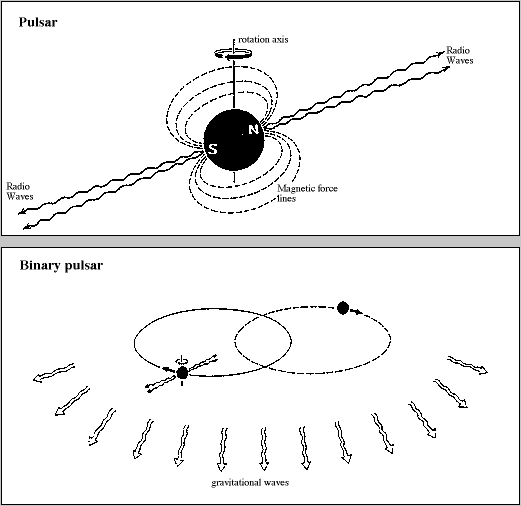
The radio waves from a pulsar are emitted in two bunches which sweep across space at the same rate as the pulsar rotates (upper figure). From a binary pulsar, gravitational waves are also emitted (lower figure).