Carl E. Wieman – Other resources
Links to other sites
Carl E. Wieman at the JILA University of Colorado web site
BEC Homepage at the University of Colorado web site
MIT Digital Thesis Library – “The study of sodium complexes in the excited state” by Carl E. Wieman
On Carl Wieman from Stanford University
Carl Wieman’s blog – Science 2.0
On Carl Edwin Wieman from National High Magnetic Field Laboratory
Wolfgang Ketterle – Other resources
Links to other sites
Wolfgang Ketterle’s page at MIT
Wolfgang Ketterle’s web page at the Center for Ultracold Atoms
An interview with Wolfgang Ketterle from Technische Universität München
Carl E. Wieman – Banquet speech
Carl E. Wieman’s speech at the Nobel Banquet, December 10, 2001
Your Majesties, Your Royal Highnesses, Distinguished Laureates of the past century, Ladies and Gentlemen,
On the behalf of my colleagues Eric Cornell and Wolfgang Ketterle I would like to say how honored and delighted we are to receive the Nobel Prize in physics for our work on the creation and study of Bose-Einstein condensation. However, the true nature and strength of science is that it is a grand staircase formed by the steps built by many individuals over many years, and often important steps come from very unexpected places. Bose-Einstein condensation provides a particularly vivid illustration of this metaphor. The origins of BEG are nearly as old as the Nobel prize itself, beginning in 1924 with the young Indian physicist Bose explaining the color of light given off by an object as it is heated. Einstein then extended Bose’s work on light to describe atoms. His equations predicted that a gas would tranform into a radically new form of matter if cooled to impossibly low temperatures. This was far ahead of its time. However, over the decades physicists have learned that there were many wider implications of this work and predicted many remarkable properties for the material of Einstein’s equations. These ranged from explaining the underlying mechanism of superfluidity to the extended coherence of atomic waves. By building on many advances in science and technology, often recognized by the Nobel Prize such as the inventions of the laser and laser cooling of atoms, and the extensive work in atomic hydrogen, we were able to finally make the impossibly low temperatures possible, and the Bose-Einstein condensate appeared 70 years after its conception. We see this as a landing on the staircase of Bose-Einstein physics that extends 70 years into the past, and we look forward to seeing where it will lead in the coming 70.
Carl E. Wieman – Prize presentation
Eric A. Cornell – Nobel diploma
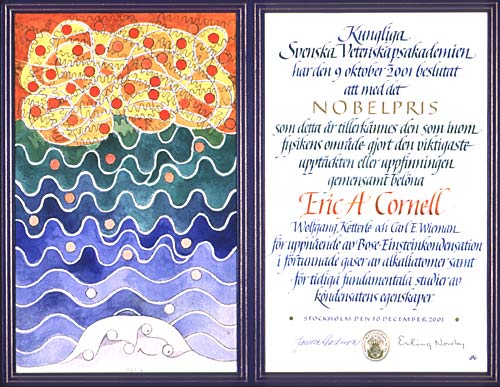
Copyright © The Nobel Foundation 2001
Artist: Nils G. Stenqvist
Calligrapher: Annika Rücker
Wolfgang Ketterle – Nobel diploma
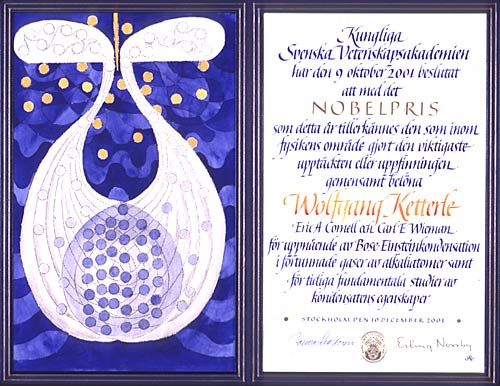
Copyright © The Nobel Foundation 2001
Artist: Nils G. Stenqvist
Calligrapher: Annika Rücker
Eric A. Cornell – Prize presentation
Watch a video clip of the 2001 Nobel Laureate in Physics, Eric A. Cornell, receiving his Nobel Prize medal and diploma during the Nobel Prize Award Ceremony at the Concert Hall in Stockholm, Sweden, on 10 December 2001.
Carl E. Wieman – Nobel diploma
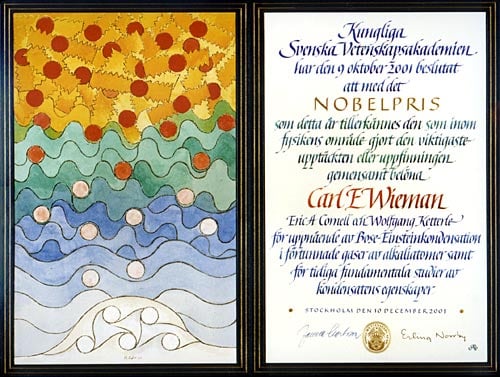
Copyright © The Nobel Foundation 2001
Artist: Nils G. Stenqvist
Calligrapher: Annika Rücker
Wolfgang Ketterle – Prize presentation
Watch a video clip of the 2001 Nobel Laureate in Physics, Wolfgang Ketterle, receiving his Nobel Prize medal and diploma during the Nobel Prize Award Ceremony at the Concert Hall in Stockholm, Sweden, on 10 December 2001.
Eric A. Cornell – Other resources
Links to other sites
On Eric Cornell from National High Magnetic Field Laboratory
Video
‘NIST Unscripted: Eric Cornell’. Eric Cornell tells the exciting story of how he and colleague Carl Weiman made the first-ever observation of a new state of matter, the Bose-Einstein condensate, in 1995. From National Institute of Standards and Technology.