Speed read: The importance of asymmetry
Luckily for us, the Universe is not symmetrical, at least at the subatomic level. If it was, the newly formed matter at the Universe’s birth would have been annihilated by an equal and opposite amount of antimatter, and nothingness would have resulted. Instead, a small imbalance, or asymmetry, in the amount of matter and antimatter created led to a slight excess of matter, from which we are all eventually formed. Such ‘broken symmetry’ is one key to our existence
Understanding symmetry, or the lack of it, is an ongoing task, and the 2008 Nobel Prize in Physics rewarded two discoveries concerning symmetry violation in the field of particle physics. In the 1960s Yoichiro Nambu, who had been working on asymmetries underlying superconductivity, was the first to model how broken symmetry can occur spontaneously at the subatomic level. The mathematical descriptions he formulated helped refine the standard model of particle physics, the current working theory that best explains much, but not all, of the way that fundamental particles and the forces that govern their behaviour interact to create the known Universe.
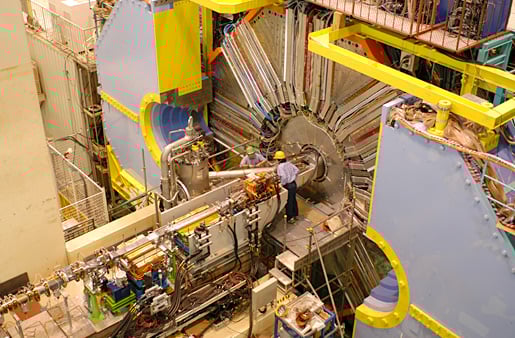
In the early 1970s, Kobayashi and Maskawa formulated a model that explained certain symmetry violations that had recently surprised observers in particle physics experiments. Their model suggested that the collection of subatomic particles known at the time were insufficient to explain the observed behaviours, and predicted the existence of as yet undiscovered elementary particles. It did not, however, specify precisely what form these particles should take. Kobayashi and Maskawa hypothesized the existence of a third family of quarks, which are some of the building blocks from which all matter and antimatter is formed. They then had to wait almost three decades for the experimental results that would verify their hypothesis. The existence of all three families was finally confirmed when the last member was observed in the mid 1990s.
Yoichiro Nambu – Photo gallery
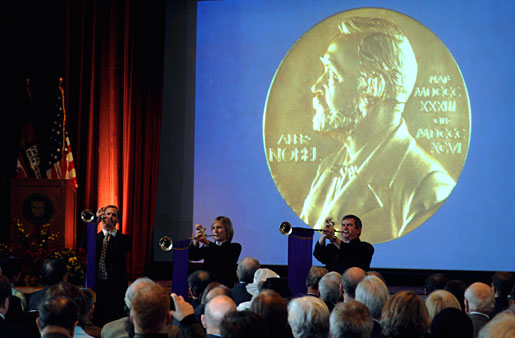
A ceremony to present the 2008 Nobel Prize in Physics to Yoichiro Nambu was held at The International House in Chicago, 10 December 2008.
Copyright © University of Chicago 2008 Photo: Dan Dry
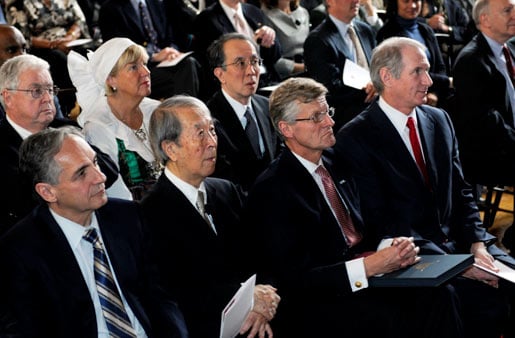
Yoichiro Nambu, second from left, at the award ceremony at The International House in Chicago, 10 December 2008.
Copyright © University of Chicago 2008 Photo: Dan Dry
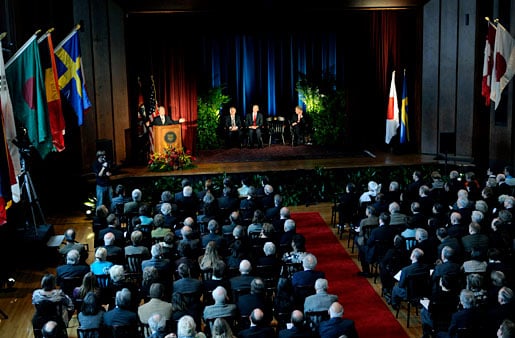
Yoichiro Nambu delivers his speech at the award ceremony at The International House in Chicago, 10 December 2008.
Copyright © University of Chicago 2008 Photo: Dan Dry
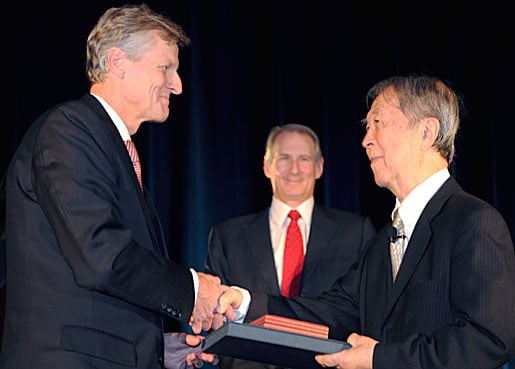
Yoichiro Nambu (right) receiving his Nobel Prize from Swedish Ambassador Jonas Hafström (left) at a ceremony at The International House in Chicago, 10 December 2008.
Copyright © University of Chicago 2008 Photo: Dan Dry
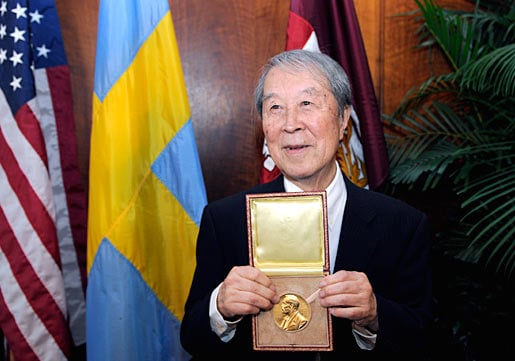
Yoichiro Nambu with his Nobel Medal.
Copyright © University of Chicago 2008 Photo: Dan Dry
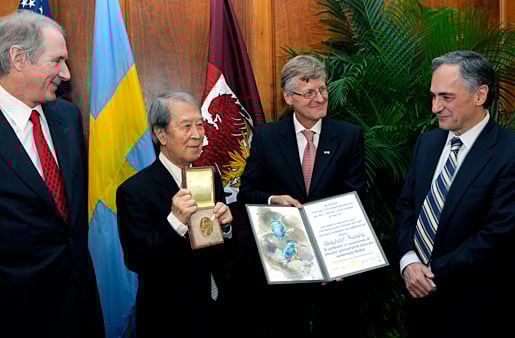
Yoichiro Nambu shows his Nobel Medal at The International House in Chicago, 10 December 2008.
Copyright © University of Chicago 2008 Photo: Dan Dry
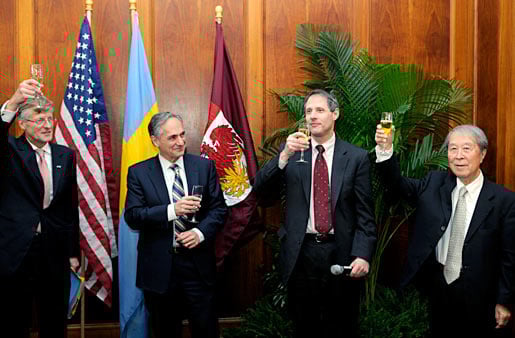
A toast for the new Nobel Laureate. From left: Swedish Ambassador Jonas Hafström, University of Chicago President Robert J. Zimmer, University of Chicago Provost Thomas Rosenbaum and Nobel Laureate Yoichiro Nambu.
Copyright © University of Chicago 2008 Photo: Dan Dry

Yoichiro Nambu, Nobel Laureate in Physics 2008.
Copyright © University of Chicago Photo: Lloyd DeGrane
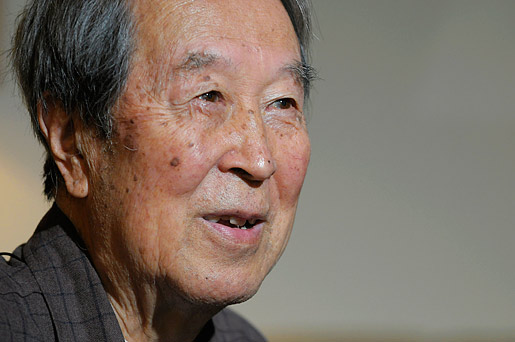
Portrait of Yoichiro Nambu.
© University of Chicago. Photo: Lloyd DeGrane
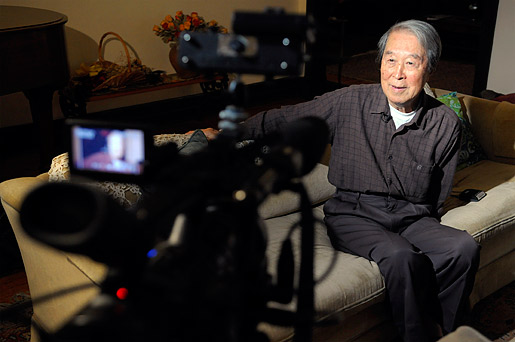
Nobel Laureate Yoichiro Nambu being filmed by the press.
Copyright © University of Chicago Photo: Lloyd DeGrane
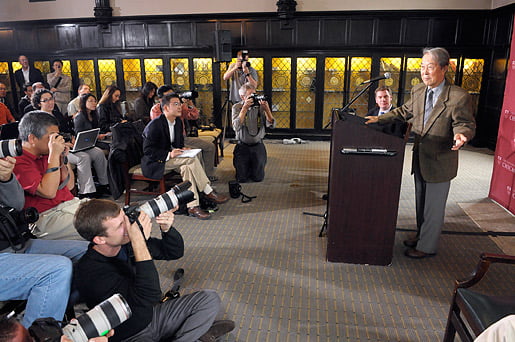
Yoichiro Nambu at a press conference at the University of Chicago.
Copyright © University of Chicago Photo: Lloyd DeGrane
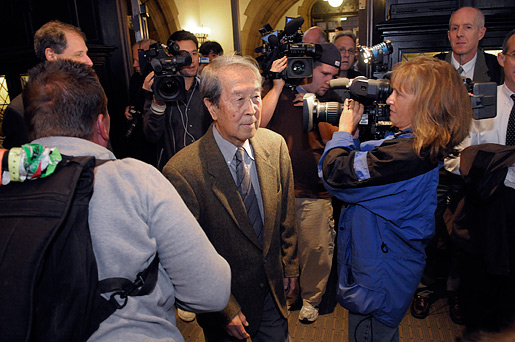
Yoichiro Nambu at a press conference.
Copyright © University of Chicago Photo: Lloyd DeGrane
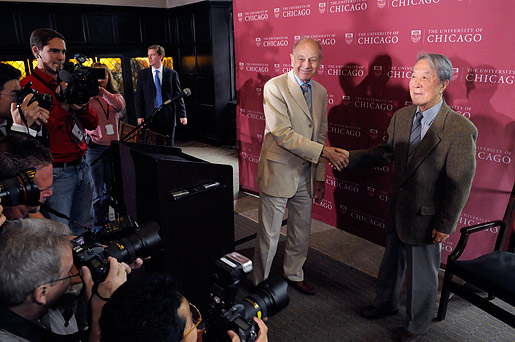
James Cronin (left), 1980 Nobel Laureate in Physics, greets Nobel Laureate Yoichiro Nambu.
Copyright © University of Chicago Photo: Lloyd DeGrane
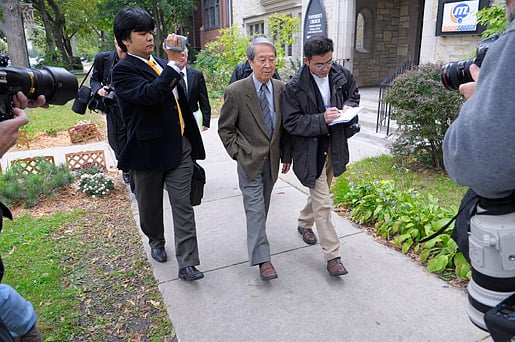
Yoichiro Nambu speaks to the media on the morning he was awarded the 2008 Nobel Prize in Physics.
Copyright © University of Chicago Photo: Lloyd DeGrane
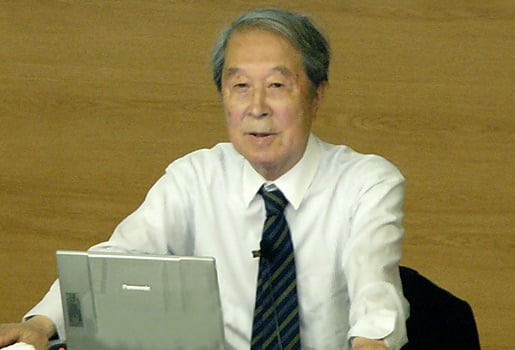
Yoichiro Nambu, June 2007.
Photo: Courtesy of KEK
Yoichiro Nambu – Nobel diploma
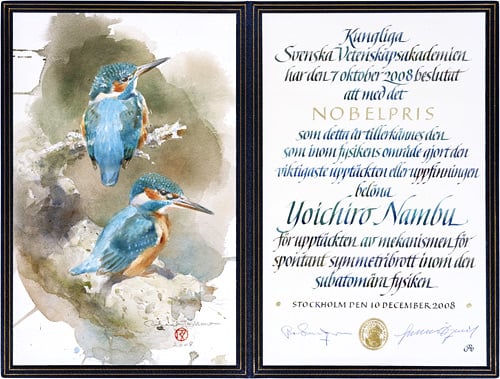
Copyright © The Nobel Foundation 2008
Artist: Roland Jonsson
Calligrapher: Annika Rücker
Photo reproduction: Fredrika Berghult
Yoichiro Nambu – Nobel Lecture
The Nobel Lecture of Yoichiro Nambu was presented by Giovanni Jona-Lasinio, La Sapienza, University of Rome, Italy, 8 December 2008, at Aula Magna, Stockholm University. He was introduced by Professor Joseph Nordgren, Chairman of the Nobel Committee for Physics.
Lecture Slides
Pdf 3.49 MB
Read the Nobel Lecture
Pdf 378 kB
Makoto Kobayashi – Photo gallery
Makoto Kobayashi receiving his Nobel Prize from His Majesty King Carl XVI Gustaf of Sweden at the Stockholm Concert Hall, 10 December 2008.
Copyright © The Nobel Foundation 2008
Makoto Kobayashi after receiving his Nobel Prize at the Stockholm Concert Hall, 10 December 2008.
Copyright © The Nobel Foundation 2008
Makoto Kobayashi delivering his banquet speech Copyright © Nobel Media AB 2008
Photo: Hans Mehlin
The 2008 Nobel Laureates assembled for a group photo during their visit to the Nobel Foundation, 12 December 2008. Back row, left to right: Nobel Laureates in Chemistry Osamu Shimomura and Martin Chalfie, Nobel Laureate in Literature Jean-Marie Gustave Le Clézio, Economics Laureate Paul Krugman and Nobel Laureate in Physiology or Medicine Harald zur Hausen. Front row, left to right: Nobel Laureate in Chemistry Roger Y. Tsien, Nobel Laureates in Physics Makoto Kobayashi and Toshihide Maskawa and Nobel Laureate in Physiology or Medicine Françoise Barré-Sinoussi and Luc Montagnier.
Copyright © The Nobel Foundation 2008
Photo: Mia Åkermark
Makoto Kobayashi (second from left) during the Nobel Foundation reception at the Nordic Museum in Stockholm, 9 December 2008.
Copyright © Nobel Media AB 2008
Makoto Kobayashi delivering his Nobel Lecture at the Aula Magna, Stockholm University, 8 December 2008.
Copyright © Nobel Media AB 2008
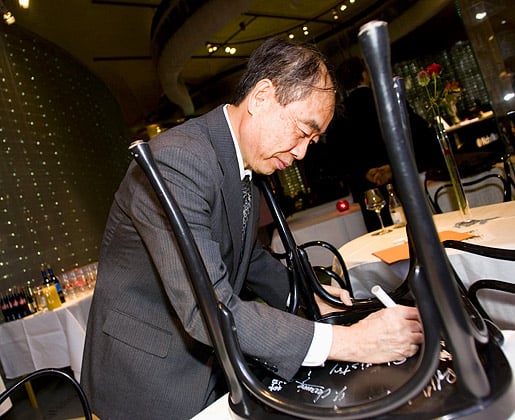
Makoto Kobayashi, like many Nobel Laureates before him, autographs a chair at Kafé Satir at the Nobel Museum in Stockholm, 6 December 2008.
Copyright © The Nobel Museum 2008
Photo: Christine Olsson
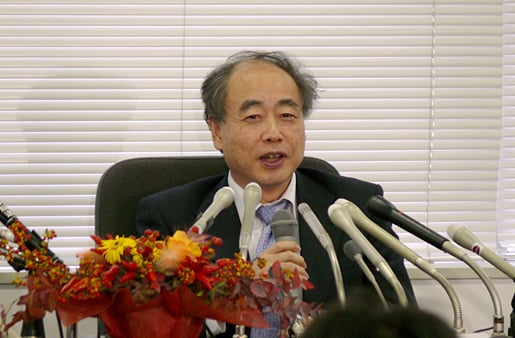
Makoto Kobayashi at a press conference at the High Energy Accelerator Research Organization (KEK), Japan, after the announcement of the 2008 Nobel Prize in Physics.
Photo: Courtesy of KEK
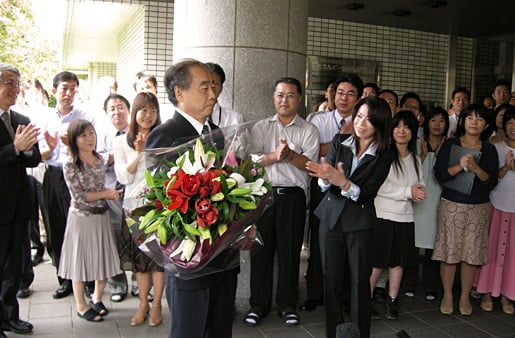
Makoto Kobayashi is greeted with flowers by colleagues at KEK.
Photo: Courtesy of KEK
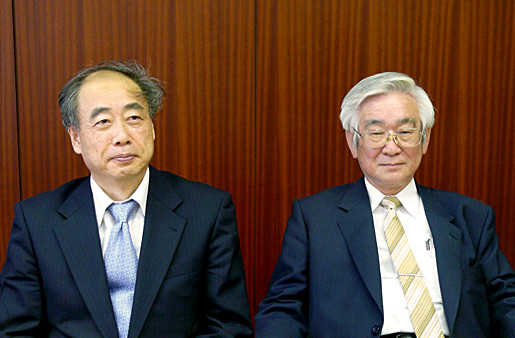
Makoto Kobayashi (left) and Toshihide Maskawa (right), 2008 Nobel Laureates in Physics.
Photo: Courtesy of KEK
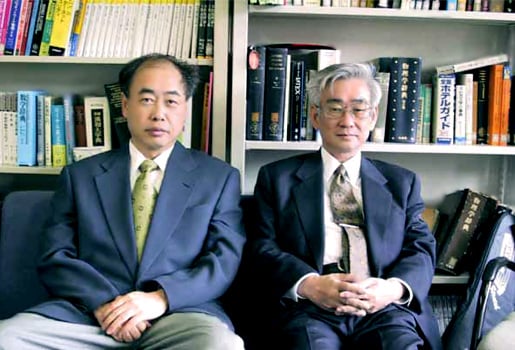
Dr Kobayashi (left) and Dr Maskawa (right), 26 September 2001.
Photo: Courtesy of KEK
The Belle Detector, which contributed to the confirmation of Kobayashi and Maskawa's theory.
Photo: Courtesy of KEK
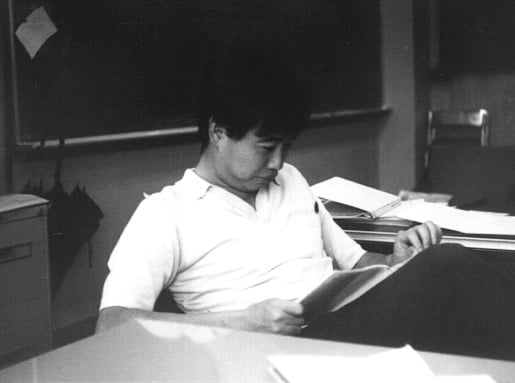
Makoto Kobayashi at a study room at Kyoto University.
Photo: Courtesy of KEK
Makoto Kobayashi in grade-school years.
Photo: Courtesy of KEK
Photo: Hans Mehlin

Photo: Hans Mehlin
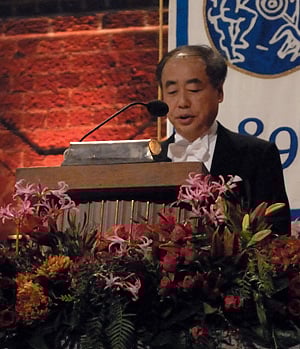
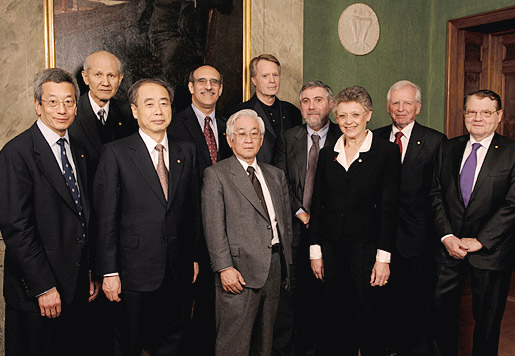
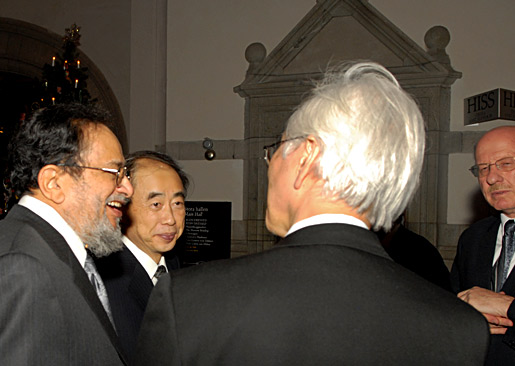
Photo: Frida Westholm
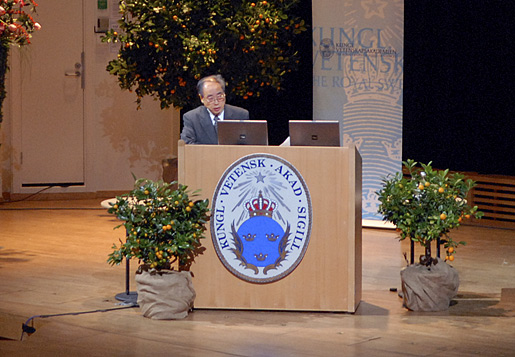
Photo: Annalisa Andersson

Makoto Kobayashi – Nobel diploma
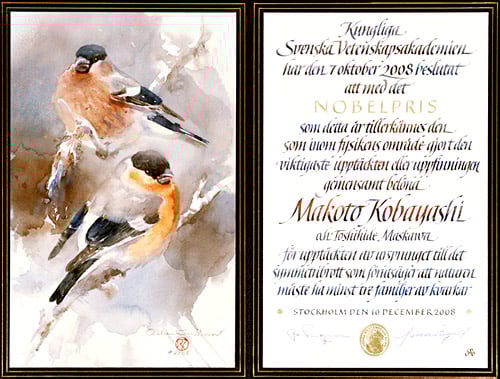
Copyright © The Nobel Foundation 2008
Artist: Roland Jonsson
Calligrapher: Annika Rücker
Photo reproduction: Fredrika Berghult
Toshihide Maskawa – Nobel diploma
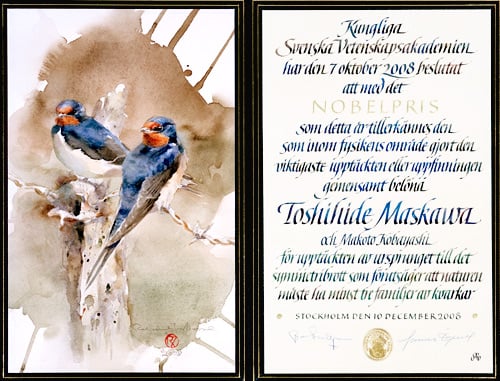
Copyright © The Nobel Foundation 2008
Artist: Roland Jonsson
Calligrapher: Annika Rücker
Photo reproduction: Fredrika Berghult
Makoto Kobayashi – Banquet speech
Makoto Kobayashi’s speech at the Nobel Banquet in the Stockholm City Hall, 10 December 2008.
Your Majesties, Your Royal Highnesses, Ladies and Gentlemen,
It is great honor for Toshihide Maskawa and me to accept the Nobel Prize in Physics, and we wish to express our sincerest gratitude to the Royal Academy of Science and the Nobel Foundation.
It is a pity that Prof. Yoichiro Nambu was not to attend this ceremony. I am greatly honored to share the Nobel Prize with him. When I entered graduate school, he was already an eminent scholar. I remember studying his theory most intently. My first research subject was on chiral symmetry, which was the direct application of Nambu’s theory for which the Prize has been awarded.
Both Maskawa and I graduated from and earned our PhDs at Nagoya University. At that time, the theoretical particle physics group of Nagoya University was conducting unique research under the mentorship of Professor Shoichi Sakata. Both of us learned a great many things from Prof. Sakata and his group.
The paper on CP violation coauthored with Maskawa was written when we were both doing research at Kyoto University. We are grateful for the support accorded to us by our colleagues at the University.
Many thanks also go to our colleagues who participated in the experiments for verifying our model. In particular, I am personally grateful to the members of the KEK B-factory and Belle Group with whom I have had the privilege of working for many years.
CP violation is an intriguing subject. A fundamental question is why the Universe is made of matter. CP violation holds the keys to solving this problem. In spite of more than 40 years of effort in theoretical and experimental, studies, however, matter dominance of the Universe still remains an open question. I hope to continue pursuing this subject with my colleagues.
Thank you very much for your attention.
Toshihide Maskawa – Photo gallery
Toshihide Maskawa receiving his Nobel Prize from His Majesty King Carl XVI Gustaf of Sweden at the Stockholm Concert Hall, 10 December 2008.
Copyright © The Nobel Foundation 2008
Toshihide Maskawa after receiving his Nobel Prize at the Stockholm Concert Hall, 10 December 2008.
Copyright © The Nobel Foundation 2008
The 2008 Nobel Laureates assembled for a group photo during their visit to the Nobel Foundation, 12 December 2008. Back row, left to right: Nobel Laureates in Chemistry Osamu Shimomura and Martin Chalfie, Nobel Laureate in Literature Jean-Marie Gustave Le Clézio, Economics Laureate Paul Krugman and Nobel Laureate in Physiology or Medicine Harald zur Hausen. Front row, left to right: Nobel Laureate in Chemistry Roger Y. Tsien, Nobel Laureates in Physics Makoto Kobayashi and Toshihide Maskawa and Nobel Laureate in Physiology or Medicine Françoise Barré-Sinoussi and Luc Montagnier.
Copyright © The Nobel Foundation 2008
Photo: Mia Åkermark
Toshihide Maskawa (right) in conversation with Professor Taichi Kugo (left), a colleague from Kyoto University, during the Nobel Foundation reception at the Nordic Museum, Stockholm, 9 December 2008.
Copyright © The Nobel Foundation 2008
Toshihide Maskawa (second from right) with his wife Akiko (far right), Toyoko Tsugane-Reinius (far left) and Professor Taichi Kugo (second from left) during the Nobel Foundation reception at the Nordic Museum, Stockholm, 9 December 2008.
Copyright © The Nobel Foundation 2008
Toshihide Maskawa delivering his Nobel Lecture at the Aula Magna, Stockholm University, 8 December 2008.
Copyright © Nobel Media AB 2008
Toshihide Maskawa, like many Nobel Laureates before him, autographs a chair at Kafé Satir at the Nobel Museum in Stockholm, 6 December 2008.
Copyright © The Nobel Museum 2008
Photo: Christine Olsson
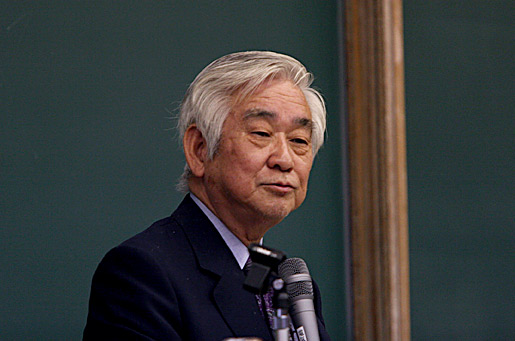
Portrait of Toshihide Maskawa.
Copyright © Kyoto Sangyo University
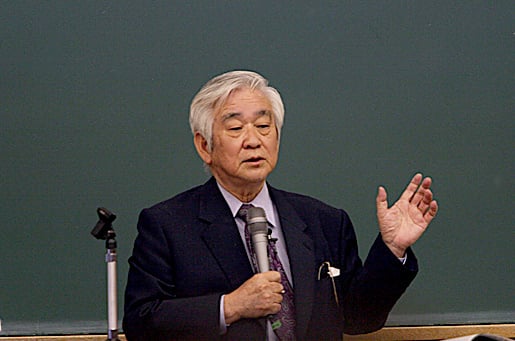
Toshihide Maskawa at a press conference at the Kyoto Sangyo University.
Copyright © Kyoto Sangyo University
Toshihide Maskawa, Nobel Laureate in Physics 2008.
Copyright © Kyoto Sangyo University
Toshihide Maskawa at a press conference at the Kyoto Sangyo University.
Copyright © Kyoto Sangyo University
Makoto Kobayashi (left) and Toshihide Maskawa (right), 2008 Nobel Laureates in Physics.
Photo: Courtesy of KEK
Dr Kobayashi (left) and Dr Maskawa (right), 26 September 2001.
Photo: Courtesy of KEK
Photo: Hans Mehlin

Photo: Hans Mehlin

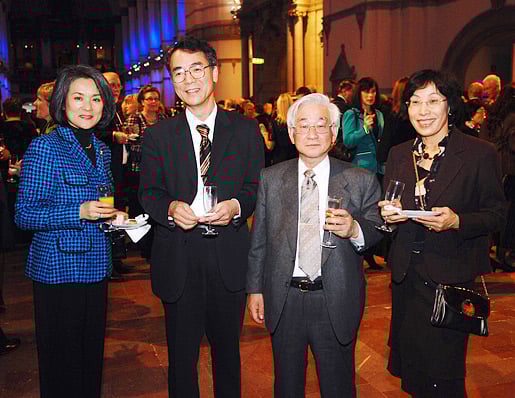
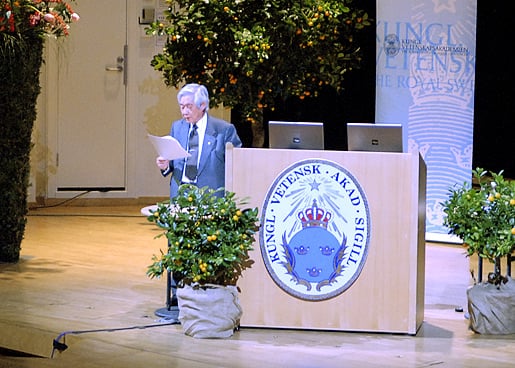
Photo: Annalisa Andersson


Makoto Kobayashi – Prize presentation
Watch a video clip of the 2008 Nobel Laureate in Physics, Makoto Kobayashi, receiving his Nobel Prize medal and diploma during the Nobel Prize Award Ceremony at the Concert Hall in Stockholm, Sweden, on 10 December 2008.