Robert S. Mulliken – Nominations
Robert S. Mulliken – Nobel Lecture
Nobel Lecture, December 12, 1966
Spectroscopy, Molecular Orbitals, and Chemical Bonding
Read the Nobel Lecture
Pdf 279 kB
Robert S. Mulliken – Prize presentation
Robert S. Mulliken – Other resources
Links to other sites
Guide to the Robert S. Mulliken Papers 1908-1985 from the University of Chicago Library
Robert S. Mulliken – Biographical
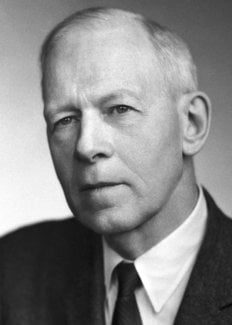
Robert Sanderson Mulliken was born in Newburyport, Massachusetts, on June 7, 1896, the son of Samuel Parsons Mulliken, Professor of Organic Chemistry, and Katherine W. Mulliken. He married Mary Helen von Noè, December 24, 1929. Their children are Lucia Maria (Mrs. John P. Heard) and Valerie Noè.
Mulliken took a B.Sc. Degree in 1917 at the Massachusetts Institute of Technology, Cambridge, Mass., and a Ph.D. degree at the University of Chicago, Ill., in 1921.
Mulliken has been deeply interested in valence theory and molecular structure. His earlier work on isotopes and on diatomic band spectra was followed by theoretical systematization of the electronic states of molecules, mainly in terms of the idea of molecular orbitals. This included work on electronegativities, dipole moments, and valence-state energies. A subsequent series of papers on the theoretical interpretation of absolute intensities of electronic spectra led him to computations on conjugated organic molecules, and to the quantum-mechanical statement of the concept of hyperconjugation. There followed work on quantum-mechanical questions underlying molecular-orbital theory and on the use of interatomic overlap integrals as measures of bond energies. His more recent work has dealt extensively with the structure and spectra of molecular complexes, on the one hand, and on the other hand (extending and developing earlier work) with the structure and spectra of hydrogen, helium, nitrogen and other small molecules.
Mulliken was National Research Council Fellow, University of Chicago, and Harvard University, 1921-1925; Guggenheim Fellow, Germany and Europe, 1930 and 1932-1933; Fulbright Scholar, Oxford University, 1952-1954; Visiting Fellow, St. John’s College, Oxford, 1952-1953; Junior Chemical Engineer, Bureau of Mines, U.S. Department of Interior, Washington, D.C. 1917-1918; Assistant in Rubber Research, New Jersey Zinc Company, Pennsylvania, 1919.
His academic career includes the following positions: Assistant Professor of Physics, Washington Square College, New York University, 1926-1928; Associate Professor of Physics, University of Chicago, 1928-1931; Professor of Physics, University of Chicago, 1931-1961, and Chemistry, 1961; Ernest de Witt Burton Distinguished Service Professor, University of Chicago, 1956-1961; Distinguished Service Professor of Physics and Chemistry, University of Chicago, since 1961; Distinguished Research Professor of Chemical Physics, Florida State University (Jan.-March), since 1964. Other professional positions held: Director, Editorial Work and Information, Plutonium Project, University of Chicago, 1942-1945; Scientific Attaché, U.S. Embassy, London, 1955; Baker Lecturer, Cornell University, 1960; Silliman Lecturer, Yale University, Spring, 1965.
Mulliken received honorary degrees at Columbia University, 1939 (Sc.D.); the University of Stockholm, 1960 (Ph.D.); Marquette University, 1967 (Sc.D.); Cambridge University, 1967 (Sc.D.) ; and he holds several professional awards and honours of which a few are listed here: Bronze Medal Award, University of Liege, 1948; Peter Debye Award, California Section of the American Chemical Society, 1963; Willard Gibbs Medal, Chicago Section of the American Chemical Society, 1965; Gold Medal Award for Scientific Achievement, City College Chemistry Alumni Association, and 15th Bicentennial Lecturer, City College of New York, 1965.
He is a Member of the American Academy of Arts and Sciences, American Chemical Society, American Philosophical Society, National Academy of Sciences, Cosmos Club (Washington, D.C.), Quadrangle Club (Chicago, Ill.); a Fellow of the American Physical Society and the American Academy for the Advancement of Science; an Honorary Fellow of the Chemical Society of Great Britain (London) and the Indian National Academy of Science; a Foreign Member of the Royal Society of Great Britain; an Honorary Member of the Société de Chimie Physique; and a Corresponding Member of the Société Royale des Sciences de Liége.
His recreational interests include: driving a car, oriental rugs, and art.
This autobiography/biography was written at the time of the award and later published in the book series Les Prix Nobel/ Nobel Lectures/The Nobel Prizes. The information is sometimes updated with an addendum submitted by the Laureate.
Robert S. Mulliken died on October 31, 1986.
Award ceremony speech
Presentation Speech by Professor Inga Fischer-Hjalmars, University of Stockholm
Your Majesty, Your Royal Highnesses, Ladies and Gentlemen.
The Greek word for Nature is jnsiz (fysis) and for Natural Science jnsich (fysiké). Later on, this science became so comprehensive that it was divided into a number of smaller domains, such as Biology, Geography, Chemistry, and Physics in a restricted sense. Subsequently, each of these domains has expanded considerably and developed several special fields. Therefore, it seems as if the different Natural Sciences only continue to diverge like the parts of an expanding Universe. However, the simultaneous deepening of our knowledge has brought about a convergence between the fundamental aspects of the different fields. Especially, Physics and Chemistry have to a great extent drawn closer together. The expression Physical Chemistry and Chemical Physics show that it is no longer possible to draw a sharp borderline between these sciences.
The problem of the nature of the chemical bond evidently belongs to this borderland. By chemical bond we mean the forces that tend to keep together the atoms in a molecule. Already in 1812 Berzelius suggested that these forces originate from positive and negative electrical charges of the atoms. This idea became more firmly founded when in the beginning of the twentieth century Rutherford discovered that each atom consists of a heavy nucleus with positive charge and a swarm of agile electrons totally with an equal amount of negative charge. In 1916 this discovery inspired Lewis to the hypothesis that the chemical bond is caused by two electrons, paired somehow and staying in the domain between the bonded atoms. Although physically questionable, Lewis’ theory has exerted a great influence upon the development of Chemistry. In an epoch-making investigation in 1927 Heitler and London also succeeded in casting Lewis’ pair theory in a physically more satisfactory form by aid of quantum mechanics. In this shape the theory has highly stimulated chemical thinking, especially under the impact of the further development and the many applications, made by Pauling, who received the 1954 Nobel Prize for Chemistry.
However, there are quite a few chemical questions that are not answered satisfactorily by the electron-pair theory, neither in its original nor in its quantum mechanical shape. Many problems in the Chemistry of unsaturated compounds belong to these questions. To clarify such obscurities in the nature of the chemical bond it was necessary with an entirely new opening. The new move was again inspired by Physics.
To understand how atoms can be bound together to complicated molecules it is first necessary to have a clear idea of the building of an isolated atom. The solution of this fundamental problem of Theoretical Chemistry was given by the Nobel Laureate in Physics Niels Bohr. He showed in 1922 that the electrons in an atom are moving in such a manner that they can be assigned to different shells at various distances from the nucleus. The electrons in the outermost shell are most loosely bonded and mainly responsible for the chemical properties of the element.
Already in 1925 Bohr’s principle for atoms was applied to the molecular problem by Robert Mulliken. He assumed a similar building-up principle for molecules as that of atoms, but differing in the respect that the electron shells of a molecule should enclose several atomic nuclei. The electronic motions extended over the whole molecule, was described by Mulliken using a theoretical concept, which he later called a molecular orbital. During the decade after the break-through of the modern quantum mechanics in 1926 these ideas were re-formulated and further developed, mainly by Hund and Mulliken, but with important contributions also from other scientists. The molecularorbital method means a principally new understanding of the nature of the chemical bond. Previous ideas started from the assumption, most natural from the chemical point of view, that the bonding depends on interaction between complete atoms. The molecular-orbital method, on the other hand, starts from quantum-mechanical interaction between all the atomic nuclei and all the electrons of the molecule. This new view has clarified many molecular properties and reactions. The method has given exceedingly important contributions to our qualitative understanding of the chemical bond and the electronic structure of molecules.
In several connections, however, a qualitative picture is not sufficient but it is necessary to have quantitative, theoretical results for comparison with experiments. Since even small molecules contain many electrons, more extensive quantitative calculations have been possible only during the last decade after the advent of the modern electronic computers. Mulliken realised early the new possibilities offered by these machines. He and his co-workers in Chicago have devoted much energy and tenacity to adapt the molecular-orbital method to computer language. For various reasons it is a difficult numerical problem to make accurate computations of the quantities, representing measurable chemical effects. In spite of this Mulliken’s laboratory has very lately succeeded to compute by the molecular-orbital method different molecular properties of small molecules with such an accuracy that the theoretical values only differ by a few per cent from the experimental ones. From these results, highly interesting by themselves, can be derived important complementary information about the nature of the chemical bond. In addition, these results demonstrate that we now have at hand an entirely new possibility to investigate small molecules, inconvenient or inaccessible to experiments. Examples of this are intermediate states of chemical reactions and molecules and molecular fragments of great importance in Space Research.
Significant, theoretical results have also been obtained for large molecules. In such cases it is not yet possible to make purely theoretical, quantitative calculations. But Mulliken has developed the general scheme of an elegant method to combine the theoretical computations with experimental information from small molecules. This kind of calculation is exceedingly illuminating in several connections, for instance for the interpretation of measurements. Just as for small molecules the method has also been used to gain information about molecules, inaccessible to experiments, such as compounds of importance for life processes. In such cases the theoretical results cannot be directly compared with measurements, but they can suggest new kinds of experiments.
It is only after time-consuming, strenuous efforts by many scientists that we now know what an extraordinary instrument for investigations of the proper ties of matter we have at our command in the molecular-orbital method. The leader of this achievement has been continuously and still is Robert Mulliken.
Professor Mulliken, it is now more than forty years since you started to investigate what the electron is doing in the molecule. Your deep understanding of the physical laws, governing the behaviour of the electron, combined with your intimate knowledge of the problems of Chemistry have greatly advanced our understanding of the properties of molecules. Especially, by the development of the molecular- orbital method you have given us a powerful key to the mechanism of the chemical bond. Your thorough penetration of the inherent possibilities of the method and your unfailing enthusiasm in guiding the development have very lately pushed the progress to the point of accurate, quantitative applications to chemical problems. By these achievements you have opened a road of exciting possibilities for future, theoretical investigations of molecular properties.
On behalf of the Royal Academy of Sciences I extend to you the most hearty congratulations. And now it is my privilege to ask you to receive the Nobel Prize for Chemistry from the hands of His Majesty the King.