Romain Rolland – Nobel Lecture
Romain Rolland did not submit a Nobel Lecture.
Romain Rolland – Bibliography
| Selected works in French |
| Les origines du théâtre lyrique moderne : histoire de l’opéra en Europe avant Lully et Scarlatti. – Paris: A. Fontemoing, 1894 |
| Aërt. – Paris: Cahiers de la Quinzaine, 1898 |
| Les loups. – Paris: Georges Bellais, 1898 |
| Le triomphe de la raison. – Paris: Revue d’Art Dramatique, 1899 |
| Danton. – Paris: Revue d’Art Dramatique, 1900 |
| Le quatorze Juillet. – Paris: Editions des Cahiers, 1902 |
| Jean-Christophe. – Paris : Cahiers de la quinzaine, 1904-1912. – 17 vol. |
| Vie de Beethoven. – Paris: Hachette, 1907 |
| La vie de Michel-Ange. – Paris : Hachette, 1907 |
| Vie de Tolstoï. – Paris : Hachette, 1911 |
| Musiciens d’autrefois. – Paris : Hachette, 1908 |
| Musiciens d’aujourd’hui. – Paris: Hachette, 1908 |
| Les Tragédies de la foi. – Paris : Hachette, 1913 |
| Au-dessus de la mêlée. – Paris : A l’Emancipatrice, 1915 |
| Colas Breugnon. – Paris : Albin Michel, 1919 |
| Pierre et Luce. – Paris: Ollendorff, 1918 |
| Les precurseurs. – Paris : Editions de l’Humanité, 1919 |
| Clerambault : histoire d’une conscience libre pendant la guerre. – Paris: Albin Michel, 1920 |
| L’ame enchantée. 1, Annette et Sylvie. – Paris : Ollendorff, 1922 |
| L’ame enchantée. 2, L’Eté. – Paris : Ollendorff, 1923 |
| Mahatma Gandhi. – Zurich : Rotapfel-Verlag, 1924 |
| Le jeu de l’amour et de la mort. – Paris : Editions du Sablier, 1925 |
| Pâques fleuries. – Paris : Editions du Sablier, 1926 |
| L’ame enchantée. 3, Mère et fils. – Paris : Albin Michel, 1927. – 2 vol. |
| Les Léonides. – Paris : Editions du Sablier, 1928 |
| Beethoven : Les Grandes Epoques créatrices. – Paris: Editions du Sablier, 1928-1945. – 7 vol. |
| Essai sur la mystique et l’action de l’Inde vivante. – Paris: Stock, Delamain & Boutelleau, 1929-1930. – 2 vol. – Comprend: [1], La vie de Ramakrishna ; [2] La vie de Vivekananda et l’Évangile universel. |
| Goethe et Beethoven. – Paris : Editions du Sablier, 1930 |
| Jean-Christophe. – Éd. Définitive. – Paris: Albin Michel, 1931-1934. – 5 vol. |
| L’ame enchantée. 4, L’annonciatrice. 1, La mort d’un mondre. – Paris : Albin Michel, 1933 |
| L’ame enchantée. 4, L’annonciatrice. 2, L’enfantement. – Paris : Albin Michel, 1933. – 2 vol. |
| L’ame enchantée. – Éd. Définitive. – Paris: Albin Michel, 1934. – 4 vol. |
| Quinze Ans de combat, 1919-1934. – Paris : Rieder, 1935 |
| Compagnons de route : essais littéraires. – Paris : Editions du Sablier, 1936 |
| Robespierre. – Paris: Albin Michel, 1939 |
| Le Voyage intérieur. – Paris : Albin Michel, 1942 |
| Péguy. – Paris : Albin Michel, 1945. – 2 vol. |
| Cahiers Romain Rolland. – Paris : Albin Michel, 1948-1996. – 30 vol. |
| Inde : journal (1915-1943) : Tagore, Gandhi, Nehru et les problèmes indiens. – Paris: Editions Vineta, 1951 |
| Journal des années de guerre 1914-1919 : notes et documents pour servir à l’histoire morale de l’Europe de ce temps / texte établi par Marie Romain Rolland. – Paris : Albin Michel, 1952 |
| Journal de Vézelay : 1938-1944. – Paris : Bartillat, 2012 |
| Selected works in English |
| Beethoven / translated by B. Constance Hull. – London : Drane, 1907 |
| Jean-Christophe : Dawn, Morning, Youth, Revolt / translated by Gilbert Cannan. – New York : Holt, 1910 |
| Tolstoy / translated by Bernard Miall. – London : Unwin, 1911 |
| The Life of Michael Angelo / translated by Frederic Lees. – New York : Dutton, 1912 |
| Musicians of To-day / translated by Mary Blaiklock. – New York : Holt, 1914 |
| Some Musicians of Former Days / translated by Mary Blaiklock. – New York : Holt, 1915 |
| Above the Battle / translated by C. K. Ogden. – London : Allen & Unwin, 1916 |
| Colas Breugnon / translated by Katherine Miller. – New York : Holt, 1919 |
| The Forerunners / translated by Eden and Cedar Paul. – London : Allen & Unwin, 1920 |
| Clerambault : the Story of an Independent Spirit during the War / translated by Katherine Miller. – New York : Holt, 1921 |
| Annette and Sylvie / translated by Ben Ray Redman. – New York: Holt, 1925 |
| Summer / translated by Eleanor Stimson and Van Wyck Brooks. – New York: Holt, 1925 |
| The Wolves / translated by Barrett H. Clark. – New York: Random House, 1937 |
| The Hungry Wolves / translated by John Holmstrom. – London : Blackie, 1966 |
| The Fourteenth of July and Danton: Two Plays of the French Revolution / translated by Barrett H. Clark. – New York: Holt, 1918 |
| Pierre and Luce / translated by Charles de Kay. – New York : Holt, 1922 |
| Mahatma Gandhi : the Man who Became One with the Universal Being / translated by Catherine D. Groth. – London : Century, 1924 |
| The Game of Love and Death / translated by Eleanor Stimson Brooks. – New York : Holt, 1926 |
| Palm Sunday / translated by Eugene Löhrke. – New York : Holt, 1928 |
| I Will Not Rest / translated by K. S. Shelvanker. – London: Selwyn & Blount, 1935 |
| Journey Within / translated by Elsie Pell. – New York : Philosophical Library, 1947 |
| Essays on Music / edited by David Ewen. – New York : Allen, Towne & Heath, 1948 |
The Swedish Academy, 2013
Romain Rolland – Nominations
Romain Rolland – Other resources
Links to other sites
On Romain Rolland from Pegasos Author’s Calendar
Presentation
The following account of the work of Romain Rolland is by Sven Söderman, Swedish Critic*
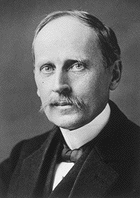
Romain Rolland was born on January 29, 1866, in the district of Nièvre. He studied literature, music, and philosophy, and in 1895 he published two doctoral theses: Les Origines du théâtre lyrique moderne, an erudite and penetrating work which was awarded a prize by the French Academy, and a Latin thesis, Cur ars picturae apud Italos XVI saeculi deciderit, a study of the decline of Italian painting in the sixteenth century. After several tiresome years as a schoolmaster, he was appointed to the École Normale as maître de conférences and thereafter (1903) to the Sorbonne, where until 1910 he gave a remarkable course on the history of music. In addition to his duties at the university, he devoted himself to music criticism during these years and acquired a wide reputation not only in France but all over Europe when he published his articles and reviews in book form under the titles Musiciens d’autrefois (1908) [Some Musicians of Former Days] and Musiciens d’aujourd’hui (1908) [Musicians of Today]. They reveal him as a critic of great judgment, both fair and bold, without prejudices or allegiance to any one party, and as one always striving to reach through music the very sources of life. His biographies of Beethoven (1903) and Händel (1910), inspired as well as learned, are proof of his understanding of music. Besides these, he has written equally remarkable biographies of François Millet (1902), Michelangelo (1905-06), and Tolstoi (1911), in which he has stressed the heroic character of the lives and talents of these artists.
Rolland made his debut in pure literature in 1897 with a play in five acts, Saint-Louis, which he published together with Aërt (1898) and Le Triomphe de la raison (1899), under the common title Les Tragédies de la foi (1909) [Tragedies of Faith]. In these plays he sought to set forth, under the mask of historical events, the miseries that souls faithful to their ideals meet in their struggle with the world. He also wrote Théâtre de la révolution (1909), which includes Le 14 Juillet (1902), Danton (1900), Les Loups (1898) [The Wolves], and a pacifist drama about the war in the Transvaal, Le Temps viendra (1903) [The Time Will Come]. The plays about the Revolution were conceived during a period when Rolland dreamed of a dramatic reform. He wanted to create a new theatre, to free the art from the domination of a selfish clique, and to entrust it to the people. He had previously outlined his ideas in an essay called Le Théâtre du peuple (1900-03) [The People’s Theatre]. He tried to make his own contribution to this new popular drama by describing the principal episodes of the French Revolution and by representing in a dramatic cycle the Iliad of the French nation. These dramas, which seek moral truth at the sacrifice of anecdotal color, reveal historical intuition, and their characters are fully alive. They are very interesting to read and deserve to be staged.
From 1904 to 1912 Rolland published his great novel Jean-Christophe, which is composed of a series of independent narratives: L’Aube, Le Matin, L’Adolescent, La Révolte, La Foire sur la place, Antoinette, Dans la maison, Les Amies, Le Buisson ardent, and La Nouvelle Journée [Dawn, Morning, Youth, Revolt, The Market Place, Antoinette, The House, Love and Friendship, The Burning Bush, The New Dawn]. In 1910 he resigned from his duties at the University; since then he has devoted himself entirely to writing, living most of the time in Rome and Switzerland. During the war, he wrote a series of articles in Swiss newspapers; these were subsequently published in a volume called Au-dessus de la mêlée (1915) [Above the Battle]. In this, he maintains that the future of mankind is superior to the interests of nations. War for him is barbarous violence, and over the bloody struggles of nations which seek power he turns our eyes toward the cause of humanity. Rolland’s recent works are a novel, Colas Breugnon (1918), a dramatic fantasy, Liluli (1919), and a study of Empedocles (1917).
Romain Rolland’s masterpiece, for which he has received the Nobel Prize in Literature in 1915, is Jean-Christophe. This powerful work describes the development of a character in whom we can recognize ourselves. It shows how an artistic temperament, by raising itself step by step, emerges like a genius above the level of humanity; how a powerful nature which has the noblest and most urgent desire for truth, moral health, and artistic purity, with an exuberant love of life, is forced to overcome obstacles that rise up ceaselessly before it; how it attains victory and independence; and how this character and this intelligence are significant enough to concentrate in themselves a complete image of the world. This book does not aim solely at describing the life of the principal hero and his environment. It seeks also to describe the causes of the tragedy of a whole generation; it gives a sweeping picture of the secret labour that goes on in the hidden depths and by which nations, little by little, are enlightened; it covers all the domains of life and art; it contains everything essential that has been discussed or attempted in the intellectual world during the last decades; it achieves a new musical aesthetic; it contains sociological, political and ethnological, biological, literary, and artistic discussions and judgments, often of the highest interest. The artistic personality which is revealed in Jean-Christophe is one of rare resoluteness and strong moral structure. In this work Rolland has not simply followed a literary impulse; he does not write to please or to delight. He has been compelled to write by his thirst for truth, his need for morality, and his love of humanity. For him the purpose of the aesthetic life consists not merely in the creation of beauty; it is an act of humanism. Jean-Christophe is a profession of faith and an example; it is a combination of thought and poetry, of reality and symbol, of life and dream, which attracts us, excites us, reveals us to ourselves, and possesses a liberating power because it is the expression of a great moral force.
In addition to the Romain Rolland who is concerned about truth and altruism there is also the artist. He is a poet of great scope. Although he has assigned the novel only to second place in his work, his mastery of the genre is superb. The character study of Jean-Christophe is an inspired creation, astonishing in spontaneity, with individuality in every trait, every movement, every thought.
Around this central, monumental figure, we find a whole series of characters of great human interest. Rolland’s observation is precise and profound. He penetrates to the depths of the beings whom he describes; he studies their characters and paints their souls with incomparable psychological art. His portraits of women, especially, are masterpieces. His characters come from all walks of life and are astonishingly true to type – the bourgeois, the politician, the artist. Sometimes the descriptions are brief but powerful sketches full of drama and pathos; sometimes they are extended to form immense tableaux of manners that are striking because of their keenness of vision and their singular penetration. His innate sincerity prevents Rolland from using rhetorical devices. He says in an exact and natural manner what he has to say – and nothing more. But when his thought is inflamed, when his heart is filled with emotion-love, anger, enthusiasm, scorn, joy, or sadness – then a wind swells the sentence and gives to the text a beauty that, before Rolland, only the greatest masters of French prose have attained.
The author of Jean-Christophe is one of the most imposing literary figures of the contemporary era; he is a mighty spirit and an original poet. His masterpiece has taken its place in world literature among the most original, the boldest, and the healthiest works of our century.
Biographical note on Romain Rolland
The works of Romain Rolland (1866-1945) written after the First World War continued to reflect all his earlier interests. During the twenties he began another «roman fleuve», L’Ame enchantée (7 vols., 1922-33) [The Soul Enchanted]. Music and the problem of the artist are the subject of his Beethoven: Les grandes époques créatrices (1928) [Beethoven the Creator]. Rolland persisted in his quest for peace and was attracted by the non-violence movement of Ghandi, about whom he wrote a book (1924). His fascination with India and Buddhism led to the study Essai sur la mystique et l’action de L’Inde vivante (1929-30) [Prophets of the New India]. His political ideas were increasingly influenced by socialism, as is evident from his many essays. Other works of his later period are Les Précurseurs (1919) [The Forerunners], Clerambault: histoire d’une conscience libre pendant la guerre (1920) [Clerambault], Le Jeu de l’amour et de la mort (1925) [The Game of Love and Death], and Péguy (1944), the study of his boyhood friend.
* The Nobel Prize in Literature 1915 was announced on November 9, 1916.
Romain Rolland died on December 30, 1944.
Romain Rolland – Biographical
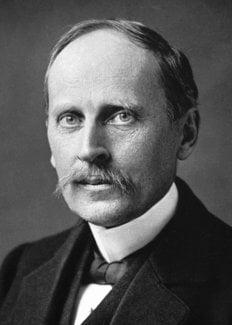
Romain Rolland did not submit an autobiography.