Sigrid Undset – Banquet speech
Sigrid Undset’s speech at the Nobel Banquet at Grand Hôtel, Stockholm, December 10, 1928
(Translation)
The preceding speakers have far better expressed our gratitude for the Prizes awarded to us than I could have done, and I subscribe to their words. I write more readily than I speak and I am especially reluctant to talk about myself. Instead, I wish to offer a salute to Sweden. Before I left for Sweden, a party was given for me – that is to say, not strictly speaking for me but because I was going to leave for Sweden – and everybody, the President of the Council of Ministers of Norway as well as my personal friends, asked me to give regards to Sweden. After all, the people of our peninsula form a distinct part of the world. Our forests and our mountains run into each other and our rivers carry their waters from one country to the other. Our houses in Norway resemble those in Sweden. God be praised! We have always lived in a great number of small, private dwellings spread all over our countries. Modern technology has not yet completely intruded on the humanity of the North.
But what I wished to say here is that I have been asked to give regards to Sweden, the country we think of with joy, and to Stockholm, which we Norwegians consider the most beautiful city in the world.
Prior to the speech, Professor Gösta Forssell addressed these remarks to the laureate: «In her extensive work, an Iliad of the North, Sigrid Undset has resurrected in a new and visionary light the ideals which once guided our forefathers who built that community from which our Germanic culture derived. To an age in which it may be easier to acknowledge that the right to the greatest happiness is the duty of renunciation – to this age Sigrid Undset has shown the ideals of our forefathers: duty and faithfulness.»
The Nobel Foundation's copyright has expired.Sigrid Undset – Bibliography
| Works in Norwegian |
| Fru Marta Oulie. – Kristiania : Aschehoug, 1907 |
| Den lykkelige alder. – Christiania : Aschehoug, 1908 |
| Fortællingen om Viga-Ljot og Vigdis. – Christiania : Aschehoug, 1909 |
| Ungdom : dikte. – Christiania : Aschehoug, 1910 |
| Jenny. – Christiania : Aschehoug, 1911 |
| Fattige skjebner. – Christiania : Aschehoug, 1912 |
| Vaaren. – Christiania : Aschehoug, 1914 |
| Fortællinger om Kong Artur og ridderne av det runde bord: fortalt på norsk. – Christiania : Aschehoug, 1915 |
| Splinten av troldspeilet. – Christiania : Aschehoug, 1917 |
| De kloge jomfruer. – Christiania : Aschehoug, 1918 |
| Et kvindesynspunkt. – Christiania : Aschehoug, 1919 |
| Kransen. – Christiania : Aschehoug, 1920. – (Kristin Lavransdatter; 1) |
| Splinten av troldspeilet : vårskyer. – Christiania : Aschehoug, 1921 |
| Husfrue. – Christiania : Aschehoug, 1922. – (Kristin Lavransdatter; 2) |
| Korset. – Christiania : Aschehoug, 1922. – (Kristin Lavransdatter; 3) |
| Olav Audunssøn i Hestviken. – Oslo : Aschehoug, 1925 |
| Fortællingen om Viga-Ljot og Vigdis; og, Sankt Halvards liv, død og jærtegn. – Oslo : Aschehoug, 1925 |
| Olav Audunssøn og hans børn. – Oslo : Aschehoug, 1927 |
| Katholsk propaganda. – Oslo : Aschehoug, 1927 |
| Etaper. – Oslo : Aschehoug, 1929 |
| Gymnadenia. – Oslo: Aschehoug, 1929 |
| Den brænnende busk. – 2 vol. / Oslo : Aschehoug, 1930 |
| Ida Elisabeth. – Oslo : Aschehoug, 1932 |
| Etapper : ny række. – Oslo : Aschehoug, 1933 |
| To europeiske helgener. – Oslo : Aschehoug, 1933 |
| Elleve aar. – Oslo : Aschehoug, 1934 |
| Den trofaste hustru. – Oslo : Aschehoug, 1936 |
| Norske helgener. – Oslo : Aschehoug, 1937 |
| Selvportretter og landskapsbilleder. – Oslo : Aschehoug, 1938 |
| Madame Dorthea. – Oslo : Aschehoug, 1939 |
| Tilbake til Fremtiden. – Oslo : Aschehoug, 1945 |
| Steen Steensen Blicher. – København : Rosenkilde & Bagger, 1946 |
| Lykkelige Dager. – Oslo : Aschehoug, 1947 |
| Middelalder romaner. – 10 vol. – Oslo : Aschehoug, 1949 |
| Caterina av Siena. – Oslo : Aschehoug, 1951 |
| Sigurd og hans tapre venner / translated into Norwegian by Signe Undset Thomas. – Oslo : Aschehoug, 1955 |
| Romaner og fortellinger fra nåtiden. – 10 vol. – Oslo : Aschehoug, 1964 |
| Tolv år. – Oslo : Aschehoug, 1998 |
| Translations into English |
| Gunnar’s Daughter / translated by Arthur G. Chater. – New : York: Knopf, 1936 |
| Images in a Mirror / translated by Arthur G. Chater. – New York : Knopf, 1938 |
| Jenny / translated by William Emmé. – London : Gyldendal, 1920 |
| The Bridal Wreath / translated by Charles Archer and J. S. Scott. – New York : Knopf, 1923. – (Kristin Lavransdatter; 1) |
| The Mistress of Husaby / translated by Charles Archer. – New York : Knopf, 1923. – (Kristin Lavransdatter; 2) |
| The Cross / translated by Charles Archer. – New York : Knopf, 1927. – (Kristin Lavransdatter; 3) |
| The Master of Hestviken : The Axe / translated by Arthur G. Chater. – New York : Knopf, 1928 |
| The Master of Hestviken : The Snake Pit / translated by Arthur G. Chater. – New York : Knopf, 1929 |
| The Master of Hestviken : In the Wilderness / translated by Arthur G. Chater. – New York : Knopf, 1929 |
| The Master of Hestviken : The Son Avenger / translated by Arthur G. Chater. – New York : Knopf, 1930 |
| The Wild Orchid / translated by Arthur G. Chater. – New York : Knopf, 1931 |
| The Burning Bush / translated by Arthur G. Chater. – New York : Knopf, 1932 |
| Ida Elisabeth / translated by Arthur G. Chater. – New York : Knopf, 1933 |
| Stages on the Road / translated by Arthur G. Chater. – New York : Knopf, 1934 |
| Saga of Saints / translated by E. C. Ramsden. – New York : Longmans, Green, 1934 |
| The Longest Years / translated by Arthur G. Chater. – New York : Knopf, 1935 |
| The Faithful Wife / translated by Arthur G. Chater. – New York : Knopf, 1937 |
| Men, Women, and Places / translated by Arthur G. Chater. – New York : Knopf, 1939 |
| Madame Dorthea / translated by Arthur G. Chater. – New York : Knopf, 1940 |
| Return to the Future / translated by Henriette C. K. Næseth. – New York : Knopf, 1942 |
| Happy Times in Norway / translated by Joran Birkeland. – New York : Knopf, 1942 |
| Sigurd and His Brave Companions : a Tale of Medieval. – New York : Knopf, 1943 |
| Catherine of Siena / translated by Kate Austin-Lind. – New York : Sheed & Ward, 1954 |
| Four Stories / translated by Naomi Walford. – New York : Knopf, 1959 |
| The Wreath / translated by Tiina Nunnally. – New York : Penguin, 1997. – (Kristin Lavransdatter; 1) |
| The Wife / translated by Tiina Nunnally. – New York: Penguin, 1999. – (Kristin Lavransdatter; 2) |
| The Cross / translated by Tiina Nunnally. – New York: Penguin, 2000. – (Kristin Lavransdatter; 3) |
| The Unknown Sigrid Undset : Jenny and Other Works / edited with an introduction by Tim Page ; with new translations by Tiina Nunnally. – South Royalton, Vt. : Steerforth Press, 2001 |
| Jenny : a novel / translated by Tiina Nunnally. – South Royalton, Vt. : Steerforth Press, 2002 |
| Kristin Lavransdatter / translated with notes by Tiina Nunnally ; introduction by Brad Leithauser. – New York : Penguin Books, 2005 |
| Critical studies (a selection) |
| Steen, Ellisiv, Kristin Lavransdatter : en kristisk studie. – Oslo : Aschehoug, 1959 |
| Deschamps, Nicole, Sigrid Undset ou la morale de la passion. – Montréal : Presses univ. de Montreal, 1966 |
| Thorn, Finn, Sigrid Undset : kristentro og kirkesyn. – Oslo : Aschehoug, 1975 |
| Amadou, Anne-Lisa, Å gi kjærligheten et språk : syv studier i Sigrid Undsets forfatterskap. – Oslo : Aschehoug, 1994 |
| Ørjasæter, Tordis, Menneskenes hjerter : Sigrid Undset – en livshistorie. – Oslo : Aschehoug, 1993 |
| Bliksrud, Liv, Natur og normer hos Sigrid Undset. – Oslo : Aschehoug, 1995 |
| Maman, Marie, Sigrid Undset in America : an Annotated Bibliography and Research Guide. – Lanham, MD : Scarecrow, 2000 |
| Skille, Nan Bentzen, Innenfor gjerdet. Hos Sigris Undset på Bjerkebæk. – Oslo : Aschehoug, 2003 |
| Oftestad, Bernt T., Sigrid Undset : modernitet og katolisisme. – Oslo : Universitetsforl., 2003 |
| Skille, Nan Bentzen: Inside the Gate. Sigrid Undset’s life at Bjerkebæk. – Oslo : Aschehoug, 2009 |
The Swedish Academy, 2010
Sigrid Undset – Nominations
Sigrid Undset – Other resources
Links to other sites
Home page of Sigrid Undset Society (in Norwegian)
On Sigrid Undset from Pegasos Author’s Calendar
Sigrid Undset – Facts
Award ceremony speech
Presentation Speech by Per Hallström, Chairman of the Nobel Committee of the Swedish Academy, on December 10, 1928
In her first novels or novellas, all of them remarkable works, Sigrid Undset painted the present-day world of young women in the environs of Christiania. It was a restless generation, prompt to make the gravest decisions as soon as its aspirations for happiness were at stake, ready to take the ultimate logical and sentimental consequences of its impulsive nature, and impassioned for truth. This generation had to pay dearly for the sense of reality it acquired. It had to pass through many trials before regaining its inner unity, and some of its representatives succumbed in the struggle. The women of this generation were strangely isolated in this disconcerting world. Far from finding support in a firmly established social rule, they had, in full consciousness, renounced the heritage of the past. Hostile to all established social order, which they considered a useless yoke, they counted only on themselves to create a new society, consistent with a conviction, doubtless sincere at bottom, but easily misled.
With a lively imagination, Sigrid Undset lived the life of these women; she portrayed them sympathetically but with merciless truthfulness. She traced the tragedy of their lives without embellishing or amplifying it; and she conveyed the evolution of their destinies with the most implacable logic, which implied the condemnation of her heroines and of the world in which they were living. The picture is gripping, as far as the scope of the personages permits; it is attractive only in its marvellously fresh and brilliant descriptions of nature. Remaining forever in the reader’s memory are the excursions on skis in the Norwegian solitude, the effects of the capricious play of the winter light, the exhilaration of the icy wind during the run, the mad dance of the blood in the veins, the spirit of adventure, the joy, the feeling of life and strength which makes the heart pound. And Sigrid Undset describes with the same mastery the splendours of spring, saturated with light and full of promises. In this domain her art attained greatness quite early.
This greatness began to extend to her entire work as soon as she abandoned the disunified and uprooted beings of the present time who had attracted her attention, in order to dedicate herself to the life of a distant past. She was destined by birth to do pioneer work in this area. Her father was a gifted historian, and from childhood she had lived in an atmosphere of historic legend and folklore. Moreover, she acquired a solid historical knowledge, guided, it would seem, by this premonition of the task her genius had set for her.
There she found the material which truly suited her nature, and her imagination was confronted with a task adequate to its scope. The characters she was going to make appear out of the past would offer a more complete unity and would be of a firmer cast than the contemporary characters. Far from being confined in a sterile isolation, they would participate in the great solidarity of past generations. These great masses would come alive in her work in a more vivid, firmer shape than the amorphous society of our era. Here was a great challenge to a writer who felt capable of carrying a heavy burden.
In their fashion, the generations of the Middle Ages also enjoyed a more varied inner life than the present generation, which Sigrid Undset found obsessed with the pursuit of sexual happiness, a quest which also determined their concepts of truth. These ancestors were strongly determined by the sentiment of honour and by faith. Here was the rich field for a psychology adequate to them. Moreover, the author’s imagination was bound to be attracted by the difficult task of conjuring out of the darkness of a little known past the external life of former generations in all its diversity. Sigrid Undset has done so to an extent that has aroused general admiration.
In so far as the inner life is concerned, her work can hardly be criticized. Intimately combined with the consciousness of the nation, in her depiction, honour retains all the rigour and all the weight that it had for the chevaliers and great landowners of the fourteenth century. The demands of honour are clearly stated, and the conflicts it creates are worked out regardless of their brutal consequences. Religious life is described with startling truth. Under Sigrid Undset’s pen it does not become a continuous holiday of the mind, penetrating and dominating human nature; it remains, as in our day, insecure and rebellious, and is often even harsher. Profoundly conscious of the hold of faith on these inexperienced and unpolished souls, the author has given it, in the grave hours of existence, an overwhelming power.
The erotic life, the problem common to the two sexes, which constitutes the centre of Sigrid Undset’s psychological interest, is found again, almost without modifications, in her historical novels. In this respect, objections naturally come to mind. In medieval documents, the feminist question is not known; one never finds hints of the inner personal life which later was to raise this question. The historian, demanding proofs, has the right to note this discrepancy. But the historian’s claim is not absolute; the poet has at least an equal right to express himself when he relies on a solid and intuitive knowledge of the human soul. The archaeologist must admit that there existed in the past instruments of a nature other than those which have come down to us, not to mention the often fortuitous ways in which the memories of the past have reached us. The poet has the right to suppose that human nature has hardly varied in the course of ages, even if the annals of the past are silent in certain regards.
In spite of the laws imposed by necessity, the common life of man and woman could scarcely have been peaceful and simple. It was no doubt less noisy than in our day, but it was exempt from neither conflicts nor bloody disturbances. To these conflicts and disturbances Sigrid Undset gave a voice, although it sometimes seems that the voice had accents far too modern and that the sentiments were too subtle for an era in which the influence of poetry had not yet manifested itself. The heavier and harsher environment seems also to have been of a nature which hardened the characters more firmly. But it is to this dissemblance, if indeed one can speak of dissemblance, that her poetic work owes its poignant and evocative life. In the inevitable compromise between the present and the past, from which the historical novel cannot escape, Sigrid Undset has chosen a richly rewarding way.
Her narrative is vigorous, sweeping, and at times heavy. It rolls on like a river, ceaselessly receiving new tributaries whose course the author also describes, at the risk of overtaxing the reader’s memory. This stems in part from the very nature of the subject. In the series of generations, conflicts and destinies assume a very concentrated form; these are whole masses of clouds which collide when the lightning flashes. However, this heaviness is also a result of the author’s ardent and instant imagination, forming a scene and a dialogue of each incident in the narrative without taking the necessary backward look at the general perspective. And the vast river, whose course is difficult to embrace comprehensively, rolls its powerful waves which carry along the reader, plunged into a sort of torpor. But the roaring of its waters has the eternal freshness of nature. In the rapids and in the falls, the reader finds the enchantment which emanates from the power of the elements, as in the vast mirror of the lakes he notices a reflection of immensity, with the vision there of all possible greatness in human nature. Then, when the river reaches the sea, when Kristin Lavransdatter has fought to the end the battle of her life, no one complains of the length of the course which accumulated so overwhelming a depth and profundity in her destiny. In the poetry of all times, there are few scenes of comparable excellence.
Sigrid Undset’s last novel, the two-volume story of Olav Audunssøn (1925-27), is generally on a level with the preceding novel, although it does not soar to its tragic finale. It attains, however, almost the same height in the scene in which Olav kills the Icelander. This scene constitutes a magnificent tableau, a masterly expression of the inner life, with a loftiness, a justice, an almost superhuman breadth of view rising above all the atrocities. One rediscovers here the same ripening of power as in Kristin Lavransdatter (1920-22). As far as the character studies are concerned, it seems impossible to reach higher than the portrayal of Eirik, the principal personage of the last part of the novel. Here is the complete evolution of a human being, from the first manifestations of childhood which are recorded not only with a vigorous strictness but also with a surprising superimposition of new traits, proportionate to the increasing clarity in the character delineation. One sees a human soul freely develop under one’s eyes, a true creation of a truly superior art.
Sigrid Undset has received the Nobel Prize in Literature while still in her prime, an homage rendered to a poetic genius whose roots must be in a great and well-ordered spirit.
The Nobel Prize in Literature 1928
Sigrid Undset – Biographical
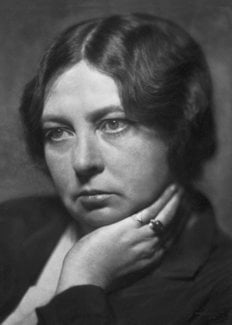
My father’s family came from Østerdalen. The first ancestor of ours of whom anything at all was known was one Peder Halvorsen who, in 1730, lived in Grytdalen in the Sollien valley of the river Atna where some men from Østerdalen had been allowed to settle and farm the land. My father’s folk remained there until my grandfather, Halvor Halvorsen, came to Trondhjem as a non-commissioned officer and became warden of a workhouse. He took the name of Undset from a hamlet in which my grandmother had lived when she became a widow.
My father, Ingvald Martin Undset, obtained his doctorate in 1881 with a thesis on The Beginnings of the Iron Age in Northern Europe. In the same year he married my mother, Charlotte Gyth of Kallundborg, whose family had, for some obscure reason, settled in Denmark toward the end of the eighteenth century. Since most of my father’s life consisted of travelling to almost every part of Europe, he set up a temporary home at Kallundborg. It was there that, in 1882, I first saw the light of day – the eldest of three sisters. In 1884 my father moved to Norway to take up a post at the Museum of Antiquities which was attached to the University of Christiania. I was sent to a school run by Mrs. Ragna Nielsen because my father was already aware that his days were numbered, and he was anxious for me to acquire a good education and follow in his footsteps. Mrs. Nielsen’s school was co-educational and heavily committed to progressive educational ideas. It played an important role in shaping my character, inspiring me with an indelible distrust of enthusiasm for such beliefs! It was not that I disliked Mrs. Nielsen or suspected her of not being so noble-minded or attached to her principles as she appeared to be. No, it was those very principles which filled me with boundless scepticism; I knew not why either then or for a long time afterwards. Many years later I was to find some kind of an answer in the words uttered by St. Augustine concerning the leader of the Donatists: «securus judicat orbis terrarum». At the time, however, my only reaction was to roll myself up into a tight ball of resistance and it was thus, hedgehog-wise, that I went through my school years.
My father died in 1893 and Mrs. Nielsen offered my mother free education for all of us three children. Then when I was about fourteen, a memorable thing happened. Mrs. Nielsen called me into an empty classroom and told me that though she would keep her promise to my mother, «You, dear Sigrid, show so little interest in the school and there are so many children who would dearly love to be in your place and enjoy a free education, that I am asking you now: are you sure you want to take your entrance examinations?» «No, thank you», was my reply. Mrs. Nielsen looked somewhat startled but all she said was, «Very well then, you must now decide about your future like a grown-up person». I am afraid that my behaviour that day was more akin to that of a small animal! Mrs. Nielsen was as good as her word where my sisters were concerned, but this was one of the few decisions in my life I have never regretted.
My mother had no choice but to send me to a commercial school in Christiania. I did not like it there but it had one great advantage over my old school; no one there expected me to like anything!
Later on, I went to work in an office and learned among other lessons to do things I did not care for, and to do them well. I remained there for ten years – from the age of 17 until I was 27. Before I left this office, two of my books had already been published – Fru Marte Oulie in 1907, and Den lykkelige alder (The Happy Age) in 1908. After leaving the office job, I went to Germany and Italy on a scholarship.
I have published a number of books since, my last two novels being set in the Middle Ages. They are Kristin Lavransdatter, which appeared in three volumes (192O-1922): Kransen (The Garland), Husfrue (The Mistress of Husaby), Korset (The Cross); and Olav Audunssøn i Hestviken (1925 ) [The Master of Hestviken] and its sequel Olav Audunssen og hans børn (1927) [Olav Audunssøn and his Children].
In 1912, I was married in Belgium to the Norwegian painter A. C. Svarstad. I was received into the Roman Catholic Church in 1924, and my marriage was then dissolved, since my husband had earlier been married to a woman who is still living. We have three children.
Since 1919, I have lived in Lillehammer.
Biographical note on Sigrid Undset
Sigrid Undset (1882-1949) was forced by the Second World War and the Nazi invasion to leave her native Norway. She went to the United States but continued to support the resistance movement. After the war she returned to her country and received the Grand Cross of St. Olav for her writing and her patriotic endeavours. Her later works are determined by the experience of her religious conversion and are chiefly apologetic in character. Gymnadenia (1929) [The Wild Orchid], Den brænnende busk (1930) [The Burning Bush], Ida Elisabeth (1932), and Den trofaste hustru (1936) [The Faithful Wife] deal with contemporary subjects. Madame Dorothea (1939) is a historical novel. Her biography of Catherine of Siena was published posthumously in 1951. Sigrid Undset is the author of the autobiographical volumes, Etapper (1929 and 1933) [Stages on the Road] and Elleve aar (1934) [The Longest Years].
This autobiography/biography was written at the time of the award and first published in the book series Les Prix Nobel. It was later edited and republished in Nobel Lectures. To cite this document, always state the source as shown above.
Sigrid Undset died on June 10, 1949.
The Nobel Foundation's copyright has expired.