Mikhail Sholokhov – Bibliography
| Works in Russian |
| Aleshkino serdtse. – Moskva : Gos. izd-vo, 1925 |
| Protiv chernogo znameni. – Moskva : Gos. izd-vo, 1925 |
| Nakhalenok. – Moskva : Gos. izd-vo, 1925 |
| Krasnogvardeitsy. – Moskva : Gos. izd-vo, 1925 |
| Dvukhmuzhniaia. – Moskva : Gos. izd-vo, 1925 |
| Donskie rasskazy. – Moskva : Novaia Moskva, 1926 |
| Lazorevaia step’. – Moskva : Novaia Moskva, 1926 |
| O Kolchake, krapive i prochem. – Moskva : Gos. izd-vo, 1927 |
| Chervotochina. – Moskva : Gos. izd-vo, 1927 |
| Tikhii Don. – Moskva, 1928-1940. – 4 vol. |
| Podniataia tselina. – Moskva : Federatsiia, 1932 |
| Kazaki. – Piatigorsk: Ordzhonikidzevskoe kraevoe izd-vo, 1941 |
| Na Donu. – Rosizdat, 1941 |
| Na iuge. – Moskva : Voenizdat, 1942 |
| Nauka nenavisti. – Moskva : Voenizdat, 1942 |
| Oni srazhalis’ za rodinu. – Moskva : Voennoe izdatel’stvo narodnogo komissariata oborony, 1943-1944 |
| Slovo o rodine. – Moskva : Pravda, 1948 |
| Svet i mrak. – Rostov : Rostizdat, 1949 |
| Ne uiti palacham ot suda narodov. – Moskva : Pravda, 1948 |
| Podniataia tselina. – [2]. – Moskva : Pravda, 1955-1960 |
| Sbornik statei. – Leningrad : Izdatel’stvo Leningradskogo universiteta, 1956 |
| Sud’ba cheloveka. – Moskva : Pravda, 1957 |
| Rannie rasskazy. – Moskva : Sovetskaia Rossiia, 1961 |
| Po veleniu dushi : stat’i, ocherki, vvstupleniia, dokumenty. – Moskva : Molodaia gvardiia, 1970 |
| Rossiia v serdtse. – Moskva : Sovremennik, 1975 |
| Zhivaia sila realizma. – Moskva : Sovetskaia Rossiia, 1983 |
| Zemle nuzhnye molodye ruki. – Moskva : Sovetskaia Rossiia, 1983 |
| Rasskazy. – Leningrad : Khudozhestvennaia literatura, 1983 |
| Proza i publitsistika o voine. – Moskva : Sovremennik, 1985 |
| Translations into English |
| Tales from the Don / translated by H. C. Stevens. – London : Putnam, 1961 |
| And Quiet Flows the Don / translated by Stephen Garry. – Moscow : Foreign Languages Publishing House, 1930 |
| The Soil Upturned / translated by Stephen Garry ; edited by Albert Lewis. – Moscow : Co-operative Publishing Society of Foreign Workers in the U.S.S.R., 1934. – Republished as The Virgin Soil Upturned. – London : Putnam, 1935. – Republished as Seeds of Tomorrow. – New York : Knopf, 1935 |
| The Don Flows Home to the Sea / translated by Stephen Garry. – New York : Knopf, 1941 |
| Hate. – Moscow : Foreign Languages Publishing House, 1942. – Content: Hate ; Down south |
| Harvest on the Don / translated by H. C. Stevens. – London: Putnam, 1960 |
| Early Stories / translated by Robert Daglish and Yelena Altshuler. – Moskva : Progress, 1966 |
| One Man’s Destiny and Other Stories : Articles, and Sketches, 1923-1963 / translated by H. C. Stevens. – London : Putnam, 1966 |
| Fierce and Gentle Warriors : Three Stories. – Garden City, N.Y. : Doubleday, 1967 |
| At the Bidding of the Heart : Essays, Sketches, Speeches, Papers / translated by Olga Shartse. – Moscow : Progress, 1973 |
| Collected Works in Eight Volumes / translated by Robert Daglish. – 8 vol. – Moscow : Raduga, 1984 |
| Critical studies (a selection) |
| Bearne, C. G., Sholokhov. – Edinburgh, 1969 |
| Žuravleva, Anna, & Kovaleva, Aleksandra, Michail Šolochov. – Moskva : Prosvešcěnie, 1975 |
| Sofronov, Anatolij, Meetings with Sholokhov. – Moskva : Progress Publ., 1985 |
| Kuznecov, Feliks, “Tichij Don” : sudba i pravda velikogo romana. – Moskva : Narodnaja kniga, 2005 |
The Swedish Academy, 2006
Mikhail Sholokhov – Nominations
Mikhail Sholokhov – Banquet speech
English
Russian
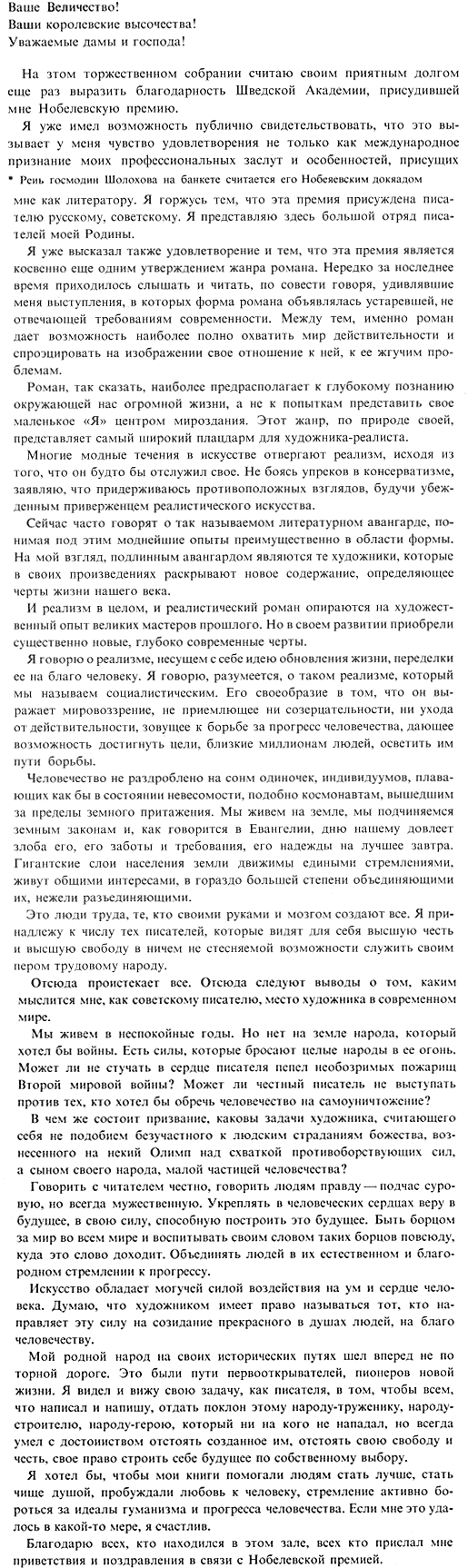
Mikhail Sholokhov’s speech at the Nobel Banquet at the City Hall in Stockholm, December 10, 1965*
(Translation)
On this solemn occasion I find it my pleasant duty to extend my thanks once more to the Swedish Academy, which has awarded me the Nobel Prize.
As I have already had occasion to testify in public, the feeling of satisfaction which this award arouses in me is not solely due to the international recognition of my professional merits and my individual characteristics as a writer. I am proud that this Prize has been awarded to a Russian, a Soviet writer. Here I represent a multitude of writers from my native land.
I have also previously expressed my satisfaction that, indirectly, this Prize is yet another recognition of the novel as a genre. I have not infrequently read and heard recent statements which have quite frankly astonished me, in which the novel has been declared an outdated form that does not correspond to present-day demands. Yet it is just the novel that makes possible the most complete comprehension of the world of reality, that permits the projection of one’s attitude to this world, to its burning problems.
One might say that the novel is the genre that most predisposes one to a profound insight into the tremendous life around us, instead of putting forward one’s own tiny ego as the centre of the universe. This genre, by its very nature, affords the very widest scope for a realistic artist.
Many fashionable currents in art reject realism, which they assume has served its time. Without fear of being accused of conservatism, I wish to proclaim that I hold a contrary opinion and am a convinced supporter of realistic art.
There is a lot of talk nowadays about literary avantgardism with reference to the most modern experiments, particularly in the field of form. In my opinion the true pioneers are those artists who make manifest in their works the new content, the determining characteristics of life in our time.
Both realism as a whole and the realistic novel are based upon artistic experiences presented by great masters in the past. During their development, however, they have acquired important new features that are fundamentally modern.
I am speaking of a realism that carries within itself the concept of life’s regeneration, its reformation for the benefit of mankind. I refer, of course, to the realism we describe as socialist. Its peculiar quality is that it expresses a philosophy of life that accepts neither a turning away from the world nor a flight from reality, a philosophy that enables one to comprehend goals that are dear to the hearts of millions of people and that lights up their path in the struggle.
Mankind is not divided into a flock of individuals, people floating about in a vacuum, like cosmonauts who have penetrated beyond the pull of Earth’s gravity. We live on Earth, we are subject to its laws and, as the Gospel puts it, sufficient unto the day is the evil thereof, its troubles and trials, its hopes for a better future. Vast sections of the world’s population are inspired by the same desires, and live for common interests that bind them together far more than they separate them.
These are the working people, who create everything with their hands and their brains. I am one of those authors who consider it their highest honour and their highest liberty to have a completely untrammelled chance of using their pens to serve the working people.
This is the ultimate foundation. From it are derived the conclusions as to how I, a Soviet writer, view the place of the artist in the world of today.
The era we live in is full of uncertainty. Yet there is not one nation on Earth that desires a war. There are, however, forces that hurl whole nations into the furnaces of war. Is it not inevitable that the ashes from the indescribable conflagration of the Second World War should move the writer’s heart? Is not an honest writer bound to stand up against those who wish to condemn mankind to self-destruction?
What, then, is the vocation and what are the tasks of an artist who sees himself, not as an image of a god who is indifferent to the sufferings of mankind, enthroned far above the heat of battle, but as a son of his people, a tiny particle of humanity?
To be honest with the reader, to tell people the truth – which may sometimes be unpleasant but is always fearless. To strengthen men’s hearts in their belief in the future, in the belief in their own ability to build this future. To be a champion of peace throughout the world and with his words breed such champions wherever those words penetrate. To unite people in their natural, noble striving toward progress.
Art possesses a great ability to influence people’s intellects and brains. I believe that anyone has the right to call himself an artist, if he channels this ability into creating someting beautiful in the minds of men, if he benefits humanity.
My own people have not followed beaten tracks in their historical journey. Their journey has been that of the explorers, the pioneers for a new life. I have regarded and still regard it as my task as an author in all that I have written and in whatever I may come to write, to show my great respect for this nation of workers, this nation of builders, this nation of heroes, which has never attacked anyone but which knows how to put up an honourable defence of what it has created, of its freedom and dignity, of its right to build the future as it chooses.
I should like my books to assist people in becoming better, in becoming purer in their minds; I should like them to arouse love of one’s fellow men, a desire to fight actively for the ideal of humanity and the progress of mankind. If I have managed to do this in some measure, then I am happy.
I thank all those of you here tonight, and all those who have sent me greetings and good wishes in connection with the Nobel Prize.
Prior to the speech, Karl Ragnar Gierow of the Swedish Academy addressed the Soviet novelist: «Mr. Sholokhov – You received news of the Nobel Prize when in the Ural Mountains for a couple of weeks’ shooting, and, according to a Moscow newspaper, that same day you brought down two fine greylag geese at a long range with a single shot. But if you are celebrated tonight as the crack marksman amongst the Nobel laureates, it is because that coincidental hit has a certain relevance to your work.
An epic achievement like yours could be written on that enormous scale, with that breadth of view, with that wild and still majestic flow of events and figures, with that imposing execution of the theme – with all that, and be a masterpiece, never to be forgotten. Or the epic could be presented with that vivid sense of the dramatic situation, with that sharp eye for every detail of artistic value, with that passionate feeling for its characters – with all that, and be a work of art, always to be loved. The combination of both is the mark of the genius, of your genius. It is about as common as seeing two birds in flight aligned with one’s gunsight. You brought the two down with one shot.
Your great epic of an old rule, desperately defending itself, and a new rule, as desperately fighting for every foot of blood-drenched earth, keeps posing from the outset the question: who-or what-rules? It also provides an answer. It says: the heart. The human heart, with all it holds of love and cruelty, hope and sorrow, pride and debasement. The human heart, which is the real battlefield of all victories and defeats that befall this earth of ours. Thus your art ranges beyond all frontiers, and we take it to our hearts with the deepest gratitude.»
* Mr Sholokov’s dinner speech is being considered as his Nobel Lecture.
Mikhail Sholokhov – Banquet speech
English
Russian
Mikhail Sholokhov’s speech at the Nobel Banquet at the City Hall in Stockholm, December 10, 1965
* Disclaimer
Every effort has been made by the publisher to credit organizations and individuals with regard to the supply of audio files. Please notify the publishers regarding corrections.
Mikhail Sholokhov – Other resources
Links to other sites
On Mikhail Sholokhov from Pegasos Author’s Calendar
Mikhail Sholokhov – Facts
Mikhail Sholokhov – Biographical
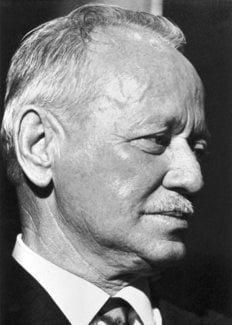
Mikhail Aleksandrovich Sholokhov (1905-1984) was born in the land of the Cossacks, now known as the Kamenskaya region of the R.S.F.S.R. He attended several high schools until 1918. During the civil war he fought on the side of the revolutionaries, and in 1922 he moved to Moscow to become a journalist. There he published a number of short stories in newspapers. He made his literary debut in 1926 with a volume of stories, Donskie rasskazy (Tales from the Don), 1926, about the Cossacks of his native region, to which he had returned two years earlier.
In the same year, 1926, Sholokhov began writing Tikhi Don (And Quiet Flows the Don), 1928-1940, which matured slowly and took him fourteen years to complete. Reminiscent of Tolstoy in its vividly realistic scenes, its stark character descriptions and, above all, its vast panorama of the revolutionary period, Sholokhov’s epic became the most read work of Soviet fiction. Deeply interested in human destinies which are played against the background of the transformations and troubles in Russia, he unites in his work the artistic heritage of Tolstoy and Gogol with a new vision introduced into Russian literature by Maxim Gorky.
His other major work in the Don cycle, Podnyataya tselina (Virgin Soil Upturned), 1932 and 1959, deals in part with the collectivization of the Don area. There are a number of works such as the short story Sudba cheloveka (The Fate of a Man), 1957 – made into a popular Russian film – which treat the power and the resilience of human love under adversity. His collected works, Sobranie sochineny, were published in eight volumes between 1956 and 1960. In 1932 Sholokhov joined the Communist Party and, on several occasions, has been a delegate to the Supreme Soviets. In 1939 he became a member of the Soviet Academy of Sciences and later vice president of the Association of Soviet Writers.
This autobiography/biography was written at the time of the award and first published in the book series Les Prix Nobel. It was later edited and republished in Nobel Lectures. To cite this document, always state the source as shown above.
Mikhail Sholokov died on February 21, 1984.
Award ceremony speech
Presentation Speech by Anders Österling, Member of the Swedish Academy
This year’s Nobel Prize for Literature has, as you all know, been awarded to the Russian writer Mikhail Sholokhov, born in 1905, and now in his sixty-first year. Sholokhov’s childhood was spent in the country of the Don Cossacks; and the strong ties that have always bound him to this district grew out of his sympathy for the highly individual temperament of its people and the wildness of its landscape. He saw his native province pass through the various phases of the revolution and the Russian civil war. After he had tried his hand at manual work in Moscow for a while, he soon began to concentrate on writing and produced a series of sketches describing the battles along the Don, a genre that was later to bring him fame. It is striking evidence of the precociousness of the war generation that Sholokhov was only 21 when he set to work on the first parts of the great epic novel, And Quiet Flows the Don. Its Russian title is simply, The Quiet Don, which acquires an undeniably ironic undertone in view of the extreme violence of the action in Sholokhov’s masterpiece.
It took Sholokhov 14 years to complete the project, a highly exacting one in every way, covering as it does the period including the First World War, the Revolution and the Civil War, and, having as its main theme, the tragic Cossack revolt. The four parts of the epic appeared at relatively long intervals between 1928 and 1940, and were long viewed with some concern by the Soviet critics, whose political affiliation made it difficult for them to accept, wholeheartedly, Sholokhov’s quite natural commitment to his theme, that of the Cossacks’ revolt against the new central authorities; nor could they easily accept his endeavour to explain and defend objectively the defiant spirit of independence that drove these people to resist every attempt at subjection.
In view of the controversial aspects of his theme there can surely be no doubt that in starting out upon the writing of this novel Sholokhov was taking a daring step, a step which, at that point in his career, also meant the settling of a conflict with his own conscience.
And Quiet Flows the Don is so well known to Swedish readers that an introduction may well seem superfluous. With magnificent realism the book portrays the unique character of the Cossack, the traditional mixture of cavalryman and farmer, with instincts that seem to conflict with one another but which nevertheless allow themselves to be welded together to form a firmly co-ordinated whole. There is no glamorization. The coarse and savage streaks in the Cossack temperament are displayed openly; nothing is hidden or glossed over, but, at the same time, one is aware of an undercurrent of respect for all that is human. Although a convinced Communist, Sholokhov keeps ideological comment out of his book completely and we are compensated for the amount of blood shed in the battles he describes by the full-blooded vigour of his narrative.
The Cossack’s son, Gregor, who goes over from the Reds to the Whites and is forced against his will to continue the struggle to its hopeless conclusion is both hero and victim. The conception of honour that he has inherited is put to the sternest of tests, and he is defeated by a necessity of history which here plays the same role as the classical Nemesis. But our sympathy goes out to him and to the two unforgettable women, Natalja, his wife, and Aksinia, his mistress, who both meet disaster for his sake. When he finally returns to his native village, after digging Aksinia’s grave with his sabre out on the steppe, he is a grey-haired man who has lost everything in life but his young son.
Stretching away behind the whole gallery of figures, seen either in their personal relationships or playing their parts as military personnel, lies the mighty landscape of the Ukraine, the steppes in all the changing seasons, the villages with their sweet-smelling pastures and grazing horses, the grass billowing in the wind, the banks of the river and the never-ending murmur of the river itself. Sholokhov never tires of describing the Russian steppes. Sometimes he breaks off the narrative right in the middle of his story to burst out in exultation:
“My beloved steppes under the low sky of the Don country! Ravines winding across the plain with their walls of red earth, a sea of waving feather-grass, marked only by the print of horses’ hoofs leaving trail like a myriad birds’ nests, and by the graves of the Tartars who in wise silence watch over the buried glory of the Cossacks… I bow low before you, and, as a son, kiss your fresh earth, unspoiled steppe of the Don Cossacks, watered with blood.”
It may well be said that Sholokhov is using a well-tried realistic technique, breaking no new ground, a technique that may seem naive in its simplicity if we set it beside that offered us in many a later model in the art of novel-writing. But his subject surely could not have been presented in any other way, and the powerful, evenly-sustained, epic flow of the writing makes And Quiet Flows the Don a genuine roman fleuve in two senses.
Sholokhov’s more recent work, for example, Podnyataya tselina, 1932 and 1959 (Virgin Soil Upturned) – a novel describing compulsory collectivization and the introduction of kolkhozy – has a vitality that never flags and shows us Sholokhov’s fondness for characters that are richly comic but at the same time observed with a sympathetic eye. But, of course, And Quiet Flows the Don would, on its own, thoroughly merit the present award, a distinction which, it is true, has come rather late in the day, but happily not too late to add to the roll of Nobel prize-winners the name of one of the most outstanding writers of our time.
In support of its choice the Swedish Academy speaks of “the artistic power and integrity with which, in his epic of the Don, Sholokhov has given expression to a historic phase in the life of the Russian people”.
Sir – this distinction is intended as a tribute of justice and gratitude to you for your important contribution to modern Russian literature, a contribution as well-known in this country as it is all over the world. May I offer you the congratulations of the Swedish Academy, and at the same time, ask you to receive from His Majesty, the King, this year’s Nobel Prize in Literature.