Mother Teresa was born Agnes Gonxha Bojaxhiu in Uskup, Ottoman Empire (now Skopje, North Macedonia), on August 26, 1910. Her family was of Albanian descent. At the age of twelve, she felt strongly the call of God …
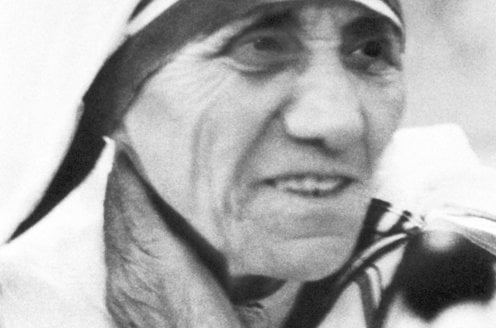
Mother Teresa was awarded the Nobel Peace Prize for her efforts to bring help to suffering humanity.
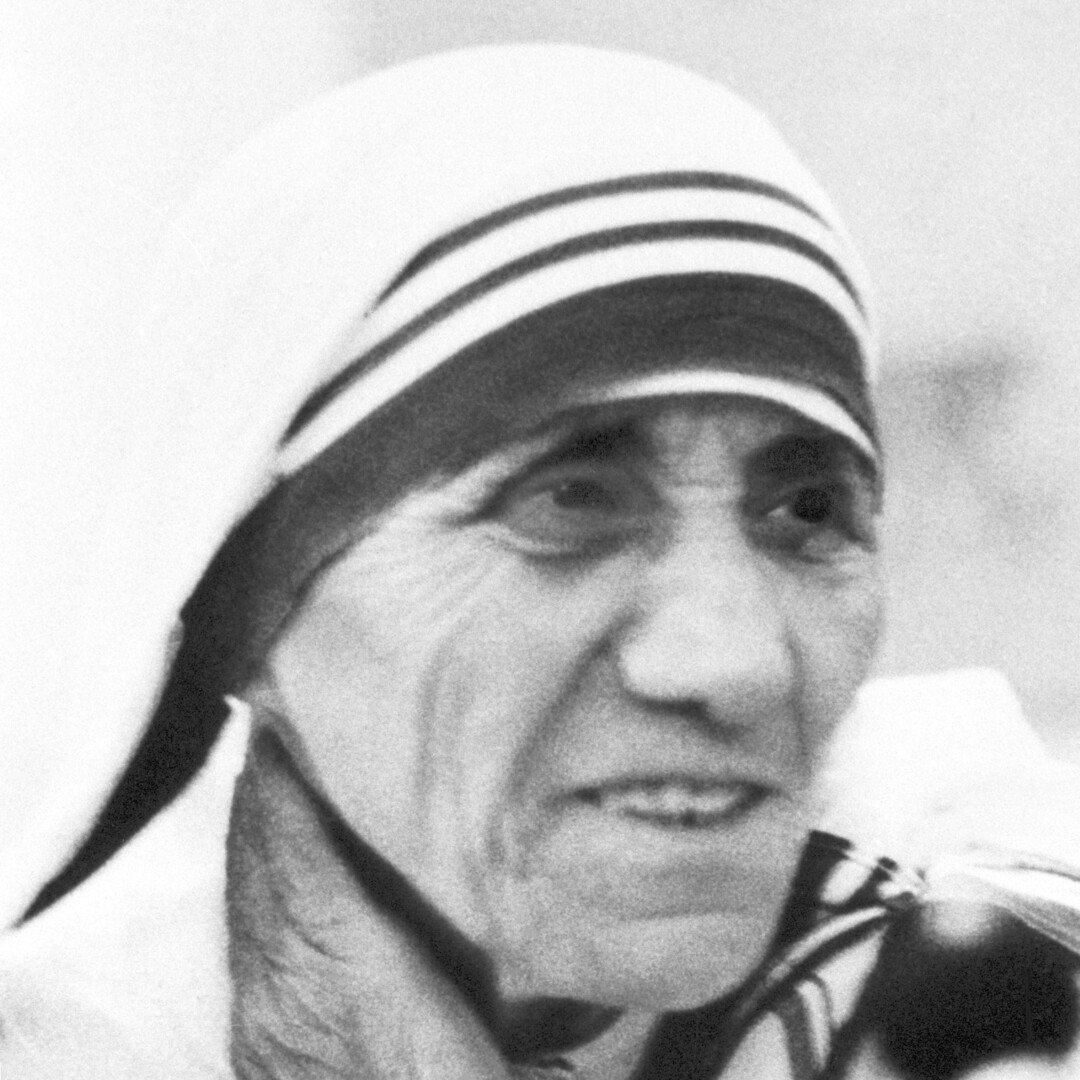
Full name: Mother Teresa
Born: 26 August 1910, Uskup, Ottoman Empire (now Skopje, North Macedonia)
Died: 5 September 1997, Calcutta, India
Date awarded: 27 October 1979
At the age of twelve, Agnes Gonxha Bojaxiu, a Catholic girl in Albania, received a call to dedicate her life to God. She joined an order of nuns, received an education and was sent to Calcutta, India to teach. Her new name was Teresa. In India she received a new call from God: she was to help the poor while living among them. She founded a new order, the “Missionaries of Charity,” which built orphanages, leprosy centres and hostels for the terminally ill in Calcutta. Mother Teresa’s organisation also ministered to the needy in other parts of the world. The modest nun in the white sari with blue edging and a silver cross on her left shoulder became a familiar figure throughout the world. She met with many heads of state, and donations poured in to the “Missionaries of Charity.”
“You have been the Mother of Bengal, now you are the Mother of the World.”
Jyoti Basu, Indian politician,1979.
While riding on a train in 1946, Mother Teresa received her second call. As she later explained, she was certain that she heard the voice of God calling to her. “The message was clear. I was to leave the convent and help the poor, while living among them.” This was a call that had to be obeyed, a call within her vocation. The following year the Vatican gave its consent. After an intensive course in nursing training, she began her work in the slums of Calcutta. A handful of students from the school where she had taught volunteered to help her. She distributed food to the poor and opened a primitive hospital.
In 1950 Mother Teresa founded the order “Missionaries of Charity.” Placed directly under the jurisdiction of the Vatican, this order experienced phenomenal growth. When Mother Teresa received the Nobel Peace Prize in 1979, the order numbered 1100 nuns and 300 novices. In India the nuns ran 30 orphanages, 70 leprosy centres and a number of hospices for the terminally ill. Mother Teresa also cared about those who were suffering in other parts of the world. She was a marvellous fundraiser, organising relief work in Africa, the Middle East, South America and the USA.
“The poor are great! The poor are wonderful! The poor are very generous! They give us much more than we give them.”
Mother Teresa in ‘In my own words’, 1997.
Mother Teresa’s Nobel Prize lecture gave her an opportunity to talk about matters close to her heart. She viewed Christ’s teachings about loving one’s neighbours as fundamental. People who say they love God, but who do not love their fellow man, are liars, she said. She vehemently attacked abortion: “Abortion is a direct war, a direct killing – direct murder by the mother herself.” Nor was birth control acceptable. Instead, the “Missionaries of Charity” chose to teach the poor what Mother Teresa called “natural” family planning: abstinence and safe periods.
Mother Teresa was born Agnes Gonxha Bojaxhiu in Uskup, Ottoman Empire (now Skopje, North Macedonia), on August 26, 1910. Her family was of Albanian descent. At the age of twelve, she felt strongly the call of God …
Disclaimer: Every effort has been made by the publisher to credit organisations and individuals with regard to the supply of photographs. Please notify the publishers regarding corrections.
On Mother Teresa of Calcutta from the Holy See
Let us all together thank God for this beautiful occasion where we can all together proclaim the joy of spreading peace, the joy of loving one another and the joy acknowledging that the poorest of the poor are our brothers and sisters.
As we have gathered here to thank God for this gift of peace, I have given you all the prayer for peace that St Francis of Assisi prayed many years ago, and I wonder he must have felt the need what we feel today to pray for. I think you have all got that paper? We’ll say it together.
Lord, make me a channel of your peace, that where there is hatred, I may bring love; that where there is wrong, I may bring the spirit of forgiveness; that where there is discord, I may bring harmony; that where there is error, I may bring truth; that where there is doubt, I may bring faith; that where there is despair, I may bring hope; that where there are shadows, I may bring light; that where there is sadness, I may bring joy.
Lord, grant that I may seek rather to comfort than to be comforted; to understand, than to be understood; to love, than to be loved. For it is by forgetting self, that one finds. It is by forgiving that one is forgiven. It is by dying, that one awakens to eternal life. Amen.
God loved the world so much that he gave his son and he gave him to a virgin, the blessed virgin Mary, and she, the moment he came in her life, went in haste to give him to others. And what did she do then? She did the work of the handmaid, just so. Just spread that joy of loving to service. And Jesus Christ loved you and loved me and he gave his life for us, and as if that was not enough for him, he kept on saying: Love as I have loved you, as I love you now, and how do we have to love, to love in the giving. For he gave his life for us. And he keeps on giving, and he keeps on giving right here everywhere in our own lives and in the lives of others.
It was not enough for him to die for us, he wanted that we loved one another, that we see him in each other, that’s why he said: Blessed are the clean of heart, for they shall see God.
And to make sure that we understand what he means, he said that at the hour of death we are going to be judged on what we have been to the poor, to the hungry, naked, the homeless, and he makes himself that hungry one, that naked one, that homeless one, not only hungry for bread, but hungry for love, not only naked for a piece of cloth, but naked of that human dignity, not only homeless for a room to live, but homeless for that being forgotten, been unloved, uncared, being nobody to nobody, having forgotten what is human love, what is human touch, what is to be loved by somebody, and he says: Whatever you did to the least of these my brethren, you did it to me.
It is so beautiful for us to become holy to this love, for holiness is not a luxury of the few, it is a simple duty for each one of us, and through this love we can become holy. To this love for one another and today when I have received this reward, I personally am most unworthy, and I having avowed poverty to be able to understand the poor, I choose the poverty of our people. But I am grateful and I am very happy to receive it in the name of the hungry, of the naked, of the homeless, of the crippled, of the blind, of the leprous, of all those people who feel unwanted, unloved, uncared, thrown away of the society, people who have become a burden to the society, and are shunned by everybody.
In their name I accept the award. And I am sure this award is going to bring an understanding love between the rich and the poor. And this is what Jesus has insisted so much, that is why Jesus came to earth, to proclaim the good news to the poor. And through this award and through all of us gathered here together, we are wanting to proclaim the good news to the poor that God loves them, that we love them, that they are somebody to us, that they too have been created by the same loving hand of God, to love and to be loved. Our poor people are great people, are very lovable people, they don’t need our pity and sympathy, they need our understanding love. They need our respect; they need that we treat them with dignity. And I think this is the greatest poverty that we experience, that we have in front of them who may be dying for a piece of bread, but they die to such dignity. I never forget when I brought a man from the street. He was covered with maggots; his face was the only place that was clean. And yet that man, when we brought him to our home for the dying, he said just one sentence: I have lived like an animal in the street, but I am going to die like an angel, love and care, and he died beautifully. He went home to God, for dead is nothing but going home to God. And he having enjoyed that love, that being wanted, that being loved, that being somebody to somebody at the last moment, brought that joy in his life.
And I feel one thing I want to share with you all, the greatest destroyer of peace today is the cry of the innocent unborn child. For if a mother can murder her own child in her own womb, what is left for you and for me to kill each other? Even in the scripture it is written: Even if mother could forget her child – I will not forget you – I have carved you in the palm of my hand. Even if mother could forget, but today millions of unborn children are being killed. And we say nothing. In the newspapers you read numbers of this one and that one being killed, this being destroyed, but nobody speaks of the millions of little ones who have been conceived to the same life as you and I, to the life of God, and we say nothing, we allow it. To me the nations who have legalized abortion, they are the poorest nations. They are afraid of the little one, they are afraid of the unborn child, and the child must die because they don’t want to feed one more child, to educate one more child, the child must die.
And here I ask you, in the name of these little ones, for it was that unborn child that recognized the presence of Jesus when Mary came to visit Elizabeth, her cousin. As we read in the gospel, the moment Mary came into the house, the little one in the womb of his mother, leapt with joy, recognized the Prince of Peace. And so today, let us here make a strong resolution, we are going to save every little child, every unborn child, give them a chance to be born. And what we are doing, we are fighting abortion by adoption, and the good God has blessed the work so beautifully that we have saved thousands of children, and thousands of children have found a home where they are loved, they are wanted, they are cared. We have brought so much joy in the homes that there was not a child, and so today, I ask His Majesties here before you all who come from different countries, let us all pray that we have the courage to stand by the unborn child, and give the child an opportunity to love and to be loved, and I think with God’s grace we will be able to bring peace in the world. We have an opportunity here in Norway, you are with God’s blessing, you are well to do. But I am sure in the families and many of our homes, maybe we are not hungry for a piece of bread, but maybe there is somebody there in the family who is unwanted, unloved, uncared, forgotten, there isn’t love. Love begins at home. And love to be true has to hurt. I never forget a little child who taught me a very beautiful lesson. They heard in Calcutta, the children, that Mother Teresa had no sugar for her children, and this little one, Hindu boy four years old, he went home and he told his parents: I will not eat sugar for three days, I will give my sugar to Mother Teresa. How much a little child can give. After three days they brought into our house, and there was this little one who could scarcely pronounce my name, he loved with great love, he loved until it hurt. And this is what I bring before you, to love one another until it hurts, but don’t forget that there are many children, many children, many men and women who haven’t got what you have. And remember to love them until it hurts. Sometime ago, this to you will sound very strange, but I brought a girl child from the street, and I could see in the face of the child that the child was hungry. God knows how many days that she had not eaten. So I give her a piece of bread. And then the little one started eating the bread crumb by crumb. And I said to the child, eat the bread, eat the bread. And she looked at me and said: I am afraid to eat the bread because I’m afraid when it is finished I will be hungry again. This is a reality, and yet there is a greatness of the poor. One evening a gentleman came to our house and said, there is a Hindu family and the eight children have not eaten for a long time. Do something for them. And I took rice and I went immediately, and there was this mother, those little ones’ faces, shining eyes from sheer hunger. She took the rice from my hand, she divided into two and she went out. When she came back, I asked her, where did you go? What did you do? And one answer she gave me: They are hungry also. She knew that the next door neighbor, a Muslim family, was hungry.
What surprised me most, not that she gave the rice, but what surprised me most, that in her suffering, in her hunger, she knew that somebody else was hungry, and she had the courage to share, share the love. And this is what I mean, I want you to love the poor, and never turn your back to the poor, for in turning your back to the poor, you are turning it to Christ. For he had made himself the hungry one, the naked one, the homeless one, so that you and I have an opportunity to love him, because where is God? How can we love God? It is not enough to say to my God I love you, but my God, I love you here. I can enjoy this, but I give up. I could eat that sugar, but I give that sugar. If I stay here the whole day and the whole night, you would be surprised of the beautiful things that people do, to share the joy of giving. And so, my prayer for you is that truth will bring prayer in our homes, and the fruit of prayer will be that we believe that in the poor, it is Christ. And if we really believe, we will begin to love. And if we love, naturally, we will try to do something. First in our own home, our next door neighbor, in the country we live, in the whole world. And let us all join in that one prayer, God give us courage to protect the unborn child, for the child is the greatest gift of God to a family, to a nation and to the whole world. God bless you!
Did you find any typos in this text? We would appreciate your assistance in identifying any errors and to let us know. Thank you for taking the time to report the errors by sending us an e-mail.
Question: When and where was Mother Teresa born?
Answer: Mother Teresa was born on 26 August 1910 as Agnes Gonxha Bojaxhiu in Uskup (now Skopje), Ottoman Empire (now North Macedonia). She was baptised on 27 August.
Question: What were the names of Mother Teresa’s family members?
Answer: Mother Teresa was the third child of Albanian grocer Nikola Bojaxhiu and his wife Drane. She had an older sister, Aga, and an older brother, Lazar. Her father died when she was about eight years old.
Question: Why did Mother Teresa go to India?
Answer: In 1928, when Mother Teresa was 18 years old, she went to Ireland to join the Sisters of Loreto at the Institute of the Blessed Virgin Mary, a community of nuns with missions in India. Six weeks later she travelled to India to work as a teacher in the order’s school in Calcutta.
Question: What order did Mother Teresa start?
Answer: In 1946 Mother Teresa experienced what she described as a “call within a call”, or inspiration, to leave the Loreto convent and devote herself to caring for the sick and poor. She then moved into the slums. In 1950, she received permission from the Vatican to found the Missionaries of Charity, a Roman Catholic religious order of women, dedicated to serving “the poorest of the poor”.
Question: Why was she called Mother Teresa?
Answer: When she joined the Irish order Sisters of Loreto, she was given the name Sister Teresa after Saint Thérèse de Lisieux. She became Mother Teresa after making her final vows.
Question: Why did Mother Teresa start her own hospice?
Answer: Mother Teresa’s “call” was caring for the sick and poor. In 1952, she established a hospice where the terminally ill could die with dignity.
At the time of her death, Mother Teresa’s Missionaries of Charity had over 4,000 sisters and hundreds of thousand of volunteers working in hundreds of centres around the world. These included homes for orphaned children, homes for people with HIV/AIDS, leper colonies, and hospices for the terminally ill.
Question: What influenced Mother Teresa?
Answer: In her Nobel Lecture, Mother Teresa said: “I think that we in our family don’t need bombs and guns, to destroy to bring peace – just get together, love one another, bring that peace, that joy, that strength of presence of each other in the home. And we will be able to overcome all the evil that is in the world.”
Question: Was Mother Teresa ever named a saint and is it documented?
Answer: In 1999, only two years after her death, the process to declare her a saint began; a process that normally takes about five years. On 10 October 2003 she was beatified by Pope John Paul II, the third of the four steps in the canonization process to declare a deceased person to be a saint. On 4 September 2016 Mother Teresa was canonized, declared a saint, by Pope Francis.
Question: Why did Mother Teresa get the 1979 Nobel Peace Prize?
Answer: The Norwegian Nobel Committee writes in their motivation: “In making the award the Norwegian Nobel Committee has expressed its recognition of Mother Teresa’s work in bringing help to suffering humanity. This year the world has turned its attention to the plight of children and refugees, and these are precisely the categories for whom Mother Teresa has for many years worked so selflessly.”
Question: When did Mother Teresa die?
Answer: Mother Teresa died of heart failure at the age of 87 on 5 September 1997 in Calcutta, India.
First published 17 September 2008
Watch a video clip of Mother Teresa receiving the Nobel Peace Prize medal and diploma during the Nobel Peace Prize Award Ceremony at the Aula of the University of Oslo, Norway, 10 December 1979.
Mother Teresa delivering her acceptance speech on 10 December 1979, in the aula of the University of Oslo, Norway. Photo: Laurent Maous/Gamma-Rapho via Getty Images
Portrait of Mother Teresa during a visit to Bonn, Germany. Photo taken in 1986.
Photo: Wikimedia-Commons User Túrelio, Creative Commons 2.0


Nobel Lecture, 11 December, 19791
As we have gathered here together to thank God for the Nobel Peace Prize I think it will be beautiful that we pray the prayer of St. Francis of Assisi which always surprises me very much – we pray this prayer every day after Holy Communion, because it is very fitting for each one of us, and I always wonder that 4-500 years ago as St. Francis of Assisi composed this prayer that they had the same difficulties that we have today, as we compose this prayer that fits very nicely for us also. I think some of you already have got it – so we will pray together.2
Let us thank God for the opportunity that we all have together today, for this gift of peace that reminds us that we have been created to live that peace, and Jesus became man to bring that good news to the poor. He being God became man in all things like us except sin, and he proclaimed very clearly that he had come to give the good news. The news was peace to all of good will and this is something that we all want – the peace of heart – and God loved the world so much that he gave his son – it was a giving – it is as much as if to say it hurt God to give, because he loved the world so much that he gave his son, and he gave him to Virgin Mary, and what did she do with him?
As soon as he came in her life – immediately she went in haste to give that good news, and as she came into the house of her cousin, the child – the unborn child – the child in the womb of Elizabeth, leapt with joy. He was that little unborn child, was the first messenger of peace. He recognised the Prince of Peace, he recognised that Christ has come to bring the good news for you and for me. And as if that was not enough – it was not enough to become a man – he died on the cross to show that greater love, and he died for you and for me and for that leper and for that man dying of hunger and that naked person lying in the street not only of Calcutta, but of Africa, and New York, and London, and Oslo – and insisted that we love one another as he loves each one of us. And we read that in the Gospel very clearly – love as I have loved you – as I love you – as the Father has loved me, I love you – and the harder the Father loved him, he gave him to us, and how much we love one another, we, too, must give each other until it hurts. It is not enough for us to say: I love God, but I do not love my neighbour. St. John says you are a liar if you say you love God and you don’t love your neighbour. How can you love God whom you do not see, if you do not love your neighbour whom you see, whom you touch, with whom you live. And so this is very important for us to realise that love, to be true, has to hurt. It hurt Jesus to love us, it hurt him. And to make sure we remember his great love he made himself the bread of life to satisfy our hunger for his love. Our hunger for God, because we have been created for that love. We have been created in his image. We have been created to love and be loved, and then he has become man to make it possible for us to love as he loved us. He makes himself the hungry one – the naked one – the homeless one – the sick one – the one in prison – the lonely one – the unwanted one – and he says: You did it to me. Hungry for our love, and this is the hunger of our poor people. This is the hunger that you and I must find, it may be in our own home.
I never forget an opportunity I had in visiting a home where they had all these old parents of sons and daughters who had just put them in an institution and forgotten maybe. And I went there, and I saw in that home they had everything, beautiful things, but everybody was looking towards the door. And I did not see a single one with their smile on their face. And I turned to the Sister and I asked: How is that? How is it that the people they have everything here, why are they all looking towards the door, why are they not smiling? I am so used to see the smile on our people, even the dying one smile, and she said: This is nearly every day, they are expecting, they are hoping that a son or daughter will come to visit them. They are hurt because they are forgotten, and see – this is where love comes. That poverty comes right there in our own home, even neglect to love. Maybe in our own family we have somebody who is feeling lonely, who is feeling sick, who is feeling worried, and these are difficult days for everybody. Are we there, are we there to receive them, is the mother there to receive the child?
I was surprised in the West to see so many young boys and girls given into drugs, and I tried to find out why – why is it like that, and the answer was: Because there is no one in the family to receive them. Father and mother are so busy they have no time. Young parents are in some institution and the child takes back to the street and gets involved in something. We are talking of peace. These are things that break peace, but I feel the greatest destroyer of peace today is abortion, because it is a direct war, a direct killing – direct murder by the mother herself. And we read in the Scripture, for God says very clearly: Even if a mother could forget her child – I will not forget you – I have carved you in the palm of my hand. We are carved in the palm of His hand, so close to Him that unborn child has been carved in the hand of God. And that is what strikes me most, the beginning of that sentence, that even if a mother could forget something impossible – but even if she could forget – I will not forget you. And today the greatest means – the greatest destroyer of peace is abortion. And we who are standing here – our parents wanted us. We would not be here if our parents would do that to us. Our children, we want them, we love them, but what of the millions. Many people are very, very concerned with the children in India, with the children in Africa where quite a number die, maybe of malnutrition, of hunger and so on, but millions are dying deliberately by the will of the mother. And this is what is the greatest destroyer of peace today. Because if a mother can kill her own child – what is left for me to kill you and you kill me – there is nothing between. And this I appeal in India, I appeal everywhere: Let us bring the child back, and this year being the child’s year: What have we done for the child? At the beginning of the year I told, I spoke everywhere and I said: Let us make this year that we make every single child born, and unborn, wanted. And today is the end of the year, have we really made the children wanted? I will give you something terrifying. We are fighting abortion by adoption, we have saved thousands of lives, we have sent words to all the clinics, to the hospitals, police stations – please don’t destroy the child, we will take the child. So every hour of the day and night it is always somebody, we have quite a number of unwedded mothers – tell them come, we will take care of you, we will take the child from you, and we will get a home for the child. And we have a tremendous demand from families who have no children, that is the blessing of God for us. And also, we are doing another thing which is very beautiful – we are teaching our beggars, our leprosy patients, our slum dwellers, our people of the street, natural family planning.
And in Calcutta alone in six years – it is all in Calcutta – we have had 61,273 babies less from the families who would have had, but because they practise this natural way of abstaining, of self-control, out of love for each other. We teach them the temperature meter which is very beautiful, very simple, and our poor people understand. And you know what they have told me? Our family is healthy, our family is united, and we can have a baby whenever we want. So clear – those people in the street, those beggars – and I think that if our people can do like that how much more you and all the others who can know the ways and means without destroying the life that God has created in us.
The poor people are very great people. They can teach us so many beautiful things. The other day one of them came to thank and said: You people who have vowed chastity you are the best people to teach us family planning. Because it is nothing more than self-control out of love for each other. And I think they said a beautiful sentence. And these are people who maybe have nothing to eat, maybe they have not a home where to live, but they are great people. The poor are very wonderful people. One evening we went out and we picked up four people from the street. And one of them was in a most terrible condition – and I told the Sisters: You take care of the other three, I take of this one that looked worse. So I did for her all that my love can do. I put her in bed, and there was such a beautiful smile on her face. She took hold of my hand, as she said one word only: Thank you – and she died.
I could not help but examine my conscience before her, and I asked what would I say if I was in her place. And my answer was very simple. I would have tried to draw a little attention to myself, I would have said I am hungry, that I am dying, I am cold, I am in pain, or something, but she gave me much more – she gave me her grateful love. And she died with a smile on her face. As that man whom we picked up from the drain, half eaten with worms, and we brought him to the home. I have lived like an animal in the street, but I am going to die like an angel, loved and cared for. And it was so wonderful to see the greatness of that man who could speak like that, who could die like that without blaming anybody, without cursing anybody, without comparing anything. Like an angel – this is the greatness of our people. And that is why we believe what Jesus had said: I was hungry – I was naked – I was homeless – I was unwanted, unloved, uncared for – and you did it to me.
I believe that we are not real social workers. We may be doing social work in the eyes of the people, but we are really contemplatives in the heart of the world. For we are touching the Body of Christ 24 hours. We have 24 hours in this presence, and so you and I. You too try to bring that presence of God in your family, for the family that prays together stays together. And I think that we in our family don’t need bombs and guns, to destroy to bring peace – just get together, love one another, bring that peace, that joy, that strength of presence of each other in the home. And we will be able to overcome all the evil that is in the world.
There is so much suffering, so much hatred, so much misery, and we with our prayer, with our sacrifice are beginning at home. Love begins at home, and it is not how much we do, but how much love we put in the action that we do. It is to God Almighty – how much we do it does not matter, because He is infinite, but how much love we put in that action. How much we do to Him in the person that we are serving.
Some time ago in Calcutta we had great difficulty in getting sugar, and I don’t know how the word got around to the children, and a little boy of four years old, Hindu boy, went home and told his parents: I will not eat sugar for three days, I will give my sugar to Mother Teresa for her children. After three days his father and mother brought him to our home. I had never met them before, and this little one could scarcely pronounce my name, but he knew exactly what he had come to do. He knew that he wanted to share his love.
And this is why I have received such a lot of love from you all. From the time that I have come here I have simply been surrounded with love, and with real, real understanding love. It could feel as if everyone in India, everyone in Africa is somebody very special to you. And I felt quite at home I was telling Sister today. I feel in the Convent with the Sisters as if I am in Calcutta with my own Sisters. So completely at home here, right here.
And so here I am talking with you – I want you to find the poor here, right in your own home first. And begin love there. Be that good news to your own people. And find out about your next-door neighbour – do you know who they are? I had the most extraordinary experience with a Hindu family who had eight children. A gentleman came to our house and said: Mother Teresa, there is a family with eight children, they had not eaten for so long – do something. So I took some rice and I went there immediately. And I saw the children – their eyes shinning with hunger – I don’t know if you have ever seen hunger. But I have seen it very often. And she took the rice, she divided the rice, and she went out. When she came back I asked her – where did you go, what did you do? And she gave me a very simple answer: They are hungry also. What struck me most was that she knew – and who are they, a Muslim family – and she knew. I didn’t bring more rice that evening because I wanted them to enjoy the joy of sharing. But there were those children, radiating joy, sharing the joy with their mother because she had the love to give. And you see this is where love begins – at home. And I want you – and I am very grateful for what I have received. It has been a tremendous experience and I go back to India – I will be back by next week, the 15th I hope – and I will be able to bring your love.
And I know well that you have not given from your abundance, but you have given until it has hurt you. Today the little children they have – I was so surprised – there is so much joy for the children that are hungry. That the children like themselves will need love and care and tenderness, like they get so much from their parents. So let us thank God that we have had this opportunity to come to know each other, and this knowledge of each other has brought us very close. And we will be able to help not only the children of India and Africa, but will be able to help the children of the whole world, because as you know our Sisters are all over the world. And with this prize that I have received as a prize of peace, I am going to try to make the home for many people that have no home. Because I believe that love begins at home, and if we can create a home for the poor – I think that more and more love will spread. And we will be able through this understanding love to bring peace, be the good news to the poor. The poor in our own family first, in our country and in the world.
To be able to do this, our Sisters, our lives have to be woven with prayer. They have to be woven with Christ to be able to understand, to be able to share. Because today there is so much suffering – and I feel that the passion of Christ is being relived all over again – are we there to share that passion, to share that suffering of people. Around the world, not only in the poor countries, but I found the poverty of the West so much more difficult to remove. When I pick up a person from the street, hungry, I give him a plate of rice, a piece of bread, I have satisfied. I have removed that hunger. But a person that is shut out, that feels unwanted, unloved, terrified, the person that has been thrown out from society – that poverty is so hurtable and so much, and I find that very difficult. Our Sisters are working amongst that kind of people in the West. So you must pray for us that we may be able to be that good news, but we cannot do that without you, you have to do that here in your country. You must come to know the poor, maybe our people here have material things, everything, but I think that if we all look into our own homes, how difficult we find it sometimes to smile at each, other, and that the smile is the beginning of love.
And so let us always meet each other with a smile, for the smile is the beginning of love, and once we begin to love each other naturally we want to do something. So you pray for our Sisters and for me and for our Brothers, and for our Co-Workers that are around the world. That we may remain faithful to the gift of God, to love Him and serve Him in the poor together with you. What we have done we should not have been able to do if you did not share with your prayers, with your gifts, this continual giving. But I don’t want you to give me from your abundance, I want that you give me until it hurts.
The other day I received 15 dollars from a man who has been on his back for twenty years, and the only part that he can move is his right hand. And the only companion that he enjoys is smoking. And he said to me: I do not smoke for one week, and I send you this money. It must have been a terrible sacrifice for him, but see how beautiful, how he shared, and with that money I bought bread and I gave to those who are hungry with a joy on both sides, he was giving and the poor were receiving. This is something that you and I – it is a gift of God to us to be able to share our love with others. And let it be as it was for Jesus. Let us love one another as he loved us. Let us love Him with undivided love. And the joy of loving Him and each other – let us give now – that Christmas is coming so close. Let us keep that joy of loving Jesus in our hearts. And share that joy with all that we come in touch with. And that radiating joy is real, for we have no reason not to be happy because we have no Christ with us. Christ in our hearts, Christ in the poor that we meet, Christ in the smile that we give and the smile that we receive. Let us make that one point: That no child will be unwanted, and also that we meet each other always with a smile, especially when it is difficult to smile.
I never forget some time ago about fourteen professors came from the United States from different universities. And they came to Calcutta to our house. Then we were talking about that they had been to the home for the dying. We have a home for the dying in Calcutta, where we have picked up more than 36,000 people only from the streets of Calcutta, and out of that big number more than 18,000 have died a beautiful death. They have just gone home to God; and they came to our house and we talked of love, of compassion, and then one of them asked me: Say, Mother, please tell us something that we will remember, and I said to them: Smile at each other, make time for each other in your family. Smile at each other. And then another one asked me: Are you married, and I said: Yes, and I find it sometimes very difficult to smile at Jesus because he can be very demanding sometimes. This is really something true, and there is where love comes – when it is demanding, and yet we can give it to Him with joy. Just as I have said today, I have said that if I don’t go to Heaven for anything else I will be going to Heaven for all the publicity because it has purified me and sacrificed me and made me really ready to go to Heaven. I think that this is something, that we must live life beautifully, we have Jesus with us and He loves us. If we could only remember that God loves me, and I have an opportunity to love others as he loves me, not in big things, but in small things with great love, then Norway becomes a nest of love. And how beautiful it will be that from here a centre for peace has been given. That from here the joy of life of the unborn child comes out. If you become a burning light in the world of peace, then really the Nobel Peace Prize is a gift of the Norwegian people. God bless you!.
1. Apparently Mother Teresa had planned to begin her Nobel lecture on the following day with this prayer, as is indicated in her prepared text, which is what was submitted for publication in Les Prix Nobel and is printed below. In the newspaper reports of the ceremonies, however, it is clear that she included the prayer in her acceptance speech on 10 December and did not refer to it in her lecture the next day.
2. The text which Mother Teresa used of the prayer which is attributed to St. Francis has been kindly provided by the Missionaries of Charity in Calcutta. It reads as follows:
Lord, make a channel of Thy peace that, where there is hatred, I may bring love; that where there is wrong, I may bring the spirit of forgiveness; that, where there is discord, I may bring harmony; that, where there is error, I may bring truth; that, where there is doubt, I may bring faith; that, where there is despair, I may bring hope; that, where there are shadows, I may bring light; that, where there is sadness, I may bring joy.
Lord, grant that I may seek rather to comfort than to be comforted, to understand than to be understood; to love than to be loved; for it is by forgetting self that one finds; it is forgiving that one is forgiven; it is by dying that one awakens to eternal life.
Mother Teresa, who was awarded the 1979 Nobel Peace Prize, dedicated her life to the sick and hungry. Her simple message was “the poor must know that we love them”. Her followers regarded her as a saint, but Mother Teresa believed she was only doing God’s work. Amidst the poverty and slums of Calcutta, Mother Teresa’s efforts provided shelter to thousands of the sick and dying, and ensured that thousands of children were cared for and given foster parents. More than two million sick, including nearly fifty thousand lepers, were treated by mobile dispensaries and special clinics. But for Mother Teresa, the Nobel Peace Prize was simply a gift to the poor.
Credit: ITN Archive/Reuters
Questions and Answers on Mother Teresa
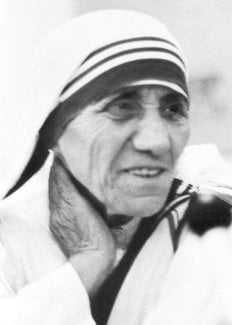
Mother Teresa was born Agnes Gonxha Bojaxhiu in Uskup, Ottoman Empire (now Skopje, North Macedonia), on August 26, 1910. Her family was of Albanian descent. At the age of twelve, she felt strongly the call of God. She knew she had to be a missionary to spread the love of Christ. At the age of eighteen she left her parental home in Skopje and joined the Sisters of Loreto, an Irish community of nuns with missions in India. After a few months’ training in Dublin she was sent to India, where on May 24, 1931, she took her initial vows as a nun. From 1931 to 1948 Mother Teresa taught at St. Mary’s High School in Calcutta, but the suffering and poverty she glimpsed outside the convent walls made such a deep impression on her that in 1948 she received permission from her superiors to leave the convent school and devote herself to working among the poorest of the poor in the slums of Calcutta. Although she had no funds, she depended on Divine Providence, and started an open-air school for slum children. Soon she was joined by voluntary helpers, and financial support was also forthcoming. This made it possible for her to extend the scope of her work.
On October 7, 1950, Mother Teresa received permission from the Holy See to start her own order, “The Missionaries of Charity”, whose primary task was to love and care for those persons nobody was prepared to look after. In 1965 the Society became an International Religious Family by a decree of Pope Paul VI.
Today the order comprises Active and Contemplative branches of Sisters and Brothers in many countries. In 1963 both the Contemplative branch of the Sisters and the Active branch of the Brothers was founded. In 1979 the Contemplative branch of the Brothers was added, and in 1984 the Priest branch was established.
The Society of Missionaries has spread all over the world, including the former Soviet Union and Eastern European countries. They provide effective help to the poorest of the poor in a number of countries in Asia, Africa, and Latin America, and they undertake relief work in the wake of natural catastrophes such as floods, epidemics, and famine, and for refugees. The order also has houses in North America, Europe and Australia, where they take care of the shut-ins, alcoholics, homeless, and AIDS sufferers.
The Missionaries of Charity throughout the world are aided and assisted by Co-Workers who became an official International Association on March 29, 1969. By the 1990s there were over one million Co-Workers in more than 40 countries. Along with the Co-Workers, the lay Missionaries of Charity try to follow Mother Teresa’s spirit and charism in their families.
Mother Teresa’s work has been recognised and acclaimed throughout the world and she has received a number of awards and distinctions, including the Pope John XXIII Peace Prize (1971) and the Nehru Prize for her promotion of international peace and understanding (1972). She also received the Balzan Prize (1979) and the Templeton and Magsaysay awards.
This autobiography/biography was written at the time of the award and first published in the book series Les Prix Nobel. It was later edited and republished in Nobel Lectures. To cite this document, always state the source as shown above.
Mother Teresa died on 5 September 1997.