Kofi A. Annan of Ghana, the seventh Secretary-General of the United Nations, is the first to be elected from the ranks of UN staff. His first five-year term began on 1 January 1997 …
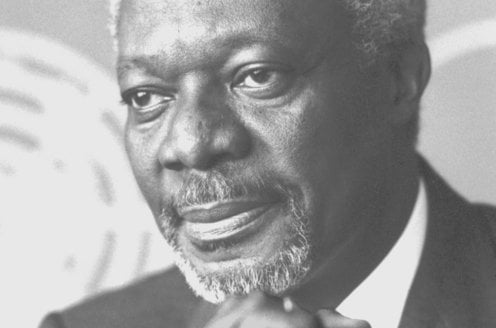
The United Nations was awarded the Nobel Peace Prize, jointly with Kofi Annan, for their work for a better organised and more peaceful world.
Full name: United Nations (UN)
Native name: United Nations
Founded: 1945, New York, NY, USA
Date awarded: 12 October 2001
Throughout its history, the Norwegian Nobel Committee has supported organised cooperation between nations. Therefore, it was not unexpected when the committee divided the Nobel Peace Prize between the UN and UN Secretary-General Kofi Annan in 2001, the centennial anniversary of the prize. Up to that date, the committee had honoured 13 laureates affiliated with the UN. In 1945, the UN replaced the League of Nations as a forum for ensuring world peace. Differences between the major powers prevented the establishment of a military force that could intervene when peace was broken. Instead, the organisation concentrated its efforts on eradicating poverty and promoting economic and social development. After 1970, human rights issues steadily gained importance within the UN.
“Over the hundred years that have passed since the first Peace Prize was awarded in 1901, the foremost sustained intention of the Norwegian Nobel Committee has been precisely that: of strengthening international co-operation between states.”
Gunnar Berge, Presentation Speech, 10 December 2001.
“Securing real and lasting improvement in the lives of individual men and women is the measure of all we do at the United Nations.”
– Kofi Annan, Nobel Prize lecture, 10 December 2001.
The 1948 Universal Declaration of Human Rights encompassed political and civil rights. Its scope was extended in 1966 with one covenant on political and civil rights and another on economic, social and cultural rights. In the 1980s, additional human rights legislation was introduced to safeguard the right to live in a sustainable society in ecological balance. The UN has also ratified conventions on women’s and children’s rights. This development clearly shows that the UN is becoming more concerned with conditions within nations than with relations between nations.
| Human rights Rights that apply to all persons regardless of gender, race, ethnicity, religious affiliation or nationality. The most important are the rights enshrined in the UN Declaration of Human Rights, adopted in 1948. |
| Ecology From the Greek oikos meaning house and logos meaning teaching. Environmental thinking. Knowledge of how processes in nature are interrelated and what the consequences will be if these processes are changed. |
In 2005, the UN dealt with a number of recommendations for the revitalisation of the organisation. In addition to restructuring the Security Council, there were calls for increased focus on efforts to combat poverty, pollution and the spread of infectious disease. Other priorities included implementing measures to stop the proliferation of weapons of mass destruction and international crime. There was also a demand that the war on terrorism be conducted with respect for human rights and international law.
| UN Security Council The only UN body empowered to take military action. Member states are under obligation to follow the Council’s resolutions. The Council has 15 members. The five permanent members – the USA, Russia, China, the United Kingdom and France – have veto rights. |
| Weapons of mass destruction Nuclear, chemical and biological weapons that can exterminate large human populations in a short amount of time. |
“The founding Charter of the United Nations talked of ‘the scourge of war.’ The task of finding ways to put an end to that scourge is as vital today as it was in 1945.”
James Robbins, BBC News, 22 December 2001.
Disclaimer: Every effort has been made by the publisher to credit organisations and individuals with regard to the supply of photographs. Please notify the publishers regarding corrections.
Kofi Annan was awarded the Nobel Peace Prize, jointly with the United Nations, for his work for a better organised and more peaceful world.
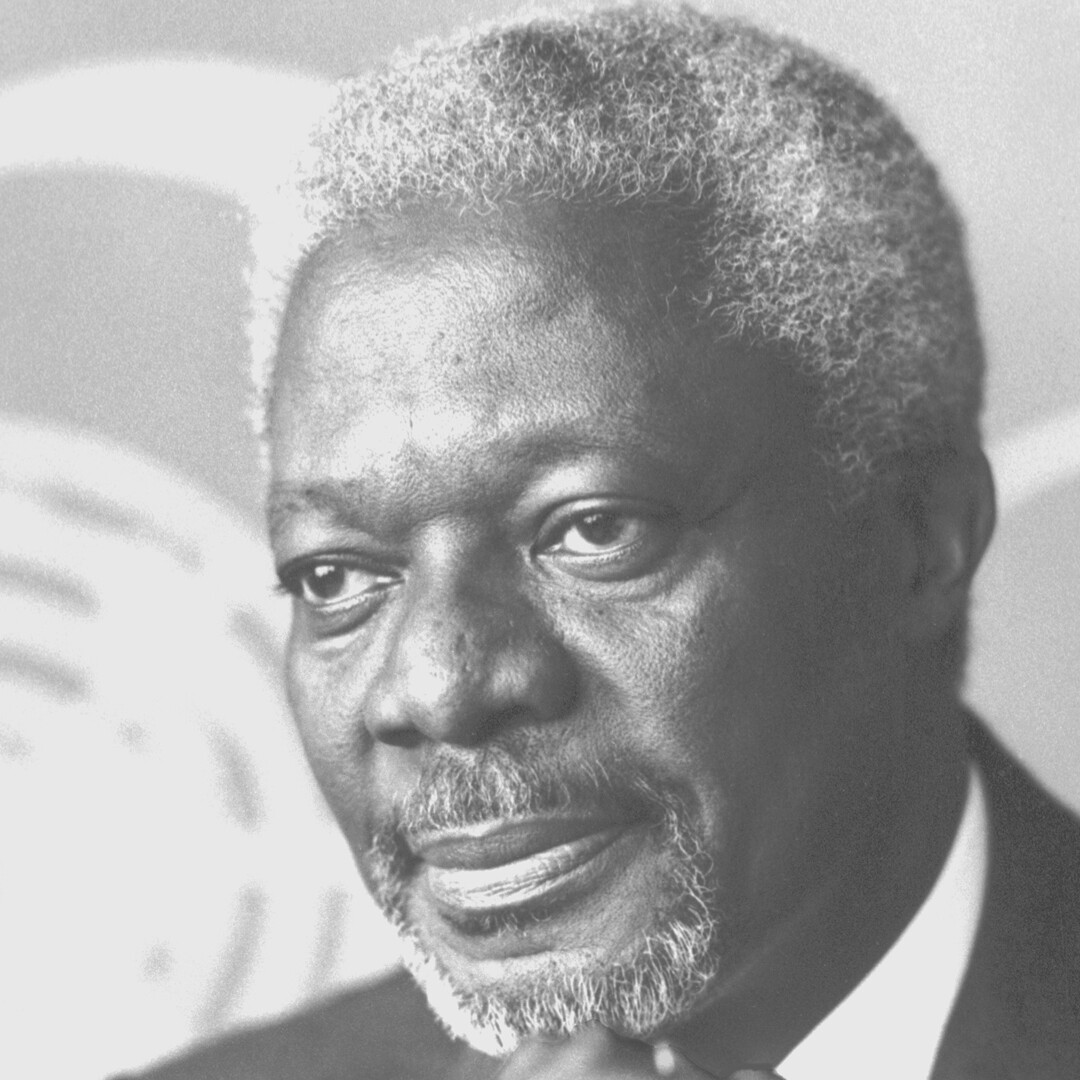
Full name: Kofi Atta Annan
Born: 8 April 1938, Kumasi, Gold Coast (now Ghana)
Died: 18 August 2018, Bern, Switzerland
Date awarded: 12 October 2001
In 2001, the centennial of the Nobel Peace Prize, the Norwegian Nobel Committee divided the prize between the United Nations (UN) and UN Secretary-General Kofi Annan. Its decision reflected a long-time practice of supporting organised cooperation between nations. Kofi Annan rose through the ranks of the UN. In 1993, he was appointed Undersecretary-General for peacekeeping operations, a position he held until 1997 when he became the seventh UN Secretary-General. Annan received the peace prize for revitalising the UN and placing priority on human rights issues. The committee also commended his efforts to stop the spread of the HIV virus and his condemnation of international terrorism.
| UN Secretary-General The top executive of the UN. Since 1945, the following have served as Secretary-General: Trygve Lie (Norway), Dag Hammarskjöld (Sweden), U-Thant (Burma), Kurt Waldheim (Austria), Javier Péres de Cuellar (Peru), Boutros Boutros-Ghali (Egypt), Kofi Annan (Ghana), Ban Ki-moon (South Korea), António Guterres, Portugal. |
“In this new century, we must start from the understanding that peace belongs not only to states or peoples, but to each and every member of those communities. The sovereignty of States must not longer be used as a shield for gross violations of human rights.”
Kofi Annan, Nobel Prize lecture, 10 December 2001.
With the support of UN employees, Annan succeeded in making the UN more efficient and acknowledged the need for further reform within the organisation. In response, the USA paid its debt to the UN. Annan believed that the Security Council ought to have a greater number of permanent members from different parts of the world and that the UN should close its doors to undemocratic nations. These suggestions were reviewed by a commission of 16 internationally prominent persons. In December 2004, they put forth their recommendations for organisational changes within the UN.
“Mr. Annan is the best secretary-general in the history of the UN.”
Richard Holbrooke, BBC News, 28 June 2001.
Kofi Annan’s ability to criticise his own actions was a sign of his good leadership skills. Former Prime Minister of Norway and WHO Director-General Gro Harlem Bruntland characterised him as a person who possesses “a tremendous power of persuasion.” Others were impressed by his “warmth and charm,” or described him as “gentle, yet effective.” In the autumn of 2001, Saudi Arabian terrorist Osama Bin Laden criticised Annan harshly. He called the peace laureate a “criminal” for his participation in the effort to gain East Timor’s independence from the Muslim world with the help of Australian “crusaders.”
| WHO World Health Organisation. The UN specialised organisation responsible for health issues. Founded in 1948. Its goal is to promote the best possible health for the world’s population. Headquartered in Geneva. |
“No one has done more than Kofi Annan to revitalize the UN.”
Gunnar Berge, Presentation Speech, 10 December 2001.
In his Nobel Prize lecture, Annan formulated three key priorities for the UN for the future: eradicating poverty, preventing conflict, and promoting democracy. He gave the following grounds for the priorities: “Only in a world that is rid of poverty can all men and women make the most of their abilities. Only where individual rights are respected can differences be channelled politically and resolved peacefully. Only in a democratic environment, based on respect for diversity and dialogue, can individual self-expression and self-government be secured, and freedom of association be upheld.”
As the head of the office of the UN Peacekeeping Forces, Kofi Annan shared the responsibility for the fact that the UN had not intervened to stop the massacre of over 800 000 people in Rwanda in 1994. A report from a 1999 inquiry seriously criticised Annan for ignoring warnings about the Tutsi genocide and for failing to take measures to stop the Hutu militia’s murderous rampage. Faced with the report’s conclusions, the Secretary-General had to offer a full apology.
Kofi A. Annan of Ghana, the seventh Secretary-General of the United Nations, is the first to be elected from the ranks of UN staff. His first five-year term began on 1 January 1997 …
Disclaimer: Every effort has been made by the publisher to credit organisations and individuals with regard to the supply of photographs. Please notify the publishers regarding corrections.
On Kofi Annan from United Nations’ homepage
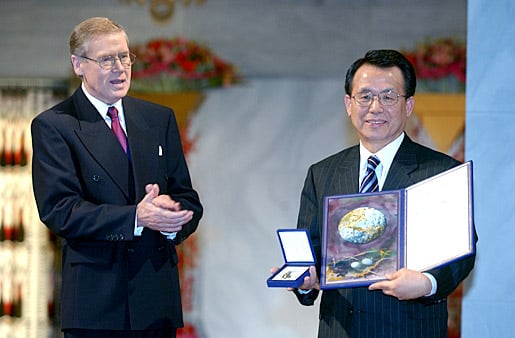
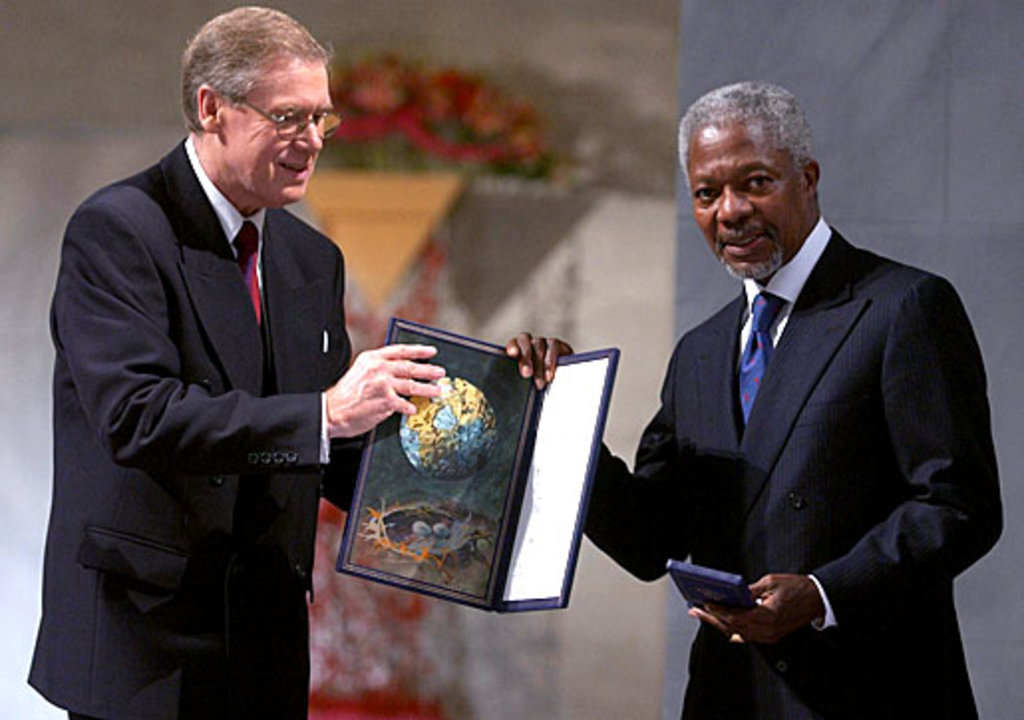
Han Seung-soo, President of the UN General Assembly, receiving the Nobel Peace Prize from Gunnar Berge, Chairman of the Norwegian Nobel Committee. © Pressens Bild AB 2001, SE-112 88 Stockholm, Sweden, telephone: +46 (0)8 738 38 00. Photo: Heiko Junge
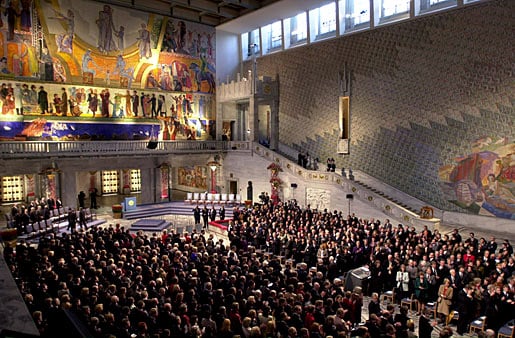
View of the Oslo City Hall during the Prize Award Ceremony on 10 December 2001, where the Nobel Peace Prize was awarded to the United Nations and its Secretary-General, Kofi Annan. Receiving the Prize on behalf of the UN was the President of the U.N. General Assembly, South Korean Foreign Minister Han Seung-soo.
© Pressens Bild AB 2001, SE-112 88 Stockholm, Sweden, telephone: +46 (0)8 738 38 00. Photo: Knut Fjeldstad
Kofi Annan and Han Seung-soo, President of the U.N. General Assembly, receiving their Nobel Prize medals and diplomas at the Nobel Peace Prize award ceremony at the Oslo City Hall in Norway, 10 December 2001. © Knudsens fotosenter/Dextra Photo, Norsk Teknisk Museum.
Han Seung-soo, President of the U.N. General Assembly, signing the guest book during his visit to the Norwegian Nobel Institute, December 2001. © Knudsens fotosenter/Dextra Photo, Norsk Teknisk Museum.
Han Seung-soo, President of the U.N. General Assembly, during a press conference at the Norwegian Nobel Institute, December 2001. © Knudsens fotosenter/Dextra Photo, Norsk Teknisk Museum.
Kofi Annan and Han Seung-soo, President of the U.N. General Assembly, viewing the traditional torch light procession in Oslo from a balcony at the Grand Hotel in Oslo, Norway, 10 December 2001. © Knudsens fotosenter/Dextra Photo, Norsk Teknisk Museum.


Kofi Annan receiving his Nobel Peace Prize from
Gunnar Berge, Chairman of the Norwegian Nobel
Committee, 10 December 2001.
© Pressens Bild AB 2001, SE-112 88 Stockholm, Sweden, telephone: +46 (0)8 738 38 00. Photo: Heiko Junge
View of the Oslo City Hall during the Prize Award Ceremony on 10 December 2001, where the Nobel Peace Prize was awarded to the United Nations and its Secretary-General, Kofi Annan. Receiving the Prize on behalf of the UN was the President of the U.N. General Assembly, South Korean Foreign Minister Han Seung-soo.
© Pressens Bild AB 2001, SE-112 88 Stockholm, Sweden, telephone: +46 (0)8 738 38 00. Photo: Knut Fjeldstad
Kofi Annan and Han Seung-soo, President of the U.N. General Assembly, receiving their Nobel Prize medals and diplomas at the Nobel Peace Prize award ceremony at the Oslo City Hall in Norway, 10 December 2001. © Knudsens fotosenter/Dextra Photo, Norsk Teknisk Museum.
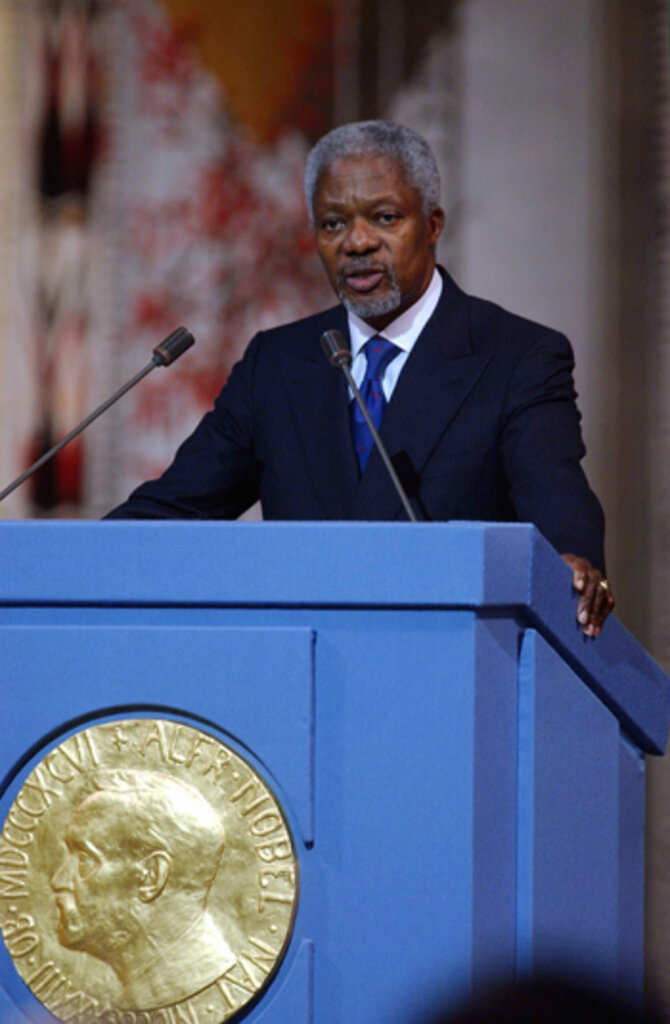
2001 Nobel Peace Prize Laureate Kofi Annan giving his Nobel Lecture at the Prize Award Ceremony in Oslo, 10 December.
Copyright © Pressens Bild AB 2001,
SE-112 88 Stockholm, Sweden, telephone: +46-8-738 38 00
Photo: Heiko Junge
Kofi Annan giving his Nobel Lecture. © Knudsens fotosenter/Dextra Photo, Norsk Teknisk Museum.
Kofi Annan during a press conference at the Norwegian Nobel Institute, December 2001. © Knudsens fotosenter/Dextra Photo, Norsk Teknisk Museum.
Kofi Annan signing the guest book during his visit to the Norwegian Nobel Institute, December 2001. © Knudsens fotosenter/Dextra Photo, Norsk Teknisk Museum.
Kofi Annan and his wife Nane watching photos of previous peace laureates in the Committee room at the Norwegian Nobel Institute in Oslo, Norway, December 2001. © Knudsens fotosenter/Dextra Photo, Norsk Teknisk Museum.
Kofi Annan and Han Seung-soo, President of the U.N. General Assembly, viewing the traditional torch light procession in Oslo from a balcony at the Grand Hotel in Oslo, Norway, 10 December 2001. © Knudsens fotosenter/Dextra Photo, Norsk Teknisk Museum.
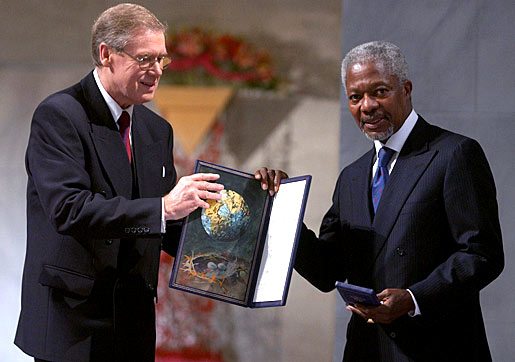


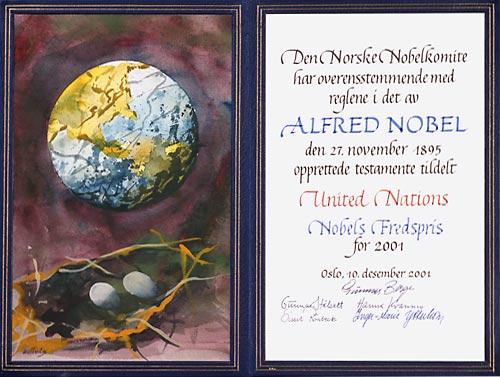
Copyright © The Nobel Foundation 2001
Artist: Håkon Gullvåg
Calligrapher: Inger Magnus
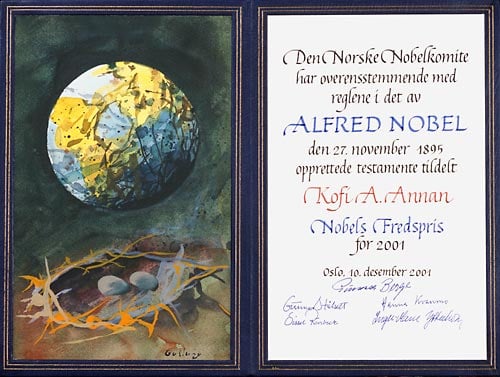
Copyright © The Nobel Foundation 2001
Artist: Håkon Gullvåg
Calligrapher: Inger Magnus
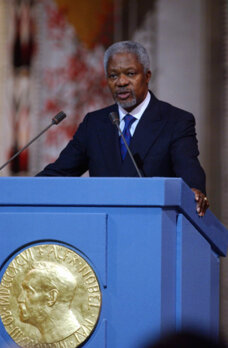
Kofi Annan giving his Nobel Prize lecture
© Pressens Bild AB. Photo: Heiko Junge
Nobel Lecture, Oslo, December 10, 2001
Your Majesties, Your Royal Highnesses, Excellencies,
Members of the Norwegian Nobel Committee, Ladies and Gentlemen,
Today, in Afghanistan, a girl will be born. Her mother will hold her and feed her, comfort her and care for her – just as any mother would anywhere in the world. In these most basic acts of human nature, humanity knows no divisions. But to be born a girl in today’s Afghanistan is to begin life centuries away from the prosperity that one small part of humanity has achieved. It is to live under conditions that many of us in this hall would consider inhuman.
I speak of a girl in Afghanistan, but I might equally well have mentioned a baby boy or girl in Sierra Leone. No one today is unaware of this divide between the world’s rich and poor. No one today can claim ignorance of the cost that this divide imposes on the poor and dispossessed who are no less deserving of human dignity, fundamental freedoms, security, food and education than any of us. The cost, however, is not borne by them alone. Ultimately, it is borne by all of us – North and South, rich and poor, men and women of all races and religions.
Today’s real borders are not between nations, but between powerful and powerless, free and fettered, privileged and humiliated. Today, no walls can separate humanitarian or human rights crises in one part of the world from national security crises in another.
Scientists tell us that the world of nature is so small and interdependent that a butterfly flapping its wings in the Amazon rainforest can generate a violent storm on the other side of the earth. This principle is known as the “Butterfly Effect.” Today, we realize, perhaps more than ever, that the world of human activity also has its own “Butterfly Effect” – for better or for worse.
Ladies and Gentlemen,
We have entered the third millennium through a gate of fire. If today, after the horror of 11 September, we see better, and we see further – we will realize that humanity is indivisible. New threats make no distinction between races, nations or regions. A new insecurity has entered every mind, regardless of wealth or status. A deeper awareness of the bonds that bind us all – in pain as in prosperity – has gripped young and old.
In the early beginnings of the 21st century – a century already violently disabused of any hopes that progress towards global peace and prosperity is inevitable — this new reality can no longer be ignored. It must be confronted.
The 20th century was perhaps the deadliest in human history, devastated by innumerable conflicts, untold suffering, and unimaginable crimes. Time after time, a group or a nation inflicted extreme violence on another, often driven by irrational hatred and suspicion, or unbounded arrogance and thirst for power and resources. In response to these cataclysms, the leaders of the world came together at mid-century to unite the nations as never before.
A forum was created – the United Nations – where all nations could join forces to affirm the dignity and worth of every person, and to secure peace and development for all peoples. Here States could unite to strengthen the rule of law, recognize and address the needs of the poor, restrain man’s brutality and greed, conserve the resources and beauty of nature, sustain the equal rights of men and women, and provide for the safety of future generations.
We thus inherit from the 20th century the political, as well as the scientific and technological power, which – if only we have the will to use them – give us the chance to vanquish poverty, ignorance and disease.
In the 21st Century I believe the mission of the United Nations will be defined by a new, more profound, awareness of the sanctity and dignity of every human life, regardless of race or religion. This will require us to look beyond the framework of States, and beneath the surface of nations or communities. We must focus, as never before, on improving the conditions of the individual men and women who give the state or nation its richness and character. We must begin with the young Afghan girl, recognizing that saving that one life is to save humanity itself.
Over the past five years, I have often recalled that the United Nations’ Charter begins with the words: “We the peoples.” What is not always recognized is that “we the peoples” are made up of individuals whose claims to the most fundamental rights have too often been sacrificed in the supposed interests of the state or the nation.
A genocide begins with the killing of one man – not for what he has done, but because of who he is. A campaign of ‘ethnic cleansing’ begins with one neighbour turning on another. Poverty begins when even one child is denied his or her fundamental right to education. What begins with the failure to uphold the dignity of one life, all too often ends with a calamity for entire nations.
In this new century, we must start from the understanding that peace belongs not only to states or peoples, but to each and every member of those communities. The sovereignty of States must no longer be used as a shield for gross violations of human rights. Peace must be made real and tangible in the daily existence of every individual in need. Peace must be sought, above all, because it is the condition for every member of the human family to live a life of dignity and security.
The rights of the individual are of no less importance to immigrants and minorities in Europe and the Americas than to women in Afghanistan or children in Africa. They are as fundamental to the poor as to the rich; they are as necessary to the security of the developed world as to that of the developing world.
From this vision of the role of the United Nations in the next century flow three key priorities for the future: eradicating poverty, preventing conflict, and promoting democracy. Only in a world that is rid of poverty can all men and women make the most of their abilities. Only where individual rights are respected can differences be channelled politically and resolved peacefully. Only in a democratic environment, based on respect for diversity and dialogue, can individual self-expression and self-government be secured, and freedom of association be upheld.
Throughout my term as Secretary-General, I have sought to place human beings at the centre of everything we do – from conflict prevention to development to human rights. Securing real and lasting improvement in the lives of individual men and women is the measure of all we do at the United Nations.
It is in this spirit that I humbly accept the Centennial Nobel Peace Prize. Forty years ago today, the Prize for 1961 was awarded for the first time to a Secretary-General of the United Nations – posthumously, because Dag Hammarskjöld had already given his life for peace in Central Africa. And on the same day, the Prize for 1960 was awarded for the first time to an African – Albert Luthuli, one of the earliest leaders of the struggle against apartheid in South Africa. For me, as a young African beginning his career in the United Nations a few months later, those two men set a standard that I have sought to follow throughout my working life.
This award belongs not just to me. I do not stand here alone. On behalf of all my colleagues in every part of the United Nations, in every corner of the globe, who have devoted their lives – and in many instances risked or given their lives in the cause of peace – I thank the Members of the Nobel Committee for this high honour. My own path to service at the United Nations was made possible by the sacrifice and commitment of my family and many friends from all continents – some of whom have passed away – who taught me and guided me. To them, I offer my most profound gratitude.
In a world filled with weapons of war and all too often words of war, the Nobel Committee has become a vital agent for peace. Sadly, a prize for peace is a rarity in this world. Most nations have monuments or memorials to war, bronze salutations to heroic battles, archways of triumph. But peace has no parade, no pantheon of victory.
What it does have is the Nobel Prize – a statement of hope and courage with unique resonance and authority. Only by understanding and addressing the needs of individuals for peace, for dignity, and for security can we at the United Nations hope to live up to the honour conferred today, and fulfil the vision of our founders. This is the broad mission of peace that United Nations staff members carry out every day in every part of the world.
A few of them, women and men, are with us in this hall today. Among them, for instance, are a Military Observer from Senegal who is helping to provide basic security in the Democratic Republic of the Congo; a Civilian Police Adviser from the United States who is helping to improve the rule of law in Kosovo; a UNICEF Child Protection Officer from Ecuador who is helping to secure the rights of Colombia’s most vulnerable citizens; and a World Food Programme Officer from China who is helping to feed the people of North Korea.
Distinguished guests,
The idea that there is one people in possession of the truth, one answer to the world’s ills, or one solution to humanity’s needs, has done untold harm throughout history – especially in the last century. Today, however, even amidst continuing ethnic conflict around the world, there is a growing understanding that human diversity is both the reality that makes dialogue necessary, and the very basis for that dialogue.
We understand, as never before, that each of us is fully worthy of the respect and dignity essential to our common humanity. We recognize that we are the products of many cultures, traditions and memories; that mutual respect allows us to study and learn from other cultures; and that we gain strength by combining the foreign with the familiar.
In every great faith and tradition one can find the values of tolerance and mutual understanding. The Qur’an, for example, tells us that “We created you from a single pair of male and female and made you into nations and tribes, that you may know each other.” Confucius urged his followers: “when the good way prevails in the state, speak boldly and act boldly. When the state has lost the way, act boldly and speak softly.” In the Jewish tradition, the injunction to “love thy neighbour as thyself,” is considered to be the very essence of the Torah.
This thought is reflected in the Christian Gospel, which also teaches us to love our enemies and pray for those who wish to persecute us. Hindus are taught that “truth is one, the sages give it various names.” And in the Buddhist tradition, individuals are urged to act with compassion in every facet of life.
Each of us has the right to take pride in our particular faith or heritage. But the notion that what is ours is necessarily in conflict with what is theirs is both false and dangerous. It has resulted in endless enmity and conflict, leading men to commit the greatest of crimes in the name of a higher power.
It need not be so. People of different religions and cultures live side by side in almost every part of the world, and most of us have overlapping identities which unite us with very different groups. We can love what we are, without hating what – and who – we are not. We can thrive in our own tradition, even as we learn from others, and come to respect their teachings.
This will not be possible, however, without freedom of religion, of expression, of assembly, and basic equality under the law. Indeed, the lesson of the past century has been that where the dignity of the individual has been trampled or threatened – where citizens have not enjoyed the basic right to choose their government, or the right to change it regularly – conflict has too often followed, with innocent civilians paying the price, in lives cut short and communities destroyed.
The obstacles to democracy have little to do with culture or religion, and much more to do with the desire of those in power to maintain their position at any cost. This is neither a new phenomenon nor one confined to any particular part of the world. People of all cultures value their freedom of choice, and feel the need to have a say in decisions affecting their lives.
The United Nations, whose membership comprises almost all the States in the world, is founded on the principle of the equal worth of every human being. It is the nearest thing we have to a representative institution that can address the interests of all states, and all peoples. Through this universal, indispensable instrument of human progress, States can serve the interests of their citizens by recognizing common interests and pursuing them in unity. No doubt, that is why the Nobel Committee says that it “wishes, in its centenary year, to proclaim that the only negotiable route to global peace and cooperation goes by way of the United Nations”.
I believe the Committee also recognized that this era of global challenges leaves no choice but cooperation at the global level. When States undermine the rule of law and violate the rights of their individual citizens, they become a menace not only to their own people, but also to their neighbours, and indeed the world. What we need today is better governance – legitimate, democratic governance that allows each individual to flourish, and each State to thrive.
Your Majesties,
Excellencies,
Ladies and Gentlemen,
You will recall that I began my address with a reference to the girl born in Afghanistan today. Even though her mother will do all in her power to protect and sustain her, there is a one-in-four risk that she will not live to see her fifth birthday. Whether she does is just one test of our common humanity – of our belief in our individual responsibility for our fellow men and women. But it is the only test that matters.
Remember this girl and then our larger aims – to fight poverty, prevent conflict, or cure disease – will not seem distant, or impossible. Indeed, those aims will seem very near, and very achievable – as they should. Because beneath the surface of states and nations, ideas and language, lies the fate of individual human beings in need. Answering their needs will be the mission of the United Nations in the century to come.
Thank you very much.
Watch a video clip of the 2001 Nobel Peace Prize Laureate, Kofi Annan, receiving his Nobel Prize medal and diploma during the Nobel Peace Prize Award Ceremony at the Oslo City Hall in Norway, 10 December 2001.