Frits Zernike – Photo gallery

1 (of 5) Fritz Zernike receives his Nobel Prize from Sweden’s King Gustaf VI Adolf on 10 December 1953.
Photo: Owe Sjöblom. Public domain, via Wikimedia Commons

2 (of 5) Fritz Zernike and Sweden’s Queen Louise at the Nobel Banquet, 10 December 1953.
Photo: Owe Sjöblom. Public domain, via Wikimedia Commons

3 (of 5) From left: Medecine laureate Fritz Lipmann with his wife Elfreda, physics laureate Frits Zernike and chemistry laureate Hermann Staudinger with his wife Magda at the Nobel Banquet, 10 December 1953.
Photographer unknown. Public domain, via Wikimedia Commons

4 (of 5) Frits Zernike with his invention, the phase contrast microscope, in 1953.
Courtesy of University of Groningen

5 (of 5) Frits Zernike with his son Frits Zernike Jr. at the Natuurkundig Laboratory, Groningen.
Photo: Piet Boonstra. Courtesy of University of Groningen.
Frits Zernike – Biographical
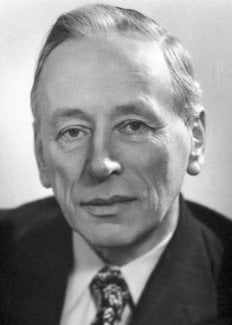
Frits Zernike was born in Amsterdam, 16th July 1888, as the second son in a family of six children. His father, Carl Frederick August Zernike, was teacher in mathematics and head of a primary school in Amsterdam, and was a highly gifted man having interests in many branches of science; he compiled numerous elementary books in a series of subjects, and had also articles on pedagogy to his credit. His mother, Antje Dieperink, was also a teacher of mathematics. One of his brothers also became a professor of physics, one of his sisters, married to the well-known painter Jan Mankes, was the first woman ordained in the Dutch Protestant Church, another sister is one of The Netherlands’ foremost literary figures.
Frits inherited his passion for physics from his father; as a boy he already possessed an arsenal of pots, crucibles, tubes, which he scraped together with his own pocket money, or received as gifts from understanding manufacturers. At the secondary school he excelled in the scientific subjects, and neglected topics such as history and languages, including Greek and Latin, for which later on he was obliged to pass a State matriculation test in order to be fully admitted to the University.
During these school years he devoted all his spare time to his endless experiments, entering also the realms of colour photography. His limited financial means forced him to synthesize his own ether which he required for his photographic experiments. Other results of his ingenuity were a photographic camera and a miniature astronomical observatory equipped with the clockwork of an old record player, which enabled him to take pictures of a comet. Together with his father and mother he also indulged in solving arduous mathematical problems.
He entered the University of Amsterdam in 1905, studying chemistry, with physics and mathematics as minor subjects. His early interest in mathematics appears from a prize essay on probabilities for which he obtained a gold medal of the University of Groningen in 1908. A more elaborate work on critical opalescence was similarly rewarded in 1912 by the Dutch Society of Sciences at Haarlem, which had as jury distinguished scientists of those days: Lorentz, Van der Waals, and Haga. When asked to choose between a gold medal and an amount of money, he wrote back that he preferred the money, since he had already enjoyed the privilege of receiving a gold medal. The prize essay later formed the basis of his doctor’s thesis (1915). In its theoretical part he applied Gibbs’ statistical mechanics and this formed the starting-point of years of fruitful collaboration with L.S. Ornstein, who worked in the same field.
In 1913 Kapteyn, the famous Professor of Astronomy at Groningen University, invited him to be his assistant. In 1915 he got his first university teaching post, not in chemistry, not in astronomy, but as successor of Ornstein as lecturer in mathematical physics at Groningen, where he was made a full professor in 1920. His papers on statistics include a paper with J.A. Prins, introducing the g-function for the correlation of the position of two molecules in a liquid, an extensive article in the Geiger and Scheel handbook, and an approximation method in the order-disorder problem (1940). Of his experimental work, the sensitive galvanometer, manufactured since 1923 by Kipp and Sons, Delft, is well known. From 1930 on he turned to optics, developed phase contrast, wrote on imaging errors of the concave grating and on partial coherence. With the collaboration of his pupils he solved the problem of the influence of lens aberrations on the diffraction pattern at a focus (1938-1948)
It is interesting to know that his great discovery of the phase-contrast phenomenon, which he discovered one evening in 1930 in his totally blackpainted optical laboratory, did not immediately receive the attention it deserved. The world-famous Zeiss factories at Jena completely underestimated the value of his phase-contrast microscope. It was not until the German Wehrmacht took stock of all inventions which might serve in the war that at last (in 1941) the first phase-contrast microscopes were manufactured. The grotesque situation thus arose that the German war machinery helped to develop on an industrial scale Professor Zernike’s long-neglected invention while its inventor, like his fellow-countrymen, suffered under the oppression by the same German powers during the occupation of the Netherlands. After the war, other firms also took up the production of many thousands of phase-contrast microscopes, thereby providing the service to science, and in particular to medicine, which should have been effectuated some twenty years earlier.
Zernike’s achievements were recognized by the Royal Microscopical Society; he was also awarded the Rumford Medal of the Royal Society (London) and an honorary doctorate in Medicine from the University of Amsterdam.
Zernike married twice. His first wife, Dora van Bommel van Vloten, died in 1945; they had one son. In 1954 he married Mrs. L. Koperberg-Baanders. After his retirement from Groningen University they moved to Naarden, a town in the countryside near Amsterdam.
This autobiography/biography was written at the time of the award and first published in the book series Les Prix Nobel. It was later edited and republished in Nobel Lectures. To cite this document, always state the source as shown above.
Frits Zernike died on March 10, 1966.
Frits Zernike – Nobel Lecture
Nobel Lecture, December 11, 1953
How I Discovered Phase Contrast
Read the Nobel Lecture
Pdf 56 kB
Frits Zernike – Documentary
Frits Zernike – Nominations
Frits Zernike – Facts
Award ceremony speech
Presentation Speech by Professor E. Hulthén, member of the Nobel Committee for Physics
Your Majesty, Your Royal Highnesses, Ladies and Gentlemen.
The Royal Academy of Sciences has this year awarded the Nobel Prize for Physics to Professor Frits Zernike, Groningen, for the phase-contrast method devised by him, and particularly for his invention of the phase-contrast microscope.
Zernike’s discovery falls within that part of optics in which one operates with the notion of light as a wave motion. From this it follows, amongst other things, that light may be extinguished by light through interference, and is diffracted and scattered by small particles such as the microscopic objects. All this, as far as the principles involved are concerned, belongs to a closed chapter that is generally referred to as classical physics.
When on this occasion a Nobel Prize is awarded for contributions in classical physics, the fact is so remarkable that we must go back to the very earliest Nobel Prizes to find a counterpart. All later Nobel Prizes, with the exception of a couple of awards where the stress was rather upon the technical aspect, have been awarded for discoveries in atomic and nuclear physics, the physics of this century.
It would scarcely be an exaggeration to claim that the microscope is one of our most important instruments of research. Every improvement, even a slight sharpening of this eye towards the microcosmos, may pave the way to great advances in the natural sciences, medicine, and the technical sciences.
Probably no other instrument has been the object of so much technical and theoretical study as the microscope. The thorough theoretical foundation that we owe to the genius of Ernst Abbe of the famous Zeiss concern was followed at the end of the last century by a development of the microscope that brought its optical and illumination system very close to perfection.
But even Abbe’s theory had a gap, for it took into account only those conditions in which the microscopic objects appear against the background as a result of their contrasts in colour and intensity. Many microscopic objects, however, micro-organisms such as bacteria and cells, are colourless and transparent, and for this reason difficult to distinguish from their surroundings. Attempts have been made to overcome this difficulty with various methods of staining or with a special illumination system, the so-called darkfield illumination. The staining methods are not always suitable, as for example when we are dealing with living objects; and dark-field illumination easily leads to a misinterpretation of the finer details in the structural picture.
It was this gap in Abbe’s theory that in the 1930’s led Zernike to re-investigate the refraction processes in the light that give rise to the image in a microscope. Even if the eye is not able to discern the change undergone by a beam of light when it passes through a transparent object, the change does nonetheless exist as a phase-difference of a quarter of a wavelength relative to the direct beam that does not pass through the object. The problem was thus to transform these otherwise imperceptible phase differences to visible contrasts in intensity. Zernike was able to show that this was possible, thanks to the fact that the two rays of light take different routes through the microscope before being reunited in the image. By interposing in the paths of the direct ray a so-called “phase-plate” which either further increases the phase-displacement to half a light-wavelength or smooths it out completely, Zernike attained the desired effect, so that the two rays either extinguish or reinforce each other. In this way the formerly invisible particle appears in dark or light contrast to the surroundings.
I have deliberately dwelt upon the description of the phase-contrast microscope as the result of Zernike’s method which is, so far, the most valuable. The phase-contrast method has, however, many other and increasingly important applications in optics. In addition to its capacity to render colourless and transparent objects visible in the microscope, it also enables one to detect slight flaws in mirrors, telescope lenses, and other instruments indispensable for research. In this connection, Zernike’s phase-plate serves as an indicator which locates and measures small surface irregularities to a fraction of a light-wavelength. This sharpness of depth is so great that it penetrates to the point at which the atomic structure of the substance begins to become manifest.
Professor Zernike. The Royal Academy of Sciences has awarded you the Nobel Prize in Physics for your eminent “method of phase contrast” and especially for your invention of the “phase-contrast microscope”.
I now ask you to receive the prize from the hands of His Majesty.
The Nobel Prize Award Ceremony 1953
While the rain poured down outside on a gloomy afternoon in Stockholm, 10 December 1953, inside the Stockholm Concert Hall the lights glittered on a festively dressed audience including the Swedish Royal family: King Gustaf VI Adolf, Queen Louise, Princesses Sibylla and Margaretha and Prince Bertil. The Nobel Laureates entered the scene. After Birger Ekeberg delivered his presentation speech, each Nobel Laureate was introduced and the Prize awarded. Professor Erik Hultén introduced the Physics Nobel Laureate, Frits Zernike; the Chemistry Nobel Laureate, Hermann Staudinger, was introduced by Professor Arne Fredga; Professor Einar Hammarsten introduced the Nobel Laureates in Physiology or Medicine, Hans Krebs and Fritz Lipmann; and author Sigfrid Siwertz spoke for the absent Nobel Laureate in Literature, Sir Winston Churchill; Lady Clementine Churchill received the Nobel Prize on behalf of her husband.