Sir William Ramsay – Other resources
Links to other sites
On William Ramsay from The Chemical Heritage Foundation
The Life of Sir William Ramsay from University College London
Sir William Ramsay – Nominations
Sir William Ramsay – Photo gallery

1 (of 1) William Ramsay working.
Public domain via Wikimedia Commons Photographer unknown
Sir William Ramsay – Biographical
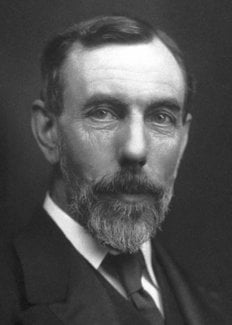
William Ramsay was born in Glasgow on October 2, 1852, the son of William Ramsay, C.E. and Catherine, née Robertson. He was a nephew of the geologist, Sir Andrew Ramsay.
Until 1870 he studied in his native town, following this with a period in Fittig’s laboratory at Tübingen until 1872. While there his thesis on orthotoluic acid and its derivatives earned him the degree of doctor of philosophy.
On his return to Scotland in 1872 he became assistant in chemistry at the Anderson College in Glasgow and two years later secured a similar position at the University there. In 1880 he was appointed Principal and Professor of Chemistry at University College, Bristol, and moved on in 1887 to the Chair of Inorganic Chemistry at University College, London, a post which he held until his retirement in 1913.
Ramsay’s earliest works were in the field of organic chemistry. Besides his doctor’s dissertation, about this period he published work on picoline and, in conjunction with Dobbie, on the decomposition products of the quinine alkaloids (1878-1879). From the commencement of the eighties he was chiefly active in physical chemistry, his many contributions to this branch of chemistry being mostly on stoichiometry and thermodynamics. To these must be added his investigations carried on with Sidney Young on evaporation and dissociation (1886-1889) and his work on solutions of metals (1889).
It was however in inorganic chemistry that his most celebrated discoveries were made. As early as 1885-1890 he published several notable papers on the oxides of nitrogen and followed those up with the discovery of argon, helium, neon, krypton, and xenon. Led to the conclusion by different paths and, at first, without working together, both Lord Rayleigh and Sir William Ramsay succeeded in proving that there must exist a previously unknown gas in the atmosphere. They subsequently worked in their separate laboratories on this problem but communicated the results of their labours almost daily. At the meeting of the British Association in August 1894, they announced the discovery of argon.
While seeking sources of argon in the mineral kingdom, Ramsay discovered helium in 1895. Guided by theoretical considerations founded on Mendeleev’s periodic system, he then methodically sought the missing links in the new group of elements and found neon, krypton, and xenon (1898).
Yet another discovery of Ramsay (in conjunction with Soddy), the importance of which it was impossible to foresee, was the detection of helium in the emanations of radium (1903).
With regard to the scientific honours which – besides the Nobel Prize have been awarded to Ramsay, mention can be made of a great number of honorary memberships, viz. of the Institut de France, the Royal Academies of Ireland, Berlin, Bohemia, The Netherlands, Rome, Petrograd, Turin, Roumania, Vienna, Norway and Sweden; the Academies of Geneva, Frankfurt and Mexico; the German Chemical Society; the Royal Medical and Chirurgical Society of London; the Académie de Médecine de Paris; the Pharmaceutical Society, and the Philosophical Societies of Manchester, Philadelphia and Rotterdam. He also received the Davy and Longstaff Medals, honorary doctorate of Dublin University, the Barnardo Medal and a prize of $ 5,000 from the Smithsonian Institution, a prize of Fr. 25,000 from France (together with Moissan), and the A.W. Hoffmann Medal in gold (Berlin, 1903). He was created K.C.B.(Knight Commander of the Order of Bath) in 1902, and was also a Knight of the Prussian order “Pour le mérite”, Commander of the Crown of Italy, and Officer of the Legion d’Honneur of France.
In 1881 Ramsay married Margaret, the daughter of George Stevenson Buchanan. They had one son and one daughter. His recreations were languages and travelling.
Sir William Ramsay died at High Wycombe, Buckinghamshire, on July 23, 1916.
This autobiography/biography was written at the time of the award and first published in the book series Les Prix Nobel. It was later edited and republished in Nobel Lectures. To cite this document, always state the source as shown above.
The Nobel Foundation's copyright has expired.Sir William Ramsay – Nobel Lecture
Nobel Lecture, December 12, 1904
The Rare Gases of the Atmosphere
The discoveries which have gained for me the supreme honour of the Nobel Prize for Chemistry appear to me to have been the result of causes only partially within my control; and as it is one of the rules of the Academy, of which I have to thank you for admitting me to the membership, to require a curriculum vitae, it has appeared to me not inopportune if, in giving a sketch of my work on the rare gases of the atmosphere, I trace the sequence of events which led to their investigation.
My grandfather on my father’s side, William Ramsay, was a chemical manufacturer in Glasgow; he came of a long line of dyers, who carried on their work in Haddington, a small country town in the east of Scotland. He was the first, I believe, to distil wood for the production of pyroligneous acid; and he purified it by “torrefying” the acetate of lime formed by its neutralization, and distilling with oil of vitriol. He also was the first to manufacture bichrome; and for many years, he and his partners, the Messrs. Turnbull, made “Turnbull’s blue”.
My mother’s father was a medical man, practising in Edinburgh. He was the author of a series of textbooks for medical students, one of which was entitled Colloquia Chymica. Hence, I inherited the taste for chemistry from my ancestors on both sides of the family.
While I was an assistant in Glasgow University, in 1879, it occurred to me that an easy method of determining the volumes of liquids at their boiling points and consequently their molecular volumes would be to use their own vapours, coming from the liquids boiling under atmospheric pressure, as a means of securing the desired temperature. A simple modification of this plan made it possible to obtain a range of temperatures by altering the pressure under which the liquid boiled. This device led to a study of the critical phenomena of liquids; for by employing vapours as heating agents, great uniformity of temperature could be secured. In this work, which was carried out at Bristol, where I was Professor of Chemistry from 1880 till 1887, my assistant and collaborator was Sydney Young. On my removal to London in that year, the problem of the adiabatic behaviour of liquids and gases suggested itself; the ratio of the specific heat at constant volume to that at constant pressure was measured in the year 1892, with the assistance of Dr. E. Perman; but an account of the results was not published till 1896; the method employed, that of Kundt and Warburg, gave adiabatic curves for ethyl ether, both in the liquid and the gaseous state.
Before leaving Bristol, I had carried out some experiments in connection with the combination of gaseous nitrogen with hydrogen and with oxygen, with the aid of platinum as a catalysing agent; the results of the research were negative, and were not published. But I must have read the well-known account of Cavendish’s classical experiment on the combination of the nitrogen and the oxygen of the air at that date; for in my copy of Cavendish’s life, published by the Cavendish Society in 1849, opposite his statement that on passing electric sparks through a mixture of nitrogen with excess of oxygen, he had obtained a small residue, amounting to not more than 1/125th of the whole, I find that I had written the words “look into this “. It must have been the latent memory of this circumstance which led me, in 1894, to suggest to Lord Rayleigh a reason for the high density which he had found for “atmospheric nitrogen”.
With the discovery and properties of argon I do not propose to deal. Hence, I pass on to the discovery of terrestrial helium and of its congeners.
One of the most characteristic properties, or rather want of properties of argon is its forming no compounds; a circumstance which led to the choice of its name. It had been observed by Dr. Hillebrand, one of the chemists to the Geological Survey of the United States, that certain minerals, notably those containing uranium, gave off a gas when heated with dilute sulphuric acid. I was told recently that the investigators of this gas observed in its spectrum certain unknown lines; but they were deterred by the criticism of their colleagues from attaching much importance to the observation. The spectrum contained the usual bands of nitrogen, and they contended themselves with chronicling this observation. The evolution of this gas from a rare mineral struck me as likely to afford a clue to the direction in which to seek for a compound of argon; for it appeared not unlikely that the gas examined by Hillebrand might turn out to be argon, mixed with nitrogen. But on examining the gas, a brilliant yellow line was observed, nearly, though not quite identical in position with the double line of sodium. Reference to a list of spectrum lines established the coincidence of the new line with a line which had been first observed in the solar spectrum by P.J.C Janssen, during an eclipse of the sun, to observe which an expedition had been sent to India in 1868. It was suspected by Frankland and Lockyer that the line was due to hydrogen; but no means was found of causing that element to show such a line. They therefore came to the conclusion that it must be due to the presence in the solar atmosphere of an element unknown on the earth; and they gave it the name “helium”, to suggest its solar origin. Shortly afterwards, Langlet, working in Cleve’s laboratory, discovered helium independently.
Helium, like argon, is a gas, sparingly soluble in water, withstanding the action of oxygen in presence of caustic soda, under the influence of the electric discharge, as well as of red-hot magnesium. Like argon, the ratio of its specific heat at constant volume to that at constant pressure shows it to be a monatomic element, the atom and the molecule being the same; and its density was found both by Langlet and myself to be nearly 2; it is therefore the lightest gas known, with the exception of hydrogen. These properties in common made it evident that helium and argon belong to the same natural family; and it was also obvious that there must exist at least three other elements of the same class; this is evident on inspection of the periodic table where the following elements are in apposition: In the belief that these elements would be discovered, I predicted, in the Presidential Address which I gave to the Chemical Section of the British Association when it met in Canada in 1897, the discovery of ” a new element”. I thought it well to be on the safe side; and the necessity of an element with the atomic weight 20 was evident, although it might have been maintained with almost equal probability that two other awaited discovery.
Dr. Travers, then my assistant, now my successor in the Bristol chair, was kind enough to lend his help in the search for this new gas. We made a plan of campaign which was strictly adhered to, and which resulted in success. First, we investigated the gases evolved from every mineral which we could obtain; and the authorities of the British Museum were so good as to place a large number of specimens at our disposal. Second, various meteorites were heated, and their gases examined spectroscopically, after removing those gases which could be induced to enter into combination. Third, Dr. Travers and I made an expedition to Cauterets in the Pyrenees, and I collected gases from the hot springs in Iceland, and in addition, gases from various English and Scottish mineral springs were investigated. Fourth, about four litres of helium were prepared from fergusonite; and this gas was fractionally diffused during about three months, in the hope of obtaining heavier fractions, which might contain the looked-for gases; for they would certainly betray themselves by their spectra, if present. Fifth, a similar set of diffusions was carried out with argon, though not to the same extent; for by that time we had other facilities. Sixth, about 15 litres of argon was prepared, with the intention of submitting it to fractional distillation; for, in the meantime, Dr. Hampson was working at his excellent machine for liquefying air, and he kept me informed of his progress.
The carrying out of this long programme occupied me a large part of the years 1896 and 1897; the 15 litres of argon was prepared after Christmas, 1897. The results of these attempts to detect a new gas may be disposed of in a few words. First, those minerals which contain the elements uranium and thorium yielded helium in small quantity; but in no case were we certain of a new line in the spectrum of that element, with which, it may be remarked, we became almost painfully familiar. The only mineral which yielded a gas containing argon was malacone, a silicate of zirconium. Second, only one meteorite, from Augusta County, Virginia, U.S.A., gave inactive gases; both argon and helium were found. Third, the Cauterets gases contained both helium and argon; but although they were fractionated, nothing new could be discovered. It has since turned out, however, that the water from the Bath springs contains neon. Fourth, the diffusion of helium yielded a small residue in which only the familiar lines of argon could be detected; but again, the use of liquid hydrogen has made it possible to cool a large quantity of helium to a very low temperature, and the condensed portion has been found to exhibit the spectrum of krypton. Fifth, the diffusion of argon resulted in the accumulation of two fractions, one of which was slightly more dense than the other; and this, although we now know that the difference must have been due to errors of experiment, afforded us at the time a little encouragement.
While the 15 litres of argon was being purified, Dr. Hampson had succeeded in perfecting his machine; and he placed at our disposal about a litre of liquid air. After “playing” with it, so as to familiarize ourselves with its properties, there remained in the vessel about 100 cubic centimetres. I suggested that we should allow this portion to evaporate almost entirely away, and that we should collect the last 10 cubic centimetres by allowing it to boil off into a gas-holder. This was done; and after removal of oxygen and nitrogen, there remained 26 cubic centimetres of a gas which showed, besides the spectrum of argon, a bright yellow and a bright green line, of wavelengths 5571 and 5570.5, respectively. Although the density of the new gas, which we named “krypton” or “hidden” was found to be only 22.5, we conjectured that, when purified, it would turn out to be forty times as heavy as hydrogen, implying the atomic weight 80, for our early experiments established the fact that, like argon, its molecular and atomic weights were identical.
An account of this discovery was communicated to the Royal Society on June 3rd, 1898; and no time was lost in examining the argon by liquefaction and fractional distillation. On June 13th, we were able to announce that the lower boiling portions of the 15 litres of argon contained a gas which we called “neon ” or “new”; it showed a spectrum characterized by a brilliant flame-coloured light, consisting of many red, orange, and yellow lines. A preliminary determination of its density yielded the number 14.7, and after one fractionation, the density decreased to 13.7. We were at this time misled in supposing that a second gas was present, showing a spectrum different from that of argon, but possessing almost the same density; we regarded it as bearing to argon the same relation as that of nickel to cobalt; and we christened it “metargon”. This gas subsequently turned out to be argon in the main, but to contain carbon monoxide, owing to the use of an impure specimen of phosphorus containing carbon in removing the oxygen; but it gave us a great deal of trouble to make sure that it was not a new individual.
Kellas, working in my laboratory, and Schloesing, in Paris, had independently determined the amount of argon in the air; they found almost identical numbers – 0.01183 (Schloesing) and 0.01186 (Kellas) part by volume in 1 part of “atmospheric” nitrogen.
The separation of the lighter and heavier gases from argon gave occasion for a re-determination of the density of argon, using a pure sample. While the crude argon prepared by withdrawing the nitrogen from “atmospheric” nitrogen by the electric flame was found to have the density 19.94, and by the use of red-hot magnesium 19.941, the density of the purified sample gave the number 19.95. The refractivity, however, shows a greater difference; for the admixture of helium and neon in the crude sample lowers the refractivity from 0.9665 for the pure gas to 0.961 or 0.960.
In September, 1898, the discovery of another gas was announced; it was separated from krypton by fractionation, and possessed a still higher boiling point. We named it “xenon” or the “stranger”. And during the next two years, Travers and I prepared a larger quantity of these gases, and purified them by fractionation; while Baly erected an apparatus for the accurate determination of the wavelengths of their spectral lines.
We procured from the “Brin” Oxygen Company one of Hampson’s airliquefiers, and from the Whitehead Torpedo Company, one of their compressors; the latter was driven electrically, by means of a S-horse-power motor. The motor has since been replaced by a more powerful one; but the compressor and liquefier have given no trouble, and still work as satisfactorily as when first purchased. In ten minutes after starting, without any preliminary cooling, liquid air begins to run; and the yield is over a litre an hour. By help of this machine, air was so fractionated as to furnish portions rich in the gases which we wished to investigate. The process was as follows. The air-liquefier furnished a supply of liquid air; the gas escaping from the liquefier consisted largely of nitrogen; this mixture was liquefied under pressure in a bulb cooled by the liquid air boiling under reduced pressure. When the bulb had been filled with liquid nitrogen, a current of air was blown through the liquid until some of the gas had evaporated. That gas was collected separately, and deprived of oxygen by passage over red-hot copper; it contained the major part of the neon and helium present in the air. The remainder of the nitrogen was added to the liquid air used for cooling the bulb in which the nitrogen was condensed. Having obtained a considerable quantity of this light nitrogen, it was purified from that gas in the usual manner, and the argon containing neon and helium was fractionated. By fractional distillation, it was possible to remove the greater portion of the helium and neon from this mixture of gases, leaving the argon behind.
The air used in these fractionations was allowed to evaporate in vacuum vessels, during the operations; but care was always taken to save the dregs, and collect them in a gas-holder. In this way, a large quantity of the heavier portions of the air was accumulated; we estimated the quantity of air thus concentrated as not less than 30 litres of liquid. After removal of oxygen and nitrogen, the argon was separated for the most part by fractional distillation, and the residue of crude krypton and xenon purified by repeated fractionation. While krypton has a considerable vapour pressure at the temperature of boiling air, the vapour pressure of xenon is hardly appreciable; hence their separation, although tedious, presented no particular difficulty.
It was otherwise with neon. It soon transpired that the neon was contaminated with helium, and many attempts were made to effect a separation, before they were crowned with success. Among these, was fractional solution in oxygen, followed by a systematic diffusion of the two gases; but it was not found possible to raise the density of the neon above the number 9-16, and its spectrum still showed helium lines. Neither neon nor helium can be liquefied by cooling with liquid air, and it soon became evident that without the aid of liquid hydrogen, no further progress could be made.
Dr. Travers therefore undertook, with the assistance of Mr. Holding, the laboratory mechanic, to construct an apparatus for liquefying hydrogen; and in doing this, he had to start from first principles, for no account had been published of the process. After two months’ work, a machine was produced, in which the hydrogen, after preliminary cooling with liquid air, entered a chamber in which air boiled at low pressure, at a temperature of -205°. This degree of cold was sufficient to carry it below the critical temperature for the development of the positive Joule-Thomson effect; so that, when it was allowed to expand, after traversing a regenerative coil it ran out in the liquid form.
With this powerful agent to help us, the separation was effected in less than an hour. The mixture of helium and neon, compressed into a bulb cooled with liquid hydrogen, deposited the neon in the liquid, or more probably in the solid state; the vapour pressure of liquid neon at that low temperature is not more than 17 millimetres of mercury; while helium is permanently gaseous. It was easy, therefore, to purify the neon from helium; though it would have been a difficult task to purify the helium from neon.
That these are all monatomic gases was proved by determining the ratio of their specific heats by Kundt’s method; and accurate determinations were made of their refractivities, their densities, their compressibilities at two temperatures, 11.2° and 237.3°; and the vapour pressures of argon, krypton, and xenon were determined, as well as their volumes at their boiling points, in the liquid state. The critical temperatures and pressures of the last three were also determined. It may be stated in general terms that these gases show a regular gradation of properties, from helium to xenon; and that they fill the gaps in the periodic table below and above argon, with the atomic weights: neon, 20; krypton, 82; and xenon, 128.
The amounts of neon and helium in air have since been measured; the former is contained in air in the proportion of I volume in 81,000; the latter, I volume in 245,000; the amounts of krypton and xenon are very much smaller – not more than 1 part of krypton by volume can be separated from 20,000,000, of air; and the amount of xenon in air by volume is not more than 1 part in 170,000,000.
In June, 1903, Mr. Baly published an account of his determination of the wavelengths of the lines in the spectra of neon, krypton, and xenon, photographed by help of a concave Rowland’s grating of ten feet radial curvature. In all, the positions of 2,400 lines were accurately measured.
The discovery that uranium emits “rays” capable of discharging an electroscope and impressing a photographic plate, made in 1896, was followed by the separation from pitchblende, the chief ore of uranium, of that remarkable element, radium, by Madame Curie, in 1898. In 1899, Giesel and Meyer and Schweidler in Germany and Austria, and Becquerel and P. Curie in France, found almost simultaneously that certain rays from radium, later called the b-rays, could be deviated by a magnetic field; and these rays have since been shown to be identical with the cathode rays, proceeding from the cathode of a highly exhausted tube. These rays possess great penetrating power, for they pass through considerable thicknesses of metal without absorption. It was not till 1900 that Madame Curie threw out the suggestion that the a-rays, which were stopped by small thicknesses of metal or glass, proceeding from polonium, might be of the nature of small particles, projected with great velocity, but which lost their energy in passing through matter. Strutt, in 1901, made the same suggestion for the a-rays from radium, which are not deviable except in a very powerful magnetic field. Rutherford, in 1902, determined the deviation of these rays in a known magnetic field, and also in an electrostatic field, and arrived at an estimate of the value of the ratio of mass to electric charge for each particle; and on the supposition that the charge is the same as that carried by an ion of say hydrogen, he arrived at an estimate of the mass of each particle. Calculation showed it to approximate to twice that of an atom of hydrogen.
After Schmidt and Madame Curie’s discovery in 1898 that compounds of thorium and the minerals containing it possessed properties similar to those of uranium, Owens found that the power of discharging an electroscope could be greatly modified by blowing a current of air over the specimen. And in I900, Rutherford proved that this was due to the fact that the thorium evolves a radioactive gas. This gas was investigated by Rutherford and Soddy, who made numerous experiments with the view of elucidating its chemical nature. They found that it resisted the action of all oxidizing agents, and also of magnesium at a red heat. From these observations they concluded that the emanation “is an inert gas, analogous in nature to the members of the argon family”. The emanation was found to decompose after a few minutes, losing its radioactivity, while it evolved rays a large proportion of which was of the kind termed a, and bearing in mind that the mass of the a-particle was probably of the same magnitude as that of helium, and also recalling the observation that those minerals which yield helium when heated almost invariably contain uranium or thorium or both, they continued: “The speculation naturally arises whether the presence of helium in minerals and its invariable association with radium and thorium may not be connected with their radioactivity.”
Mr. Soddy came to work in my laboratory in the spring of 1903; and we at once began to investigate the properties of the radium emanation; for its life is so much longer than that of the thorium emanation (in the proportion 463,000 to 87) that it is possible to deal with it by ordinary physical methods. The emanation from about 60 milligrams of radium bromide was collected during eight days; it was introduced into a minute measuring tube, and its volume determined; it was found to be a self-luminous gas, obeying Boyle’s law ; and its volume slowly contracted during four weeks, until at the end of that time only the smallest visible bubble remained, which nevertheless still appeared as a brilliant speck of light; and on heating the tube which had contained the gas, a gas was evolved from the walls, possessing three and a half times the volume of the emanation, which showed the spectrum of helium. It had doubtless been projected with a velocity considerable enough to cause the molecules to imbed themselves in the glass of tube, from which they were expelled at a red heat.
Other experiments showed that it is easy, by heating a radium salt which has been prepared for some time, to expel the helium which has accumulated; this result has been repeatedly confirmed, not only by Mr. Soddy and myself, but also by other observers.
Much work remains to be done on these emanations. In conjunction with Dr. Collie, my colleague, the spectrum of the radium emanation has been mapped. It resembles generally speaking those of the inert gases; and although its density has not been accurately determined, it appears to be approximately 80, which would imply a molecular weight of 160; and if it is a monatomic gas, its atomic weight would also be 160. It might then be an unstable member of the argon family; there is a vacant place for an element with atomic weight about 162. The rate of diffusion of the thorium emanation is even less satisfactorily determined; but it also appears to be high. It is still more unstable, and might perhaps have the atomic weight 215, for which there is a gap. And it is not inconceivable that the still more unstable emanation from the matter named actinium by Debierne and emanium by Giesel may be found to possess an even higher atomic weight than uranium; judging by the phenomenon of brilliant illumination when a preparation of emanium is held above a screen of zinc sulphide, the impression is formed that a very dense matter is falling down on the screen.
But I am leaving the regions of fact, which are difficult to penetrate, but which bring in their train rich rewards, and entering the regions of speculation, where many roads lie open, but where a few lead to a definite goal. I will therefore content myself with thanking you for the kind attention with which you have listened to my discourse.
The Nobel Foundation's copyright has expired.Sir William Ramsay – Facts
Award ceremony speech
Presentation Speech by Professor J.E. Cederblom, President of the Royal Swedish Academy of Sciences, on December 10, 1904
Your Majesty, Your Royal Highnesses, Ladies and Gentlemen.
One of the most prominent features of natural science research in our day is the reciprocal action characterizing physics and chemistry, causing an important discovery in one of these sciences almost invariably to affect the sister science. Thus Lord Rayleigh’s investigations concerning the physical properties of certain gases that have just received award gave rise to a whole series of surprising and important discoveries in the department of pure chemistry.
Lord Rayleigh having proved the remarkable difference in density existing between atmospheric nitrogen and chemically prepared nitrogen, another British scientist, already well-known as an eminent chemist, received permission to co-operate in the continued investigations with the intention of discovering, if possible, the cause of the peculiar state of things previously mentioned. The result of this co-operation was the discovery (published in 1894) that the air contains a gaseous component, previously unknown, of nearly one-and-a-half the density of nitrogen, which explains the higher specific weight of the atmospheric nitrogen. A careful study of the properties of the new gas soon proved beyond all doubt that a new chemical element had been discovered, which owing to its disinclination to enter into chemical association with other elements was called argon (“the inactive one”).
Not content with having proved the presence of argon in the gaseous envelope of the globe, Lord Rayleigh’s chemical co-operator, on his own initiative, devoted himself to searching for the occurrence of argon in the solid crust of the earth. This led him to a new discovery, scarcely less surprising than the preceding. He succeeded in isolating from certain uranium minerals a gas, which in the spectroscope proved identical, not to argon, but to the long sought-for solar element helium hitherto undiscovered on earth, the existence of which had first been demonstrated by Janssen, the French astronomer, during a spectroscopic examination of the solar chromosphere in 1868, while making observations on an eclipse of the sun in India. It has subsequently been found that helium is also present in the water of some mineral springs, in certain meteorites, and that like argon, only in a far less degree, it forms a component of the atmosphere of the earth.
As soon as the atomic weight of the two new gases had been approximately determined – as 4 for helium and 40 for argon- the energetic scientist was led, by theoretical reasoning, to search for yet another elementary gas, the atomic weight of which should lie between the two preceding gases and should probably be about 20. Having made a great number of fruitless attempts in various directions, he at last obtained an active agent when the problem of making liquid air on a large scale was practically solved. With the assistance of the low temperature which occurs when liquid air evaporates (-200°C and lower) he was able to obtain considerable quantities of liquid argon without any great difficulty, and both by fractional distillation thereof and by direct fractionation of liquid air, he succeeded in demonstrating in the more freely volatile fractions the sought-for element which was called by him neon (“the new one”). Not was this all: in the less freely diffused fractions of the air he almost simultaneously discovered two new elements, both gaseous at ordinary temperature, of greater density than argon, the existence of which he had predicted – though with rather less certainty – and for which he proposed the denominations krypton (“the hidden one”) and xenon (“the strange one”).
These gases occur in the air but sparingly as a rule, for while argon forms nearly 1 hundredth of the volume of the air, neon occurs only as 1 to 2 hundred-thousandth, helium as 1 to 2 millionth, krypton as 1 millionth and xenon only as about 1 twenty-millionth part per volume. This more than anything else will enable us to form an idea of the vast difficulties which attend these investigations. In spite of all obstacles, however, it has not only been found possible to isolate the new elements but also to study their peculiarities with an accuracy which enabled their place to be determined in the periodic system of the elements. It has been demonstrated that the five new gases, or “noble gases” as they are often called, form a natural family of elements which by the absence of electric polarity is strictly differentiated from all elements previously known, filling a void in the periodic system hitherto existing between the highly negative halogens and the highly positive alkali metals.
The discovery of an entirely new group of elements, of which no single representative had been known with any certainty, is something utterly unique in the history of chemistry, being intrinsically an advance in science of peculiar significance. The more remarkable is this advance when we recollect that all these elements are components of the atmosphere of the earth, and that, though apparently so accessible for scientific research, they have for so long a time baffled the acumen of eminent scientists, who from the time of Scheele, Priestley, and Lavoisier to our own day have been occupied in determining the chemical and physical properties of the air. The discovery, however, signifies far more than the simple addition of five new elements to the seventy odd that are already known. This to no slight degree owing to the inert character of the new gases, which certainly renders their study very difficult, but at the same time places them in a very peculiar position among the other elements. In spite of repeated and indefatigable endeavours it has been found impossible in any authenticated case to induce chemical combination either with each other or with other known elements. Such a total inertness among elements was previously unknown; indeed it was almost generally believed that the power of entering into chemical reaction was a fundamental attribute which- though in a higher or lower degree – characterized all the elements. The discovery of the noble gases has removed this impediment to our knowledge, widened our far too narrow view of the nature of the elements, and for this reason, from a theoretical aspect, is of special interest.
This interest has of late been still further heightened by the observation that the spectral lines of helium appear in the emanations from radium, that very puzzling element, an observation which may bear fruit in results for science, the full extent of which it is now impossible to foresee.
The scientific triumphs gained by the discovery of the noble gases are easily described, though they have not been acquired without great toil, being not merely a combination of fortunate circumstances but the result of a well-planned, persevering, and tiresome work. The man who has opened these new realms of nature to science, and to whom the Royal Swedish Academy of Sciences has decided to award the Nobel Prize in Chemistry for the present year is Sir William Ramsay, Professor at University College, London.