Marie Curie – Nominations
Marie Curie – Banquet speech
Marie Curie’s speech at the Nobel Banquet in Stockholm, December 10, 1911 (in French)
Je remercie l’Académie des Sciences du très grand honneur qu’elle m’a fait. Je crois que cet honneur ne s’adresse point uniquement à moi. Pendant de longues années, Pierre Curie et moi avons consacré toutes nos journées aux travaux concernant nos découvertes communes du radium et du polonium. Je crois donc interpréter dans son vrai sens la pensée de l’Académie, en disant que ce prix Nobel qu’on vient de me décerner est aussi un hommage rendu au nom de Pierre Curie.
Qu’on me permette en outre d’exprimer la joie que je ressens en pensant à la radio-activité. La découverte des phénomènes radio-actifs ne date que de quinze ans. La radio-activité est donc une science très jeune. C’est un enfant que j’ai vu naître et que j’ai contribué, de toutes mes forces, à élever. L’enfant a grandi, il est devenu beau. La radio-activité est une science nouvelle qui a des rapports très étroits avec la physique et la chimie mais qui n’en est pas moins absolument distincte. Nous avons aujourd’hui des institutions et des laboratoires pour la radio-activité; de nombreux savants se consacrent à l’étude des phénomènes radio-actifs. Le développement en a été admirable; mais l’on n’aurait pu espérer non plus de plus bel encouragement que celui dont la jeune science a été l’objet de la part de l’Académie des Sciences de Suède qui a décerné trois prix Nobel, un de physique, deux de chimie, aux quatre chercheurs Henri Becquerel, Pierre Curie, Marie Curie et E. Rutherford.
The Nobel Foundation's copyright has expired.Marie Curie – Other resources
Links to other sites
On Marie Curie from The American Institute of Physics
Marie Curie and the NBS Radium Standards at NIST Virtual Museum
On Marie Curie from Atomic Heritage Foundation
Video
Marie Curie receives the ACR (American College of Radiology) Gold Medal in July, 1931. This is the only known film in which you can hear the voice of Marie Curie.
Marie Curie – Facts
Explore and learn
Marie Curie – Photo gallery

Portrait of Marie Curie (1934).
Source: Smithsonian Institution Archives Photographer unknown No known copyright restrictions
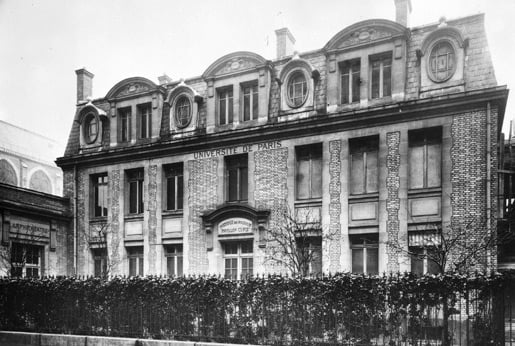
The Curie Pavillion at the Radium Institute in 1925.
Copyright © Association Curie Joliot-Curie Photographer unknown

Marie Curie and her daughter Irène in the laboratory at the Radium Institute in Paris, France, 1921.
Copyright © Association Curie Joliot-Curie Photographer unknown

Marie Curie in her chemistry laboratory at the Radium Institute in France, April 1921.
Source: Nationaal Archief of the Netherlands Photographer unknown No known copyright restrictions

Marie Curie and her daughter Irène at the Hoogstade Hospital in Belgium, 1915. Radiographic equipment is installed.
Copyright © Association Curie Joliot-Curie Photographer unknown

Marie Curie and four of her students. (Photo taken between 1910 and 1915.)
Source: Library of Congress Photographer unknown No known copyright restrictions

Marie Curie and her daughters Irène and Eve sitting on a bench in the garden (1905).
Copyright © Association Curie Joliot-Curie Photographer unknown

On 25 June 1903 Marie Curie defended her doctoral thesis on radioactive substances at Université de la Sorbonne in Paris, thus becoming the first woman in France to receive a doctoral degree. Image shows the thesis cover: Recherches sur les substances radioactives (Research on Radioactive Substances).
Photo: Public domain, via Wikimedia Commons
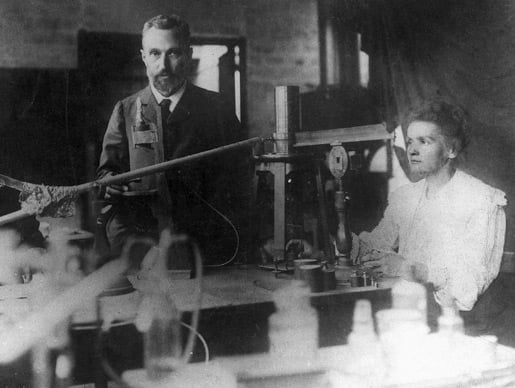
Pierre and Marie Curie in the "hangar" at l'Ecole de physique et chimie industrielles in Paris, France, where they made their discovery. (Photo taken 1898.)
Copyright © Association Curie Joliot-Curie Photographer unknown

Wedding photo of Pierre and Marie Curie, 1895.
Copyright © Association Curie Joliot-Curie Photographer unknown
Marie Curie – Biographical
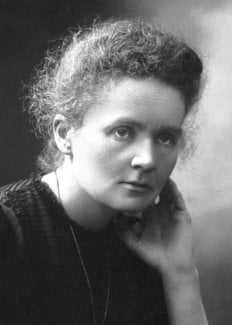
Marie Curie, née Maria Sklodowska, was born in Warsaw on November 7, 1867, the daughter of a secondary-school teacher. She received a general education in local schools and some scientific training from her father. She became involved in a students’ revolutionary organization and found it prudent to leave Warsaw, then in the part of Poland dominated by Russia, for Cracow, which at that time was under Austrian rule. In 1891, she went to Paris to continue her studies at the Sorbonne where she obtained Licenciateships in Physics and the Mathematical Sciences. She met Pierre Curie, Professor in the School of Physics, in 1894 and in the following year they were married. She succeeded her husband as Head of the Physics Laboratory at the Sorbonne, gained her Doctor of Science degree in 1903, and following the tragic death of Pierre Curie in 1906, she took his place as Professor of General Physics in the Faculty of Sciences, the first time a woman had held this position. She was also appointed Director of the Curie Laboratory in the Radium Institute of the University of Paris, founded in 1914.
Her early researches, together with her husband, were often performed under difficult conditions, laboratory arrangements were poor and both had to undertake much teaching to earn a livelihood. The discovery of radioactivity by Henri Becquerel in 1896 inspired the Curies in their brilliant researches and analyses which led to the isolation of polonium, named after the country of Marie’s birth, and radium. Mme. Curie developed methods for the separation of radium from radioactive residues in sufficient quantities to allow for its characterization and the careful study of its properties, therapeutic properties in particular.
Mme. Curie throughout her life actively promoted the use of radium to alleviate suffering and during World War I, assisted by her daughter, Iréne, she personally devoted herself to this remedial work. She retained her enthusiasm for science throughout her life and did much to establish a radioactivity laboratory in her native city – in 1929 President Hoover of the United States presented her with a gift of $50,000 donated by American friends of science, to purchase radium for use in the laboratory in Warsaw.
Mme. Curie, quiet, dignified and unassuming, was held in high esteem and admiration by scientists throughout the world. She was a member of the Conseil du Physique Solvay from 1911 until her death and since 1922 she had been a member of the Committee of Intellectual Co-operation of the League of Nations. Her work is recorded in numerous papers in scientific journals and she is the author of Recherches sur les Substances Radioactives (Investigations on radioactive substances) (1904), L’Isotopie et les Eléments Isotopes (Isotopy and isotopic elements) and the classic Traité de radioactivité (Treatise on radioactivity) (1910).
The importance of Mme. Curie’s work is reflected in the numerous awards bestowed on her. She received many honorary science, medicine and law degrees and honorary memberships of learned societies throughout the world. Together with her husband, she was awarded half of the Nobel Prize for Physics in 1903, for their study into the spontaneous radiation discovered by Becquerel, who was awarded the other half of the Prize. In 1911 she received a second Nobel Prize, this time in Chemistry, in recognition of her work in radioactivity. She also received, jointly with her husband, the Davy Medal of the Royal Society in 1903 and, in 1921, President Harding of the United States, on behalf of the women of America, presented her with one gram of radium in recognition of her service to science.
The Curie’s elder daughter, Iréne, married Frédéric Joliot in 1926 and they were joint recipients of the Nobel Prize for Chemistry in 1935. The younger daughter, Eve, married the American diplomat H.R. Labouisse. They have both taken lively interest in social problems, and as Director of the United Nations’ Children’s Fund he received on its behalf the Nobel Peace Prize in Oslo in 1965. She is the author of a famous biography of her mother, Madame Curie (Gallimard, Paris, 1938), translated into several languages.
Mme. Curie died in Savoy, France, after a short illness, on July 4, 1934.
This autobiography/biography was written at the time of the award and first published in the book series Les Prix Nobel. It was later edited and republished in Nobel Lectures. To cite this document, always state the source as shown above.
The Nobel Foundation's copyright has expired.Marie Curie – Documentary
As the first woman elected to the Academy of Medicine in France, Marie Curie visits American President Warren Harding in his garden, in October 1921. American women honour Mrs. Curie with a gift of one gram of radium, worth half a million Swedish kronor.
Marie Curie – Nobel Lecture
Nobel Lecture, December 11, 1911*
Radium and the New Concepts in Chemistry
Some 15 years ago the radiation of uranium was discovered by Henri Becquerel1, and two years later the study of this phenomenon was extended to other substances, first by me, and then by Pierre Curie and myself2. This study rapidly led us to the discovery of new elements, the radiation of which, while being analogous with that of uranium, was far more intense. All the elements emitting such radiation I have termed radioactive, and the new property of matter revealed in this emission has thus received the name radioactivity. Thanks to this discovery of new, very powerful radioactive substances, particularly radium, the study of radioactivity progressed with marvellous rapidity: Discoveries followed each other in rapid succession, and it was obvious that a new science was in course of development. The Swedish Academy of Sciences was kind enough to celebrate the birth of this science by awarding the Nobel Prize for Physics to the first workers in the field, Henri Becquerel, Pierre Curie and Marie Curie (1903).
From that time onward numerous scientists devoted themselves to the study of radioactivity. Allow me to recall to you one of them who, by the certainty of his judgement, and the boldness of his hypotheses and through the many investigations carried out by him and his pupils, has succeeded not only in increasing our knowledge but also in classifying it with great clarity; he has provided a backbone for the new science, in the form of a very precise theory admirably suited to the study of the phenomena. I am happy to recall that Rutherford came to Stockholm in 1908 to receive the Nobel Prize as a well-deserved reward for his work.
Far from halting, the development of the new science has constantly continued to follow an upward course. And now, only 15 years after Becquerel’s discovery, we are face to face with a whole world of new phenomena belonging to a field which, despite its close connexion with the fields of physics and chemistry, is particularly well-defined. In this field the importance of radium from, the viewpoint of general theories has been decisive. The history of the discovery and the isolation of this substance has furnished proof of my hypothesis that radioactivity is an atomic property of matter and can provide a means of seeking new elements. This hypothesis has led to present-day theories of radioactivity, according to which we can predict with certainty the existence of about 30 new elements which we cannot generally either isolate or characterize by chemical methods. We also assume that these elements undergo atomic transformations, and the most direct proof in favour of this theory is provided by the experimental fact of the formation of the chemically defined element helium starting from the chemically-defined element radium.
Viewing the subject from this angle, it can be said that the task of isolating radium is the corner-stone of the edifice of the science of radioactivity. Moreover, radium remains the most useful and powerful tool in radioactivity laboratories. I believe that it is because of these considerations that the Swedish Academy of Sciences has done me the very great honour of awarding me this year’s Nobel Prize for Chemistry.
It is therefore my task to present to you radium in particular as a new chemical element, and to leave aside the description of the many radioactive phenomena which have already been described in the Nobel Lectures of H. Becquerel, P. Curie and E. Rutherford.
Before broaching the subject of this lecture, I should like to recall that the discoveries of radium and of polonium were made by Pierre Curie in collaboration with me. We are also indebted to Pierre Curie for basic research in the field of radioactivity, which has been carried out either alone, in collaboration with his pupils.
The chemical work aimed at isolating radium in the state of the pure salt, and at characterizing it as a new element, was carried out specially by me, but it is intimately connected with our common work. I thus feel that I interpret correctly the intention of the Academy of Sciences in assuming that the award of this high distinction to me is motivated by this common work and thus pays homage to the memory of Pierre Curie.
I will remind you at the outset that one of the most important properties of the radioactive elements is that of ionizing the air in their vicinity (Becquerel). When a uranium compound is placed on a metal plate A situated opposite another plate B and a difference in potential is maintained between the plates A and B, an electric current is set up between these plates; this current can be measured with accuracy under suitable conditions and will serve as a measure of the activity of the substance. The conductivity imparted to the air can be ascribed to ionization produced by the rays emitted by the uranium compounds.
In 1897, using this method of measurement, I undertook a study of the radiation of uranium compounds, and soon extended this study to other substances, with the aim of finding out whether radiation of this type occurs in other elements. I found in this way that of the other elements known, only the compounds of thorium behave like the compounds of uranium.
I was struck by the fact that the activity of uranium and thorium compounds appears to be an atomic property of the element uranium and of the element thorium. Chemical compounds and mixtures containing uranium and thorium are active in direct proportion to the amount of these metals contained in them. The activity is not destroyed by either physical changes of state or chemical transformations.
I measured the activity of a number of minerals; all of them that appear to be radioactive always contain uranium or thorium. But an unexpected fact was noted: certain minerals (pitchblende, chalcolite, autunite) had a greater activity than might be expected on the basis of their uranium or thorium content. Thus, certain pitchblendes containing 75% of uranium oxide are about four times as radioactive as this oxide. Chalcolite (crystallized phosphate of copper and uranium) is about twice as radioactive as uranium. This conflicted with views which held that no mineral should be more radioactive than metallic uranium. To explain this point I prepared synthetic chalcolite from pure products, and obtained crystals, whose activity was completely consistent with their uranium content; this activity is about half that of uranium.
I then thought that the greater activity of the natural minerals might be determined by the presence of a small quantity of a highly-radioactive material, different from uranium, thorium and the elements known at present. It also occurred to me that if this was the case I might be able to extract this substance from the mineral by the ordinary methods of chemical analysis. Pierre Curie and I at once carried out this research, hoping that the proportion of the new element might reach several per cent. In reality the proportion of the hypothetical element was far lower and it took several years to show unequivocally that pitchblende contains at least one highly-radioactive material which is a new element in the sense that chemistry attaches to the term.
We were thus led to create a new method of searching for new elements, a method based on radioactivity considered as an atomic property of matter. Each chemical separation is followed by a measurement of the activity of the products obtained, and in this way it is possible to determine how the active substance behaves from the chemical viewpoint. This method has come into general application, and is similar in some ways to spectral analysis. Because of the wide variety of radiation emitted, the method could be perfected and extended, so that it makes it possible, not only to discover radioactive materials, but also to distinguish them from each other with certainty.
It was also found in using the method being considered, that it was in fact possible to concentrate the activity by chemical methods. We found that pitchblende contains at least two radioactive materials, one of which, accompanying bismuth, has been given the name polonium, while the other, paired with barium, has been called radium.
Other radioactive elements have been discovered since: actinium (Debierne), radiothorium and mesothorium (Hahn), ionium (Boltwood), etc.
We were convinced that the materials which we had discovered were new chemical elements. This conviction was based solely on the atomic nature of radioactivity. But at first, from the chemical viewpoint, it was as if our substances had been, the one pure bismuth, and the other pure barium. It was vital to show that the radioactive property was connected with traces of elements that were neither bismuth nor barium. To do that the hypothetical elements had to be isolated. In the case of radium isolation was completely successful but required several years of unremitting effort. Radium in the pure salt form is a substance the manufacture of which has now been industrialized; for no other new radioactive substance have such positive results been obtained.
The radiferous minerals are being subjected to very keen study because the presence of radium lends them considerable value. They are identifiable either by the electrometric method, or very simply by the impression they produce on a photographic plate. The best radium mineral is the pitchblende from St. Joachimsthal (Austria) which has for a long time been processed to yield uranium salts. After extraction of the latter, the mineral leaves a residue which contains radium and polonium. We have normally used this residue as our raw material.
The first treatment consists in extracting the radiferous barium and the bismuth containing the polonium. This treatment, which was first performed in the laboratory on several kilograms of raw material (as many as 20 kg) had then to be undertaken in a factory owing to the need to process thousands of kilograms. Actually, we gradually learned from experience that the radium is contained in the raw material in the proportion of a few decigrams per ton. About 10 to 20 kg crude barium sulphate containing radium are extracted from one ton of residue. The activity of these sulphates is even then 30 to 60 times greater than that of uranium. These sulphates are purified and converted to chlorides. In the mixture of barium and radium chlorides the radium is present only in the proportion of about 3 parts per 100,000. In the radium industry in France a much lower grade mineral is most often used and the proportion indicated is far lower still. To separate the radium from the barium I have used a method of fractional crystallization of the chloride (the bromide can also be used). The radium salt, less soluble than the barium salt, becomes concentrated in the crystals. Fractionation is a lengthy, methodical operation which gradually eliminates the barium. To obtain a very pure salt I have had to perform several thousands of crystallizations. The progress of the fractionation is monitored by activity measurements.
A first proof that the element radium existed was furnished by spectral analysis. The spectrum of a chloride enriched by crystallization exhibited a new line which Demarcay attributed to the new element. As the activity became more concentrated, the new line increased in intensity and other lines appeared while the barium spectrum became at the same time less pronounced. When the purity is very high the barium spectrum is scarcely visible.
I have repeatedly determined the average atomic weight of the metal in the salt subjected to spectral analysis. The method used was the one consisting in determining the chlorine content in the form of silver chloride in a known amount of the anhydrous chloride. I have found that this method gives very good results even with quite small amounts of substance (0.1 to 0.5 g), provided a very fast balance is used to avoid the absorption of water by the alkaline-earth salt during the weighings. The atomic weight increases with the enrichment of the radium as indicated by the spectrum. The successive atomic weights obtained were: 138; 146; 174; 225; 226.45. This last value was determined in 1907 with 0.4 g of very pure radium salt. The results of a number of determinations are, 226.62; 226.31; 226.42. These have been confirmed by more recent experiments.
The preparation of pure radium salts and the determination of the atomic weight of radium have proved positively that radium is a new element and have enabled a definite position to be assigned to it. Radium is the higher homologue of barium in the family of alkaline-earth metals; it has been entered in Mendeleev’s table in the corresponding column, on the row containing uranium and thorium. The radium spectrum is very precisely known. These very clear-cut results for radium have convinced chemists and justified the establishment of the new science of radioactive substances.
In chemical terms radium differs little from barium; the salts of these two elements are isomorphic, while those of radium are usually less soluble than the barium salts. It is very interesting to note that strong radioactivity of radium involves no chemical anomalies and that the chemical properties are actually those which correspond to the position in the Periodic System indicated by its atomic weight. The radioactivity of radium in solid salts is ca. 5 million times greater than that of an equal weight of uranium. Owing to this activity its salts are spontaneously luminous. I also wish to recall that radium gives rise to a continuous liberation of energy which can be measured as heat, being about 118 calories per gram of radium per hour.
Radium has been isolated in the metallic state (M. Curie and A. Debierne, 1910). The method used consisted in distilling under very pure hydrogen the amalgam of radium formed by the electrolysis of a chloride solution using a mercury cathode. One decigram only of salt was treated and consequently considerable difficulties were involved. The metal obtained melts at about 700°C, above which temperature it starts to volatilize. Is it very unstable in the air and decomposes water vigorously.
The radioactive properties of the metal are exactly the ones that can be forecast on the assumption that the radioactivity of the salts is an atomic property of the radium which is unaffected by the state of combination. It was of real importance to corroborate this point as misgivings had been voiced by those to whom the atomic hypothesis of radioactivity was still not evident.
Although radium has so far only been obtained in very small amounts, it is nevertheless true to say, in conclusion, that it is a perfectly defined and already well-studied chemical element.
Unfortunately, the same cannot be stated for polonium, for which nevertheless considerable effort has already been spent. The stumbling block here is the fact that the proportion of polonium in the mineral is about 5,000 times smaller than that of radium.
Before theoretical evidence was available from which to forecast this proportion, I had conducted several extremely laborious operations to concentrate polonium and in this way had secured products with very high activity without being able to arrive at definite results as in the case of radium. The difficulty is heightened by the fact that polonium disintegrates spontaneously, disappearing by half in a period of 140 days. We now know that radium has not an infinite life either, but the rate of disappearance is far less (it disappears by half in 2,000 years). With our facilities we can scarcely hope to determine the atomic weight of polonium because theory foresees that a rich mineral can contain only a few hundredths of a milligram per ton, but we can hope to observe its spectrum. The operation of concentrating polonium, as I shall point out later, is, moreover, a problem of great theoretical interest.
Recently, in collaboration with Debierne, I undertook to treat several tons of residues from uranium mineral with a view to preparing polonium. Initially conducted in the factory, then in the laboratory, this treatment finally yielded a few milligrams of substance about 50 times more active than an equal weight of pure radium. In the spectrum of the substance some new lines could be observed which appear attributable to polonium and of which the most important has the wavelength 4170.5 Å. According to the atomic hypothesis of radioactivity, the polonium spectrum should disappear at the same time as the activity and this fact can be confirmed experimentally,
I have so far considered radium and polonium only as chemical substances. I have shown how the fundamental hypothesis which states that radioactivity is an atomic property of the substance has led to the discovery of new chemical elements. I shall now describe how the scope of this hypothesis has been greatly enlarged by the considerations and experimental facts which resulted in establishing the theory of atomic radioactive transformations.
The starting-point of this theory must be sought in the considerations of the source of the energy involved in the phenomena of radioactivity. This energy becomes manifest as an emission of rays which produce thermal, electrical and light phenomena. As the emission occurs spontaneously without any known cause of excitation, various hypotheses have been advanced to account for the liberation of energy. One of the hypotheses put forward at the beginning of our research by Pierre Curie and myself consisted in assuming that the radiation is an emission of matter accompanied by a loss in weight of the active substances and that the energy is taken from the substance itself whose evolution is not yet completed and which undergoes an atomic transformation. This hypothesis, which at first could only be enunciated together with other equally valid theories, has attained dominant importance and finally asserted itself in our minds owing to a body of experimental evidence which substantiated it. This evidence is essentially the following: A series of radioactive phenomena exists in which radioactivity appears to be tied up to matter in an imponderable quantity, the radiation moreover not being permanent but disappearing more or less rapidly with time. Such are polonium, radioactive emanations and deposits of induced radioactivity.
It has been established moreover in certain cases that the radioactivity observed increases with time. This is what happens in the case of freshly prepared radium, of the emanation freshly introduced into the measuring apparatus, of thorium deprived of thorium X, etc.
A careful study of these phenomena has shown that a very satisfactory general explanation can be given by assuming that each time a decrease of radioactivity is observed there is a destruction of radioactive matter, and that each time an increase of activity is observed, there is a production of radioactive matter. The radiations which disappear and appear are, besides, of very varied nature and it is admitted that every kind of rays determined can serve to characterize a substance which is its source, and appears and disappears with it.
As radioactivity is in addition a property which is essentially atomic, the production or the destruction of a distinct type of radioactivity corresponds to a production or a destruction of atoms of a radioactive substance.
Finally, if it is supposed that radioactive energy is a phenomenon which is borrowed from atomic transformation, it can be deduced from this that every radioactive substance undergoes such a transformation, even though it appears to us to be invariable. Transformation in this case is only very slow and this is what takes place in the case of radium or uranium.
The theory I have just summarized is the work of Rutherford and Soddy, which they have called theory of atomic disintegration. By applying this theory it can be concluded that a primary radioactive substance such as radium undergoes a series of atomic transmutations by virtue of which the atom of radium gives birth to a train of atoms of smaller and smaller weights, since a stable state cannot be attained as long as the atom formed is radioactive. Stability can only be attained by inactive matter.
From this point of view one of the most brilliant triumphs of the theory is the prediction that the gas helium, always present in radioactive minerals, can represent one of the end-products of the evolution of radium, and that it is in the form of alpha rays that the helium atoms which are formed when radium atoms distintegrate are discharged. Now, the production of helium by radium has been proved by the experiments of Ramsay and Soddy, and it cannot now be contested that the perfectly defined chemical element, radium, gives rise to the formation of another equally defined element – helium. Moreover, the investigations done by Rutherford and his students have proved that the alpha particles emitted by radium with an electric charge are also to be found in the form of helium gas in the space where they have been recovered.
I must remark here that the bold interpretation of the relationship existing between radium and helium rests entirely upon the certitude that radium has the same claim to be a chemical element as have all the other known elements, and that there can be no question of regarding it to be a molecular combination of helium with another element. This shows how fundamental in these circumstances has been the work carried out to prove the chemical individuality of radium, and it can also be seen in what way the hypothesis of the atomic nature of radioactivity and the theory of radioactive transformations have led to the experimental discovery of a first clearly-established example of atomic transmutation. This is a fact the significance of which cannot escape anyone, and one which incontestably marks an epoch from the point of view of chemists.
Considerable work, guided by the theory of radioactive transformations, has led to approximately 30 new radioactive elements being envisaged, classified in 4 series according to the primary substance: these series are uranium, radium, thorium and actinium. The uranium and radium series can, in fact, be combined, for it seems to be proved that radium is a derivative of uranium. In the radium series the last known radioactive body is polonium, the production of which by radium is now a proven fact. It is likely that the actinium series is related to that of radium.
We have seen that helium gas is one of the products of radium distintegration. The helium atoms are detached from those of radium and its derivatives during the course of the transformation. It is supposed that after the departure of four atoms of helium, the radium atom yields one atom of polonium; the departure of a fifth helium atom determines the formation of an inactive body with an atomic weight believed to be equal to 206 (20 units below that of radium). According to Rutherford this final element is nothing more than lead, and this supposition is now being subjected to experimental verification in my laboratory. The production of helium from polonium has been directly proved by Debierne.
The relatively large amount of polonium prepared by Curie and Debierne has allowed an important study to be undertaken. This consists in counting a large number of alpha particles emitted by polonium and in collecting and measuring the corresponding volume of helium. Since each particle is a helium atom, the number of helium atoms is thus found which occupy a given volume and have a given weight. It can therefore allow us to deduce, in a general way, the number of molecules in a grammolecule. This number, known as Avogadro’s constant, is of great importance. Experiments conducted on polonium have supplied a first value for this number, which is in good agreement with the values obtained by other methods. The enumeration of alpha particles is done by an electrometric method due to Rutherford; this method has been brought to perfection by means of a photographic recording apparatus.
Recent investigations have shown that potassium and rubidium emit a very feeble radiation, similar to the beta radiation of uranium and radium. We do not yet know whether we should regard these substances as true radioactive bodies, i.e. bodies in the process of transformation.
To conclude I should like to emphasize the nature of the new chemistry of radioactive bodies. Tons of material have to be treated in order to extract radium from the ore. The quantities of radium available in a laboratory are of the order of one milligram, or of a gram at the very most, this substance being worth 400,000 francs per gram. Very often material has been handled in which the presence of radium could not be detected by the balance, nor even by the spectroscope. And yet we have methods of measuring so perfect and so sensitive that we are able to know very exactly the small quantities of radium we are using. Radioactive analysis by electrometric methods allows us to calculate to within 1% a thousandth of a milligram of radium, and to detect the presence of 10-10 grams of radium diluted in a few grams of material. This method is the only one which could have led to the discovery of radium in view of the dilution of this substance in the ore. The sensitivity of the methods is still more striking in the case of radium emanation, which can be detected when the quantity present amounts, for example, to only 10-10 mm3. As the specific activity of a substance is, in the case of analogous radiations, approximately in inverse proportion to the average life, the result is that if the average life is very brief, the radioactive reaction can attain an unprecedented sensitivity. We are also accustomed to deal currently in the laboratory with substances the presence of which is only shown to us by their radioactive properties but which nevertheless we can determine, dissolve, reprecipitate from their solutions and deposit electrolytically. This means that we have here an entirely separate kind of chemistry for which the current tool we use is the electrometer, not the balance, and which we might well call the chemistry of the imponderable.
*The lecture was held in the lecture hall at the Royal Academy of Sciences. The Royal Academy of Sciences were at the time located in the Westman Palace, a building behind Adolf Fredrik church in Stockholm, Sweden.
1. H. Becquerel, Compt. Rend., (1896).
2. P. Curie and M. Curie, Compt. Rend., (1898); (1899).
3. M. Curie, Rev. Gen. Sci., (1899); Rev. Sci., (1900).
The Nobel Foundation's copyright has expired.
Marie Curie – Questions and answers
Question: When was Marie Curie born?
Answer: Marie Curie was born on 7 November 1867.
Question: When did she die?
Answer: Marie Curie died on 4 July 1934, in Savoy, France. She died of aplastic anaemia, a blood disease that often results from exposure to large amounts of radiation.
Question: Where was she born?
Answer: She was born in Warsaw, now the capital of Poland, but at that time the city belonged to the Russian Empire.
Question: What was her maiden name?
Answer: Her maiden name was Maria Sklodowska. She was also called ‘Manya’ by her family and friends. She later changed her name to ‘Marie’ when she moved to Paris, France in later years.
Question: What was her family background?
Answer: Marie had four brothers and sisters. Both her parents were teachers. Her father was a patriot whose views about an independent Poland often made it difficult for him to keep his job. When Marie was 11 years old, her oldest sister died of typhus and her mother of tuberculosis.
Question: What was her educational background?
Answer: Marie finished high school at 15, with the highest honours. She worked as a private tutor for children in Poland before moving to Paris, France at the age of 24 to study mathematics and physics at the Sorbonne. Her goal was to get a teacher’s diploma and return to Poland.
Question: Why did she not return to Poland?
Answer: Marie stayed in France after she met a French scientist, Pierre Curie, in the spring of 1894. Pierre was the head of a laboratory at the School of Industrial Physics and Chemistry. She later married Pierre and they had two daughters, Irène, born in 1897, and Eve, born in 1904. Marie and Pierre worked together in the laboratory, which later resulted in a Nobel Prize in Physics in 1903, making Marie Curie the first woman to receive the Nobel Prize.
Question: What was the 1903 Nobel Prize in Physics awarded for?
Answer: Henri Becquerel was awarded half of the prize for his discovery of spontaneous radioactivity. Marie and Pierre Curie were awarded half the prize for their research on the radiation phenomena discovered by Becquerel.
Question: What did Marie Curie discover?
Answer: Marie Curie studied the radiation of all compounds containing the known radioactive elements, including uranium and thorium, which she later discovered was also radioactive. She also found out that:
– you can exactly measure the strength of the radiation from uranium;
– the intensity of the radiation is proportional to the amount of uranium or thorium in the compound – no matter what compound it is;
– the ability to emit radiation does not depend on the arrangement of the atoms in a molecule; it must be linked to the interior of the atom itself – a revolutionary discovery!
When she realized that some uranium and/or thorium compounds had stronger radiation than uranium, she made the following hypothesis: there must be an unknown element in the compound which had a stronger radiation than uranium or thorium. Her work aroused the interest of her husband, Pierre Curie, who stopped his own research on crystals and joined the “detective work” with his wife. And Marie was proven right: in 1898 the Curies discovered two new radioactive elements: radium (named after the Latin word for ray) and polonium (named after Marie’s home country, Poland).
Question: Was she awarded another Nobel Prize?
Answer: Yes, Marie Curie was awarded the 1911 Nobel Prize in Chemistry for her discoveries and studies of the elements radium and polonium. She is the only woman so far, who has been awarded the Nobel Prize twice.
Question: Were there other members of Marie Curie’s family who were awarded the Nobel Prize?
Answer: Yes, Marie and Pierre’s (who died in an accident in 1906) daughter, Irène Joliot-Curie, was awarded the 1935 Nobel Prize in Chemistry, sharing it with her husband, Frédéric Joliot, for their synthesis of new radioactive elements.
Sources:
Marie and Pierre Curie and the Discovery of Polonium and Radium
(https://www.nobelprize.org/prizes/themes/marie-and-pierre-curie-and-the-discovery-of-polonium-and-radium/)
Marie Curie – Her Story in Brief (http://www.aip.org/history/curie/brief/index.html)
First published 22 January 2008
Marie Curie – Nobel diploma
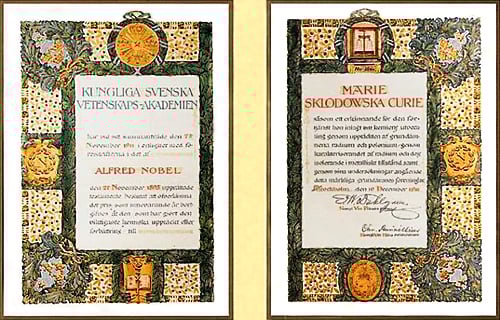
Copyright © The Nobel Foundation 1911
Artist: Sofia Gisberg
Source: Witkacy at en.wikipedia [public domain], via Wikimedia Commons