Frederick Soddy – Photo Gallery

Frederick Soddy in the laboratory in Glasgow
University of Glasgow Archives & Special Collections, GB248 ACCN3817/1/4.
Frederick Soddy – Nobel Lecture
Nobel Lecture, December 12, 1922
The Origins of the Conception of Isotopes
Read the Nobel Lecture
Pdf 162 kB
Frederick Soddy – Banquet speech
Frederick Soddy’s speech at the Nobel Banquet in Stockholm, December 10, 1922
I wish to thank you for the very great honour which you have paid to my country, to the University of which I am a member, and to my students and myself, by the award of the Nobel Prize for Chemistry for 1921. In the first place, the preparation of the Nobel lecture which I am to give has shown me, even more clearly than I knew before, how many others share with me, often, indeed, have anticipated me, in the discoveries for which you have awarded me the prize. Secondly, I should like to recall that the two former British Nobel laureates in Chemistry, Sir Ernest Rutherford and Sir William Ramsay were both my masters, and it is under them I received my training in scientific investigation. So that it is peculiarly gratifying to me to be chosen to receive the same honour as my distinguished teachers.
I take it almost as a personal compliment that Sweden so soon has donned her winter dress, for this work began for me with Rutherford in Canada, at Montreal, and the appearance of Stockholm today vividly recalls to me those early and exciting years. Ever since, I have felt that winter in the North speaks to the spirit of man with something of the appeal of Science. Nature is in austere mood, even terrifying, withal majestically beautiful. The pure air and dazzling snow belong to things beyond the reach of all personal feeling, almost beyond the reach of life. Yet such things are a part of our life, neither the least noble nor the most terrible.
It is appropriate, therefore, that this unique benefaction, which Science owes to Alfred Nobel, should be in the gift of Sweden and that Stockholm should be its home. Nowhere else, I am sure, in the whole world will one find, from the highest to the lowest, so eager a welcome for, or such universal appreciation of, the intellectual values that it was Nobel’s desire to honour and advance.
The proposer of this toast has paid today generous tributes to the work of the new laureates, for which we all must feel, as I do, profoundly grateful. But he has touched also on the darker side of the picture. As a scientific man I wish to acknowledge and accept my own share of responsibility and blame for this. As scientific men we have all, no doubt, felt that our work has been put often to base uses, which must lead to disaster. But what sin is to the moralist and crime to the jurist so to the scientific man is ignorance. On our plane knowledge and ignorance are the immemorial adversaries.
Scientific men can hardly escape the charge of ignorance with regard to the precise effect of the impact of modern science upon the mode of living of the people and upon their civilisation. For them, such a charge is worse than that of crime.
The catastrophe which has recently engulfed the world has, however, not been without its own intellectual renaissance. The effects are not yet apparent, but, at least, perhaps not all of us are now totally blind to the dangers ahead, or to the need of that impersonal but remorseless re-examination of the foundations of society, which Science has already applied to the mechanism of the physical universe. Possibly it may fail. Perhaps it may be too late. Even so, yet I cherish the fancy that, whatever may happen in the crowded and fevered countries that are still ranged in fratricidal animosity, here at least, here in the Northlands, truth will endure.
Frederick Soddy – Documentary
Frederick Soddy – Biographical
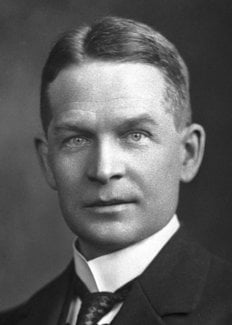 Frederick Soddy, the son of Benjamin Soddy, a London merchant, was born at Eastbourne, Sussex, England, on September 2, 1877. He was educated at Eastbourne College and the University College of Wales, Aberystwyth.
In 1895 he obtained a scholarship at Merton College, Oxford, from which University he graduated in 1898 with first class honours in chemistry. After two years of research at Oxford he went to Canada and from 1900 to 1902 was Demonstrator in the Chemistry Department of McGill University, Montreal. Here he worked with Professor Sir Ernest Rutherford on problems of radioactivity. Together they published a series of papers on radioactivity and concluded that it was a phenomenon involving atomic disintegration with the formation of new kinds of matter. They also investigated the gaseous emanation of radium.
Leaving Canada, Soddy then worked with Sir William Ramsay at University College, London where he continued the study of radium emanation. Here, Soddy and Ramsay were able to demonstrate, by spectroscopic means, that the element helium was produced in the radioactive decay of a sample of radium bromide and that helium was evolved in the decay of emanation.
From 1904 to 1914 Soddy was lecturer in physical chemistry and radioactivity in the University of Glasgow. Here he did much practical chemical work on radioactive materials. During this period he evolved the so-called “Displacement Law”, namely that emission of an alpha-particle from an element causes that element to move back two places in the Periodic Table. His peak was reached in 1913 with his formulation of the concept of isotopes, which stated that certain elements exist in two or more forms which have different atomic weights but which are indistinguishable chemically.
In 1914 he was appointed Professor of Chemistry at the University of Aberdeen, but plans for research were hampered by the war. In 1919 he became Dr. Lees Professor of Chemistry at Oxford University, a post he held until 1937 when he retired, on the death of his wife.
After his period at Glasgow he did no further work in radioactivity. His interest changed to economic, social and political theories which gained no general acceptance at the time, and to unusual mathematical and mechanical problems.
His books include Radioactivity (1904), The Interpretation of Radium (1909), The Chemistry of the Radioactive Elements (1912-1914), Matter and Energy (1912), Science and Life (1920), The Interpretation of the Atom (1932), The Story of Atomic Energy (1949), and Atomic Transmutation (1953).
Soddy was elected a Fellow of the Royal Society in 1910 and Oxford awarded him an honorary degree. He was awarded the Albert Medal in 1951.
He was a man of strong principles and obstinate views, friendly with students and prickly with colleagues.
ln 1908, he married Winifred Beilby. He died on September 22, 1956 at Brighton.
This autobiography/biography was written at the time of the award and first published in the book series Les Prix Nobel. It was later edited and republished in Nobel Lectures. To cite this document, always state the source as shown above.
Frederick Soddy – Nominations
Award ceremony speech
Presentation Speech by Professor H.G. Söderbaum, member of the Nobel Committee for Chemistry of the Royal Swedish Academy of Sciences, on December 10, 1922*
Your Majesty, Your Royal Highnesses, Ladies and Gentlemen.
One of the most fruitful ideas in the chemical research of the last century was put forward in 1869, when the Russian scientist Dmitri Ivanovitch Mendeleev drew up the Periodical System named after him, which is now well known to every chemist.
This classification revealed in a convincing manner that the various physical and chemical qualities in the fundamental elements of nature are to be conceived as functions of the atomic weights of those elements, that is to say, the relative weights of their units of mass. At the same time it made clear the relationship between the then known elements, about seventy in number, by grouping them into a limited number of natural families, which in the tabular scheme stand out graphically as a corresponding number of vertical rows with a regular increase in atomic weights in each column.
In this system each element has its given place: and each place has a given element corresponding to it. At the time when the system was drawn up, most of the places were already occupied: oxygen had its place, just like carbon, phosphorus, gold, etc. each had their own place. But there were also a number of empty places to which as yet there was nothing known to correspond; and the system celebrated its greatest triumphs perhaps when one after another of these empty places was gradually filled by the discovery of hitherto unknown elements, the existence of which could be foreseen and the qualities of which could be calculated beforehand with satisfactory exactitude thanks to the Periodical System. This took place when, in the course of the seventies and the eighties, scandium was discovered by a Swede, germanium by a German, and gallium by a Frenchman.
Even when, late in the eighteen-nineties, Sir William Ramsay discovered a whole group of new elements, known as the inactive constituents of the atmosphere – a discovery which in due time earned him a Nobel Prize in Chemistry – all these newcomers could without any great difficulty be fitted into the Mendeleev Table, although, it is true, a new column had to be created on their account – the zero vertical column.
But no long time elapsed before difficulties began to appear.
For a long time it had been felt as an imperfection that the Periodical System, though it gave expression to en unmistakable regularity in the matter of the mutual relations of the magnitude of the atomic weights, was unable to give the key to the interpretation of this law. As it were behind a semitransparent veil, men believed that they could catch a glimpse of a genetic connection between all the various fundamental forms in which matter reveals itself to our observation; but every attempt to raise a corner of this Veil of Isis long appeared to be fruitless.
This chronic symptom of weakness was soon joined by another of a more acute kind. The principal cause of this was Madame Curie’s brilliant discovery of radium – which also became in due time the subject of a Nobel Prize in Chemistry. Certainly it was easy enough to fit radium itself into the system; but things became worse when the continued study of radioactive phenomena led ere long to the knowledge of whole swarms – we now call them pleiads – of elements previously unknown, to say nothing of the fact that many of these elements, in consequence of their instability could not be isolated, and probably will never be able to be isolated in a form discernible by our external senses. The fact is that the span of their existence varies from milliards of years down to elusive fractions of a second. But their existence was in any case indisputable, and their rapid growth in number threatened to explode irremediably the whole of the Periodical System.
At that moment – just when the danger seemed to be greatest that the well-ordered regularity should be succeeded by an unintelligible chaos there appeared an eminent English scientist with the redeeming word isotopy.
This scientist was no stranger in the world of science. Many years before he had in a brilliant manner won his spurs by showing how helium comes from radium – the first clear experimental proof of the generation of one known element from another. And he was not one of those who idly rest upon their laurels. By a happy combination of experimental and speculative methods of investigation he was soon to attain still more important results.
What now occurred reminds one in certain respects of a previous episode in the history of chemistry. A hundred years ago it passed as an article of faith that in chemical compounds similarity in composition must also involve similarity in properties. Our countryman Berzelius upset this doctrine by his discovery of isomerism, in that he showed that two or more compounds may be completely identical in their composition, but may nevertheless diverge more or less in their chemical and physical relations.
In a similar way the people of our own day had laid it down as a kind of corollary, that the same place in the System must involve the same atomic weight and the same general properties, or, in other words, that every square in the Table could only contain one single element. The English scientist in question now showed that two or more elements might quite well be identical in a chemical respect and occupy the same place in the System – or, as he called it, be “isotopes” – but nevertheless be unlike one another as regards both atomic weight and certain physical properties. Taking his stand on the discovery of the material nature of the alpha-rays by the Nobel Prizeman Rutherford, he further laid down, by way of explanation of the mutual genetic connection between the elements, the proposition that every loss of an alpha-particle involves a shifting of the element in question two vertical columns to the left from its original place in the System: a proposition which was later supplemented by someone else to the effect that each loss of a beta-particle involves a shifting of one vertical column to the right. This law of shifting can be explained by Rutherford’s well-known nucleus theory. According to this theory, if the positive charge of the nucleus is identical with the atomic number of the element in the System, the loss of an alpha-particle – that is to say, an atom of helium carrying two positive charges – must diminish the charge of the nucleus by 2, and consequently lower the atomic number by the same number of units; while on the other hand, the loss of a beta-particle, that is to say a negative electron, must increase the positive charge of the nucleus by 1 and thus raise the atomic number by one unit.
Now if an atom of a radioactive element simultaneously loses one alpha-particle and two beta-particles, its nuclear charge, and consequently its number in the System, clearly undergoes no change; and though the atomic weight is reduced by 4 units, by the loss of one atom of helium, the new element can neither chemically, not yet spectroscopically, be distinguished from the old one: they are isotopes. Conversely, two elements may have the same atomic weight, but different nuclear charges, from which follows a different place in the System and different chemical properties. Such elements are called “isobares”, and they arise, one from the other, solely by beta-ray changes, whereby the mass is practically unaltered.
With regard to the theory of isotopes one can say with Hamlet: “This was sometime a paradox, but now the time gives it proof.” On its first appearance the proposition undeniably took one by surprise owing to its boldness; but since then it has gained more and more firm support through numerous experiments, in which its author himself has played a leading part. Here there is no possibility of giving even the meagrest account of these investigations, which extend over a decade and a half. Let it suffice to call to mind how it proved possible to produce from certain thorium minerals lead with precisely the same chemical properties as ordinary lead, but with considerably higher atomic weight – that is to say, an isotope to lead.
The theory of isotopes, in fact, has proved to be extremely fruitful and has during the last two or three years led to results which place its importance in a yet clearer light. But more about this will be said in the following address. It now remains merely to mention the name of the foremost author of the theory. It is: Frederick Soddy.
Professor Soddy. The Royal Swedish Academy of Sciences, of which institution you have for several years been a highly valued member, is sure that it is acting in complete accordance with the opinion of the scientific world in awarding to you the Nobel Prize in Chemistry for 1921, on account of your important contributions to our knowledge of the radioactive bodies and of your pioneer works on the existence and nature of isotopes.
It is with sincere gratification that I have the honour, on behalf of the Academy, to beg you to receive this prize from the hands of His Majesty, who has been graciously pleased to undertake to present it to you.
* The Nobel Prize in Chemistry 1921 was announced on November 9, 1922.