Hans von Euler-Chelpin – Photo gallery

1 (of 1) Nobel Prize award ceremony in Stockholm, Sweden, 10 December 1929. From left: Owen Willans Richardson, physics laureate 1928; Louis de Broglie, physics laureate 1929; Arthur Harden and Hans von Euler-Chelpin, chemistry laureates 1929; Sir Frederick Hopkins, medicine laureate 1929 and Thomas Mann, literature laureate 1929.
Photo: A. Malmström. Public domain, via Wikimedia Commons. Source: Digitala stadsmuseet.
Arthur Harden – Photo gallery
1 (of 1) Nobel Prize award ceremony in Stockholm, Sweden, 10 December 1929. From left: Owen Willans Richardson, physics laureate 1928; Louis de Broglie, physics laureate 1929; Arthur Harden and Hans von Euler-Chelpin, chemistry laureates 1929; Sir Frederick Hopkins, medicine laureate 1929 and Thomas Mann, literature laureate 1929.
Photo: A. Malmström. Public domain, via Wikimedia Commons. Source: Digitala stadsmuseet.
Arthur Harden – Nobel Lecture
Nobel Lecture, December 12, 1929
The Function of Phosphate in Alcoholic Fermentation
Read the Nobel Lecture
Pdf 60 kB
Hans von Euler-Chelpin – Nobel Lecture
Nobel Lecture, May 23, 1930
Fermentation of Sugars and Fermentative Enzymes
Read the Nobel Lecture
Pdf 61 kB
Arthur Harden – Banquet speech
Arthur Harden’s speech at the Nobel Banquet in Stockholm, December 10, 1929
Your Royal Highnesses, Ladies and Gentlemen,
My first duty, and it is a most congenial one, is to express on behalf of Professor von Euler, whose name is as well known throughout the Scientific World as here in Stockholm – his adopted home – and myself, between whom the Nobel Prize in Chemistry has this year been divided, our sincere gratitude to the Nobel Committee and the Swedish Academy of Sciences for the great honour which has been conferred upon us, and through us upon the subject of Biochemistry, that branch of Chemistry upon which we have both been chiefly engaged. The Nobel awards have always been made with such care and impartiality as to render them the most noteworthy of all scientific distinctions, a distinction not confined to the individuals to whom the Prizes are awarded but shared by the special branch of Science they represent. I do not hesitate to say that biochemists of all nations felt a thrill of pleasure and satisfaction when this year’s Nobel award was published. Biochemistry, one of the youngest of the Sciences, has gradually arisen as an independent branch of learning and research during the last fifty years. This science continues the line of study which was at first that of organic chemistry, which, as its name indicates, was devoted to the chemistry of organised matter.
The organic chemists did not long content themselves with the study of naturally occurring substances, but passed to the synthetical preparation of innumerable compounds not previously to be found in nature. The study of the chemistry of life and of the products of living organisms, always pursued by some who were irresistibly attracted by the fascination of the problem, was greatly stimulated by the discoveries of Pasteur with regard to the intense chemical activities of micro-organisms, and its foundations have been firmly established by the work and teachings of many illustrious men. Hammarsten here in Sweden, where we rejoice to hear he still enjoys a dignified old age; Fischer in Germany, who laid bare the secrets of the sugars, the purines and – greatest mystery of all – the proteins and many others.
At the beginning of the present century this branch of chemistry was gradually winning recognition as an independent science under the name of Biochemistry. Simultaneously in England, America and Germany, Journals devoted to it alone were established – Journals all of which are embarrassed by a superfluity of matter. The Nobel awards of this year both in Chemistry and Medicine will go far to secure the due recognition of the subject – not yet everywhere accorded – as an independent branch of Science.
If I may for a moment yield to the Scandinavian atmosphere of Saga and fairy tale, Biochemistry was for long the Cinderella of the Sciences, lorded over by her elder – though I will not say ugly – sisters, Chemistry and Physiology. But now the secret visit to the ball has been paid, the fur slipper has been found and brought home (no doubt to the Nobel Institute) by the Prince, and Biochemistry, raised to a position of proud independence, knocks boldly at the door of the Palace of Life itself.
The Nobel Foundation's copyright has expired.Arthur Harden – Documentary
Hans von Euler-Chelpin – Nominations
Arthur Harden – Nominations
The Nobel Prize in Chemistry 1929
Arthur Harden – Biographical
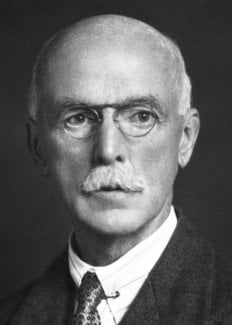
Arthur Harden was born in Manchester, England, on October 12, 1865; his father was Albert Tyas Harden and his mother Eliza Macalister. He was educated at a private school in Victoria Park (1873-1877) and at Tettenhall College, Staffordshire (1877-1881). He entered The Owens College in the University of Manchester in 1882, studying under Sir H.E. Roscoe, and graduated in 1885 with first-class honours in chemistry. In 1886 he was awarded the Dalton Scholarship in Chemistry and he spent twelve months during 1887-1888 working with Otto Fischer at Erlangen. He returned to Manchester as lecturer and demonstrator, and remained until 1897 when he was appointed chemist to the newly founded British Institute of Preventive Medicine, which later became the Lister Institute. In 1907 he was appointed Head of the Biochemical Department, a position which he held until his retirement in 1930, and in 1912 he received the title of Emeritus Professor of Chemistry, University of London. He continued his scientific work at the Institute after his retirement.
Before he went to London, Harden had studied the action of light on mixtures of carbon dioxide and chlorine. He entered the Institute with an excellent chemical background and applied his methods to the investigation of biological phenomena (among others: the chemical action of bacteria and alcoholic fermentation). He studied the breakdown products of glucose but he was soon to be drawn to the problem of the chemistry of the yeast cell. His classic study of the chemistry of the fermentation of sugar by yeast juice, which have advanced the knowledge of the processes of intermediary metabolism in all living forms, lasted for many years and provided a stepping-stone for many research workers in allied fields. Harden himself contributed to the vitamin field with a series of papers on the antiscorbutic and antineuritic vitamins and their occurrence in food and drinks.
Harden was Joint Editor (with W.M. Bayliss) of The Biochemical Journal from 1913 to 1938, and, in addition wrote numerous papers in scientific journals. He is the author of Alcoholic Fermentation, A New View of the Origin of Dalton’s Atomic Theory, and Chemistry for Advanced Studies (with Sir H.E. Roscoe), Inorganic Chemistry for Advanced Students, and An Elementary Course of Practical Organic Chemistry (with F.C. Garrett).
Harden was knighted in 1926. He was honorary Doctor of Science, University of Athens and honorary Doctor of Laws, Universities of Manchester and Liverpool. A Fellow of the Royal Society (1909), he received the Davy Medal in 1935.
He married Georgina Sydney Bridge, daughter of C. Wynyard Bridge of Christchurch, New Zealand, in 1900. They had no children. His wife died in January, 1928, and Sir Arthur on June 17, 1940, at his home in Bourne End, Buckinghamshire.
This autobiography/biography was written at the time of the award and first published in the book series Les Prix Nobel. It was later edited and republished in Nobel Lectures. To cite this document, always state the source as shown above.
The Nobel Foundation's copyright has expired.