Hans Fischer – Photo gallery

Nobel Prize award ceremony 1930: Sir Chandrasekhara Venkata Raman (physics laureate), Hans Fischer (chemistry laureate), Karl Landsteiner (medicine laureate) and Sinclair Lewis (literature laureate).
Photographer unknown (TT Nyhetsbyrån). Public domain, via Wikimedia Commons
Hans Fischer – Nobel Lecture
Nobel Lecture, December 11, 1930
On Haemin and the Relationships between Haemin and Chlorophyll
Read the Nobel Lecture
Pdf 214 kB
The Nobel Foundation's copyright has expired.
Hans Fischer – Documentary
Hans Fischer – Nominations
The Nobel Prize in Chemistry 1930
Hans Fischer – Biographical
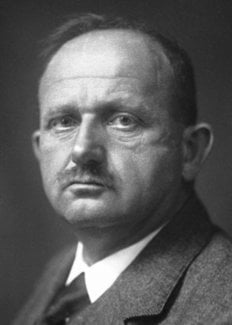
Hans Fischer was born in July 27, 1881 at Hoechst, on the river Main, in Germany. His father was Dr. Eugen Fischer, Director of the firm of Kalle & Co, Wiesbaden, and Privatdozent at the Technical High School, Stuttgart; his mother was Anna Herdegen. He went to a primary school in Stuttgart, and later to the “humanistische Gymnasium” (grammar school with emphasis on the classics) in Wiesbaden, matriculating in 1899. He read chemistry and medicine simultaneously, first at the University of Lausanne and then at Marburg. He obtained his chemistry degree under T. Zincke at Marburg in 1904; two years later, in 1906, a licence for medicine was conferred on him at Munich. In 1908 he qualified for his M.D. under F. von Müller, also at Munich.
Fischer spent his first working years at the Second Medical Clinic in Munich and at the First Berlin Chemical Institute under Emil Fischer. He returned to Munich in 1911 and qualified as lecturer on internal medicine one year later. In 1913 he was appointed E.F. Weinland’s successor at the Physiological Institute (O. Frank) in Munich, where he became a lecturer on physiology. In 1916 Fischer followed the invitation of the University of Innsbruck to succeed Windaus as Professor of Medical Chemistry; from there he went to the University of Vienna in 1918.
From April 1, 1921 until his death he held the position of Professor of Organic Chemistry at the Technische Hochschule (Technical University) in Munich, as successor to Wieland.
Fischer’s scientific work was mostly concerned with the investigation of the constitutive properties of the pigments in blood, bile, and also leaves, as well as with the chemistry of pyrrole. The main reason for the latter investigation was the synthesis of these natural pyrrole pigments. Of special importance was his synthesis of bilirubin. His numerous papers were mostly published in Liebigs Annalen der Chemie and Hoppe-Seylers Zeitschrift für physiologische Chemie.
In recognition of his work in these fields, the title of a “Geheimer Regierungsrat” (Privy Councillor) was conferred upon Hans Fischer in 1925; in 1929 he was awarded the Liebig Memorial Medal; Harvard University bestowed the title of honorary doctor on him in 1936; he received the Davy Medal in 1937. Fischer received the greatest honour of all, the Nobel Prize for 1930, for his work on the chemistry of pyrrole and the synthesis of haemin. In 1935, Professor Fischer married Wiltrud Haufe.
He died on March 31, 1945 in Munich.
This autobiography/biography was written at the time of the award and first published in the book series Les Prix Nobel. It was later edited and republished in Nobel Lectures. To cite this document, always state the source as shown above.
The Nobel Foundation's copyright has expired.
Hans Fischer – Facts
Award ceremony speech
Presentation Speech by Professor H.G. Söderbaum, Chairman of the Nobel Committee for Chemistry of the Royal Swedish Academy of Sciences, on December 10, 1930
Your Majesty, Your Royal Highnesses, Ladies and Gentlemen.
“Blood is a very special liquid”, this was asserted some 140 years ago by Goethe. When writing these words and ascribing them to Mephistopheles he probably had in mind first and foremost the mystical aura with which popular superstition has been wont to invest since time immemorial the red river of life that flows in our blood vessels, and the magical forces with which it had long been held to be endowed. The methodical scientific research of a later age has however affirmed the phrase to a far greater degree than its author could have surmised. Many and difficult have been the riddles scientists have had to solve in research on blood. The number of those who have applied their ingenuity to the solution of the riddle is large. It is the privilege of this present generation to witness the raising of the veil of Isis which previously concealed the solution from view. The research to which the Academy of Sciences has felt itself constrained to award the Nobel Prize for Chemistry this year is exceptionally successful and significant.
Once the anatomists of the 17th century had demonstrated with the aid of the microscope that blood is a tissue – in the anatomical sense of the word – and that it consists partly of extremely small cells, the so-called blood corpuscles, partly of a liquid substance, the so-called plasma, it became the task of the chemists and physiologists to determine the composition of these constituents and their diverse functions in the vital process. As to the red blood corpuscles in particular it was found that their colour is due to an iron-containing substance, later called haemoglobin, which, by virtue of its strong affinity to oxygen, is of fundamental importance for the familiar changes venous blood undergoes in the lungs during respiration. Haemoglobin can be separated into a protein substance, i.e. globin, and a red substance, still containing iron which, after oxidation, with hydrochloric acid yields a saltlike complex iron compound, called haemin. Considerable uncertainty however prevailed for a long time even regarding the empirical formula of haemin, and the uncertainty as to its internal chemical structure was even greater. Elementary analysis showed that the haemin molecule contains a large number of carbon atoms (the data fluctuated between 32 and 34) and an almost equal number of hydrogen atoms, and also 4 oxygen atoms, 4 nitrogen atoms, 1 iron atom, and 1 chlorine atom. To determine the manner in which all these atoms, numbering more than 70, are linked, or in other words to determine the chemical constitution of haemin, was one of the most difficult and complicated tasks with which any chemist could be faced.
It was discovered that the haemin molecule can be converted by certain chemical procedures into iron-free substances, called porphyrins, and that the porphyrins can be broken down, by other procedures, into pyrrole derivatives, i.e. into compounds containing four carbon atoms and one nitrogen atom in a closed ring. It was clear that the road to an exact knowledge of the structure of the blood pigments would involve detailed examination of these pyrroles and porphyrins.
This is the road which Professor Hans Fischer of Munich travelled, to reach his destination with perseverance and determination; not only did he determine completely the constitution of haemin and all its decomposition products: he also prepared the blood pigments from their simplest constituents by synthesis, a scientific achievement which would scarcely have been considered possible even a generation ago. By this synthesis he crowned his researches which both in extent and in the unbelievable difficulties associated with them deserve to be called a gigantic labour.
Moreover, these researches were not wholly restricted to blood pigments. Closely related pigments occur in Nature and not only in the blood. These include the pigments in the bile, of which bilirubin is the best characterized to date. Its constitution, too, has been determined by Fischer who established the connection between this bile pigment and the blood pigment. Further, it was discovered that the pigment in the pinions of certain birds is the copper salt of a porphyrin, whereas the pigment which forms the dark spots on the eggs of a large number of wild birds, the so-called ooporphyrin, has been found to be blood pigment without iron. Even if I add that Fischer has demonstrated the occurrence of haemin in yeast, all this is overshadowed by the fact that, chemically speaking, the pigment of green plants, i.e. chlorophyll, is closely related with the red blood pigment, and even derives, as Fischer has shown, from exactly the same parent substance, as regards the porphyrins.
This shows that Nature in spite of her extravagant diversity was sufficiently economical to use exactly the same building material when constructing these two substances which are so greatly different in appearance and occurrence.
Having completed his work on the blood pigments and their components by the haemin synthesis, Fischer turned with undiminished energy to research into chlorophyll. In this field, where a scientist has previously gained a Nobel Prize, but where much work remained to be done, conditions are even more complicated and the difficulties as a consequence are even greater than in the other field. Nevertheless, Fischer obtained results which are so important that the Academy has considered it fitting to include them in the award.
What has been said, though necessarily brief, could give some idea of the variety and range of Fischer’s researches, and has shown at the same time the singlemindedness that prevails in all this variety in that a leading fundamental idea firmly combines the researches in a systematic whole.
These researches have in the main been concerned as we have seen with the two most vital pigments, haemin and chlorophyll. Almost, we are tempted to say that life is pigment, because oxygen transport, by means of blood pigment, to the various tissues of the bodies of animals and humans, and carbon dioxide assimilation in plants, due to chlorophyll, constitute two of the most fundamental processes of organic life. It is therefore hardly possible to overestimate the importance of detailed knowledge of these two vital factors. If we remember moreover that the pyrrole complexes determined by Fischer are contained as basic components partly in the principal catalysts of respiration, partly in an enzyme (catalase) which is indispensable to all living cells, it will be found that the intrinsic value of the researches on it is in full accord with the prize which will now be awarded.
Herr Geheimrat Fischer. The gold medal which you are about to receive shows, on the obverse, the figure of Science, unveiling the goddess Isis. The symbol seems to me particularly appropriate on the present occasion, because you yourself, dear colleague, have solved previously veiled secrets of Nature in exactly the same manner.
By your analytical and synthetic work on the porphyrins, on the blood pigment, on leaf pigments, and other related substances, you have accomplished an achievement which can only be described a great feat in chemistry which will undoubtedly have a beneficial effect on the most diverse branches of natural sciences.
To have mastered a multitude of individual results so successfully testifies not only to untiring, I am tempted to say indefatigable energy, and to superior experimental ability, but also to a rare determination and consistency of scientific thought, which is rivalled by few examples in the history of our science.
In gratitude for your achievement, and with cordial congratulations, I now ask you, in the name of our Academy of Sciences, to receive, from the hands of His Majesty the King, the Nobel Prize in Chemistry for the year 1930.
Speed read: Establishing plant’s blood relatives
Two of the most fundamental processes in life, the transport of oxygen by blood in animals and the absorption of light during photosynthesis in plants, rely on pigments to carry out their highly important missions. Hans Fischer received the 1930 Nobel Prize in Chemistry for showing how Nature constructs these different coloured pigments from the same chemical building blocks.
Chemists knew that haemoglobin, the complex oxygen-transporting molecule in blood, can be divided into one portion that contains the red pigment and another so-called protein part. Through isolating and examining crystals of the pigment-containing part, known as haemin or haem, Fischer could identify its chemical components. Fischer discovered that haemin could be broken down into less complex compounds called porphyrins, and that in turn these could be broken down into relatively simpler compounds that share ring-like structures with a group of chemicals called pyrroles. Reversing this process, he successfully achieved the considerable feat of artificially synthesising haemin completely from its simplest chemical constituents.
Structural similarities between haemoglobin and the plant pigment chlorophyll had been uncovered by the 1915 Chemistry Laureate Richard Willstätter, when he showed that chlorophyll holds an atom of magnesium within the centre of the molecule in the same way in which iron is held within haemin. Fischer provided a more detailed view of this similarity when he showed that chlorophyll is constructed from the same pyrrole constituents that make up haemin. He subsequently found that other biologically important pigments are derived from the same blood line of chemicals. Chief amongst these is bilirubin, a bile pigment that is derived from haemin, and which is responsible for the yellowing skin colour of patients suffering from jaundice.