Adolf Butenandt – Nobel Lecture
Adolf Butenandt did not deliver a Nobel Lecture.
Leopold Ruzicka – Nobel Lecture
Nobel Lecture, December 12, 1945
Multimembered Rings, Higher Terpene Compounds and Male Sex Hormones
Read the Nobel Lecture
Pdf 525 kB
Leopold Ruzicka – Banquet speech
Leopold Ruzicka’s speech from the ceremony in Zurich, Switzerland, where the prize was distributed, January 16, 1940 (in German)
Exzellenz,
Meine Damen und Herren!
Es war für mich eine angenehme Überraschung, als ich hörte, dass Eure Exzellenz im Auftrage der hohen schwedischen Regierung nach Zürich kommen werden zur persönlichen Überreichung dieser schönen Medaille und des so bedeutungsvollen Dokuments. Diese bescheidene Zeremonie hier in der Schweiz bildet dadurch einen gewissen Ersatz für die traditionelle eindrucksvolle Feierlichkeit, die wie alljährlich am 10. Dezember in Stockholm hätte stattfinden sollen und die regelmässig durch die Anwesenheit Sr. Majestät des schwedischen Königs eine besondere Weihe erhielt.
Ich beehre mich daher, Eurer Exzellenz meine tiefempfundene Dankbarkeit auszusprechen für die grosse Ehre, die Sie uns allen hier erwiesen haben, und bitte Sie, diesen Dank Ihrer hohen Regierung und der Schwedischen Akademie der Wissenschaften in Stockholm übermitteln zu wollen.
Diese ehrwürdige Akademie hat durch die Zuerkennung ihres Preises in symbolischer Weise gewisse systematische Arbeiten anerkennen wollen, die im Laboratorium des Sprechenden im Laufe der letzten 20 Jahre durchgeführt wurden.
Jene Arbeiten bewegen sich auf einem Gebiete, das zu Beginn des 19. Jahrhunderts unter besonders wirkungsvoller Mitarbeit eines der hervorragendsten Mitglieder der Schwedischen Akademie der Wissenschaften, Jacob Berzelius, zur Wissenschaft erhoben worden ist. Berzelius ist der hohen Tradition der schwedischen Phlogistiker Bergman und Scheele gefolgt und hat gleich diesen das Experiment vor die Theorie gestellt. Er betrachtete es als seine Lebensaufgabe, möglichst genau die mengenmässigen Proportionen zu bestimmen, in denen sich die chemischen Elemente zu Verbindungen vereinigen, um so eine chemische Systematik aufstellen zu können. Dieses Bestreben erinnert an die Leistungen eines anderen grossen Schweden, Linné, des Schöpfers der Pflanzensystematik.
Berzelius hat, durch Einführung der noch heute geltenden Symbole, der Chemie ihre so wichtige Formel-Sprache gegeben, er hat das erste eigentliche chemische Lehrbuch geschrieben, er hat die Bezeichnung “organische Chemie” geprägt, er ist Schöpfer der Begriffe Isomerie, Polymerie, Katalyse, er ist Mitbegründer der ersten wissenschaftlichen chemischen Theorie, der Radikaltheorie.
Auf dem von Berzelius vorbereiteten Boden nahm die Chemie in Schweden bis zur Gegenwart einen überaus glücklichen Entwicklungsgang. Dieser hohe Stand der schwedischen Wissenschaft bildete die unentbehrliche Voraussetzung für die technischen Grosstaten Alfred Nobels. Die Schöpfung der modernen Sprengstofftechnik bildet auch heute noch eine der wichtigsten Grundlagen des Fortschrittes in Wirtschaft, Technik und Wissenschaft: es sei nur an die Revolutionierung des Bahn-, Strassen-, Kanal- und Bergbaues, sowie der Bewässerungsanlagen durch Nobel erinnert. Er hat sich damit in die erste Linie der grossen Förderer der Kultur und Zivilisation gestellt. A. Nobel hat weiter durch Schaffung seiner bekannten Stiftung, die nicht nur Wissenschaft und Literatur, sondern auch die Bestrebungen um die Pflege friedlicher internationaler Beziehungen fördern soll, ein hohes sittliches Verantwortungsgefühl bewiesen.
Angesichts des unverzeihlichen Missbrauchs, der, wie mit so vielen anderen Errungenschaften von Wissenschaft und Technik, auch mit den Entdeckungen Nobels getrieben wird, blieb der Vorwurf nicht aus, dass diese die Kultur, die sie mitgeschaffen haben, wieder zu zerstören helfen. Glücklicherweise ist die Veranlassung zum Missbrauch keine der wissenschaftlich feststellbaren Eigenschaften der Nobelschen Produkte, und der in Schweden selbst und an vielen Orten herrschende Abscheu gegen diesen Missbrauch lässt uns daher einer glücklicheren Zeit entgegensehen, die auch Nobel vorschwebte, in der die Kräfte, die er schuf, nur zum Segen der Menschheit gereichen und die internationale friedliche Zusammenarbeit vertiefen helfen werden.
Leopold Ruzicka – Other resources
Links to other sites
On Leopold Ruzicka from ETH Zürich
On Leopold Ruzicka from Universität Zürich
Leopold Ruzicka – Nominations
Adolf Butenandt – Nominations
Award ceremony speech
The following account of Butenandt’s work has been made.
As recently as twelve years ago, very little was known about the nature of the sex hormones. As regards the oestrogenic, or follicle, hormone it was established that extracts from certain organs, e.g. the ovaries and placenta, bring about the characteristic oestrus phenomena in castrated female rats. Only a few observations were available concerning the stability and solubility of their active principles. Further development in the chemistry of the oestrogenic hormones could not take place until the purely biological discoveries by Allen and Doisy in 1923 and by Aschheim and Zondek in 1927 had been made.
Butenandt made the first big step forward in clarifying the chemistry of the follicle hormone in 1929 in Göttingen, simultaneously with Doisy in the United States. Both workers succeeded in isolating from the urine of pregnant women a substance in crystalline form having oestrogenic effects. Butenandt named this substance folliculine, a designation which was later changed to oestrone. He established that its empirical formula was C18H22O2, and that it was an oxyketone.
Shortly after the discovery of oestrone, Marrian in London (1930) isolated from the urine of pregnant women a new hormone which he called oestriol. Butenandt confirmed Marrian’s discovery and explained the relationship between the new substance and oestrone. The relation between sterols and oestrogenic substances which had been assumed on crystallographical grounds became probable from the chemical point of view only after Butenandt and Marrian had shown, independently of one another, that only three benzoide double bonds enter into the ring system of these substances.
In 1932, Butenandt was able, from observations made in spectral analysis, and especially on the basis of the then established correct formula of cholesterol to draw up the formulae of the chemical structure of oestrone and oestriol. But there remained the important task of proving the chemical structure of the ring system as assumed by Butenandt. By breaking down the oestriol molecule stage by stage Butenandt proved that both œstrogenic hormones contained a phenanthrene core. At the same time he was able to obtain the same dimethyl phenanthrene from etiobilianic acid, a transformation product of cholic acid. He had thus confirmed the close relationship existing between the follicle hormones on the one hand and the bile acids and sterols on the other.
The second important ovarian hormone, the corpus luteum hormone, was by various workers obtained in crystalline form from corpus luteum in 1931 and 1932. In 1934, Butenandt and Westphal succeeded in producing this hormone, which was given the name progesterone, in a chemically pure form. They also demonstrated its close relationship with pregnanediol, a physiologically inactive dihydric alcohol which Butenandt and Marrian had found independently of one another in the urine of pregnant women. In the autumn of 1934, Butenandt succeeded in converting pregnanediol into progresterone. The synthesis of this important pregnancy hormone from cholesterol was carried out by Butenandt in a simple way in 1939.
The merit of the chemical exploration of the testicular, or androgenic, hormones falls to Butenandt and Ruzicka in common. Butenandt was the first to tackle this problem, and it was only possible to work on it after biological research had found a quantitative test for the determination of these substances – the so-called capon comb test.
Butenandt started with male urine, or alternatively its chloroform extract – approximately 0.8 per thousand dissolved in chloroform. In the process of purification it proved that the male hormone behaved in many respects like oestrone; when he realized this, it made Butenandt’s work considerably easier.
When the purification had been successfully accomplished, there presented for the first time a crystalline substance with the physiological properties of a male sex hormone.
Butenandt gave this substance the name androsterone and defined its composition as C19H30O2. It differs from oestrone only in the additional content of 1 methyl group and 5 hydrogen atoms. Butenandt drew up the full constitutional formula in 1934 on the basis of the formula of cholesterol.
Androsterone had been synthesized from epi-cholestanol by Ruzicka, but it soon proved to be not identical with the genuine male hormone from the testicles. For this reason it made a great stir when in 1935 Laqueur and his collaborators isolated from testicular extract a highly active hormonetestosterone.
The close relationship of testosterone to androsterone made it comparatively easy to clarify its chemical composition, and still in the same year 1935 Ruzicka and Butenandt were able, in the same way but independently of each other, to obtain testosterone from trans-dehydro-androsterone.
Butenandt, Ruzicka and others then produced from sterols various new substances which, when tested as male sex hormones, were found to be active in varying degrees.*
* Professor Adolf Butenandt was awarded half of the Nobel Prize in Chemistry for 1939, for his work on sex hormones. Owing to political conditions at the time, Professor Butenandt was prevented from accepting the prize. In 1949 he received the gold medal and the diploma.
The following account of Ruzicka’s work has been made.
The higher terpenoids or polyterpenes, which occur in great variety in the vegetable kingdom, were originally the main subject of Ruzicka’s investigations, and the extremely difficult determination of their structure has been made possible through his exceptional experimental skill. The pioneering work of Ruzicka and his co-workers has led to thorough investigations of a very large number of important polyterpenes.
When studying the natural odorants occurring in musk and civet, muscone and civetone, little known until then, Ruzicka obtained fundamentally new and surprising results during the years 1924-1926. He discovered that the molecule of muscone as well as that of civetone contains one single ring of carbon atoms, the number of which was considerably larger than that in all hitherto known cyclic molecules, larger even than had been considered possible. During his investigations of these odora he synthesized many kindred macrocyclic compounds, and drew attention to the plant-physiologically remarkable fact that these could be prepared from natural fatty acids.
Many interesting relationships exist between the polyterpenes studied by Ruzicka and a series of physiologically and medicinally important groups of compounds, viz. the bile acids, the sterols and the sex hormones. Among the many interesting results obtained by Ruzicka and his collaborators with sex hormones, the preparation of compounds with the same action as male sex hormones is of signal importance. It is his merit that by establishing preparative methods for androsterone and testosterone the technical synthesis of these two hormones has been made possible.
Moreover, the numerous new related compounds prepared by Ruzicka have contributed fundamentally to our knowledge of the physiologically so very important sex hormones, thus creating a sound basis for future investigations *.
At a special ceremony in Zurich the prize was handed over to Professor Ruzicka by the Swedish ambassador Baron H. G. Beck-Friis on January 16, 1940, after a speech ending with the following words:
Professor Ruzicka. On behalf of the Nobel Foundation and the Royal Swedish Academy of Sciences I convey to you the most cordial congratulations – to which I may be permitted to add my own – and at the same time express my hope that you will be able to extend your research successfully to ever-increasing fields in the service of mankind.
With this hope I have the honour to present you with the Certificate of the Nobel Prize for Chemistry for the year 1939 and with the Nobel Medal.
* Professor L. Ruzicka was awarded half of the Nobel Prize in Chemistry for 1939, for his work on polymethylenes and higher terpenes. Owing to the war conditions Professor Ruzicka attended the ceremonies later in 1945.
Speed read: Exploring the sexual divide
For centuries, philosophers, writers and musicians have all mused upon the differences between the sexes, but to scientists this can be largely explained by the actions of a variety of chemical messengers, or sex hormones, that influence the development of masculine or feminine characteristics. Very little was known about the origin of these sex hormones until the independent chemical explorations of Adolf Butenandt and Leopold Ruzicka converged to form an understanding of how they are created.
The discovery that pregnant women’s urine contains unusually high quantities of female sex hormones provided Adolf Butenandt with the essential starting point for unlocking their chemical secrets. From thousands of litres of urine, he successfully extracted milligrams of pure crystals of a female sex hormone, a form of oestrogen called oestrone. At around the same time another researcher Edward Doisy accomplished the same feat, but Butenandt also worked out the chemical structure of oestrone. Butenandt then went on to isolate pure crystals of the male sex hormone androsterone from men’s urine, and from extracts of pig ovaries he isolated progesterone, which plays an important part in the female reproductive cycle. By analysing these isolated hormones Butenandt could see that they have similar chemical structures, which, in turn, bear a striking resemblance to sterols or steroids, a group of biologically important compounds, of which cholesterol is the best-known member.
At around the same time, Leopold Ruzicka had switched his attention from studying the structures of the active components of natural musk perfumes to studying their chemical relations. He proposed that the huge family of chemicals called terpenes, with members ranging from rubber to cholesterol, were in fact related through all being created from a common building block – in this case the small carbon-containing compound isoprene. His suspicion that the ring-like chains of carbon atoms that form the structural backbone of compounds like cholesterol provide the starting basis for constructing sex hormones proved to be correct. By tweaking and manipulating specific parts of the cholesterol molecule Ruzicka successfully created molecules of androsterone, and on the basis of this, Butenandt and Ruzicka independently showed how testosterone, the primary hormone responsible for male characteristics, could be synthesized from cholesterol. With the structures and blueprints for construction in their hands, scientists at last had the fundamental information they needed to understand the roles of sex hormones in human sexuality and reproduction.
The Nobel Prize in Chemistry 1939
Adolf Butenandt – Biographical
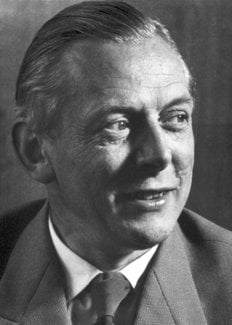
Adolf Frederick Johann Butenandt was born on March 24, 1903 at Bremerhaven-Wesermünde. The son of a business man Otto Butenandt of Hamburg, he went to school at Bremerhaven and studied chemistry at the Universities of Marburg and Göttingen. In 1927 he graduated at the University of Göttingen, where he had studied under Adolf Windaus.
From 1927 until 1930 he was Scientific Assistant at the Institute of Chemistry, Göttingen, and from 1931 until 1933 he was Privatdozent in the Department of Biological Chemistry at the University of Göttingen and acting Head of the laboratories for organic and inorganic chemistry. He then became Professor Ordinarius and Director of the Institute for Organic Chemistry at the Institute of Technology at Danzig, a post which he held until 1936.
From 1936 until 1960 he was Professor in the University of Berlin and Director of the Max Planck Institute for Biochemistry, Berlin-Dahlem, which later moved to Tübingen and then to Munich. From 1945 until 1956 he was Professor of Physiological Chemistry at Tübingen and in 1956 he became Professor of Physiological Chemistry in the University of Munich. From 1956 until 1960 he was Director of the Institute of Physiological Chemistry in the University of Munich.
Since 1960 he has been President of the Max Planck Society at Munich.
Butenandt’s name will always be associated with his work on sex hormones, for which he was awarded, jointly with Leopold Ruzicka, the Nobel Prize for Chemistry for 1939. In 1929 he isolated oestrone in pure, crystalline form, almost at the same time that E.A. Doisy did this in America. In 1931 he isolated androsterone in pure, crystalline form. From androsterone he as well as Ruzicka, independently of each other, obtained testosterone in 1939, a compound which had been obtained from the testes in 1935 by Ernst Laqueur. Progesterone was isolated by Butenandt from the corpus luteum in 1934.
In addition to these researches, Butenandt carried out much investigation of the interrelationships of the sex hormones and on the possible carcinogenic properties of some of them. His work on the sex hormones was largely responsible for the production of cortisone on a large scale.
A great number of honours and distinctions was bestowed upon him. He was awarded several medals and prizes from Germany, France, Sweden and England, he received the Grand Cross for Federal Services with Star (1959), he holds six honorary doctorates (Munich, Graz, Leeds, Madrid and two from Tübingen) and is Freeman of the city of Bremerhaven. He is corresponding member of the Academy of Sciences at Göttingen, honorary life member of the New York Academy of Sciences, and honorary member of the Japanese Biochemical Society, the Deutsche Akademie der Naturforscher Leopoldina, Halle, and the Austrian Academy of Sciences.
He married Erika Ziegner in 1931; they have seven children and live at Munich-Obermenzing.
This autobiography/biography was written at the time of the award and first published in the book series Les Prix Nobel. It was later edited and republished in Nobel Lectures. To cite this document, always state the source as shown above.
Adolf Butenandt died on January 18, 1995.