Otto Hahn – Banquet speech
Otto Hahn’s speech at the Nobel Banquet in Stockholm, December 10, 1946 (in German)
Der Schwedischen Akademie der Wissenschaften und dem Nobelkomite möchte ich meinen tiefgefühlten Dank aussprechen für die grosse Ehre, die sie mir mit der Erteilung des Nobelpreises erwiesen haben, und auch Ihnen, sehr verehrter Herr Präsident Curman, möchte ich herzlich danken für Ihre gütigen Worte.
Mein Dank ist besonders tiefempfunden, weil ich hier als Angehöriger eines Landes stehe, das durch sein Regime und durch einen fast 6-jährigen Krieg das wohl unglücklichste Land der Welt geworden ist. Es steht allein da und hat keinen Freund. Durch die Verleihung des Preises glaube ich aber doch zu erkennen, dass die Verbindung wenigstens der internationalen Wissenschaft nicht abgerissen ist. Diesen beglückenden Eindruck hatte ich schon vor einigen Monaten, als ausländische, vor allem britische Gelehrte nach Göttingen kamen, um an den Tagungen der Chemiker und Physiker in der Britischen Zone teilzunehmen. Denselben Eindruck hatten wir durch die Einladung einzelner Deutscher nach England zur Newton-Feier und zu einem Röntgen-Kongress.
Es ist ja wirklich nicht so, dass während der letzten 13 Jahre alle Deutschen und vor allem alle deutschen Wissenschaftler sich mit fliegenden Fahnen dem Hitlerregime verschrieben hätten.
Und dass die Wissenschaft auch während des Krieges in Deutschland nicht zum Erliegen kam, wird die auf Anregung der Alliierten zurzeit in Deutschland zur Veröffentlichung vorbereitete Monographien-Sammlung wohl zeigen, wenn die Arbeiten auch vielfach unter dem Motto «kriegswichtig» oder gar «kriegsentscheidend» liefen. Tausende junger Deutscher sind dadurch der Forschung erhalten geblieben. Tausende wurden in die neue Zeit herübergerettet.
Und was die deutsche Jugend angeht, so ist das Verhalten grosser Teile von ihr vielleicht nicht so hart zu beurteilen, wie es wohl gelegentlich geschieht. Sie hatte ja keine Möglichkeiten einer eigenen Urteilsbildung, keine unabhängige Presse, keine ausländische Radioübertragung, konnte das Ausland nicht persönlich kennenlernen. Wer ins Ausland geschickt wurde, wurde überprüft, und wer Kritik übte, wurde nicht fortgelassen.
Wieviel leichter war es für uns von der alteren Generation. Dass ich das Glück habe, heute hier zu sprechen, verdanke ich meinem verehrten englischen Lehrer, Sir William Ramsay, auf dessen Vorschlag ich von der Organischen Chemie zur Radioaktivitat übergewechselt bin, verdanke ich vor allem meinem hochverehrten Lehrer, Professor Rutherford, der vor 40 Jahren mit seiner eigenen Begeisterung mich selbst mit Begeisterung fiir das damals neue Gebiet der Radiumforschung erfüllte.
Und bis in die letzten Jahre hinein konnte ich die Verbindung mit dem Ausland aufrechterhalten. 1939 hatte ich die Möglichkeit, in den drei skandinavischen Ländern und in England ein paar Vorträge zu halten, und 1943 verlebte ich einige unvergessliche Tage in Ihrer wunderschönen Stadt. Schon damals kam mir das wie ein Märchen vor; wieviel mehr noch ist dies heute der Fall!
Bis in die letzte Zeit hinein scheinen übrigens meine Reisen nicht aufgehört zu haben! Wenn ich die Zeitungen des Jahres 1946 aufschlage, so kann ich lesen, dass ich in Tennessee in den Vereinigten Staaten gesehen wurde, dass ich nach Russland entfiihrt bin, dass ich aber auch schon 1939 nach Schweden emigriert bin; und was sonst noch alles über meine Tätigkeit geredet worden ist, wird umso unrichtiger je romantischer es wird. In Wirklichkeit haben wir auch während des Krieges unsere Arbeiten durchgeführt und zur Veröffentlichung gebracht. Wir sind froh darüber.
Aber alle konnten dies nicht. Es ist wohl doch nicht vielen Menschen ausserhalb Deutschlands wirklich klar, unter welchem Druck die meisten während der letzten 10 oder 12 Jahre gelebt haben; und ich darf noch einmal sagen, wieviele meiner deutschen Kollegen sich trotz aller äusserlichen Hemmnisse bemüht haben, auch die reine Wissenschaftsforschung, soweit es irgend möglich war, wahrend der Kriegszeit fortzusetzen.
Noch einmal meinen tiefempfundenen Dank!
From Les Prix Nobel en 1946, Editor Arne Holmberg, [Nobel Foundation], Stockholm, 1946
Otto Hahn – Nobel Lecture
Nobel Lecture, December 13, 1946
From the Natural Transmutations of Uranium to Its Artificial Fission
Read the Nobel Lecture
Pdf 175 kB
Otto Hahn – Other resources
Links to other sites
On Otto Hahn from Chemical Heritage Foundation
On Otto Hahn from Atomic Heritage Foundation
Otto Hahn – Nominations
Award ceremony speech: The Nobel Prize in Chemistry 1944
Presentation Speech by Professor A. Westgren, Chairman of the Nobel Committee for Chemistry of the Royal Swedish Academy of Sciences, on December 10, 1945*
Your Majesty, Your Royal Highnesses, Ladies and Gentlemen.
When chemical compounds form or decompose, interaction takes place between the outer parts of the electron shells. In view of the fact that, up to recent times, chemistry was nearly entirely concerned with the study of the combining of atoms and their release from combined units, it can be said that up till recently it was the science of the peripheral parts of the atom. But today a new discipline has grown up, that of nuclear chemistry, which deals with the centre parts of atoms, their nuclei, and which to judge from its recent achievements, promises to revolutionize science.
An atomic nucleus is a very small thing. Rutherford found that its diameter is about ten thousand times smaller than that of the atom, or about one billionth (10-12) of a centimetre. And yet, by means of the particles charged with energy of the radioactive elements, particles which act as projectiles, he succeeded in detaching small fragments from certain nuclei. The fragments detached in this way were found to be hydrogen nuclei or protons, which showed that these atomic nuclei, despite their minute dimensions, were composite structures made up of protons. Later, Joliot and his wife Irène Joliot-Curie studied in greater detail what happens when different kinds of elements are exposed to radiation by positive particles rich in energy. Here transmutations of elements may occur, but the atoms which then form are generally unstable and break up spontaneously with the emission of different kinds of elementary particles.
Fermi used the neutron discovered by Chadwick as a projectile to obtain nuclear syntheses. The neutron has the same mass as the proton, but as its name indicates it differs from it through bearing no charge. Thus it is not repelled by the positive atomic nuclei and will combine with them more easily than the projectiles with a positive charge used previously. In this way Fermi was able to produce a large number of new kinds of radioactive atoms.
All these researches into nuclear chemistry were concerned with relatively slight modifications to the mass of the reactive nuclei. Here it was simply a question of the addition or loss of different sorts of elementary particles. The reaction processes discovered by Otto Hahn are of quite a different nature. They involve the splitting of heavy atomic nuclei into two parts of more or less equal size.
In collaboration with Lise Meitner, with whom he has worked for nearly thirty years, Hahn studied from 1936 to 1938 the products obtained by projecting neutrons on to the heaviest elements, thorium and uranium. According to Fermi, elements would appear which would form a continuation of the Periodic Table of the elements. Hahn and Meitner believed they could confirm this assumption. But towards the end of 1938, Hahn, in an investigation carried out with one of his young colleagues, F. Strassmann, found that one of the products formed through the reaction of uranium with neutrons and which had been assumed to be a kind of radium, behaved chemically in fact like barium. In January 1939 Hahn announced this discovery and expressed in very discreet terms the daring opinion that on being allied with neutrons, the atoms of the heaviest elements could split in half as it were and produce elements belonging to the middle of the Periodic Table of the elements. After a month he was able to provide proof of his theory, which was confirmed almost simultaneously in research carried out in different parts of the world by scientists using different methods.
Hahn’s discovery caused great surprise and evoked lively interest among the world’s scientists. It was immediately made the object of important theoretical investigations by Lise Meitner and Frisch, who based their study on the theory of the structure of atomic nuclei developed by Bohr. These investigators pointed out that nuclear fission should take place with an enormous generation of energy, due to the conversion of matter into energy. Calculations showed that the fragments produced in this break-up would disperse in all directions with immense force. Frisch demonstrated this experimentally. In connection with Joliot’s observation that certain products of nuclear fission break up with the emission of neutrons, this discovery indicated that it was possible by splitting uranium to produce a chain reaction generating a very large amount of energy. The outlook for later research thus became very promising.
Without equal in the art of the chemical identification of radioactive elements in minute quantities, Hahn, together with his colleagues, paved the way for the chemical research which had to be carried out on the numerous products of the splitting of heavy atomic nuclei. Fission can be carried out in many ways, depending on the structure of the reactive nuclei and the energy of the splitting neutrons. The primary products of fission are unstable and they gradually decompose, emitting elementary particles, so that each of them acts as the starting-off point for more or less long series of different sorts of atoms. So far, the presence has been demonstrated of about one hundred bodies which are the direct or indirect products of the processes of the splitting of matter; these products are connected with 25 elements which lie between selenium and praseodymium in the Periodic Table of the elements.
The discovery of nuclear fission is very momentous and indeed dangerous, but even more, it is full of promise. In autumn 1943, Hahn read a paper to the Swedish Academy of Sciences on his latest work in nuclear chemistry, and there referred to the possibility of splitting uranium by means of a chain reaction. In this process such enormous quantities of energy would be produced in a short instant that the effect would exceed any explosion phenomenon so far known. Hahn doubted however whether it was possible to surmount the technical difficulties involved. “Providence has not wanted the trees to reach to the sky”, he said, and his hearers guessed from the passion in his voice that he wished that this conquest of atomic energy had been made at a much later date. He certainly shuddered at the thought that the atomic bomb was nearer at hand than the use of atomic energy for peaceful purposes.
Hahn’s work has been inspired throughout by an invincible desire to solve the problems which he has encountered. Unlike Prometheus, who gave fire to Man, he has never dreamed of giving Man control over atomic energy. May humanity weigh deeply the responsibility which the gift of this discovery has imposed on it. Then this will be a blessing and a step towards the improvement of the conditions of human life.
The Academy of Sciences has decided to award to Professor Hahn the Nobel Prize in Chemistry for the year 1944 in reward for his discovery of the fission of heavy atomic nuclei. Professor Hahn has expressed his gratitude, but he has informed us that he is regrettably unable to attend this ceremony. Therefore the decision of the Academy cannot at present be implemented by the awarding of the prize.
Professor A. Tiselius addressed the following words to Professor Otto Hahn, at the Nobel Prize Award Ceremony on December 10, 1946
Professor Hahn. At the Nobel ceremony held on 10th December, 1945, you were unfortunately unable to be here in person to receive your Nobel Prize. On that occasion, however, a detailed account of the results of your researches was given by the President of the Nobel Committee for Chemistry. I must therefore restrict myself today to the expression of our great pleasure at the fact that you are able to attend today in person to receive your prize and our congratulations. The discovery of the fission of heavy nuclei has led to consequences of such a nature that all of us, indeed the whole of humanity, look forward with great expectations, but at the same time with great dread, to further developments. I am convinced, Professor, that just as your great discovery has been a result of your far-reaching researches on atomic nuclei, irrespective of any eventual practical applications, the further ardent development of research in this field as a consequence of your work will be of particularly great pleasure to you. With regard to its practical application I am also sure that you share all our hopes that this application will serve in the end as a blessing to mankind.
Professor Otto Hahn. Whilst offering you the sincere congratulations of the Academy, I ask you to receive from the hands of His Majesty the King the Nobel Prize for Chemistry for the year 1944.
* The Nobel Prize in Chemistry 1944 was announced on November 15, 1945.
The Nobel Prize in Chemistry 1944
Otto Hahn – Biographical
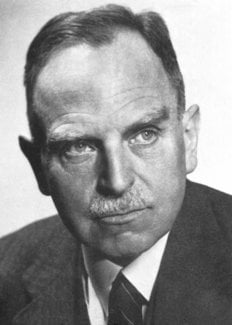
Otto Hahn was born on 8th March, 1879, at Frankfurt-on-Main. He attended the secondary high school there until he matriculated.
From 1897 Hahn studied chemistry at Marburg and Munich, taking his doctorate examination in 1901 at Marburg and submitting to Professor Theodor Zincke a thesis on organic chemistry.
He obtained a post as assistant in the Chemical Institute at Marburg, staying there two years, after which he worked under Sir William Ramsay at University College, London, from the autumn of 1904 to the following summer. His work here was rewarded by the discovery of a new radioactive substance, radiothorium, while working on the preparation of pure radium salts.
From the autumn of 1905 to the summer of the following year Hahn was at the Physical Institute of McGill University, Montreal (Canada) working under Professor Ernest Rutherford. Here he discovered radioactinium and conducted investigations with Rutherford on alpha-rays of radiothorium and radioactinium.
On his return to Europe Hahn moved to Berlin, to the Chemical Institute (Emil Fischer) of the University and there he qualified as a university lecturer in the spring of 1907, which year also saw his discovery of mesothorium.
At the end of 1907, Dr. Lise Meitner came to Berlin from Vienna and then began more than thirty years’ collaboration. Their joint work embraced: investigations on beta-rays, their absorbability, magnetic spectra, etc.; use of the radioactive recoil, discovered shortly before by Hahn, to obtain new radioactive transformation products.
Between 1914 and 1918 Hahn’s work was interrupted by his service in the First World War, but he resumed his research with Professor Meitner in 1918, and discovered protactinium, the long-lived mother substance of the actinium series. Hahn’s own particular sphere was chemistry and he further discovered uranium Z, the first case of a nuclear isomerism of radioactive kinds of atoms. Using radioactive methods he investigated the absorption and precipitation of the smallest quantities of substances, normal and abnormal formation of crystals, etc. Hahn used the emanation method to test substances superficially rich or poor, and he elaborated the strontium method to determine the age of geological periods.
Following the discovery of artificial radioactivity by M and Mme. Joliot-Curie and the use of neutrons by Fermi for atomic nuclear processes, Hahn again collaborated with Professor Meitner and afterwards with Dr. Strassmann on the processes of irradiating uranium and thorium with neutrons.
Hahn and Prof. Meitner had also worked together on the discovery of an artificially active uranium isotope, which represents the basic substance of the elements neptunium and plutonium, first revealed later in America.
Hahn’s work has won recognition in many learned circles. In 1912 he became scientific member of the Kaiser Wilhelm Institute for Chemistry and has been Director of this Institute since 1928. 1933 saw his appointment as Visiting Professor at Cornell University, Ithaca, New York. From 1st April, 1946, he has officiated as President of the Kaiser Wilhelm Society and from 28th February, 1948, has served as President of the Max Planck Society in Western Germany, being created Honorary President of the same Society in May, 1960.
His most spectacular discovery came at the end of 1938. While working jointly with Dr. Strassmann, Hahn discovered the fission of uranium and thorium in medium heavy atomic nuclei and his first work on these subjects appeared on 6th January and 10th February, 1939, in Naturwissenschaften. Since that time and until 1944 Hahn continued investigation on the proof and separation of many elements and kinds of atoms which arise through fission.
Hahn has been granted membership of the Academies of Berlin, Göttingen, Munich, Halle, Stockholm, Vienna, Boston, Madrid, Helsinki, Lisbon, Mainz, Rome (Vatican), Allahabad, Copenhagen, and the Indian Academy of Sciences.
In 1913 Hahn married Edith, née Junghans and they had one son, Hanno, born in 1922, killed by accident in 1960.
This autobiography/biography was written at the time of the award and first published in the book series Les Prix Nobel. It was later edited and republished in Nobel Lectures. To cite this document, always state the source as shown above.
For more updated biographical information, see: Hahn, Otto, My Life. Macdonald & Co, London, 1970.
Otto Hahn died on July 28, 1968.