Lord Todd – Photo gallery

1 (of 1) The 1957 Nobel Prize laureates assembled onstage for the Nobel Prize award ceremony on 10 December. From left: Physics laureates Chen Ning Yang and Tsung-Dao Lee, chemistry laureate Lord Todd, medicine laureate Daniel Bovet and literature laureate Albert Camus.
Photo credit: The Chinese University of Hong Kong
Lord Todd – Banquet speech
Lord Todd’s speech at the Nobel Banquet in Stockholm, December 10, 1957
Your Majesties, Your Royal Highnesses, Your Excellencies, Ladies and Gentlemen,
I find it hard to express adequately my appreciation of the honour which has been done me – for surely the bestowal of a Nobel Prize is the greatest honour a man of science can receive. It is, at the same time, an honour which brings with it a sense of humility and when I think of the great names which adorn the roll of Nobel prizewinners in chemistry, I am deeply moved that the Royal Swedish Academy of Sciences should have felt me worthy of such recognition. And I would mention especially that among these names is that of Sir Robert Robinson, whom I first knew as my teacher and since then as a staunch friend, I am proud to acknowledge publicly the immense debt I owe him for his guidance and encouragement.
In making its award, the Academy is recognising not only my work but also that of the research students from many lands with whom I have had the good fortune to be associated over the years. Without their devoted help I should have achieved but little and I am deeply grateful to them.
As an organic chemist I have naturally a soft spot in my heart for Sweden – for was it not your countryman Berzelius who first defined organic chemistry as the chemistry of the substances found in living matter? There have been other, later, definitions of different types and it is, of course, clear, if only from the enormous development of the organic chemical industry that the science deals with many things seemingly far removed from living matter. But, for myself, I have in my work followed, in the main, the definition of Berzelius, and I believe that we stand today on the threshold of a new era in which the organic chemist following this path may provide the keys necessary to unlock the secrets of the cell nucleus. There is, in these days, a natural tendency for us to marvel at the secrets of the atomic nucleus, whose exploration by the physicists and whose harnessing for use – and, alas, misuse – by man have been the outstanding feature of this century so far. The nucleus of the living cell has received much less notice. But in my view the secrets of the cell nucleus are at least as important as those of the atomic nucleus and their revelation may yet prove to be man’s greatest triumph in the second half of the twentieth century. In this revelation, the organic chemist must play a major role and the outlook for the young research worker is as bright and full of promise as it has ever been in the past.
In conclusion, I should like also to express on behalf of myself, my wife and my family our thanks for your warm welcome and your wonderful hospitality. We are indeed grateful and we will always cherish the memory of this occasion.
Prior to the speech, B. Karlgren, Member of the Royal Academy of Sciences, addressed the laureate: You have, Sir Alexander, with a rare tenacity and a wonderful acumen pushed forward step by step into the enigmatic realm that now fascinates many of the keenest brains working in the field of organic chemistry, that of the fundamental structure of the cells. From your workshop in that venerable stronghold of learning and research, Cambridge, you have been able to issue bulletins announcing victories upon victories, time and again new domains conquered by you and your collaborators, and today no scholar can seriously approach this line of research without making constant and extensive use of your results. No wonder that your colleagues in the Stockholm Academy have been eager to signalize your conquests by aid of the Nobel prize. Our congratulations should best be formed as a fervent wish that you will be allowed to continue for many years your epoch-making studies.
Lord Todd – Nobel Lecture
Nobel Lecture, December 11, 1957
Synthesis in the Study of Nucleotides
Read the Nobel Lecture
Pdf 100 kB
Lord Todd – Nominations
Lord Todd – Other resources
Links to other sites
Lord Todd – Facts
Award ceremony speech
Presentation Speech by Professor A. Fredga, member of the Nobel Committee for Chemistry of the Royal Swedish Academy of Sciences
Your Majesties, Your Royal Highnesses, Ladies and Gentlemen.
Nucleotides and nucleotide coenzymes are words that may seem strange and abstruse, but these compounds are of great importance to all of us. We have such substances everywhere in our bodies and they regulate many of the processes of life. The term is derived from nucleus, which here refers to cell-kernels or nuclei. The Nobel Prize of this year has nothing to do with atomic nuclei, nuclear fission or hydrogen bombs. Nucleotides are regularly found in the chromosomes of the cell-kernels, where they are connected with the units of heredity, but also in the cell plasma. In combination with proteins they constitute the virus molecules and many coenzymes are nucleotides of low molecular weight but with a special structure. Thus they are a group of substances of very great biological importance, perhaps the most important of all.
The nucleotides have been known for nearly 90 years and they have been frequently studied by both chemists and biologists, but for a long time they were, from the chemist’s point of view, an underdeveloped field of research. The difficulties were too great. Gradually it was established that they are built up of three different kinds of “building-stones” of quite different chemical character: phosphoric acid, a sugar, and a heterocyclic base containing nitrogen. I cannot express it more popularly, except to mention that these bases are compounds related to caffeine. Two different sugars are found, ribose and desoxy-ribose, and about half a dozen different bases. The simple building-stones may then be combined in hundreds or thousands to form macromolecules, the nucleic acids.
It is, however, not enough to know the building-stones; we must also know how they are connected to each other. The building-plan, the pattern or whatever you prefer to call it, must be very essential for the behaviour of the macromolecule in chemical and biological processes. The sugars and the heterocyclic bases are both somewhat complicated molecules, which may be connected to each other in several different ways, and finally it must be established how the phosphoric acid is bound. The task is very difficult; the combination of three quite different kinds of building-stones in one macromolecule gives it a very special character and neither the traditional methods of organic chemistry, nor those of inorganic chemistry are directly applicable. It is, however, pre-eminently a task for an organic chemist, and for more than ten years Sir Alexander Todd has held a leading position in this field.
Some idea of the building-plan may be obtained by examining the products formed by partial degradation of the macromolecule into small fragments containing a limited number of building-stones. Conclusive evidence can, however, only be obtained by synthetic methods, by building up possible combinations of sugars and bases – with or without phosphoric acid and comparing them with the degradation products. It is of course imperative to use such methods that the structure of the synthetic products is irrefutable.
The work has been very comprehensive, and many special methods have been evolved, but it is hardly possible to give a non-chemist a clear idea of the brilliant experimental work accomplished. Perhaps I should specially mention the methods for introducing phosphoric acid, the phosphorylation. In recent years, the fundamental role of phosphoric acid in the biochemical processes has become more and more evident, and the new phosphorylation methods – now approximating to those used in the biosynthetic procedures – are also of interest outside the special domain of nucleotide chemistry.
The building-plan of the nucleic acids is now established, at least in its outlines. We have a long chain, where the links are alternately sugar and phosphoric acid, and to each sugar molecule is attached a heterocyclic base as a small pendant. Thus there is an equal number of acid and basic groups. The different building-stones are always connected according to the same pattern and the difference between various nucleic acids must therefore be due to the kinds of bases and their relative arrangement. The number of different types is small – in a certain chain usually only four different bases occur – but in a macromolecule with thousands of appendant base molecules the number of possible combinations must be very great. We are familiar with the coding potentialities of the Morse alphabet, which has only two symbols, dots and dashes.
Through Sir Alexander’s work a solid foundation is laid for the future development in this field. Starting from this work, other scientists have advanced very fascinating theories as to the arrangement of the chains; it seems that they may be coiled up as a helix with the bases inside. This model can perhaps explain how a nucleic acid chain can bring about the formation of another similar chain or even of a protein. We are here approaching very fundamental biological questions.
The synthetic methods have also been successfully applied to the preparation of low-molecular nucleotide coenzymes, for instance the cozymase, which plays a part in alcoholic fermentation and other biochemical processes. The ways are now open for synthetic preparation of the different types occurring in nature. It is also possible to synthesize coenzymes with slightly modified structure and study the effect of these modifications on the activity, and hence gain better insight into the mode of action of the enzymes.
Sir Alexander Todd. Some fifteen years ago you started your work in nucleotide chemistry. You saw the great importance of this topic and you did not underrate the difficulties. Today the chemical structure of these compounds is established – in any case in its outlines – and a solid foundation is laid for future work by biochemists and biologists. Results of utmost interest have already been reported and others will follow.
An organic chemist is perhaps most impressed by your studies in phosphorylation. We know today that phosphoric acid is engaged in most biochemical processes, but we know rather little of how it works. Some years ago, you expressed the opinion that the methods used by the living organism owe their air of magic largely to our lack of knowledge of the simple chemistry of the esters of phosphoric acids. You have learned to handle these esters with amazing skill, and I am sure that in due time the air of magic will disperse.
In recognition of your services to chemistry and to natural science as a whole, the Royal Swedish Academy of Sciences has decided to bestow upon you the Nobel Prize for Chemistry for your work on nucleotides and nucleotide coenzymes. To me has been granted the privilege of conveying to you the most hearty congratulations of the Academy, and of inviting you to receive your prize from the hands of His Majesty the King.
The Nobel Prize in Chemistry 1957
Lord Todd – Biographical
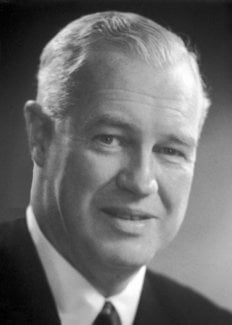
Sir Alexander Robertus Todd was born in Glasgow on October 2, 1907, the elder son of Alexander Todd, a business man of that city, and his wife Jean Lowrie. He was educated at Allan Glen’s School and Glasgow University, where he took his B.Sc. degree in 1928 and, after a short initial research training with T.S. Patterson he proceeded to the University of Frankfurt-on-Maine. Here he studied under W. Borsche and obtained his Ph.D. (Dr.Phil.nat.) in 1931 for a thesis on the chemistry of the bile acids.
Returning to England he worked from 1931-1934 on anthocyanins and other colouring matters with Sir Robert Robinson, the Nobel Prize winner, and took a Ph.D. degree at Oxford University in 1933.
Todd went back to Scotland in 1934 when he joined the staff of Edinburgh University under G. Barger. Two years later, i.e. in 1936 he moved to the Lister Institute of Preventive Medicine, Chelsea, and became Reader in Biochemistry in the University of London in 1937.
In 1938 he was appointed as Sir Samuel Hall Professor of Chemistry and Director of the Chemical Laboratories of the University of Manchester, which position he held until 1944, when he accepted an appointment as Professor of Organic Chemistry at Cambridge University and Fellow of Christ’s College.
Todd’s work has gained him recognition in many universities and countries. He holds the D.Sc. degree of Glasgow University and has had bestowed upon him honorary doctorates from the Universities of Kiel (Dr.rer.nat.), Glasgow (LL.D.), Hon.D.Sc. London (1958), Madrid (1959), Exeter (1960), Leicester (1960), Aligarh (1960), and in 1961 Wales, Yale and Sheffeld; also Hon.LL.D. from Melbourne in 1960. He is a Fellow of the Royal Society, foreign member of the National Academy of Sciences, the American Academy of Arts and Sciences, the Austrian Academy of Sciences and the Spanish Council of Scientific Investigation, and an honorary member of the French, German and Spanish chemical societies and member of the Deutsche Akad. Naturforscher Leopoldina, Halle, (1959). He holds the Meldola Medal of the Royal Institute of Chemistry and the Society of Maccabeans; the Davy Medal and Royal Medal of the Royal Society, the Cannizaro Medal of the Italian Chemical Society and the Lavoisier Medal of the French Chemical Society. He has been Tilden Lecturer and Pedler Lecturer of the Chemical Society, Bakerian Lecturer of the Society of Chemical Industry, also visiting professor at California Institute of Technology (1938), the University of Chicago (1948), Sidney University (1950), Massachusetts Institute of Technology (1954) and the University of California (1957). He was elected Hon. Member, New York Academy of Sciences (1959), Hon. Fellow of the Royal Australian Chemical Institute (1960), President of the Chemical Society, London, 1960-1962, Master of the Worshipful Company of Salters, 1961-1962.
Todd has taken considerable interest in international scientific affairs; he is President of the International Union of Pure and Applied Chemistry, and Chairman of the British National Committee for Chemistry. He has served on many Government Committees and in 1952 was elected Chairman of the British Government’s Advisory Council on Scientific Policy. He is a Managing Trustee of the Nuff’eld Foundation.
The main subjects of Todd’s researches have been the chemistry of natural products of biological importance and, in addition to the nucleotide and nucleotide coenzyme studies described in his Nobel Lecture, the chemistry of vitamins B1, E and B12, the constituents of Cannabis species, insect colouring matters, factors influencing obligate parasitism and various mould products.
Knighted in 1954, he was raised to the Peerage in March, 1962, being created Baron Todd of Trumpington.
Lord Todd is married to Alison Sarah, daughter of Nobel Prize winner Sir Henry Dale, and they have a son, Alexander Henry, and two daughters, Helen Jean and Hilary Alison.
This autobiography/biography was written at the time of the award and first published in the book series Les Prix Nobel. It was later edited and republished in Nobel Lectures. To cite this document, always state the source as shown above.
Lord Todd died on January 10, 1997.