Melvin Calvin – Nobel Lecture
Nobel Lecture, December 11, 1961
The Path of Carbon in Photosynthesis
Pdf 443 kB
Melvin Calvin – Other resources
Links to other sites
‘Discovery of the canonical Calvin-Benson cycle’ from DOE Pages
Melvin Calvin – Banquet speech
Melvin Calvin’s speech at the Nobel Banquet in Stockholm, December 10, 1961
Your Majesties, Your Royal Highnesses, Your Excellencies, Ladies and Gentlemen.
To express to you in mere words, our personal feelings on this occasion you must know to be impossible, and particularly so for one who normally has to describe only things outside himself. You have honoured my colleagues, my family and me, but mostly my comrades in science. I speak not only of those with whom I have had the pleasure to work directly – but the many others who preceded us and surround us in our work. For each of us who appear to have had a successful experiment there are many to whom their own experiments seem barren and negative. But they contribute their strength to the structure within which we all build.
Alfred Nobel, in creating his foundation and naming the four prize-awarding bodies, sought to enhance international understanding. By elevating scientists and thus their science he has certainly succeeded. If I may take the liberty to speak for science at least, today his name and his prizes are without a peer in the world. He not only elevates science but he influences it as well.
Your Majesty – your Royal Academy of Science and its Nobel Committees in physics and in chemistry and your Royal Caroline Medico-Chirurgical Institute and its Nobel Committee have done their work so well over the past six decades that their decisions are universally accepted and point the new frontiers in science for the coming generations. He designed well and you and your countrymen may well be proud of your construction.
Prior to the speech, G. Liljestrand, member of the Royal Academy of Sciences, addressed the laureate: No chemical process has a greater importance than the incorporation of atmospheric carbon dioxide into the starch molecule of the green plants under the influence of light from the sun. This reaction is the foundation of life, not only for the green plants themselves but also for all higher animals. This complicated process – the object of intense studies for more than a century – has now been unravelled, Professor Calvin, by your establishing the intermediate steps in the reaction. We express our deep admiration of your achievements.
Melvin Calvin – Photo gallery

1 (of 1) Melvin Calvin receiving his Nobel Prize from His Majesty the King Gustav VI Adolf of Sweden at the Stockholm Concert Hall, December 10, 1961.
Source: Berkeley Lab Image Library Photographer unknown Public domain via Wikimedia Commons
The Nobel Prize Award Ceremony 1961
Credit: ITN Archive/Reuters
Melvin Calvin – Nominations
Award ceremony speech
Presentation Speech by Professor K. Myrbäck, member of the Nobel Committee for Chemistry of the Royal Swedish Academy of Sciences
Your Majesties, Your Royal Highnesses, Ladies and Gentlemen.
In order to grow and to perform its various activities, every living organism needs a supply of energy in some suitable form. In this respect the organisms existing on this planet can be divided into two fundamentally different groups. All animals, including man, and also some lower organisms, require a supply of energy-rich organic material, food-stuffs that “contain calories”, to use a popular expression. The energy contained in the food-stuffs is made available by a biological oxidation (“combustion”) of carbohydrates, fats, etc. Obviously, these types of organisms, the so-called heterotrophic organisms, are absolutely dependent on supplies of organic material, occurring outside themselves.
As opposed to the heterotrophic organisms, the organisms belonging to the second group, the so-called autotrophic organisms, i.e. the green plants and certain bacteria, do not require organic material supplied from without. They synthesize organic compounds, primarily carbohydrates, from simple substances, carbon dioxide and water, substances that, in themselves, do not contain any calories. The energy needed for the synthesis is supplied by light which is absorbed by the organisms and subsequently converted by them from light energy into chemical energy. The sequence of reactions by which carbon dioxide and water are converted to carbohydrate is called carbon dioxide assimilation or, taking into account the role of light energy, photosynthesis.
It becomes obvious that photosynthesis not only provides an explanation for the existence of the autotrophic organisms but also furnishes food for man and animals. In other words, photosynthesis is the absolute prerequisite for all life on earth and the most fundamental of all biochemical reactions. It has been estimated that plants and microorganisms on earth transform about 6,000 tons of carbon from carbon dioxide to carbohydrate per second, with at least four-fifths of this amount contributed by organisms in the oceans.
It is understandable that a reaction of such importance and such dimensions should attract the interest of science at an early stage. For more than a century, however, progress in the understanding of the chemistry of photosynthesis was very slow, partly for want of suitable experimental methods.
More than fifty years ago it was recognized that photosynthesis comprised two distinct phases, light reactions and dark reactions. The Nobel Laureate today, Dr. Melvin Calvin, has spent many years of research work on the chemistry of both phases of photosynthesis and, in the case of the second phase, that is to say the reactions leading from carbon dioxide to the assimilation products – to quote Calvin, “the path of carbon in photosynthesis” his work has resulted in the complete clarification of an extremely intricate problem.
Success was achieved as a result of sharp-witted, skilful and persistent work, to some degree facilitated by the availability of certain modern experimental methods that allow investigations which, in older times, were simply impossible. Two such methods may be mentioned: the method of the isotopic labeling of molecules, introduced by de Hevesy, and the chromatographic methods, developed by Martin and Synge, which permit the separation of minute quantities of compounds in complicated mixtures. By an ingenious combination of these and many other methods, Calvin succeeded in tracking the path of the carbon atom from carbon dioxide, taken up by the plant, to the finished assimilation products. The radioactive carbon isotope, 14C well-known also in other connections, has played a particularly important role in Calvin’s work.
Most of Calvin’s experiments have been performed using a microscopic green alga, Chlorella pyrerloidosa, but parallel experiments with higher plants have shown that the mechanism of carbon dioxide assimilation is the same in all plants.
A question that had occupied scientists for more than a century, was: “What is the primary product of the assimilation; what first happens to the carbon dioxide taken up by the plant?” Calvin demonstrated that the primary reaction is not, as had been assumed previously, a reduction of carbon dioxide as such, but a fixation of carbon dioxide to a substance, the carbon dioxide acceptor, occurring in the plant. Calvin was able to show that the product formed in this fixation reaction is an organic compound known as phosphoglyceric acid.
This discovery was of fundamental importance for the development that followed. The primary product of assimilation was recognized as being a compound, well-known from earlier work as an intermediary product of the biological degradation of carbohydrates, and not some previously unknown compound; phosphoglyceric acid had been identified as a breakdown product of sugar as early as 1929 by Ragnar Nilsson here in Stockholm. Calvin’s identification of the primary assimilation product with phosphoglyceric acid led to the very important conclusion that there is an intimate connection between photosynthesis and carbohydrate metabolism as a whole.
Calvin’s subsequent investigations mapped out the path between the primary product and the end products of assimilation, the various carbohydrates. What had formerly been assumed to be a reduction of carbon dioxide was shown to be a reduction of phosphoglyceric acid. For a reduction of phosphoglyceric acid to the carbohydrate level, the plant has to supply both a reducing agent and a so-called energy-rich phosphate. It is for the production of these co-factors that plants utilize light energy. This means that light energy is not directly involved in the reactions of assimilation; light energy is used for regeneration of co-factors which are consumed in the assimilation reactions.
As mentioned above, the primary reaction in the assimilation is a fixation of carbon dioxide to an acceptor, the chemical nature of which has been established by Calvin. Rather unexpectedly, this acceptor was found to be a derivative of a sugar, ribulose, to which nobody had paid much attention previously. When carbon dioxide is fixed to the ribulose derivative, phosphoglyceric acid is formed.
As the acceptor is consumed during the fixation reaction it must obviously be regenerated from the assimilation products. Calvin has elucidated the very complicated mechanism of this regeneration. Between the primary product and the acceptor there are no less than ten intermediary products and the reactions between these products are catalyzed by eleven different enzymes.
Professor Melvin Calvin. Your investigations on plant photosynthesis have shed light on a field of biochemistry which was, until recently, veiled in obscurity. You have tracked the various steps of the path of carbon in photosynthesis and created a clear picture of this complicated sequence of reactions, reactions of immense importance for life on our planet.
On behalf of the Royal Academy of Sciences, I extend to you our warm congratulations, and I ask you to receive this year’s Nobel Prize for Chemistry from the hands of His Majesty the King.
The Nobel Prize in Chemistry 1961
Melvin Calvin – Biographical
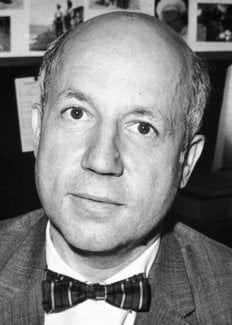
Melvin Calvin was born in St. Paul, Minnesota, April 8, 1911, of Russian emigrant parents. He received the B.S. degree in Chemistry in 1931 at the Michigan College of Mining and Technology, and the Ph.D. degree in Chemistry from the University of Minnesota in 1935. He spent the academic years 1935-1937 at the University of Manchester, England. He began his academic career at the University of California at Berkeley in 1937, as an instructor, and has been a full professor since 1947. He has served as Director of the big-organic chemistry group in the Lawrence Radiation Laboratory since 1946. This group became the Laboratory of Chemical Biodynamics in 1960.
He has been the recipient of a number of medals, awards, and lectureships, and holds membership in numerous learned societies. In addition, he has been elected to the National Academy of Sciences, the American Philosophical Society, the American Academy of Arts and Sciences, the Royal Society of London, the Royal Netherlands Academy of Sciences and Letters, and the German Academy of Scientists, Leopoldina. He holds honorary D.Sc. degrees from Michigan College of Mining and Technology, the University of Nottingham, Oxford University, and Northwestern University.
His scientific life began with a thesis on the electron affinity of halogens, done under the direction of Professor George A. Glocker at the University of Minnesota and completed in 1935. The following two-year postdoctoral period was spent with Professor Michael Polanyi at the University of Manchester, at which time his interest in coordination catalysis, particularly metalloporphyrins, was awakened. This interest is still paramount and has resulted both in theoretical (The Chemistry of Metal Chelate Compounds) and practical (oxygen-carrying synthetic chelate compounds) applications. The investigation of the electronic, photoelectric and photochemical behaviour of such materials now occupies a good fraction of his time.
Upon coming to Berkeley, California, at the invitation of Professor Gilbert N. Lewis, his interest turned to general theoretical aspects of organic molecular structure and behaviour.There were two prime publications of this period. The first, with Professor Gilbert N. Lewis, was on The Color of Organic Substances, and the second, with Professor G.E.K. Branch, was The Theory of Organic Chemistry. It was from these men that the fundamental interest in the behaviour of organic molecules in their most detailed terms was derived.
This interest combined with the earlier one on the catalytic behaviour of coordination compounds were the natural parents of his present preoccupation with the problem of photosynthesis. The ready availability of carbon-14 which began in 1945 channeled the early work to development of techniques for its use (Isotopic Carbon) and its application to the exploration of photosynthetic carbon dioxide reduction (The Path of Carbon in Photosynthesis).
An extension of his interest from here into the general problems of biology was unavoidable, and thus his laboratory is at present peopled by emigrants from all areas of science on both sides of chemistry – physics on the one hand and biology on the other.
Dr. Calvin is married to the former Genevieve Jemtegaard, daughter of Norwegian emigrant parents, they have two daughters, Elin and Karole, and one son, Noel.
This autobiography/biography was written at the time of the award and first published in the book series Les Prix Nobel. It was later edited and republished in Nobel Lectures. To cite this document, always state the source as shown above.
For more updated biographical information, see:
Calvin, Melvin, Following the Trail of Light – A Scientific Odyssey. Oxford University Press, Oxford, 1998.
Melvin Calvin died on January 8, 1997.