Geoffrey Wilkinson – Nominations
Ernst Otto Fischer – Nominations
Geoffrey Wilkinson – Biographical
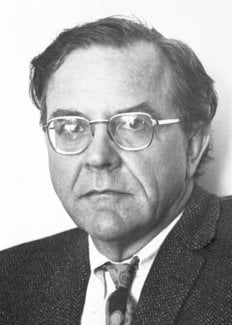
I was born in Springside, a village close to Todmorden in west Yorkshire on July 14th, 1921. The house where I was born and indeed most of the village has been demolished by the local council as being unfit for habitation. My father, and his father, also Geoffrey, were both master house painters and decorators, the latter, youngest of twelve children having migrated from Boroughbridge in Yorkshire about 1880. My mother’s family were originally of hill farming stock but many of my relations were weavers in the local cotton mills and indeed my mother went into the mill at an early age. My first introduction to chemistry came at a quite early age through my mother’s elder brother. A well known organist and choirmaster he had married into a family that owned a small chemical company making Epsom and Glauber’s salt for the pharmaceutical industry. I used to play around in their small laboratory as well as go with my uncle on visits to various chemical companies.
The oldest of three children, I was educated in the local council primary school and after winning a County Scholarship in 1932, went to Todmorden Secondary School. This small school has had an unusual record of scholarly achievement, including two Nobel Laureates within 25 years. I actually had the same Physics teacher as Sir John Cockcroft, but physics was never my favourite subject.
In 1939 I obtained a Royal Scholarship for study at the Imperial College of Science and Technology where I graduated in 1941. As it was wartime, I was directed to stay on and did some research under the supervision of my predecessor, Professor H.V.A. Briscoe. In late 1942, Professor F.A. Paneth was recruiting young chemists for the nuclear energy project which I joined. I was sent out to Canada in January 1943 and remained in Montreal and later Chalk River until I could leave in 1946. Having been attracted by the prospect of California, I wrote to, and was accepted by Professor Glenn T. Seaborg. For the next four years in Berkeley I was engaged mostly on nuclear taxonomy and made many new neutron deficient isotopes using the cyclotrons of the Radiation Laboratory.
On a visit in 1949 to England, Briscoe advised me that I was unlikely to get an academic position in England in nuclear chemistry so that when I went as Research Associate to the Massachusetts Institute of Technology in 1950, I began to return to my first interest as a student – transition metal complexes such as carbonyls and olefin complexes.
In 1951 I was offered an Assistant Professorship at Harvard University, largely because of my nuclear background. I was at Harvard from September 1951 until I returned to England in December, 1955, with a sabbatical break of nine months in Copenhagen in Professor Jannik Bjerrum’s laboratory as a John Simon Guggenheim Fellow. At Harvard, I still did some nuclear work on excitation functions for protons on cobalt but I had already begun to work on olefin complexes so that I was primed for the appearance of the celebrated Kealy and Pauson note on dicyclopentadienyliron in Nature in early 1952.
In June 1955, I was appointed to the chair of Inorganic Chemistry at Imperial College in the University of London, which, at that time was the only established chair in the subject in the United Kingdom and took up the position in January 1956. I have been at the College ever since and have worked, with a relatively few students and postdoctoral fellows, almost entirely on the complexes of transition metals. I have been much interested in the complex chemistry of ruthenium, rhodium and rhenium, in compounds of unsaturated hydrocarbons and with metal to hydrogen bonds. The latter led to work on homogeneous catalytic reactions such as hydrogenation and hydroformylation of olefins.
In 1952 I married Lise Sølver, only daughter of Professor and Mrs. Svend Aage Schou, lately Rector of Denmark’s Pharmaceutical High School and we have two daughters.
This autobiography/biography was written at the time of the award and later published in the book series Les Prix Nobel/ Nobel Lectures/The Nobel Prizes. The information is sometimes updated with an addendum submitted by the Laureate.
Sir Geoffrey Wilkinson died on September 26, 1996.
Geoffrey Wilkinson – Other resources
Links to other sites
On Geoffrey Wilkinson from The Yorkshire Philosophical Society
On Geoffrey Wilkinson from Lindau Nobel Laureate Meetings
Ernst Otto Fischer – Nobel Lecture
Nobel Lecture, December 11, 1973
On the Road to Carbene and Carbyne Complexes
Read the Nobel Lecture
Pdf 253 kB
Geoffrey Wilkinson – Banquet speech
Geoffrey Wilkinson’s speech at the Nobel Banquet, December 10, 1973
Your Majesty, Your Royal Highnesses,
Ladies and Gentlemen, My Fellow Students,
It is an old English convention that experienced speakers always begin by saying “unaccustomed as I am to public speaking”. In my case it is really true and when I was given the honour of replying on behalf of my fellow Nobel Laureates, and was struggling to find some appropriate phrases, I was reminded in my situation, though in an insignificant way, by a similarity to the plight of the ancient Chinese philoshoper Lao Weh Chang.
As you will recall, as a young man, labouring under the wild fig trees of Fu Chong, he discovered the secret of transforming base metals into gold. With increasing knowledge of the chemical arts of old China, he was able to turn everything into everything else, and ultimately at his pinnacle, everything into nothing. Finally, when contemplating the awesome magnitude of his achievements he was rendered totally speechless. But we have it on excellent authority that whenever he opened his mouth there ensued a most magnificent display of fireworks and all was suffused with an everlasting rosy glow.
Now friends, when I was labouring under the eucalyptus trees of California, I too made some gold, but unfortunately it was only from platinum and I didn’t make much since it was costing 100 m dollars a gram. Later I turned many things into many other things but the ultimate has always eluded me. However, my students have quite often turned everything into nothing but a lot of old rubbish. Finally on October 23rd, when contemplating what had been wrought here in Stockholm, I too was rendered speechless. Unfortunately this proved only temporary, so that I am quite unable to provide you with the magnificent display of fireworks that this happy occasion so richly deserves.
However, in thanking you most sincerely for your kind thoughts, on behalf of my fellow Laureates, I can only pray that everyone of you will be suffused with that most satisfying of rosy glows – the inner one of tranquility, the spirit and the intellect – and that it will last you throughout your lifetime.
Mange tak!
Ernst Otto Fischer – Banquet speech
Ernst Otto Fischer’s speech at the Nobel Banquet, December 10, 1973 (in German)
Eure Majestät, Königliche Hoheiten, Meine Damen und Herren,
Eine festliche, frohgestimmte, grosse Tafelrunde schenkt uns Preisträgern aus so verschiedener Herren Länder an diesem Ehrentag die Freude ihrer Anwesenheit. Dafür sei der Nobel-Stiftung und Ihnen allen herzlich gedankt.
Lassen wir in dieser Stunde in Gedanken auch einen ruhelosen Mann des späten letzten Jahrhunderts seiner Kutsche entsteigen und, so wenig er der Welt der Bankette zugeneigt war, unter uns still Platz nehmen. Ihm und den Behütern seines Vermächtnisses ist all das zu verdanken, was wir in diesen Tagen an Freude und herzlicher, menschlicher Begegnung erfahren dürfen.
Die Preisträger der Chemie fühlen sich Alfred Nobel und seinem Wirken besonders eng verbunden.
Die Natur und das Unerforschliche, das hinter ihr verborgen bleibt und Verehrung fordert, hat dem Chemiker eine Orgel mit nun schon über 100 verschiedenen Tönen zur Verfügung gestellt, auf der er komponieren und musizieren darf. Er kann aber auch dem immer noch unendlich schöneren Spiel ihrer selbst lauschend und forschend nachgehen. Beides wohl Aufgaben, die ein Leben erfüllen können, wenn es nachdenklich sein soll.
Mögen wir Chemiker auch in Zukunft harmonische Musik machen, zur Freude und zum Nutzen der Menschen im Sinne Alfred Nobels und nicht zu ihrem Schaden.
Alfred Nobel hat einmal im Gespräch zu einem Freund gesagt, er wolle den Träumern unter den Wissenschaftlern helfen.
Daß den Träumern im Reiche der Chemie auch in Zukunft ein Platz erhalten bleibe, ist der Wunsch der Preisträger in Chemie in diesem Jahr.
Geoffrey Wilkinson – Nobel Lecture
Nobel Lecture, December 11, 1973
The Long Search for Stable Transition Metal Alkyls
Read the Nobel Lecture
Pdf 83 kB