Mario Molina – Podcast
Nobel Prize Conversations
“I had decided as a child if it was possible to become a scientist and to do scientific research for a living that’s what I wanted to do”
In this podcast episode, we meet physical chemist Mario Molina who spent his life working on climate research. He was awarded the Nobel Prize in 1995 for his investigations into how CFC gases damage the ozone layer. Molina dedicated his life to reducing their use and advocating for ways in which we can reduce our impact on the Earth. Molina speaks about his report ‘What We Know’, a paper which discussed what we know about climate change in an effort to inform the public and oppose those who deny climate change. He also speaks about his childhood and about how his interest in science was sparked.
Listen as we take you back to this conversation with Molina, recorded in 2014 as part of the series ‘Nobel Prize talks’. The host of this podcast is nobelprize.org’s Adam Smith, joined by Clare Brilliant.
Below you find a transcript of the podcast interview. The transcript was created using speech recognition software. While it has been reviewed by human transcribers, it may contain errors.
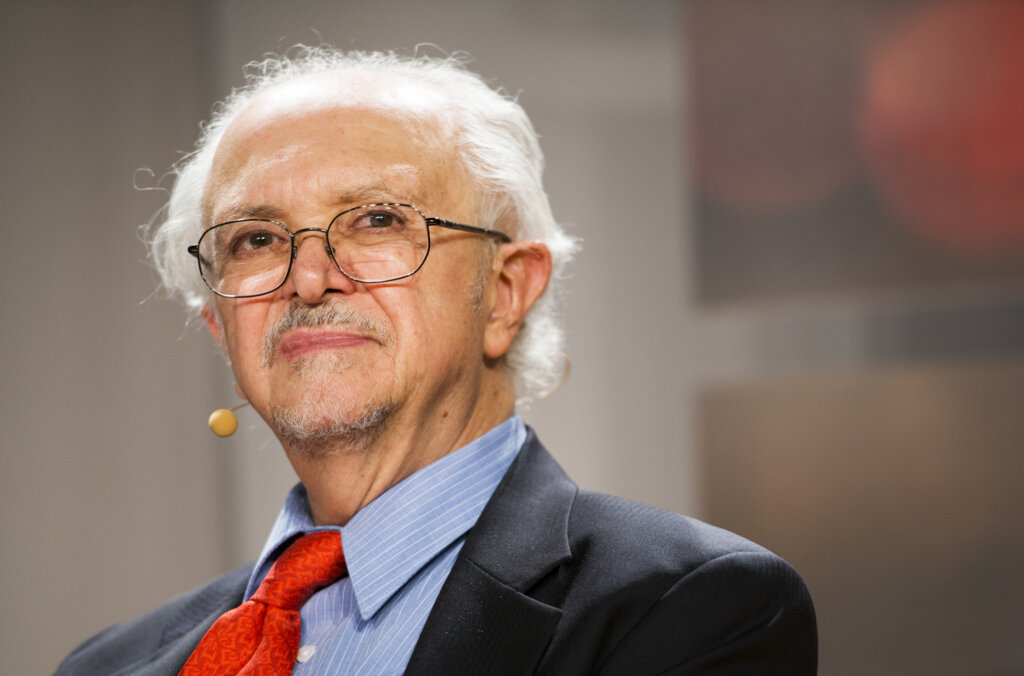
Clare Brilliant: Welcome to Nobel Prize Conversations and this encore presentation of our April 2014 talk with chemistry laureate Mario Molina. I’m Claire. Brilliant, and I’m here with our host Adam Smith. Hi, Adam.
Adam Smith: Hi, Clare.
Brilliant: With 1995 chemistry laureate Mario Molina we wrap up our series of six classic podcasts.
Smith: And hasn’t it been interesting to hear this variety of podcasts from the past? Some of them are completely timeless, but others seem to have aged considerably in 10 years.
Brilliant: How is it to listen to yourself now 10 years later?
Smith: Maybe I’m one of the more things that hasn’t aged so well over the 10 years. It’s strange because you think you’re the same, you don’t change, but actually when you listen to yourself and the questions you ask, you think, gosh, things are a bit different. It was a “the past is a different country”, as L.P. Hartley said in The Go-Between and it really can bring it home.
Brilliant: When you spoke to Mario in 2014, he’d already been living with the prize for nearly 20 years, and he’d really embraced a role as a leader in communicating about climate change. In this episode, you spend quite a lot of time talking about a 2014 paper called ‘What We Know’, and then you and I actually had the privilege of meeting Mario when we attend an event with him in 2018. I was really struck by his positivity, despite some of the enormous challenges posed by climate change.
Smith: He was extremely good at getting that optimism across in 2018, wasn’t he? I remember audiences had become more worried about climate change than they were back in 2014 when we recorded this. But they seemed to come out of his talks more optimistic than they were when they went in, which is an incredible achievement.
Brilliant: He was talking about such a difficult, and I guess, to most people, scary subject, but somehow you came out with a message of hope and I think that does come across in this interview as well. Sadly, Mario Molina is no longer with us as he died in 2020, but do you think the messages from this podcast are still relevant today?
Smith: The world doesn’t see many people like Mario Molina with such optimism and the engaging power to convince people to come together. I really think that for that reason, this podcast stands the test of time and deserves another listen. It’s really worth taking seriously what Mario Molina has to say. Let’s listen to this encore presentation, the last in our series with Mario Molina.
MUSIC
Mario Molina: Hello.
Adam Smith: To start out so you have just released from the American Academy for the Advancement of Science, this new report called ‘What We Know’, which you have chaired.
Molina: Right.
Smith: This is another report on global warming, and there have been many reports on global warming of course. Can you tell me what’s the need for this new report?
Molina: Yes, the purpose is not really to issue a new report, it’s to communicate with the public at large, particularly in the United States, in a more efficient way. We’re not seeking to bring the science up to date or anything like that. We’re just attempting to have a better communication strategy highlighting just a few steps, maybe three at most four. The report is just a background so that it’s documented where this comes from, but the main work to be done will be to somehow through the media and interviews just to stress briefly these three or four important points about climate change that we want the public to be aware of.
Smith: So it’s clarifying the message.
Molina: It is clarifying the message. We’re working with professional communicators, understanding that we scientists often do not communicate well. That’s the main purpose and difference from other reports.
Smith: The choice of title is very emphasise then: what we know. It’s just trying to communicate in simple, straightforward language what is currently understood about global warming. Is that right?
Molina: That’s right.
Smith: Okay. What is currently understood? What’s the main message?
Molina: The main message is that there is a very clear consensus among experts and we quote numbers like, more than 90-97% of climate change experts agree that climate change is taking place and it’s most likely of human origin. That’s the main message. Then a second message is that it’s already happening. It’s not just something for the end of the century. The third, perhaps what is the newer message if you want, is that we’re dealing with risks. We are not necessarily worried mostly about the most likely chain of events, but working with economists in particular, we reached the conclusion that the society should react based on the on risks, namely that there will be some abrupt changes with very important consequences for society at large or for many groups if you want that risks that are unacceptable. Even if they’re not very likely, if you have something of a 10 or 20% risk or more of real calamities to happen, that should be avoided. The science is rather uncertain about this, but this is based on scientific insights and these changes can indeed happen. Perhaps also the fourth important message is that we can deal with this, we can do something about this in contrast to ideas that have been spread out that, oh, this would be just incredibly expensive and we can’t stop in any way using fossil fuels. We believe that’s the wrong message. The message is that we can deal with the problem at the reasonable cost, certainly smaller than what it would cost to shoot some of these abrupt changes that take place.
Smith: That’s a hopeful message to end with.
Molina: That’s right. Yes.
Smith: There’s a lot in there. If we start first of all with this idea of climate change is happening and it is most likely caused by human activity. A lot of people seem to get quite hung up on that most likely piece and say, well, maybe it’s something we are doing, or maybe it’s something we’re not doing. That seems to stop other action, the conversation can in a way stop there. Why do you think everybody’s got so excited by this question of whether or not it is truly anthropogenic?
Molina: When we elaborate on this, we use metaphors. When you drive your car, you wear seat belts and have airbags and not because you have a certainty that you will crash. There are so many things along these lines that prompt society to act. If you have a tumour and your physician tells you, oh, there’s only 80% chance that it’s cancer, just don’t worry about it, go home. It doesn’t make any sense to require certainty, but we clarify that indeed science is a complex system, and we have a very conservative, if you want, group of scientists behind this report precisely to be able to document these statements. There have been lots of exaggerations and unclear statements precisely because they were aware about people misunderstanding the message and scientists are just not happy with making statements that are actually not correct.
Smith: Yes. We are very used to dealing with uncertainty in our own lives. Yet on the climate change issue, as I say, there seems to be more scope for the discussion of the importance of that certainty. For instance, you have the well-publicised climate change sceptics who seem to hold a lot of public opinion, have a lot of public interest in them. People listen to them. That’s odd in a way.
Molina: Yes. We, of course, we’re very much aware of that. That’s why we want to give out a clear message and as needed, explain it with metaphors. Let me give you an even a more striking example. Extreme events that we’re worried about but that’s bringing climate change closer to home for many people. The metaphor we use is in the US for baseball games, if it’s clear that at some point some of the best known players were taking some drugs, okay? There are many more home runs, but you can’t assign any particular home runs because somebody took some drugs. All you can say is that the likelihood of having home runs clearly increased. That’s what’s happening with extreme events. We can’t attribute any particular one to climate change. That’s even less certain if you want, but overall, the statistics is clear. The idea that you need certainty is that something we want to explain? There are so many other examples, that society makes all sorts of political decisions, there’s almost never certainty withheld issues as well. Why would one want to have certainty with something so clearly worrisome that it would be so much against society a reasonable way of acting to ignore these threats.
Smith: Do you have an answer to the question of why that has become such an issue? Have you an understanding of what it is that is stopping people accepting the idea?
Molina: Oh, yes. We know that there was a very well financed public media campaign from interest groups. We also know that there are some artisan issues. It has to do with politics issue became polarised, and it’s a worry with, particularly with the Republican party in the United States that at some point took extreme positions. But those extreme positions, they’re not questioning whether it’s slightly or not, they’re simply claiming that this is all a hoax and that it’s just because the scientists want more money and so on. That’s why, in this case, we also stress that this is the consensus of experts and also of well-established scientific groups, the national academies, professional societies. You have to claim that all of sciences corrupt, and that begins to be sort of crazy, even the enormous impact that science has had on our lives. There is a whole range of reasons behind scepticism. Perhaps we can address them all as needed. But the most worrisome one is just perhaps the one that said, oh, it’s uncertain that scientists do not agree. That’s why that’s the first message. Scientists do agree that it’s happening, it’s real, and they do agree that it’s a big risk.
Smith: Yes.
Molina: That’s the point. I know it’s a challenge.
Smith: You mentioned that this is directed particularly at the American public. Is this, and I guess American institutions as well, is this a particular problem do you think for America? Is the acceptance of the evidence harder in America than elsewhere?
Molina: Yes. But this, of course, we no longer elaborate in these documents and so on, but what is clear in terms of assessing what needs to be done about these problems? It’s clear that one of the best solutions would be to have an international agreement that would put a price on emissions. By the way, just stepping back for a moment, we don’t prescribe with these reports or messages, they’re not prescriptive. They just say, let’s put it on the table and let society take it seriously, discuss what to do. But coming back to your question, it’s clear that the main bottleneck for this international agreement at the moment is US Congress, because they will certainly not stratify any international agreement dealing with climate change because of the official posture of the Republican party. Without their approval, you can’t ratify an international agreement. Their official posture is to deny climate change science. My reasoning is that it’s something equivalent to still living in the age of astrology. That’s unacceptable for any rational society. I hope this for this reasons, if we make the message clear we should be able to bring the rationality to the system. But that’s the reason why the United States is particularly worrisome. It’s international political arena. We certainly know that countries like China, India and so on are very important for these agreements as well. We have indications that they would be willing to move much further ahead in terms of this sort of international agreements than at least the United States at the moment. That’s the bottleneck in terms of coming with a real solution to the problem.
Smith: That anti-science stance in this case of the Republican party is a very peculiar thing. Because I suppose it’s partly vested interests causing one to have that policy but it’s also an antagonistic attitude to science itself. It’s been pointed out by others that the number of scientists within the political system is extremely small or perhaps even zero. On the face of it, it just seems ludicrous that one would have an antagonistic attitude towards the practice of science.
Molina: Yes. That’s why there’s such a strong division, because in fact some Republicans tend to agree. It’s just that they are at the moment compelled to take the parking line. That’s beginning to change. There are beginning to be some very important divisions within the Republican party. Second point, we work with many Republicans that are not now in Congress, but were in government before, and many of them very much agree with our conclusions. In fact, many important decisions connected with the environmental problems and global environmental problems as well were carried up with Republican administrations. One point that we’re also bringing forth that appears to appeal to the public in the United States is we’ve done this before. The United States has been a leader in many environmental issues. One example is the stratospheric cause issue that I was involved with, and it’s one global problem has been solved very efficiently with leadership from the United States, from Republicans. It has happened before.
Smith: Sorry to dwell on this question of why people find it hard to just accept that action is needed, but is it also the magnitude of the problem? People just feel completely overwhelmed by that?
Molina: Sure. That’s why one of the important messages is that it’s a challenge, but we’re not suggesting solving on very expensive changes. This has been carefully analysed, again, by experts, economists, and we can certainly deal with it. It’s an enormous challenge, but it’s something that is striking that it’s not an enormous cost, because with creativity and with technologies for clean energies being further developed, we do have examples of things that are already happening that would bring us to a solution of this problem, or at least a clear indication of the right path. We don’t have to speculate that this is something that perhaps society could actually deal with. We can cite specific examples.
Smith: Then I wanted to move on to this question of risk. You mentioned that there are the kind of the gradual changes that we are already observing, but you are pointing out that there are risks of truly catastrophic events ahead. Tell me more about those.
Molina: One worry we had is for the scientific community to perceive this as alarm and so on. That’s why we don’t even use the word catastrophe in the document. It’s very carefully avoided, but it’s the equivalent, that you’ll have extremely damaging events. But the risk is based on science. We have indications of changes in climate in the past, and we have very clear indications that there’s more energy in the system now and so on. It is not sheer speculation. The existence of risk is based on science. We are very much aware that it’s one of those issues that is hard to communicate to the public, because they’re often very ill-informed about the nature of risks. This is where our work with professional communicators is also very helpful because they can measure and probe how do people react to all to these various sorts of statements and what’s the normal conception they have about risk? They don’t have a good quantification of risks. If it’s small or large, they often just get confused. We’re, again, perhaps through metaphors or examples, we can explain why is it very important for society to take some sort of insurance if you want. That’s one way to explain it to them for risks that are real, and that’s quite reasonable and accepted by people in general, it’s very quite acceptable to spend some resources on insurance because it has paid off clearly in the past.
Smith: What’s an example of the sort of thing that we’re insuring against?
Molina: Here we’re again very careful and we cite and quote some studies like a national academy story or some IPCC stories, they’re actually quite conservative here. But examples would be say the drying up of the Amazon forest or changes in the ocean circulation. Here a conclusion is the following: that one scientist begin to look very carefully at some of these specific possibilities, they turn out not to be very likely so the main worry remains surprises. That’s why we don’t want to give many very specific examples of things to worry about without the statement look. Once we identify this large releases of methane from permafrost, these are all feasible. Those do not seem very likely, but we have so much experience with surprises, even the extreme events. We’re not quite expected, and they are happening already. I realise it’s a difficult issue to communicate, but again, we want to be very honest and not put on the table issues or possibilities that have already been carefully examined. There are, on the other hand, issues such as the rising sea levels that are happening and happening faster than anticipated with very clear consequences that are already materialising. Once you have higher sea level, then if you have a bad weather or hurricane storms and coastal areas they become much more damaging, even if there’s just a relatively small increase in sea level. That’s one of the main worries if you want.
Smith: I can see it’s a very difficult situation because if you elaborate specific risks and they don’t come to pass, then people on the other side of the fence will turn around and say that didn’t happen. You see, it’s all wrong. In a way, that’s the permanent problem. I suppose that you are trying to be very measured and precise in what you say, and the people who are arguing against you don’t have that limitation. They can just pull, if they want, anything out of the air and say, look, climate change scientists say that this is going to happen and it’s not happening, so it’s all wrong. Which obviously doesn’t hold up as an argument, but it’s good as a soundbite.
Molina: That’s right. That’s why, first of all, in the end we make a strong case that the climate is indeed changing because sceptics, until perhaps very recently, were claiming that, oh, it’s actually the climate goes up and down and so on. That part is clear and that part there is consensus. But the second point, in some sense, we try to rely on the record and the honesty that is established or in many other areas of the experts, the scientific community and so on. If necessary, we can certainly have debates or do whatever is needed with people that think to be experts on the other side. For the public in general, we believe we don’t need to sort of do the signs, the complicated science in great detail. We just need to make the case that the science is clear about the risk.
Smith: What do you hope the report will achieve? What do you hope will be the result?
Molina: The result, we hope, is that the polls will begin to show a shift, which is happening already. We will push the shift in public opinion. It’s happening already because of extreme events that are people just until recently, where all this is just a worry for future generations. It doesn’t affect us at all, but there’s so many people already being affected that there is a change in perception. We believe if we, for the first time if you want, could organise a public relations campaign comparable to the one that was carried out. One the other side, we hope to have an impact on public opinion and subsequently on the perception of politicians about this, of course, because they count on public opinion often to support their decisions. We realise that it’s not something that’s going to happen immediately, but we believe that if a world carried out campaign can in fact move the results of the poll.
MUSIC
Smith: When you compare this problem to the one you worked on earlier on CFCs and reducing CFC emissions, was the same kind of publicity campaign required for that? Or was there just an easier acceptance?
Molina: It was easier because energy is behind so many activities of society that’s clearly more difficult and behind economic road. We had an easier time with the CFCs, but fortunately we were able to act before it became polarised or politicised. We did not have this division along party lines materialising. We were able to act before that, and public opinion was important, but it was really the opinion of decision makers, leaders in government that were able to make things sufficiently important to reach an international agreement. We were not really counting there on public opinion driving the solution to the problem but it was certainly part of it. Whoever had looked at it and so on, it supported. There were of course sceptics as well. Another very important difference if you want, is that we were able to work with industry. At the beginning, they were sceptics, of course, but after the science became very clear the industrial sector collaborated with us. By the way, what’s happening now with climate change is not that the private sector is against it. It’s just some interest groups in the private sector are against it, but some others are in favour. That’s another thing we will try to take advantage of, that we can work with powerful groups that understand the problem. Not all the business minded people think that the problem is a hoax. But again, we clearly had an advantage with the stratospheric on issue in that at some point essentially all of industry was behind the solution to the problem.
Smith: If you can help to achieve this ongoing change in the public opinion in the US, that’s part of the battle. Do you think that in the long term, the combination of a developed world already sort of at high levels of energy usage and an emerging world using more and more energy as time goes on, can reach a solution and in fact, act concertedly to prevent truly damaging global warming?
Molina: Yes. That’s of course a very important question. We believe that it’s possible, but it will require further development in technology so that the options to use less fossil fuel become also more economically attractive. That’s happening. There is a clear tendency for clean energies to become cheaper. Two points here to make, one is we’re very much aware of the need of a good section of the global population that doesn’t have access to energy, and that’s a high priority also. But at the moment, at least for the near future, that would not be, even if they were to use fossil fuels or wood that would not detract from the main effort of the rest of the countries. We are very willing to promote access to energy for poor populations. Obviously, we’re not suggesting that there should be zero emissions. We’re just suggesting to do the most efficient way. By the way, these questions are no longer part of this report, we’re suggesting let’s put all of this on the table and have experts continue discussing that. The second point is that, yes, although there are still some problems ahead, we should put everything on the table. Carbon capture, for example, and storage is at the moment just too expensive but perhaps in the future it might be feasible. One of the more controversial possibilities, which we do not deal with in this particular report, is nuclear energy, because that has a very safe historical record in spite of Fukushima. We know that was a big problem in time, but it’s a form of energy that exists. The price keeps coming down, and it’s not that high according to the recent studies. It’s available. The hope is that we will, again, with time develop even safer technologies. But again, the point there with nuclear energy is that it’s the historical fact that it has worked with relatively little problem compared to fossil fuels and other forms.
Smith: Yes. It’s, again, down to this perception of risk.
Molina: That’s right.
MUSIC
Smith: You find yourself at the forefront of arguments about global climate. As a child, you were a very scientifically interested child, were you not?
Molina: That’s right. Yes.
Smith: What form did your scientific explorations take?
Molina: When I was child, quite young, 10 years old or so, I was already quite interested. I like to read and read the biographies of scientists and so on, and then started to play with the chemistry sets, microscopes. I was fascinated with these games if you want. Then I just continued it. It was not something connected to school, but it was more connected to as a hobby.
Smith: I like the use of the word games that. Was it the tools that you enjoyed? Was it the questions you enjoyed?
Molina: It was probably the questions and doing experiments myself. I was lucky my father’s sister was a chemist, and after I showed a lot of interest in these things, she helped me do more sophisticated experiments. To me, that was just fascinating to actually see things with my own eyes and do the experiments with my own hands. It’s this active learning, which by the way, is a tendency nowadays to change education quite dramatically, to have kids do these sort of things rather than just memorising. This natural curiosity that we have as children, just looking through a microscope and suddenly discovering a new world there with all sorts of little creatures moving that you don’t see with your naked eyes. That sort of thing was fascinating to me. I had a number of good teachers that were sympathetic, if you want to, with this attitude towards science eventually this could materialise. I had decided as a child if it was possible to become a scientist and to do scientific research for a living that’s what I wanted to do.
Smith: You had your aunt who was influencing you, and your parents were nurturing. They gave you the space you needed.
Molina: My parents were nurturing. They were not scientists. My father was a lawyer, but they nurtured it. They supported my interest.
Smith: Yes. Did you ever contemplate any other career?
Molina: I did. As a kid, I liked music. I still like it a lot of course. I used to play the violin. I did contemplate, well, maybe that’s an option. I could become a musician. Somehow my parents got some advice that unless I was willing to spend eight or 10 hours a day just playing the violin that I should just give it up. To me, that was very bad advice because you could of course, get very involved in music without being a musician. Fortunately, even though I gave up eventually playing the violin myself, I never gave up my fondness for music. But if I had a chance again, I would not give it up. I would just do it as a hobby. I think that was just because I did not get the correct advice. Fortunately, that didn’t affect at least learning and listening to music.
MUSIC
Smith: That’s true. You were brought up in Mexico, but also traveling around?
Molina: Yes, actually as a child, because of this interest I had in the sciences, my parents sent me to Switzerland for a couple of years to learn German.
Smith: How old were you?
Molina: I was probably 11.
Smith: Gosh. Yes.
Molina: This was to just boarding school. It was a very good experience because my chemistry teacher in Switzerland was somebody I got along very well with and did experiments. The disappointment I had, which fortunately was not seriously, I thought now that I’m going to Europe, all my friends will also be like me and they will like science a lot. They were just like my Mexican friends. Of course, I had normal friends and played and did things, but my friends at that age did not like anything connected to school. In Europe, it was something I did on my own or with my teachers, not with my friends. That happened much later. Eventually just in college, or actually when I start the college and the PhD, that’s when you begin to, of course, share all these interesting times with your colleagues. As a child, it was very much a lonely activity because again of the normal situation that I hope is changing now of children just disliking school and disliking science because it’s just memorising all sorts of facts and very boring.
Smith: Yes. The opposite of what it is really.
Molina: Exactly. Yes.
Smith: That does indicate you were quite a precocious child then, that you were so turned onto science by the age of 11 that you were sent to a school to nurture those interests. That’s unusual.
Molina: My parents had sort of tradition they wanted to us and my brothers and sisters abroad as young kids to learn a lot, another language and to be exposed to another culture. I was very lucky to be part of that. But in my case, of course, very much along the lines, as you just mentioned of, of pursuing my interest in science.
Smith: You obviously feel very tied to Mexico, and now you divide your time between United States and Mexico.
Molina: That’s right.
Smith: Is that a hard balance to manage?
Molina: It’s, but for many years, again, when I was, for example, just at MIT a researcher, then I went to Mexico just for vacations and so on. But at some point I started to do some work with my MIT colleagues that was connected with air quality in Mexico City, because we wanted to do something very interdisciplinary, not just involving science, but also policy economics and so on. That was remarkably successful because we got our students very interested in this interdisciplinary approach to social problems. Making sure that their basic interest in whatever field they were working remained very strong. But as a consequence of that, I realised I could at some stage that I was going to have more impact or that it was something more satisfactory to go back to Mexico to really do some work in my country of origin. I am born a Mexican and an American citizen, and I remain, of course, very much involved with my activities in the United States. The main example, perhaps been on this scientific advisory board to President Obama. I think fortunately what these issues I work with, they are very much international in scope. It’s both to Mexico and the United States interest to have this international perspective. That’s what brings it all together. Take this climate change approach, even though we’re focusing it to begin with in the United States, it’s something we can expand to Mexico and Latin Americans as well. But in Mexico, it’s really a change in field from science to science policy. The big challenge is how can we change not just regulations, but how can we actually affect the way society functions? It’s a big challenge, but we’ve been able to manage in some cases, like improving air quality in Mexico City and so on. It’s a challenge indeed.
Smith: Is it a model you can export to other cities the successful way you’ve tackled it in Mexico City?
Molina: Yes. In fact, we work closely with all the cities. Beginning with Latin America, we have some projects where we were simultaneously working also with Bogota and Santiago in Chile and Sao Paolo in Brazil. We have a lot to learn from each other. But again, there are other examples, other cities, not just in Latin America. That’s beginning to happen. There’s a lot of effort. There are associations of cities now, for example, dealing with a climate change issue, but in broader terms, in just in terms of improving the quality of life, greener cities where transportation works efficiently and so on and so forth. So this is an international effort that I think is beginning to take that form and becoming stronger and stronger learning from each other what works.
Smith: The collaborative approach that sort of powers science that expanded to encompass everybody.
Molina: That’s right. It’s a challenge because you have to deal with society that is hard to change, but if you find the right leaders, then we think it can be moved.
Smith: It seems to me that in many ways you have transitioned really talking the word leader from being a practicing scientist to almost a sort of scientific leader. Do you miss the actual science, or are you so busy leading that you don’t miss it, you don’t have time?
Molina: I do miss it. I was very much involved very early on doing experiments myself, but then later when having a large group, the experiments were actually carried out by my students. But now the way I looked at it is the even though I missed, if you want being heavily involved in just fundamental science or even applied science, but with a group of students, many of my former students are doing excellent science now as faculties in very well-known universities and so on. In some sense, I feel that I was able to keep that going, and I can do something that has more impact, a larger challenge to this translation of science into policy, which relatively few scientists successfully can do. It’s something we have to educate our students more and more about. That’s one component is this policy aspect. The other one is educational. Just making sure that the educational system keeps evolving and changing to become more and more effective.
Smith: It is a very important point on both counts. I suppose as we were saying earlier, the idea that there is so little science in the political system just argues that there needs to be a greater cohort of scientists who want to be involved in politics.
Molina: That’s right.
Smith: And policy. Sure.
Molina: I agree. Yes.
Smith: Last question. Do you yourself think that at some point you might actually enter politics full time?
Molina: No. I had that option some time ago. Already because having a Nobel Prize gives you all sorts of opportunities if you want. A few of my colleagues have done that. But no, I decided that was not the way I could function best. I could probably have more impact to things in a more important fashion, remaining outside politics but stressing disconnection between science and policy. It’s a different world if you really become a Secretary of Energy or whatever. There are so many other pressures for Secretary of the Environment, it’s just I decided that was not the way I would be most productive.
Smith: It’s been absolutely splendid speaking to you. Thank you very much indeed for giving me your time.
Molina: I’m pleased to do that. Sure.
Smith: Okay. Thanks. Bye.
MUSIC
Brilliant: This podcast was presented by Nobel Prize Conversations. If you’d like to know more about Mario Molina, you can go to nobelprize.org. Where you’ll find a wealth of information about the prizes and the people behind the discoveries.
Nobel Prize Conversations is a podcast series with Adam Smith, a co-production of FILT and Nobel Prize Outreach. The producer for Nobel Prize Talks was Magnus Gylje. The editorial team for this encore production includes Andrew Hart, Olivia Lundqvist and me, Clare Brilliant. Music by Epidemic Sound. You can find previous seasons and conversations on Acast or wherever you listen to podcasts. Thanks for listening.
Nobel Prize Conversations is produced in cooperation with Fundación Ramón Areces.
Did you find any typos in this text? We would appreciate your assistance in identifying any errors and to let us know. Thank you for taking the time to report the errors by sending us an e-mail.
Paul J. Crutzen – Photo gallery

All 1995 Nobel Prize laureates on stage for the Nobel Prize award ceremony. From left: physics laureates Martin L. Perl and Frederick Reines; chemistry laureates Paul J. Crutzen, Mario J. Molina and F. Sherwood Rowland; medicine laureates Edward B. Lewis, Christiane Nüsslein-Volhard and Eric F. Wieschaus; literature laureate Seamus Heaney and laureate in economic sciences Robert E. Lucas Jr.
Photo from the Lars Åström archive

1995 Nobel Prize laureates assembled during Nobel Week in Stockholm, Sweden, December 1995. Back row: Chemistry laureate Paul J. Crutzen, economic sciences laureate Robert E. Lucas Jr, medicine laureate Christiane Nüsslein-Volhard, chemistry laureate Mario J. Molina and medicine laureate Edward B. Lewis. Front row: medicine laureate Eric F. Wieschaus, physics laureates Frederick Reines and Martin L. Perl and chemistry laureate F. Sherwood Rowland.
Nobel Foundation. Photo: Lars Åström
F. Sherwood Rowland – Photo gallery

Chemistry laureate F. Sherwood Rowland, medicine laureates Edward B. Lewis, Christiane Nüsslein-Volhard and Eric F. Wieschaus and literature laureate Seamus Heaney on stage at the award ceremony at the Stockholm Concert Hall on 10 December 1995.
Nobel Foundation. Photo: Lars Åström
All 1995 Nobel Prize laureates on stage for the Nobel Prize award ceremony. From left: physics laureates Martin L. Perl and Frederick Reines; chemistry laureates Paul J. Crutzen, Mario J. Molina and F. Sherwood Rowland; medicine laureates Edward B. Lewis, Christiane Nüsslein-Volhard and Eric F. Wieschaus; literature laureate Seamus Heaney and laureate in economic sciences Robert E. Lucas Jr.
Photo from the Lars Åström archive

F. Sherwood Rowland and Sweden’s Queen Silvia at the Nobel Banquet, 10 December 1995.
Photo from the Lars Åström archive

F. Sherwood Rowland delivering his speech of thanks at the Nobel Prize banquet in the Stockholm City Hall, 10 December 1995.
Nobel Foundation. Photo: Lars Åström

F. Sherwood Rowland delivering his Nobel Prize lecture on 8 December 1995.
Nobel Foundation. Photo: Lars Åström

Sherwood Rowland and Mario Molina at work, January 1975.
University of California, Irvine
F. Sherwood Rowland – Nobel Lecture
Nobel Lecture, December 8, 1995
Nobel Lecture in Chemistry
Read the Nobel Lecture
Pdf 646 kB
F. Sherwood Rowland – Other resources
Links to other sites
F. Sherwood Rowland’s page at University of California Irvine
An interview with F. Sherwood Rowland from Vega Science Trust
Mario Molina – Nobel Lecture
Nobel Lecture, December 8, 1995
Polar Ozone Depletion
Read the Nobel Lecture
Pdf 296 kB
F. Sherwood Rowland – Banquet speech
F. Sherwood Rowland’s speech at the Nobel Banquet, December 10, 1995
Your Majesties, Your Royal Highnesses, Ladies and Gentlemen,
My friends and colleagues, Paul Crutzen and Mario Molina, and I are most grateful for the honors bestowed upon us today, for the Nobel Prize is the ultimate in recognition in the scientific world. It is immensely satisfying to us that our efforts to understand the chemistry of ozone in the atmosphere have been judged worthy of this honor.
The atmosphere and its manifold changes have held fascination for men and women ever since human beings have trod this Earth. Its study played an integral role in the evolution of natural philosophy from which all of our present sciences have sprung. The scientific and technological developments of the past several decades, not available to our predecessors in past millennia, have provided the theories and tools which have now permitted us to develop a significant understanding of several atmospheric processes which affect the concentration of ozone in our stratosphere. This ozone is vital to us and to all other species living on the sunlit Earth because it both establishes the temperature structure of the atmosphere and simultaneously protects us against damage from the most energetic solar ultraviolet radiation. We now know that ozone is subject to transformation by long-lived chemicals, both natural and man-made, released at the Earth’s surface, and substantial reductions in its concentration could have a strongly deleterious effect upon mankind and upon the rest of the biosphere.
Our gratitude extends well beyond our own personal satisfaction because these honors also confer high scientific approval upon the field of atmospheric chemistry and upon environmental science in general. The current understanding of the atmosphere has progressed over the past two decades through the skillful and dedicated work of many hundreds of our colleagues in the field of atmospheric chemistry. Their work has collectively evolved to the point that the nations of the world have accepted through the Montreal Protocol of the United Nations the need for careful monitoring and, in some instances, control of gaseous emissions to the atmosphere.
Once again, speaking on behalf of Paul Crutzen, Mario Molina, and myself, we thank you all for the wonderful honors given to us today.
Mario Molina – Photo gallery
All 1995 Nobel Prize laureates on stage for the Nobel Prize award ceremony. From left: physics laureates Martin L. Perl and Frederick Reines; chemistry laureates Paul J. Crutzen, Mario J. Molina and F. Sherwood Rowland; medicine laureates Edward B. Lewis, Christiane Nüsslein-Volhard and Eric F. Wieschaus; literature laureate Seamus Heaney and laureate in economic sciences Robert E. Lucas Jr.
Photo from the Lars Åström archive

Mario J. Molina delivering his Nobel Prize lecture 'Polar Ozone Depletionon' 8 December 1995.
Nobel Foundation. Photo: Lars Åström

When Mario Molina was 11 years old his parents sent him to the Institut auf dem Rosenberg boarding school in St. Gallen, Switzerland. There he developed his interest in chemistry and mathematics. Many years later, Molina was awarded the Nobel Prize in Chemistry for his research on the atmosphere’s ozone layer. His Nobel Diploma bears an image of an umbrella; a symbol for the way the ozone layer protects us from harmful ultraviolet radiation. When Molina later visited his old boarding school, he received exactly that—an umbrella. For Molina, the umbrella symbolises both his old school and the fragile ozone layer.
Photo: The Nobel Prize Museum

Mario J. Molina, Nobel Laureate in Chemistry 1995.
© University of California, San Diego Photo: Donna Coveney/MIT
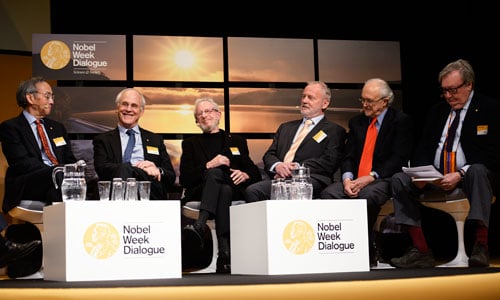
Six Nobel Laureates in a panel discussion at the 2013 Nobel Week Dialogue, Exploring The Future of Energy, on 9 December 2013. From left: 1997 Physics Laureate Steven Chu, 2004 Physics Laureate David Gross, 2000 Chemistry Laureate Alan Heeger, 1988 Chemistry Laureate Hartmut Michel, 1995 Chemistry Laureate Mario Molina and 1984 Physics Laureate Carlo Rubbia.
Copyright © Nobel Media AB 2013
Photo: Alexander Mahmoud
Sherwood Rowland and Mario Molina at work, January 1975.
University of California, Irvine
Mario Molina – Other resources
Links to other sites
On Mario Molina from The Chemical Heritage Foundation
On Mario Molina from the Lindau Mediatheque
‘Mario Molina, Chlorofluorocarbons (CFCs), and Ozone Depletion’ from DOE R&D Accomplishments
Paul J. Crutzen – Interview
Interview transcript
Dr Crutzen, I would like to begin to ask you something about your family background, where you grew up and where you went to school and so on?
Paul J. Crutzen: I’m born in Amsterdam in 1933; well until 1958 I was basically all the time in Amsterdam. My family was a worker’s family, my father was a waiter, a restaurant waiter, my mother did some work in hospital. Life was not always easy and of course from 1940 to 1945 there was the World War and the Netherlands were occupied by the German Nazi troops. So we had that experience also. So even after the war, of course, things were a little slim. Because of course everything had to be built up again.
So it was not an easy time in Europe particularly.
Paul J. Crutzen: It was not an easy start.
But so how did your interest in science then begin? Was it at an early age at school already or did it come later?
Paul J. Crutzen: Firstly, I did quite well in school. It was easy for me to learn, especially natural sciences but also languages. I was early interested in languages because my father was very good in French and he wanted to show this off on me so, we had some competition in that way, you can almost say. And my mother was born in Germany so I could speak German pretty good.
So you were multi-lingual from the beginning?
 … that book fascinated me so much and things like that pushed me sort of in the scientific area. …
Paul J. Crutzen: Yes, I was basically from home to bi-lingual, but then through school and through contacts with my father also French and then English and later of course Swedish when I moved to Sweden. But natural sciences I became interested in, I don’t know how, it’s just by reading books and the first books maybe were about explorations you know, the people, the Jules Verne books, the stories about the march to the North and to the South Pole and so on. And I remember at home we had a fantastic picture book about Yellowstone National Park, it was black and white of course, but that book fascinated me so much and things like that pushed me sort of in the scientific area.
Then I understand that you did not immediately start to work in science, you were educated as an engineer from the beginning and also worked as an engineer as I understand it?
Paul J. Crutzen: Well ,subject which I was also interested in was bridges, of course in Holland you have plenty of bridges. So, that I read a lot about. When I did my final exams for entrance into the university, the last year of our high school, I was very sick and had to do my exams with very high fever over a two-week period and so I had to do it that way because if I didn’t do the exams I would have to wait another year. So, there were no other opportunities.
A tough system?
Paul J. Crutzen: A tough system … so feverish I went to the written examinations and then part of the oral examinations and my grades which came out at the end were not top, they were reasonable, but not top and not good enough to get a stipend for university studies which I needed because my parents were certainly not able to pay too much for me. So I then decided well, the other love is bridges. And I then studied bridge building and building of waterways, locks etc. in a school which is a high technical school but not the Institute of Technology so in between. It was a three year course of which the second year was a practical year so you earned some money of which I could then survive also the third year so I wasn’t so much of a burden to my parents. So that’s how I entered here.
But then you also moved to Sweden after this period of studies I realise?
Paul J. Crutzen: I met a Finish girl on the mountain top in Switzerland. She was vacationing and I was sort of hiking in Switzerland and we started corresponding and I visited her and then in 1958 we married and then we decided to move half way between Finland and Holland and that is Sweden, and I learnt Swedish, which is a reasonably easy language to learn. It’s not very difficult, the grammar is relatively simple. So I worked in a house construction company for about 1,5 years and then I saw an advertisement by the University for Stockholm, Meteorology Department. They were looking for a programmer, computer programmer, and although I had no background in that area and … but I thought well must have something to do with mathematics which I liked very much.
… I could not afford doing the more experimental courses …I applied and among quite many candidates, they picked me for some reason. That was my big luck, because I then started working at the Institute of Meteorology of the university as a programmer, but they allowed me to go to courses in mathematical statistics and then meteorology, very theoretical courses. Because I could not afford doing the more experimental courses which take time, you have to spend a considerable amount of hours in the lab and I couldn’t afford that. One of the reasons why I became a theoretician is because of practical reasons.
So this is when your interest in atmospheric chemistry rised in this environment of meteorology or did it come later?
Paul J. Crutzen: It came later and initially I studied as I said mathematics, mathematical statistics and then finally I decided, let me try out meteorology. I must say it was a little bit of a shock because mathematics is so clean and mathematical statistics … and meteorology is a very much also an intuitive science. You have to bring in, you apply of course the laws of dynamics and thermal dynamics, but then there’s so many … the system around us is so complex, you have to be very, very intuitive to pick the right things.
And at the Institute after a while, and it’s about 10 years or so, well a little less than 10 years, I became a programmer for a US scientist who was coming to get his PhD at the Institute of Meteorology. So I did the programming for him, the subject was always ozone, was one of the first models of the virtual distribution of ozone which we developed. And while I was doing that I started studying photo chemistry and I got suddenly fascinated and in spectroscopy and so on. That became then my … and one of the very important things I found out is that people just repeated themselves. It is obvious that, these sentences that this and this is true.
Yes.
Paul J. Crutzen: Well, that was no so obvious to me, so I started doubting.
You came with fresh eyes?
Paul J. Crutzen: Yes, well this is often the case and I was allowed to come with fresh eyes. I couldn’t have picked a better environment to do my studies than the Institute of Meteorology and there was a lot of support for what I was doing. I got more and more freedom too, not to programme for others but to do …
To really think about some new questions.
Paul J. Crutzen: For myself, so it was very generous. Maybe it was not totally legal.
Very good obviously.
… but the reaction rates were wrong, and that I discovered and I said: That must be something else …Paul J. Crutzen: So I then discovered that the reactions which were then supposed to explain the composition of the ozone layer, the vertical distributions, that were insufficient. That reaction rates we used, which gave about the right answer, but the reaction rates were wrong, and that I discovered and I said: That must be something else and I then came upon the idea that nitrogen oxide were controlling the ozone in the stratosphere.
And that in natural circumstances that was the first thought but then I also very soon discovered that big fleets of supersonic aircraft were going to be built in the United States, Boeing and the Concorde’s between France and England and then also in Russia or the Soviet Union there were big plans. Hundreds or up to thousands airplanes would be flying in the stratosphere emitting NOx and that would break down ozone. Independent of me also a United States scientist, Harold Johnston, Berkeley, made this discovery that the purely theoretical ideas I had about the role of NOx suddenly became a big societal issue, whether you should build those planes or not.
Also the research in this area exploded, before that we were maybe a handful of scientists worrying or not worrying but studying the ozone layer and suddenly it became a big public issue and lots of research money was going into this direction.
Yes of course. But this is an interesting question: Did the society immediately see the serious consequences of this just because you were a scientist’s projecting something or that was accepted?
Paul J. Crutzen: That was surprising. It was surprising because I mean the ideas were on the table and very soon of course no measures were immediately taken. The industry was hoping to build these planes. But it was clear that major studies had to be conducted before this expansion of the aircraft lead would take place. And we did several years of research, three or four years on this topic. But at the end suddenly there came another problem which already existed namely the release of chlorine into the stratosphere and by the chlorofluorocarbons gases.
So that was next.
Paul J. Crutzen: So we layered the basis for an even worse concern namely the spray gas.
And they just came then. So but at this time then you did move to the United States at some point here.
Paul J. Crutzen: In 1974, I firstly … I was then a “biträdande professor” it was called, I was just elected to become and that I already had decided to try it out in the United States for a year in Boulder, Colorado, National Centre for Atmospheric Research and then, well one year was not enough so I did a second year and finally we stayed there for a period of six years and I became director also for the research division, International Centre.
But then what was it after you left Stockholm and went to the States that you did more serious work on the ozone and NOx or was that already?
Paul J. Crutzen: Before.
It was before.
Paul J. Crutzen: Now of course I was involved also in the studies on the effects of chlorofluorocarbons and then my interest also turned not only to the ozone in the stratosphere but also close to ground, in the troposphere and discovered that a nitrogen oxides did the opposite that they do in the stratosphere. The stratosphere be above about 20 kilometres the nitrogen oxide catalytically destroy ozone. But in the troposphere they catalytically produce ozone.
I see.
Paul J. Crutzen: And these two thoughts which make basically much of my work.
Why is that so? Why do they grow up can you explain that in simple ways or?
… but one did not consider that these reactions basically take place everywhere …Paul J. Crutzen: Well, it’s not so simple, you need a blackboard to write some equations down. If we only would consider the chemistry of the nitrogen oxides and indeed ozone would be depleted everywhere. However, low down we also have the emissions of hydrocarbons from automobiles but even more by force and it is the products from the oxidation of the hydrocarbons together with the catalytic action of NOx which then creates ozone and of course you need sunlight. That’s why the photo chemicals were mainly due in summer on the very stable conditions when hydro carbons can accumulate in the lower atmosphere and also nitrogen oxides, then you get these. But this was known already for say Los Angeles area but one did not consider that these reactions basically take place everywhere.
Oh yes, it’s just a question of amounts that you have more in the big cities of the hydro carbons.
Paul J. Crutzen: But the total production of ozone in the troposphere is much more determined by what is happening in the wide world and specifically over Los Angeles or other parts of the world, so that was another idea I brought in and well, they were nice ideas and I sort of survived on them.
Quite obviously very important ideas that also had quite a large impact on how society dealt with these problems because I realise nowadays, we may still have supersonic planes of course but at least we don’t have much spray cans anymore.
Paul J. Crutzen: And very few supersonic planes, less than 10 instead of thousands or so.
And then if you look now at the problems of the atmosphere would you say that at least these questions are under control or would you say that we are still developing, you could say dangerous conditions which are the result of things that we do wrong. I’m not talking now about the green house effect, we’ll come to that later, but what about the ozone? Even if the ozone hole and those variations that we see, are they more or less natural and under control or are they completely uncontrolled.
Paul J. Crutzen: No, they are not natural, the ozone holes would not be there without the input of the chlorofluorocarbons by human activities in the atmosphere but we recognise that as science is established and we have a very good picture of what is happening and because of that also political decisions are more easily made. If you stand there and say well it is maybe so but maybe not I mean a politician won’t do anything.
Now initially we were in that state also with regards to the ozone hole but that didn’t last very long, it was a question of three or four years when we had all the pictures, the hole pictures together, it was so obvious that the chlorofluorocarbons were the culprit and then over a number of years and the emissions were reduced and since 1996 the chlorofluorocarbons are no longer produced in the industrial world and in the near future also in the developing world which anyhow have produced very little chlorofluorocarbons, there would also be regulations.
And would that be enough to heal the hole do you think?
… the ideas which have been spread around so far on mending the ozone layer have been totally unpractical …Paul J. Crutzen: We cannot do more. There have been, it will take 30 even up to a 100 years before the ozone hole will have disappeared. But that’s … nature must have its way now because the chlorofluorocarbons gases are so diluted in the atmosphere that you cannot just take them out and destroy them. It’s too late. And all the ideas which have been spread around so far on mending the ozone layer have been totally unpractical. And mostly many of those are also lounged by former military laboratories who wanted somebody to save the world. But nothing practical.
There is no such way.
Paul J. Crutzen: No, no and in fact in principal there are ways but you don’t create even those conditions.
Yes so now we would.
Paul J. Crutzen: The energy needed to do that is so overwhelming that you create an in house carbon dioxide problem.
Another a worse problem perhaps. So then maybe we should spend a few minutes on the greenhouse effect and your opinions about the carbon dioxide problem and what’s your opinion of our future there?
Paul J. Crutzen: We have still … maybe you can repeat the question … We have still one, you asked me at the end, have you forgotten something and that of course is one thing that we should also talk about and that is nuclear wind.
Yes of course.
Paul J. Crutzen: Yes, okay, good. But the question is about the effect of the emissions of greenhouse gases in the atmosphere in climate and in my opinion there is very little doubt that there is an effect that much of the temperature increase we are seeing is coming from that. I mean it’s … you cannot say that this issue is as clear as in the chlorofluorocarbon issue but it is so more logical that we are heating up the atmosphere and the earth surface, they’re not. It depends … the warm temperature on the whole on earth, above freezing, 15 degrees above freezing, is simply due to the presence of greenhouse gases in the atmosphere. They serve as a blanket over us keeping the warm radiation coming from the earth trapped, in fact the energy is recycled five to six times, before it gets out into space. It’s a wonderful machine doing this.
And we are now adding greenhouse gases, why wouldn’t it become warmer, it’s so … I think the others should prove much more than those saying there is nothing there … than we, but still all the models we develop indicate the same. That doesn’t prove models of course can be deficient but altogether if you want to bet you would be rather stupid to say it’s not getting warmer it’s all likelihood the case. And we see it in the temperature records.
Yes for maybe 50 years ago the statistics were not so clear about that but I think they are now that it is definitely an effect.
… we are at beginning of the warming, it will accelerate …Paul J. Crutzen: And we are at beginning of the warming, it will accelerate and that is inevitable if people in the developing world are going to use as much or approaching to use as much energy as we are using per capita in the industrial world. Countries like India per capita use only 10-20% of the energy which is used than the United States. And so they of course want to have a similar standard of living and inevitably that will lead to larger emissions so we should do every effort to reduce the emissions by saving energy, by developing alternative techniques which do not depend on burning of fossil fuels, whatever we can do. And maybe become a little more modest, we would be satisfied with somewhat less, but that’s very hard for people to do.
Yes perhaps not. It was probably easier to convince people not to use spray cans with freon in them than to convince them of not using cars or such. But of course one can never predict the future I suppose but I’m sure that one will realise as this process goes on that one has to be more and more strict about doing something in the developed countries, particularly we have to be going ahead, so to speak.
Paul J. Crutzen: Well, you said about predicting the future, we can of course, we don’t know everything and we never know whether there are effects which can come as a big surprises. For instance the ozone hole was far away from predicted by any scientist. It was a few measurements by colleagues of the British Antarctic survey over Antarctica which showed that ozone was going down. No model predicted that, it was thought a dead part of the world, ozone is in the most stable condition as you can imagine. Just exactly there ozone breaks down in the height region in which normally ozone is at the maximum and then suddenly a few weeks, two months later it is gone.
And how could that happen then? Does one know that now?
Paul J. Crutzen: What we had not considered is that ice particles which form in the stratosphere at low temperatures below minus 80 degrees that on these ice particles reactions take place, which lead to the conversion of relatively stable, we call it reservoir molecules, into very aggressive chlorine atoms and chlorine monoxide radicals which attack ozone very efficiently. And the formation of the ice particles is a, you can almost say natural, process, that is dependent on that’s what is happening over Antarctica because it’s simply cold in winter time, early spring. But the reactions on the ice particles involving chlorine, they are of course coming from human activities.
So even in the Antarctic there is the spread of this chlorine that comes from other parts of the world.
Paul J. Crutzen: The residence time in the atmosphere is of the order of 50-100 years. So there is plenty of time to spread from the middle altitudes in the Northern Hemisphere where they are mostly used into any corner of the world. You find them every day, you find them also in ocean water because they are not very soluble in water but there is some solubility and we can follow that. There are concentration in the oceans and that learns something about the flow in the ocean.
So that’s another aspect of course. It just so happens that while you have the coldest places on earth that’s where this ozone hole will form.
Paul J. Crutzen: And the other thing is that the destruction of ozone is dependent on the concentration of chlorine atoms and chlorine monoxide radicals to the power too.
Aha so it is a cooperative thing.
Paul J. Crutzen: And now we have about six times more chlorine in the stratosphere than under natural conditions, so the ozone destruction is say 36 times larger than naturally. Under natural conditions these reactions would not have … a very low probability. But because of our input of chlorine in the stratosphere these large amounts by small emissions every year but because of the long lifetime of the species adding up, adding up until we have now six times more chlorine in the stratosphere than under natural conditions. It’s amazing.
You mentioned one other thing you wanted to speak about when we talked about is different scientific topics. I had also another question about what is your major interest right now so to speak, but maybe you want to bring up this question to begin with?
… pollution is not only created by industry but also by mass burning …Paul J. Crutzen: With nuclear wind, well, one of the things I have been very much involved in the past with studying the effects of by a mass burning in the tropics on atmospheric chemistry. It’s normally assumed that the tropics is a very clean part of our environment and people go on vacation to the most wonderful places and of course they are not thinking about pollution there. However, pollution is not only created by industry but also by mass burning and that is happening a lot in the tropics. We have deforestation activities, we have people burn just to cook or they burn to get rid of stubble or old wood or old plant material so they burn everywhere. In the Savannah regions of the world of the one about every year half the area is burnt to get rid of the high dry yellow grass which is not very fancied much by cattle for instance.
So this is a lot of pollution coming into the atmosphere in the tropics so that has been one scientific activity of me and related also to human activities but out of that and my interest in that came totally by chance one day thought that maybe the fires which would be raging following a nuclear war a major nuclear war in cities and oil refineries etc bringing large amounts of soot into the atmosphere. What that would do to the radiation balance of the atmosphere and what we found out and that was actually, that work was initiated by an invitation by Ambio, a Swedish journal issued by the Royal Swedish Academy of Sciences. They asked a number of scientists to think about what would be the environmental consequences of nuclear war. Initially I didn’t want to participate in this study. I thought well a nuclear war everybody’s killed five or six times over and I was in the belief that this would be true, but then finally I realised this is not true. You can kill one person or a number of persons six or maybe even more times over really, theoretically, but people are spread all around the world.
And you cannot wipe out human race just by nuclear war, you can make an awful world, but to wipe out humans altogether is a story which is not true. But then one day when I thought about it what is happening when all the soot gets into the atmosphere from heavy fires deposited higher up in the atmosphere and then we found out that would block sunlight from reaching the earth’s surface and we then would create almost something like an anti-greenhouse effect in other words that, because of that, the earth’s surface would cool very strongly and the higher layers up into the atmosphere where the soot is were warm.
So you get a temperature profile which is totally opposite to what is usual when it is warmer low down than higher up. So you turn it the thermo structure of the atmosphere upside down. And of course photo synthesis is reduced under these circumstances, then additional this became a big international study and additional facts were found for instance that temperatures at the earth’s surface may go down below freezing and that of course would be even during summertime this could happen. And that would of course then be disastrous for food production and so on. So suddenly this idea that mankind or a large part of it could be really at risk by nuclear war suddenly became a hypothetical reality.
By you could say the after the fact consequences on the environment.
Paul J. Crutzen: And that is dumped and goes under the name nuclear winter.
So that is a rather terrifying prospect or aspect or even worse than just the reality.
Paul J. Crutzen: It’s really no fun to think about the consequences, but when I look back it’s probably almost the most important work I have done. And it’s also a warning sign and not just for the past and present but also the future because nuclear bombs still are not abolished and there may be proliferation and maybe future use of.
So then I think I don’t have any more questions on my note book here, but maybe you just want to say something more, you could say, less pessimistic about our future disregarding now the nuclear war which we all of course hope will never happen.
Paul J. Crutzen: Of course we never know what the future will bring. There will be large … they are large problems to solve but we must hope that our coming generations will have learned from the past and will have learned from these horrifying predictions and things like this will not happen but I think for that reason science is needed to understand and to warn for the wrong side effects of technological development. Military developments are part of technological developments maybe implying the potentially negative side.
Okay thank you very much.
Did you find any typos in this text? We would appreciate your assistance in identifying any errors and to let us know. Thank you for taking the time to report the errors by sending us an e-mail.