Sinclair Lewis – Photo gallery

Nobel Prize award ceremony 1930: Sir Chandrasekhara Venkata Raman (physics laureate), Hans Fischer (chemistry laureate), Karl Landsteiner (medicine laureate) and Sinclair Lewis (literature laureate).
Photographer unknown (TT Nyhetsbyrån). Public domain, via Wikimedia Commons

Sinclair Lewis and his wife Dorothy Thompson, 1931.
Photographer unknown. Public domain, via Wikimedia Commons.

American writer Sinclair Lewis with wife Dorothy Thompson, 1931.
Photographer unknown. Public domain, via Wikimedia Commons.

Italian author Luigi Pirandello, Nobel Prize in Literature 1934, with Sinclair Lewis, Nobel Prize in Literature 1930 and Italian publisher Arnoldo Mondadori, 1932.
Archivi Mondadori, CC BY-SA 4.0, via Wikimedia Commons
Sinclair Lewis – Nobel Lecture
Nobel Lecture, December 12, 1930
The American Fear of Literature
Were I to express my feeling of honor and pleasure in having been awarded the Nobel Prize in Literature, I should be fulsome and perhaps tedious, and I present my gratitude with a plain «Thank you».
I wish, in this address, to consider certain trends, certain dangers, and certain high and exciting promises in present-day American literature. To discuss this with complete and unguarded frankness – and I should not insult you by being otherwise than completely honest, however indiscreet – it will be necessary for me to be a little impolite regarding certain institutions and persons of my own greatly beloved land.
But I beg of you to believe that I am in no case gratifying a grudge. Fortune has dealt with me rather too well. I have known little struggle, not much poverty, many generosities. Now and then I have, for my books or myself, been somewhat warmly denounced – there was one good pastor in California who upon reading my Elmer Gantry desired to lead a mob and lynch me, while another holy man in the state of Maine wondered if there was no respectable and righteous way of putting me in jail. And, much harder to endure than any raging condemnation, a certain number of old acquaintances among journalists, what in the galloping American slang we call the «I Knew Him When Club », have scribbled that since they know me personally, therefore I must be a rather low sort of fellow and certainly no writer. But if I have now and then received such cheering brickbats, still I, who have heaved a good many bricks myself, would be fatuous not to expect a fair number in return.
No, I have for myself no conceivable complaint to make, and yet for American literature in general, and its standing in a country where industrialism and finance and science flourish and the only arts that are vital and respected are architecture and the film, I have a considerable complaint.
I can illustrate by an incident which chances to concern the Swedish Academy and myself and which happened a few days ago, just before I took the ship at New York for Sweden. There is in America a learned and most amiable old gentleman who has been a pastor, a university professor, and a diplomat. He is a member of the American Academy of Arts and Letters and no few universities have honored him with degrees. As a writer he is chiefly known for his pleasant little essays on the joy of fishing. I do not Suppose that professional fishermen, whose lives depend on the run of cod or herring, find it altogether an amusing occupation, but from these essays I learned, as a boy, that there is something very important and spiritual about catching fish, if you have no need of doing so.
This scholar stated, and publicly, that in awarding the Nobel Prize to a person who has scoffed at American institutions as much as I have, the Nobel Committee and the Swedish Academy had insulted America. I don’t know whether, as an ex-diplomat, he intends to have an international incident made of it, and perhaps demand of the American Government that they land Marines in Stockholm to protect American literary rights, but I hope not.
I should have supposed that to a man so learned as to have been made a Doctor of Divinity, a Doctor of Letters, and I do not know how many other imposing magnificences, the matter would have seemed different; I should have supposed that he would have reasoned, «Although personally I dislike this man’s books, nevertheless the Swedish Academy has in choosing him honored America by assuming that the Americans are no longer a puerile backwoods clan, so inferior that they are afraid of criticism, but instead a nation come of age and able to consider calmly and maturely any dissection of their land, however scoffing.»
I should even have supposed that so international a scholar would have believed that Scandinavia, accustomed to the works of Strindberg, Ibsen, and Pontoppidan, would not have been peculiarly shocked by a writer whose most anarchistic assertion has been that America, with all her wealth and power, has not yet produced a civilization good enough to satisfy the deepest wants of human creatures.
I believe that Strindberg rarely sang the «Star-Spangled Banner» or addressed Rotary Clubs, yet Sweden seems to have survived him.
I have at such length discussed this criticism of the learned fisherman not because it has any conceivable importance in itself, but because it does illustrate the fact that in America most of us – not readers alone but even writers – are still afraid of any literature which is not a glorification of everything American, a glorification of our faults as well as our virtues. To be not only a best seller in America but to be really beloved, a novelist must assert that all American men are tall, handsome, rich, honest, and powerful at golf; that all country towns are filled with neighbors who do nothing from day to day save go about being kind to one another; that although American girls may be wild, they change always into perfect wives and mothers; and that, geographically, America is composed solely of New York, which is inhabited entirely by millionaires; of the West, which keeps unchanged all the boisterous heroism of 1870; and of the South, where everyone lives on a plantation perpetually glossy with moonlight and scented with magnolias.
It is not today vastly more true than it was twenty years ago that such novelists of ours as you have read in Sweden, novelists like Dreiser and Willa Cather, are authentically popular and influential in America. As it was revealed by the venerable fishing Academician whom I have quoted, we still most revere the writers for the popular magazines who in a hearty and edifying chorus chant that the America of a hundred and twenty million population is still as simple, as pastoral, as it was when it had but forty million; that in an industrial plant with ten thousand employees, the relationship between the worker and the manager is still as neighborly and uncomplex as in a factory of 1840, with five employees; that the relationships between father and son, between husband and wife, are precisely the same in an apartment in a thirty-story palace today, with three motor cars awaiting the family below and five books on the library shelves and a divorce imminent in the family next week, as were those relationships in a rose-veiled five-room cottage in 1880; that, in fine, America has gone through the revolutionary change from rustic colony to world empire without having in the least altered the bucolic and Puritanic simplicity of Uncle Sam.
I am, actually, extremely grateful to the fishing Academician for having somewhat condemned me. For since he is a leading member of the American Academy of Arts and Letters, he has released me, has given me the right to speak as frankly of that Academy as he has spoken of me. And in any honest study of American intellectualism today, that curious institution must be considered.
Before I consider the Academy, however, let me sketch a fantasy which has pleased me the last few days in the unavoidable idleness of a rough trip on the Atlantic. I am sure that you know, by now, that the award to me of the Nobel Prize has by no means been altogether popular in America. Doubtless the experience is not new to you. I fancy that when you gave the award even to Thomas Mann, whose Zauberberg seems to me to contain the whole of intellectual Europe, even when you gave it to Kipling, whose social significance is so profound that it has been rather authoritatively said that he created the British Empire, even when you gave it to Bernard Shaw, there were countrymen to those authors who complained because you did not choose another.
And I imagined what would have been said had you chosen some American other than myself. Suppose you had taken Theodore Dreiser.
Now to me, as to many other American writers, Dreiser more than any other man, marching alone, usually unappreciated, often hated, has cleared the trail from Victorian and Howellsian timidity and gentility in American fiction to honesty and boldness and passion of life. Without his pioneering, I doubt if any of us could, unless we liked to be sent to jail, seek to express life and beauty and terror.
My great colleague Sherwood Anderson has proclaimed this leadership of Dreiser. I am delighted to join him. Dreiser’s great first novel, Sister Carrie, which he dared to publish thirty long years ago and which I read twenty-five years ago, came to housebound and airless America like a great free Western wind, and to our stuffy domesticity gave us the first fresh air since Mark Twain and Whitman.
Yet had you given the Prize to Mr. Dreiser, you would have heard groans from America; you would have heard that his style – I am not exactly sure what this mystic quality «style» may be, but I find the word so often in the writings of minor critics that I suppose it must exist – you would have heard that his style is cumbersome, that his choice of words is insensitive, that his books are interminable. And certainly respectable scholars would complain that in Mr. Dreiser’s world, men and women are often sinful and tragic and despairing, instead of being forever sunny and full of song and virtue, as befits authentic Americans.
And had you chosen Mr. Eugene O’Neill, who has done nothing much in American drama save to transform it utterly, in ten or twelve years, from a false world of neat and competent trickery to a world of splendor and fear and greatness, you would have been reminded that he has done something far worse than scoffing – he has seen life as not to be neatly arranged in the study of a scholar but as a terrifying, magnificent, and often quite horrible thing akin to the tornado, the earthquake, the devastating fire.
And had you given Mr. James Branch Cabell the Prize, you would have been told that he is too fantastically malicious. So would you have been told that Miss Willa Cather, for all the homely virtue of her novels concerning the peasants of Nebraska, has in her novel, The Lost Lady, been so untrue to America’s patent and perpetual and possibly tedious virtuousness as to picture an abandoned woman who remains, nevertheless, uncannily charming even to the virtuous, in a story without any moral; that Mr. Henry Mencken is the worst of all scoffers; that Mr. Sherwood Anderson viciously errs in considering sex as important a force in life as fishing; that Mr. Upton Sinclair, being a Socialist, sins against the perfectness of American capitalistic mass production; that Mr. Joseph Hergesheimer is un-American in regarding graciousness of manner and beauty of surface as of some importance in the endurance of daily life; and that Mr. Ernest Hemingway is not only too young but, far worse, uses language which should be unknown to gentlemen; that he acknowledges drunkenness as one of man’s eternal ways to happiness, and asserts that a soldier may find love more significant than the hearty slaughter of men in battle.
Yes, they are wicked, these colleagues of mine; you would have done almost as evilly to have chosen them as to have chosen me; and as a chauvinistic American – only, mind you, as an American of 1930 and not of 1880 – I rejoice that they are my countrymen and countrywomen, and that I may speak of them with pride even in the Europe of Thomas Mann, H. G. Wells, Galsworthy, Knut Hamsun, Arnold Bennett, Feuchtwanger, Selma Lagerlöf, Sigrid Undset, Verner von Heidenstam, D’Annunzio, Romain Rolland.
It is my fate in this paper to swing constantly from optimism to pessimism and back, but so is it the fate of anyone who writes or speaks of anything in America – the most contradictory, the most depressing, the most stirring, of any land in the world today.
Thus, having with no muted pride called the roll of what seem to me to be great men and women in American literary life today, and having indeed omitted a dozen other names of which I should like to boast were there time, I must turn again and assert that in our contemporary American literature, indeed in all American arts save architecture and the film, we – yes, we who have such pregnant and vigorous standards in commerce and science – have no standards, no healing communication, no heroes to be followed nor villains to be condemned, no certain ways to be pursued, and no dangerous paths to be avoided.
The American novelist or poet or dramatist or sculptor or painter must work alone, in confusion, unassisted save by his own integrity.
That, of course, has always been the lot of the artist. The vagabond and criminal François Villon had certainly no smug and comfortable refuge in which elegant ladies would hold his hand and comfort his starveling soul and more starved body. He, veritably a great man, destined to outlive in history all the dukes and puissant cardinals whose robes he was esteemed unworthy to touch, had for his lot the gutter and the hardened crust.
Such poverty is not for the artist in America. They pay us, indeed, only too well; that writer is a failure who cannot have his butler and motor and his villa at Palm Beach, where he is permitted to mingle almost in equality with the barons of banking. But he is oppressed ever by something worse than poverty – by the feeling that what he creates does not matter, that he is expected by his readers to be only a decorator or a clown, or that he is good-naturedly accepted as a scoffer whose bark probably is worse than his bite and who probably is a good fellow at heart, who in any case certainly does not count in a land that produces eighty-story buildings, motors by the million, and wheat by the billions of bushels. And he has no institution, no group, to which he can turn for inspiration, whose criticism he can accept and whose praise will be precious to him.
What institutions have we?
The American Academy of Arts and Letters does contain, along with several excellent painters and architects and statesmen, such a really distinguished university president as Nicholas Murray Butler, so admirable and courageous a scholar as Wilbur Cross, and several first-rate writers: the poets Edwin Arlington Robinson and Robert Frost, the free-minded publicist James Truslow Adams, and the novelists Edith Wharton, Hamlin Garland, Owen Wister, Brand Whitlock, and Booth Tarkington.
But it does not include Theodore Dreiser, Henry Mencken, our most vivid critic, George Jean Nathan, who, though still young, is certainly the dean of our dramatic critics, Eugene O’Neill, incomparably our best dramatist, the really original and vital poets, Edna St. Vincent Millay and Carl Sandburg, Robinson Jeffers and Vachel Lindsay and Edgar Lee Masters, whose Spoon River Anthology was so utterly different from any other poetry ever published, so fresh, so authoritative, so free from any gropings and timidities that it came like a revelation and created a new school of native American poetry. It does not include the novelists and short-story writers, Willa Cather, Joseph Hergesheimer, Sherwood Anderson, Ring Lardner, Ernest Hemingway, Louis Bromfield, Wilbur Daniel Steele, Fannie Hurst, Mary Austin, James Branch Cabell, Edna Ferber, nor Upton Sinclair, of whom you must say, whether you admire or detest his aggressive socialism, that he is internationally better known than any other American artist whosoever, be he novelist, poet, painter, sculptor, musician, architect.
I should not expect any Academy to be so fortunate as to contain all these writers, but one which fails to contain any of them, which thus cuts itself off from so much of what is living and vigorous and original in American letters, can have no relationship whatever to our life and aspirations. It does not represent the literary America of today – it represents only Henry Wadsworth Longfellow.
It might be answered that, after all, the Academy is limited to fifty members; that, naturally, it cannot include every one of merit. But the fact is that while most of our few giants are excluded, the Academy does have room to include three extraordinarily bad poets, two very melodramatic and insignificant playwrights, two gentlemen who are known only because they are university presidents, a man who was thirty years ago known as a rather clever, humorous draughtsman, and several gentlemen of whom – I sadly confess my ignorance – I have never heard.
Let me again emphasize the fact – for it is a fact – that I am not attacking the American Academy. It is a hospitable and generous and decidedly dignified institution. And it is not altogether the Academy’s fault that it does not contain many of the men who have significance in our letters. Sometimes it is the fault of those writers themselves. I cannot imagine that grizzly bear Theodore Dreiser being comfortable at the serenely Athenian dinners of the Academy, and were they to invite Mencken, he would infuriate them with his boisterous jeering. No, I am not attacking – I am reluctantly considering the Academy because it is so perfect an example of the divorce in America of intellectual life from all authentic standards of importance and reality.
Our universities and colleges, or gymnasia, most of them, exhibit the same unfortunate divorce. I can think of four of them, Rollins College in Florida, Middlebury College in Vermont, the University of Michigan, and the University of Chicago – which has had on its roll so excellent a novelist as Robert Herrick, so courageous a critic as Robert Morss Lovett – which have shown an authentic interest in contemporary creative literature. Four of them. But universities and colleges and musical emporiums and schools for the teaching of theology and plumbing and signpainting are as thick in America as the motor traffic. Whenever you see a public building with Gothic fenestration on a sturdy backing of Indiana concrete, you may be certain that it is another university, with anywhere from two hundred to twenty thousand students equally ardent about avoiding the disadvantage of becoming learned and about gaining the social prestige contained in the possession of a B.A degree.
Oh, socially our universities are close to the mass of our citizens, and so are they in the matter of athletics. A great college football game is passionately witnessed by eighty thousand people, who have paid five dollars apiece and motored anywhere from ten to a thousand miles for the ecstasy of watching twenty-two men chase one another up and down a curiously marked field. During the football season, a capable player ranks very nearly with our greatest and most admired heroes – even with Henry Ford, President Hoover, and Colonel Lindbergh.
And in one branch of learning, the sciences, the lords of business who rule us are willing to do homage to the devotees of learning. However bleakly one of our trader aristocrats may frown upon poetry or the visions of a painter, he is graciously pleased to endure a Millikan, a Michelson, a Banting, a Theobald Smith.
But the paradox is that in the arts our universities are as cloistered, as far from reality and living creation, as socially and athletically and scientifically they are close to us. To a true-blue professor of literature in an American university, literature is not something that a plain human being, living today, painfully sits down to produce. No; it is something dead; it is something magically produced by superhuman beings who must, if they are to be regarded as artists at all, have died at least one hundred years before the diabolical invention of the typewriter. To any authentic don, there is something slightly repulsive in the thought that literature could be created by any ordinary human being, still to be seen walking the streets, wearing quite commonplace trousers and coat and looking not so unlike a chauffeur or a farmer. Our American professors like their literature clear and cold and pure and very dead.
I do not suppose that American universities are alone in this. I am aware that to the dons of Oxford and Cambridge, it would seem rather indecent to suggest that Wells and Bennett and Galsworthy and George Moore may, while they commit the impropriety of continuing to live, be compared to anyone so beautifully and safely dead as Samuel Johnson. I suppose that in the universities of Sweden and France and Germany there exist plenty of professors who prefer dissection to understanding. But in the new and vital and experimental land of America, one would expect the teachers of literature to be less monastic, more human, than in the traditional shadows of old Europe.
They are not.
There has recently appeared in America, out of the universities, an astonishing circus called «the New Humanism.» Now of course «humanism» means so many things that it means nothing. It may infer anything from a belief that Greek and Latin are more inspiring than the dialect of contemporary peasants to a belief that any living peasant is more interesting than a dead Greek. But it is a delicate bit of justice that this nebulous word should have been chosen to label this nebulous cult.
Insofar as I have been able to comprehend them – for naturally in a world so exciting and promising as this today, a life brilliant with Zeppelins and Chinese revolutions and the Bolshevik industrialization of farming and ships and the Grand Canyon and young children and terrifying hunger and the lonely quest of scientists after God, no creative writer would have the time to follow all the chilly enthusiasms of the New Humanists – this newest of sects reasserts the dualism of man’s nature. It would confine literature to the fight between man’s soul and God, or man’s soul and evil.
But, curiously, neither God nor the devil may wear modern dress, but must retain Grecian vestments. Oedipus is a tragic figure for the New Humanists; man, trying to maintain himself as the image of God under the menace of dynamos, in a world of high-pressure salesmanship, is not. And the poor comfort which they offer is that the object of life is to develop self- discipline – whether or not one ever accomplishes anything with this self-discipline. So the whole movement results in the not particularly novel doctrine that both art and life must be resigned and negative. It is a doctrine of the blackest reaction introduced into a stirringly revolutionary world.
Strangely enough, this doctrine of death, this escape from the complexities and danger of living into the secure blankness of the monastery, has become widely popular among professors in a land where one would have expected only boldness and intellectual adventure, and it has more than ever shut creative writers off from any benign influence which might conceivably have come from the universities.
But it has always been so. America has never had a Brandes, a Taine, a Goethe, a Croce.
With a wealth of creative talent in America, our criticism has most of it been a chill and insignificant activity pursued by jealous spinsters, ex-baseball-reporters, and acid professors. Our Erasmuses have been village schoolmistresses. How should there be any standards when there has been no one capable of setting them up?
The great Cambridge-Concord circle of the middle of the nineteenth century – Emerson, Longfellow, Lowell, Holmes, the Alcotts – were sentimental reflections of Europe, and they left no school, no influence. Whitman and Thoreau and Poe and, in some degree, Hawthorne, were outcasts, men alone and despised, berated by the New Humanists of their generation. It was with the emergence of William Dean Howells that we first began to have something like a standard, and a very bad standard it was.
Mr. Howells was one of the gentlest, sweetest, and most honest of men, but he had the code of a pious old maid whose greatest delight was to have tea at the vicarage. He abhorred not only profanity and obscenity but all of what H. G. Wells has called «the jolly coarsenesses of life». In his fantastic vision of life, which he innocently conceived to be realistic, farmers, and seamen and factory hands might exist, but the farmer must never be covered with muck, the seaman must never roll out bawdy chanteys, the factory hand must be thankful to his good kind employer, and all of them must long for the opportunity to visit Florence and smile gently at the quaintness of the beggars.
So strongly did Howells feel this genteel, this New Humanistic philosophy that he was able vastly to influence his contemporaries, down even to 1914 and the turmoil of the Great War.
He was actually able to tame Mark Twain, perhaps the greatest of our writers, and to put that fiery old savage into an intellectual frock coat and top hat. His influence is not altogether gone today. He is still worshipped by Hamlin Garland, an author who should in every way have been greater than Howells but who under Howells’ influence was changed from a harsh and magnificent realist into a genial and insignificant lecturer. Mr. Garland is, so far as we have one, the dean of American letters today, and as our dean, he is alarmed by all of the younger writers who are so lacking in taste as to suggest that men and women do not always love in accordance with the prayer-book, and that common people sometimes use language which would be inappropriate at a women’s literary club on Main Street. Yet this same Hamlin Garland, as a young man, before he had gone to Boston and become cultured and Howellsised, wrote two most valiant and revelatory works of realism, Main-Traveled Roads and Rose of Dutcher’s Coolie.
I read them as a boy in a prairie village in Minnesota just such an environment as was described in Mr. Garland’s tales. They were vastly exciting to me. I had realized in reading Balzac and Dickens that it was possible to describe French and English common people as one actually saw them. But it had never occurred to me that one might without indecency write of the people of Sauk Centre, Minnesota, as one felt about them. Our fictional tradition, you see, was that all of us in Midwestern villages were altogether noble and happy; that not one of us would exchange the neighborly bliss of living on Main Street for the heathen gaudiness of New York or Paris or Stockholm. But in Mr. Garland’s Main-Traveled Roads I discovered that there was one man who believed that Midwestern peasants were sometimes bewildered and hungry and vile – and heroic. And, given this vision, I was released; I could write of life as living life.
I am afraid that Mr. Garland would be not pleased but acutely annoyed to know that he made it possible for me to write of America as I see it, and not as Mr. William Dean Howells so sunnily saw it. And it is his tragedy, it is a completely revelatory American tragedy, that in our land of freedom, men like Garland, who first blast the roads to freedom, become themselves the most bound.
But, all this time, while men like Howells were so effusively seeking to guide America into becoming a pale edition of an English cathedral town, there were surly and authentic fellows – Whitman and Melville, then Dreiser and James Huneker and Mencken – who insisted that our land had something more than tea-table gentility.
And so, without standards, we have survived. And for the strong young men, it has perhaps been well that we should have no standards. For, after seeming to be pessimistic about my own and much beloved land, I want to close this dirge with a very lively sound of optimism.
I have, for the future of American literature, every hope and every eager belief. We are coming out, I believe, of the stuffiness of safe, sane, and incredibly dull provincialism. There are young Americans today who are doing such passionate and authentic work that it makes me sick to see that I am a little too old to be one of them.
There is Ernest Hemingway, a bitter youth, educated by the most intense experience, disciplined by his own high standards, an authentic artist whose home is in the whole of life; there is Thomas Wolfe, a child of, I believe, thirty or younger, whose one and only novel, Look Homeward, Angel, is worthy to be compared with the best in our literary production, a Gargantuan creature with great gusto of life; there is Thornton Wilder, who in an age of realism dreams the old and lovely dreams of the eternal romantics; there is John Dos Passos, with his hatred of the safe and sane standards of Babbitt and his splendor of revolution; there is Stephen Benét, who to American drabness has restored the epic poem with his glorious memory of old John Brown; there are Michael Gold, who reveals the new frontier of the Jewish East Side, and William Faulkner, who has freed the South from hoopskirts; and there are a dozen other young poets and fictioneers, most of them living now in Paris, most of them a little insane in the tradition of James Joyce, who, however insane they may be, have refused to be genteel and traditional and dull.
I salute them, with a joy in being not yet too far removed from their determination to give to the America that has mountains and endless prairies, enormous cities and lost far cabins, billions of money and tons of faith, to an America that is as strange as Russia and as complex as China, a literature worthy of her vastness.
The Nobel Foundation's copyright has expired.Sinclair Lewis – Bibliography
| Works in English |
| Hike and the Aeroplane. – New York : Stokes, 1912. – Published under the pseudonym Tom Graham |
| Our Mr. Wrenn : The Romantic Adventures of a Gentle Man. – New York : Harper, 1914 |
| The Trail of the Hawk : A Comedy of the Seriousness of Life. – New York : Harper, 1915 |
| The Job : An American Novel. – New York : Harper, 1917 |
| The Innocents : A Story for Lovers. – New York : Harper, 1917 |
| Free Air. – New York : Harcourt, Brace & Howe, 1919 |
| Main Street : The Story of Carol Kennicott. – New York : Harcourt, Brace & Howe, 1920 |
| Babbitt. – New York : Harcourt, Brace, 1922 |
| Arrowsmith. – New York : Harcourt, Brace, 1925 |
| Mantrap. – New York : Harcourt, Brace, 1926 |
| Elmer Gantry. – New York : Harcourt, Brace, 1927 |
| The Man Who Knew Coolidge ; Being the Soul of Lowell Schmaltz. – New York : Harcourt, Brace, 1928 |
| Dodsworth. – New York : Harcourt, Brace, 1929 |
| Cheap and Contented Labor : The Picture of a Southern Mill Town in. – New York : United Textile Workers of America/Women’s Trade Union League, 1929 |
| Speech Accepting the Nobel Prize. – Girard, Kans. : Haldeman-Julius, 1931 |
| Ann Vickers. – Garden City, N.Y. : Doubleday, Doran, 1933 |
| Work of Art. – Garden City, N.Y. : Doubleday, Doran, 1934 |
| Jayhawker : A Play in Three Acts / Sinclair Lewis, Lloyd Lewis. – Garden City, N.Y. : Doubleday, Doran, 1935 |
| It Can’t Happen Here. – Garden City, N.Y. : Doubleday, Doran, 1935 |
| Selected Short Stories. – Garden City, N.Y. : Doubleday, Doran, 1935 |
| The Prodigal Parents. – Garden City, N.Y. : Doubleday, Doran, 1938 |
| Bethel Merriday. – New York : Doubleday, Doran, 1940 |
| Gideon Planish. – New York : Random House, 1943 |
| Cass Timberlane : A Novel of Husbands and Wives. – New York : Random House, 1945 |
| Kingsblood Royal. – New York : Random House, 1947 |
| The God-Seeker. – New York : Random House, 1949 |
| World So Wide. – New York : Random House, 1951 |
| From Main Street to Stockholm: Letters of Sinclair Lewis, 1919-1930 / edited by Harrison Smith. – New York : Harcourt, Brace, 1952 |
| The Man From Main Street : a Sinclair Lewis reader: Selected Essays and Other Writings 1904-1950 / Ed.by Harry E. Maule and Melville H. Cane, Assisted by Philip Allan Friedman. – New York : Random House, 1953 |
| I’m a Stranger Here Myself and Other Stories / edited by Mark Schorer. – New York : Dell, 1962 |
| Storm in the West / Sinclair Lewis, Dore Schary. – New York : Stein & Day, 1963 |
| If I Were Boss : The Early Business Stories of Sinclair Lewis / edited by Anthony Di Renzo. – Carbondale : Southern Illinois University Press, 1997 |
| Minnesota Diary, 1942-46 / edited by George Killough. – Moscow : University of Idaho Press, 2000 |
| The Minnesota Stories of Sinclair Lewis / edited by Sally E. Parry. – St. Paul, Minn. : Borealis Books, 2005 |
| Go East, Young Man : Sinclair Lewis on Class in America / edited by Sally E. Parry. – New York : Signet Classics, 2005 |
| Critical studies (selection) |
| Schorer, Mark, Sinclair Lewis : An American Life. – New York : McGraw-Hill, 1961 |
| Sinclair Lewis : A Collection of Critical Essays / ed. by Mark Schorer. – Englewood Cliffs, N.J. : Prentice-Hall, 1962 |
| Grebstein, Sheldon Norman, Sinclair Lewis. – New York : Twayne, 1962 |
| Sheean, Vincent, Dorothy and Red. – London : Heinemann, 1964 |
| Twentieth Century Interpretations of Arrowsmith : A Collection of Critical Essays. – Englewood Cliffs, N.J. : Prentice-Hall, 1968 |
| Hutchisson, James M., The Rise of Sinclair Lewis, 1920-1930. – University Park : Pennsylvania State Univ. Press, 1996 |
| Lingeman, Richard R., Sinclair Lewis : Rebel from Main Street. – New York : Random House, 2002 |
The Swedish Academy, 2007
Sinclair Lewis – Documentary
Sinclair Lewis – Nominations
Sinclair Lewis – Other resources
Links to other sites
On Sinclair Lewis from Pegasos Author’s Calendar
On Sinclair Lewis from Minnesota Digital Library
Sinclair Lewis – Biographical
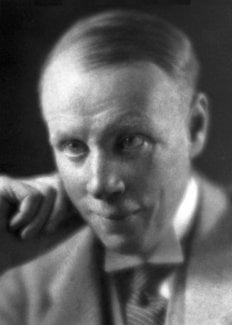
To recount my life for the Nobel Foundation, I would like to present it as possessing some romantic quality, some unique character, like Kipling‘s early adventures in India, or Bernard Shaw‘s leadership in the criticism of British arts and economics. But my life, aside from such youthful pranks as sailing on cattleships from America to England during university vacations, trying to find work in Panama during the building of the Canal, and serving for two months as janitor of Upton Sinclair’s abortive co-operative colony, Helicon Hall, has been a rather humdrum chronicle of much reading, constant writing, undistinguished travel à la tripper, and several years of comfortable servitude as an editor.
I was born in a prairie village in that most Scandinavian part of America, Minnesota, the son of a country doctor, in 1885. Until I went East to Yale University I attended the ordinary public school, along with many Madsens, Olesons, Nelsons, Hedins, Larsons. Doubtless it was because of this that I made the hero of my second book, The Trail of the Hawk, a Norwegian, and Gustaf Sondelius, of Arrowsmith, a Swede – and to me, Dr. Sondelius is the favorite among all my characters.
Of Carl Ericson of The Trail of the Hawk, I wrote -back in 1914, when I was working all day as editor for the George H. Doran Publishing Company, and all evening trying to write novels – as follows:
«His carpenter father had come from Norway, by way of steerage and a farm in Wisconsin, changing his name (to Americanize it) from Ericsen… Carl was second-generation Norwegian; American-born, American in speech, American in appearance, save for his flaxen hair and china-blue eyes… When he was born the ‹typical Americans› of earlier stocks had moved to city palaces or were marooned on run-down farms. It was Carl Ericson, not a Trowbridge or a Stuyvesant or a Lee or a Grant, who was the ‹typical American› of his period. It was for him to carry on the American destiny of extending the Western horizon; his to restore the wintry Pilgrim virtues and the exuberant October, partridge-drumming days of Daniel Boone; then to add, in his own or another generation, new American aspirations for beauty.»
My university days at Yale were undistinguished save for contributions to the Yale Literary Magazine. It may be interesting to say that these contributions were most of them reeking with a banal romanticism; that an author who was later to try to present ordinary pavements trod by real boots should through university days have written nearly always of Guinevere and Lancelot – of weary bitterns among sad Irish reeds – of story-book castles with troubadours vastly indulging in wine, a commodity of which the author was singularly ignorant. What the moral is, I do not know. Whether imaginary castles at nineteen lead always to the sidewalks of Main Street at thirty-five, and whether the process might be reversed, and whether either of them is desirable, I leave to psychologists.
I drifted for two years after college as a journalist, as a newspaper reporter in Iowa and in San Francisco, as – incredibly – a junior editor on a magazine for teachers of the deaf, in Washington, D.C. The magazine was supported by Alexander Graham Bell, inventor of the telephone. What I did not know about teaching the deaf would have included the entire subject, but that did not vastly matter, as my position was so insignificant that it included typing hundreds of letters every week begging for funds for the magazine and, on days when the Negro janitress did not appear, sweeping out the office.
Doubtless this shows the advantages of a university education, and it was further shown when at the age of twenty-five I managed to get a position in a New York publishing house at all of fifteen dollars a week. This was my authentic value on the labor market, and I have always uncomfortably suspected that it would never have been much higher had I not, accidentally, possessed the gift of writing books which so acutely annoyed American smugness that some thousands of my fellow citizens felt they must read these scandalous documents, whether they liked them or not.
From that New York position till the time five years later when I was selling enough short stories to the magazines to be able to live by free-lancing, I had a series of typical white-collar, unromantic, office literary jobs with two publishing houses, a magazine (Adventure), and a newspaper syndicate, reading manuscripts, writing book advertising, writing catalogues, writing uninspired book reviews – all the carpentry and plumbing of the city of letters. Nor did my first five novels rouse the slightest whispers: Our Mr. Wrenn, The Trail of the Hawk, The Job, The Innocents, and Free Air they were called, published between 1914 and 1919, and all of them dead before the ink was dry. I lacked sense enough to see that, after five failures, I was foolish to continue writing.
Main Street, published late in 1920, was my first novel to rouse the embattled peasantry and, as I have already hinted, it had really a success of scandal. One of the most treasured American myths had been that all American villages were peculiarly noble and happy, and here an American attacked that myth. Scandalous. Some hundreds of thousands read the book with the same masochistic pleasure that one has in sucking an aching tooth.
Since Main Street, the novels have been Babbitt (1922); Arrowsmith (1925); Mantrap (1926); Elmer Gantry (1927); The Man Who Knew Coolidge (1928); and Dodsworth (1929). The next novel, yet unnamed, will concern idealism in America through three generations, from 1818 till 1930-an idealism which the outlanders who call Americans «dollar-chasers» do not understand. It will presumably be published in the autumn of 1932, and the author’s chief difficulty in composing it is that, after having received the Nobel Prize, he longs to write better than he can.
I was married, in England, in 1928, to Dorothy Thompson, an American who had been the Central European correspondent and chef de bureau of the New York Evening Post. My first marriage, to Grace Hegger, in New York, in 1914, had been dissolved.
During these years of novelwriting since 1915, I have lived a quite unromantic and unstirring life. I have travelled much; on the surface it would seem that one who during these fifteen years had been in forty states of the United States, in Canada, Mexico, England, Scotland, France, Italy, Sweden, Germany, Austria, Czechoslovakia, Jugoslavia, Greece, Switzerland, Spain, the West Indies, Venezuela, Colombia, Panama, Poland, and Russia must have been adventurous. That, however, would be a typical error of biography. The fact is that my foreign travelling has been a quite uninspired recreation, a flight from reality. My real travelling has been sitting in Pullman smoking cars, in a Minnesota village, on a Vermont farm, in a hotel in Kansas City or Savannah, listening to the normal daily drone of what are to me the most fascinating and exotic people in the world – the Average Citizens of the United States, with their friendliness to strangers and their rough teasing, their passion for material advancement and their shy idealism, their interest in all the world and their boastful provincialism – the intricate complexities which an American novelist is privileged to portray.
And nowadays, at forty-six, with my first authentic home – a farm in the pastoral state of Vermont – and a baby born in June 1930, I am settled down to what I hope to be the beginning of a novelist’s career. I hope the awkward apprenticeship with all its errors is nearly done.
Biographical note on Sinclair Lewis
Sinclair Lewis (1885-1951) continued to be a prolific writer, but none of his later writings equalled the success or stature of his chiefworks of the twenties. After his divorce from his second wife in 1942, Sinclair Lewis lived chiefly in Europe. His later novels include Ann Vickers (I933), It Can’t Happen Here (1935), The Prodigal Parents (1938), Gideon Planish (1943), Cass Timberlane (1945), Kingsblood Royal ( 1947), The God-Seeker (1949), and World So Wide (1951). From Main Street to Stockholm: Letters of Sinclair Lewis 1919-1930 was published in 1952, one year after his death in Rome.
This autobiography/biography was written at the time of the award and first published in the book series Les Prix Nobel. It was later edited and republished in Nobel Lectures. To cite this document, always state the source as shown above.
Sinclair Lewis died on January 10, 1951.
The Nobel Foundation's copyright has expired.
Sinclair Lewis – Facts
Award ceremony speech
Presentation Speech by Erik Axel Karlfeldt, Permanent Secretary of the Swedish Academy, on December 10, 1930
This year’s winner of the Nobel Prize in Literature is a native of a part of America which for a long time has had Swedish contacts. He was born at Sauk Centre, a place of about two or three thousand inhabitants in the great cornland of Minnesota. He describes the place in his novel Main Street (1920), though there it is called Gopher Prairie.
It is the great prairie, an undulating land with lakes and oak groves, which has produced that little town and many others exactly like it. The pioneers have need of places to sell their grain, shops to purchase their supplies, banks for their mortgage loans, doctors for their bodies, and clergymen for their souls. There is cooperation between the country and the town, but at the same time there is conflict. Does the town exist for the sake of the country, or the country for the town?
The prairie makes its power felt. During the winters, long and cold as ours, terrific storms dump their snow in the wide streets, between low and shabby houses. The summer scorches with an intense heat and the town smells, because it lacks both sewers and street cleaning. Yet the town naturally feels its superiority; it is the flower of the prairie. It has the economic threads in its hands, and it is the focus of civilization – a concentrated, proud America amidst these earth-bound thralls of foreign origin, Germans and Scandinavians.
Thus the town lives happily in its self-confidence and its belief in true democracy, which does not exclude a proper stratification of the people, its faith in a sound business morality, and the blessings of being motorized; for there are many Fords in Main Street.
To this town comes a young woman filled with rebellious emotions. She wants to reform the town, inside and out, but fails completely, almost going under in the attempt.
As a description of life in a small town, Main Street is certainly one of the best ever written. To be sure, the town is first and foremost American, but it could, as a spiritual milieu, be situated just as well in Europe. Like Mr. Lewis, many of us have suffered from its ugliness and bigotry. The strong satire has aroused local protests, but one need not be keensighted to see the tolerant strain in Lewis’s sketch of his native town and its people.
Behind the puffed-up complacency of Gopher Prairie, however, lurks jealousy. At the edge of the plain stand cities like St. Paul and Minneapolis, already little metropolitan centres with their skyscraper windows gleaming in the sunlight or the evening’s electricity. Gopher Prairie wants to be like them and finds the time ripe for a campaign of progress, based on the rising war price of wheat.
A stump orator is imported, a real rabble-rouser of the peppiest kind, and with blatant eloquence he demonstrates that nothing will be easier than for Gopher Prairie to take the lead and reach the 200,000 class.
Mr. Babbitt – George Follansbee Babbitt – is the happy citizen of such a city (Babbitt, 1922). It is called Zenith, but probably it cannot be found on the map under that name. This city with its enlarged horizons hereafter becomes the starting point for Mr. Lewis’s critical raids into the territories of Americanism. The city is a hundred times larger than Gopher Prairie and, therefore, a hundred times richer in one hundred per cent Americanism and one hundred times as satisfied with itself, and the enchantment of its optimism and progressive spirit is embodied in George F. Babbitt.
As a matter of fact, Babbitt probably approaches the ideal of an American popular hero of the middle class. The relativity of business morals as well as private rules of conduct is for him an accepted article of faith, and without hesitation he considers it God’s purpose that man should work, increase his income, and enjoy modern improvements. He feels that he obeys these commandments and therefore lives in complete harmony with himself and society.
His profession, real estate, is the highest in existence, and his house near the city, with its trees and lawn, is standard, inside and out. The make of his car corresponds to his position, and in it he whizzes through the streets, proud as a young hero amidst the perils of the traffic. His family life also corresponds to the bourgeois average. His wife has become used to his masculine rumblings at home, and the children are impertinent, but that is what one expects.
He enjoys excellent health, is well-fed and thriving, alert and good-natured. His daily lunches at the club are feasts of instructive business conversation and stimulating anecdotes; he is sociable and winning. Babbitt is furthermore a man with the gift of speech. He has learned all the national slogans and whirls them about with his flowing tongue in his popular talks before clubs and mass meetings. Not even for the most elevated spirituality does he lack sympathy. He basks in the company of the noted poet, Cholmondeley Frink, who concentrates his genius on the composition of striking, rhymed advertisements for various firms and thereby earns a good annual income.
Thus Babbitt lives the life of the irreproachable citizen conscious of his respectability. But the jealousy of the gods broods over a mortal whose happiness grows too great. A soul such as Babbitt’s is, of course, incapable of growth; it is a ready-made article from the start. Then Babbitt discovers that he has tendencies toward vice which he has neglected – although not wholly, one ought to add. As he approaches fifty, he hastens to make up for the neglect. He enters into an irregular relationship and joins a frivolous gang of youths, in which he plays the role of a generous sugar daddy. But his deeds find him out. His lunches at the club become more and more painful through the silence and aloofness of his friends. They hint that he is spoiling this chance of future membership in the committee of progress. Here it is naturally New York and Chicago that loom before him. He succeeds in recovering his better self, and it is edifying to see him kneel in his pastor’s study, where he receives absolution. And then Babbitt can once more devote himself to the Sunday school and other socially useful activities. His story ends as it began.
That it is institutions as representatives of false ideas, and not individuals, that Mr. Lewis wants to attack with his satire, he has himself indicated. It is then a triumph for his art, a triumph almost unique in literature, that he has been able to make this Babbitt, who fatalistically lives within the borders of an earth-bound but at the same time pompous utilitarianism, an almost lovable individual.
Babbitt is naive, and a believer who speaks up for his faith. At bottom there is nothing wrong with the man, and he is so festively refreshing that he almost serves as a recommendation for American snap and vitality. There are bouncers and Philistines in all countries, and one can only wish that half of them were half as amusing as Babbitt.
To the splendour of the figure, as well as to other speaking characters in the book, Mr. Lewis has added his unparalleled gift of words. Listen, for example, to the conversation of a few commercial travellers, sitting together in a compartment of the New York express. An unsuspected halo falls over the profession of selling. «To them, the Romantic Hero was no longer the knight, the wandering poet, the cowpuncher, the aviator, nor the brave young district attorney, but the great sales manager, who had an Analysis of Merchandizing Problems on his glass-topped desk, whose title of nobility was ‹Go-getter› and who devoted himself and all his young samurai to the cosmic purpose of Selling – not of selling anything in particular, for or to anybody in particular, but pure Selling.»
Arrowsmith (1925) is a work of a more serious nature. Lewis has there attempted to represent the medical profession and science in all its manifestations. As is well known, American research in the natural sciences, physics, chemistry, and medicine ranks with the best of our age, and it has several times been recognized as such from this very platform. Tremendous resources have been placed at its command. Richly endowed institutions work unceasingly on its development.
That even here some speculative persons want to take advantage of their opportunities may be regarded as inevitable. Private industries are on the alert for scientific discoveries and want to profit from them before they have been tested and finally established. The bacteriologist, for instance, searches with infinite care for vaccines to cure widespread diseases, and the manufacturing chemist wants to snatch them prematurely from his hand for mass production.
Under the guidance of a gifted and conscientious teacher, Martin Arrowsmith develops into one of the idealists of science. The tragedy of his life as research worker is that, after making an important discovery, he delays its announcement for constantly renewed tests until he is anticipated by a Frenchman in the Pasteur Institute.
The book contains a rich gallery of different medical types. We have the hum of the medical schools with their quarrelling and intriguing professors. Then there is the unpretentious country doctor, recalled from Main Street, who regards it as an honour to merge with his clientele and become their support and solace. Then we have the shrewd organizer of public health and general welfare, who works himself into popular favour and political power. Next we have the large institutes with their apparently royally independent investigators, under a management which to a certain extent must take into consideration the commercial interests of the donors and drive the staff to forced work for the honour of the institutes.
Above these types rises Arrowsmith’s teacher, the exiled German Jew, Gottlieb, who is drawn with a warmth and admiration that seem to suggest a living model. He is an incorruptibly honest servant of science, but at the same time a resentful anarchist and a stand-offish misanthrope, who doubts whether the humanity whose benefactor he is amounts to as much as the animals he kills with his experiments. Further we meet the Swedish doctor, Gustaf Sondelius, a radiant Titan, who with singing and courage pursues pests in their lairs throughout the world, exterminates poisonous rats and burns infected villages, drinks and preaches his gospel that hygiene is destined to kill the medical art.
Alongside all of this runs the personal history of Martin Arrowsmith. Lewis is much too clever to make his characters without blemish, and Martin suffers from faults which at times seem obstructive to his development, both as a man and as a scientist. As a restless and irresolute young man he gets his best help from a little woman he encountered at a hospital where she was an insignificant nurse. When he begins to drift about the country as an unsuccessful medical student, he looks her up in a little village in the Far West, and there she becomes his wife. She is a devoted and simple soul, who demands nothing and who patiently waits in her solitude when, bewitched by the siren of science, her husband loses himself in the labyrinths of his work.
Later she accompanies him and Sondelius to the plague-infected island where Arrowsmith wants to test his serum. Her death in the abandoned hut, while her husband listens distractedly to another and more earthy siren than that of science, seems like a poetically crowning final act to a life of primitive self-sacrificing femininity.
The book is full of admirable learning, certified by experts as being accurate. Though a master of light-winged words, Lewis is never superficial when it comes to the foundations of his art. His study of details is always as careful and thorough as that of such a scientist as Arrowsmith or Gottlieb. In this work he has built a monument to the profession of his own father, that of the physician, which certainly is not represented by a charlatan or a faker.
His big novel Elmer Gantry (1927) is like a surgical operation on one of the most delicate parts of the social body. Presumably it would not pay to search anywhere in the world for the old Puritanical virtues, but possibly one might find in some of the oldest corners of America a remnant of the sect which regarded it as a sin to remarry, once it had pleased God to make one a widower or widow, and wicked to lend money at interest. But otherwise America has no doubt had to moderate its religious rigidity. To what extent a pulpiteer like Elmer Gantry is common over there, we cannot here have the slightest idea. Neither his slapdash style of preaching with his cocky pugilistic manners («Hello, Mr. Devil») nor his successful collecting of money and men inside the gates of the church can hide the sad fact that he is an unusually foul fish. Mr. Lewis has been neither willing nor able to give him any attractive traits. But as description the book is a feat of strength, genuine and powerful, and its full-flavoured, sombre satire has a devastating effect. It is unnecessary to point out that hypocrisy thrives a little everywhere and that any one who attacks it at such a close range places himself before a hydra with many dangerous heads.
Sinclair Lewis’s latest work is called Dodsworth (1929). In his books we have previously caught glimpses of the family as one of the most aristocratic in Zenith – a circle where no Babbitt ever gains admission. «Most aristocratic» probably often means in America «richest», but Sam Dodsworth is both aristocratic and rich. Even after 300 years he notices the English blood in his veins and wants to know the land of his ancestors. He is an American, but not a jingo. With him travels his wife, Fran. She is already over forty, while he is fifty. She is a cool beauty, «virginal as the winter wind», though she has grown children. In the European atmosphere she blossoms as a brilliant flower of luxury, revelling in vanity, pleasure, and selfishness. She goes so far that the quiet man who loves her has to leave her to her fate.
Once alone he meditates on the problem «Europe-America», and as a real business man he wants to clear up his accounts with both. He thinks of many things, honestly and without prejudice. One of his observations is that the very soil of Europe has some of the old-time quiet, which is scorned by America, the land of restless record-hunters. But America is the land of youth and daring experiments. And when he returns there, we understand that the heart of Sinclair Lewis follows him.
Yes, Sinclair Lewis is an American. He writes the new language – American – as one of the representatives of 120,000,000 souls. He asks us to consider that this nation is not yet finished or melted down; that it is still in the turbulent years of adolescence.
The new great American literature has started with national self-criticism. It is a sign of health. Sinclair Lewis has the blessed gift of wielding his landclearing implement not only with a firm hand but with a smile on his lips and youth in his heart. He has the manners of a new settler, who takes new land into cultivation. He is a pioneer.
Mr. Sinclair Lewis – I have spoken of you to this assembly in a language which you do not understand. I might have abused the occasion to speak ill of you. I have not done it. I have spoken of you as one of the strong, young chieftains of the great new American literature. Besides, you have a special recommendation to Swedish hearts. You were born among our countrymen in America, and you have mentioned them in friendly terms in your renowned books. We are glad to see you here today and glad that our nation has a laurel of its own to bestow on you. And now I ask you to descend with me and receive it from the hand of our King.
At the banquet, Tor Hedberg, Member of the Swedish Academy, addressed the laureate: «Finally, Mr. Lewis, in your person we greet that [American] new building on its own American ground. It has been said that the Nobel Prize in Literature has found its way across the Atlantic far too late. If so, it has not been due to any indifference on the part of the Swedish Academy, nor to any lack of knowledge, but rather to an «embarras de richesse». It has further been said that the award of a prize to your work, in which the follies of mankind – not excluding those that are perhaps special to America – have been scourged, is an expression of some kind of European or Swedish animosity against America. I dare to assert that this is a complete mistake. It is with living humour that you aim the blows of your scourge, and where there is humour, there is a heart too. It is not only the keen and lively intellect, the masterly design of human shapes and characters but also the warm, open, gaily-beating heart that we have appreciated in you». Sinclair Lewis expressed his gratitude and declared that he felt closely related to the Swedish people because of his many acquaintances among the Swedish families of Minnesota. He said that the Nobel Prize had a great significance for him, that it had in fact created a new standard which implied an obligation to improve on what he had done so far. Furthermore, he considered it a high honour to have been awarded the Nobel Prize along with the renowned scholars who received the distinction. He said that, personally, he had the profoundest respect for the integrity of the scientist, and thought that a man of letters, himself included, should strive for the same integrity.