Gabriela Mistral – Photo gallery

Gabriela Mistral receiving her Nobel Prize from King Gustaf V of Sweden at Konserthuset Stockholm on 10 December 1945.
Photo: Bettmann/Getty Images
Gabriela Mistral – Nominations
Gabriela Mistral – Banquet speech
Gabriela Mistral’s speech at the Nobel Banquet at the City Hall in Stockholm, December 10, 1945
(Translation)
Today Sweden turns toward a distant Latin American country to honour it in the person of one of the many exponents of its culture. It would have pleased the cosmopolitan spirit of Alfred Nobel to extend the scope of his protectorate of civilization by including within its radius the southern hemisphere of the American continent. As a daughter of Chilean democracy, I am moved to have before me a representative of the Swedish democratic tradition, a tradition whose originality consists in perpetually renewing itself within the framework of the most valuable creations of society. The admirable work of freeing a tradition from deadwood while conserving intact the core of the old virtues, the acceptance of the present and the anticipation of the future, these are what we call Sweden, and these achievements are an honour to Europe and an inspiring example for the American continent.
The daughter of a new people, I salute the spiritual pioneers of Sweden, by whom I have been helped more than once. I recall its men of science who have enriched its national body and mind. I remember the legion of professors and teachers who show the foreigner unquestionably exemplary schools, and I look with trusting love to those other members of the Swedish people: farmers, craftsmen, and workers.
At this moment, by an undeserved stroke of fortune, I am the direct voice of the poets of my race and the indirect voice for the noble Spanish and Portuguese tongues. Both rejoice to have been invited to this festival of Nordic life with its tradition of centuries of folklore and poetry.
May God preserve this exemplary nation, its heritage and its creations, its efforts to conserve the imponderables of the past and to cross the present with the confidence of maritime people who overcome every challenge.
My homeland, represented here today by our learned Minister Gajardo, respects and loves Sweden, and it has sent me here to accept the special honour you have awarded to it. Chile will treasure your generosity among her purest memories.
Prior to the speech, Professor A.H.T. Theorell of the Department of Biochemistry, Nobel Institute of Medicine, addressed the Chilean poet: «To you, Gabriela Mistral, I wish to convey our admiring homage. From a distant continent, where the summer sun now shines, you have ventured the long journey to Gösta Berling’s land, when the darkness of winter broods at its deepest. A worthier voice than mine has praised your poetry earlier today. May I nevertheless be permitted to say that we all share in the gladness that the Nobel Prize has this time been awarded to a poetess who combines magnificent art with the deepest and noblest aims.»
Gabriela Mistral – Bibliography
| Works in Spanish |
| Desolación. – New York : Instituto de las Españas, 1922 |
| Ternura : canciones de niños. – Madrid : Saturnino Calleja, 1924 |
| Tala. – Buenos Aires : Sur, 1938 |
| Los sonetos de la muerte y otros poemas elegíacos. – Santiago : Philobiblion, 1952 |
| Lagar. – Santiago, 1954 |
| Croquis mexicanos; Gabriela Mistral en México. – México : Costa-Amic, 1957 |
| Recados : Contando a Chile. – Santiago : Editorial del Pacífico, 1957 |
| Poesías completas. – Madrid : Aguilar, 1958 |
| Páginas en prosa. – Buenos Aires : Kapelusz, 1962 |
| Motivos de San Francisco. – Santiago : Editorial del Pacífico, 1965 |
| Poema de Chile. – Barcelona : Pomaire, 1967 |
| Antología poética de Gabriela Mistral. – Santiago : Editorial Universitaria, 1974 |
| Materias : prosa inédita. – Santiago : Editorial Universitaria, 1978 |
| Gabriela anda por el mundo. – Santiago : Andrés Bello, 1978 |
| Prosa religiosa de Gabriela Mistral. – Santiago : Andrés Bello, 1978 |
| Magisterio y niño. – Santiago : Andrés Bello, 1979 |
| Grandeza de los oficios. – Santiago : Andrés Bello, 1979 |
| Elogio de las cosas de la tierra. – Santiago : Andrés Bello, 1979 |
| Reino : Poesía dispersa e inédita, en verso y prosa. – Valparaíso : Ediciones Universitarias de Valparaíso, 1983 |
| Lagar II. – Santiago : Dirreción de Bibliotecas, Archivos y Museos, Biblioteca Nacional, 1991 |
| Poesía y prosa. – Caracas : Biblioteca Ayacucho, 1993 |
| Bendita mi lengua sea : Diario íntima de Gabriela Mistral, 1905-1956. – Santiago : Planeta/Ariel, 2002 |
| Recopilación de la obra mistraliana, 1902-1922 – Santiago : Ril, 2002 |
| 50 prosas en El Mercurio 1921-1956. – Santiago : El Mercurio/Aguilar, 2005 |
| Gabriela Mistral esencial: Poesía, prosa y correspondencia. – Santiago : Aguilar Chilena de Ediciones, 2005 |
| En verso y prosa : antología. – Madrid : Real Academia Española, 2010 |
| Translations into English |
| Selected Poems of Gabriela Mistral / translated by Langston Hughes. – Bloomington : Indiana University Press, 1957 |
| Selected Poems of Gabriela Mistral / translated and edited by Doris Dana. – Baltimore: Johns Hopkins University Press, 1971 |
| A Gabriela Mistral Reader / translated by Maria Giachetti, edited by Marjorie Agosín. – Fredonia, N.Y. : White Pines, 1993 |
| Women / translated by Jacqueline C. Nanfito, edited by Agosín and Nanfito. – Buffalo : White Pine Press, 2001 |
| Selected Prose and Prose-Poems / edited and translated by Stephen Tapscott. – Austin : University of Texas Press, 2002 |
| Selected Poems of Gabriela Mistral / translated by Ursula K. Le Guin. – Albuquerque : University of New Mexico Press, 2003 |
| This America of Ours : the Letters of Gabriela Mistral and Victoria Ocampo / edited and translated by Elizabeth Horan and Doris Meyer. – Austin : University of Texas Press, 2003 |
| Gabriela Mistral : Selected Poems / translated by Paul Burns and Salvador Ortiz-Carboneres ; with an introduction by Paul Burns. – Oxford : Oxbow Books, 2006 |
| Madwomen : the Locas Mujeres Poems of Gabriela Mistral / edited and translated by Randall Couch. – A bilingual ed. – Chicago : University of Chicago Press, 2008 |
| Critical studies (a selection) |
| Fiol-Matta, Licia, A Queer Mother for the Nation : the State and Gabriela Mistral. – Minneapolis, MN : University of Minnesota Press, 2002 |
The Swedish Academy, 2011
Gabriela Mistral – Other resources
Links to other sites
Gabriela Mistral at the University of Chile
On Gabriela Mistral from Pegasos Author’s Calendar
Gabriela Mistral – Facts
Award ceremony speech
Presentation Speech by Hjalmar Gullberg, Member of the Swedish Academy, on December 10, 1945
One day a mother’s tears caused a whole language, disdained at that time in good society, to rediscover its nobility and gain glory through the power of its poetry. It is said that when [Frédéric] Mistral, the first of the two poets bearing the name of the Mediterranean wind, had written his first verses in French as a young student, his mother began to shed inexhaustible tears. An ignorant country woman from Languedoc, she did not understand this distinguished language. Mistral then wrote Mirèio, recounting the love of the pretty little peasant for the poor artisan, an epic that exudes the perfume of the flowering land and ends in cruel death. Thus the old language of the troubadours became again the language of poetry. The Nobel Prize of 1904 drew the world’s attention to this event. Ten years later the poet of Mirèio died.
In that same year, 1914, the year in which the First World War broke out, a new Mistral appeared at the other end of the world. At the Floral Games of Santiago de Chile, Gabriela Mistral obtained the prize with some poems dedicated to a dead man.
Her story is so well known to the people of South America that, passed on from country to country, it has become almost a legend. And now that she as at last come to us, over the crests of the Cordilleran Andes and across the immensities of the Atlantic, we may retell it once again.
In a small village in the Elquis valley, several decades ago, was born a future schoolteacher named Lucila Godoy y Alcayaga. Godoy was her father’s name, Alcayaga her mother’s; both were of Basque origin. Her father, who had been a schoolteacher, improvised verses with ease. His talent seems to have been mixed with the anxiety and the instability common to poets. He left his family when his daughter, for whom he had made a small garden, was still a child. Her beautiful mother, who was to live a long time, has said that sometimes she discovered her lonely little daughter engaged in intimate conversations with the birds and the flowers of the garden. According to one version of the legend, she was expelled from school. Apparently she was considered too stupid for teaching hours to be wasted on her. Yet she taught herself by her own methods, educating herself to the extent that she became a teacher in the small village school of Cantera. There her destiny was fulfilled at the age of twenty, when a passionate love arose between her and a railroad employee.
We know little of their story. We know only that he betrayed her. One day in November, 1909, he fatally shot himself in the head. The young girl was seized with boundless despair. Like Job, she lifted her cry to the Heaven that had allowed this. From the lost valley in the barren, scorched mountains of Chile a voice arose, and far around men heard it. A banal tragedy of everyday life lost its private character and entered into universal literature. Lucila Godoy y Alcayaga became Gabriela Mistral. The little provincial schoolteacher, the young colleague of Selma Lagerlöf of Mårbacka, was to become the spiritual queen of Latin America.
When the poems written in memory of the dead man had made known the name of the new poet, the sombre and passionate poems of Gabriela Mistral began to spread over all South America. It was not until 1922, however, that she had her large collection of poems, Desolación (Despair), printed in New York. A mother’s tears burst forth in the middle of the book, in the fifteenth poem, tears shed for the son of the dead man, a son who would never be born…
Gabriela Mistral transferred her natural love to the children she taught. For them she wrote the collections of simple songs and rounds, collected in Madrid in 1924 under the title Ternura (Tenderness). In her honour, four thousand Mexican children at one time sang these rounds. Gabriela Mistral became the poet of motherhood by adoption.
In 1938 her third large collection, Tala (a title which can be translated as «ravage» but which is also the name of a children’s game), appeared in Buenos Aires for the benefit of the infant victims of the Spanish Civil War. Contrasting with the pathos of Desolación, Tala expresses the cosmic calm which envelopes the South American land whose fragrance comes all the way to us. We are again in the garden of her childhood; I listen again to the intimate dialogues with nature and common things. There is a curious mixture of sacred hymn and naive song for children; the poems on bread and wine, salt, corn, and water – water that can be offered to thirsty men – celebrate the primordial foods of human life!…
From her maternal hand this poet gives us a drink which tastes of the earth and which appease the thirst of the heart. It is drawn from the spring which ran for Sappho on a Greek island and for Gabriela Mistral in the valley Elquis, the spring of poetry that will never dry up.
Madame Gabriela Mistral – You have indeed made a long voyage to be received by so short a speech. In the space of a few minutes I have described to the compatriots of Selma Lagerlöf your remarkable pilgrimage from the chair of a schoolmistress to the throne of poetry. In rendering homage to the rich Latin American literature, we address ourselves today quite specially to its queen, the poet of Desolación, who has become the great singer of sorrow and of motherhood.
I ask you now to receive from the hands of His Majesty the King the Nobel Prize in Literature, which the Swedish Academy has awarded you.
The Nobel Prize in Literature 1945
Gabriela Mistral – Biographical
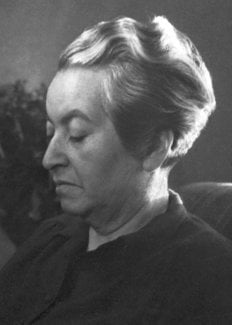
Gabriela Mistral (1889-1957), pseudonym for Lucila Godoy Alcayaga, was born in Vicuña, Chile. The daughter of a dilettante poet, she began to write poetry as a village schoolteacher after a passionate romance with a railway employee who committed suicide. She taught elementary and secondary school for many years until her poetry made her famous. She played an important role in the educational systems of Mexico and Chile, was active in cultural committees of the League of Nations, and was Chilean consul in Naples, Madrid, and Lisbon. She held honorary degrees from the Universities of Florence and Guatemala and was an honorary member of various cultural societies in Chile as well as in the United States, Spain, and Cuba. She taught Spanish literature in the United States at Columbia University, Middlebury College, Vassar College, and at the University of Puerto Rico.
The love poems in memory of the dead, Sonetos de la muerte (1914), made her known throughout Latin America, but her first great collection of poems, Desolación [Despair], was not published until 1922. In 1924 appeared Ternura [Tenderness], a volume of poetry dominated by the theme of childhood; the same theme, linked with that of maternity, plays a significant role in Tala, poems published in 1938. Her complete poetry was published in 1958.
This autobiography/biography was written at the time of the award and first published in the book series Les Prix Nobel. It was later edited and republished in Nobel Lectures. To cite this document, always state the source as shown above.
Gabriela Mistral died on January 10, 1957.