Bertrand Russell – Bibliography
| Selected works |
| German Social Democracy. – London : Longmans, Green, 1896 |
| An Essay on the Foundations of Geometry. – Cambridge : Cambridge University Press, 1897 |
| A Critical Exposition of the Philosophy of Leibniz : With an Appendix of Leading Passages. – Cambridge : Cambridge University Press, 1900. – Republ. as The Philosophy of Leibniz. – New York : Macmillan, 1937 |
| The Principles of Mathematics. – Cambridge : Cambridge University Press, 1903 |
| Philosophical Essays. – London : Allen & Unwin, 1910. – Republ. as Mysticism and Logic and Other Essays, 1918 |
| Principia Mathematica / Alfred North Whitehead, Bertrand Russell. – Cambridge : Cambridge University Press, 1910-1913. – 3 vol. |
| The Problems of Philosophy. – London : Williams & Norgate, 1912 |
| Our Knowledge of the External World as a Field for Scientific Method in Philosophy. – London : Allen & Unwin, 1914 |
| Justice in War-Time. – Chicago : Open Court, 1916 |
| Principles of Social Reconstruction. – London : Allen & Unwin, 1916. – Republ. as Why Men Fight; A Method of Abolishing the International Duel. – New York : Century, 1917 |
| Political Ideals. – New York : Century, 1917 |
| Roads to Freedom : Socialism, Anarchism and Syndicalism. – London : Allen & Unwin, 1918.– Republ. as Proposed Roads to Freedom : Socialism, Anarchism and Syndicalism. – New York : Holt, 1919 |
| Introduction to Mathematical Philosophy. – London : Allen & Unwin, 1919 |
| The Practice and Theory of Bolshevism. – London : Allen & Unwin, 1920. – Republ. as Bolshevism : Practice and Theory. – New York : Harcourt, Brace & Howe, 1920 |
| The Analysis of Mind. – London : Allen & Unwin, 1921 |
| Free Thought and Official Propaganda. – New York : Huebsch, 1922 |
| The Problem of China. – London : Allen & Unwin, 1922 |
| The Prospects of Industrial Civilization / Bertrand Russell, Dora Russell. – New York : Century, 1923 |
| The ABC of Atoms. – New York : Dutton, 1923 |
| Icarus; or, The Future of Science. – New York : Dutton, 1924 |
| How to Be Free and Happy. – New York : Rand School of Social Science, 1924 |
| What I Believe. – New York : Dutton, 1925 |
| The ABC of Relativity. – London : Harper, 1925 |
| On Education, Especially in Early Childhood. – London : Allen & Unwin, 1926. – Republ.as Education and the Good Life. – New York : Boni & Liveright, 1926 |
| Why I Am Not a Christian. – London : Watts, 1927 |
| The Analysis of Matter. – New York : Harcourt, Brace, 1927; London : Kegan Paul, Trench, Trubner, 1927 |
| An Outline of Philosophy. – London : Allen & Unwin, 1927. – Republ. as Philosophy. – New York : Norton, 1927 |
| Selected Papers of Bertrand Russell. – New York : Modern Library, 1927 |
| Sceptical Essays. – New York : Norton, 1928 |
| Marriage and Morals. – New York : Liveright, 1929 |
| Has Religion Made Useful Contributions to Civilization? : An Examination and a Criticism. – London : Watts, 1930 |
| The Conquest of Happiness. – New York : Liveright, 1930 |
| The Scientific Outlook. – New York : Norton, 1931 |
| Education and the Social Order. – London : Allen & Unwin, 1932. – Republ.as Education and the Modern World. – New York : Norton, 1932 |
| Freedom and Organization 1814-1914. – London : Allen & Unwin, 1934. – Republ.as Freedom versus Organization 1812-1914. – New York : Norton, 1934 |
| Religion and Science. – New York : Holt, 1935 |
| In Praise of Idleness and Other Essays. – New York : Norton, 1935 |
| Which Way to Peace? – London : Joseph, 1936 |
| Power: A New Social Analysis. – New York : Norton, 1938 |
| An Inquiry into Meaning and Truth. – New York : Norton, 1940 |
| A History of Western Philosophy : Its Connection with Political and Social Circumstances from the Earliest Times to the Present Day. – New York : Simon & Schuster, 1945 |
| Physics and Experience. – London : Cambridge University Press, 1946 |
| Philosophy and Politics. – London : Cambridge University Press, 1947 |
| Human Knowledge : Its Scope and Limits. – London : Allen & Unwin, 1948 |
| Authority and the Individual. – London : Allen & Unwin, 1949 |
| Unpopular Essays. – London : Allen & Unwin, 1950 |
| New Hopes for a Changing World. – London : Allen & Unwin, 1951 |
| The Impact of Science on Society. – London : Allen & Unwin, 1952 |
| Dictionary of Mind, Matter, and Morals. – New York : Philosophical Library, 1952 |
| Satan in the Suburbs and Other Stories. – New York : Simon & Schuster, 1953 |
| Nightmares of Eminent Persons and Other Stories. – London : Lane, 1954 |
| Human Society in Ethics and Politics. .– London : Allen & Unwin, 1954 |
| Logic and Knowledge. – London : Allen & Unwin, 1956 |
| Portraits from Memory and Other Essays. – London : Allen & Unwin, 1956 |
| Understanding History and Other Essays. – New York : Philosophical Library, 1957 |
| Why I Am Not a Christian and Other Essays on Religion and Related Subjects. .– London : Allen & Unwin, 1957 |
| The Will to Doubt. – New York : Philosophical Library, 1958 |
| Common Sense and Nuclear Warfare. – London : Allen & Unwin, 1959 |
| My Philosophical Development. – London : Allen & Unwin, 1959 |
| Wisdom of the West : A Historical Survey of Western Philosophy in Its Social and Political Setting / edited by Paul Foulkes. – London : Macdonald, 1959 |
| Bertrand Russell Speaks His Mind. – Cleveland & New York : World, 1960 |
| The Basic Writings of Bertrand Russell / edited by Robert E. Egner and Lester E. Denonn. – London : Allen & Unwin, 1961 |
| Fact and Fiction. – London : Allen & Unwin, 1961 |
| Has Man a Future? – London : Allen & Unwin, 1961 |
| Essays in Skepticism. – New York : Philosophical Library, 1963 |
| Unarmed Victory. – London : Allen & Unwin, 1963 |
| War and Atrocity in Vietnam. – London : Bertrand Russell Peace Foundation, 1965 |
| War Crimes in Vietnam. – London : Allen & Unwin, 1967 |
| The Autobiography of Bertrand Russell. – London : Allen & Unwin, 1967-1969. – 3 vol. |
| The Art of Philosophizing and Other Essays. – New York : Philosophical Library, 1968 |
| Russell’s Logical Atomism / edited by David Pears. – London : Fontana , 1972 |
| The Life of Bertrand Russell in Pictures and His Own Words / edited by Christopher Farley and David Hodgson. – Nottingham, U.K. : Bertrand Russell Peace Foundation, 1972 |
| My Own Philosophy. – Hamilton, Ont. : McMaster University Library Press, 1972 |
| Atheism. – New York : Arno Press, 1972 |
| The Collected Stories of Bertrand Russell / edited by Barry Feinberg. – London : Allen & Unwin, 1972 |
| Essays in Analysis / edited by Douglas Lackey. – London : Allen & Unwin, 1973 |
| Mortals and Others : Bertrand Russell’s American Essays 1931-1935 / edited by Harry Ruja. – London : Allen & Unwin, 1975 |
| Theory of Knowledge : The 1913 Manuscript / edited by Elizabeth Ramsden Eames in collaboration with Kenneth Blackwell. – London & New York : Routledge, 1992 |
| The Collected Papers of Bertrand Russell / edited by Kenneth Blackwell. – London, 1983- . – 28 vol. |
| The Selected Letters of Bertrand Russell / edited by Nicholas Griffin ; assisted by Alison Roberts Miculan. – London : Routledge, 2001 |
| Critical studies (a selection) |
| Leggett, Harry W., Bertrand Russell, O.M. : a pictorial biography. – London, 1949 |
| Götlind, Erik, Bertrand Russell’s theories of causation. – Uppsala, 1952 |
| Watling, John, Bertrand Russell. – Edinburgh : Oliver and Boyd, 1970 |
| Clark, Ronald William, The life of Bertrand Russell. – London : Cape, 1975 |
| Martin, Werner, Bertrand Russell : a bibliography of his writings : eine Bibliographie seiner Schriften, 1895-1976. – München : Saur, 1981 |
| Patterson, Wayne A., Bertrand Russell’s Philosophy of Logical Atomism. – New York : Peter Lang, 1993 |
| Miah, Sajahan, Russell’s Theory of Perception (1905-1919). – London : Continuum, 2006 |
| Potter, Michael K., Bertrand Russell’s Ethics. – London : Continuum, 2006 |
The Swedish Academy, 2007
Bertrand Russell – Photo gallery

Bertrand Russell (left) in conversation with Swedish Prince Wilhelm (right) at the Grand Hotel in Stockholm on 11 December 1950.
Photo: Vimar Ericsson. Source: Stockholms stadsmuseum. CC BY-NC-SA 2.5 SE
Bertrand Russell – Nominations
Bertrand Russell – Nobel Lecture
Nobel Lecture, December 11, 1950
What Desires Are Politically Important?
Your Royal Highness, Ladies and Gentlemen,
I have chosen this subject for my lecture tonight because I think that most current discussions of politics and political theory take insufficient account of psychology. Economic facts, population statistics, constitutional organization, and so on, are set forth minutely. There is no difficulty in finding out how many South Koreans and how many North Koreans there were when the Korean War began. If you will look into the right books you will be able to ascertain what was their average income per head, and what were the sizes of their respective armies. But if you want to know what sort of person a Korean is, and whether there is any appreciable difference between a North Korean and a South Korean; if you wish to know what they respectively want out of life, what are their discontents, what their hopes and what their fears; in a word, what it is that, as they say, «makes them tick», you will look through the reference books in vain. And so you cannot tell whether the South Koreans are enthusiastic about UNO, or would prefer union with their cousins in the North. Nor can you guess whether they are willing to forgo land reform for the privilege of voting for some politician they have never heard of. It is neglect of such questions by the eminent men who sit in remote capitals, that so frequently causes disappointment. If politics is to become scientific, and if the event is not to be constantly surprising, it is imperative that our political thinking should penetrate more deeply into the springs of human action. What is the influence of hunger upon slogans? How does their effectiveness fluctuate with the number of calories in your diet? If one man offers you democracy and another offers you a bag of grain, at what stage of starvation will you prefer the grain to the vote? Such questions are far too little considered. However, let us, for the present, forget the Koreans, and consider the human race.
All human activity is prompted by desire. There is a wholly fallacious theory advanced by some earnest moralists to the effect that it is possible to resist desire in the interests of duty and moral principle. I say this is fallacious, not because no man ever acts from a sense of duty, but because duty has no hold on him unless he desires to be dutiful. If you wish to know what men will do, you must know not only, or principally, their material circumstances, but rather the whole system of their desires with their relative strengths.
There are some desires which, though very powerful, have not, as a rule, any great political importance. Most men at some period of their lives desire to marry, but as a rule they can satisfy this desire without having to take any political action. There are, of course, exceptions; the rape of the Sabine women is a case in point. And the development of northern Australia is seriously impeded by the fact that the vigorous young men who ought to do the work dislike being wholly deprived of female society. But such cases are unusual, and in general the interest that men and women take in each other has little influence upon politics.
The desires that are politically important may be divided into a primary and a secondary group. In the primary group come the necessities of life: food and shelter and clothing. When these things become very scarce, there is no limit to the efforts that men will make, or to the violence that they will display, in the hope of securing them. It is said by students of the earliest history that, on four separate occasions, drought in Arabia caused the population of that country to overflow into surrounding regions, with immense effects, political, cultural, and religious. The last of these four occasions was the rise of Islam. The gradual spread of Germanic tribes from southern Russia to England, and thence to San Francisco, had similar motives. Undoubtedly the desire for food has been, and still is, one of the main causes of great political events.
But man differs from other animals in one very important respect, and that is that he has some desires which are, so to speak, infinite, which can never be fully gratified, and which would keep him restless even in Paradise. The boa constrictor, when he has had an adequate meal, goes to sleep, and does not wake until he needs another meal. Human beings, for the most part, are not like this. When the Arabs, who had been used to living sparingly on a few dates, acquired the riches of the Eastern Roman Empire, and dwelt in palaces of almost unbelievable luxury, they did not, on that account, become inactive. Hunger could no longer be a motive, for Greek slaves supplied them with exquisite viands at the slightest nod. But other desires kept them active: four in particular, which we can label acquisitiveness, rivalry, vanity, and love of power.
Acquisitiveness – the wish to possess as much as possible of goods, or the title to goods – is a motive which, I suppose, has its origin in a combination of fear with the desire for necessaries. I once befriended two little girls from Estonia, who had narrowly escaped death from starvation in a famine. They lived in my family, and of course had plenty to eat. But they spent all their leisure visiting neighbouring farms and stealing potatoes, which they hoarded. Rockefeller, who in his infancy had experienced great poverty, spent his adult life in a similar manner. Similarly the Arab chieftains on their silken Byzantine divans could not forget the desert, and hoarded riches far beyond any possible physical need. But whatever may be the psychoanalysis of acquisitiveness, no one can deny that it is one of the great motives – especially among the more powerful, for, as I said before, it is one of the infinite motives. However much you may acquire, you will always wish to acquire more; satiety is a dream which will always elude you.
But acquisitiveness, although it is the mainspring of the capitalist system, is by no means the most powerful of the motives that survive the conquest of hunger. Rivalry is a much stronger motive. Over and over again in Mohammedan history, dynasties have come to grief because the sons of a sultan by different mothers could not agree, and in the resulting civil war universal ruin resulted. The same sort of thing happens in modern Europe. When the British Government very unwisely allowed the Kaiser to be present at a naval review at Spithead, the thought which arose in his mind was not the one which we had intended. What he thought was, «I must have a Navy as good as Grandmamma’s». And from this thought have sprung all our subsequent troubles. The world would be a happier place than it is if acquisitiveness were always stronger than rivalry. But in fact, a great many men will cheerfully face impoverishment if they can thereby secure complete ruin for their rivals. Hence the present level of taxation.
Vanity is a motive of immense potency. Anyone who has much to do with children knows how they are constantly performing some antic, and saying «Look at me». «Look at me» is one of the most fundamental desires of the human heart. It can take innumerable forms, from buffoonery to the pursuit of posthumous fame. There was a Renaissance Italian princeling who was asked by the priest on his deathbed if he had anything to repent of. «Yes», he said, «there is one thing. On one occasion I had a visit from the Emperor and the Pope simultaneously. I took them to the top of my tower to see the view, and I neglected the opportunity to throw them both down, which would have given me immortal fame». History does not relate whether the priest gave him absolution. One of the troubles about vanity is that it grows with what it feeds on. The more you are talked about, the more you will wish to be talked about. The condemned murderer who is allowed to see the account of his trial in the press is indignant if he finds a newspaper which has reported it inadequately. And the more he finds about himself in other newspapers, the more indignant he will be with the one whose reports are meagre. Politicians and literary men are in the same case. And the more famous they become, the more difficult the press-cutting agency finds it to satisfy them. It is scarcely possible to exaggerate the influence of vanity throughout the range of human life, from the child of three to the potentate at whose frown the world trembles. Mankind have even committed the impiety of attributing similar desires to the Deity, whom they imagine avid for continual praise.
But great as is the influence of the motives we have been considering, there is one which outweighs them all. I mean the love of power. Love of power is closely akin to vanity, but it is not by any means the same thing. What vanity needs for its satisfaction is glory, and it is easy to have glory without power. The people who enjoy the greatest glory in the United States are film stars, but they can be put in their place by the Committee for Un-American Activities, which enjoys no glory whatever. In England, the King has more glory than the Prime Minister, but the Prime Minister has more power than the King. Many people prefer glory to power, but on the whole these people have less effect upon the course of events than those who prefer power to glory. When Blücher, in 1814, saw Napoleon’s palaces, he said, «Wasn’t he a fool to have all this and to go running after Moscow.» Napoleon, who certainly was not destitute of vanity, preferred power when he had to choose. To Blücher, this choice seemed foolish. Power, like vanity, is insatiable. Nothing short of omnipotence could satisfy it completely. And as it is especially the vice of energetic men, the causal efficacy of love of power is out of all proportion to its frequency. It is, indeed, by far the strongest motive in the lives of important men.
Love of power is greatly increased by the experience of power, and this applies to petty power as well as to that of potentates. In the happy days before 1914, when well-to-do ladies could acquire a host of servants, their pleasure in exercising power over the domestics steadily increased with age. Similarly, in any autocratic regime, the holders of power become increasingly tyrannical with experience of the delights that power can afford. Since power over human beings is shown in making them do what they would rather not do, the man who is actuated by love of power is more apt to inflict pain than to permit pleasure. If you ask your boss for leave of absence from the office on some legitimate occasion, his love of power will derive more satisfaction from a refusal than from a consent. If you require a building permit, the petty official concerned will obviously get more pleasure from saying «No» than from saying «Yes». It is this sort of thing which makes the love of power such a dangerous motive.
But it has other sides which are more desirable. The pursuit of knowledge is, I think, mainly actuated by love of power. And so are all advances in scientific technique. In politics, also, a reformer may have just as strong a love of power as a despot. It would be a complete mistake to decry love of power altogether as a motive. Whether you will be led by this motive to actions which are useful, or to actions which are pernicious, depends upon the social system, and upon your capacities. If your capacities are theoretical or technical, you will contribute to knowledge or technique, and, as a rule, your activity will be useful. If you are a politician you may be actuated by love of power, but as a rule this motive will join itself on to the desire to see some state of affairs realized which, for some reason, you prefer to the status quo. A great general may, like Alcibiades, be quite indifferent as to which side he fights on, but most generals have preferred to fight for their own country, and have, therefore, had other motives besides love of power. The politician may change sides so frequently as to find himself always in the majority, but most politicians have a preference for one party to the other, and subordinate their love of power to this preference. Love of power as nearly pure as possible is to be seen in various different types of men. One type is the soldier of fortune, of whom Napoleon is the supreme example. Napoleon had, I think, no ideological preference for France over Corsica, but if he had become Emperor of Corsica he would not have been so great a man as he became by pretending to be a Frenchman. Such men, however, are not quite pure examples, since they also derive immense satisfaction from vanity. The purest type is that of the eminence grise – the power behind the throne that never appears in public, and merely hugs itself with the secret thought: «How little these puppets know who is pulling the strings.» Baron Holstein, who controlled the foreign policy of the German Empire from 1890 to 1906, illustrates this type to perfection. He lived in a slum; he never appeared in society; he avoided meeting the Emperor, except on one single occasion when the Emperor’s importunity could not be resisted; he refused all invitations to Court functions, on the ground that he possessed no court dress. He had acquired secrets which enabled him to blackmail the Chancellor and many of the Kaiser’s intimates. He used the power of blackmail, not to acquire wealth, or fame, or any other obvious advantage, but merely to compel the adoption of the foreign policy he preferred. In the East, similar characters were not very uncommon among eunuchs.
I come now to other motives which, though in a sense less fundamental than those we have been considering, are still of considerable importance. The first of these is love of excitement. Human beings show their superiority to the brutes by their capacity for boredom, though I have sometimes thought, in examining the apes at the zoo, that they, perhaps, have the rudiments of this tiresome emotion. However that may be, experience shows that escape from boredom is one of the really powerful desires of almost all human beings. When white men first effect contact with some unspoilt race of savages, they offer them all kinds of benefits, from the light of the gospel to pumpkin pie. These, however, much as we may regret it, most savages receive with indifference. What they really value among the gifts that we bring to them is intoxicating liquor which enables them, for the first time in their lives, to have the illusion for a few brief moments that it is better to be alive than dead. Red Indians, while they were still unaffected by white men, would smoke their pipes, not calmly as we do, but orgiastically, inhaling so deeply that they sank into a faint. And when excitement by means of nicotine failed, a patriotic orator would stir them up to attack a neighbouring tribe, which would give them all the enjoyment that we (according to our temperament) derive from a horse race or a General Election. The pleasure of gambling consists almost entirely in excitement. Monsieur Huc describes Chinese traders at the Great Wall in winter, gambling until they have lost all their cash, then proceeding to lose all their merchandise, and at last gambling away their clothes and going out naked to die of cold. With civilized men, as with primitive Red Indian tribes, it is, I think, chiefly love of excitement which makes the populace applaud when war breaks out; the emotion is exactly the same as at a football match, although the results are sometimes somewhat more serious.
It is not altogether easy to decide what is the root cause of the love of excitement. I incline to think that our mental make-up is adapted to the stage when men lived by hunting. When a man spent a long day with very primitive weapons in stalking a deer with the hope of dinner, and when, at the end of the day, he dragged the carcass triumphantly to his cave, he sank down in contented weariness, while his wife dressed and cooked the meat. He was sleepy, and his bones ached, and the smell of cooking filled every nook and cranny of his consciousness. At last, after eating, he sank into deep sleep. In such a life there was neither time nor energy for boredom. But when he took to agriculture, and made his wife do all the heavy work in the fields, he had time to reflect upon the vanity of human life, to invent mythologies and systems of philosophy, and to dream of the life hereafter in which he would perpetually hunt the wild boar of Valhalla. Our mental make-up is suited to a life of very severe physical labor. I used, when I was younger, to take my holidays walking. I would cover twenty-five miles a day, and when the evening came I had no need of anything to keep me from boredom, since the delight of sitting amply sufficed. But modern life cannot be conducted on these physically strenuous principles. A great deal of work is sedentary, and most manual work exercises only a few specialized muscles. When crowds assemble in Trafalgar Square to cheer to the echo an announcement that the government has decided to have them killed, they would not do so if they had all walked twenty-five miles that day. This cure for bellicosity is, however, impracticable, and if the human race is to survive – a thing which is, perhaps, undesirable – other means must be found for securing an innocent outlet for the unused physical energy that produces love of excitement. This is a matter which has been too little considered, both by moralists and by social reformers. The social reformers are of the opinion that they have more serious things to consider. The moralists, on the other hand, are immensely impressed with the seriousness of all the permitted outlets of the love of excitement; the seriousness, however, in their minds, is that of Sin. Dance halls, cinemas, this age of jazz, are all, if we may believe our ears, gateways to Hell, and we should be better employed sitting at home contemplating our sins. I find myself unable to be in entire agreement with the grave men who utter these warnings. The devil has many forms, some designed to deceive the young, some designed to deceive the old and serious. If it is the devil that tempts the young to enjoy themselves, is it not, perhaps, the same personage that persuades the old to condemn their enjoyment? And is not condemnation perhaps merely a form of excitement appropriate to old age? And is it not, perhaps, a drug which – like opium – has to be taken in continually stronger doses to produce the desired effect? Is it not to be feared that, beginning with the wickedness of the cinema, we should be led step by step to condemn the opposite political party, dagoes, wops, Asiatics, and, in short, everybody except the fellow members of our club? And it is from just such condemnations, when widespread, that wars proceed. I have never heard of a war that proceeded from dance halls.
What is serious about excitement is that so many of its forms are destructive. It is destructive in those who cannot resist excess in alcohol or gambling. It is destructive when it takes the form of mob violence. And above all it is destructive when it leads to war. It is so deep a need that it will find harmful outlets of this kind unless innocent outlets are at hand. There are such innocent outlets at present in sport, and in politics so long as it is kept within constitutional bounds. But these are not sufficient, especially as the kind of politics that is most exciting is also the kind that does most harm. Civilized life has grown altogether too tame, and, if it is to be stable, it must provide harmless outlets for the impulses which our remote ancestors satisfied in hunting. In Australia, where people are few and rabbits are many, I watched a whole populace satisfying the primitive impulse in the primitive manner by the skillful slaughter of many thousands of rabbits. But in London or New York some other means must be found to gratify primitive impulse. I think every big town should contain artificial waterfalls that people could descend in very fragile canoes, and they should contain bathing pools full of mechanical sharks. Any person found advocating a preventive war should be condemned to two hours a day with these ingenious monsters. More seriously, pains should be taken to provide constructive outlets for the love of excitement. Nothing in the world is more exciting than a moment of sudden discovery or invention, and many more people are capable of experiencing such moments than is sometimes thought.
Interwoven with many other political motives are two closely related passions to which human beings are regrettably prone: I mean fear and hate. It is normal to hate what we fear, and it happens frequently, though not always, that we fear what we hate. I think it may be taken as the rule among primitive men, that they both fear and hate whatever is unfamiliar. They have their own herd, originally a very small one. And within one herd, all are friends, unless there is some special ground of enmity. Other herds are potential or actual enemies; a single member of one of them who strays by accident will be killed. An alien herd as a whole will be avoided or fought according to circumstances. It is this primitive mechanism which still controls our instinctive reaction to foreign nations. The completely untravelled person will view all foreigners as the savage regards a member of another herd. But the man who has travelled, or who has studied international politics, will have discovered that, if his herd is to prosper, it must, to some degree, become amalgamated with other herds. If you are English and someone says to you, «The French are your brothers», your first instinctive feeling will be, «Nonsense. They shrug their shoulders, and talk French. And I am even told that they eat frogs.» If he explains to you that we may have to fight the Russians, that, if so, it will be desirable to defend the line of the Rhine, and that, if the line of the Rhine is to be defended, the help of the French is essential, you will begin to see what he means when he says that the French are your brothers. But if some fellow-traveller were to go on to say that the Russians also are your brothers, he would be unable to persuade you, unless he could show that we are in danger from the Martians. We love those who hate our enemies, and if we had no enemies there would be very few people whom we should love.
All this, however, is only true so long as we are concerned solely with attitudes towards other human beings. You might regard the soil as your enemy because it yields reluctantly a niggardly subsistence. You might regard Mother Nature in general as your enemy, and envisage human life as a struggle to get the better of Mother Nature. If men viewed life in this way, cooperation of the whole human race would become easy. And men could easily be brought to view life in this way if schools, newspapers, and politicians devoted themselves to this end. But schools are out to teach patriotism; newspapers are out to stir up excitement; and politicians are out to get re-elected. None of the three, therefore, can do anything towards saving the human race from reciprocal suicide.
There are two ways of coping with fear: one is to diminish the external danger, and the other is to cultivate Stoic endurance. The latter can be reinforced, except where immediate action is necessary, by turning our thoughts away from the cause of fear. The conquest of fear is of very great importance. Fear is in itself degrading; it easily becomes an obsession; it produces hate of that which is feared, and it leads headlong to excesses of cruelty. Nothing has so beneficent an effect on human beings as security. If an international system could be established which would remove the fear of war, the improvement in everyday mentality of everyday people would be enormous and very rapid. Fear, at present, overshadows the world. The atom bomb and the bacterial bomb, wielded by the wicked communist or the wicked capitalist as the case may be, make Washington and the Kremlin tremble, and drive men further along the road toward the abyss. If matters are to improve, the first and essential step is to find a way of diminishing fear. The world at present is obsessed by the conflict of rival ideologies, and one of the apparent causes of conflict is the desire for the victory of our own ideology and the defeat of the other. I do not think that the fundamental motive here has much to do with ideologies. I think the ideologies are merely a way of grouping people, and that the passions involved are merely those which always arise between rival groups. There are, of course, various reasons for hating communists. First and foremost, we believe that they wish to take away our property. But so do burglars, and although we disapprove of burglars our attitude towards them is very different indeed from our attitude towards communists – chiefly because they do not inspire the same degree of fear. Secondly, we hate the communists because they are irreligious. But the Chinese have been irreligious since the eleventh century, and we only began to hate them when they turned out Chiang Kai-shek. Thirdly, we hate the communists because they do not believe in democracy, but we consider this no reason for hating Franco. Fourthly, we hate them because they do not allow liberty; this we feel so strongly that we have decided to imitate them. It is obvious that none of these is the real ground for our hatred. We hate them because we fear them and they threaten us. If the Russians still adhered to the Greek Orthodox religion, if they had instituted parliamentary government, and if they had a completely free press which daily vituperated us, then – provided they still had armed forces as powerful as they have now – we should still hate them if they gave us ground for thinking them hostile. There is, of course, the odium theologicum, and it can be a cause of enmity. But I think that this is an offshoot of herd feeling: the man who has a different theology feels strange, and whatever is strange must be dangerous. Ideologies, in fact, are one of the methods by which herds are created, and the psychology is much the same however the herd may have been generated.
You may have been feeling that I have allowed only for bad motives, or, at best, such as are ethically neutral. I am afraid they are, as a rule, more powerful than more altruistic motives, but I do not deny that altruistic motives exist, and may, on occasion, be effective. The agitation against slavery in England in the early nineteenth century was indubitably altruistic, and was thoroughly effective. Its altruism was proved by the fact that in 1833 British taxpayers paid many millions in compensation to Jamaican landowners for the liberation of their slaves, and also by the fact that at the Congress of Vienna the British Government was prepared to make important concessions with a view to inducing other nations to abandon the slave trade. This is an instance from the past, but present-day America has afforded instances equally remarkable. I will not, however, go into these, as I do not wish to become embarked in current controversies.
I do not think it can be questioned that sympathy is a genuine motive, and that some people at some times are made somewhat uncomfortable by the sufferings of some other people. It is sympathy that has produced the many humanitarian advances of the last hundred years. We are shocked when we hear stories of the ill-treatment of lunatics, and there are now quite a number of asylums in which they are not ill-treated. Prisoners in Western countries are not supposed to be tortured, and when they are, there is an outcry if the facts are discovered. We do not approve of treating orphans as they are treated in Oliver Twist. Protestant countries disapprove of cruelty to animals. In all these ways sympathy has been politically effective. If the fear of war were removed, its effectiveness would become much greater. Perhaps the best hope for the future of mankind is that ways will be found of increasing the scope and intensity of sympathy.
The time has come to sum up our discussion. Politics is concerned with herds rather than with individuals, and the passions which are important in politics are, therefore, those in which the various members of a given herd can feel alike. The broad instinctive mechanism upon which political edifices have to be built is one of cooperation within the herd and hostility towards other herds. The co-operation within the herd is never perfect. There are members who do not conform, who are, in the etymological sense, «egregious», that is to say, outside the flock. These members are those who have fallen below, or risen above, the ordinary level. They are: idiots, criminals, prophets, and discoverers. A wise herd will learn to tolerate the eccentricity of those who rise above the average, and to treat with a minimum of ferocity those who fall below it.
As regards relations to other herds, modern technique has produced a conflict between self-interest and instinct. In old days, when two tribes went to war, one of them exterminated the other, and annexed its territory. From the point of view of the victor, the whole operation was thoroughly satisfactory. The killing was not at all expensive, and the excitement was agreeable. It is not to be wondered at that, in such circumstances, war persisted. Unfortunately, we still have the emotions appropriate to such primitive warfare, while the actual operations of war have changed completely. Killing an enemy in a modern war is a very expensive operation. If you consider how many Germans were killed in the late war, and how much the victors are paying in income tax, you can, by a sum in long division, discover the cost of a dead German, and you will find it considerable. In the East, it is true, the enemies of the Germans have secured the ancient advantages of turning out the defeated population and occupying their lands. The Western victors, however, have secured no such advantages. It is obvious that modern war is not good business from a financial point of view. Although we won both the world wars, we should now be much richer if they had not occurred. If men were actuated by self-interest, which they are not – except in the case of a few saints – the whole human race would cooperate. There would be no more wars, no more armies, no more navies, no more atom bombs. There would not be armies of propagandists employed in poisoning the minds of Nation A against Nation B, and reciprocally of Nation B against Nation A. There would not be armies of officials at frontiers to prevent the entry of foreign books and foreign ideas, however excellent in themselves. There would not be customs barriers to ensure the existence of many small enterprises where one big enterprise would be more economic. All this would happen very quickly if men desired their own happiness as ardently as they desired the misery of their neighbours. But, you will tell me, what is the use of these utopian dreams ? Moralists will see to it that we do not become wholly selfish, and until we do the millennium will be impossible.
I do not wish to seem to end upon a note of cynicism. I do not deny that there are better things than selfishness, and that some people achieve these things. I maintain, however, on the one hand, that there are few occasions upon which large bodies of men, such as politics is concerned with, can rise above selfishness, while, on the other hand, there are a very great many circumstances in which populations will fall below selfishness, if selfishness is interpreted as enlightened self-interest.
And among those occasions on which people fall below self-interest are most of the occasions on which they are convinced that they are acting from idealistic motives. Much that passes as idealism is disguised hatred or disguised love of power. When you see large masses of men swayed by what appear to be noble motives, it is as well to look below the surface and ask yourself what it is that makes these motives effective. It is partly because it is so easy to be taken in by a facade of nobility that a psychological inquiry, such as I have been attempting, is worth making. I would say, in conclusion, that if what I have said is right, the main thing needed to make the world happy is intelligence. And this, after all, is an optimistic conclusion, because intelligence is a thing that can be fostered by known methods of education.
* Disclaimer
Every effort has been made by the publisher to credit organizations and individuals with regard to the supply of audio files. Please notify the publishers regarding corrections.
Bertrand Russell – Other resources
Links to other sites
The Bertrand Russell Archives at McMaster University
Bertrand Arthur William Russell. A Biography at the MacTutor History of Mathematics archive
On Bertrand Russell from Pegasos Author’s Calendar
Bertrand Russell – Facts
Award ceremony speech
Presentation Speech by Anders Österling, Permanent Secretary of the Swedish Academy
The great work on Western philosophy which Bertrand Russell brought out in 1946, that is, at the age of seventy-four, contains numerous characteristic reflections giving us an idea of how he himself might like us to regard his long and arduous life. In one place, speaking of the pre-Socratic philosophers, he says, «In studying a philosopher, the right attitude is neither reverence nor contempt, but first a kind of hypothetical sympathy, until it is possible to know what it feels like to believe in his theories, and only then a revival of the critical attitude, which should resemble, as far as possible, the state of mind of a person abandoning opinions which he has hitherto held.»
And in another place in the same work he writes, «It is not good either to forget the questions that philosophy asks, or to persuade ourselves that we have found indubitable answers to them. To teach how to live without certainty, and yet without being paralyzed by hesitation, is perhaps the chief thing that philosophy, in our age, can still do for those who study it.»
With his superior intellect, Russell has, throughout half a century, been at the centre of public debate, watchful and always ready for battle, as active as ever to this very day, having behind him a life of writing of most imposing scope. His works in the sciences concerned with human knowledge and mathematical logic are epoch-making and have been compared to Newton’s fundamental results in mechanics. Yet it is not these achievements in special branches of science that the Nobel Prize is primarily meant to recognize. What is important, from our point of view, is that Russell has so extensively addressed his books to a public of laymen, and, in doing so, has been so eminently successful in keeping alive the interest in general philosophy.
His whole life’s work is a stimulating defence of the reality of common sense. As a philosopher he pursues the line from the classical English empiricism, from Locke and Hume. His attitude toward the idealistic dogmas is a most independent one and quite frequently one of opposition. The great philosophical systems evolved on the Continent he regards, so to speak, from the chilly, windswept, and distinctive perspective of the English Channel. With his keen and sound good sense, his clear style, and his wit in the midst of seriousness, he has in his work evinced those characteristics which are found among only the elite of authors. Time does not permit even the briefest survey of his works in this area, which are fascinating also from a purely literary point of view. It may suffice to mention such books as the History of Western Philosophy (1946), Human Knowledge (1948), Sceptical Essays (1948), and the sketch «My Mental Development» (in The Philosophy of Bertrand Russell, 1951); but to these should be added a great number of equally important books on practically all the problems which the present development of society involves.
Russell’s views and opinions have been influenced by varied factors and cannot easily be summarized. His famous family typifies the Whig tradition in English politics. His grandfather was the Victorian statesman, John Russell. Familiar from an early age with the ideas of Liberalism, he was soon confronted by the problems of rising socialism and since then he has, as an independent critic, weighed the advantages and disadvantages of this form of society. He has consistently and earnestly warned us of the dangers of the new bureaucracy. He has defended the right of the individual against collectivism, and he views industrial civilization as a growing threat to humanity’s chances of simple happiness and joy in living. After his visit to the Soviet Union in 1920 he strongly and resolutely opposed himself to Communism. On the other hand, during a subsequent journey in China, he was very much attracted by the calm and peaceable frame of mind of China’s cultivated classes and recommended it as an example to a West ravaged by wild aggression.
Much in Russell’s writings excites protest. Unlike many other philosophers, he regards this as one of the natural and urgent tasks of an author. Of course, his rationalism does not solve all troublesome problems and cannot be used as a panacea, even if the philosopher willingly writes out the prescription. Unfortunately, there are – and obviously always will be – obscure forces which evade intellectual analysis and refuse to submit to control. Thus, even if Russell’s work has, from a purely practical point of view, met with but little success in an age which has seen two world wars – even if it may look as if, in the main, his ideas have been bitterly repudiated – we must nevertheless admire the unwavering valour of this rebellious teller of the truth and the sort of dry, fiery strength and gay buoyancy with which he presents his convictions, which are never dictated by opportunism but are often directly unpopular. To read the philosopher Russell often gives very much the same pleasure as to listen to the outspoken hero in a Shaw comedy, when in loud and cheerful tones he throws out his bold retorts and keen arguments.
In conclusion, Russell’s philosophy may be said in the best sense to fulfil just those desires and intentions that Alfred Nobel had in mind when he instituted his Prizes. There are quite striking similarities between their outlooks on life. Both of them are at the same time sceptics and utopians, both take a gloomy view of the contemporary world, yet both hold fast to a belief in the possibility of achieving logical standards for human behaviour. The Swedish Academy believes that it acts in the spirit of Nobel’s intention when, on the occasion of the fiftieth anniversary of the Foundation, it wishes to honour Bertrand Russell as one of our time’s brilliant spokesmen of rationality and humanity, as a fearless champion of free speech and free thought in the West.
My lord – Exactly two hundred years ago Jean Jacques Rousseau was awarded the prize offered by the Academy of Dijon for his famous answer to the question of «whether the arts and sciences have contributed to improve morals.» Rousseau answered «No», and this answer – which may not have been a very serious one – in any case had most serious consequences. The Academy of Dijon had no revolutionary aims. This is true also of the Swedish Academy, which has now chosen to reward you for your philosophical works just because they are undoubtedly of service to moral civilization and, in addition, most eminently answer to the spirit of Nobel’s intentions. We honour you as a brilliant champion of humanity and free thought, and it is a pleasure for us to see you here on the occasion of the fiftieth anniversary of the Nobel Foundation. With these words I request you to receive from the hands of His Majesty the King the Nobel Prize in Literature for 1950.
At the banquet, Robin Fåhraeus, Member of the Royal Academy of Sciences, made the following comment: «Dear Professor Bertrand Russell – We salute you as one of the greatest and most influential thinkers of our age, endowed with just those four characteristics which on another occasion you have regarded to be the criteria of prominent fellow men; namely, vitality, courage, receptivity, and intelligence.»
The Nobel Prize Award Ceremony 1950
The Nobel Prize in Literature 1950
Bertrand Russell – Biographical
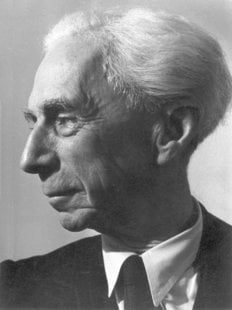
Bertrand Arthur William Russell was born at Trelleck on 18th May, 1872. His parents were Viscount Amberley and Katherine, daughter of 2nd Baron Stanley of Alderley. At the age of three he was left an orphan. His father had wished him to be brought up as an agnostic; to avoid this he was made a ward of Court, and brought up by his grandmother. Instead of being sent to school he was taught by governesses and tutors, and thus acquired a perfect knowledge of French and German. In 1890 he went into residence at Trinity College, Cambridge, and after being a very high Wrangler and obtaining a First Class with distinction in philosophy he was elected a fellow of his college in 1895. But he had already left Cambridge in the summer of 1894 and for some months was attaché at the British embassy at Paris.
In December 1894 he married Miss Alys Pearsall Smith. After spending some months in Berlin studying social democracy, they went to live near Haslemere, where he devoted his time to the study of philosophy. In 1900 he visited the Mathematical Congress at Paris. He was impressed with the ability of the Italian mathematician Peano and his pupils, and immediately studied Peano’s works. In 1903 he wrote his first important book, The Principles of Mathematics, and with his friend Dr. Alfred Whitehead proceeded to develop and extend the mathematical logic of Peano and Frege. From time to time he abandoned philosophy for politics. In 1910 he was appointed lecturer at Trinity College. After the first World War broke out, he took an active part in the No Conscription fellowship and was fined £ 100 as the author of a leaflet criticizing a sentence of two years on a conscientious objector. His college deprived him of his lectureship in 1916. He was offered a post at Harvard university, but was refused a passport. He intended to give a course of lectures (afterwards published in America as Political Ideals, 1918) but was prevented by the military authorities. In 1918 he was sentenced to six months’ imprisonment for a pacifistic article he had written in the Tribunal. His Introduction to Mathematical Philosophy (1919) was written in prison. His Analysis of Mind (1921) was the outcome of some lectures he gave in London, which were organized by a few friends who got up a subscription for the purpose.
In 1920 Russell had paid a short visit to Russia to study the conditions of Bolshevism on the spot. In the autumn of the same year he went to China to lecture on philosophy at the Peking university. On his return in Sept. 1921, having been divorced by his first wife, he married Miss Dora Black. They lived for six years in Chelsea during the winter months and spent the summers near Lands End. In 1927 he and his wife started a school for young children, which they carried on until 1932. He succeeded to the earldom in 1931. He was divorced by his second wife in 1935 and the following year married Patricia Helen Spence. In 1938 he went to the United States and during the next years taught at many of the country’s leading universities. In 1940 he was involved in legal proceedings when his right to teach philosophy at the College of the City of New York was questioned because of his views on morality. When his appointment to the college faculty was cancelled, he accepted a five-year contract as a lecturer for the Barnes foundation, Merion, Pa., but the cancellation of this contract was announced in Jan. 1943 by Albert C. Barnes, director of the foundation.
Russell was elected a fellow of the Royal Society in 1908, and re-elected a fellow of Trinity College in 1944. He was awarded the Sylvester medal of the Royal Society, 1934, the de Morgan medal of the London Mathematical Society in the same year, the Nobel Prize for Literature, 1950.
In a paper “Logical Atomism” (Contemporary British Philosophy. Personal Statements, First series. Lond. 1924) Russell exposed his views on his philosophy, preceded by a few words on historical development.1
| Principal publications |
| German Social Democracy, 1896 |
| Foundations of Geometry, 1897 |
| A Critical Exposition of the Philosophy of Leibniz, 1900 |
| Principles of Mathematics, vol. 1, 1903 |
| Philosophical Essays, 1910 |
| (with Dr. A. N. Whitehead) Principia mathematica, 3 vols, 1910-13 |
| The Problems of Philosophy, 1912 |
| Our Knowledge of the External World as a Field for Scientific Method in Philosophy, 1944 |
| Principles of Social Reconstruction, 1916 |
| Mysticism and Logic and Other Essays, 1918 |
| Roads to Freedom: Socialism, Anarchism and Syndicalism, 1918 |
| Introduction to Mathematical Philosophy, 1919 |
| The Practice and Theory of Bolshevism, 1920 |
| The Analysis of Mind, 1921 |
| The Problem of China, 1922 |
| The ABC of Atoms, 1923 |
| (with Dora Russell) The Prospects of Industrial Civilisation, 1923 |
| Logical Atomism, 1924 |
| The ABC of Relativity, 1925 |
| On Education, 1926 |
| The Analysis of Matter, 1927 |
| An Outline of Philosophy, 1927 |
| Sceptical Essays, 1928 |
| Marriage and Morals, 1929 |
| The Conquest of Happiness, 1930 |
| The Freedom and Organisation 1814-1914, 1934 |
| In Praise of Idleness, 1935 |
| Which Way to Peace?, 1936 |
| (with Patricia Russell editor of) The Amberley Papers, 2 vols, 1937 |
| Power: a new Social Introduction to its Study, 1938 |
| An Inquiry into Meaning and Truth, 1941 |
| History of Western Philosophy, 1946 |
| Human Knowledge, its Scope and Limits, 1948 |
| Authority and the Individual, 1949 |
| Unpopular Essays, 1950 |
1) The matter for this sketch is taken from general English reference books.
This autobiography/biography was written at the time of the award and later published in the book series Les Prix Nobel/ Nobel Lectures/The Nobel Prizes. The information is sometimes updated with an addendum submitted by the Laureate.
For more updated biographical information, see:
Russell, Bertrand, The Autobiography of Bertrand Russell. (3 vols.) Allen & Unwin: London, 1967-1969.
Bertrand Russell died on February 2, 1970.