Winston Churchill – Documentary
Credit: ITN Archive/Reuters
Winston Churchill – Bibliography
| Selected Works |
| The Story of the Malakand Field Force : An Episode of Frontier War. – Longmans, Green, 1898 |
| The River War : An Historical Account of the Reconquest of the Soudan. – 2 vol. – Longmans, Green, 1899 |
| Savrola : a Tale of the Revolution in Laurania. – Longmans, Green, 1900 |
| Lord Randolph Churchill. – 2 vol. – Macmillan, 1906 |
| My African Journey. – Hodder & Stoughton, 1908 |
| Liberalism and the Social Problem. – Hodder & Stoughton, 1909 |
| The People’s Rights. – Hodder & Stoughton, 1910 |
| The World Crisis. – 6 vol. – Butterworth, 1923–1931 |
| My Early Life : a Roving Commission. – Butterworth, 1930 |
| India : Speeches and an Introduction. – Butterworth, 1931 |
| Thoughts and Adventures. – Butterworth, 1932 |
| Marlborough : His Life and Times. – 4 vol. – Harrap, 1933–1938 |
| Great Contemporaries. – Butterworth, 1937 |
| Step by Step : 1936–1939. – Butterworth, 1939 |
| War Speeches : 1940–1945. – Cassell, 1946 |
| The Second World War. – 6 vol. – Houghton Mifflin, 1948–1955 |
| Painting as a Pastime. – Odham Press, 1948 |
| A History of the English-Speaking Peoples. – 4 vol. – Cassell, 1956–1958 |
| Young Winston’s Wars : The Original Despatches of Winston S. Churchill, War Correspondent, 1897–1900 / edited by Frederick Woods. – Cooper, 1972 |
| Collected Works of Sir Winston Churchill. – Centenary Limited Edition. – 34 vol. – Library of Imperial History, 1973–1976 |
| Winston S. Churchill : His Complete Speeches, 1897–1963 / edited by Robert Rhodes James. – 8 vol. – Chelsea House, 1974 |
| The Collected Essays of Sir Winston Churchill / edited by Michael Wolff. – 4 vol. – Library of Imperial History, 1976 |
| The Churchill War Papers / edited by Martin Gilbert. – 2 vol. – Norton, 1993–1995 |
| Critical studies (a selection) |
| Charmley, John, Churchill : the End of Glory : a Political Biography. – Hodder & Stoughton, 1993 |
| Churchill as Peacemaker / edited by James W. Muller. – University Press, 1997 |
| Sandys, Celia, Churchill Wanted Dead or Alive. – HarperCollins, 1999 |
| Jenkins, Roy, Churchill. – Macmillan, 2001 |
| Lukacs, John, Churchill : Visionary, Statesman, Historian. – Yale University Press, 2002 |
| Keegan, John, Churchill. – Weidenfeld & Nicolson, 2003 |
| Reynolds, David, In Command of History : Churchill Fighting and Writing the Second World War. – Allen Lane, 2004 |
| Best, Geoffrey, Churchill and War. – Hambledon and London, 2005 |
| Addison, Paul, Churchill : the Unexpected Hero. – Oxford University Press, 2005 |
| Cohen, Ronald I., Bibliography of the Writings of Sir Winston Churchill. Vol. 1-3. – Thoemmes Continuum, 2006 |
| McMenamin, Michael, & Zoller, Curt J., Becoming Winston Churchill : the Untold Story of Young Winston and His American Mentor. – Greenwood World Pub., 2007 |
| Hastings, Max, Winston’s War : Churchill, 1940-1945. – Knopf, 2009 |
| Toye, Richard, Churchill’s Empire : the World That Made Him and the World He Made. – Henry Holt, 2010 |
The Swedish Academy, 2011
Winston Churchill – Banquet speech
As the Laureate was unable to be present at the Nobel Banquet at the City Hall in Stockholm, December 10, 1953, the speech was read by Lady Churchill
«The Nobel Prize in Literature is an honour for me alike unique and unexpected and I grieve that my duties have not allowed me to receive it myself here in Stockholm from the hands of His Majesty your beloved and justly respected Sovereign. I am grateful that I am allowed to confide this task to my wife.
The roll on which my name has been inscribed represents much that is outstanding in the world’s literature of the twentieth century. The judgment of the Swedish Academy is accepted as impartial, authoritative, and sincere throughout the civilized world. I am proud but also, I must admit, awestruck at your decision to include me. I do hope you are right. I feel we are both running a considerable risk and that I do not deserve it. But I shall have no misgivings if you have none.
Since Alfred Nobel died in 1896 we have entered an age of storm and tragedy. The power of man has grown in every sphere except over himself. Never in the field of action have events seemed so harshly to dwarf personalities. Rarely in history have brutal facts so dominated thought or has such a widespread, individual virtue found so dim a collective focus. The fearful question confronts us; have our problems got beyond our control? Undoubtedly we are passing through a phase where this may be so. Well may we humble ourselves, and seek for guidance and mercy.
We in Europe and the Western world, who have planned for health and social security, who have marvelled at the triumphs of medicine and science, and who have aimed at justice and freedom for all, have nevertheless been witnesses of famine, misery, cruelty, and destruction before which pale the deeds of Attila and Genghis Khan. And we who, first in the League of Nations, and now in the United Nations, have attempted to give an abiding foundation to the peace of which men have dreamed so long, have lived to see a world marred by cleavages and threatened by discords even graver and more violent than those which convulsed Europe after the fall of the Roman Empire.
It is upon this dark background that we can appreciate the majesty and hope which inspired the conception of Alfred Nobel. He has left behind him a bright and enduring beam of culture, of purpose, and of inspiration to a generation which stands in sore need. This world-famous institution points a true path for us to follow. Let us therefore confront the clatter and rigidity we see around us with tolerance, variety, and calm.
The world looks with admiration and indeed with comfort to Scandinavia, where three countries, without sacrificing their sovereignty, live united in their thought, in their economic practice, and in their healthy way of life. From such fountains new and brighter opportunities may come to all mankind. These are, I believe, the sentiments which may animate those whom the Nobel Foundation elects to honour, in the sure knowledge that they will thus be respecting the ideals and wishes of its illustrious founder.»
Prior to the speech, G. Liljestrand, Member of the Royal Academy of Sciences, made the following remarks: «In the past, several prime ministers and ministers of foreign affairs and even two Presidents of the United States have been awarded the Nobel Peace Prize. Now, for the first time, a great statesman has received the Prize in Literature. But Sir Winston Churchill is a recognized master of the English language, that wonderful and flexible instrument of human thought. His monumental biographies are already classics, and his works on contemporary history are an outflow of deep and intimate first-hand knowledge, of lucidity of style as well as of humour and generosity. But to Sir Winston the English language has also provided an important tool, with the aid of which part of his job has been finished. His words, accompanied by corresponding deeds, have inspired hope and confidence in millions from all parts of the world during times of darkness. With a slight alteration we might use his own words: Never in the field of human conflict was so much owed by so many to one man. We would like to ask Lady Churchill to convey to her husband our respectful and sincere admiration and reverence for what he has given us in his writings and his speeches.»
Winston Churchill – Nominations
Winston Churchill – Biographical
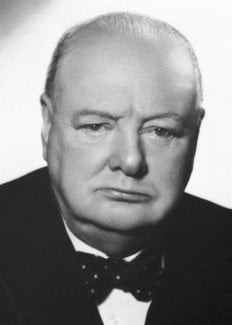
The Right Honourable Sir Winston Leonard Spencer Churchill (1874-1965), the son of Lord Randolph Churchill and his American wife Jennie Jerome, was educated at Harrow and Sandhurst. After a brief but eventful career in the army, he became a Conservative Member of Parliament in 1900. He held many high posts in Liberal and Conservative governments during the first three decades of the century. At the outbreak of the Second World War, he was appointed First Lord of the Admiralty – a post which he had earlier held from 1911 to 1915. In May, 1940, he became Prime Minister and Minister of Defence and remained in office until 1945. He took over the premiership again in the Conservative victory of 1951 and resigned in 1955. However, he remained a Member of Parliament until the general election of 1964, when he did not seek re-election. Queen Elizabeth II conferred on Churchill the dignity of Knighthood and invested him with the insignia of the Order of the Garter in 1953. Among the other countless honours and decorations he received, special mention should be made of the honorary citizenship of the United States which President Kennedy conferred on him in 1963.
Churchill’s literary career began with campaign reports: The Story of the Malakand Field Force (1898) and The River War (1899), an account of the campaign in the Sudan and the Battle of Omdurman. In 1900, he published his only novel, Savrola, and, six years later, his first major work, the biography of his father, Lord Randolph Churchill. His other famous biography, the life of his great ancestor, the Duke of Marlborough, was published in four volumes between 1933 and 1938. Churchill’s history of the First World War appeared in four volumes under the title of The World Crisis (1923-29); his memoirs of the Second World War ran to six volumes (1948-1953/54). After his retirement from office, Churchill wrote a History of the English-speaking Peoples (4 vols., 1956-58). His magnificent oratory survives in a dozen volumes of speeches, among them The Unrelenting Struggle (1942), The Dawn of Liberation (1945), and Victory (1946).
Churchill, a gifted amateur painter, wrote Painting as a Pastime (1948). An autobiographical account of his youth, My Early Life, appeared in 1930.
This autobiography/biography was written at the time of the award and first published in the book series Les Prix Nobel. It was later edited and republished in Nobel Lectures. To cite this document, always state the source as shown above.
Winston Churchill died on January 24, 1965.
Winston Churchill – Photo gallery
1 (of 1)
A preface dictated and signed by Winston Churchill, whose secretary typewrote all his books. The preface was for Erik Bergengren's book Alfred Nobel – the man and his work, published in English 1962.
From the archives of the Nobel Foundation, Stockholm, Sweden. 
Winston Churchill – Other resources
Links to other sites
The Winston Churchill Home Page by the Churchill Center, Washington, D.C.
The Life of Churchill from International Churchill Society
Churchill Archives Centre at Cambridge University, England
The Churchill Era: an educational resource, Cambridge University, England
Winston Churchill at Pegasos Author’s Calendar
On Winston Churchill from BBC History
Winston Churchill – Facts
Award ceremony speech
Presentation Speech by S. Siwertz, Member of the Swedish Academy
Very seldom have great statesmen and warriors also been great writers. One thinks of Julius Caesar, Marcus Aurelius, and even Napoleon, whose letters to Josephine during the first Italian campaign certainly have passion and splendour. But the man who can most readily be compared with Sir Winston Churchill is Disraeli, who also was a versatile author. It can be said of Disraeli as Churchill says of Rosebery, that «he flourished in an age of great men and small events». He was never subjected to any really dreadful ordeals. His writing was partly a political springboard, partly an emotional safety valve. Through a series of romantic and self-revealing novels, at times rather difficult to read, he avenged himself for the humiliation and setbacks that he, the Jewish stranger in an England ruled by aristocrats, suffered despite his fantastic career. He was not a great writer but a great actor, who played his leading part dazzlingly. He could very well repeat Augustus’ words of farewell: «Applaud, my friends, the comedy is over!»
Churchill’s John Bull profile stands out effectively against the elder statesman’s chalk-white, exotic mask with the black lock of hair on the forehead. The conservative Disraeli revered the English way of life and tradition which Churchill, radical in many respects, has in his blood, including steadfastness in the midst of the storm and the resolute impetus which marks both word and deed. He wears no mask, shows no sign of cleavage, has no complex, enigmatic nature. The analytical morbidezza, without which the modern generation finds it hard to imagine an author, is foreign to him. He is a man for whom reality’s block has not fallen apart. There, simply, lies the world with its roads and goals under the sun, the stars, and the banners. His prose is just as conscious of the goal and the glory as a runner in the stadium. His every word is half a deed. He is heart and soul a late Victorian who has been buffeted by the gale, or rather one who chose of his own accord to breast the storm.
Churchill’s political and literary achievements are of such magnitude that one is tempted to resort to portray him as a Caesar who also has the gift of Cicero’s pen. Never before has one of history’s leading figures been so close to us by virtue of such an outstanding combination. In his great work about his ancestor, Marlborough, Churchill writes, «Words are easy and many, while great deeds are difficult and rare.» Yes, but great, living, and persuasive words are also difficult and rare. And Churchill has shown that they too can take on the character of great deeds.
It is the exciting and colourful side of Churchill’s writing which perhaps first strikes the reader. Besides much else, My Early Life (1930) is also one of the world’s most entertaining adventure stories. Even a very youthful mind can follow with the keenest pleasure the hero’s spirited start in life as a problem child in school, as a polo-playing lieutenant in the cavalry (he was considered too dense for the infantry), and as a war correspondent in Cuba, in the Indian border districts, in the Sudan, and in South Africa during the Boer War. Rapid movement, undaunted judgments, and a lively perception distinguish him even here. As a word-painter the young Churchill has not only verve but visual acuteness. Later he took up painting as a hobby, and in Thoughts and Adventures (1932) discourses charmingly on the joy it has given him. He loves brilliant colours and feels sorry for the poor brown ones. Nevertheless, Churchill paints better with words. His battle scenes have a matchless colouring. Danger is man’s oldest mistress and in the heat of action the young officer was fired to an almost visionary clear-sightedness. On a visit to Omdurman many years ago I discovered how the final struggle in the crushing of the Mahdi’s rebellion, as it is depicted in The River War (1899), was branded on my memory. I could see in front of me the dervish hordes brandishing their spears and guns, the ochre-yellow sand ramparts shot to pieces, the Anglo-Egyptian troops’ methodical advance, and the cavalry charge which nearly cost Churchill his life.
Even old battles which must be dug out of dusty archives are described by Churchill with awesome clarity. Trevelyan masterfully depicts Marlborough’s campaigns, but in illusory power it is doubtful that Churchill’s historic battle scenes can be surpassed. Take, for instance, the Battle of Blenheim. One follows in fascination the moves of the bloody chess game, one sees the cannon balls plough their furrows through the compact squares, one is carried away by the thundering charge and fierce hand-to-hand fighting of the cavalry; and after putting the book down one can waken in the night in a cold sweat, imagining he is right in the front rank of English redcoats who, without wavering, stand among the piles of dead and wounded loading their rifles and firing their flashing salvoes.
But Churchill became far more than a soldier and a delineator of war. Even in the strict but brilliant school of the parliamentary gamble for power he was, perhaps from the outset, something of a problem child. The young Hotspur learned, however, to bridle his impetuosity, and he quickly developed into an eminent political orator with the same gift of repartee as Lloyd George. His sallies, often severe, excluded neither warmth nor chivalry. In his alternation between Toryism and radicalism, he followed in the footsteps of his father, Lord Randolph Churchill. He has also portrayed the latter’s short, uneasy, tragically interrupted political and personal life in a work which has an undisputed place of honour in England’s profuse biographical literature.
Even the First World War, despite all setbacks, meant a vast expansion for Churchill as both politician and writer. In his historical works the personal and the factual elements have been intimately blended. He knows what he is talking about. In gauging the dynamics of events, his profound experience is unmistakable. He is the man who has himself been through the fire, taken risks, and withstood extreme pressure. This gives his words a vibrating power. Occasionally, perhaps, the personal side gets the upper hand. Balfour called The World Crisis (1923-29) «Winston’s brilliant autobiography, disguised as world history.» With all due respect to archives and documents, there is something special about history written by a man who has himself helped to make it.
In his great book on the Duke of Marlborough (1933-38), whose life’s work is so similar to Churchill’s own, he makes an intrepid attack on his ancestor’s detractors. I do not know what professional historians say of his polemic against Macaulay, but these diatribes against the great general’s persistent haters and revilers are certainly diverting and temperamental.
The Marlborough book is not only a series of vivid battle scenes and a skillful defence of the statesman and warrior. It is also a penetrating study of an enigmatic and unique personality; it shows that Churchill, in addition to all else, is capable of real character-drawing. He returns again and again to the confusing mixture in Marlborough of methodical niggardliness and dazzling virtuosity: «His private fortune was amassed», he says, «upon the same principles as marked the staff-work of his campaigns, and was a part of the same design. It was only in love or on the battlefield that he took all risks. In these supreme exaltations he was swept from his system and rule of living, and blazed resplendent with the heroic virtues. In his marriage and in his victories the worldly prudence, the calculation, the reinsurance, which regulated his ordinary life and sustained his strategy, fell from him like a too heavily embroidered cloak, and the genius within sprang forth in sure and triumphant command.» In his military enthusiasm Churchill forgets for a moment that Marlborough’s famous and dearly loved Sarah was by no means one to let herself be ordered about. But it is a wonderful passage.
Churchill regretted that he had never been able to study at Oxford. He had to devote his leisure hours to educating himself. But there are certainly no educational gaps noticeable in his mature prose. Take, for example, Great Contemporaries (1937), one of his most charming books. He is said to have moulded his style on Gibbon, Burke, and Macaulay, but here he is supremely himself What a deft touch and at the same time what a fund of human knowledge, generosity, and gay malice are in this portrait gallery!
Churchill’s reaction to Bernard Shaw is very amusing, a piquant meeting between two of England’s greatest literary personalities. Churchill cannot resist poking fun at Shaw’s blithely irresponsible talk and flippancy, which contrasted with the latter’s fundamental gravity. Half amused, half appalled, he winces at the way in which the incorrigibly clowning genius was forever tripping himself up and turning somersaults between the most extreme antitheses. It is the contrast between the writer, who must at all costs create surprises, and the statesman, whose task it is to meet and master them.
It is not easy to sum up briefly the greatness of Churchill’s style. He says of his old friend, the Liberal statesman, John Morley, «Though in conversation he paraded and manœuvred nimbly and elegantly around his own convictions, offering his salutations and the gay compliments of old-time war to the other side, [he] always returned to his fortified camp to sleep.» As a stylist Churchill himself, despite his mettlesome chivalry, is not prone to such amiable arabesques. He does not beat about the bush, but is a man of plain speaking. His fervour is realistic, his striking – power is tempered only by broad-mindedness and humour. He knows that a good story tells itself. He scorns unnecessary frills and his metaphors are rare but expressive.
Behind Churchill the writer is Churchill the orator – hence the resilience and pungency of his phrases. We often characterize ourselves unconsciously through the praise we give others. Churchill, for instance, says of another of his friends, Lord Birkenhead, «As he warmed to his subject, there grew that glow of conviction and appeal, instinctive and priceless, which constitutes true eloquence.» The words might with greater justification have been said of Churchill himself.
The famous desert warrior, Lawrence of Arabia, the author of The Seven Pillars of Wisdom, is another who has both made and written history. Of him Churchill says, «Just as an aeroplane only flies by its speed and pressure against the air, so he flew best and easiest in the hurricane.» It is again striking how Churchill here too speaks of the same genius that carried his own words through the storm of events.
Churchill’s mature oratory is swift, unerring in its aim, and moving in its grandeur. There is the power which forges the links of history. Napoleon’s proclamations were often effective in their lapidary style. But Churchill’s eloquence in the fateful hours of freedom and human dignity was heart-stirring in quite another way. With his great speeches he has, perhaps, himself erected his most enduring monument.
Lady Churchill – The Swedish Academy expresses its joy at your presence and asks you to convey to Sir Winston a greeting of deep respect. A literary prize is intended to cast lustre over the author, but here it is the author who gives lustre to the prize. I ask you now to accept, on behalf of your husband, the 1953 Nobel Prize in Literature from the hands of His Majesty the King.
The Nobel Prize Award Ceremony 1953
While the rain poured down outside on a gloomy afternoon in Stockholm, 10 December 1953, inside the Stockholm Concert Hall the lights glittered on a festively dressed audience including the Swedish Royal family: King Gustaf VI Adolf, Queen Louise, Princesses Sibylla and Margaretha and Prince Bertil. The Nobel Laureates entered the scene. After Birger Ekeberg delivered his presentation speech, each Nobel Laureate was introduced and the Prize awarded. Professor Erik Hultén introduced the Physics Nobel Laureate, Frits Zernike; the Chemistry Nobel Laureate, Hermann Staudinger, was introduced by Professor Arne Fredga; Professor Einar Hammarsten introduced the Nobel Laureates in Physiology or Medicine, Hans Krebs and Fritz Lipmann; and author Sigfrid Siwertz spoke for the absent Nobel Laureate in Literature, Sir Winston Churchill; Lady Clementine Churchill received the Nobel Prize on behalf of her husband.