Boris Pasternak – Bibliography
| Works (large selection) |
| Bliznets v tuchakh. – Moscow : Lirika, 1914 |
| Poverkh bar’erov. – Moscow : Tsentrifuga, 1917 |
| Sestra moia zhizn’. – Moscow : Grzhebin, 1922 |
| Temy i variatsii. – Berlin : Gelikon, 1923 |
| Karusel’. – Leningrad : Gosudarstvennoe izdatel’stvo, 1925 |
| Rasskazy : [ Detstvo Liuvers, Il tratto di Apelle, Pis’ma iz Tuly, Vozdushnye puti]. – Moscow : Krug, 1925 |
| Deviat’sot piatyi god. – Moscow : Gosudarstvennoe izdatel’stvo, 1927 |
| Dve knigi : Stikhi. – Moscow : Gosudarstvennoe izdatel’stvo, 1927 |
| Zverinets. – Moscow : Gosudarstvennoe izdatel’stvo, 1929 |
| Okhrannaya gramota. – Leningrad : Izdatel’stvo pisatelei v Leningrade, 1931 |
| Spektorsky. – Moscow : Gosudarstvennoe izdatel’stvo khudozhestvennoi literatury, 1931 |
| Vtoroye rozhdenie. – Moscow : Federatsiia, 1932 |
| Stikhotvoreniia v odnom tome. – Leningrad : Izdatel’stvo pisatelei v Leningrade, 1933 |
| Vozdushnye puti. – Moscow : Gosudarstvennoe izdatel’stvo khudozhestvennoi literatury, 1933 |
| Na rannikh poezdakh. – Moscow : Sovetskii pisatel’, 1943 |
| Izbrannye stikhi i poemy. – Moscow : Gosudarstvennoe izdatel’stvo khudozhestvennoi literatury, 1945 |
| Zemnoi prostor. – Moscow : Sovetskii pisatel’, 1945 |
| Izbrannoe. – Moscow : Sovetskii pisatel’, 1948 |
| Il Dottor Zivago / translation by Pietro Zveteremich. – Milan : Feltrinelli, 1957 |
| Doktor Zhivago. – Feltrinelli, 1958 ; University of Michigan Press, 1958 |
| Kogda razgulyayetsya. – Paris : Izdatel’stvo liubitelei poezii B. L. Pasternaka, 1959 |
| Sochineniia. – 4 vol. – Ann Arbor : University of Michigan Press, 1961 |
| Stikhotvoreniia i poemy. – Moscow : Sovetskii pisatel’, 1965 |
| Slepaia krasavitsa. – London : Collins & Harvill, 1969 |
| Vozdushnye puti : proza raznykh let. – Moscow : Sovetskii pisatel’, 1982 |
| Doktor Zhivago. – 1. compl. authorized ed. – Moscow : Knizhnaia palata, 1989 |
| Sobranie sochinenii. – 5 vol. – Moscow : Khudozhestvennaia literatura, 1989-1992 |
| Translations into English (large selection) |
| Childhood / translation by Robert Payne. – Singapura : Straits Times Press, 1941 |
| Doctor Zhivago / translated by Max Hayward and Manya Harari. – London : Pantheon, 1958 |
| Safe Conduct : An Autobiography and Other Writings / translated by George Reavey. – New York : New Directions, 1958 |
| An Essay in Autobiography / translated by Manya Harari. – London : Collins & Harvill, 1959 |
| I Remember : Sketch for an Autobiography / translated by David Magarshack. – New York : Pantheon, 1959 |
| The Last Summer / translated by George Reavey. – London : Peter Owen, 1959 |
| Poems, 1955-1959 / translated by Michael Harari. – London : Collins & Harvill, 1960 |
| The Adolescence of Zhenya Luvers / translation by I. Langnas. – New York : Philosophical Library, 1961 |
| Sister My Life : Summer, 1917 / translation by Philip C. Flayderman. – New York : Washington Square Press, 1967 |
| Letters to Georgian Friends / translation with notes and introduction by David Magarshack. – New York : Harcourt, 1968 |
| The Blind Beauty / translated by Max Hayward and Manya Harari. – New York : Harcourt, 1969 |
| My Sister Life and Other Poems / translated by Olga Andreyev Carlisle. – New York : Harcourt Brace Jovanovich, 1976 |
| The Correspondence of Boris Pasternak and Olga Freidenberg, 1910-1954 / translated by Elliott Mossman and Margaret Wettlin. – New York : Harcourt, 1982 |
| The Zhivago Poems / translated by Barbara Everest. – Huntington, W. Va. : Aegina Press, 1988 |
| Second Nature : Forty-six Poems. – London : Owen, 1990 |
| Critical studies (selection) |
| Rowland, Mary F., Pasternak’s Doctor Zhivago. – Carbondale, 1967 |
| Troickij, Nikolaj A., Boris Leonidovich Pasternak, 1890-1960 : a Bibliography of the Works of B. Pasternak and Literature About Him Printed in Russian. – Ithaca, N.Y., 1969 |
| Hingley, Ronald. Pasternak : a Biography. – New York : Knopf, 1983 |
| O’Connor, Katherine Tiernan, Boris Pasternak’s My sister – Life : the Iillusion of Narrative. – Ann Arbor : Ardis, 1988 |
| Barnes, Christopher, Boris Pasternak : a literary biography Vol. 1, 1890-1928.– Cambridge : Cambridge Univ. Press, 1989 |
| Flejšman, Lazar ’, Boris Pasternak : the Poet and His Politics. – Cambridge, Mass. : Harvard University Press, 1990 |
| Rudova, Larissa, Understanding Boris Pasternak. – Columbia : University of South Carolina Press, 1997 |
| Barnes, Christopher, Boris Pasternak : a Literary Biography Vol. 2, 1928-1960. – Cambridge : Cambridge Univ. Press, 1998 |
| Witt, Susanna, Creating Creation : Readings of Pasternak’s Doktor Živago. – Stockholm : Almqvist och Wiksell International, 2000 |
The Swedish Academy, 2007
Boris Pasternak – Nominations
Boris Pasternak – Other resources
Links to other sites
On Boris Pasternak from The Academy of American Poets
On Boris Pasternak from Poetry Foundation
On Boris Pasternak from Pegasos Author’s Calendar
Boris Pasternak – Facts
Announcement
Announcement by Anders Österling, Permanent Secretary of the Swedish Academy
Your Majesties, Your Royal Highnesses, Ladies and Gentlemen:
This year’s Nobel Prize for Literature has been awarded by the Swedish Academy to the Soviet-Russian writer Boris Pasternak for his notable achievement in both contemporary poetry and the field of the great Russian narrative tradition.
As is well known, Pasternak has sent word that he does not wish to accept the distinction. This refusal, of course, in no way alters the validity of the award. There remains only for the Academy, however, to announce with regret that the presentation of the Prize cannot take place.
On October 25, 1958, two days after the official communication from the Swedish Academy that Boris Pasternak had been selected as the Nobel Prize winner in literature, the Russian writer sent the following telegram to the Swedish Academy: “Immensely thankful, touched, proud, astonished, abashed.” This telegram was followed, on October 29, by another one with this content: “Considering the meaning this award has been given in the society to which I belong, I must reject this undeserved prize which has been presented to me. Please do not receive my voluntary rejection with displeasure.”
The Nobel Prize in Literature 1958
Boris Pasternak – Biographical
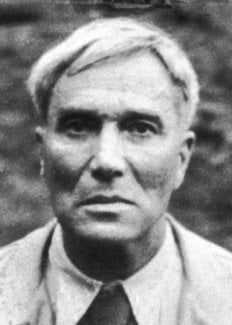
Boris Leonidovich Pasternak (1890-1960), born in Moscow, was the son of talented artists: his father a painter and illustrator of Tolstoy’s works, his mother a well-known concert pianist. Pasternak’s education began in a German Gymnasium in Moscow and was continued at the University of Moscow. Under the influence of the composer Scriabin, Pasternak took up the study of musical composition for six years from 1904 to 1910. By 1912 he had renounced music as his calling in life and went to the University of Marburg, Germany, to study philosophy. After four months there and a trip to Italy, he returned to Russia and decided to dedicate himself to literature.
Pasternak’s first books of verse went unnoticed. With Sestra moya zhizn (My Sister Life), 1922, and Temy i variatsii (Themes and Variations), 1923, the latter marked by an extreme, though sober style, Pasternak first gained a place as a leading poet among his Russian contemporaries. In 1924 he published Vysokaya bolezn (Sublime Malady), which portrayed the 1905 revolt as he saw it, and Detstvo Lyuvers (The Childhood of Luvers), a lyrical and psychological depiction of a young girl on the threshold of womanhood. A collection of four short stories was published the following year under the title Vozdushnye puti (Aerial Ways). In 1927 Pasternak again returned to the revolution of 1905 as a subject for two long works: Leytenant Shmidt, a poem expressing threnodic sorrow for the fate of Lieutenant Schmidt, the leader of the mutiny at Sevastopol, and Devyatsot pyaty god (The Year 1905), a powerful but diffuse poem which concentrates on the events related to the revolution of 1905. Pasternak’s reticent autobiography, Okhrannaya gramota (Safe Conduct), appeared in 1931, and was followed the next year by a collection of lyrics, Vtoroye rozhdenie (Second Birth), 1932. In 1935 he published translations of some Georgian poets and subsequently translated the major dramas of Shakespeare, several of the works of Goethe, Schiller, Kleist, and Ben Jonson, and poems by Petöfi, Verlaine, Swinburne, Shelley, and others. Na rannikh poyezdakh (In Early Trains), a collection of poems written since 1936, was published in 1943 and enlarged and reissued in 1945 as Zemnye prostory (Wide Spaces of the Earth). In 1957 Doktor Zhivago, Pasternak’s only novel – except for the earlier “novel in verse”, Spektorsky (1926) – first appeared in an Italian translation and has been acclaimed by some critics as a successful attempt at combining lyrical-descriptive and epic-dramatic styles. An autobiographical sketch, Biografichesky ocherk (An Essay in Autobiography), was published in 1959, first in Italian, and subsequently in English. Pasternak lived in Peredelkino, near Moscow, until his death in 1960.
This autobiography/biography was written at the time of the award and first published in the book series Les Prix Nobel. It was later edited and republished in Nobel Lectures. To cite this document, always state the source as shown above.
Boris Pasternak died on May 30, 1960.