Claude Simon – Banquet speech
Claude Simon’s speech at the Nobel Banquet, December 10, 1985 (in French)
Vos Majestés, Vos Altesses Royales, Mesdames, Messieurs,
Je n’ai pas le don de parole, et c’est d’ailleurs là une des raisons pour lesquelles j’écris, quoique encore avec beaucoup de difficultés: mon travail absorbe le plus gros de mon énergie, de sorte que l’âge aidant (ou plutôt n’aidant pas) je vis dans le silence et l’ombre. Et si l’on a pu dire qu’écrire est l’appel d’une solitude à une autre solitude, voilà soudain qu’à ces appels lancés par moi comme autant de bouteilles à la mer répond aujourd’hui une multitude, au point que j’ai l’impression d’avoir ce soir autour de moi plus d’amis que je n’en ai jamais rencontré au cours de ma vie mondaine.
C’est dire mon embarras d’être ainsi brutalement projeté en pleine lumière, sur le devant de la scène et effrayé d’avoir à prononcer des paroles qui vont être aussitôt pesées sans passer par cette médiation de la feuille imprimée derrière laquelle un auteur peut, toujours un peu lâchement se sentir à l’abri, de sorte que j’ai bien peur d’être incapable ici de présenter de façon convenable la seule chose que je devrai pouvoir offrir: l’expression de ma profonde gratitude à l’égard de tous ceux à qui je dois ce moment de ma vie, c’est à dire par ordre dans le temps:
Mon courageux éditeur et ami Jérôme Lindon, qui malgré le peu de succès de mes ouvrages s’est obstiné à publier chacun de ceux que je lui apportais.
Ma femme, Réa, qui ma’a soutenu et aidé dans mon travail pendant de longues années.
Mon ami et traducteur Carl-Gustaf Bjurström, véritable co-auteur avec moi des livres publiés en suédois, puisqu’il a su trouver dans cette autre langue ces rapports entre les mots que j’ai eu tant de peine à établir dans la mienne.
L’Académie Suédoise qui a bien voulu distinguer mes travaux par la plus haute récompense qui soit.
Et tous enfin pour la gentillesse de leur accueil et le faste dont j’ai été entouré pendant ces quelques journées,
Qu’ils en soient de cœur remerciés.
Claude Simon – Bibliography
| Works in French |
| Le Tricheur. – Paris : Sagittaire, 1945 |
| La Corde raide. – Paris : Minuit, 1947 |
| Gulliver. – Paris : Calmann-Levy, 1952 |
| Le Sacre du printemps. – Paris : Calmann-Levy, 1954 |
| Le Vent: tentative de restitution d’un retable baroque. – Paris : Minuit, 1957 |
| L’herbe. – Paris : Minuit, 1958 |
| La Route des Flandres. – Paris : Minuit, 1960 |
| Le Palace. – Paris : Minuit, 1962 |
| Histoire. – Paris : Minuit, 1967 |
| La bataille de Pharsale. – Paris : Minuit, 1969 |
| Orion aveugle. – Geneva : Skira, 1970 |
| Les Corps conducteurs. – Paris : Minuit, 1971 |
| Triptyque. – Paris : Minuit, 1973 |
| Lecon de choses. – Paris : Minuit, 1975 |
| Les Georgiques. – Paris : Minuit, 1981 |
| La Chevelure de Bérénice. – Paris : Minuit, 1983 |
| Discours de Stockholm. – Paris : Minuit, 1986 |
| L’invitation. – Paris : Minuit, 1987 |
| L’Acacia. – Paris : Minuit, 1989 |
| Le jardin des plantes. – Paris : Minuit, 1997 |
| Le tramway. – Paris : Minuit, 2001 |
| Œuvres. – Paris : Gallimard, 2006. – (Bibliothèque de la Pléiade) |
| Translations into English |
| The Wind / translated by Richard Howard. – New York : Braziller, 1959 |
| The Grass / translated by Richard Howard. – New York : Braziller 1960 |
| The Flanders Road / translated from the French by Richard Howard. – New York : Braziller, 1961 |
| The Palace / translated from the French by Richard Howard. – New York : Braziller, 1963 |
| Histoire / translated from the French by Richard Howard. – New York : Braziller, 1968 |
| The Battle of Pharsalus / translated from the French by Richard Howard. – New York : Braziller, 1971 |
| Conducting Bodies / translated from the French by Helen R. Lane. – New York, Viking Press, 1974 |
| Triptych / translated from the French by Helen R. Lane. – New York : Viking Press, 1976 |
| The World About Us / translated from the French by Daniel Weissbort. – Princeton, N.J. : Ontario Review Press, 1983 |
| The Georgics / translated by Beryl and John Fletcher. – New York : Riverrun Press, 1989 |
| The Acacia / translated from the French by Richard Howard. – New York : Pantheon Books, 1990 |
| The Invitation / translated by Jim Cross. – Elmwood Park, IL : Dalkey Archive Press, 1991 |
| The Jardin des Plantes / translated from the French and with an introduction by Jordan Stump. – Evanston, Ill. : Northwestern University Press, 2001 |
| The Trolley / translated from the French by Richard Howard. – New York : New Press, 2002 |
| Critical studies |
| Fletcher, John, Claude Simon and Fiction Now. – London : Calder & Boyars, 1975 |
| Loubère, J.A.E, The Novels of Claude Simon. – Ithaca : Cornell U.P., 1975 |
| Sykes, Stuart., Les romans de Claude Simon. – Paris : Minuit, 1979 |
| Neumann, Guy A., Echos et correspondances dans Triptyque et Leçon de choses de Claude Simon. – Lausanne : L’Age d’Homme, cop. 1983 |
| Claude Simon : New Directions : Collected Papers / edited by Alastair B. Duncan. – Edinburgh : Scottish Academic Press, cop. 1985 |
| Britton, Celia M., Claude Simon : Writing the Visible. – Cambridge :Cambridge Univ. Press, 1987 |
| Dällenbach, Lucien, Claude Simon. – Paris : Seuil, 1988 |
| Sarkonak, Ralph, Understanding Claude Simon. – Columbia, S.C. : University of South Carolina Press, cop. 1990 |
| Andrès, Bernard, Profils du personnage chez Claude Simon. – Paris: Minuit, 1992 |
| Duncan, Alastair B., Claude Simon : Adventures in Words. – Manchester : Manchester University Press, cop. 1994 |
| Piégay-Gros, Nathalie, Claude Simon : Les Géorgiques. – Paris : PUF, 1996 |
| Genin, Christine, L’écheveau de la mémoire : La route des Flandres de Claude Simon. – Paris : Champion, 1997 |
| Duffy, Jean H., Reading Between the Lines : Claude Simon and the Visual Arts. – Liverpool : Liverpool University Press, 1998 |
| Claude Simon : A Retrospective / edited by Jean H. Duffy and Alastair Duncan. – Liverpool : Liverpool University Press, 2002 |
The Swedish Academy, 2006
Claude Simon – Nobel Lecture
English
French
Conference Nobel le 9 décembre 1985
Mesdames, Mesdemoiselles, Messieurs,
Sur les sentiments que peut éprouver un lauréat distingué par l’Académie Suédoise, l’un de mes « confrères Nobel », comme nous appelle le docteur André Lwoff dans une lettre qu’il a eu la gentillesse de m’adresser, s’est on ne peut mieux expliqué :
« La recherche étant un jeu, écrivait-il dans son remerciement, il importe peu, en théorie tout au moins, que l’on gagne ou que l’on perde. Mais les savants » (et je dirai aussi les écrivains), « les savants, donc, possèdent certains traits des enfants. Comme eux ils aiment gagner et comme eux ils aiment être récompensés »; à quoi André Lwoff ajoutait : « Au fond de lui-même, tout savant » (tout écrivain, dirai-je encore) « désire être reconnu ».
Et, si j’essaie d’analyser les composantes multiples de cette satisfaction par certains côtés puérile, je dirais que s’y mêle une certaine fierté qu’au-delà de ma personne l’attention se trouve ainsi attirée sur le pays qui pour le meilleur et pour le pire est le mien et où il n’est pas mauvais que l’on sache que, malgré ce pire, existe comme une obstinée protestation, dénigrée, moquée, parfois même hypocritement persécutée, une certaine vie de l’esprit, qui, en soi, sans autre but ni raison que d’être, fait encore de ce pays un des lieux où survivent, indifférentes à l’inertie ou parfois même à l’hostilité des divers pouvoirs, quelques-unes des valeurs les plus menacées d’aujourd’hui.
Je voudrais ensuite, en m’adressant aux membres de votre Académie, leur dire que, si je me tourne vers eux pour qu’ils sachent combien je suis sensible au choix qu’ils ont fait et les en remercier, ce n’est pas seulement pour sacrifier à un rite ou me soumettre à un simple usage de courtoisie.
Ce n’est pas par hasard en effet, me semble-t-il, si cette institution siège et délibère en Suède, et plus précisément à Stockholm, c’est-à-dire à peu près au centre géographique ou, si l’on préfère, au carrefour des quatre nations qui constituent cette Scandinavie si petite par le nombre de ses habitants mais, par sa culture, ses traditions, sa civilité, son appétit de savoir et ses lois, si grande qu’elle en vient à constituer en bordure du monde de fer et de violence où nous vivons comme une sorte d’îlot privilégié et exemplaire.
Ce n’est ainsi pas un hasard si les traductions en norvégien, en suédois et en danois de mon dernier ouvrage, Les Géorgiques, ont été les premières à paraître, et ce n’est pas encore par hasard si sur les rayons de la librairie-papeterie d’un petit hameau perdu au milieu des forêts et des lacs on pouvait déjà l’hiver dernier en trouver une autre traduction, cette fois en langue finnoise, tandis que (pour ne parler que de l’un des deux monstrueux géants qui nous écrasent de leur pesanteur), tandis qu’à l’annonce de l’attribution de ce dernier Nobel, le New York Times interrogeait en vain les critiques américains et que les médias de mon pays couraient fébrilement à la recherche de renseignements sur cet auteur pratiquement inconnu, la presse à grande diffusion publiant, à défaut d’analyses critiques de mes ouvrages, les nouvelles les plus fantaisistes sur mes activités d’écrivain ou ma vie — quand ce n’a pas été pour déplorer votre décision comme une catastrophe nationale pour la France.
Bien sûr, je ne suis ni assez présomptueux ni tout de même assez sot pour ne pas savoir que dans les domaines de l’art ou de la littérature tout choix est contestable et, dans une certaine mesure, arbitraire, et je suis le premier à penser qu’ici et là dans le monde et en France, tout aussi bien que moi et peut-être plus encore, plusieurs autres écrivains à l’égard desquels j’éprouve le plus grand respect eussent pu être désignés.
Si j’ai évoqué les étonnements parfois scandalisés dont la grande presse s’est fait l’écho (parfois même effrayés : un hebdomadaire français à grand tirage a posé la question de savoir si le K. G. B. soviétique n’avait pas noyauté votre Académie!), je ne voudrais pas que l’on puisse penser que je l’ai fait dans un esprit mesquin de moquerie ou de triomphe facile, mais parce que ces protestations, cette indignation, cet effroi même, ont été formulés dans des termes qui illustrent on ne peut mieux les problèmes qui dans le domaine de la littérature et de l’art opposent les forces conservatrices à ces autres que je n’appellerai pas « de progrès » (ce mot n’a, en art, aucun sens) mais de mouvement, mettant bien en lumière ce divorce de plus en plus prononcé et dont on a tant parlé entre l’art vivant et le grand public peureusement entretenu dans un état d’arriération par les puissances de tout ordre dont la plus grande terreur est celle du changement.
Laissons de côté les griefs qui m’ont été faits d’être un auteur « difficile », « ennuyeux », « illisible » ou « confus » en rappelant simplement que les mêmes reproches ont été formulés à l’égard de tout artiste dérangeant un tant soit peu les habitudes acquises et l’ordre établi, et admirons que les petits-enfants de ceux qui ne voyaient dans les peintures impressionnistes que d’informes (c’est-à-dire d’illisibles) barbouillages stationnent maintenant en interminables files d’attente pour aller « admirer » (?) dans les expositions ou les musées les œuvres de ces mêmes barbouilleurs.
Laissons aussi de côté l’insinuation selon laquelle certains agents d’une police politique pourraient siéger parmi vous et vous dicter votre choix, quoique, au passage, il ne soit pas sans intérêt de remarquer qu’aujourd’hui encore, dans certains milieux, l’Union soviétique reste le symbole de redoutables forces de déstabilisation auxquelles il est ma foi flatteur pour un simple écrivain de se voir associé, car enfin on a tellement, ici et là, dénoncé l’égoïste et vaine gratuité de ce que l’on appelle « l’art pour l’art » que ce n’est pas pour moi une mince récompense de voir mes écrits, qui n’avaient d’autre ambition que de se hisser à ce niveau, rangés parmi les instruments d’une action révolutionnaire et déstabilisatrice.
Ce qui me paraît plus intéressant de prendre en compte et mériter, je crois, qu’on s’y arrête, ce sont d’autres jugements formulés à l’encontre de mon œuvre qui, par leur nature et le vocabulaire dont ils usent, mettent en lumière non pas un malentendu qui pourrait exister entre les tenants d’une certaine tradition et ce que j’appellerai la littérature vivante, mais ce qui apparaît comme un véritable retournement (ou, si l’on préfère, inversion) de situation, car chacun des termes employés dans un sens péjoratif l’est, en fait, très judicieusement, avec cette différence qu’au contraire des intentions du critique il se trouve avoir à mes yeux une valeur positive.
Je reviendrai sur le reproche fait à mes romans de n’avoir « ni commencement ni fin », ce qui, en un sens, est tout à fait exact, mais tout de suite je me plais à retenir deux adjectifs considérés comme infamants, naturellement ou, pourrait-on dire, corollairement associés, et qui montrent bien d’emblée où se trouve le problème : ce sont ceux qui dénoncent dans mes ouvrages le produit d’un travail « laborieux », et donc forcément « artificiel ».
Le dictionnaire donne de ce dernier mot la définition suivante : « Fait avec art », et encore : « Qui est le produit de l’activité humaine et non celui de la nature », définition si pertinente que l’on pourrait s’en contenter si, paradoxalement, les connotations qui s’y rapportent, communément chargées d’un sens péjoratif, ne se révélaient à l’examen elles aussi des plus instructives — car si, comme l’ajoute le dictionnaire, « artificiel » se dit aussi de quelque chose de « factice, fabriqué, faux, imité, inventé, postiche », il vient tout de suite à l’esprit que l’art, invention par excellence, factice aussi (du latin facere, « faire ») et donc fabriqué (mot auquel il conviendrait de restituer toute sa noblesse), est par excellence imitation (ce qui postule bien évidemment le faux). Mais il serait encore nécessaire de préciser la nature de cette imitation, car l’art s’autogénère pour ainsi dire par imitation de lui-même : de même que ce n’est pas le désir de reproduire la nature qui fait le peintre mais la fascination du musée, de même c’est le désir d’écrire suscité par la fascination de la chose écrite qui fait l’écrivain, la nature se bornant pour sa part, comme le disait spirituellement Oscar Wilde, à « imiter l’art »…
Et c’est bien un langage d’artisans que, durant des siècles, avant, pendant et après la Renaissance, tiennent les plus grands écrivains ou musiciens, parfois traités comme des domestiques, œuvrant sur commande et parlant de leurs travaux (je pense à Jean-Sébastien Bach, à Nicolas Poussin …) comme d’ouvrages très laborieusement et très consciencieusement exécutés. Comment donc expliquer qu’aujourd’hui pour une certaine critique, les notions de labeur, de travail, soient tombées dans un tel discrédit que dire d’un écrivain qu’il éprouve de la difficulté à écrire leur semble le comble de la raillerie? Peut-être n’est-il pas mauvais de s’attarder sur ce problème, qui débouche sur des horizons beaucoup plus vastes que de simples mouvements d’humeur.
« Une valeur d’usage ou un article quelconque », écrit Marx dans le premier chapitre du Capital, « n’a une valeur quelconque qu’autant que le travail humain est matérialisé en lui. » Tel est en effet le départ laborieux de toute valeur. Quoique je ne sois ni philosophe ni sociologue, il me semble troublant de constater que c’est au cours du XIXe siècle, parallèlement au développement du machinisme et d’une féroce industrialisation, qu’on assiste, en même temps qu’à la montée d’une certaine mauvaise conscience, à la dévaluation de cette notion de travail (ce travail de transformation si mal rémunéré) : l’écrivain est alors dépossédé du bénéfice de ses efforts au profit de ce que certains ont appelé l’« inspiration » qui fait de lui un simple intermédiaire, le porte-parole dont se servirait on ne sait quelle puissance surnaturelle, de sorte qu’autrefois domestique appointé ou consciencieux artisan, l’écrivain voit maintenant sa personne tout simplement niée : il n’est tout au plus qu’un copiste, ou le traducteur d’un livre déjà écrit quelque part, une sorte de machine à décoder et à délivrer en clair des messages qui lui sont dictés depuis un mystérieux au-delà.
On voit la stratégie, à la fois élitiste et annihilante : honoré dans ce rôle de Pythie ivre ou d’oracle pour n’être précisément rien, l’écrivain appartient cependant à une caste d’élus au nombre desquels nul ne peut espérer être admis par son mérite ou son travail. Bien au contraire, celui-ci, comme autrefois pour les membres de la noblesse, est considéré comme infamant, dégradant. Le terme qui sera employé pour juger d’une œuvre sera tout naturellement un terme religieux, la « grâce », cette grâce que, chacun le sait, aucune vertu, aucune ascèse même ne permettent d’acquérir.
Dépositaire ou détenteur privilégié par l’effet de cette grâce d’un savoir (« Qu’avez-vous à dire ?» demandait Sartre — en d’autres termes : « Quel savoir possédez-vous ?»), dépositaire donc avant même d’écrire d’une connaissance refusée au commun des mortels, l’écrivain se voit assigner la mission de les en instruire, et le roman va tout naturellement prendre la forme imagée sous laquelle est délivré l’enseignement religieux, celle de la parabole, de la fable. Si la personne de l’écrivain est abolie (il doit « s’effacer » derrière ses personnages), son travail l’est aussi, ainsi que le produit de celui-ci, l’écriture elle-même : « Le meilleur des styles est celui qui ne se remarque pas », a-t-on coutume d’écrire, en rappelant la célèbre formule qui veut qu’un roman ne soit qu’ « un miroir promené le long d’un chemin » : une surface plane, unie, sans aspérités, sans rien d’autre, derrière une mince plaque de métal poli, que ces images virtuelles qu’il renvoie indifféremment les unes après les autres, objectivement — en d’autres termes : « le monde comme si je n’étais pas là pour le dire », selon la formule de Baudelaire définissant ainsi ironiquement le « réalisme ».
« En décernant le Nobel à Claude Simon, a-t-on voulu confirmer le bruit que le roman était définitivement mort ?», demande un critique. Il ne semble pas s’être encore aperçu que, si par « roman » il entend le modèle littéraire qui s’est épanoui au cours du XIXe siècle, celui-ci est en effet bien mort, en dépit du fait que dans les bibliothèques de gares ou ailleurs on continue, et on continuera encore longtemps, à vendre et à acheter par milliers d’aimables ou de terrifiants récits d’aventures à conclusions optimistes ou désespérées, et aux titres annonceurs de vérités révélées comme par exemple La condition humaine, L’espoir ou Les chemins de la liberté …
* * *
Ce qui me paraît plus intéressant, c’est de constater que, si au début de notre siècle ces deux géants que furent Proust et Joyce ont ouvert de tout autres voies, ils n’ont fait que sanctionner une lente évolution au cours de laquelle le roman dit réaliste s’est lui-même, lentement, donné la mort.
« J’essayais », a écrit Marcel Proust, « de trouver la beauté là où je ne m’étais jamais figuré qu’elle fût : dans les choses les plus usuelles, dans la vie profonde des natures mortes. » Et de son côté, dans un article publié à Leningrad en 1927 et intitulé « De l’évolution littéraire », l’essayiste russe Tynianov écrivait : « En gros, les description de la nature dans les romans anciens, que l’on serait tenté, du point de vue d’un certain système littéraire, de réduire à un rôle auxiliaire de soudure ou de ralentissement (et donc de rejeter presque), devraient, du point de vue d’un autre système littéraire, être considérés comme un élément principal, parce qu’il peut arriver que la fable ne soit que motivation, prétexte à accumuler des descriptions statiques ». Ce texte, qui à certains égards apparaît comme prophétique, appelle, me semble-t-il, en certain nombre de remarques.
Tout d’abord, notons que, selon le dictionnaire, la première acception du mot « fable » est la suivante : « Petit récit d’où l’on tire une moralité. » Une objection vient aussitôt à l’esprit : c’est qu’en fait le véritable processus de fabrication de la fable se déroule exactement à l’inverse de ce schéma et qu’au contraire c’est le récit qui est tiré de la moralité. Pour le fabuliste, il y a d’abord une moralité — « La raison du plus fort est toujours la meilleure », ou « Tout flatteur vit aux dépens de celui qui l’écoute » — et ensuite seulement l’histoire qu’il imagine a titre de démonstration imagée, pour illustrer la maxime, le précepte ou la thèse que l’auteur cherche par ce moyen à rendre plus frappants.
C’est cette tradition qui, en France, à travers les fabliaux du Moyen Age, les fabulistes et la comédie dite de mœurs ou de caractère du XVIIe siècle, puis le conte philosophique du XVIIIe, a abouti au roman prétendument « réaliste » du XIXe aspirant à une vertu didactique : « Vous et quelques belles âmes, belles comme la vôtre », écrivait Balzac, « comprendront ma pensée en lisant La maison Nucingen accolée à César Birotteau. Dans ce contraste, n’y a-t-il pas tout un enseignement social ?»
Hardiment novateur à son époque (ce qu’oublient ses epigones attardés qui, un siècle et demi plus tard, le proposent en exemple), soutenu par un certain « emportement de l’écriture » et une certaine démesure qui le haussaient au-delà de ses intentions, le roman balzacien a ensuite dégénéré pour donner naissance à des œuvres qui n’en ont retenu que l’esprit purement démonstratif.
Et bien sûr, dans une telle optique, toute description apparaît non seulement superflue mais, comme le souligne Tynianov, importune, puisqu’elle vient se greffer de façon parasitaire sur l’action, interrompt son cours, ne fait que retarder le moment où le lecteur va enfin découvrir le sens de l’histoire : « Lorsque dans un roman j’arrive à une description, je saute la page », disait Henri de Montherlant, et, dans le Second manifeste du surréalisme, André Breton (que tout pourtant opposait à Montherlant), déclarant qu’il mourait d’ennui à la description de la chambre de Raskolnikov, s’exclamait avec fureur : « De quel droit l’auteur nous refile-t-il ses cartes postales ?» …
* * *
Types sociaux ou psychiques « en situation », simplifiés jusqu’à la caricature (du moins dans une certaine tradition française : « Harpagon n’est qu’avare », remarquait Strindberg dans sa préface à Mademoiselle Julie. « Il aurait en même temps pu être un excellent édile, un excellent père de famille ou tout autre chose; non, il n’est qu’avare !»), les personnages du roman traditionnel sont entraînés dans une suite d’aventures, de réactions en chaîne se succédant par un prétendu implacable mécanisme de causes et d’effets qui peu à peu les conduit à ce dénouement qu’on a appelé le « couronnement logique du roman », démontrant le bien-fondé de la thèse soutenue par l’auteur et exprimant ce que son lecteur doit penser des hommes, des femmes, de la société ou de l’Histoire …
L’ennui, c’est que ces événements soi-disant déterminés et déterminants ne dépendent que du bon vouloir de celui qui les raconte et au gré duquel tels ou tels personnages se rencontrent (ou se manquent), s’aiment (ou se détestent), meurent (ou survivent), et que si ces événements sont bien entendu possibles, ils pourraient tout aussi bien ne pas se produire. Comme le souligne Conrad dans sa préface au Nègre du Narcisse, l’auteur fait appel à notre seule crédulité, car, pour ce qui concerne la « logique » des caractères comme celle des situations, on pourrait en discuter sans fin : tandis qu’Henri Martineau, éminent stendhalien, nous assure que Julien Sorel est prédestiné dès le début du roman Le rouge et le noir à tirer le fatal coup de pistolet sur Madame de Rénal, Emile Faguet, lui, trouve ce dénouement « plus faux qu’il n’est permis »…
Sans doute est-ce là l’une des raisons du phénomène paradoxal qui fait que, dans le même temps qu’il naît, le roman réaliste commence déjà à travailler à sa propre destruction. Tout semble en effet se passer comme si, prenant conscience de la faitblesse du procédé auquel ils ont recours pour faire passer leur message didactique (procédé reposant tout entier sur un principe de causalité), ces auteurs avaient confusément ressenti le besoin, pour rendre leurs fables plus convaincantes, de leur donner une épaisseur matérielle. Jusque-là, dans le roman ou le conte philosophique, que ce soit La princesse de Clèves, Candide, Les liaisons dangereuses, ou même La nouvelle Héloïse écrite par cet amoureux de la nature qu’était Rousseau, la description est pour ainsi dire inexistante et n’apparaît que sous forme d’invariables stéréotypes : toutes les jolies femmes y ont invariablement un teint « de lys et de rosé », elles sont « faites au tour », les vieilles sont « hideuses », les ombrages « frais », les déserts « affreux », et ainsi de suite … Avec Balzac (et c’est là peut-être que réside son génie), on voit apparaître de longues et minutieuses descriptions de lieux ou de personnages, descriptions qui au cours du siècle se feront non seulement de plus en plus nombreuses mais, au lieu d’être confinées au commencement du récit ou à l’apparition des personnages, vont se fractionner, se mêler à doses plus ou moins massives au récit de l’action, au point qu’à la fin elles vont jouer le rôle d’une sorte de cheval de Troie et expulser tout simplement la fable à laquelle elles étaient censées donner corps : si la fin tragique de Julien Sorel sur l’échafaud, celle d’Emma Bovary empoisonnée à l’arsenic ou celle d’Anna Karénine se jetant sous un train peuvent apparaître comme le couronnement logique de leurs aventures et en faire ressortir une morale, aucune, en revanche, ne peut être tirée de celle d’Albertine que Proust fait disparaître (on pourrait être tenté de dire : « dont il se débarrasse ») par un banal accident de cheval …
* * *
Il y aurait, me semble-t-il, un intéressant parallèle à tracer entre l’évolution qui s’est produite dans le roman au cours du XIXe siècle et celle de la peinture, commencée beaucoup plus tôt : « La fin (le but) de l’art chrétien », écrit Ernest Gombrich, « consiste à donner au personnage sacré et surtout à l’Histoire sainte une place convaincante et émouvante aux yeux du spectateur ». Conçu au départ, chez les Byzantins, comme un instrument d’édification et employé à des fins didactiques, « l’événement y est raconté à l’aide de hiéroglyphes clairs et simples qui le feront comprendre plutôt que voir ». Un arbre, une montagne, un ruisseau, des rochers sont indiqués par des « signes » pictographiques. « Cependant, peu à peu, une exigence nouvelle se fait sentir, qui est celle de faire en sorte que le spectateur devienne pour ainsi dire le témoin de l’événement (…) qui est censé être l’object de sa méditation », et on assiste ainsi progressivement à l’avènement du naturalisme, dont Giotto est l’un des premiers artisans, l’évolution poursuivant son cours jusqu’à ce que nous dise Gombrich, « le paysage naturaliste des arrière-plans, conçu jusque-là selon les conceptions de l’art médiéval illustrant des proverbes et inculquant des leçons morales, ce paysage qui remplissait les endroits dépourvus de personnages et d’actions (…), dévore pour ainsi dire au XVIe siècle les premiers plans, jusqu’à ce que le but soit atteint avec des spécialistes comme Joachim Patinir, si bien que ce que le peintre crée tire sa pertinence, non plus de quelque association avec un sujet important, mais du fait qu’il reflète, comme la musique, l’harmonie même de l’univers. ».
* * *
Ainsi, à la suite d’une lente évolution, la fonction du peintre s’est trouvée en quelque sort inversée et le savoir ou, si l’on préfère, le sens, est passé d’un côté à l’autre de son action, la précédant dans un premier temps, la suscitant, pour, à la fin, résulter de cette action elle-même, qui va non plus exprimer du sens mais en produire.
Et de même en a-t-il été de la littérature, si bien qu’il semble aujourd’hui légitime de revendiquer pour le roman (ou d’exiger de lui) une crédibilité, plus fiable que celle, toujours discutable, qu’on peut attribuer à une fiction, une crédibilité qui soit conférée au texte par la pertinence des rapports entre ses éléments, dont l’ordonnance, la succession et l’agencement ne relèveront plus d’une causalité extérieure au fait littéraire, comme la causalité d’ordre psychosocial qui est la règle dans le roman traditionnel dit réaliste, mais d’une causalité intérieure, en ce sens que tel événement, décrit et non plus rapporté suivra ou précédera tel autre en raison de leurs seules qualités propres.
Si je ne peux accorder crédit à ce deus ex machina qui fait trop opportunément se rencontrer ou se manquer les personnages d’un récit, en revanche il m’apparaît tout à fait crédible, parce que dans l’ordre sensible des choses, que Proust soit soudain transporté de la cour de l’hôtel des Guermantes sur le parvis de Saint-Marc à Venise par la sensation de deux pavés inégaux sous son pied, crédible aussi que Molly Bloom soit entraînée dans des rêveries érotiques par l’évocation des fruits juteux qu’elle se propose d’acheter le lendemain au marché, crédible encore que le malheureux Benjy de Faulkner hurle de souffrance lorsqu’il entend les joueurs de golf crier le mot « caddie », et tout cela parce qu’entre ces choses, ces réminiscences, ces sensations, existe une évidente communauté de qualités, autrement dit une certaine harmonie qui, dans ces exemples, est le fait d’associations, d’assonances, mais peut aussi résulter, comme en peinture ou en musique, de contrastes, d’oppositions ou de dissonances.
* * *
Et dès lors on commence à entrevoir une réponse aux fameuses questions : « Pourquoi écrivez-vous? Qu’avez-vous à dire? »
« Si (…) l’on m’interroge », écrivait Paul Valéry, « si l’on s’inquiète (comme il arrive, et parfois assez vivement) de ce que j’ai voulu dire (…), je réponds que je n’ai pas voulu dire mais voulu faire et que c’est cette intention de faire qui a voulu ce que j’ai dit. » Réponse dont je pourrais reprendre les termes point par point : si l’éventail des motivations de l’écrivain est largement ouvert, le besoin d’être reconnu dont parle André Lwoff n’est peut-être pas la plus futile, car elle nécessite d’abord d’être reconnu par soi-même, ce qui implique un « faire » (je fais — je produis —, donc je suis), qu’il s’agisse de construire un pont, un navire, de « faire » venir une récolte ou de composer un quatuor. Et, si l’on se cantonne au domaine de l’écriture, faut-il rappeler que « faire » se dit en grec  , qui est à l’origine du mol poème, sur la nature duquel il faudrait encore s’interroger peut-être, car, si l’on s’accorde à concéder quelque liberté à ce qu’il est convenu d’appeler en langage populaire le poète, au nom de quoi le prosateur se la verrait-il refuser, et assigner au contraire la seule mission de conteur d’apologues, au mépris de toute autre considération sur la nature de ce langage dont il est censé se servir comme d’un simple véhicule? N’est-ce pas là oublier que, comme l’a dit Mallarmé, « chaque fois qu’il y a effort au style, il y a versification », oublier la question que pose Flaubert dans une lettre à George Sand : « Comment se fait-il qu’il y ait un rapport nécessaire entre le mot juste et le mot musical ?»
* * *
Je suis maintenant un vieil homme, et, comme beaucoup d’habitants de notre vieille Europe, la première partie de ma vie a été assez mouvementée : j’ai été témoin d’une révolution, j’ai fait la guerre dans des conditions particulièrement meurtrières (j’appartenais à l’un de ces régiments que les états-majors sacrifient froidement à l’avance et dont, en huit jours, il n’est pratiquement rien resté), j’ai été fait prisonnier, j’ai connu la faim, le travail physique jusqu’à l’épuisement, je me suis évadé, j’ai été gravement malade, plusieurs fois au bord de la mort, violente ou naturelle, j’ai côtoyé les gens les plus divers, aussi bien des prêtres que des incendiaires d’églises, de paisibles bourgeois que des anarchistes, des philosophes que des illettrés, j’ai partagé mon pain avec des truands, enfin j’ai voyagé un peu partout dans le monde … et cependant, je n’ai jamais encore, à soixante-douze ans, découvert aucun sens à tout cela, si ce n’est comme l’a dit, je crois, Barthes après Shakespeare, que « si le monde signifie quelque chose, c’est qu’il ne signifie rien » — sauf qu’il est.
Comme on voit, je n’ai rien à dire, au sens sartrien de cette expression. D’ailleurs, si m’avait été révélée quelque vérité importante dans l’ordre du social, de l’histoire ou du sacré, il m’eût semblé pour le moins burlesque d’avoir recours pour l’exposer à une fiction inventée au lieu d’un traité raisonné de philosophie, de sociologie ou de théologie.
Que « faire », donc, pour reprendre le mot de Valéry qui, immédiatement, amène à la question suivante : faire avec quoi?
Eh bien, lorsque je me trouve devant ma page blanche, je suis confronté à deux choses : d’une part le trouble magma d’émotions, de souvenirs, d’images qui se trouve en moi, d’autre part la langue, les mots que je vais chercher pour le dire, la syntaxe par laquelle ils vont être ordonnés et au sein de laquelle ils vont en quelque sorte se cristalliser.
Et, tout de suite, un premier constat : c’est que l’on n’écrit (ou ne décrit) jamais quelque chose qui s’est passé avant le travail d’écrire, mais bien ce qui se produit (et cela dans tous les sens du terme) au cours de ce travail, au présent de celui-ci, et résulte, non pas du conflit entre le très vague projet initial et la langue, mais au contraire d’une symbiose entre les deux qui fait, du moins chez moi, que le résultat est infiniment plus riche que l’intention.
Ce phénomène du présent de l’écriture, Stendhal, en fait l’expérience lorsqu’il entreprend, dans La vie d’Henry Brulard, de raconter son passage du col du Grand-Saint-Bernard avec l’armée d’Italie. Alors qu’il s’efforce d’en faire le récit le plus véridique, dit-il, il se rend soudain compte qu’il est peut-être en train de décrire une gravure représentant cet événement, gravure qu’il a vue depuis et qui, écrit-il, « a pris (en lui) la place de la réalité ». S’il avait poussé plus loin sa réflexion, il se serait rendu compte — car il est facile d’imaginer le nombre de choses représentées sur cette gravure : canons, chariots, soldats, chevaux, glaciers, rochers, etc., dont la seule énumération aurait rempli plusieurs pages, alors que le récit de Stendhal en occupe tout juste une —, il se serait rendu compte, donc, qu’il ne décrivait même pas cette gravure mais une image qui se formait alors en lui et qui prenait encore la place de la gravure qu’il se figurait décrire.
Plus ou moins consciemment, par suite des imperfections de sa perception puis de sa mémoire, l’écrivain sélectionne subjectivement, choisit, élimine, mais aussi valorise entre cent ou mille quelques éléments d’un spectacle : nous sommes fort loin du miroir impartial promené le long d’un chemin auquel prétendait ce même Stendhal …
Et s’il s’est produit une cassure, un changement radical dans l’histoire de l’art, c’est lorsque des peintres, bientôt suivis par des écrivains, ont cessé de prétendre représenter le monde visible mais seulement les impressions qu’ils en recevaient.
« Un homme en bonne santé », écrit Tolstoï, « pense couramment, sent et se remémore un nombre incalculable de choses à la fois. » Cette remarque est à rapprocher de ces phrases de Flaubert, à propos d’Emma Bovary : « Tout ce qu’il y avait en elle de réminiscences, d’images, de combinaisons s’échappait à la fois, d’un seul coup, comme les mille pièces d’un feu d’artifice. Elle aperçut nettement et par tableaux détachés son père, Léon, le cabinet de L’heureux, leur chambre là-bas, un autre paysage, des figures inconnues. »
Si Flaubert parle ainsi d’une femme malade, en proie à une sorte de délire, Tolstoï, lui, va plus loin et généralise quand il dit : « un homme en bonne santé ». Ils sont d’accord pour constater que toutes ces réminiscences, toutes ces émotions et toutes ces pensées se présentent à la fois, d’un seul coup, mais Flaubert précise pour sa part qu’il s’agit là de « tableaux détachés » en d’autres termes de fragments, et que l’aspect sous lequel ils se présentent à nous est celui de « combinaisons ». On voit désormais par où pèche la timide proposition de Tynianov qui, s’il jugeait dépassé le roman de type traditionnel, ne parvenait à concevoir pour l’avenir qu’un roman où la fable serait seulement le prétexte à une « accumulation » de descriptions « statiques ».
Car c’est bien la que réside l’un des paradoxes de l’écriture : la description de ce que l’on pourrait appeler un « paysage intérieur » apparemment statique, et dont la principale caractéristique est que rien n’y est proche ni lointain, se révèle être elle-même non pas statique mais au contraire dynamique : forcé par la configuration linéaire de la langue d’énumérer les unes après les autres les composantes de ce paysage (ce qui déjà procéder à un choix préférentiel, à une valorisation subjective de certaines d’entre elles par rapport aux autres), l’écrivain, dès qu’il commence à tracer un mot sur papier, touche aussitôt à un prodigieux ensemble, ce prodigieux réseau de rapports établis dans et par cette langue qui, comme on l’a dit, « parle déjà avant nous » au moyen de ce que l’on appelle ses « figures », autrement dit les tropes, les métonymies et les métaphores dont aucune n’est l’effet du hasard mais tout au contraire partie constitutive de la connaissance du monde et des choses peu à peu acquises par l’homme.
Et si, suivant Chlovski, on s’accorde à définir le « fait littéraire » comme « le transfert d’un objet de sa perception habituelle dans la sphère d’une nouvelle perception », comment l’écrivain chercherait-il à déceler les mécanismes qui font s’associer en lui ce « nombre incalculable » de « tableaux » apparemment « détachés » qui le constitue en tant qu’être sensible, sinon dans cette langue qui le constitue en tant qu’être pensant et parlant et au sein de laquelle, dans sa sagesse et sa logique, nous sont déjà proposés d’innombrables transferts ou transports de sens? Les mots, selon Lacan, ne sont pas seulement « signes » mais nœuds de significations ou encore, comme je l’ai écrit dans ma courte préface à Orion aveugle, carrefours de sens, de sorte que déjà par son seul vocabulaire la langue offre la possibilité de « combinaisons » en « nombre incalculable », grâce à quoi cette « aventure d’un récit » dans laquelle s’engage à ses risques et périls l’écrivain paraît finalement plus fiable que ces récits plus ou moins arbitraires que nous propose le roman naturaliste avec une assurance d’autant plus impérieuse qu’il sait la fragilité et la très discutable valeur de ses moyens.
Non plus démontrer, donc, mais montrer, non plus reproduire mais produire, non plus exprimer mais découvrir. De même que la peinture, le roman ne se propose plus de tirer sa pertinence de quelque association avec un sujet important, mais du fait qu’il s’efforce de refléter, comme la musique, une certaine harmonie. Posant la question : « Qu’est-ce que le ‘réalisme’ ? », Roman Jakobson observe que l’on a coutume déjuger du réalisme d’un roman non pas en se référant à la « réalité » elle-même (un même objet a mille aspects) mais à un genre littéraire qui s’est développé au siècle dernier. C’est oublier que les personnages de ces récits n’ont d’autre réalité que celle de l’écriture qui les instaure : comment donc cette écriture pourrait-elle « s’effacer » derrière un récit et des événements qui n’existent que par elle? En fait, de même que la peinture lorsqu’elle prenait pour prétexte telle scène biblique, mythologique ou historique (qui peut sérieusement croire à la « réalité » de telle Crucifixion, de telle Suzanne au bain ou de tel Enlèvement des Sabines?), ce que l’écriture nous raconte, même chez le plus naturaliste des romanciers, c’est sa propre aventure et ses propres sortilèges. Si cette aventure est nulle, si ces sortilèges ne jouent pas, alors un roman, quelles que puissent être, par ailleurs, ses prétentions didactiques ou morales, est nul lui aussi.
* * *
On parle volontiers ici et là, et avec autorité, de la fonction et des devoirs de l’écrivain. On a même pu déclarer, il y a quelques années, non sans démagogie, par une formule qui porte en elle-même sa propre contradiction, que, « en face de la mort d’un petit enfant au Biafra, aucun livre ne fait le poids ». Si justement, à la différence de celle d’un petit singe, cette mort est un unsupportable scandale, c’est parce que cet enfant est un petit d’homme c’est-à-dire un être doué d’un esprit, d’une conscience, même embryonnaire, susceptible plus tard, s’il survivait, de penser et de parler de sa souffrance, de lire celle des autres, d’en être à son tour ému et, avec un peu de chance, de l’écrire.
A la fin du siècle des Lumières et avant que ne se forge le mythe du « réalisme », Novalis énonçait avec une étonnante lucidité cet apparent paradoxe qu’« il en va du langage comme des formules mathématiques : elles constituent un monde en soi, pour elles seules; elles jouent entre elles exclusivement, n’expriment rien sinon leur propre nature merveilleuse, ce qui justement fait qu’elles sont si expressives que justement en elles se reflète le jeu étrange des rapports entre les choses ».
C’est à la recherche de ce jeu que l’on pourrait peut-être concevoir un engagement de l’écriture qui, chaque fois qu’elle change un tant soit peu le rapport que par son langage l’homme entretient avec le monde, contribue dans sa modeste mesure à changer celui-ci. Le chemin suivi sera alors, on s’en doute, bien différent de celui du romancier qui, à partir d’un « commencement », arrive à une « fin ». Cet autre, frayé à grand-peine par un explorateur dans une contrée inconnue (s’égarant, revenant, sur ses pas, guidé, — ou trompé — par la ressemblance de certains lieux pourtant différents ou, au contraire, les différents aspects du même lieu), cet autre se recoupe fréquemment, repasse par des carrefours déjà traversés, et il peut même arriver (c’est le plus logique) qu’à la fin de cette investigation dans le présent des images et des émotions dont aucune n’est plus loin ni plus près que l’autre (car les mots possèdent ce prodigieux pouvoir de rapprocher et de confronter ce qui, sans eux, resterait épars dans le temps des horloges et l’espace mesurable), il peut arriver que l’on soit ramené à la base de départ, seulement plus riche d’avoir indiqué quelques directions, jeté quelques passerelles pour être peut-être parvenu, par l’approfondissement acharné du particulier et sans prétendre avoir tout dit, à ce « fonds commun » où chacun pourra reconnaître un peu — ou beaucoup — de lui-même.
Aussi ne peut-il y avoir d’autre terme que l’épuisement du voyageur explorant ce paysage inépuisable, contemplant la carte approximative qu’il en a dressée et à demi rassuré seulement d’avoir obéi de son mieux dans sa marche à certains élans, certaines pulsions. Rien n’est sûr ni n’offre d’autres garanties que celles dont Flaubert parle après Novalis : une harmonie, une musique. A sa recherche, l’écrivain progresse laborieusement, tâtonne en aveugle, s’engage dans des impasses, s’embourbe, repart — et, si l’on veut à tout prix tirer un enseignement de sa démarche, on dira que nous avançons toujours sur des sables mouvants.
Merci de votre attention.
* Disclaimer
Every effort has been made by the publisher to credit organizations and individuals with regard to the supply of audio files. Please notify the publishers regarding corrections.
Claude Simon – Nobel Lecture
English
French
Nobel Lecture 9 December 1985
(Translation)
Ladies and gentlemen.
The feelings of a laureate honoured by the Swedish Academy have been perfectly expressed by one of my “Nobel colleagues”, to use Dr. André Lwoffs expression in a letter he has been so kind as to write to me:
“Research being a game or a gamble,” he writes in his letter of thanks, “it matters little, at least in theory, whether one wins or loses. Yet scientists” (and I would add, authors), “are in some respects like children. Like them, they love to win and, like them, they love rewards”. Whereto André adds: “In the bottom of his heart, every scientist,” (every author, I should add, again) “longs to be recognized”.
Were I to try and analyse this kind of satisfaction’s many components in point of some of their puerile aspects, I should say a certain pride is involved. Quite apart from my own person, attention is directed to the country which, for better or for worse, is mine. It is by no means a bad thing that people should be reminded that, despite all that is “worse” about it, a certain life of the intellect, although denigrated, laughed to scorn and sometimes even hypocritically persecuted, still, like a stubborn protest, makes my country one of the places where some of our most currently menaced values still survive, indifferent to the inertia or sometimes even the hostility of the powers that be.
Further, if I, addressing as I now do the members of your Academy, say how sensible I am of your goodness in choosing me and thank you for doing so, it is no mere ritual act of submission to custom and good manners.
It is no mere chance, namely, or so it seems to me, that this institution has its seat and deliberates its choices here in Sweden, more precisely in Stockholm, at more or less the geographical centre or, if you prefer it, the crossroads of four nations whose populations, though small, by virtue of their culture, their traditions, their civility and their laws, have made Scandinavia so great that it is a kind of privileged and exemplary islet on the fringe of the iron world of violence we today inhabit.
Thus it is not by chance, either, that the Norwegian, Swedish and Danish translations of Les Géorgiques, my latest work, should have been the first to appear; nor that it was already possible last winter to come across another translation on the shelves of a stationer’s shop in a remote hamlet among the lakes and forests of Finland. Yet when this latest Nobel award was announced, the New York Times (to mention only one of the two giants whose monstrous weight today is crushing us) vainly asked American critics for their opinion, my own country’s media meanwhile searching feverishly for information about this virtually unknown author and while its popular press, for lack of any critical analyses of my works, published completely fanciful items about my life and activities as a writer – that is, when not deploring your decision as a national catastraphe for France.
Admittedly, I am not so presumptuous or even so stupid I do not realise that every choice in the realms of art and literature is contestable and, to some extent, arbitrary; and I am the first to regard several other writers for whom I have the greatest respect, in France and elsewhere, as equally eligible.
If I refer to the scandalized amazement (amounting at times even to terror – one French mass-circulation weekly has even suspected your Academy of having been infiltrated by the Soviet’s KGB!), the amazement, I say, echoed by the big newspapers, I hope no one will think it is in a spirit of mockery or malignancy, or of facile triumph. But because the terms in which these protests, this indignation, this terror even, are formulated confront within the realm of literature and art the forces of conservatism with those others, I will not call them “of progress” (a word devoid of meaning in relation to art) but anyway of movement, thus to spotlight the much bruited and ever more aggravated divorce between living art and the great public, held timidly in a state of backwardness by all kinds of powers terrified above all of change.
Leaving aside the complaints that I am a “difficult”, “boring”, “unreadable” or “confused” writer, and recalling that the same reproaches have always been levelled at any artist who even to the slightest degree upsets acquired habits and the established order of things, let us wonder, instead, at the way in which the grandchildren of those people who in impressionist paintings once saw nothing but shapeless (i.e., illegible) daubs today form endless queues outside exhibitions and museums to admire the works of those very same daubers.
Likewise, let us leave aside the insinuation that you have chosen me at the instigation of agents of a certain political police, seated among you – however curious it may be to note that, even today, the Soviet Union remains in certain circles the symbol of redoubtable forces hostile to social stability; forces with which I, a simple writer, flatter myself I am associated. For indeed, the egoistic and vain gratuity of what some people call “art for art’s sake” has been so reviled that it is no small recompense for me to see my writings, which have had no greater ambition than to raise themselves to that level, ranked among the instruments of revolutionary and upsetting action.
What do seem to me more interesting, worth taking into account and worth pausing over, are certain other judgements on my work which, by their nature and their vocabulary, reveal, not so much a misunderstanding which may exist between the supporters of a certain tradition and of what I would call living literature, as what would seem to be a reversed (or, if you like, inverted) situation, all the terms used pejoratively having been most judiciously chosen, the only difference being that, in my eyes and oppositely to what my critics intend, they possess a positive value.
I will come back to those who reproach my novels for having “neither a beginning nor an end”, which is perfectly correct. Here I would like to dwell on two adjectives regarded as defamatory, and which are always naturally or, one could say, correlatively associated, and which serve precisely to pin-point the nature of this problem; namely those which denounce my works as a product of “labour”, and thus necessarily “artificial”.
The dictionary defines this last word as follows: “Made with art”. Further: “Anything which is the product of human activity and not of nature”, – a definition so pertinent that one would be happy to accept it, if it were not for its connotations, which, commonly loaded with pejorative meaning, paradoxically turn out under scrutiny to be highly instructive. For if, as the dictionary adds, “artificial” also implies something “factitious, fabricated, false, imitated, invented, supererogatory”, the thought immediately occurs that art, which is the acme of invention, and likewise factitious (from the Latin facere, “to make”) and thus “fabricated” (another word which should be reinstated) is par excellence imitation (something which also obviously postulates falsity). Nevertheless it is necessary to define the exact nature of this imitation, inasmuch as it is by imitating itself, so to speak, that art generates itself: even to a point where it is not the desire to reproduce nature that makes the painter, but the fascination exerted by museums, just as it is the fascination of the written word that makes the author. As for Nature, she (as Oscar Wilde so wittily put it) contents herself with “imitating art …”
And certainly the language spoken by the greatest writers and musicians during the centuries before, during, and after the Renaissance – some of whom were treated like domestic servants, working to order – was an artisan’s language. They referred to the fruits of their labours (here I’m thinking of Johann Sebastian Bach, of Nicolas Poussin …) as works most laboriously and conscientiously executed. How to explain that today, for a certain school of criticism, the very notion of labour, of work, should have fallen into such discredit that to say of any writer that he finds writing difficult is just about the most scathing thing one could say about him? Perhaps we should dwell a moment on this problem, for it opens vistas on to horizons much vaster than derive from mere pique.
“Use-value or the value of any article,” Marx writes in the first chapter of Das Kapital, “only has value insofar as it embodies and materializes human labour.” And in fact, that is any value’s laborious point of departure. I am neither a philosopher nor a sociologist; yet I am struck by the fact that it should be during the 19th Century that, parallel with the development of machinery and of a ferocious industrialism, we on the one hand see the growth of a certain bad conscience and, on the other, the whole concept of work (the ill-paid work of transmutation) being devalued. In this way the writer is denied the virtue of his efforts, in favour of what some people call “inspiration”, and is turned into a simple intermediary, a spokesman of goodness knows what supernatural power, in such fashion that he, the whilom domestic servant or conscientious artisan, now sees himself, as a person, put out of court, negated. At best he becomes a copyist, the translator of a book already written somewhere else, a kind of decoding machine, whose job it is to deliver, in plain language, messages dictated to him from a mysterious “beyond”.
The strategy, at once élitist and annihilating, is obvious. Honoured in his role of inebriated Python or oracle, precisely because he is in himself nobody, the writer now nevertheless belongs to an exclusive caste, to which no one thereafter can expect to be admitted on grounds of his own merit or labour. On the contrary, work is regarded, as formerly by the aristocracy, as something infamous and degrading. From now on a work of art will be judged with a word drawn, quite naturally, from religion: namely, “grace”, that divine grace to which, as everyone knows, no virtue, not even self-denial, can ever attain.
By grace of this knowing (“What have you got to say?” Sartre used to say – or, in other words: “What knowledge do you possess?”), the writer becomes a despositary or retainer, someone who, even before he puts pen to paper, possesses within himself a knowledge refused to other mortal men. This means that the writer sees himself as assigned the mission of teaching it to other people, so that the novel, quite logically, becomes imagistic in form, in the same way as religious instruction is done by parable and fable. The writer’s own person being abolished (it becomes his business to “efface” himself behind his characters), so is his work, and likewise its product, namely the piece of writing. “The best style is an unnoticeable style”, we are in the habit of saying, remembering the famous formula of someone who wanted a novel should be nothing but “a mirror walking along a road”: a flat, uniform surface, free of all asperities, and behind its thin polished metal plate containing nothing but these virtual images that he indifferently and objectively, one after another, places on it. In other words: “the world as if I were not there to give it tongue”, in Baudelaire’s ironical formula with which he defined “realism”.
“Have they given Claude Simon the Nobel Prize to confirm the rumour that the novel is finally dead?” asks one critic. What he does not yet seem to have noticed is that, if by “novel” he means the literary model which established itself in the 19th Century, then it is certainly dead, no matter how many copies of amiable or terrifying tales of adventure, with their happy or desperate endings, railway station and other bookstalls are still buying and selling, and for a long time to come will go on selling, and whose titles announce such revealed truths as La Condition Humaine, L’Espoir, or Les Chemins de la Liberté …
“I endeavoured,” writes Marcel Proust, “to find beauty where I had never imagined it could be: in the most everyday objects, in the profound life of natures mortes.” And in an article published in Leningrad in 1927, entitled On the Evolution of Literature, the Russian essayist Tynianov wrote: “Taken as a whole, the descriptions of nature in older novels which, from the point of view of one literary system, one would be tempted to reduce to the ancillary role of link-passages or of slowing up the action (and thus almost negating it), from the point of view of another literary system should be regarded as a principal element; the fable may be only a motive, a pretext for accumulating static descriptions”. This text which, in certain respects, can be regarded as prophetic, also seems to deserve a few observations.
First and foremost, we should note that the chief dictionary sense of the word “fable” is: “A short tale from which a moral can be extracted”. Immediately, an objection occurs: namely, that in reality the process of fabricating a fable unfolds in exactly the opposite direction: that it is the fable which is extracted from the moral, not vice versa. For the writer of fables, the moral – “The strongest reason is always best”, or “Every flatterer lives at the expense of his listener” – is there first; only thereafter the story which he makes up, as an imagistic demonstration illustrating some maxim, precept, or thesis which he tries by means of it to render more striking.
It is this tradition which, in France, via the mediaeval fabliaux, the fablewriters and the so-called comedy of manners or character of the 17th Century, and then of the philosophical tale of the 18th Century, led up to the l9th Century’s allegedly “realistic” novel, such as aspired to a didactic virtue: “You and a few beautiful souls, beautiful as your own”, Balzac wrote, “will understand my thought as you read La Maison Nucingen immediately after César Birotteau. Does not this contrast contain a whole social doctrine?”
In its day and age a bold innovation (a point overlooked by latter-day epigones who, a century and a half later, would set it up as exemplary), and supported by a certain “flight of the pen” and by a certain larger-than-life quality which raised it above the level of its own intentions, the Balzac-type novel afterwards degenerated and gave birth to works retaining only its purely demonstrative element.
Seen through such a lens, all description would seem not merely supererogatory but, as Tynianov stresses, impertinent, since it parasitically attaches itself to the action, whose course it interrupts, merely putting off the moment when the reader at long last shall tumble to the sense of the tale. “When I come to a description in a novel”, wrote Henri de Montherlant, “I skip a page”. And André Breton (who had nothing else in common with Montherlant) declared he could die of boredom at the description of Raskolnikov’s room, exclaiming furiously: “What right has the author to fob us off with his postcards?” …
The tedium of it all is that these supposedly determined and determining events depend only on the goodwill of him who relates them. It is at his good pleasure that one character meets another (or fails to), that they fall in love (or hate each other), die (or survive); and equally well these events, whilst of course perfectly possible, might not happen. As Conrad emphasizes in his preface to The Nigger of the Narcissus, all the author appeals to is our credulity; as to the “logic” of the characters, as of the situations, they could be discussed ad infinitum. On the one hand Henri Martineau, that eminent Stendhalian, assures us that from the outset of Le Rouge et le Noir Julien Sorel is predestined to fire his fatal pistol shot at Madame de Rénal. Whilst, on the other, Emile Faguet, for his part, finds this dénouement “impermissibly false”.
No doubt this is one of the reasons for the paradox which, from the very moment of its birth, caused the realistic novel to work for its own destruction. Indeed, it was as if these authors, aware of the feebleness of the means they have recourse to in order to transmit their didactic message, felt a confused need, if their fables were to be convincing, to endue them with material density. Up to then, whether in La Princesse de Clèves, Candide, Les Liaisons Dangereuses, or even in La Nouvelle Héloise, a work of so great a nature-lover as Rousseau, description, in a novel or a philosophical tale, had been as it were non-existent, or only appeared in stereotypes: all pretty women’s complexions are those “of the lily and the rose”. They have “a fine figure”. All old women are “hideous”, all shadows are “cool”, all deserts “monstrous”, and so forth … Not until Balzac (perhaps it was there his genius lay) do we come across minute and lengthy descriptions of place or character. As the century wore on, such descriptions would not only become steadily more numerous, but, no longer confined to the beginning of a story or the first appearances of its characters, progressively break up the action or, in more or less massive doses, are infused in it, even in the end becoming a kind of Trojan horse, quite simply ousting the fable which it had been their purpose to lend body to. Julien Sorel’s tragic end on the scaffold, Emma Bovary’s death by arsenic, or Anna Karenina throwing herself under a train may seem the logical climaxes of their adventures, whose sens moral they serve to underline. But none can surely be drawn from Albertine’s end. Proust quite simply makes her disappear (one could be tempted to say “gets rid of her”) as a result of a banal riding accident …
“However, little by little, a new requirement makes itself felt: to proceed in such a fashion that the spectator as it were becomes a witness to the event (…) which is intended to be the object of his meditation.” This leads gradually at the advent of naturalism, one of whose first artisans was Giotto, an evolution which pursued its course until, Gombrich tells us, “the naturalistic landscape of the backgrounds, hitherto designed according to the notions of mediaeval art about how proverbs should be illustrated or moral lessons inculcated, and which had filled up areas devoid of characters or actions (…), in the 16th Century this landscape as it were eats up the foregrounds, even to a point where the work is so well done by specialists like Joachim Pantinir that what the painter is creating no longer acquires its pertinence from some association with an important subject, but by reflecting, like music, the very harmony of the universe”.
The same thing has happened to literature, and this makes it seem legitimate, today, to demand for (or of) the novel a credibility more reliable than the credibility, always open to discussion, that can be attributed to a fiction; the credibility a text acquires when its components stand in a right relationship to each other and to their overall arrangement; where sequence and composition are no longer subordinate to a causality lying outside the “literary phenomenon”, as does the psycho-social causality which is normally the rule in the so-called realistic novel; but an interior causality, in the sense that such or such an event, described and no longer reported, will follow or precede such or such another event, simply by virtue of their inherent qualities.
If I can lend no credence to the deus ex machina who altogether too opportunely causes the characters in a story to meet, it seems to me on the other hand altogether credible, simply because it lies in the intelligible order of things, that Proust should suddenly be transported from the courtyard of the Guermantes’ townhouse to the parvis of St. Mark’s in Venice by a sensation of having two pavings underfoot; equally credible that Molly Bloom, in her erotic reveries, should be carried away by the thought of some juicy fruits she intends to buy the next day at market; and equally credible that Faulkner’s unfortunate Benjy should always howl with pain at the golfers’ shout of “caddie!”. And why? Because there exists an obvious communion of qualities, or, in other words, a certain harmony between these objects, these reminiscences, these sensations; a harmony which, in these examples, is the upshot of associations or assonances, but which can also arise, as in painting or music, from contrasts, clashes or dissonances.
“If (…) someone were to ask me”, wrote Paul Valéry, “if someone were to worry himself (as happens, and sometimes intensely) about what I’ve meant to say (…), I reply that I haven’t wanted to say anything, but wanted to make something, and that it’s this intention of making which has wanted what l’ve said.” I could take up this reply by point. If the writer’s array of motivations is like a wide-open fan, the need to be recognized, which André Lwoff speaks of, is perhaps not the most futile, demanding as it in the first place does a self-recognition, which in turn implies a “making”, a “doing” (I make – I produce – therefore I am), whether it is a question of building a bridge, a ship, of bringing in a harvest or of composing a string quartet. And if we restrict ourselves to the realm of literature we should bear in mind that the Greek word for”make” or “do” is which is also the origin of the word poem, whose nature we should perhaps plumb even deeper. For if we are agreed in allowing some freedom of language to the kind of writer usually called a poet, on what grounds do we refuse it to the prose-writer, to whom we assign only one task: to tell apologetic tales, ignoring meanwhile all other aspects of the nature of this language, which he also has to use as a simple means of communication? Isn’t this to forget, as Mallarmé says, that “each time a stylistic effort is made, there is versification”, and to forget Flaubert’s question in a letter to George Sand: “How come there is a necessary link between the exact word and the musical word?”
As you see, I’ve nothing, in Sartre’s sense, to say. Even if some important truth of a social, historical, or sacred nature had been revealed to me, it would have seemed to me a burlesque proceeding, at the very least, to have invented fictions to express it, rather than by a reasoned philosophical, sociological, or theological thesis.
So – to return to Valéry’s word – what’s to be “done” or “made”: which in turn leads straight to the question: “made out of what?”
Well, in front of my blank sheet of paper, two things confront me: on the one hand, the troublesome muddle of emotions, memories, images inside myself. On the other, the language, the words I’m going to look for in order to express it, and the syntax which will determine their arrangement and in whose womb they in some sense are going to take form.
And immediately I find that, first: what one writes (or describes) is never something which has happened prior to the work of writing. On the contrary it produces itself (in every sense of the term) in the course of working, within its own present. It is the upshot, not of the conflict between the very vague initial project and the language, but, on the contrary, of their symbiosis, so that, at least in my case, the result is infinitely richer than the intention.
Stendhal experienced this phenomenon of the literary present. In his La Vie de Henri Brulard he undertook to describe the Army of Italy going over the Great St. Bernard. While doing his very best to give his tale all possible veridicality, he says, he suddenly realized he was perhaps describing, not so much the event itself, as an engraving of it, seen subsequently. This engraving, (he writes) “had (in me) replaced the reality”. If Stendhal had meditated further on the matter, he would have realized – anyone can imagine the numbers of objects represented in the engraving: guns, wagons, horses, glaciers, rocks, etc., but their enumeration would fill several pages, whilst Stendhal’s account fills exactly one, he would have realized, I say, that it was not even this engraving he was describing, but an image just then forming itself inside him, and which, in its turn, was replacing the engraving he thought he was describing.
More or less consciously, as a result of the imperfections, first of his perception and then of his memory, the author not only subjectively selects, chooses, eliminates, but also valorizes some few of the hundreds or thousands of elements in a scene: and immediately we are very far indeed from the impartial mirror walking along beside a road, to which this same Stendhal pretended …
If a breaking point occurred, a radical change in the history of art, it was when painters, soon followed by writers, gave up pretending to represent the visible world, and contented themselves with the impressions it produced on them.
“A man in good health”, writes Tolstoy, “is all the time thinking, feeling, and recalling an incalculable number of things at once”. This observation should be set beside Flaubert’s apropos Madame Bovary: “Everything she had in her, of reminiscences, images, combinations, escaped at once, in a single movement, like the thousand sparks of a firework. Sharply, in separate pictures, she saw her father, Léon, Lhereux’ office, their own room downstairs, another landscape, unknown figures …”
If Flaubert here speaks of a sick woman, the prey of a kind of delirium, Tolstoy, for his part, when he says “any man in good health”, goes further and generalizes. Where they agree is in saying that all these reminiscences, all these emotions, and all these thoughts present themselves simultaneously. Only Flaubert is specific about it being a matter of “separate pictures”, fragments, in other words; and that the aspect under which they present themselves to us is that of “combinations”. And this exposes for us the weak side of Tynianov’s timid proposition which, while regarding the traditional novel as passe, failed to conceive of a future type of novel, where the fable would merely be a pretext for an “accumulation” of “static” descriptions.
And here we come across one of the paradoxes of literature. A description of what one might call an apparently static “interior landscape”, whose main characteristic is that nothing in it is near or remote, turns out itself, not to be static, but, on the contrary, dynamic. Forced by the linear configuration of language to enumerate successively such a landscape’s components (which in itself involves priorities, thus a subjective valorization of certain objects in relation to others), the author, as soon as he begins to write down a word on paper, immediately touches on this prodigious whole, this astounding network of relationships established in and by this language which, as someone has said, “speaks before we do” by means of what one calls “figures of speech”; in other words tropes, metonymies, and metaphors. Nothing of this is the result of chance but, quite the contrary, a constitutive part of man’s gradually acquired knowledge of the world and of objects.
And if, following Chlovski, we agree on defining the “literary act” as “the transfer of an object of habitual perception into the sphere of a new perception”, how can the author hope to reveal the mechanisms which cause this “incalculable number” of apparently “separate pictures” within him to form associations which are his very self as a conscious being, if not in this language which is his very self qua thinking and speaking being, and in whose bosom, in its wisdom, and its logic, innumerable transfers or implied senses already occur to him? According to Lacan, words, so far from merely being “signs”, are nodes of meaning; or even, as I have written in my brief preface to Orion Aveugle, crossroads of sense, so that language, by its mere vocabulary, offers potential “combinations” in “innumerable numbers”. And it is thanks to this that this “adventure of narration” in which the writer, at his own risk and peril, involves himself, finally can seem more believable than the more or less arbitrary tales which the naturalistic novel, with a self-assurance the more imperious for knowing how fragile and utterly controversial are its methods, proposes to us.
Not demonstrate, but show; not reproduce, but produce; no longer express, but discover. Like painting, the novel no longer claims to draw its pertinence from its association with some important topic; but from the fact that it, like music, struggles to reflect a certain harmony. Asking “what is ‘realism’?”, Roman Jakobson remarks that a novel’s realism is not usually assessed in terms of actual “reality” (one object with a thousand aspects), but in terms of a literary genre, developed during the last century. This is to forget that the characters in these tales have no other reality than the writing which brings them into being: how therefore can this piece of writing “efface itself” behind a story and events which have no existence except within itself? And indeed, just as painting once took as its pretext some Biblical scene, mythological, or historical (who can seriously believe in the “reality” of a Crucifixion, a Suzanna and the Elders or a Rape of the Sabine Women?), what a writer even the most naturalistic of novelists, relates is his own adventure, his own magical incantations. If the adventure is null and void, if his incantations fail of their effect, then his novel, whatever other didactic or moral pretensions it may have, is also null and void.
Before the end of the century of the Enlightenment, before the myth of “realism” was forged, Novalis enunciated with astonishing lucidity this apparent paradox: “with language it is as with mathematical formulae: each contains a world of its own, for itself alone. Their play is exclusive and internal, expresses nothing except their own marvellous nature, and it is precisely this which makes them so expressive that it is within them, precisely, that the interplay of objects is so singularly reflected.”
It is in its search for this interplay that one perhaps could conceive an involvement for the act of writing which, in all modesty, contributes to changing the world every time it, even in the tiniest degree, changes the way in which man, by his language, relates to it. Questionless, the path then followed will be very different from that of the novelist who, starting out from a “beginning”, reaches an “ending”. This other way, which it costs an explorer of an unknown country such pains to find (losing himself, retracing his steps, guided or led astray by resemblances between different places, the same place’s different aspects) will constantly call for rechecks, pass across crossroads already crossed. As for the end of this investigation into the “present” of images and emotions none closer or more distant than any other (word, namely, having a prodigious power to bring nearer and juxtapose objects which for lack of them would remain scattered in clock-time or in measurable space), this journey’s end may well be that he comes back to his point of departure, the richer only for having indicated certain directions, thrown a few footbridges, and by obstinately penetrating particularities without laying claim to say everything that could be said, may even attain to that “common sense” where to some greater or smaller extent everyone can recognize some part of himself.
To this path there can thus be no other term except the exhaustion of him who, exploring this inexhaustible countryside as he travels through it, contemplates the rough map he has drawn up in the course of his march, never quite sure he has done his best to follow certain enthusiasms, obey certain impulses. Nothing is sure, nor does it offer any other guarantees than those Flaubert, following Novalis, speaks of: a harmony, a music. Searching for it, the writer makes only laborious progress. Feeling his way forward like a blind man, he goes up culs-de-sac, gets bogged down and starts out anew. If we at all costs must find some edification in his efforts, one could say it lies in seeing that always we are advancing across sands which shift under our feet.
Thank you for your attention.
Claude Simon – Other resources
Links to other sites
On Claude Simon from Pegasos Author’s Calendar
Claude Simon – Facts
Press release

Swedish Academy
The Permanent Secretary
Press release
October 1985
The Nobel Prize in Literature 1985
Claude Simon
Claude Simon began to be noticed in earnest at the end of the 1950s in connection with the great interest in the so-called “new novel” in France. The term had been introduced by the critic Roland Barthes and was effectively launched a few years later by Alain Robbe-Grillet. The idea behind the term was to collect a group of French prose writers with little else in common except that they were against the more conventional fiction and broke its rules that a novel should have a continuous and realistic story and move along in a lucid and coherent way in time. The new storytellers in France linked up with other traditions, with patterns from poetry and the visual arts and with forerunners such as Faulkner and Proust. Their prose works had the appearance of linguistic montages or collages. They took place in the dimensions of memory and the apparently arbitrary or free association. Fragments from different times were closely joined on the basis of their content or emotional correspondences or aesthetic effects, but not on the basis of how they might have followed each other in the ordinary course of time. Influences from the visual arts were strongly in evidence. In a picture everything is contemporaneous. The flow of things that follow each other is brought about by the beholder’s attention and co-creative feeling moving over what actually exists as a single coherent now. This abstract description can fairly well cover what seemed to unite the advocates of “le nouveau roman”. In its general form it still applies to Claude Simon and his prose. However, the writers who used to be included under this term were very unlike each other, with very different aims and commitments in their linguistic work. And they did oppose being lumped together in a group as happened.
Claude Simon had begun with several partly autobiographical novels from the middle of the 1940s up to the middle of the 1950s. These works, nowadays little read, nevertheless heralded his later production, among other things in the feeling for the tragic and absurd in the human condition. The narrative method was however almost traditional, but influenced by Faulkner. The change in Simon’s author-character came with the novels Le Vent, 1957, and L’Herbe, 1958. He himself counts the latter as the turning point in his writing. Both stories take place in the South of France, where Simon himself has his roots and lives as a viticulturist. The principal character in Le Vent is akin to the one in Dostoievsky’s “The Idiot” – a mysteriously complex man, at once confused and discerning, exposed to the fascination and inquisitive provocations and cruelties of his fellow men. He returns to the small town in the South of France to take over a bequest, a farm – and is caught up in absurd conflicts of various kinds, financial, erotic, and those involving prestige and the struggle for power. And over it all howls the hot mistral, the wind that fills the people with its everlasting, parching, dusty indefatigability – an inhuman element in which the people live as if, despite their activities and meddling, they are imprisoned in conditions which are more lasting and more powerful than themselves. In both these novels the author weaves a close and evocative web of words, of events and environments, of memories, thoughts, associations, with glidings and joins of elements according to a logic different from what the realistic continuity in time and space prescribes. Here we perceive how Claude Simon’s linguistic art and peculiarity take shape, such as we shall recognize his prose in later works. The language begins to live its own life. Each word and description leads on to the next. Elucidations, amplifications, developments of thoughts and memories and pictures, nuances, corrections with the insertion of alternatives and possibilities, etc. cause the text to grow as if the language were an independently living organism which buds, puts out tendrils and sows seeds of its own accord and as if the author were a tool or a medium for its own creative force.
So too has Claude Simon himself described his way of working, especially after his experiences when writing the book Histoire, 1967 nothing short of a rapturous awareness of the sensual life and charm in giving oneself up to linguistic work and its surprises and seductions. The book is one of the peaks in Simon’s writing, perhaps the work in which his linguistic peculiarity is most clearly evident.
It was preceded by two other novels, in which we can find some of the basic themes that constantly recur in Claude Simon’s novels, also in Histoire – La Route des Flandres, 1960, and Le Palace, 1962. The first of these two novels made Simon’s name internationally. It is a broad and complex description with strongly autobiographical touches and with memories and traditions from Simon’s family. The story is thought to take place during the night that “the hero”, Georges, spends with his mistress, Corinne – and this alone is a radical break with all realist narrative methods. The profusely flowing narration, its fragmentations and piling up of parallel actions and its discontinuous joining of scenes and of stories within stories burst the framework for every realistic narrative art in the traditional sense. The novel takes the shape of a penetrating description of the French collapse in 1940, when Simon himself took part as a cavalryman – ending up in due course as a prisoner-of-war. Simon’s experiences during this war, like during the Spanish Civil War in which he took part in 1936, have been of immense importance to him, constantly recurring in his writings. Cruelty and absurdity are the dominating things – unforeseeable. What is apparently well-planned ends in confusion and dissolution, in which each one lives through his hardships and has to save himself as best he can. Simon’s experiences from the Spanish Civil War were similar, depicted in Le Palace and his latest and most important novel, Les Georgiques, 1981. For all the sympathies which he and others might have for those faithful to the government who fought against the fascists, it soon turned out that these government champions for their part, could by no means follow any regular and intelligently planned strategies and operations. On the contrary, the fighters were split into factions and mutual strife, giving way to meaningless and absurd foolhardiness, obstructions and hazardous enterprises. In Les Georgiques George Orwell appears, thinly disguised. Simon’s picture of the Spanish Civil War and of the intellectual idealists who like Orwell, and his English sympathizers, wanted to find an ideologically clear reason in the fight against oppression, shapes itself into a version, at once grotesque and tragic, compassionate and ironic, of war’s reality and of man’s inability to guide his fate and correct his conditions. La Route des Flandres and Les Georgiques are richly decorated compositions which, with sensuous perspicacity and linguistic invocation, conjure up an extremely complicated pattern of personal memories and family traditions, of experiences during modern war and of equivalents from bygone ages, to be exact the Napoleonic era. In other contexts Simon goes still farther back – to Caesar’s fight against Pompey in 43 B.C. (in the novel La Bataille de Pharsale, 1969). The parallels are the same the cruelty, the violence and the absurdity are common to all, likewise the painful compassion and feeling that the author expresses in paradoxical contrast to the fascination that these phenomena obviously have for him. A similar feeling is characteristic of Simon’s descriptions of erotic relationships, more rightly the sexual. In these contexts too there is a fascination or a fixation with violence and violation. The sexual contacts appear as conquests, the taking in possession, mountings which resemble what stallions and mares do, or outrages resembling what occurs in battle. A tragic feeling of life emerges also here – a picture of human loneliness and of how people are exposed to destructive passions and selfish impulses, disguised as vain striving for fellowship and intimacy .
Against these grim descriptions are contrasting elements of another kind – of tenderness and loyalty, of devotion to work and duty, to heritage and traditions and solidarity with dead and living kinsmen. In particular there appears as a contrast of a consoling or edifying kind the devotion to such as grows and sprouts independent of man’s lust for power and overweening enterprise. There is a growth which lives by its own power, despite what men can do. The best people in Simon’s novels are those who subordinate themselves to this growth and serve it. We meet some old women, loyal to farm and family and traditions. We even meet in the brutal and at last disillusioned warrior a loyal love for his dead young wife. We meet a serving and a patient endurance which, without any self-important airs, is reflected within these people, which lives with them even if otherwise in their ostentatious deeds and ways they seem filled with egoism and brutality.
First and foremost we meet this growth, this vitality and this creativeness and this viability in language and memory, in the shaping, the renewal and the development of what is and was and what rises again inspired and alive through the pictures in words and story for which we seem to be more instruments than masters. Claude Simon’s narrative art may appear as a representation of something that lives within us whether we will or not, whether we understand it or not, whether we believe it or not – something hopeful, in spite of all cruelty and absurdity which for that matter seem to characterize our condition and which is so perceptively, penetratingly and abundantly reproduced in his novels.
Award ceremony speech
Presentation Speech by Professor Lars Gyllensten, of the Swedish Academy
Translation from the Swedish text
Your Majesties, Your Royal Highnesses, Ladies and Gentlemen,
Claude Simon began to be noticed in earnest at the end of the 1950s in connection with the great interest in the so-called “new novel” in France. The new writers were against the more conventional fiction and broke its rules that a novel should have a realistic story and move along in a lucid and coherent way in time. Their prose works had the appearance of linguistic montages or collages. They took place in the dimensions of memory and the apparently arbitrary or free association. Fragments from different times were closely joined on the basis of their content or emotional correspondences, but not on the basis of how they might have followed each other in the ordinary course of time. Influences from the visual arts were strongly in evidence. In a picture everything is contemporaneous. The flow of things that follow each other is brought about by the beholder’s co-creative feeling moving over what actually exists as a single coherent now.
Claude Simon had begun with several partly autobiographical novels from the middle of the 1940s. The narrative method was almost traditional, but influenced by Faulkner. The change in Simon’s author-character came with the novels Le Vent, 1957, and L’Herbe, 1958. He himself counts the latter as the turning point in his writing. Both stories take place in the South of France, where Simon himself has his roots and lives as a viticulturist. The principal character in Le Vent is a mysteriously complex man, at once confused and discerning, exposed to the inquisitive provocations of his fellow men. He returns to the small town in the South of France to take over a bequest, a farm – and is caught up in conflicts of various kinds. And over it all howls the keen mistral, the wind that fills the people with its everlasting, parching, dusty indefatigability – an inhuman element in which the people live as if, despite their activities and meddling, they are imprisoned in conditions which are more lasting and more powerful than themselves. In both these novels the author weaves a close and evocative web of words, of events and environments, with glidings and joins of elements according to a logic different from what the realistic continuity in time and space prescribes. Here we perceive how Claude Simon’s linguistic art takes shape, such as we shall recognize his prose in later works. The language begins to live its own life. Each word and description leads on to the next. The text grows as if the language were an independently living organism which buds, puts out tendrils and sows seeds of its own accord and as if the author were a tool or a medium for its own creative force.
So too has Claude Simon himself described his way of working especially after his experiences when writing the book Histoire, 1967 – nothing short of a rapturous awareness of the sensual life and charm in giving oneself up to linguistic work and its surprises and seductions. The book is one of the peaks in Simon’s writing, perhaps the work in which his linguistic peculiarity is most clearly evident.
It was preceded by two other novels, in which we can find some of the basic themes that constantly recur in Claude Simon’s novels La Route des Flandres, 1960, and Le Palace, 1962. The first of these two novels made Simon’s name international. It is a broad and complex description with strongly autobiographical touches and with memories and traditions from Simon’s family. The profusely flowing narration, its fragmentations and piling up of parallel actions and its discontinuous joining of scenes and of stories within stories burst the framework for narrative art in the traditional sense. The novel takes the shape of a penetrating description of the French collapse in 1940, when Simon himself took part as a cavalryman. Simon’s experiences during this war, like during the Spanish Civil War in 1936, have been of immense importance to him, constantly recurring in his writings. Cruelty and absurdity are the dominating things – unforeseeable. What is apparently well-planned ends in confusion and dissolution. Each one lives through his hardships and has to save himself as best he can. Simon’s experiences from the Spanish Civil War were similar, depicted in Le Palace and his latest and most important novel, Les Géorgiques, 1981. For all the sympathies which he and others might have for those faithful to the government who fought against the fascists, it soon turned out that these government champions for their part could not follow any regular and intelligently planned strategies and operations. On the contrary, the fighters were split into factions and mutual strife, obstructions and hazardous enterprises. Simon’s picture of the Spanish Civil War and of the intellectual idealists who wanted to find an ideologically clear reason in the fight against oppression, shapes itself into a version, at once grotesque and tragic, compassionate and ironic, of war’s reality and of man’s inability to guide his fate and correct his conditions. La Route des Flandres and Les Géorgiques are richly decorated compositions which, with sensuous perspicacity and linguistic invocation, conjure up an extremely complicated pattern of personal memories and family traditions, of experiences during modern war and of equivalents from bygone ages, to be exact the Napoleonic era. The parallels are the same. The violence and the absurdity are common to all, likewise the painful compassion and feeling that the author expresses in paradoxical contrast to the fascination that these phenomena obviously have for him. A similar feeling is characteristic of Simon’s descriptions of erotic relationships. In these contexts too there is a fixation with violence and violation. The sexual contacts appear as conquests, the taking in possession, mountings which resemble what stallions and mares do, or outrages resembling what occurs in battle. A tragic feeling of life emerges also here – a picture of human loneliness and of how people are exposed to destructive passions and selfish impulses, disguised as vain striving for fellowship and intimacy.
Against these descriptions are contrasting elements of another kind – of tenderness and loyalty, or devotion to work and duty, to heritage and traditions and solidarity with dead and living kinsmen. In particular there appears as a contrast of a consoling or edifying kind the devotion to such as grows and sprouts independent of man’s lust for power and overweening enterprise. There is a growth which lives by its own power, despite what men can do. The best people in Simon’s novels are those who subordinate themselves to this growth and serve it. We meet some old women, loyal to farm and family and traditions. We even meet in the brutal and at last disillusioned warrior a loyal love for his dead young wife. We meet a serving and a patient endurance which, without any self-important airs, is reflected within these people, which lives with them even if otherwise in their ostentatious deeds and ways they seem filled with egoism and brutality.
First and foremost we meet this growth, this vitality and this creativeness and this viability in language and memory, in the shaping, the renewal and the development of what is and was and what rises again inspired and alive through the pictures in words and story for which we seem to be more instruments than masters. Claude Simon’s narrative art may appear as a representation of something that lives within us whether we will or not, whether we understand it or not, whether we believe it or not – something hopeful, in spite of all cruelty and absurdity which for that matter seem to characterize our condition and which is so perceptively, penetratingly and abundantly reproduced in his novels.
Monsieur Claude Simon,
Pour caractériser vos romans, on devrait pouvoir faire œuvre à la fois de peintre et de poète. En ce peu de temps qui m’était imparti, j’ai été force de me contenter d’autre chose: un compte-rendu assez abstrait et sommaire. Si j’ai pourtant réussi à exprimer tant bien que mal la haute estime que vos œuvres peuvent susciter chez un lecteur, je me déclarerai satisfait.
Sur ces mots, je vous prie, au nom de l’Academie Suedoise, de bien vouloir accepter l’expression de notre admiration et de nos felicitations les plus cordiales.
Enfin je vous invite à recevoir de la main de Sa Majesté le Roi le Prix Nobel de littérature de cette année.
The Nobel Prize in Literature 1985
Claude Simon – Biographical
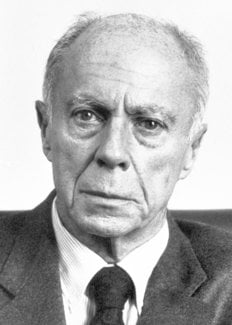
Claude Simon was born in 1913 at Tananarive (Madagascar). His parents were French, his father being a career officer who was killed in the first World War. He grew up with his mother and her family in Perpignan in the middle of the wine district of Roussillon. Among his ancestors was a general from the time of the French Revolution.
After secondary school at Collège Stanislas in Paris and brief sojourns at Oxford and Cambridge he took courses in painting at the André Lhote Academy. He then travelled extensively through Spain, Germany, the Soviet Union, Italy and Greece. This experience as well as those from the Second World War show up in his literary work. At the beginning of the war Claude Simon took part in the battle of the Meuse (1940) and was taken prisoner. He managed to escape and joined the resistance movement. At the same time he completed his first novel, Le Tricheur (“The Cheat”, published in 1946), which he had started to write before the war.
He lives in Paris and spends part of the year at Salses in the Pyrenees.
In 1961 Claude Simon received the prize of l’Express for “La Route des Flandres” and in 1967 the Médicis prize for “Histoire”. The University of East Anglia made him honorary doctor in 1973.
| Works |
| Le Tricheur/The Cheat 1945 |
| La Corde Raide/The Tightrope 1947 |
| Gulliver 1952 |
| Le Sacre du printemps/The Anointment of Spring 1954 |
| Le vent. Tentative de restitution d ‘un rétable baroque/The Wind. Attempted Restoration of a Baroque Altarpiece 1957 |
| L’Herbe/The Grass 1958 |
| La Route des Flandres/The Flanders Road 1960 |
| Le Palace/The Palace 1962 |
| La Separation/The Separation 1963 (Play adapted from the novel L’Herbe) |
| Femmes/Women. Ill by Joan Miró. – New edition entitled La Chevelure de Bérénice/Berenice’s Hair 1984 |
| Histoire/Story 1967 |
| La Bataille de Pharsale/The Battle of Pharsalus 1969 |
| Orion aveugle. Essai/Blind Orion. Essay 1970 |
| Les Corps conducteurs/Conducting Bodies 1971 |
| Triptyque/Triptych 1973 |
| Leçon de choses/Lesson in Things 1975 |
| Les Géorgiques/The Georgics 1981 |
| L’Invitation/The Invitation 1987 |
| L’Acacia/The Acacia 1989 |
| Le jardin des plantes/The Jardin des Plantes, 1997* |
| Le tramway/The Trolley, 2001* |
This autobiography/biography was written at the time of the award and first published in the book series Les Prix Nobel. It was later edited and republished in Nobel Lectures. To cite this document, always state the source as shown above.
* Updated by the Laureate, May 2005.
Claude Simon died on July 6, 2005.