Seamus Heaney – Photo gallery

Seamus Heaney receiving his Nobel Prize from King Carl XVI Gustaf of Sweden at the Stockholm Concert Hall, 10 December 1995.
Photo from the Lars Åström archive

Seamus Heaney after receiving his Nobel Prize from H.M. King Carl XVI Gustaf of Sweden at the Stockholm Concert Hall on 10 December 1995.
Nobel Foundation. Photo: Lars Åström

Christiane Nüsslein-Volhard and Eric F. Wieschaus and literature laureate Seamus Heaney on stage at the award ceremony at the Stockholm Concert Hall on 10 December 1995.
Nobel Foundation. Photo: Lars Åström

All 1995 Nobel Prize laureates on stage for the Nobel Prize award ceremony. From left: physics laureates Martin L. Perl and Frederick Reines; chemistry laureates Paul J. Crutzen, Mario J. Molina and F. Sherwood Rowland; medicine laureates Edward B. Lewis, Christiane Nüsslein-Volhard and Eric F. Wieschaus; literature laureate Seamus Heaney and laureate in economic sciences Robert E. Lucas Jr.
Photo from the Lars Åström archive

Seamus Heaney showing his Nobel Prize medal after the award ceremony, 10 December 1995.
Nobel Foundation. Photo: Lars Åström

Seamus Heaney showing his Nobel Prize after the award ceremony, 10 December 1995.
Nobel Foundation. Photo: Lars Åström

Literature laureate Seamus Heaney proceeds with Sweden's Princess Christina into the Blue Hall of the Stockholm City Hall for the Nobel Prize banquet, 10 December 1995.
Nobel Foundation. Photo: Lars Åström

Seamus Heaney with Sweden's Princess Christina to the left at the Nobel Prize banquet in the Stockholm City Hall, 10 December 1995.
Nobel Foundation. Photo: Lars Åström

Seamus Heaney delivering his banquet speech at the Nobel Prize banquet in the Stockholm City Hall, 10 December 1995.
Nobel Foundation. Photo: Lars Åström

Seamus Heaney delivering his Nobel Prize lecture at the Swedish Academy on 7 December 1995.
Photo from the Lars Åström archive

Seamus Heaney takes a closer look at his Nobel Prize medal and diploma during a visit to the Nobel Foundation in December 1995.
Nobel Foundation. Photo: Lars Åström

Seamus Heaney during a visit to the Nobel Foundation, December 1995.
Nobel Foundation. Photo: Lars Åström
Seamus Heaney – Other resources
Links to other sites
The Internet Poetry Archive presents several poems and sound recordings
On Seamus Heaney from Pegasos Author’s Calendar
On Seamus Heaney from The Academy of American Poets
On Seamus Heaney from The Poetry Foundation
This is not a spade: The poetry of Seamus Heaney

This is not a spade: The poetry of Seamus Heaney
by Ola Larsmo*
This article was published on 20 February 2007.
At the core of Seamus Heaney’s poetry a profound experience is revealed – that a gap exists between the totality of what can be said and the totality of all that can be witnessed, between the limits of languages and the margins of the actual world in which we live. For Heaney ‘poetry’ is a means of measuring this gap – if not bridging it.
In Heaney’s early poems this gap is connected to a sense of deep loss and even of moral guilt. The young poet keeps encountering a growing distance between the world of language and the physical world he sees around him. In a biographical sense, this may be linked to the fact of being born within an agrarian society where the poet has his roots, but from which the gifts of language and education has excluded him, so that he does not fully belong there any more. This distance is superbly captured in his poem ‘Digging’, from the debut collection Death of a Naturalist (1966).
The young Heaney sits by his desk, pen in hand, and watches his father digging in the garden. As both come from a long line of Ulster farmers, the father is doing what the Heaneys have been doing for generations: tending the land.
by God, the old man could handle a spade.
Just like his old man.
The son does something different:
But I’ve no spade to follow men like them.
Between my finger and my thumb
The squat pen rests.
I’ll dig with it.
The son has moved into a different world, yet, through his words, both tasks become related. Both dig beneath the surface of things, cultivating the possibilities of what may grow. In this early poem – the first one in his Selected Poems – Heaney uses a rhetoric figure that for a considerable period would be his trademark: the ‘chiasma’, or crossing of themes. The poem starts out with the image of the pen, and goes on to relate what could be termed as the young intellectual’s respect and awe for the seemingly commonplace skills of the working man, represented by his father’s ‘spademanship’ – before the focus returns to the pen, which has now been transformed to a tool for hard work – which Heaney enlists in the genealogical, or historical, line of working men. The pen and the spade trade places and within the course of the poem, quite literally, became metaphors for each other. Spade-as-pen; pen-as-spade.
This ‘crossing of themes’ is a method that Heaney uses repeatedly. In one of the more quoted of his ‘Glanmore Sonnets’ from the collection Field Work (1979) you can see the more mature poet playing with the same method of building a poem, only now in a more intricate fashion:
Outside the kitchen window a black rat
Sways on the briar like infected fruit:
‘It looked me through, it stared me out, I’m not
Imagining things. Go you out to it.’
Did we come to the wilderness for this?We have our burnished bay tree at the gate,
Classical, hung with the reek of silage
From the next farm, tart-leafed as inwit.
Blood on a pitchfork, blood on chaff and hay,
Rats speared in the sweat and dust of threshing –
What is my apology for poetry?The empty briar is swishing
When I come down, and beyond, inside, your face
Haunts like a new moon glimpsed through tangled glass.
A poem such as this becomes almost mathematical in its precision. On the way downstairs the writing “I” of the poem has identified himself with the small, exposed and wordless living thing, the rat: at the end of the poem the “I” looks up at the window, himself in the position of the rat. In the last stanza the poet has traded places with the rat itself, the intruder, that threatening piece of nature.
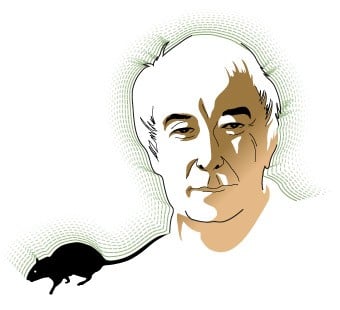
Halfway there you find the real hinge of the poem, the place where things trade places: the “bay tree”, symbol of poetry and a classic heritage, “reek with silage”. A familiar, rural smell, in itself a modern phenomenon of the countryside, is projected onto the symbol of antiquity. And the moral problem from the poem ‘Digging’ presents itself again.
Blood on a pitchfork, blood on chaff and hay,
Rats speared in the sweat and dust of threshing –
What is my apology for poetry?
Does poetry need an excuse? Or a defence: the word “apology” is, of course, ambiguous. In the sheer face of bloody violence, the everyday slaughter in the farmyard or the political violence of Irish history, past and present – what place is there for poetry at all, what role can this heightened form of language play in the face of crisis, death, distress?
This is the question addressed in one of Heaneys’ best essays on literature and the ‘meaning’ of poetry, ‘Feeling into Words’ (in Preoccupations, 1980). He takes his starting point in a quote from one of Shakespeare’s Sonnets, number 65: “How, with this rage, shall beauty hold a plea?”
This question is central to Heaney’s own poetry and to his prose writings about his own poetry and that by others: among his close, literary ‘relatives’ you find a number of other Nobel Laureates, such as Joseph Brodsky, Derek Walcott and Czesław Miłosz. How then should beauty, or poetry, hold a plea?
The answer, that slowly works its way to the surface in all of Heaney’s writings, is quite straightforward. By showing us things as they are.
As he writes in another of the ‘Glanmore Sonnets’, which takes its poetic impulse from the BBC weather report:
Dogger. Rockall. Malin. Irish Sea:
Green, swift upsurges, North Atlantic flux
Conjured by that strong gale-warning voice,
Collapse into a sibilant penumbra.
(…)L’Etoile, Le Guillemot, La Belle Helene
Nursed their bright names this morning in the bay
That toiled like mortar. It was marvellous
And actual. I said out loud, ‘A haven,’
The word deepening, clearing, like the sky
Elsewhere on Minches, Cromarty, The Faroes.
The “actual” is “A haven”. Heaney creates a way in which you learn to see the actual world around you, in a new light. But “seeing” in the Heaney sense can mean two things, two concepts which we find in the centre of modernist poetry; ‘epiphany’ and ‘correspondence’.
It is quite simple: ‘epiphany’ is here, as in the works of James Joyce and Tomas Tranströmer, the moment where you experience a sudden insight into the meaning of things seemingly trivial, for example the BBC weather forecast –how it in itself can contain a world of life, of thousands of living people along a coastline, exposed to the same weather, something very real as the rain and the wind – as opposed to strange political ideas of ‘purity’, ‘nation’ or ‘race’. A haven.
‘Correspondence’, on the other hand, is when you realise previously invisible connections between things, connections perhaps only made possible through the special kind of language we call poetry. The most obvious case of correspondences in Heaneys’ work you find in the suite of poems he wrote in the early seventies, where he – again like Tranströmer – shows his fascination with the ‘bog bodies’, the startlingly well-preserved remains of prisoners executed and buried in peat bogs in Denmark in prehistoric times. The most well known example is ‘the Tollund man’, who was strangled somewhere around the year 350 B.C., and was sunk into a peat bog outside of Silkeborg in Denmark.
The custom of human sacrifice combined with the burial of the victims in bogs is connected to the Celtic culture of the time, a point driven home by Heaney in his poems about the ‘bog bodies’ in Wintering Out (1972) where he openly compares the – in our eyes – senseless murder of human beings, for the sake of an abstract god or goddess, to the slaughter of men and women, for the abstract ideas of nationalism and loyalism, in his own contemporary Ulster.
The here and now is a sanctuary, we live in a real world, it has to be seen, you have to experience its stark reality if you are not to succumb to seductive ideologies. But, on the other hand: everything you see is in itself connected to a vibrating sense of history, everything has meanings beyond itself, and beyond your own life. That is the paradox, if you will, that you find in Heaney’s earlier poetry.
But a paradox can, strangely enough, be something very stable. You have ‘this’ on the one hand, and ‘that’ on the other. The first phase of Heaney’s poetry can rest almost comfortably in that kind of balance. A metaphor is introduced in the first stanza and recurs, with its meaning turned inside out, in the last. This kind of irony has its place. But Heaney’s poetry has continued to grow and change. It has become more restless.
This change is visible in a collection like Electric Light from 2001. Nothing has been lost, but new elements have been added. In the poem that gives the book its title, you recognize the ‘old’ Heaney:
In the first house where I saw electric light,
She sat with her fur-lined felt slippers unzipped
Year in, year out, in the same chair, and whispered
In a voice that at its loudest did nothing else
But whisper.
In this poem you see the weaving together of the old, rural community – here represented by the poets’ grandparents, the oral storytelling, the old farmhouse with the stable on the other side of the bedroom wall. And the electric light, the “wireless” set with its green eye and voices from afar. Vintage Heaney.
But in the same volume you also find a poem like ‘The Loose Box’ – a strange, winding tale that starts out in an ordinary, abandoned stable, somewhere in the northern Irish countryside – and then moves on to the birth of Jesus on a bed of straw, in another stable – and then covers the fall of Troy (with the use of a wooden horse, filled with straw), to the death of Irish revolutionary Michael Collins in the civil war – and his own background in the countryside, in the stable, on the straw. You could boil it all down to one sentence: “all flesh is straw” – but it is not a stable poem in the way that Heaney’s poems used to be stable. Something happens here, in a pun or word-play with the word “stable” – and all of history comes undone, spilling into the poets’ own biography, spilling straw. It is a magnificent poem. It is like seeing a sail flapping in the wind, not because the ship has lost its momentum but because it is ready to change its course.

This tendency to outgrow the balances and ironies of the earlier phases is very visible in Seamus Heaney’s latest collection to date, District and Circle (2006). The district and circle in the title shows itself to be the subway system, subterranean connections deep underground. All the elements from his earlier works are very present, like in the opening poem about the old “turnip-snedder”, an ancient piece of farming machinery that sits abandoned in a barn somewhere – but still loaded with meaning and threat, as being watched by a child that now has grown up to become a poet: “this is the way that God sees life.” A churning mechanism, impersonal, forceful, ready to crush turnips and boys’ fingers alike.
District and Circle is also a book that digs deeper and deeper into memory: it recalls boyhood encounters, the American presence in Northern Ireland during World War II, even the ‘Tollund man’ himself makes a guest appearance. But the very method of this ‘new’ poetry is not to balance things evenly on a scale, but to make them merge, go up into each other.
This is very visible in the subway poem. Heaney has written about the “underground” before, in the opening poem of Station Island (1984) where the poet, hurrying through the London subway, finds himself transformed into Orpheus, dreading the moment when he has to look back over his shoulder.
That was a poem about death, about loss. The same is true about District and Circle: the “underground” is here the realm of the dead, too, something that becomes apparent in the opening lines:
Tunes from a tin-whistle underground
Curled up a corridor I was walking down
Where the eerie music at the same time is that of a street musician and at the same time the alluring music of the “people underground”, the Tuatha de Danaan of Irish folk lore. The poem goes on in the same vein, with the vendor in the ticket booth being Charon, which is obvious without the poet mentioning it. Stepping onto the subway carriage becomes the passing on, with all the other passengers, to another destination:
My back to the unclosed door, the platform empty;
And wished it could have lasted
… and the poet sees his father’s face in his own reflection in the window, it all leading up to the final stanza:
And so by night and day to be transported
Through galleried earth with them, the only relict
Of all that I belonged to, hurtled forward,
Reflecting in a window mirror-backed
By blasted weeping rock-walls
Flicker-lit.
The distance between language and world is gone. The subway train is a subway train, no more, no less; at the same time the voyage is a ritual passing from life to death, a fact that is stated nowhere in the poem, but nonetheless becomes obvious to the reader. The train is no ‘metaphor’ for death, it is death.
This transformation is present in all the best poems in the volume. ‘Poet to blacksmith’ claims to be a translation of a letter from the Irish-speaking, 18th century poet Rua Ó Súilleabháin to his blacksmith, asking for a new kind of spade, perfect, shining, with “no trace of hammer to the blade”.
And best thing of all, the ring of it, sweet as a bell
The reader has no problem here recognizing the spade from ‘Digging’. It is no longer a question of pen and spade trying to coexist, or doing ‘the same thing’. They now are the very same thing. The gap has, in one way at least, finally been bridged. By poetry itself.
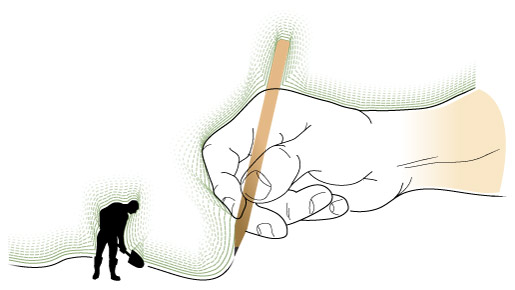
As in ‘A Shiver’. On the surface, a poem about knowing your tools, about craftsmanship or silent knowledge: deeper down, about a labour that has been there all the time, throughout forty years of writing:
The way you had to stand to swing the sledge,
Your two knees locked, your lower back shock-fast
As shields in a testudo, spine and waist
A pivot for the tight-braces, tilting rib-cage;
The way its iron head planted the sledge
Unyieldingly as a club-footed last;
The way you had to heft and then half-rest
Its gathered force like a long-nursed rage
About to be let fly: do you good
To have known it in your bones, directable,
Withholdable at will,
A first blow that could make air of a wall,
A last one so unanswerably landed
The staked earth quailed and shivered in the handle?
Poetry is that shiver in the handle.
References
Death of a Naturalist (Faber & Faber, 1966).
Wintering Out (1972).
Field Work (Faber & Faber, 1979).
Preoccupations (essays, Faber & Faber 1980).
Electric Light (Faber & Faber, 2001).
District and Circle (Faber & Faber, 2006).
* Ola Larsmo (b. 1957), writer and literary critic. Between 1984–1990 Larsmo was editor of BLM (‘Bonniers Literary Magazine’). Today he writes literary criticism in the Swedish newspaper Dagens Nyheter. Ola Larsmo has published some fifteen books, alone and in collaboration with others, mainly novels, but also essays on contemporary Irish and Swedish literature and on the subject of the Internet and democracy. His latest novel is En glänta i skogen (‘A Glen in the Forest’, 2004). In the fall of 2007 it will be followed by Djävulssonaten (‘The Devil’s Sonata’).
First published 20 February 2007
Seamus Heaney – Bibliography
| Poetry (a selection) |
| Eleven Poems. Belfast : Festival Publications, Queen’s University, 1965 |
| Death of a Naturalist. London : Faber, 1966 |
| A Lough Neagh Sequence. Didsbury, Manchester : Phoenix Pamphlets Poets Press, 1969 |
| Boy Driving His Father to Confession. Farnham, Surrey : Sceptre Press, 1970 (150 numbered copies) |
| Night Drive. Crediton, Devon : Richard Gilbertson, 1970 |
| Servant Boy. Detroit : Red Hanrahan Press, 1971 |
| Wintering Out. London : Faber, 1972 |
| Stations. Belfast : Ulsterman Publications, 1975 |
| North. London : Faber, 1975 |
| Bog Poems : London : Rainbow Press, 1975 |
| After Summer. Old Deerfield, Mass.: Deerfield Press / Dublin: Gallery Press, 1978 |
| Field Work. London : Faber, 1979 |
| Gravities : a Collection of Poems and Drawings. Newcastle upon Tyne : Charlotte Press, 1979 |
| Hedge School : Sonnets from Glanmore. Salem, Ore.: C. Seluzichi, 1979 |
| Selected Poems 1965-1975. London : Faber, 1980 |
| An Open Letter. Derry : Field Day, 1983 |
| Hailstones. Dublin : Gallery Press, 1984 |
| Station Island. London : Faber, 1984 |
| The Haw Lantern. Faber, 1987 |
| New Selected Poems 1966-1987. London : Faber, 1990 |
| The Tree Clock. Belfast : Linen Hall Library, 1990 |
| Seeing Things. London : Faber, 1991 |
| Keeping Going. Concord, N.H. : Bow and Arrow Press, 1993 |
| The Spirit Level. Faber, 1996 |
| Opened Ground : poems, 1966-1996. Faber, 1998 |
| Electric Light. London : Faber, 2001 |
| District and Circle. London : Faber, 2006 |
| Human Chain. London : Faber, 2010 |
| Prose, essays (a selection) |
| The Fire i’ the Flint : Reflections on the Poetry of Gerard Manley Hopkins. London : Oxford University Press, 1975 |
| Preoccupations : Selected Prose 1968-1978. London : Faber 1980 |
| The Government of the Tongue. London : Faber 1988 |
| The Place of Writing. Atlanta : Scholars Press, 1989 |
| The Redress of Poetry : Oxford lectures. London : Faber 1995 |
| Crediting Poetry : the Nobel lecture. London : Faber, 1995 |
| Finders Keepers : Selected Prose, 1971-2001. London : Faber, 2002 |
| Translations |
| Sweeney Astray : a Version From the Irish by Seamus Heaney. London : Faber, 1984 |
| The Cure at Troy : a version of Sophocles’ Philoctetes. Farrar, Straus and Giroux 1991 |
| The Midnight Verdict. Old Castle : Gallery Books, 1993 |
| Beowulf : a New Translation. London : Faber, 1999 |
| The Burial at Thebes : a Version of Sophocles’ Antigone. New York : Farrar, Straus, 2004 |
| Critical studies (a selection) |
| Morrison, Blake, Seamus Heaney. London : Methuen, 1982 |
| The Art of Seamus Heaney. Edited and introduced by Tony Curtis. Bridgend : Poetry Wales, 1982 |
| Seamus Heaney. Edited and with an introduction by Harold Bloom. New York : Chelsea House Publishers, 1986 |
| Foster, Thomas C., Seamus Heaney. Boston : Twayne, 1989 |
| Hart, Henry, Seamus Heaney : Poet of Contrary Progressions. Syracuse University Press, 1992 |
| Parker, Michael, Seamus Heaney : the Making of the Poet. Basingstoke : Macmillan, 1993 |
| Critical Essays on Seamus Heaney. Edited by Robert F. Garratt. New York : G.K. Hall, 1995 |
| Seamus Heaney. Edited by Michael Allen. Basingstoke : Macmillan, 1997 |
| Vendler, Helen, Seamus Heaney. London : HarperCollins, 1998 |
| Corcoran, Neil, The Poetry of Seamus Heaney : a critical study. London : Faber, 1998 |
| Gilsenan Nordin, Irene, Crediting Marvels in Seamus Heaney’s Seeing Things. Acta Universitatis Upsaliensis, 1999 |
| Tobin, Daniel, Passage to the Center : Imagination and the Sacred in the Poetry of Seamus Heaney. University Press of Kentucky, 1999 |
| Heaney, Seamus, Seamus Heaney in Conversation with Karl Miller. London : Between The Lines, 2000 |
| O’Brien, Eugene, Seamus Heaney : Creating Irelands of the Mind. Dublin : Liffey Press, 2002 |
| O’Brien, Eugene, Seamus Heaney and the Place of Writing. University Press of Florida, 2002 |
| Finn, Christine, Past Poetic : Archaeology and the Poetry of W.B. Yeats and Seamus Heaney. London : Duckworth, 2004 |
| Seamus Heaney : Poet, Critic, Translator / edited by Ashby Bland Crowder and Jason David Hall. – Basingstoke : Palgrav Macmillan, 2007 |
| Wilson, Michiko Niikuni, The marginal world of Oe Kenzaburo : a study in themes and techniques. – Armonk, N.Y. : Sharpe, 1986 |
| Brandes, Rand, & Durkan, Michael J., Seamus Heaney : a bibliography (1959-2003). London : Faber, 2008 |
| O’Driscoll, Dennis, Stepping stones : interviews with Seamus Heaney. London : Faber, 2008 |
| Hall, Jason David, Seamus Heaney’s Rhythmic Contract. Basingstoke : Palgrave Macmillan, 2009 |
The Swedish Academy, 2011
Seamus Heaney – Nobel diploma
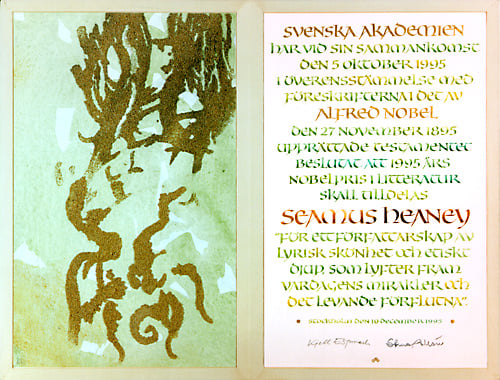
Copyright © The Nobel Foundation 1995
Artist: Bo Larsson
Calligrapher: Annika Rücker
Seamus Heaney – Poetry
Mossbawn
For Mary Heaney
I. Sunlight
There was a sunlit absence.
The helmeted pump in the yard
heated its iron,
water honeyed
in the slung bucket
and the sun stood
like a griddle cooling
against the wall
of each long afternoon.
So, her hands scuffled
over the bakeboard,
the reddening stove
sent its plaque of heat
against her where she stood
in a floury apron
by the window.
Now she dusts the board
with a goose’s wing,
now sits, broad-lapped,
with whitened nails
and measling shins:
here is a space
again, the scone rising
to the tick of two clocks.
And here is love
like a tinsmith’s scoop
sunk past its gleam
in the meal-bin.
By Seamus Heaney
From “North”, 1975
Copyright © Seamus Heaney
The Haw Lantern
The wintry haw is burning out of season,
crab of the thorn, a small light for small people,
wanting no more from them but that they keep
the wick of self-respect from dying out,
not having to blind them with illumination.
But sometimes when your breath plumes in the frost
it takes the roaming shape of Diogenes
with his lantern, seeking one just man;
so you end up scrutinized from behind the haw
he holds up at eye-level on its twig,
and you flinch before its bonded pith and stone,
its blood-prick that you wish would test and clear you,
By its pecked-at ripeness that scans you, then moves on.
By Seamus Heaney
From “The Haw Lantern”, 1987
Copyright © Seamus Heaney
Lightenings viii
The annals say: when the monks of Clonmacnoise
Were all at prayers inside the oratory
A ship appeared above them in the air.
The anchor dragged along behind so deep
It hooked itself into the altar rails
And then, as the big hull rocked to a standstill,
A crewman shinned and grappled down the rope
And struggled to release it. But in vain.
‘This man can’t bear our life here and will drown,’
The abbot said, ‘unless we help him.’ So
They did, the freed ship sailed, and the man climbed back
Out of the marvellous as he had known it.
Seamus Heaney – Selected Poems by Seamus Heaney
From “Seeing Things”, 1991
Copyright © Seamus Heaney
Poems selected by the Nobel Library of the Swedish Academy
Seamus Heaney – Banquet speech
Seamus Heaney’s speech at the Nobel Banquet, December 10, 1995
Your Majesties, Your Royal Highnesses, Ladies and Gentlemen,
Today’s ceremonies and tonight’s banquet have been mighty and memorable events. Nobody who has shared in them will ever forget them, but for the laureates these celebrations have had a unique importance. Each of us has participated in a ritual, a rite of passage, a public drama which has been commensurate with the inner experience of winning a Nobel Prize. The slightly incredible condition we have lived in since the news of the prizes was announced a couple of weeks ago has now been rendered credible. The mysterious powers represented by the words Nobel Foundation and Swedish Academy have manifested themselves in friendly human form. For me, it has been a great joy and a great reassurance to come to Stockholm and to meet at every turn people of such grace, such intelligence and such good will. Which is another way of saying that the whole week has not only been ceremonially impressive: it has also felt emotionally true, and it is that sense of something personally trustworthy at the centre of the great event that I finally value most, and cherish and give you thanks for. It has helped more than anything else to bring home to me the reality of the great honour I have received. Oscar Wilde once said that the only way to survive temptation was to yield to it. So here and now, I happily and gratefully yield to the temptation to believe that I am indeed the winner of a Nobel Prize. Thank you very much.
Seamus Heaney – Nobel Lecture
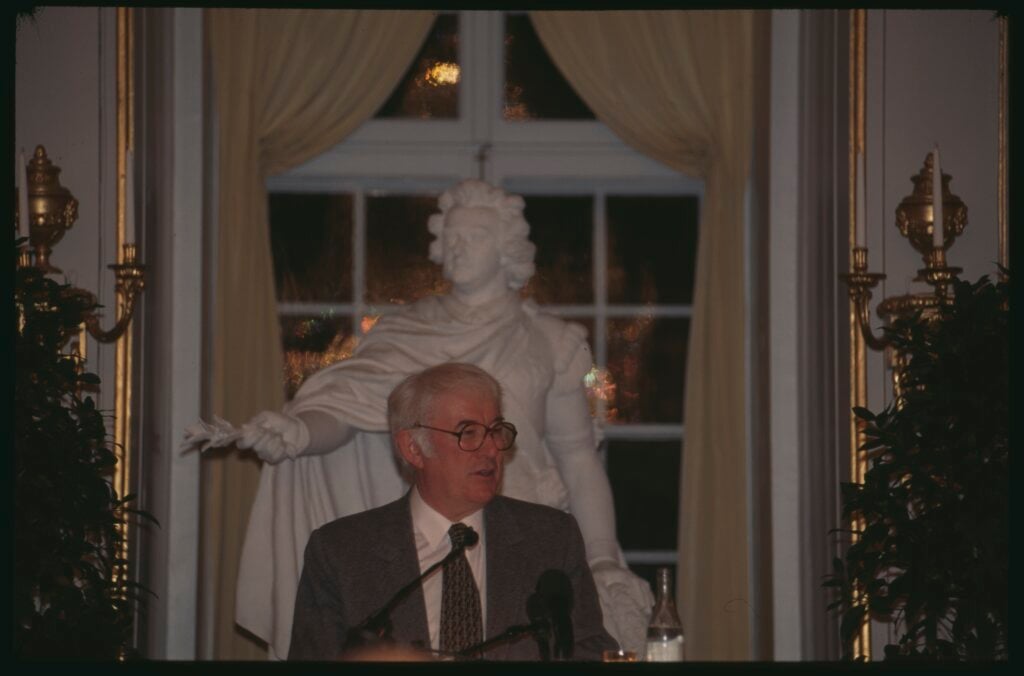
Nobel Lecture, December 7, 1995
Listen to an audio recording of Seamus Heaney’s Nobel Lecture
Crediting Poetry
When I first encountered the name of the city of Stockholm, I little thought that I would ever visit it, never mind end up being welcomed to it as a guest of the Swedish Academy and the Nobel Foundation. At the time I am thinking of, such an outcome was not just beyond expectation: it was simply beyond conception. In the nineteen forties, when I was the eldest child of an ever-growing family in rural Co. Derry, we crowded together in the three rooms of a traditional thatched farmstead and lived a kind of den-life which was more or less emotionally and intellectually proofed against the outside world. It was an intimate, physical, creaturely existence in which the night sounds of the horse in the stable beyond one bedroom wall mingled with the sounds of adult conversation from the kitchen beyond the other. We took in everything that was going on, of course – rain in the trees, mice on the ceiling, a steam train rumbling along the railway line one field back from the house – but we took it in as if we were in the doze of hibernation. Ahistorical, pre-sexual, in suspension between the archaic and the modern, we were as susceptible and impressionable as the drinking water that stood in a bucket in our scullery: every time a passing train made the earth shake, the surface of that water used to ripple delicately, concentrically, and in utter silence.
But it was not only the earth that shook for us: the air around and above us was alive and signalling too. When a wind stirred in the beeches, it also stirred an aerial wire attached to the topmost branch of the chestnut tree. Down it swept, in through a hole bored in the corner of the kitchen window, right on into the innards of our wireless set where a little pandemonium of burbles and squeaks would suddenly give way to the voice of a BBC newsreader speaking out of the unexpected like a deus ex machina. And that voice too we could hear in our bedroom, transmitting from beyond and behind the voices of the adults in the kitchen; just as we could often hear, behind and beyond every voice, the frantic, piercing signalling of morse code.
We could pick up the names of neighbours being spoken in the local accents of our parents, and in the resonant English tones of the newsreader the names of bombers and of cities bombed, of war fronts and army divisions, the numbers of planes lost and of prisoners taken, of casualties suffered and advances made; and always, of course, we would pick up too those other, solemn and oddly bracing words, “the enemy” and “the allies”. But even so, none of the news of these world-spasms entered me as terror. If there was something ominous in the newscaster’s tones, there was something torpid about our understanding of what was at stake; and if there was something culpable about such political ignorance in that time and place, there was something positive about the security I inhabited as a result of it.
The wartime, in other words, was pre-reflective time for me. Pre-literate too. Pre-historical in its way. Then as the years went on and my listening became more deliberate, I would climb up on an arm of our big sofa to get my ear closer to the wireless speaker. But it was still not the news that interested me; what I was after was the thrill of story, such as a detective serial about a British special agent called Dick Barton or perhaps a radio adaptation of one of Capt. W.E. Johns’s adventure tales about an RAF flying ace called Biggles. Now that the other children were older and there was so much going on in the kitchen, I had to get close to the actual radio set in order to concentrate my hearing, and in that intent proximity to the dial I grew familiar with the names of foreign stations, with Leipzig and Oslo and Stuttgart and Warsaw and, of course, with Stockholm.
I also got used to hearing short bursts of foreign languages as the dial hand swept round from BBC to Radio Eireann, from the intonations of London to those of Dublin, and even though I did not understand what was being said in those first encounters with the gutturals and sibilants of European speech, I had already begun a journey into the wideness of the world beyond. This in turn became a journey into the wideness of language, a journey where each point of arrival – whether in one’s poetry or one’s life turned out to be a stepping stone rather than a destination, and it is that journey which has brought me now to this honoured spot. And yet the platform here feels more like a space station than a stepping stone, so that is why, for once in my life, I am permitting myself the luxury of walking on air.
*
I credit poetry for making this space-walk possible. I credit it immediately because of a line I wrote fairly recently instructing myself (and whoever else might be listening) to “walk on air against your better judgement”. But I credit it ultimately because poetry can make an order as true to the impact of external reality and as sensitive to the inner laws of the poet’s being as the ripples that rippled in and rippled out across the water in that scullery bucket fifty years ago. An order where we can at last grow up to that which we stored up as we grew. An order which satisfies all that is appetitive in the intelligence and prehensile in the affections. I credit poetry, in other words, both for being itself and for being a help, for making possible a fluid and restorative relationship between the mind’s centre and its circumference, between the child gazing at the word “Stockholm” on the face of the radio dial and the man facing the faces that he meets in Stockholm at this most privileged moment. I credit it because credit is due to it, in our time and in all time, for its truth to life, in every sense of that phrase.
*
To begin with, I wanted that truth to life to possess a concrete reliability, and rejoiced most when the poem seemed most direct, an upfront representation of the world it stood in for or stood up for or stood its ground against. Even as a schoolboy, I loved John Keats’s ode “To Autumn” for being an ark of the covenant between language and sensation; as an adolescent, I loved Gerard Manley Hopkins for the intensity of his exclamations which were also equations for a rapture and an ache I didn’t fully know I knew until I read him; I loved Robert Frost for his farmer’s accuracy and his wily down-to-earthness; and Chaucer too for much the same reasons. Later on I would find a different kind of accuracy, a moral down-to-earthness to which I responded deeply and always will, in the war poetry of Wilfred Owen, a poetry where a New Testament sensibility suffers and absorbs the shock of the new century’s barbarism. Then later again, in the pure consequence of Elizabeth Bishop’s style, in the sheer obduracy of Robert Lowell’s and in the barefaced confrontation of Patrick Kavanagh’s, I encountered further reasons for believing in poetry’s ability – and responsibility – to say what happens, to “pity the planet,” to be “not concerned with Poetry.”
This temperamental disposition towards an art that was earnest and devoted to things as they are was corroborated by the experience of having been born and brought up in Northern Ireland and of having lived with that place even though I have lived out of it for the past quarter of a century. No place in the world prides itself more on its vigilance and realism, no place considers itself more qualified to censure any flourish of rhetoric or extravagance of aspiration. So, partly as a result of having internalized these attitudes through growing up with them, and partly as a result of growing a skin to protect myself against them, I went for years half-avoiding and half- resisting the opulence and extensiveness of poets as different as Wallace Stevens and Rainer Maria Rilke; crediting insufficiently the crystalline inwardness of Emily Dickinson, all those forked lightnings and fissures of association; and missing the visionary strangeness of Eliot. And these more or less costive attitudes were fortified by a refusal to grant the poet any more license than any other citizen; and they were further induced by having to conduct oneself as a poet in a situation of ongoing political violence and public expectation. A public expectation, it has to be said, not of poetry as such but of political positions variously approvable by mutually disapproving groups.
In such circumstances, the mind still longs to repose in what Samuel Johnson once called with superb confidence “the stability of truth”, even as it recognizes the destabilizing nature of its own operations and enquiries. Without needing to be theoretically instructed, consciousness quickly realizes that it is the site of variously contending discourses. The child in the bedroom, listening simultaneously to the domestic idiom of his Irish home and the official idioms of the British broadcaster while picking up from behind both the signals of some other distress, that child was already being schooled for the complexities of his adult predicament, a future where he would have to adjudicate among promptings variously ethical, aesthetical, moral, political, metrical, sceptical, cultural, topical, typical, post-colonial and, taken all together, simply impossible. So it was that I found myself in the mid-nineteen seventies in another small house, this time in Co. Wicklow south of Dublin, with a young family of my own and a slightly less imposing radio set, listening to the rain in the trees and to the news of bombings closer to home-not only those by the Provisional IRA in Belfast but equally atrocious assaults in Dublin by loyalist paramilitaries from the north. Feeling puny in my predicaments as I read about the tragic logic of Osip Mandelstam’s fate in the 1930s, feeling challenged yet steadfast in my noncombatant status when I heard, for example, that one particularly sweetnatured school friend had been interned without trial because he was suspected of having been involved in a political killing. What I was longing for was not quite stability but an active escape from the quicksand of relativism, a way of crediting poetry without anxiety or apology. In a poem called “Exposure” I wrote then:
If I could come on meteorite!
Instead, I walk through damp leaves,
Husks, the spent flukes of autumn,Imagining a hero
On some muddy compound,
His gift like a slingstone
Whirled for the desperate.How did I end up like this?
I often think of my friends’
Beautiful prismatic counselling
And the anvil brains of some who hate meAs I sit weighing and weighing
My responsible tristia.
For what? For the ear? For the people?
For what is said behind-backs?Rain comes down through the alders,
Its low conducive voices
Mutter about let-downs and erosions
And yet each drop recallsThe diamond absolutes.
I am neither internee nor informer;
An inner émigré, a grown long-haired
And thoughtful; a wood-kerneEscaped from the massacre,
Taking protective colouring
From bole and bark, feeling
Every wind that blows;Who, blowing up these sparks
For their meagre heat, have missed
The once in a lifetime portent,
The comet’s pulsing rose.
(from North)
In one of the poems best known to students in my generation, a poem which could be said to have taken the nutrients of the symbolist movement and made them available in capsule form, the American poet Archibald MacLeish affirmed that “A poem should be equal to/not true.” As a defiant statement of poetry’s gift for telling truth but telling it slant, this is both cogent and corrective. Yet there are times when a deeper need enters, when we want the poem to be not only pleasurably right but compellingly wise, not only a surprising variation played upon the world, but a re-tuning of the world itself. We want the surprise to be transitive like the impatient thump which unexpectedly restores the picture to the television set, or the electric shock which sets the fibrillating heart back to its proper rhythm. We want what the woman wanted in the prison queue in Leningrad, standing there blue with cold and whispering for fear, enduring the terror of Stalin’s regime and asking the poet Anna Akhmatova if she could describe it all, if her art could be equal to it. And this is the want I too was experiencing in those far more protected circumstances in Co. Wicklow when I wrote the lines I have just quoted, a need for poetry that would merit the definition of it I gave a few moments ago, as an order “true to the impact of external reality and … sensitive to the inner laws of the poet’s being.”
*
The external reality and inner dynamic of happenings in Northern Ireland between 1968 and 1974 were symptomatic of change, violent change admittedly, but change nevertheless, and for the minority living there, change had been long overdue. It should have come early, as the result of the ferment of protest on the streets in the late sixties, but that was not to be and the eggs of danger which were always incubating got hatched out very quickly. While the Christian moralist in oneself was impelled to deplore the atrocious nature of the IRA’s campaign of bombings and killings, and the “mere Irish” in oneself was appalled by the ruthlessness of the British Army on occasions like Bloody Sunday in Derry in 1972, the minority citizen in oneself, the one who had grown up conscious that his group was distrusted and discriminated against in all kinds of official and unofficial ways, this citizen’s perception was at one with the poetic truth of the situation in recognizing that if life in Northern Ireland were ever really to flourish, change had to take place. But that citizen’s perception was also at one with the truth in recognizing that the very brutality of the means by which the IRA were pursuing change was destructive of the trust upon which new possibilities would have to be based.
Nevertheless, until the British government caved in to the strong-arm tactics of the Ulster loyalist workers after the Sunningdale Conference in 1974, a well-disposed mind could still hope to make sense of the circumstances, to balance what was promising with what was destructive and do what W.B. Yeats had tried to do half a century before, namely, “to hold in a single thought reality and justice.” After 1974, however, for the twenty long years between then and the ceasefires of August 1994, such a hope proved impossible. The violence from below was then productive of nothing but a retaliatory violence from above, the dream of justice became subsumed into the callousness of reality, and people settled in to a quarter century of life-waste and spirit- waste, of hardening attitudes and narrowing possibilities that were the natural result of political solidarity, traumatic suffering and sheer emotional self-protectiveness.
*
One of the most harrowing moments in the whole history of the harrowing of the heart in Northern Ireland came when a minibus full of workers being driven home one January evening in 1976 was held up by armed and masked men and the occupants of the van ordered at gunpoint to line up at the side of the road. Then one of the masked executioners said to them, “Any Catholics among you, step out here”. As it happened, this particular group, with one exception, were all Protestants, so the presumption must have been that the masked men were Protestant paramilitaries about to carry out a tit-for-tat sectarian killing of the Catholic as the odd man out, the one who would have been presumed to be in sympathy with the IRA and all its actions. It was a terrible moment for him, caught between dread and witness, but he did make a motion to step forward. Then, the story goes, in that split second of decision, and in the relative cover of the winter evening darkness, he felt the hand of the Protestant worker next to him take his hand and squeeze it in a signal that said no, don’t move, we’ll not betray you, nobody need know what faith or party you belong to. All in vain, however, for the man stepped out of the line; but instead of finding a gun at his temple, he was thrown backward and away as the gunmen opened fire on those remaining in the line, for these were not Protestant terrorists, but members, presumably, of the Provisional IRA.
*
It is difficult at times to repress the thought that history is about as instructive as an abattoir; that Tacitus was right and that peace is merely the desolation left behind after the decisive operations of merciless power. I remember, for example, shocking myself with a thought I had about that friend who was imprisoned in the seventies upon suspicion of having been involved with a political murder: I shocked myself by thinking that even if he were guilty, he might still perhaps be helping the future to be born, breaking the repressive forms and liberating new potential in the only way that worked, that is to say the violent way – which therefore became, by extension, the right way. It was like a moment of exposure to interstellar cold, a reminder of the scary element, both inner and outer, in which human beings must envisage and conduct their lives. But it was only a moment. The birth of the future we desire is surely in the contraction which that terrified Catholic felt on the roadside when another hand gripped his hand, not in the gunfire that followed, so absolute and so desolate, if also so much a part of the music of what happens.
As writers and readers, as sinners and citizens, our realism and our aesthetic sense make us wary of crediting the positive note. The very gunfire braces us and the atrocious confers a worth upon the effort which it calls forth to confront it. We are rightly in awe of the torsions in the poetry of Paul Celan and rightly enamoured of the suspiring voice in Samuel Beckett because these are evidence that art can rise to the occasion and somehow be the corollary of Celan’s stricken destiny as Holocaust survivor and Beckett’s demure heroism as a member of the French Resistance. Likewise, we are rightly suspicious of that which gives too much consolation in these circumstances; the very extremity of our late twentieth century knowledge puts much of our cultural heritage to an extreme test. Only the very stupid or the very deprived can any longer help knowing that the documents of civilization have been written in blood and tears, blood and tears no less real for being very remote. And when this intellectual predisposition co-exists with the actualities of Ulster and Israel and Bosnia and Rwanda and a host of other wounded spots on the face of the earth, the inclination is not only not to credit human nature with much constructive potential but not to credit anything too positive in the work of art.
Which is why for years I was bowed to the desk like some monk bowed over his prie-dieu, some dutiful contemplative pivoting his understanding in an attempt to bear his portion of the weight of the world, knowing himself incapable of heroic virtue or redemptive effect, but constrained by his obedience to his rule to repeat the effort and the posture. Blowing up sparks for meagre heat. Forgetting faith, straining towards good works. Attending insufficiently to the diamond absolutes, among which must be counted the sufficiency of that which is absolutely imagined. Then finally and happily, and not in obedience to the dolorous circumstances of my native place but in despite of them, I straightened up. I began a few years ago to try to make space in my reckoning and imagining for the marvellous as well as for the murderous. And once again I shall try to represent the import of that changed orientation with a story out of Ireland.
This is a story about another monk holding himself up valiantly in the posture of endurance. It is said that once upon a time St. Kevin was kneeling with his arms stretched out in the form of a cross in Glendalough, a monastic site not too far from where we lived in Co. Wicklow, a place which to this day is one of the most wooded and watery retreats in the whole of the country. Anyhow, as Kevin knelt and prayed, a blackbird mistook his outstretched hand for some kind of roost and swooped down upon it, laid a clutch of eggs in it and proceeded to nest in it as if it were the branch of a tree. Then, overcome with pity and constrained by his faith to love the life in all creatures great and small, Kevin stayed immobile for hours and days and nights and weeks, holding out his hand until the eggs hatched and the fledglings grew wings, true to life if subversive of common sense, at the intersection of natural process and the glimpsed ideal, at one and the same time a signpost and a reminder. Manifesting that order of poetry where we can at last grow up to that which we stored up as we grew.
*
St. Kevin’s story is, as I say, a story out of Ireland. But it strikes me that it could equally well come out of India or Africa or the Arctic or the Americas. By which I do not mean merely to consign it to a typology of folktales, or to dispute its value by questioning its culture bound status within a multi-cultural context. On the contrary, its trustworthiness and its travel-worthiness have to do with its local setting. I can, of course, imagine it being deconstructed nowadays as a paradigm of colonialism, with Kevin figuring as the benign imperialist (or the missionary in the wake of the imperialist), the one who intervenes and appropriates the indigenous life and interferes with its pristine ecology. And I have to admit that there is indeed an irony that it was such a one who recorded and preserved this instance of the true beauty of the Irish heritage: Kevin’s story, after all, appears in the writings of Giraldus Cambrensis, one of the Normans who invaded Ireland in the twelfth century, one whom the Irish-language annalist Geoffrey Keating would call, five hundred years later, “the bull of the herd of those who wrote the false history of Ireland.” But even so, I still cannot persuade myself that this manifestation of early Christian civilization should be construed all that simply as a way into whatever is exploitative or barbaric in our history, past and present. The whole conception strikes me rather as being another example of the kind of work I saw a few weeks ago in the small museum in Sparta, on the morning before the news of this year’s Nobel Prize in literature was announced.
This was art which sprang from a cult very different from the faith espoused by St. Kevin. Yet in it there was a representation of a roosted bird and an entranced beast and a self-enrapturing man, except that this time the man was Orpheus and the rapture came from music rather than prayer. The work itself was a small carved relief and I could not help making a sketch of it; but neither could I help copying out the information typed on the card which accompanied and identified the exhibit. The image moved me because of its antiquity and durability, but the description on the card moved me also because it gave a name and credence to that which I see myself as having been engaged upon for the past three decades: “Votive panel”, the identification card said, “possibly set up to Orpheus by local poet. Local work of the Hellenistic period.”
*
Once again, I hope I am not being sentimental or simply fetishizing – as we have learnt to say – the local. I wish instead to suggest that images and stories of the kind I am invoking here do function as bearers of value. The century has witnessed the defeat of Nazism by force of arms; but the erosion of the Soviet regimes was caused, among other things, by the sheer persistence, beneath the imposed ideological conformity, of cultural values and psychic resistances of a kind that these stories and images enshrine. Even if we have learned to be rightly and deeply fearful of elevating the cultural forms and conservatisms of any nation into normative and exclusivist systems, even if we have terrible proof that pride in an ethnic and religious heritage can quickly degrade into the fascistic, our vigilance on that score should not displace our love and trust in the good of the indigenous per se. On the contrary, a trust in the staying power and travel-worthiness of such good should encourage us to credit the possibility of a world where respect for the validity of every tradition will issue in the creation and maintenance of a salubrious political space. In spite of devastating and repeated acts of massacre, assassination and extirpation, the huge acts of faith which have marked the new relations between Palestinians and Israelis, Africans and Afrikaners, and the way in which walls have come down in Europe and iron curtains have opened, all this inspires a hope that new possibility can still open up in Ireland as well. The crux of that problem involves an ongoing partition of the island between British and Irish jurisdictions, and an equally persistent partition of the affections in Northern Ireland between the British and Irish heritages; but surely every dweller in the country must hope that the governments involved in its governance can devise institutions which will allow that partition to become a bit more like the net on a tennis court, a demarcation allowing for agile give-and-take, for encounter and contending, prefiguring a future where the vitality that flowed in the beginning from those bracing words “enemy” and “allies” might finally derive from a less binary and altogether less binding vocabulary.
*
When the poet W.B. Yeats stood on this platform more than seventy years ago, Ireland was emerging from the throes of a traumatic civil war that had followed fast on the heels of a war of independence fought against the British. The struggle that ensued had been brief enough; it was over by May, 1923, some seven months before Yeats sailed to Stockholm, but it was bloody, savage and intimate, and for generations to come it would dictate the terms of politics within the twenty-six independent counties of Ireland, that part of the island known first of all as the Irish Free State and then subsequently as the Republic of Ireland.
Yeats barely alluded to the civil war or the war of independence in his Nobel speech. Nobody understood better than he the connection between the construction or destruction of state institutions and the founding or foundering of cultural life, but on this occasion he chose to talk instead about the Irish Dramatic Movement. His story was about the creative purpose of that movement and its historic good fortune in having not only his own genius to sponsor it, but also the genius of his friends John Millington Synge and Lady Augusta Gregory. He came to Sweden to tell the world that the local work of poets and dramatists had been as important to the transformation of his native place and times as the ambushes of guerrilla armies; and his boast in that elevated prose was essentially the same as the one he would make in verse more than a decade later in his poem “The Municipal Gallery Revisited”. There Yeats presents himself amongst the portraits and heroic narrative paintings which celebrate the events and personalities of recent history and all of a sudden realizes that something truly epoch-making has occurred: ” ‘This is not’, I say,/’The dead Ireland of my youth, but an Ireland/The poets have imagined, terrible and gay.’ ” And the poem concludes with two of the most quoted lines of his entire oeuvre:
Think where man’s glory most begins and ends,
And say my glory was I had such friends.
And yet, expansive and thrilling as these lines are, they are an instance of poetry flourishing itself rather than proving itself, they are the poet’s lap of honour, and in this respect if in no other they resemble what I am doing in this lecture. In fact, I should quote here on my own behalf some other words from the poem: “You that would judge me, do not judge alone/This book or that.” Instead, I ask you to do what Yeats asked his audience to do and think of the achievement of Irish poets and dramatists and novelists over the past forty years, among whom I am proud to count great friends. In literary matters, Ezra Pound advised against accepting the opinion of those “who haven’t themselves produced notable work,” and it is advice I have been privileged to follow, since it is the good opinion of notable workers and not just those in my own country-that has fortified my endeavour since I began to write in Belfast more than thirty years ago. The Ireland I now inhabit is one that these Irish contemporaries have helped to imagine.
Yeats, however, was by no means all flourish. To the credit of poetry in our century there must surely be entered in any reckoning his two great sequences of poems entitled “Nineteen Hundred and Nineteen” and “Meditations in Time of Civil War”, the latter of which contains the famous lyric about the bird’s nest at his window, where a starling or stare had built in a crevice of the old wall. The poet was living then in a Norman tower which had been very much a part of the military history of the country in earlier and equally troubled times, and as his thoughts turned upon the irony of civilizations being consolidated by violent and powerful conquerors who end up commissioning the artists and the architects, he began to associate the sight of a mother bird feeding its young with the image of the honey bee, an image deeply lodged in poetic tradition and always suggestive of the ideal of an industrious, harmonious, nurturing commonwealth:
The bees build in the crevices
Of loosening masonry, and there
The mother birds bring grubs and flies.
My wall is loosening; honey-bees,
Come build in the empty house of the stare.We are closed in, and the key is turned
On our uncertainty; somewhere
A man is killed, or a house burned,
Yet no clear fact to be discerned:
Come build in the empty house of the stare.A barricade of stone or of wood;
Some fourteen days of civil war;
Last night they trundled down the road
That dead young soldier in his blood:
Come build in the empty house of the stare.We had fed the heart on fantasies,
The heart’s grown brutal from the fare;
More substance in our enmities
Than in our love; O honey-bees,
Come build in the empty house of the stare.
I have heard this poem repeated often, in whole and in part, by people in Ireland over the past twenty-five years, and no wonder, for it is as tender minded towards life itself as St. Kevin was and as tough-minded about what happens in and to life as Homer. It knows that the massacre will happen again on the roadside, that the workers in the minibus are going to be lined up and shot down just after quitting time; but it also credits as a reality the squeeze of the hand, the actuality of sympathy and protectiveness between living creatures. It satisfies the contradictory needs which consciousness experiences at times of extreme crisis, the need on the one hand for a truth telling that will be hard and retributive, and on the other hand, the need not to harden the mind to a point where it denies its own yearnings for sweetness and trust.
It is a proof that poetry can be equal to and true at the same time, an example of that completely adequate poetry which the Russian woman sought from Anna Akhmatova and which William Wordsworth produced at a corresponding moment of historical crisis and personal dismay almost exactly two hundred years ago.
*
When the bard Demodocus sings of the fall of Troy and of the slaughter that accompanied it, Odysseus weeps and Homer says that his tears were like the tears of a wife on a battlefield weeping for the death of a fallen husband. His epic simile continues:
At the sight of the man panting and dying there,
she slips down to enfold him, crying out;
then feels the spears, prodding her back and shoulders,
and goes bound into slavery and grief.
Piteous weeping wears away her cheeks:
but no more piteous than Odysseus’ tears,
cloaked as they were, now, from the company.
Even to-day, three thousand years later, as we channel-surf over so much live coverage of contemporary savagery, highly informed but nevertheless in danger of growing immune, familiar to the point of overfamiliarity with old newsreels of the concentration camp and the gulag, Homer’s image can still bring us to our senses. The callousness of those spear shafts on the woman’s back and shoulders survives time and translation. The image has that documentary adequacy which answers all that we know about the intolerable.
But there is another kind of adequacy which is specific to lyric poetry. This has to do with the “temple inside our hearing” which the passage of the poem calls into being. It is an adequacy deriving from what Mandelstam called “the steadfastness of speech articulation,” from the resolution and independence which the entirely realized poem sponsors. It has as much to do with the energy released by linguistic fission and fusion, with the buoyancy generated by cadence and tone and rhyme and stanza, as it has to do with the poem’s concerns or the poet’s truthfulness. In fact, in lyric poetry, truthfulness becomes recognizable as a ring of truth within the medium itself. And it is the unappeasable pursuit of this note, a note tuned to its most extreme in Emily Dickinson and Paul Celan and orchestrated to its most opulent in John Keats, it is this which keeps the poet’s ear straining to hear the totally persuasive voice behind all the other informing voices.
Which is a way of saying that I have never quite climbed down from the arm of that sofa. I may have grown more attentive to the news and more alive to the world history and world-sorrow behind it. But the thing uttered by the speaker I strain towards is still not quite the story of what is going on; it is more reflexive than that, because as a poet I am in fact straining towards a strain, seeking repose in the stability conferred by a musically satisfying order of sounds. As if the ripple at its widest desired to be verified by a reformation of itself, to be drawn in and drawn out through its point of origin.
I also strain towards this in the poetry I read. And I find it, for example, in the repetition of that refrain of Yeats’s, “Come build in the empty house of the stare,” with its tone of supplication, its pivots of strength in the words “build” and “house” and its acknowledgement of dissolution in the word “empty”. I find it also in the triangle of forces held in equilibrium by the triple rhyme of “fantasies” and “enmities” and “honey-bees”, and in the sheer in-placeness of the whole poem as a given form within the language. Poetic form is both the ship and the anchor. It is at once a buoyancy and a steadying, allowing for the simultaneous gratification of whatever is centrifugal and whatever is centripetal in mind and body. And it is by such means that Yeats’s work does what the necessary poetry always does, which is to touch the base of our sympathetic nature while taking in at the same time the unsympathetic nature of the world to which that nature is constantly exposed. The form of the poem, in other words, is crucial to poetry’s power to do the thing which always is and always will be to poetry’s credit: the power to persuade that vulnerable part of our consciousness of its rightness in spite of the evidence of wrongness all around it, the power to remind us that we are hunters and gatherers of values, that our very solitudes and distresses are creditable, in so far as they, too, are an earnest of our veritable human being.
Seamus Heaney – Biographical
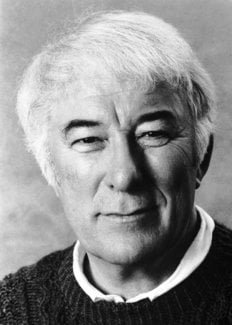
Seamus Heaney was born in April 1939, the eldest member of a family which would eventually contain nine children. His father owned and worked a small farm of some fifty acres in County Derry in Northern Ireland, but the father’s real commitment was to cattle-dealing. There was something very congenial to Patrick Heaney about the cattle-dealer’s way of life to which he was introduced by the uncles who had cared for him after the early death of his own parents. The poet’s mother came from a family called McCann whose connections were more with the modern world than with the traditional rural economy; her uncles and relations were employed in the local linen mill and an aunt had worked “in service” to the mill owners’ family. The poet has commented on the fact that his parentage thus contains both the Ireland of the cattle-herding Gaelic past and the Ulster of the Industrial Revolution; indeed, he considers this to have been a significant tension in his background, something which corresponds to another inner tension also inherited from his parents, namely that between speech and silence. His father was notably sparing of talk and his mother notably ready to speak out, a circumstance which Seamus Heaney believes to have been fundamental to the “quarrel with himself” out of which his poetry arises.
Heaney grew up as a country boy and attended the local primary school. As a very young child, he watched American soldiers on manoeuvres in the local fields, in preparation for the Normandy invasion of 1944. They were stationed at an aerodrome which had been built a mile or so from his home and once again Heaney has taken this image of himself as a consciousness poised between “history and ignorance” as representative of the nature of his poetic life and development. Even though his family left the farm where he was reared (it was called Mossbawn) in 1953, and even though his life since then has been a series of moves farther and farther away from his birthplace, the departures have been more geographical than psychological: rural County Derry is the “country of the mind” where much of Heaney’s poetry is still grounded.
When he was twelve years of age, Seamus Heaney won a scholarship to St. Columb’s College, a Catholic boarding school situated in the city of Derry, forty miles away from the home farm, and this first departure from Mossbawn was the decisive one. It would be followed in years to come by a transfer to Belfast where he lived between 1957 and 1972, and by another move from Belfast to the Irish Republic where Heaney has made his home, and then, since 1982, by regular, annual periods of teaching in America. All of these subsequent shifts and developments were dependent, however, upon that original journey from Mossbawn which the poet has described as a removal from “the earth of farm labour to the heaven of education.” It is not surprising, then, that this move has turned out to be a recurrent theme in his work, from “Digging”, the first poem in his first book, through the much more orchestrated treatment of it in “Alphabets”(The Haw Lantern, 1987), to its most recent appearance in “A Sofa in the Forties” which was published this year in The Spirit Level.
At St. Columb’s College, Heaney was taught Latin and Irish, and these languages, together with the Anglo-Saxon which he would study while a student of Queen’s University, Belfast, were determining factors in many of the developments and retrenchments which have marked his progress as a poet. The first verses he wrote when he was a young teacher in Belfast in the early 1960s and many of the best known poems in North, his important volume published in 1975, are linguistically tuned to the Anglo-Saxon note in English. His poetic line was much more resolutely stressed and packed during this period than it would be in the eighties and nineties when the “Mediterranean” elements in the literary and linguistic heritage of English became more pronounced. Station Island (1984) reveals Dante, for example, as a crucial influence, and echoes of Virgil – as well as a translation from Book VI of The Aeneid – are to be found in Seeing Things (1991). Heaney’s early study of Irish bore fruit in the translation of the Middle Irish story of Suibhne Gealt in Sweeney Astray (1982) and in several other translations and echoes and allusions: the Gaelic heritage has always has been part of his larger keyboard of reference and remains culturally and politically central to the poet and his work.
Heaney’s poems first came to public attention in the mid-1960s when he was active as one of a group of poets who were subsequently recognized as constituting something of a “Northern School” within Irish writing. Although Heaney is stylistically and temperamentally different from such writers as Michael Longley and Derek Mahon (his contemporaries), and Paul Muldoon, Medbh McGuckian and Ciaran Carson (members of a younger Northern Irish generation), he does share with all of them the fate of having be en born into a society deeply divided along religious and political lines, one which was doomed moreover to suffer a quarter-century of violence, polarization and inner distrust. This had the effect not only of darkening the mood of Heaney’s work in the 1970s, but also of giving him a deep preoccupation with the question of poetry’s responsibilities and prerogatives in the world, since poetry is poised between a need for creative freedom within itself and a pressure to express the sense of social obligation felt by the poet as citizen. The essays in Heaney’s three main prose collections, but especially those in The Government of the Tongue (1988) and The Redress of Poetry (1995), bear witness to the seriousness which this question assumed for him as he was coming into his own as a writer.
These concerns also lie behind Heaney’s involvement for a decade and a half with Field Day, a theatre company founded in 1980 by the playwright Brian Friel and the actor Stephen Real. Here, he was also associated with the poets Seamus Deane and Tom Paulin, and the singer David Hammond in a project which sought to bring the artistic and intellectual focus of its members into productive relation with the crisis that was ongoing in Irish political life. Through a series of plays and pamphlets (culminating in Heaney’s case in his version of Sophocles’ Philoctetes which the company produced and toured in 1990 under the title, The Cure at Troy), Field Day contributed greatly to the vigour of the cultural debate which flourished throughout the 1980s and 1990s in Ireland.
Heaney’s beginnings as a poet coincided with his meeting the woman whom he was to marry and who was to be the mother of his three children. Marie Devlin, like her husband, came from a large family, several of whom are themselves writers and artists, including the poet’s wife who has recently published an important collection of retellings of the classic Irish myths and legends (Over Nine Waves, 1994). Marie Heaney has been central to the poet’s life, both professionally and imaginatively, appearing directly and indirectly in individual poems from all periods of his oeuvre right down to the most recent, and making it possible for him to travel annually to Harvard by staying on in Dublin as custodian of the growing family and the family home.
The Heaneys had spent a very liberating year abroad in 1970/71 when Seamus was a visiting lecturer at the Berkeley campus of the University of California. It was the sense of self-challenge and new scope which he experienced in the American context that encouraged him to resign his lectureship at Queen’s University (1966-72) not long after he returned to Ireland, and to move to a cottage in County Wicklow in order to work full time as a poet and free-lance writer. A few years later, the family moved to Dublin and Seamus worked as a lecturer in Carysfort College, a teacher training college, where he functioned as Head of the English Department until 1982, when his present arrangement with Harvard University came into existence. This allows the poet to spend eight months at home without teaching in exchange for one semester’s work at Harvard. In 1984, Heaney was named Boylston Professor of Rhetoric and Oratory, one of the university’s most prestigious offices. In 1989, he was elected for a five-year period to be Professor of Poetry at Oxford University, a post which requires the incumbent to deliver three public lectures every year but which does not require him to reside in Oxford.
In the course of his career, Seamus Heaney has always contributed to the promotion of artistic and educational causes, both in Ireland and abroad. While a young lecturer at Queen’s University, he was active in the publication of pamphlets of poetry by the rising generation and took over the running of an influential poetry workshop which had been established there by the English poet, Philip Hobsbaum, when Hobsbaum left Belfast in 1966. He also served for five years on The Arts Council in the Republic of Ireland (1973-1978) and over the years has acted as judge and lecturer for countless poetry competitions and literary conferences, establishing a special relationship with the annual W.B. Yeats International Summer School in Sligo. In recent years, he has been the recipient of several honorary degrees; he is a member of Aosdana, the Irish academy of artists and writers, and a Foreign Member of The American Academy of Arts and Letters. In 1996, subsequent to his winning the Nobel Prize in Literature in 1995, he was made a Commandeur de L’Ordre des Arts et Lettres by the French Ministry of Culture.
This autobiography/biography was written at the time of the award and later published in the book series Les Prix Nobel/ Nobel Lectures/The Nobel Prizes. The information is sometimes updated with an addendum submitted by the Laureate.
Seamus Heaney died on 30 August 2013.
Press release

Swedish Academy
The Permanent Secretary
Press release
October 5, 1995
The Nobel Prize in Literature 1995
Seamus Heaney
“for works of lyrical beauty and ethical depth, which exalt everyday miracles and the living past”
Seamus Heaney was born on a farm some distance west of Belfast in Northern Ireland 56 years ago. After studies and marriage he moved to the Irish Republic and has been living in Dublin since 1976. He has held a post as visiting professor in rhetoric at Harvard since 1982, and from 1989 to 1994 he was Professor of Poetry at Oxford. Heaney is a poet, essayist and translator.
One point of departure for Heaney is what he calls, in one of the poems in his collection “North” (1975), northern reticence. He sympathises with this stance but is of course at the same time aware of the risks it involves for a writer. In an interview, he acknowledges that he feels a form of guilt when he writes. He assumes that generations of rural ancestors – who while not illiterate were not literary either – are asserting themselves within him. He speaks with warmth of the rich experience his parents have communicated, but can also express some impatience with their reticence. It is against this background that one can read the poem “Alphabets” (in “The Haw Lantern”, 1987) with the lines “The poet’s dream stole over him like sunlight / And passed into the tenebrous thickets”.
As an Irish Catholic he has concerned himself with analysis of the violence in Northern Ireland – with the express reservation that he wants to avoid the conventional terms. In his opinion, the fact that there has been unwillingness on both sides to speak out – even about manifest injustices – has been of great importance in the explosive development. But he also opposes the defeatism of the Catholics, as in the poem “From the canton of expectation” (in “The Haw Lantern”) which begins: “We lived deep in a land of optative moods, / under high, banked clouds of resignation.”
In collections of essays such as “The Government of the Tongue” (1988) and “The Place of Writing” (1989) Heaney discusses the role of poetry and the poet, a theme he often returns to. Experiences from the lives of Osip Mandelstam and other 20th century writers lead him to the conclusion that the task of the poet is to ensure the survival of beauty, especially in times when tyrannical regimes threaten to destroy it.
In 1990 Heaney published “The Cure at Troy”, a translation of Sophocles’ “Philoctetes”, from the point of view of composition the most modern of the classical dramas. The play was staged by the Field Day Theatre in the same year and received a positive reception although no direct link was made to his poetry. It can, however, be seen as one element of Heaney’s continual endeavour to find poetic expression for complex ethical issues. The translation points forward to his next collection of poems.
“Seeing Things” (1991) includes the very interesting section “Squarings”. Here the poems consist of twelve lines, their fixed, restrained form matching only superficially the content of the poems with their breadth of variation. A poem like “Lightenings viii”, on the miracle at Clonmacnoise, is a crystallisation of much of Heaney’s imaginative world: history and sensuality, myths and the day-to-day – all articulated in Heaney’s rich language.