Fem dikter av Tomas Tranströmer
English
Swedish
Allegro
Jag spelar Haydn efter en svart dag
och känner en enkel värme i händerna.
Tangenterna vill. Milda hammare slår.
Klangen är grön, livlig och stilla.
Klangen säger att friheten finns
och att någon inte ger kejsaren skatt.
Jag kör ner händerna i mina haydnfickor
och härmar en som ser lugnt på världen.
Jag hissar haydnflaggan – det betyder:
»Vi ger oss inte. Men vill fred.«
Musiken är ett glashus på sluttningen
där stenarna flyger, stenarna rullar.
Och stenarna rullar tvärs igenom
men varje ruta förblir hel.
Ur Den halvfärdiga himlen, Bonniers 1962
Copyright © Tomas Tranströmer 1962
Återgiven med vänligt tillstånd av Tomas Tranströmer och Bonniers
Den halvfärdiga himlen
Modlösheten avbryter sitt lopp.
Ångesten avbryter sitt lopp.
Gamen avbryter sin flykt.
Det ivriga ljuset rinner fram,
även spökena tar sig en klunk.
Och våra målningar kommer i dagen,
våra istidsateljéers röda djur.
Allting börjar se sig omkring.
Vi går i solen hundratals.
Var människa en halvöppen dörr
som leder till ett rum för alla.
Den oändliga marken under oss.
Vattnet lyser mellan träden.
Insjön är ett fönster mot jorden.
Ur Den halvfärdiga himlen, Bonniers 1962
Copyright © Tomas Tranströmer 1962
Återgiven med vänligt tillstånd av Tomas Tranströmer och Bonniers
Under tryck
Den blå himlens motordån är starkt.
Vi är närvarande på en arbetsplats i darrning,
där havsdjupet plötsligt kan uppenbara sig –
snäckor och telefoner susar.
Det sköna hinner man bara se hastigt från sidan.
Den täta säden på åkern, många färger i en gul ström.
De oroliga skuggorna i mitt huvud dras dit.
De vill krypa in i säden och förvandlas till guld.
Mörkret faller. Vid midnatt går jag till sängs.
Den mindre båten sätts ut från den större båten.
Man är ensam på vattnet.
Samhällets mörka skrov driver allt längre bort.
Ur Klanger och spår, Bonniers 1966
Copyright © Tomas Tranströmer 1966
Återgiven med vänligt tillstånd av Tomas Tranströmer och Bonniers
Öppna och slutna rum
En man känner på världen med yrket som en handske.
Han vilar en stund mitt på dagen och har lagt ifrån sig
handskarna på hyllan.
Där växer de plötsligt, breder ut sig
och mörklägger hela huset inifrån.
Det mörklagda huset är mitt ute bland vårvindarna.
»Amnesti« går viskningen i gräset: »amnesti«.
En pojke springer med en osynlig lina som går snett
upp i himlen
där hans vilda dröm om framtiden flyger som en drake
större än förstaden.
Längre norrut ser man från en höjd den blå oändliga
barrskogsmattan
där molnskuggorna
står stilla.
Nej, flyger fram.
Ur Klanger och spår, Bonniers 1966
Copyright © Tomas Tranströmer 1966
Återgiven med vänligt tillstånd av Tomas Tranströmer och Bonniers
Näktergalen i Badelunda
I den gröna midnatten vid näktergalens nordgräns. Tunga löv hänger i trance, de döva bilarna rusar mot neonlinjen. Näktergalens röst stiger inte åt sidan, den är lika genomträngande som en tupps galande, men skön och utan fåfänga. Jag var i fängelse och den besökte mig. Jag var sjuk och den besökte mig. Jag märkte den inte då, men nu. Tiden strömmar ned från solen och månen och in i alla tick tack tick tacksamma klockor. Men just här finns ingen tid. Bara näktergalens röst, de råa klingande tonerna som slipar natthimlens ljusa lie.
Ur För levande och döda, Bonniers 1989
Copyright © Tomas Tranströmer 1989
Återgiven med vänligt tillstånd av Tomas Tranströmer och Bonniers
Dikterna valda av Svenska Akademiens Nobelbibliotek.
Tomas Tranströmer – Introduction
English
English [pdf]
Swedish
Swedish [pdf]
At the Nobel Lecture in Literature on 7 December 2011, a programme featuring texts by Tomas Tranströmer was introduced by Peter Englund, Permanent Secretary of the Swedish Academy.
Tomas and Monica Tranströmer, esteemed Academicians, Ladies and Gentlemen:
I bid you a warm welcome to the Swedish Academy and this presentation marking the year’s Nobel Prize in Literature!
Good poetry is a powerful thing. It can change our picture of the world, making it clearer, sharper, more comprehensible. And forever.
We should not be taken in by the understated tone of Tomas Tranströmer’s poetry. Several of the real wonders of our existence are constantly present: Memory, History, Death, Nature – nature not least. But each not as an overwhelming exterior presence, nor as something that assumes life under our gaze. In your work it is the very opposite: Ego, the individual, is the prism into which everything is drawn. It gives us a feeling of context, even obligation.
Dear Tomas, it is impossible to feel insignificant after having read your poetry. Neither is it still possible to love the world for the wrong reasons.
But what makes great poetry great is not only that it clarifies or reveals something already present in our world, but also that it has the ability to actually widen the boundaries of that world. Therein lies its power.
Paul Valéry – one of those renowned men of letters who would have been given the Nobel Prize had not death been too hasty – once said, approximately, that “words are more a part of us than our nerves. I know my mind solely through hearsay.” This is for better and for worse. Where a person’s language ends, so does that person’s world. But while the physical world is what it is, possessing definite limits – ultimately in the form of, let us say, the speed of light or absolute zero or the simple fact that life is given only at the cost of death – the world of language has limits that actually permit extension, movement, expansion. And those who conduct the vital but difficult explorations of this terra incognita are generally the great poets, such as Tomas Tranströmer. “The endless expanses of the human mind are shrunk to the size of a fist”.
So it is with especial gratitude that we stand before you on a day such as this. Because you have made our world far richer and far, far larger.
Copyright © The Swedish Academy, 2011
Tomas Tranströmer – Introduktion
English
English [pdf]
Swedish
Swedish [pdf]
Vid Nobelföreläsningen i litteratur den 7 december 2011 introducerade Peter Englund, Svenska Akademiens ständige sekreterare, ett program med texter av Tomas Tranströmer.
Tomas och Monica Tranströmer, kära Akademiledamöter, mina damer och herrar.
Hjärtligt välkomna till Svenska Akademien och detta arrangemang med anledning av årets Nobelpris i litteratur!
God poesi är ett mäktigt ting. Det kan förvandla vår bild av världen, göra den klarare, tydligare, skarpare. Och det för alltid.
Man ska inte låta sig luras av den lågmälda tonen i Tomas Tranströmers poesi. Vissa av existensens verkliga storheter finns där ständigt närvarande: Minnet, Historien, Döden, Naturen – inte minst naturen. Men inte som en överväldigande närvaro utanför oss, eller som något som blir levande inför vår blick. Hos dig är det precis tvärtom: jaget, den enskilda människan är det prisma där allt detta löper samman. Det skänker oss en känsla av sammanhang, ja uppgift.
Käre Tomas, det är omöjligt att känna sig obetydlig efter att ha läst din poesi. Inte heller är det längre möjligt att älska världen av fel skäl.
Men det som också gör stor poesi stor är inte bara detta att den förtydligar eller blottlägger något i världen redan närvarande, utan också att den har förmågan att faktiskt vidga gränserna för denna värld. Däri ligger makten.
Paul Valéry, en av dessa berömda litteratörer som skulle givits Nobelpriset om inte döden varit snabbare, Paul Valéry har sagt, ungefär, att “Ord är mer en del av oss än våra nerver. Jag känner min hjärna blott genom hörsägen”. Slut citat. Och detta på gott och ont. Där en människas språk tar slut tar också hennes värld slut. Men medan den fysiska världen ligger där den ligger, och har sina absoluta gränser, ytterst i form av, säg, ljusets hastighet eller den absoluta nollpunkten eller det enkla faktum att livet bara ges till priset av döden, så har språkets värld gränser som faktiskt låter sig ändras, flyttas, vidgas. Och de som gör dessa viktiga men svåra upptäcktsfärder in i detta terra inkognita är i regel stora poeter, som Tomas Tranströmer. “Människohjärnans ändlösa vidder är hopskrynklade till en knytnäves storlek”. Och omvänt.
Så det är med särskild tacksamhet vi nu står inför dig en dag som denna. För du har gjort vår värld mycket rikare, och mycket, mycket större.
Copyright © Svenska Akademien, 2011
Tomas Tranströmer – Banquet speech
Your Majesties
Your Royal Highnesses
Excellencies
Ladies and Gentlemen
FRIENDS!
On behalf of my husband, Tomas Tranströmer, I want you to know how honored and how moved he is to receive the Nobel Prize.
Thank you Swedish Academy:
thank you for your courage and your beautiful prize citation.
Special thanks to all the translators, who work so hard for so little reward.
Your motivation is your curiosity and commitment.
It should be called love – the only realistic basis for translating poetry.
When Tomas was 16 he started writing along with some like-minded friends
When the lessons seemed more than usually trying,
they would pass notes and poems between them.
“What an impression those scribblings would make!” Tomas later wrote –
“There is the fundamental situation of poetry.
The lesson of official life goes rumbling on.
We send inspired notes to each other.”
And to end, I will read one of Tomas’ poems – a short one – in English and in Swedish:
From March -79
Tired of all who come with words, words but no language
l went to the snow-covered island.
The wild does not have words.
The unwritten pages spread out on all sides!
I come upon the tracks of roe deer in the snow.
Language but no words.
Från mars -79
Trött på alla som kommer med ord, ord men inget språk
for jag till den snötäckta ön.
Det vilda har inga ord.
De oskrivna sidorna breder ut sig åt alla håll!
Jag stöter på spåren av rådjursklövar i snön.
Språk men inga ord.
Tack så mycket. Thank you.
Tomas Tranströmer – Prize presentation
Watch a video clip of the 2011 Nobel Laureate in Literature, Tomas Tranströmer, receiving his Nobel Prize medal and diploma during the Nobel Prize Award Ceremony at the Concert Hall in Stockholm, Sweden, on 10 December 2011.
Tomas Tranströmer – Poetry
Five Poems by Tomas Tranströmer
English
Swedish
Allegro
I play Haydn after a black day
and feel a simple warmth in my hands.
The keys are willing. Soft hammers strike.
The resonance green, lively and calm.
The music says freedom exists
and someone doesn’t pay the emperor tax.
I push down my hands in my Haydnpockets
and imitate a person looking on the world calmly.
I hoist the Haydnflag – it signifies:
“We don’t give in. But want peace.’
The music is a glass-house on the slope
where the stones fly, the stones roll.
And the stones roll right through
but each pane stays whole.
The Half-Finished Heaven
Despondency breaks off its course.
Anguish breaks off its course.
The vulture breaks off its flight.
The eager light streams out,
even the ghosts take a draught.
And our paintings see daylight,
our red beasts of the ice-age studios.
Everything begins to look around.
We walk in the sun in hundreds.
Each man is a half-open door
leading to a room for everyone.
The endless ground under us.
The water is shining among the trees.
The lake is a window into the earth.
Under Pressure
The blue sky’s engine-drone is deafening.
We’re living here on a shuddering work-site
where the ocean depths can suddenly open up –
shells and telephones hiss.
You can see beauty only from the side, hastily,
The dense grain on the field, many colours in a yellow stream.
The restless shadows in my head are drawn there.
They want to creep into the grain and turn to gold.
Darkness falls. At midnight I go to bed.
The smaller boat puts out from the larger boat.
You are alone on the water.
Society’s dark hull drifts further and further away.
Open and Closed Spaces
A man feels the world with his work like a glove.
He rests for a while at midday having laid aside the gloves on the shelf.
There they suddenly grow, spread
and black-out the whole house from inside.
The blacked-out house is away out among the winds of spring.
‘Amnesty,’ runs the whisper in the grass: ‘amnesty.’
A boy sprints with an invisible line slanting up in the sky
where his wild dream of the future flies like a kite bigger than the
suburb.
Further north you can see from a summit the blue endless carpet of
pine forest
where the cloud shadows
are standing still.
No, are flying.
The Nightingale in Badelunda
In the green midnight at the nightingale’s northern limit. Heavy leaves hang in trance, the deaf cars race towards the neon-line. The nightingale’s voice rises without wavering to the side, it is as penetrating as a cock-crow, but beautiful and free of vanity. I was in prison and it visited me. I was sick and it visited me. I didn’t notice it then, but I do now. Time streams down from the sun and the moon and into all the tick-tock-thankful clocks. But right here there is no time. Only the nightingale’s voice, the raw resonant notes that whet the night sky’s gleaming scythe.
All poems from Tomas Tranströmer, New Collected Poems, translated by Robin Fulton (Bloodaxe Books, 1997/2011)
http://www.bloodaxebooks.com/
Poem selected by the Nobel Library of the Swedish Academy.
Tomas Tranströmer – Nobel Lecture
The 2011 Nobel Lecture in Literature consisted of a program featuring texts by Tomas Tranströmer in the presence of the Laureate, on Wednesday 7 December 2011 at the Swedish Academy in Stockholm. Participants: Actor Kristina Adolphson, actor Krister Henriksson, pianist Roland Pöntinen, conductor Gustaf Sjöqvist’s Chamber Choir and Uppsala Chamber Soloist and others.
Read the introduction by Peter Englund, Permanent Secretary of the Swedish Academy
English
Swedish
Programme of Texts
English
Swedish
Swedish/English [pdf]
© Tomas Tranströmer, Albert Bonniers Förlag.
© Tomas Tranströmer, Bloodaxe Books Ltd.
Publication in periodicals or books requires the consent of the author and the publisher, Albert Bonniers Förlag, and for the English translation, Bloodaxe Books Ltd.
December 7, 2011
A Programme of Texts by Tomas Tranströmer
Programme – The Grand Hall, December 7, 2011
Introduction
The Permanent Secretary
Memories Look at Me from The Wild Market Square (1983)
Music: Anna Cederberg-Orreteg
Gustaf Sjökvist Chamber Choir
An Artist in the North from Bells and Tracks (1966)
Funchal from The Truth-Barrier (1978)
Krister Henriksson
The Light Streams In from The Sad Gondola (1996)
Music: Daniel Börtz
Song: Jeanette Köhn, piano: Roland Pöntinen
Vermeer from For Living and Dead (1989)
Kristina Adolphson
The Journey to C
The Journey / C Major from The Half-Finished Heaven (1962)
Music: Bo Holten
Gustaf Sjökvist Chamber Choir
Alone from Bells and Tracks (1966)
Tomas Tranströmer,
Aimée Delblanc, Jasim Mohamed, Dan Shafran,
Chen Wenfen, Antolina Gutiérrez del Castro
The Sad Gondola
Music: Franz Liszt
Piano: Roland Pöntinen
The Sad Gondola II from The Sad Gondola (1996)
Krister Henriksson
Slow Music from Bells and Tracks (1966)
Music: Sven-David Sandström, premiere performance
Gustaf Sjökvist Chamber Choir
The Blue Wind-Flowers from The Wild Market Square (1983)
Kristina Adolphson
November in the Former DDR from The Sad Gondola (1996)
Music: Georg Riedel
Gustaf Sjökvist Chamber Choir
Schubertiana from The Truth-Barrier (1978)
Tomas Tranströmer
Adagio from String Quintet in C Major
Music: Franz Schubert
Uppsala Chamber Soloists
Participants
Peter Englund, Permanent Secretary of the Swedish Academy
Kristina Adolphson, actor
Krister Henriksson, actor
Jeanette Köhn, soprano
Roland Pöntinen, pianist
Gustaf Sjökvist Chamber Choir
Gustaf Sjökvist, conductor
Aimée Delblanc, translator
Antolina Gutiérrez del Castro, actor
Jasim Mohamed, translator and author
Dan Shafran, director of the Romanian Cultural Institute
Chen Wenfen, author
Uppsala Chamber Soloists
Bert Lysell, violin
Klara Hellgren, violin
Susanne Magnusson, viola
Erik Wahlgren, cello
Daniel Blendulf, cello
Memories Look at Me
A June morning, too soon to wake,
too late to fall asleep again.
I must go out – the greenery is dense
with memories, they follow me with their gaze.
They can’t be seen, they merge completely with
the background, true chameleons.
They are so close that I can hear them breathe
although the birdsong here is deafening.
An Artist in the North
I Edvard Grieg moved like a free man among men.
Ready with a joke, read the papers, travelled here and there.
Led the orchestra.
The concert-hall with its lamps trembling in triumph like the train-ferry
when it puts in.
I have brought myself up here to be shut in with silence.
My work-cottage is small.
The piano a tight fit like the swallow under the eaves.
For the most part the beautiful steep slopes say nothing.
There is no passageway
but sometimes a little hatch opens
and a strangely seeping light direct from trolldom.
Reduce!
And the hammer-blows in the mountain came
came
came
came one spring night into our room
disguised as beating of the heart.
The year before I die I’ll send out four hymns to track down God.
But it starts here.
A song about what is near.
What is near.
The battlefield within us
where we the Bones of the Dead
fight to become living.
Funchal
The fish-restaurant on the beach, simple, a shack built by ship-wrecked people. Many turn away at the door, but not the gusts from the sea. A shadow stands in his reeking cabin frying two fish according to an old recipe from Atlantis, small explosions of garlic, oil running over the tomato slices. Every bite says that the ocean wishes us well, a humming from the deeps.
She and I look into each other. Like climbing up the wild blossoming hillsides without feeling the least tiredness. We’re on the side of the animals, we’re welcome, we don’t get older. But over the years we’ve experienced so much together, we remember that, also times we were good for nothing (as when we queued up to give blood to the flourishing giant – he’d ordered transfusions), things that would’ve separated us if they hadn’t brought us closer, and things we forgot together – but they have not forgotten us. They’ve become stones, dark ones and light ones. Stones in a scattered mosaic. And now it happens: the bits fly together, the mosaic is visible. It’s waiting for us. It’s shining from the wall in our hotel room, a design both violent and tender, perhaps a face, we haven’t time to notice everything as we pull off our clothes …
At dusk we go out. The cape’s enormous dark blue paw lies sprawled in the sea. We step into the human whirlpool, pushed around in a friendly way, soft controls, everyone chattering in that foreign language. “No man is an island.” We become stronger through them, but also through ourselves. Through that within us which the other can’t see. Which can meet only itself. The innermost paradox, the garage flower, the ventilator to the good darkness. A drink that bubbles in empty glasses. A loudspeaker that sends out silence. A pathway that grows over again behind each step. A book that can be read only in the dark.
The Light Streams In
Outside the window, the long beast of spring
the transparent dragon of sunlight
rushes past like an endless
suburban train – we never got a glimpse of its head.
The shoreline villas shuffle sideways
they are proud as crabs.
The sun makes the statues blink.
The raging sea of fire out in the space
is transformed to a caress.
The countdown has begun.
Vermeer
No protected world…Just behind the wall the noise begins,
the inn is there
with laughter and bickering, rows of teeth, tears, the din of bells
and the insane brother-in-law, the death-bringer we all must
tremble for.
The big explosion and the tramp of rescue arriving late
the boats preening themselves on the straits, the money creeping
down in the wrong man’s pocket
demands stacked on demands
gaping red flowerheads sweating premonitions of war.
In from there and right through the wall into the clear studio
into the second that’s allowed to live for centuries.
Pictures that call themselves “The Music Lesson”
or “Woman in Blue Reading a Letter” –
she’s in her eighth month, two hearts kicking inside her.
On the wall behind is a wrinkled map of Terra Incognita.
Breathe calmly…An unknown blue material is nailed to the chairs.
The gold studs flew in with incredible speed
and stopped abruptly
as if they had never been other than stillness.
Ears sing, from depth or height.
It’s the pressure from the other side of the wall.
It makes each fact float
and steadies the brush.
It hurts to go through walls, it makes you ill
but is necessary
The world is one. But walls…
And the wall is part of yourself –
we know or we don’t know but it’s true for us all
except for small children. No walls for them.
The clear sky has leant against the wall.
It’s like a prayer to the emptiness.
And the emptiness turns its face to us
and whispers
“I am not empty, I am open.”
The Journey
In the underground station.
A crowding among placards
in a staring dead light.
The train came and collected
faces and portfolios.
Darkness next. We sat
in the carriages like statues,
hauled through the caverns.
Restraint, dreams, restraint.
In stations under sea-level
they sold the news of the dark.
People in motion sadly
silently under the clock-dials.
The train carried
outer garments and souls.
Glances in all directions
on the journey through the mountain.
Still no change.
But nearer the surface a murmuring
of bees began – freedom.
We stepped out of the earth.
The land beat its wings
once and became still
under us, widespread and green.
Ears of corn blew in
over the platforms.
Terminus – I
followed on, further.
How many were with me? Four,
five, hardly more.
Houses, roads, skies,
blue inlets, mountains
opened their windows.
C Major
When he came down to the street after the rendezvous
the air was swirling with snow.
Winter had come
while they lay together.
The night shone white.
He walked quickly with joy.
The whole town was downhill.
The smiles passing by –
everyone was smiling behind turned-up collars.
It was free!
And all the question-marks began singing of God’s being.
So he thought.
A music broke out
and walked in the swirling snow
with long steps.
Everything on the way towards the note C.
A trembling compass directed at C.
One hour higher than the torments.
It was easy!
Behind turned-up collars everyone was smiling.
Alone
I
One evening in February I came near to dying here.
The car skidded sideways on the ice, out
on the wrong side of the road. The approaching cars –
their lights – closed in.
My name, my girls, my job
broke free and were left silently behind
further and further away. I was anonymous
like a boy in a playground surrounded by enemies.
The approaching traffic had huge lights.
They shone on me while I pulled at the wheel
in a transparent terror that floated like egg white.
The seconds grew – there was space in them –
they grew as big as hospital buildings.
You could almost pause
and breathe out for a while
before being crushed.
Then something caught: a helping grain of sand
or a wonderful gust of wind. The car broke free
and scuttled smartly right over the road.
A post shot up and cracked – a sharp clang – it
flew away in the darkness.
Then – stillness. I sat back in my seat-belt
and saw someone coming through the whirling snow
to see what had become of me.
II
I have been walking for a long time
on the frozen Östergötland fields.
I have not seen a single person.
In other parts of the world
there are people who are born, live and die
in a perpetual crowd.
To be always visible – to live
in a swarm of eyes –
a special expression must develop.
Face coated with clay.
The murmuring rises and falls
while they divide up among themselves
the sky, the shadows, the sand grains.
I must be alone
ten minutes in the morning
and ten minutes in the evening.
– Without a programme.
Everyone is queuing at everyone’s door.
Many.
One.
The Sad Gondola
I
Two old men, father-in-law and son-in-law, Liszt and Wagner,
are staying by the Grand Canal
together with the restless woman who married King Midas
the man who transforms everything he touches into Wagner.
The green chill of the sea forces its way up through the palace
floors.
Wagner is marked, the well-known Mr Punch profile is wearier
than before
the face a white flag.
The gondola is heavily laden with their lives, two returns and one
single.
II
One of the palace windows flies open and the people inside
grimace in the sudden draught.
Outside on the water the garbage gondola appears, paddled by
two one-oared bandits.
Liszt has written down some chords that are so heavy they ought
to be sent
to the mineralogical institute in Padua for analysis.
Meteorites!
too heavy to rest, they can only sink and sink through the
future right down
to the years of the brownshirts.
The gondola is heavily laden with the crouching stones of the
future.
III
Peep-holes, opening on 1990.
March 25. Anxiety over Lithuania.
Dreamt that I visited a large hospital.
No staff. Everyone a patient.
In the same dream a new-born girl
who spoke in complete sentences.
IV
Beside his son-in-law, who is a man of the age, Liszt is a moth-
eaten Grand Seigneur.
It’s a disguise.
The deep that tries on and rejects different masks has picked out
this one for him.
The deep that wants to step in, to visit the humans, without
showing its face.
V
Abbé Liszt is accustomed to carrying his own suitcase through
slush and sunshine
and when the time comes to die no one will meet him at the
station.
A warm breeze of highly-gifted brandy carries him off in the
middle of some task.
He is never free of tasks.
Two thousand letters per year!
The schoolboy writing out the wrongly-spelt word a hundred
times before he can go home.
The gondola is heavily laden with life, it is simple and black.
VI
1990 again.
Dreamt that I drove 200 kilometres for nothing.
Then everything grew large. Sparrows
big as hens sang deafeningly.
Dreamt that I drew piano keys
on the kitchen table. I played on them, silently.
The neighbours came in to listen.
VII
The keyboard which has kept silent through the whole of Parsifal
(but it has listened) is at last allowed to say something.
Sighs… sospiri…
When Liszt plays this evening he holds down the sea-pedal
so that the green power of the sea rises through the floor and
merges with the stonework of the building.
Good evening, beautiful deep!
The gondola is heavily laden with life, it is simple and black.
VIII
Dreamt that I was to start school but came late.
Everyone in the room was wearing a white mask.
Impossible to tell who the teacher was.
Slow Music
The building is closed. The sun crowds in through the windows
and warms up the surfaces of desks
that are strong enough to take the load of human fate.
We are outside, today, on the long wide slope.
Many have dark clothes. You can stand in the sun with your eyes shut
and feel yourself being slowly blown forward.
I come down to the water too seldom. But here I am now,
among large stones with peaceful backs.
Stones which slowly migrated backwards up out of the waves.
The Blue Wind-Flowers
To be spell-bound – nothing’s easier. It’s one of the oldest tricks of the soil and springtime: the blue wind-flowers. They are in a way unexpected. They shoot up out of the brown rustle of last year in overlooked places where one’s gaze never pauses. They glimmer and float, yes, float, and that comes from their colour. That sharp violet-blue now weighs nothing. Here is ecstasy, but low-voiced. “Career” – irrelevant! “Power” and “publicity” – ridiculous! They must have laid on a great reception up in Nineveh, with pompe and “Trompe up!”. Raising the rafters. And above all those brows the crowning crystal chandeliers hung like glass vultures. Instead of such an over-decorated and strident cul-de-sac, the wind-flowers open a secret passage to the real celebration, which is quiet as death.
November in the Former DDR
The almighty cyclop’s-eye clouded over
and the grass shook itself in the coal dust.
Beaten black and blue by the night’s dreams
we board the train
that stops at every station
and lays eggs.
Almost silent.
The clang of the church bells’ buckets
fetching water.
And someone’s inexorable cough
scolding everything and everyone.
A stone idol moves its lips:
it’s the city.
Ruled by iron-hard misunderstandings
among kiosk attendants butchers
metal-workers naval officers
iron-hard misunderstandings, academics!
How sore my eyes are!
They’ve been reading by the faint glimmer of the glow-worm
lamps.
November offers caramels of granite.
Unpredictable!
Like world history
laughing at the wrong place.
But we hear the clang
of the church bells’ buckets fetching water
every Wednesday
– is it Wednesday? –
so much for our Sundays!
Schubertiana
1
In the evening darkness in a place outside New York, an outlook point
where one single glance will encompass the homes of eight
million people.
The giant city over there is a long shimmering drift, a spiral galaxy
seen from the side.
Within the galaxy coffee-cups are pushed across the counter, the
shop-windows beg from passers-by, a flurry of shoes that leave
no prints.
The climbing fire escapes, the lift doors that glide shut, behind doors
with police locks a perpetual seethe of voices.
Slouched bodies doze in subway coaches, the hurtling catacombs.
I know too – without statistics – that right now Schubert is being played
in some room over there and that for someone the notes are
more real than all the rest.
2
The endless expanses of the human brain are crumpled to the size
of a fist.
In April the swallow returns to last year’s nest under the guttering of
this very barn in this very parish.
She flies from Transvaal, passes the equator, flies for six weeks over
two continents, makes for precisely this vanishing dot in the
land-mass.
And the man who catches the signals from a whole life in a few ordinary
chords for five strings,
who makes a river flow through the eye of a needle,
is a stout young gentleman from Vienna known to his friends as ‘The
Mushroom’, who slept with his glasses on
and stood at his writing desk punctually of a morning.
And then the wonderful centipedes of his manuscript were set in
motion.
3
The string quintet is playing. I walk home through warm forests with
the ground springy under me,
curl up like an embryo, fall asleep, roll weightless into the future,
suddenly feel that the plants have thoughts.
4
So much we have to trust, simply to live through our daily day without
sinking through the earth!
Trust the piled snow clinging to the mountain slope above the village.
Trust the promises of silence and the smile of understanding, trust
that the accident telegram isn’t for us and that the sudden
axe-blow from within won’t come.
Trust the axles that carry us on the highway in the middle of the three
hundred times life-size bee-swarm of steel.
But none of that is really worth our confidence.
The five strings say we can trust something else. And they keep us
company part of the way there.
As when the time-switch clicks off in the stairwell and the fingers –
trustingly – follow the blind handrail that finds its way in the
darkness.
5
We squeeze together at the piano and play with four hands in F minor,
two coachmen on the same coach, it looks a little ridiculous.
The hands seem to be moving resonant weights to and fro, as if we
were tampering with the counterweights
in an effort to disturb the great scale arm’s terrible balance: joy and
suffering weighing exactly the same.
Annie said, ‘This music is so heroic,’ and she’s right.
But those whose eyes enviously follow men of action, who secretly
despise themselves for not being murderers,
don’t recognise themselves here,
and the many who buy and sell people and believe that everyone can
be bought, don’t recognise themselves here.
Not their music. The long melody that remains itself in all its
transformations, sometimes glittering and pliant, sometimes
rugged and strong, snail-track and steel wire.
The perpetual humming that follows us – now –
up
the depths.
© Tomas Tranströmer, Albert Bonniers Förlag
© Robin Fulton, Bloodaxe Books
The poems are included in New Collected Poems,
translated by Robin Fulton (Bloodaxe Books, 2011).
Photos from the event
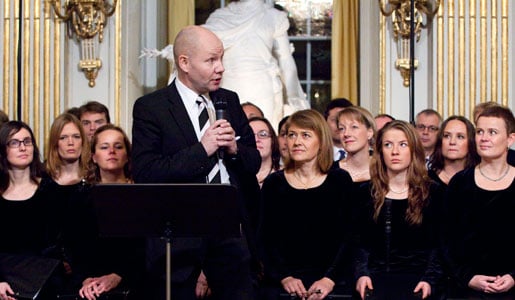
Introduction by Peter Englund, Permanent Secretary of the Swedish Academy.
© The Swedish Academy 2011. Photo: Helena Paulin-Strömberg
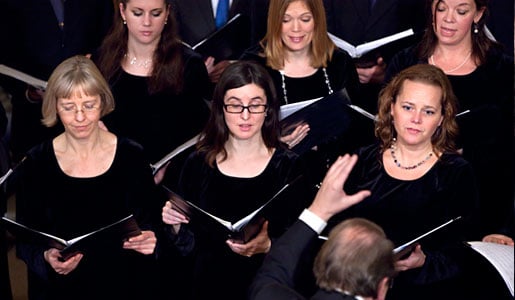
Gustaf Sjökvist Chamber Choir performs.
© The Swedish Academy 2011. Photo: Helena Paulin-Strömberg
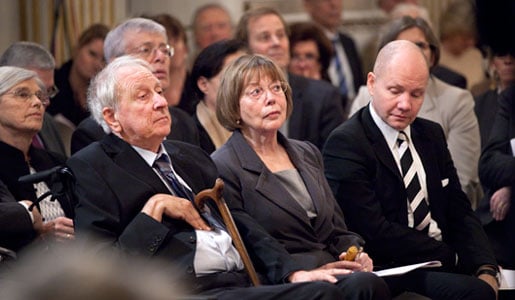
Nobel Laureate Tomas Tranströmer (left) with his wife Monica and Peter Englund, Permanent Secretary of the Swedish Academy (right).
© The Swedish Academy 2011. Photo: Helena Paulin-Strömberg

Tomas Tranströmer's poetry was read aloud in different languages, among them, Spanish, read by Antolina Gutiérrez del Castro.
© The Swedish Academy 2011. Photo: Helena Paulin-Strömberg
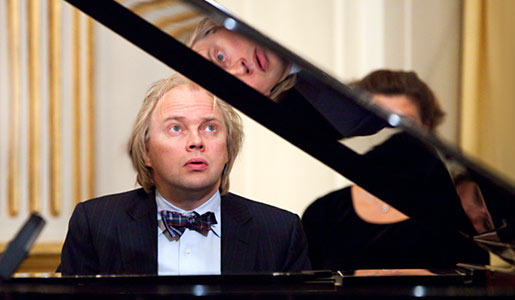
Roland Pöntinen playing music by Franz Liszt.
© The Swedish Academy 2011. Photo: Helena Paulin-Strömberg
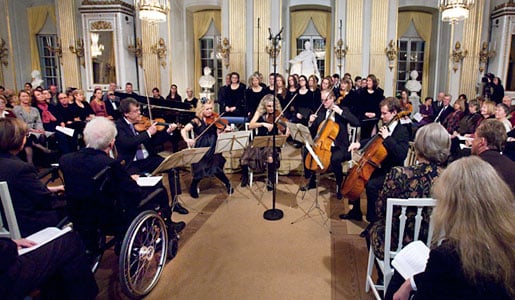
Uppsala Chamber Soloists playing during the program for Nobel Laureate Tomas Tranströmer at the Swedish Academy.
© The Swedish Academy 2011. Photo: Helena Paulin-Strömberg
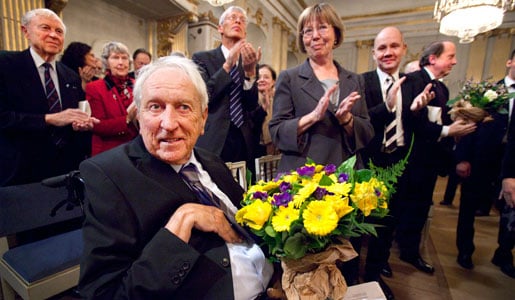
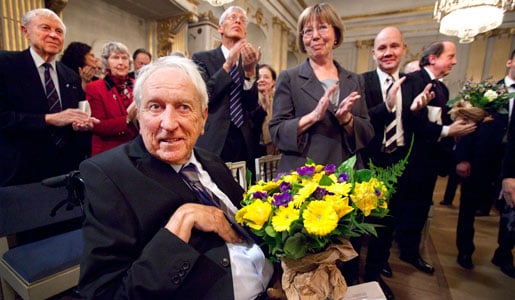
Tomas Tranströmer receives applause after the program at the Swedish Academy.
© The Swedish Academy Photo: Helena Paulin-Strömberg
MLA style: “Tomas Tranströmer – Nobel Lecture”. Nobelprize.org. Nobel Media AB 2014. Web. 22 Jun 2018. <http://www.nobelprize.org/nobel_prizes/literature/laureates/2011/transtromer-lecture.html>
Tomas Tranströmer – Nobel diploma
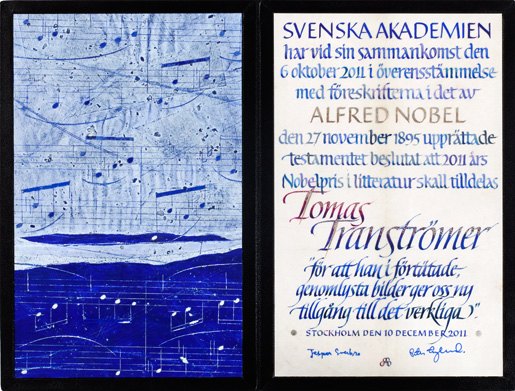
Copyright © The Nobel Foundation 2011
Artist: John Stenborg
Calligrapher: Annika Rücker
Book binder: Ingemar Dackéus
Photo reproduction: Lovisa Engblom
Tomas Tranströmer – Photo gallery
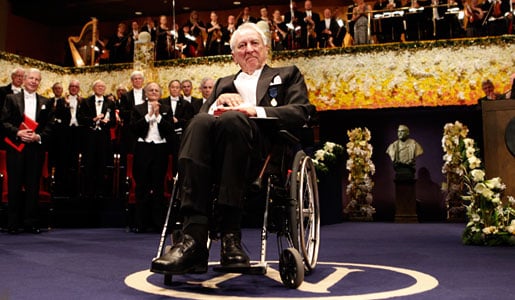
Tomas Tranströmer receiving his Nobel Medal and Diploma from His Majesty King Carl XVI Gustaf of Sweden at the Nobel Prize Award Ceremony, 10 December 2011.
© The Nobel Foundation 2011. Photo: Lina Göransson
Tomas Tranströmer after receiving the Nobel Medal and Diploma at the Nobel Prize Award Ceremony, 10 December 2011.
© The Nobel Foundation 2011. Photo: Lina Göransson
Tomas Tranströmer takes a look at his Nobel diploma at the Nobel Prize Award Ceremony, 10 December 2011.
© The Nobel Foundation 2011. Photo: Frida Westholm
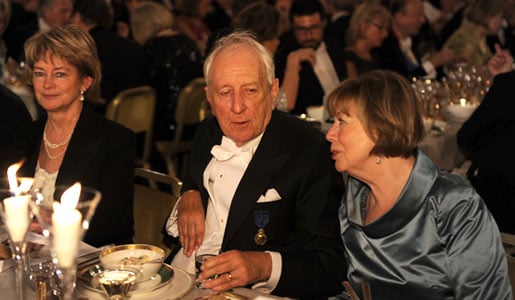
Tomas Tranströmer and his wife Monica at the Nobel Banquet, 10 December 2011. To the left: Lena Liljeroth Adelsohn, Swedish Minister for Culture and Sports.
© The Nobel Foundation 2011. Photo: Orasisfoto
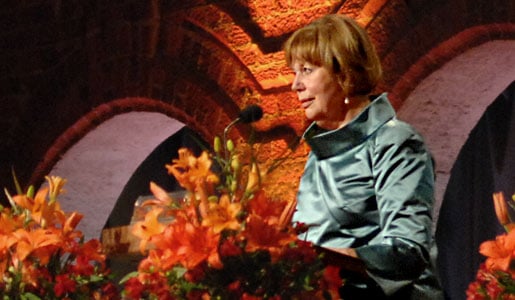
Monica Tranströmer's speech on behalf of Nobel Laureate Tomas Tranströmer.
© The Nobel Foundation 2011. Photo: Orasisfoto
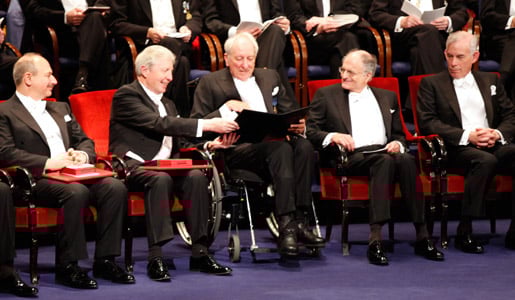
Eleven of the thirteen 2011 Nobel Laureates assembled for a group photo during their visit to the Nobel Foundation in Stockholm, 12 December 2011. Back row, left to right: Nobel Peace Prize Laureates Tawakkol Karman and Leymah Gbowee, Nobel Laureates in Physics Brian P. Schmidt, Saul Perlmutter and Adam G. Riess, Nobel Laureate in Chemistry Dan Shechtman and Nobel Laureate in Physiology or Medicine Bruce A. Beutler. Front row, left to right: Nobel Peace Prize Laureate Ellen Johnson Sirleaf, Laureate in Economic Sciences Christopher A. Sims, Nobel Laureate in Literature Tomas Tranströmer and Laureate in Economic Sciences Thomas J. Sargent. © The Nobel Foundation 2011. Photo: Orasisfoto
Uppsala Chamber Soloists playing during the program for Nobel Laureate Tomas Tranströmer at the Swedish Academy, 7 December 2011.
© The Swedish Academy 2011. Photo: Helena Paulin-Strömberg
Tomas Tranströmer receives applause after the program at the Swedish Academy, 7 December 2011.
© The Swedish Academy 2011. Photo: Helena Paulin-Strömberg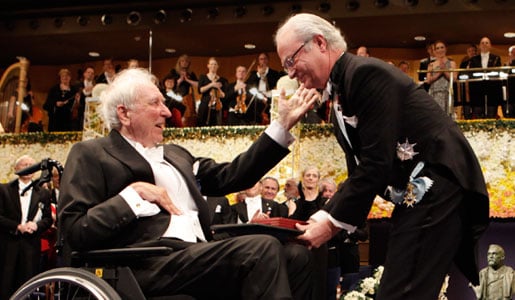


Tomas Tranströmer – Bibliography
| Works in Swedish |
| Poetry collections |
| 17 dikter. – Stockholm : Bonnier, 1954 |
| Hemligheter på vägen. – Stockholm : Bonnier, 1958 |
| Den halvfärdiga himlen. – Stockholm : Bonnier, 1962 |
| Klanger och spår. – Stockholm : Bonnier, 1966 |
| Mörkerseende. – Göteborg : Författarförlaget, 1970 |
| Stigar / Tomas Tranströmer, Robert Bly, János Pilinszky ; övers. av Tomas Tranströmer tillsammans med Géza Thinsz. – Göteborg : Författarförlaget, 1973 |
| Östersjöar. – Stockholm : Bonnier, 1974 |
| Sanningsbarriären. – Stockholm : Bonnier, 1978 |
| Det vilda torget. – Stockholm : Bonnier, 1983 |
| The Blue House = Det blå huset / translated from the Swedish by Göran Malmqvist. – Houston, TX. : Thunder City Press, 1987 |
| För levande och döda. – Stockholm : Bonnier, 1989 |
| Sorgegondolen. – Stockholm : Bonnier, 1996 |
| Fängelse : nio haikudikter från Hällby ungdomsfängelse (1959). – Uppsala : Ed. Edda, 2001 |
| Den stora gåtan. – Stockholm : Bonnier, 2004 |
| Tomas Tranströmers ungdomsdikter / utgivna och kommenterade av Jonas Ellerström. – Lund : Ellerström, 2006. – 2., utök. uppl. 2011 |
| Collections |
| Kvartett : 17 dikter ; Hemligheter på vägen ; Den halvfärdiga himlen ; Klanger och spår. – Stockholm : Bonnier, 1967 |
| Dikter 1954-1978. – Stockholm : Bonnier, 1979 |
| Dikter. – Stockholm : MånPocket, 1984 |
| Samlade dikter : 1954-1996. – Stockholm : Bonnier, 2001. – Ny utg. 2002 och 2005 |
| Dikter och prosa 1954-2004. – Stockholm : Bonnier, 2011 |
| Miscellaneous |
| Minnena ser mig. – Stockholm : Bonnier, 1993 |
| Tolkningar / redaktör: Niklas Schiöler. – Stockholm : Bonnier, 1999 |
| Air mail : brev 1964-1990 / Tomas Tranströmer, Robert Bly ; en bok sammanställd av Torbjörn Schmidt ; översättning av Lars-Håkan Svensson. – Stockholm : Bonnier, 2001 |
| Works in English |
| Twenty Poems / translated by Robert Bly. – Madison, MN. : Seventies Press, 1970 |
| Night Vision / selected and translated from the Swedish by Robert Bly. – London : London Magazine Editions, 1972 |
| Windows & Stones : Selected Poems / translated by May Swenson with Leif Sjöberg. – Pittsburgh : University of Pittsburgh Press, 1972 |
| Elegy ; Some October notes / translated from the Swedish of Tomas Tranströmer. – Rushden : Sceptre, 1973 |
| Citoyens / translated from the Swedish by Robin Fulton. – Knotting, Bedfordshire : Sceptre Press, 1974 |
| Baltics / translated by Samuel Charters. – Berkeley : Oyez, 1975. – Translation of Östersjöar |
| Baltics / translated from the Swedish by Robin Fulton. – London : Oasis Books, 1980. – Translation of Östersjöar |
| How the Late Autumn Night Novel Begins / translated by Robin Fulton. – Knotting, Bedfordshire : Sceptre Press, 1980 |
| Truth Barriers : Poems / translated and introduced by Robert Bly. – San Francisco : Sierra Club Books, 1980. – Translation of Sanningsbarriären |
| Selected Poems / translated by Robin Fulton. – Ann Arbor, MI. : Ardis Publishers, 1981 |
| The Truth Barrier / translated from the Swedish by Robin Fulton. – London : Oasis, 1984 |
| The Wild Marketplace / translated by John F. Deane. – Sandymount, Dublin : Dedalus, 1985. – Translation of Det vilda torget |
| Tomas Tranströmer : Selected Poems, 1954-1986 / edited by Robert Hass. – New York : Ecco Press, 1987 |
| The Blue House = Det blå huset / translated from the Swedish by Göran Malmqvist. – Houston, TX. : Thunder City Press, 1987 |
| Collected Poems / translated by Robin Fulton. – Newcastle upon Tyne : Bloodaxe Books, 1987 |
| For the Living and the Dead / poems translated from Swedish by John F. Deane. – Dublin : Dedalus, 1994 |
| For the Living and the Dead : New Poems and a Memoir / edited by Daniel Halpern. – Hopewell, NJ : Ecco Press, 1995 |
| For the Living and the Dead : A Bilingual Edition / translation from the Swedish by Don Coles. – Ottawa, Ont. : BuschekBooks, 1996 |
| New Collected Poems / translated by Robin Fulton. – Newcastle upon Tyne : Bloodaxe Books, 1997 |
| Sorgegondolen = The Sorrow Gondola / translated from the Swedish by Robin Fulton. – Dublin : Dedalus Press, 1997 |
| The Half-Finished Heaven : The Best Poems of Tomas Tranströmer / chosen and translated by Robert Bly. – Saint Paul, MN. : Graywolf Press, 2001 |
| The Deleted World. – Bilingual ed. / new versions in English by Robin Robertson. – London : Enitharmon Press, 2006 |
| The Great Enigma : New Collected Poems / translated from the Swedish by Robin Fulton. – New York, NY : New Directions, 2006 |
| The Sorrow Gondola = Sorgegondolen / translated by Michael McGriff & Mikaela Grassl. – København : Green Integer, 2010 |
| Memories Look At Me : A Memoir / translated from the Swedish by Robin Fulton. – New York, NY : New Directions, 2011 |
| Airmail : The Letters of Robert Bly and Tomas Transtromer / edited by Thomas R. Smith, Torbjorn Schmidt. – Minneapolis, MN : Graywolf Press, 2013 |
| Miscellaneous |
| Fulton, Robin, The Poetry of Tomas Tranströmer. – London : Academic Press, 1973 |
| Espmark, Kjell, Resans formler : en studie i Tomas Tranströmers poesi. – Stockholm : Norstedt, 1983 |
| Bergsten, Staffan, Den trösterika gåtan : tio essäer om Tomas Tranströmers lyrik. – Stockholm : FIB:s lyrikklubb, 1989 |
| Karlström, Lennart, Tomas Tranströmer : en bibliografi. – Stockholm : Kungl. bibl., 1990-2001. – 2 vol. |
| Bankier, Joanna, The sense of time in the poetry of Tomas Tranströmer. – Ann Arbor, MI. : UMI, 1993 |
| Ringgren, Magnus, Det är inte som det var att gå längs stranden : en guide till Tomas Tranströmers Östersjöar. – Stockholm : Bokbandet, 1997 |
| Schiöler, Niklas, Koncentrationens konst : Tomas Tranströmers senare poesi. – Stockholm : Bonnier, 1999 |
| Ringgren, Magnus, Stjärnhimlen genom avloppsgallret : fyra essäer om Tomas Tranströmer. – Uppsala : Ed. Edda, 2001 |
| Sjöberg, Fredrik, Tranströmerska insektsamlingen från Runmarö. – Lund : Ellerström, 2001 |
| Ett drömseminarium = Traumseminar = Unenäoseminar = Seminar snov = Seminár snov = Seminarium oniryczne = Sapnu seminars = Yumeno semunaru / [redaktör: Richard Pietrass]. – Visby : Östersjöns författar- och översättarcentrum, 2002 |
| Nielsen, Birgitte Steffen, Den grå stemme : stemmen i Tomas Tranströmers poesi. – Viborg : Arena, 2002 |
| Rönnerstrand, Torsten, “Varje problem ropar på sitt eget språk” : om Tomas Tranströmer och språkdebatten. – Karlstad : Karlstad Univ. Press, 2003 |
| Slyk, Magdalena, “Vem är jag?” : det lyriska subjektet och dess förklädnader i Tomas Tranströmers författarskap. – Uppsala : Uppsala universitet, 2010 |
| Bergsten, Staffan, Tomas Tranströmer : ett diktarporträtt. – Stockholm : Bonnier, 2011 |
The Swedish Academy, 2013