Speed read: Exposing the forest
The 1906 Nobel Prize in Physiology or Medicine was awarded to Camillo Golgi and Santiago Ramón y Cajal for revealing the inner beauty of the nervous system. By developing methods that could colour and highlight its key components, Golgi and Cajal allowed the anatomy of the nervous system to be observed and documented in precise detail.
When Camillo Golgi began studying the grey matter of the brain, existing techniques used to stain cells marked almost all parts of this dense tissue simultaneously, revealing no information about its finer details. Searching for a better staining method, Golgi experimented by candlelight in a hospital kitchen that he converted into a laboratory. There, he discovered a way of impregnating nervous tissue with a silver solution, which stained only a small number of nerve cells in black. This made it possible to view neurons in their entirety, from which Golgi could see the complex outlines and details of numerous branches with remarkable clarity.
Golgi’s silver staining method for nerves went unappreciated, until Ramón y Cajal enhanced its resolution and used this technique to investigate brains from young animals. Armed with a microscope, pen and paper, and endowed with artistic talent, Cajal created thousands of beautiful drawings depicting the intricate details of nervous tissue – which to him resembled a forest of outstretched trees. From his observations, Cajal developed the theory that the brain and spinal cord are made up of countless numbers of individual functional units, which his colleague Wilhelm von Waldeyer-Hartz later called neurons. According to this neuron doctrine, these individual cells have their own unique set of nerve processes, and the contents of each cell do not come into direct contact with that of other cells. Each neuron conveys its information to other cells through nerve fibres that extend across the space and barriers that separate them.
However, at the time the Nobel Prize was awarded, Golgi did not support the neuron theory for which Cajal had provided so much evidence – Golgi still interpreted the observations to indicate that the nervous system existed as a seamless continuous network, which forms an entirely distinct anatomical entity. Despite their difference in opinion, Golgi and Cajal became the first scientists to ever share a Medicine Prize.
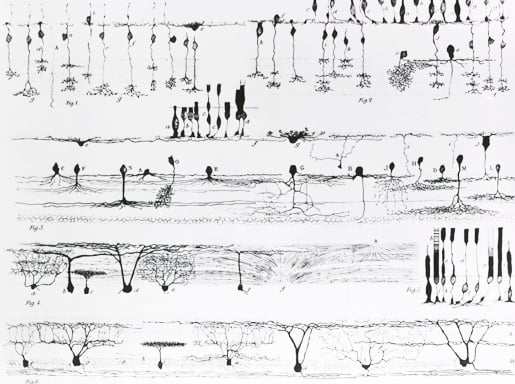
Various types of nerve structures. Illustration by Cajal from the book Die Retina der Wirbelthiere, Tafel II.
Source: U.S National Library of Medicine, History of Medicine Division
Photographer unknown
Kindly provided by U.S National Library of Medicine
By Joachim Pietzsch, for Nobelprize.org
This Speed read is an element of the multimedia production “Nerve Signaling”. “Nerve Signaling” is a part of the AstraZeneca Nobel Medicine Initiative.
How Golgi Shared the 1906 Nobel Prize in Physiology or Medicine with Cajal

by Gunnar Grant*
This article was published on 12 September 1999.
Camillo Golgi was nominated for the Nobel Prize in Physiology or Medicine as early as 1901, when the first prize was awarded. After that, his name came up every year until 1906, when he was finally awarded the prize together with Santiago Ramón y Cajal.
There were four proponents for Golgi that year, namely Hertwig, professor of comparative anatomy from Berlin, Kölliker, professor of anatomy from Würzburg, and two Swedes, Gustaf Retzius, former professor of anatomy from Stockholm, and Carl Magnus Fürst, professor of anatomy from Lund. Kölliker, Retzius and Fürst proposed Golgi and Cajal. Retzius, however, proposed Cajal alone as an alternative. Cajal’s nomination was also supported by, in addition, Ziehen, professor of psychiatry and neurology from Berlin, and by Emil Holmgren, from Stockholm.
Kölliker had proposed Golgi in 1901. He nominated him again in 1905 and then, as in 1906, he proposed both Golgi and Cajal. Retzius sent in proposals for Golgi all the five years from 1902. The first three times he proposed Golgi and Cajal, but in 1905 he nominated Cajal, and after him, Golgi. Finally, as mentioned, in 1906 his suggestion was for Golgi and Cajal, or Cajal alone.
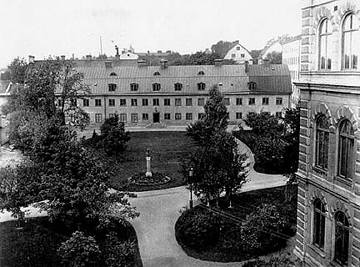
It may be of some interest that, in 1902, Emil Holmgren, professor of histology at the Caroline Institute in Stockholm, had been one of the proponents in favor of Golgi. It was Holmgren who was commissioned by the Nobel Committee to carry out the investigation on Golgi’s and Cajal’s work and to write the reports for all the five years from 1902, until the time they were awarded the prize in 1906.
The comprehensive report by Holmgren in 1906, corresponding to nearly 50 type-written pages of size A4 paper, was based on a careful and extensive analysis of the merits of the two candidates, who were also weighed against each other. Holmgren’s conclusion was the following (translation from Swedish by G.G.): “If the achievements by Golgi, on the one hand, and Cajal, on the other, in the research on the nervous system are considered, one can not, in justice, evade the final conclusion that Cajal is far superior to Golgi.” It may be noted that this was his conclusion during the later years. In his report, Holmgren made it clear that he would have given Golgi a higher priority if it had been some years earlier. Now, however, according to Holmgren, Cajal had made such important and principally valuable discoveries, and also interpreted his findings in a correct way, as had been confirmed by others. Because of this, Holmgren was predisposed to rank Cajal before Golgi.
Favouring Cajal over Golgi, Holmgren writes (translation from Swedish by G.G.): “Cajal has not served science by singular corrections of observations by others, or by adding here and there an important observation to our stock of knowledge, but it is he who has built almost the whole framework of our structure of thinking, in which the less fortunately endowed forces have had to, and will still have to put in their contributions.”
Holmgren’s evaluation included Cajal’s more recent contributions based on his neurofibrillar impregnation method, both for a better understanding of the interior of the nerve cell and for studies of regeneration of peripheral nerve fibers – which had also been studied by Perroncito in Pavia, a pupil of Golgi – as well as for studies of outgrowth of axons during the embryonic development, demonstrating end bulbs (growth cones). These formed part of the basis for his support for Cajal’s scientific superiority.
Regarding Golgi, Holmgren discussed some of the findings which had turned out to be wrong. The most important of these were Golgi’s adherence to the reticular theory, against which the neuron doctrine had been put forward and gained acceptance by most neuroscientists during this period. Further to this was Golgi’s view on the dendrites, which he regarded as nutritive elements for the neurons and not involved in the conduction of impulses, as well as his view on his type II cells, which he suggested to be involved in sensory function, sending axons out from the central nervous system to the periphery, on the sensory side.
Carl Sundberg, professor of pathology at the Caroline Institute, who was also Vice President at the Institute at that time, was thereupon asked for another evaluation of the candidates, after Holmgren’s conclusions had become known to members of the Nobel Committee. Contrary to Holmgren’s conclusions, Sundberg, for his part, put more stress upon Golgi’s valuable contributions, citing not only the development of the Golgi method but also, for instance, his findings of collaterals both in the gray matter and in the longitudinally running white columns of the spinal cord. He tried to soften the weak points in Golgi’s contributions and quoted passages from evaluations done by Holmgren during the earlier years that were in support of Golgi.
Before the final decision was taken on October 25th, written opinions were expressed both by Holmgren and Sundberg, and in addition, by Bror Gadelius, professor of psychiatry at the Caroline Institute. Gadelius supported Holmgren’s views.
The final voting among the professors at the Institute resulted in a majority for a Nobel Prize shared by Golgi and Cajal. Only two were against – their names were not given, but it should not be difficult to guess who they were.
Of some interest may also be Gustaf Retzius’ view on the decision that was taken. This is expressed in a passage in his autobiography (1948, p. 246; translation by G.G. – italics also in the Swedish text): “… Cajal…But it is true that already at his arrival in Stockholm, I thought that he had deserved receiving a full, and undivided Nobel Prize, and asked about this by the Nobel Council of the staff of professors at the Caroline Institute, I expressed this opinion of mine decidedly.”
That Retzius was asked for his opinion but did not take part in the decision, is explained by the fact that he was no longer a member of the Medical Faculty at the Caroline Institute. He had resigned from his chair in anatomy in 1890, in protest over the failure to get his candidate appointed to a professorship in ophthalmology. Paradoxically, however, his membership both in the Royal Swedish Academy of Sciences and in the Swedish Academy, meant that he took part in the election of the Laureates both in Physics and Chemistry, and in Literature.
Going back to the nominations, this was the first time that the Nobel Prize was shared between two Laureates. Cajal writes about this (from the English translation of his autobiography, 1989, p. 546): “The other half was very justly adjudicated to the illustrious professor of Pavia, Camillo Golgi, the originator of the method with which I accomplished my most striking discoveries.”
Acknowledgements
Material from the Nobel Archives was kindly provided by the Nobel Committee for Physiology or Medicine.
Permission to reproduce the lecture given at the Golgi and Bizzozero symposium was given by the Giornale dell’Accademia di Medicina di Torino.
References
Ramón y Cajal S (1989) Recollections of my life; translated by E. Horne Craigie, with the assistance of Juan Cano. Cambridge, Massachusetts, The MIT Press, 638 pp.
Retzius, G (1948) Biografiska Anteckningar och Minnen, vol. II. Uppsala, Almqvist & Wiksell AB, 285 pp.
* This article is based in part on a lecture entitled “Camillo Golgi and the Nobel Prize”, given at a symposium entitled “Golgi and Bizzozero nel centenario della scoperta dell’apparato reticulare interno” at the Accademia di Medicina di Torino, Italy, November 24, 1998. Original information was achieved from the archives of the Nobel Committee for Physiology or Medicine after a formal request by the author to get access to these archives.
Gunnar Grant, born January 6, 1932. Studied medicine in Stockholm and Uppsala. MD 1959 and PhD 1962, School of Medicine, Uppsala University. Positions at the Anatomy Department, Uppsala University School of Medicine, from 1962 to 1970, Associate Professor (1970) and Professor (1979) of Anatomy at Karolinska Institutet, Stockholm. Chairman of the Department of Anatomy, Karolinska Institutet in 1971-1977, and in 1984-1992. Publications in Neuroanatomy. Member of the Norwegian Academy of Sciences.
First published 12 September 1999
Santiago Ramón y Cajal – Nominations
Camillo Golgi – Nominations
Camillo Golgi – Photo gallery

Portrait of Camillo Golgi.
Source: Wellcome Images, a website operated by Wellcome Trust, a global charitable foundation based in the United Kingdom. Photo: Anton Mansch CC BY 4.0 via Wikimedia Commons

Group portrait including Camillo Golgi outside Old Schools, Cambridge 1898. From left to right: E.J. Marey, A. Dohrn, Camillo Golgi, E.H.P.A. Haeckel, A.A.W. Hubrecht, W.F. Kuehne, H.P. Bowditch, Hugo Kronecker and H. Kronecker.
Source: Wellcome Images, a website operated by Wellcome Trust, a global charitable foundation based in the United Kingdom. CC BY 4.0 via Wikimedia Commons
Santiago Ramón y Cajal – Other resources
Links to other sites
On Santiago Ramón y Cajal from Instituto Cajal
Santiago Ramón y Cajal – Photo gallery

Portrait of Santiago Ramón y Cajal.
Source: U.S National Library of Medicine, History of Medicine Division Photographer unknown Kindly provided by U.S National Library of Medicine

Santiago Ramón y Cajal
Photo: Legado Cajal. Instituto Cajal (CSIC). Madrid.

Santiago Ramón y Cajal at work, ca 1915.
Photo: Legado Cajal. Instituto Cajal (CSIC). Madrid.

Santiago Ramón y Cajal in his laboratory in Madrid, surrounded by some of his students, ca 1915.
Photo: Legado Cajal. Instituto Cajal (CSIC). Madrid.

Santiago Ramón y Cajal at his desk, ca 1890.
Photo: Legado Cajal. Instituto Cajal (CSIC). Madrid.

Self-portrait of Santiago Ramón y Cajal in his laboratory in Valencia, ca 1885.
Photo: Legado Cajal. Instituto Cajal (CSIC). Madrid.

Pyramidal cells of the cerebral cortex of a cat.
Source: U.S National Library of Medicine, History of Medicine Division Photographer unknown Kindly provided by U.S National Library of Medicine

A schematic illustration of a section of the spinal cord depicting the nerve roots. Illustration by Cajal from the book Recuerdos de mi vida.
Source: U.S National Library of Medicine, History of Medicine Division Photographer unknown Kindly provided by U.S National Library of Medicine

Neuroglial cells of a cat. Illustration by Cajal from the book Recuerdos de mi vida.
Source: U.S National Library of Medicine, History of Medicine Division Photographer unknown Kindly provided by U.S National Library of Medicine

Detail of neural connections. Illustration by Cajal from the book Recuerdos de mi vida.
Source: U.S National Library of Medicine, History of Medicine Division Photographer unknown Kindly provided by U.S National Library of Medicine
Various types of nerve structures. Illustration by Santiago Ramón y Cajal from the book Die Retina der Wirbelthiere, Tafel II.
Source: U.S National Library of Medicine, History of Medicine Division Photographer unknown Kindly provided by U.S National Library of Medicine
Camillo Golgi – Other resources
Links to other sites
On Camillo Golgi from Museo Golgi (in Italian)
Camillo Golgi – Nobel Lecture
Nobel Lecture, December 11, 1906
The Neuron Doctrine – Theory and Facts
Read the Nobel Lecture
Pdf 462 kB
Santiago Ramón y Cajal – Nobel Lecture
Nobel Lecture, December 12, 1906
The Structure and Connexions of Neurons
Read the Nobel Lecture
Pdf 705 kB