Speed read: Tailoring nerve transmissions
When it comes to sending electrical nerve signals, some messages are more urgent than others. Our muscles need to be activated quickly when we are attacked, for instance, while our receptors for chronic pain do not require such a rapid response. To meet these various delivery requirements, nerve fibres differ considerably in the way they transmit and fire signals. Understanding these variations is an ongoing task, but for recording these differences and showing how they relate to nerve design, Joseph Erlanger and Herbert Gasser were awarded the 1944 Nobel Prize in Physiology or Medicine.
Erlanger and his student Gasser were interested in developing tools that could measure impulses fired through nerve cells, and they turned to the cathode-ray oscilloscope – an instrument that allows electrical currents to be visualized as a moving two-dimensional graph on a phosphorescent screen. After its invention by Ferdinand Braun, the oscilloscope soon became the most effective tool for detecting rapid changes in electrical voltage, but still it was not sensitive enough to measure the weak and rapid electrical impulses that are fired along nerve cells. Erlanger and Gasser solved this problem by constructing an amplification device which magnified the minute impulses in a single nerve fibre millions of times, so that they became visible as distinctive waves on the screen.
Using their apparatus, Erlanger and Gasser found that stimulating isolated nerves with identical single shocks created a variety of waves on the screen. Deconstructing this complex pattern revealed that nerve fibres conduct impulses at different rates depending on their thickness. On this basis, fibres could be classified into three distinct types, and Erlanger and Gasser also showed that each type requires a stimulus of different intensity to create an impulse. From their observations, Erlanger and Gasser formulated a theory proposing that different fibres transmit different kinds of impulses, where touch travels along thicker, rapidly conducting fibres, while pain is mostly perceived by very thin, slowly conducting fibres. In other words, they showed how the functionality of our central nervous system relies on the precise timing of its tasks.
By Joachim Pietzsch, for Nobelprize.org
This Speed read is an element of the multimedia production “Nerve Signaling”. “Nerve Signaling” is a part of the AstraZeneca Nobel Medicine Initiative.
Joseph Erlanger – Nobel Lecture
Nobel Lecture, December 12, 1947
Some Observations on the Responses of Single Nerve Fibers
Read the Nobel Lecture
Pdf 141 kB
Herbert S. Gasser – Nobel Lecture
Nobel Lecture, December 12, 1945
Mammalian Nerve Fibers
Read the Nobel Lecture
Pdf 114 kB
Herbert S. Gasser – Banquet speech
Herbert S. Gasser’s speech at the Nobel Banquet in Stockholm, December 10, 1945
Your Highnesses, Your Excellencies, Ladies and Gentlemen,
The pleasure of the moment could only be augmented had it been possible for more of the group of which I am a member to have been able to accept the invitation to be here today, and to join with me in bringing messages of friendship from the United States of America. Their wish to come can have been no less than mine. Together, a year ago today, we participated in a most unusual event in which six Nobel awards in science were presented to residents in our country, – in a ceremony that because of the troubled times took place in New York City. In all solemnity, in the name of his Majesty, the King of Sweden, the prizes were distributed by the Swedish Minister to the United States at a luncheon meeting arranged by the American-Scandinavian Foundation.
So high is the world-wide esteem of the judgments of the Nobel Committees, that there could not fail to be present a pardonable element of national rejoicing. It was something far different, however, that caused the occasion to be one never to be forgotten. Chords were struck in which there sounded in harmony sympathetic vibrations between your country and ours, resonant with our mutual love of learning, tolerance, freedom, and peace. And there were overtones of good will that caused the whole, in the ears of a war torn world, to seem to mount to a hymn to the international ideal to which Alfred Nobel devoted his life and his fortune.
By happy chance the selection fell to me to express over the radio the gratitude of four of my colleagues and myself. You will recall that Professor Dam of Denmark also took part. When the greetings of His Royal Highness the Crown Prince, and of Professor Svedberg began to come forth with beautiful clarity from the loud speakers in the reception room, Sweden indeed seemed near to us. Still, after the words of Professor Svedberg, one felt very deeply that what we wanted to say could only be said adequately if we could have the privilege of grasping you by the hand as we told of our indebtedness.
Through the gracious invitation to attend these ceremonies, the satisfaction of our desire has become possible. But now that I am here, and the heart would speak, it cannot find the words. May I therefore say, quite simply, I thank you.
Joseph Erlanger – Photo gallery

1 (of 3) Joseph Erlanger seated in the laboratory.
Source: U.S National Library of Medicine, Images from the History of Medicine Collection Photographer unknown Kindly provided by National Library of Medicine

2 (of 3) In the fall of 1947, the Washington University faculty honored three of the University's four Nobel Laureates: Dr. Joseph Erlanger (far left), the 1944 Nobel Laureate in Physiology or Medicine, and Drs. Carl F. and Gerty T. Cori, Nobel Laureates in Physiology or Medicine in 1947. Dr. Carl A. Dauten (right), President of the Men's Faculty Club, presents a scroll to the Nobel Laureates.
Copyright © Becker Medical Library, Washington University School of Medicine Photographer unknown Kindly provided by Becker Medical Library
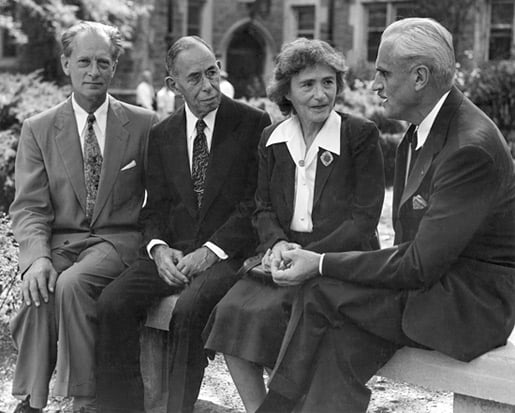
3 (of 3) Four Nobel Laureates at the Washington University. From left to right Dr. Carl F. Cori, Professor of Biochemistry and the 1947 Nobel Laureate in Physiology or Medicine, Dr. Joseph Erlanger, Professor Emeritus of Physiology and the 1944 Nobel Laureate in Physiology or Medicine, Dr. Gerty T. Cori, Professor of Biochemistry and the 1947 Nobel Laureate in Physiology or Medicine, and Chancellor Arthur H. Compton, the 1927 Nobel Laureate in Physics. Photo taken in 1947.
Copyright © Becker Medical Library, Washington University School of Medicine Photographer unknown Kindly provided by Becker Medical Library
Herbert S. Gasser – Photo gallery
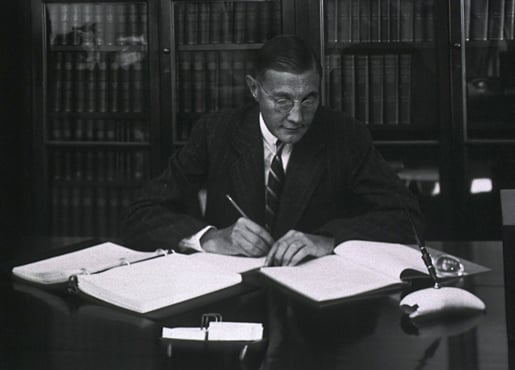
1 (of 1) Herbert S. Gasser in his office.
Copyright © The Rockefeller Archive Center Photographer unknown Kindly provided by The Rockefeller Archive Center
Herbert S. Gasser – Nominations
Joseph Erlanger – Nominations
Award ceremony speech
In regard to Erlanger’s and Gasser’s works, Professor R. Granit, Head of the Department of Neurophysiology of the Nobel Institute of the Royal Caroline Institute, made the following statement*.
Three great electrophysiological discoveries can be regarded as milestones in the development of our knowledge of nerve physiology. In the middle of the last century, long before Alfred Nobel had bequeathed this great fund to the world, Du Bois-Reymond showed that the nerve impulse was an electrical wave of negativity transmitted along the nerve. Helmholtz made the first measurements of its average speed of propagation in a nerve stem. The second great discovery, rewarded with a share in the Nobel Prize for 1932, was Adrian‘s observation that sense organs and nerve cells discharge whole series of such impulses. In each individual fibre the nerve impulse is of constant size but the stronger the stimulus, the greater the frequency of the impulses discharged along the nerve. The nerve cells, as it were, communicate with each other by a kind of machine-gun fire. This description of the mechanism is inadequate from the standpoint of physics but otherwise illuminating. And, indeed, if the impulses are led to a loudspeaker over an amplifier it does sound like machine-gun fire. The discoveries of Erlanger and Gasser constitute a third step forwards.
In 1907 the Swedish physiologist Gustaf Göthlin made the assumption that conduction velocity in thick nerve fibres is greater than in thin ones. The basis for this view was W. Thompson’s formula for electrical-cable conduction. This assumption gave a physiological interpretation of the well-known fact that the individual fibres of a nerve stem vary in cross section. Some fibres are less than 0.001 mm in diameter, others just above 0.020 mm. Lapicque and his colleagues, from 1913 onwards, published some papers in which indirect evidence in support of this view was advanced. In a series of remarkable papers – remarkable in respect of both technique and wealth of new information unearthed – Erlanger and Gasser proved this hypothesis to have been correct. As so often happens in experimental sciences, the additional steps necessary for full clarity as well as the development of an elegant new technique, heralded an experimental expansion of great width and significance. The seemingly simple cables turned out to have been endowed with a high degree of differentiation. Since nerve fibres are to be regarded as extensions of nerve cells these results are indeed of extreme importance for the physiology of the higher centres such as the brain and the spinal cord. This fact should be given especial consideration in appraising the significance of the work of Erlanger and Gasser.
Erlanger and Gasser showed that the nerve fibres, according to their conduction velocities, could be divided into three main groups of which the first, group A, could be further subdivided. The thickest mammalian fibres, the A-fibres, conduct impulses as fast as from 5 to 100 metre per second, the thinnest, the C-fibres, have conduction velocities below 2 metre per second. Between these two groups there are the B-fibres with conduction velocities from 3 to 14 metre per second. A large number of other properties of the nerve fibres vary with the speed of conduction, for instance, the duration of the impulse, its rate of rise, its size, the duration of the inexcitable or refractory period following each impulse, the threshold of excitation, the sensitivity of the discharge to pressure on the nerve and to asphyxia, in short, an array of properties connected with impulse conduction all of which need not vary in an exactly parallel manner. Erlanger and Gasser also showed how this highly differentiated system with its three main types of fibre was distributed over the in- and outgoing fibres of the spinal cord, the so-called sensory and motor roots. The perception of pain is largely mediated by very thin, slowly conducting fibres, muscle sense and touch by rapidly conducting fibres. The muscles of the body are also thrown into movement by fast fibres.
In the brain and the spinal cord the time ratios of the impulses are of primary importance for the cooperation of the nerve cells. A difference of 0.001-0.005 seconds in the time of arrival of impulses means that a given path may be found opened or closed for their passage onwards. Problems of this kind belong to the present-day programme of experimentation in these fields.
The admirable technique of Erlanger and Gasser soon showed them a road to new discoveries, chiefly concerned with the changes of excitability that occur at a nerve cross section at which impulses arrive. The arrival of one or several impulses to such a region was found to be followed by slow changes of excitability which were associated with slow changes of electrical potential, studied in detail by Gasser. These changes of excitability enhance or depress succeeding impulses. Such «after-potentials» had been seen before, but Gasser and his collaborators demonstrated their independent character and showed that they behaved in a different manner in the three main types of fibre. The concept of a high degree of differentiation of the nerve fibres for their different tasks was thus again supported by a new group of facts. These are of particular importance for the physiology of the central nervous system. A prominent feature of this region is interaction between excitation and inhibition in close association with slow potential changes. Erlanger and his collaborators devoted themselves to an analysis of the changes of excitability in a nerve influenced by a constant electrical current. One of their most important discoveries was the demonstration that sensory nerves in many respects differed from motor nerves. The sensory nerves had, for instance, lower thresholds of excitation and they put up less resistance to impulse generation (less «accommodation») than motor nerves. This fresh contribution to the differentiation among the nerve fibres has far-reaching consequences.
When today Erlanger and Gasser receive the 1944 Nobel Prize for their discoveries concerning the highly differentiated properties of single nerve fibres, it might be pointed out that their achievement was not born, fixed and armoured, in the manner of the birth of Pallas Athene. But no sooner had their first result given them the key word than discovery followed hard upon discovery until their colleagues everywhere in the world came to realize that a great new synthesis had been born to nerve physiology. This synthesis is based on new facts, well-hardened by a masterly technique cementing them into a groundwork on which will be erected whatever structure the future has in store for the physiology of the central and peripheral nervous system.
*Broadcast lecture delivered on the 10th December, 1944.