Severo Ochoa – Photo gallery

1 (of 2) Laureates Severo Ochoa and Owen Chamberlain with their wives during Nobel Week in Stockholm, December 1959.
Photographer unknown (Svenska Daglabdet), Public domain, via Wikimedia Commons

2 (of 2) From left: Physics laureate Emilio Segrè, medicine laureate Severo Ochoa and literature laureate Salvatore Quasimodo during Nobel Week in Stockholm, December 1959.
Photographer unknown (Svenska Dagbladet), Public domain, via Wikimedia Commons
Arthur Kornberg – Nobel Lecture
Nobel Lecture December 11, 1959
The Biologic Synthesis of Deoxyribonucleic Acid
Read the Nobel Lecture
Pdf 153 kB
Arthur Kornberg – Interview
Interview transcript
Arthur Kornberg, welcome back to Stockholm again, another family get-together in Stockholm. You were here with your son Roger when you received the Nobel Prize in Physiology or Medicine in 1959 and now you’re back to see him receive the Nobel Prize in Chemistry this year, the sixth father/son team to do this. It must be very pleasant to be back?
Arthur Kornberg: Yes, it’s a great, great pleasure to be resurrected after all these years through Roger’s awesome achievements. He’s done things that I could have dreamed of but never accomplished and without going into great detail, he’s moved from biochemistry, taking genetics along with it and onto structural studies of crystallography and x-ray defraction which he learned entirely on his own and put this piece together. That is, I would say, perfectly awesome. Very proud.
In some ways your beginnings were similar in that you both came from a chemistry background and when I spoke with Roger yesterday he was saying that chemistry was really the fundamental thing you needed to know in order to understand biology and he said that in very elegant terms. I presume, since you majored in chemistry yourself, that you’d agree with him totally?
Arthur Kornberg: That’s not quite correct. Roger has had, I might say, almost a royal training in chemistry because I arranged, during his high school and college years, to spend summers working with distinguished chemists and biochemists and geneticists. I never had that background. When I entered college, I didn’t know what I would do. When I left college, I had a chemistry major but a very mild one and almost by defect, went into medicine. Medicine was not chemical and trained as an internist after medical school and really came into chemistry by a wide detour. Shall I go on and tell you the…?
Yes, please, please.
Arthur Kornberg: When I was given leave to complete my clinical training after 1941, outside of war. I then in July of that year was mustered into the coastguard as a doctor and I was then part of a navy and so I was on ships for about six months, as the doctor on the ship. Then through some devious way in which some research that I’d done as a medical student gained me an invitation to come to the National Institute of Health. I was assigned to rat nutrition, which I did for three years. Then got bored with feeding rats and counting the sick and dead ones, became convinced that I needed to understand what vitamins did, which I was feeding them and keeping some alive including folic acid as an important component and gained a special dispensation from the NIH, still in uniform, to work in an entomology laboratory of Severo Ochoa, who later I shared the prize with in 1959. He was very kind and patient and I learned the rudiments and then progressed to doing something more meaningful. Then he persuaded me, and I didn’t need that much persuasion, to borrow another half year from the NIH, still in uniform, to work with two Nobelists later, Carl and Gerty Cori in St Louis. That was again a major episode that utterly separated me from ever returning to medicine, let alone things that are more physiological. Returning to the NIH, I then took up a privilege that had been given to me to start a laboratory of entomology and from there on, I’ll say briefly, I fell in love with enzymes.
Your path really took you from an applied approach to research back to a very basic approach. I’ve read that you described your approach to physiology as being to isolate the actors with which you can then investigate the dramas they perform. That’s a direct quote from you.
Arthur Kornberg: Aren’t you nice to remember that?
That reductionist approach has been the hallmark of your work since then.
Arthur Kornberg: Yes, and I still find that in essence what one needs to do, faced with a biologic event, but I’ve come around in recent years to appreciate that that’s only part of the story. That one has ultimately to put it into the context of a functioning entity, a cell, because many of the players have been eliminated in that reduction to simplicity of an enzyme reaction or even an enzyme pathway. And also, I’ve been persuaded that even with bacteria, which I’ve worked with almost all my life, that they have a defined ultra structure, they’re not simply a bag of enzymes, but unfortunately it’s too late in life to make up for all that lost ground but it’s part of our future in biology and science.
Sure, but despite your being persuaded that there’s more than the reductionist approach, which of course you knew, there is nevertheless I think now quite a rush towards in vivo work. And does that, do you think confuse issues, the fact that people want to get into the animal as quickly as they can?
Arthur Kornberg: It’s worse than that. In trying to see a broad picture, the power of genomics and proteomics and metabolomics and economics. All of that has contrived to separate people from what I’d say the wet nature of life. We may pick this up later, the subject that I’m working on intensely now, or try to. I appreciate how little has been done at that level of breaking the cell open perturbing it minimally, but still being able to introduce and extract things from that broken cell, that has a world of mystery in it.
In thinking about the appeal of science to people coming into the subject, do you think that the move towards genomics and metabolomics and the rest of it, has in some way distanced people from the ability to become excited by science?
Arthur Kornberg: Oh, I can’t comment on that. People doing the current work and sitting at the front of their computers, which is now commonplace in my lab and department, and not over an ice bucket with chilled reagents and pipetting from one to another. They’re so different and I’m not prepared to say that this generation has gone off the deep end, but it will have to come back. I don’t think any system as refined as genomics can be, and I’ve used it because it’s so informative about other aspects of living systems that relate to what you’re doing. Still the urgency, let’s say in Roger’s work, which I won’t for a moment denigrate in any way. But when I’ve talked to him about the subject that I’m interested in and I told you I’d get to it, polyphosphate, it’s there, /- – -/ in abundance but they’re not in the reduced, refined, almost atomically resolved system for which he’s getting this highly deserved credit. So that’s your mode and who might be doing that kind of work. I had breakfast with Dave Bushnell, a very devoted and highly capable research associate of Roger’s and checked with him, David, is anyone even thinking about that, oh no, it’s another world.
Tell us a little bit about the work that you’re currently doing then?
Arthur Kornberg: I didn’t think you’d get around to asking me so soon. I don’t want to extend this, as you said earlier, having in many people’s minds the image of a molecular fossil. But in fact let me reflect on when I first heard the word. It was in the laboratory of Carl and Gerty Cori in 1947. It was that second interval or half year bonus that I had to study entomology. A Belgian came through, Wiame, and he brought the news that a particle had been known from the turn of the century, called Viatine, which had the property of metachromatic staining. It was prominent in many organisms, abundance and less so. No one knew what it did. They had discovered in that Belgian laboratory that it was inorganic polyphosphate. At that time, the nature of those bonds which are high energy phosphor and hydroid bonds, we didn’t know about mitochondria. We knew about ATP but in 1947, we didn’t know about mitochondria and immediately set to wonder, could this inorganic polyphosphate be somehow involved in the generation of ATP. As it turned out, that was not a part of the picture. ATP and ATP synthase and ultimately the proton motive force that drives the synthesis of ATP from ADP was elucidated and the ATP synthase, the enzyme because better known and polyphosphate was forgotten.
In fact, when I was in St Louis, about that time, it coincided with an asbestos scare. People were being diagnosed and dying from asbestosis, which was being used to coat all kinds of ducts and insulating infants clothing from fire. It was a determined that people were dying of asbestosis, a pulmonary disease in the shedding of the asbestos from industrial and even domestic use. Monsanto set about to replace asbestos with some mineral fibre and that was polyphosphate and you could make polyphosphate, much like it was made on Earth billions of years ago, by heating phosphate rock and you get long chains of polyphosphate. The cost was pennies a pound and so they developed very good technology for making fibrous constructions out of this polyphosphate. Until the marketing people said it won’t sell, it won’t go because it’s a fibre. The fact that it’s biodegradable in your body and nature and the fact now that it’s used in making meats resistant to bacteria, packed meats commonly had polyphosphate. They glisten as a result of it and many dental flosses, toothpastes have polyphosphate. It’s utterly innocuous but it has origins and has kinds of either utter indifference or even fear that’s made its marketing and acceptance so delayed.
So, polyphosphates are with us all the time, despite the fact that scientifically they’ve been somewhat ignored?
Arthur Kornberg: More than that, I conjecture, no-one knows how life started but I would think polyphosphate would have been an ideal candidate for the first vesicle that surrounded something and called a cell because it’s a phosphorylating agent, it helps in the creation of peptides and fatty acids, it’s a reservoir of energy, it makes ATP, it phosphorylates sugars and it’s responsive to the environment. It grows and recedes of course by adding enzymes and permeases and what not, but enough of that. But incidentally, people who write about the origin of life and speculate about it, rarely mention polyphosphate, isn’t that astonishing?
Yes, it doesn’t come up in the RNA world discussions.
Arthur Kornberg: Yes, exactly, but long before there was an RNA world or a carbon word, poly P was there. And the fact is, and this is what persuaded me, polyphosphate is in every cell in nature. Every bacterium, fungus, plant, every animal, every tissue, every sub-cellular element in a cell, in the nervous system, it’s chains of thousands and it’s in the nuclei, the mitochondria, attached to the ribosomes, a variety of vesicles, it’s everywhere.
You see it now as a very good candidate for a drug target in microbiology?
Arthur Kornberg: I came about, I should say, blossomed. We then made our bug as E. coli. We’ve done so much with it and DNA replication and we could show that when we deprive this bacterium of these enzyme, we established the enzyme that makes it called PPK, polyphosphate kinase, converts ATP, takes the phosphate ATP, puts it on a growing chain and it just whizzes off and we really don’t know the intimate details of how that process goes from one to many. We were able to purify the enzyme, characterise it and make mutants of it. We found very early on that they didn’t survive. They might grow through the typical expediential phase, but they couldn’t survive and then they couldn’t swim. They couldn’t talk to each other and make biofilms and eventually we moved more towards Pseudomonas Aeruginosa, a fascinating organism, and found that it was not pathogenic and that’s a bad bug because it kills children with cystic fibrosis, with pneumonia. It’s the bane of surgeons because it causes wounds that cannot be healed and it makes such firm biofilms.
Biofilms are another area that hasn’t been very investigated.
Arthur Kornberg: Biofilms is what bugs behave in almost 98% of the time. They’re not simple little rods or spheres, they collect under a variety of circumstances and aggregate as a film, which they have totally different properties and very resistant to antibodies. Anyway, you need poly P, we’ll call it poly P then, shall we, to make biofilms and pseudomonas, that is deprived of the kinase that makes polyphosphate is no longer pathogenic. We’re not sure that’s true, salmonella, shigella, vibrio cholerae, helical bacteria that forms peptic ulcers /- – -/ for cancer. Each of these when we isolate the enzyme, mutate it, these bugs no longer are pathogens. Which brings me to my current involvement, which is really current, I’ve been in touch with people several days last week, tuberculosis. It so happens that mycobacterium tuberculosis, the agent that causes tuberculosis, has firstly the same enzyme as the one in E. coli, that enzyme has been conserved in terms of its amino acid chain almost intact.
That enzyme could be a target and we arranged some years ago through friends and contacts, to have a company call ICOS in Washington, near Seattle, to screen libraries for their capacity of hundreds of thousands of compounds to inhibit that enzyme with a very high affinity. Found many, many, more important they had 62 compounds that they could play with and this may not, digress for a moment, two things happened in that history of … that’s socially interesting, their Chief Scientific Advisor of ICOS, very good friend of mine, Stanley Falkow at Stanford advised that the FDA, The Federal Drug Administration, likely wouldn’t approve a drug that wasn’t killing bugs, it’s seen that polyphosphate was a bacteria static drug. I’m not sure, FDA has now for some time been happy to give approval to compounds that weaken the organism and could be used in conjunction with another drug. The second thing is that ICOS had a contract with Lilly to produce Cialis. Cialis is the Viagra drug and two weeks ago, Lilly bought out ICOS for two billion dollars and just dissolved the company. Anyway, so polyphosphate didn’t do well on either score…
Except you have your candidate molecules.
Arthur Kornberg: But the tubercle bacillus, and this comes now very recently, there are two groups in India, Datta, Santanu Datta, who’s at the AstraZeneca in Bangalore and Kundu, now I can’t remember, it’s M, rather a long name, in Bose Institute in Calcutta and they’ve been showing now something extraordinary. Tuberculosis is difficult to treat because it has such a long growth period, not minutes and hours but days and weeks and then it needs a given level of ATP to keep growing and polyphosphate is essential for that. So PPK, which we understand very well is a wonderful target and the face of a global problem of drug resistant tuberculosis, kills millions in underdeveloped countries or India and incompromise people, immunologically compromise. So that’s what I mentioned was the current, the excitement at the level of marketing. Marketing, by that I mean giving advice and there’s a global alliance that the Gates Foundation has and another group, again Gates sponsored for diarrhoeal diseases that kill children. Anyway, we’ve gotten away from science, but not really.
No, no, not at all. The ICOS story in particular raises the spectre of biotech and the enzymes you discovered are at the very heart of the biotechnology industry and you yourself have been very intimately involved in it. Would it be fair to ask you what influence you think biotech has had on the practice of life science?
Arthur Kornberg: I’ve written about that and whatever I’ve written is probably changing or has changed a lot. As you mentioned, I was involved in starting a biotech company or two and was with them and to date I’m on the board of directors of Xoma, which is a biotech company. I’d say that biotechnology, in fact, Thomas Friedman who writes op-ed articles for the New York Times, three times a week I always read Tom Friedman. I don’t know him and I don’t write letters to the editor but in this case, I thought there was an occasion when he talks about global problems, which he does. The occasion was to mention that biotech was important now and would be even more so in dictating the practice of medicine and all kinds of real life problems and he wrote me a note saying thank you for your letter and I haven’t heard that he’s mentioned anything like that since. Biotech by definition, it’s etymology, it’s a hybrid of biology and technology and they really don’t belong together. Biology, we want to find out how nature is put together and how it operates, we don’t want to be annoyed with what use to which that information can be put, exaggerated. Technology is, can we get a market or marketable product to use this information for the public welfare and to make a profit? They’re really socially distinct but yet they do blend in some very meaningful ways. Biology is basic to what technology can do to define the molecules, the enzymes, the targets, the receptors. Technology has done wonders for biology by providing and accelerating the genomics and the proteomics and the reagents we have and the instruments we have. There wouldn’t be a market for a very specialised instrument if it weren’t that the biotech industry drove it, so I say it could be a very happy marriage, but with care.
It’s a very intimate relationship between academic and industrial.
Arthur Kornberg: Yes, we don’t want it to be too intimate.
Yes, and that’s the point I’d like you to talk about a bit because it is increasingly intimate, there is increasingly a drive…
Arthur Kornberg: Which is what I’ve just mentioned. ICOS which was doing a number of interesting things in science was dissolved instantly by the drive that Lilly had to market its billion dollar Cialis blockbuster. I’ve seen that happen, not quite as dramatically but repeatedly, that very promising work that didn’t have an immediate use in the programme of a biotech group, would be set aside.
Do you think the climate of funding academic research is changing towards favouring?
Arthur Kornberg: It’s always in danger. I know this again intimately from recent days in which a very talented, accomplished post-doctoral fellow from Spain, Maria Rosario Gomez-Garcia. I’ve been trying very hard to get her a place to do research in Europe which she contributed enormously from her background and her ability, very tough, very tough. It isn’t simply maintaining the status of basic science is preventing an erosion of it that is frightening. I once wrote an essay for Science I think called ‘NIH Alma Mater’ because I wanted to give proper due to what the NIH did for me, to create me as a scientist and I’ve mentioned that I came from a coastguard and did rat research and until a couple of years ago, there was a drive and I tried to be helpful in that, to double the NIH budget. Now in doing so you realise there are twenty-seven disease institutes within the NIH, there’s one called GMS, General Medical Sciences, which has about one tenth of that budget or less. The other institutes are quite good too because they do have a reasonable regard for the basic chemistry and physiology that underlies cancer and heart disease and stroke. Now with this squeeze, the budget’s been reduced in effect because of the expansion of cost of technology and worst of all, people are running scared. My NIH grant was terminated a year ago. It was a very mild, small grant and people increasingly, one of my son’s, Roger’s younger brother, who does excellent work on the development of Drosophila, had three modest grants. They were terminated and he’s now been able to wangle, wangle might be a good word, two back to a moderate level but not to support his research programme which was vigorous. So, with the threat of losing support, people make more applications, and the applications are increasingly safe rather than adventurous.
I think we should maybe change tack a little bit…
Arthur Kornberg: Okay.
…and think about the almost 50 years since you were awarded the Nobel Prize and I’d like to ask you what you think the influence of the Nobel Prize is on the subject in which it’s awarded, so in particular in medicine and physiology, how do you think the Nobel Prize influences the progresses of research?
Arthur Kornberg: I would hope and I’m going to be daring, that it has no influence on the investigator. That’s of course extreme. The Nobel Prize in Chemistry, I have a special liking for that because in a number of cases, someone’s been awarded the Nobel Prize in Chemistry and the chemist don’t even know because it’s been a tradition that the committee regards biochemistry as a form of chemistry. In Roger’s case, he was trained as a chemist and I don’t think there’s any confusion about that but my colleague, a very close colleague and former post-doc of mine, Paul Berg got a prize in chemistry for recombinant DNA. Chemists in the major departments, Stanford, Harvard, Yale, anywhere, never heard of it.
It’s been a large percentage of the prizes though?
Arthur Kornberg: I wouldn’t say large but a reasonable percentage. So that’s going very well. The medicine prize, with which I’m much more familiar, has on occasion gone to someone who’s done something notable or saleable or in the news without a sufficient background in the fundamentals of that discovery or any future beyond that award and I’m not going to name them, there are very few, very, very few.
But those few are very well known.
Arthur Kornberg: But on the whole, my impression, and one doesn’t know this until it’s revealed fifty years later, but I know the people on the committee that have served and they do a superb job of investigating the subject and material, the background and people associated with it. They incubate that for a period of time and ultimately come up with a choice. We can argue about that choice because I know of several people who richly deserved it and never got it but on the whole, as a human activity, with such wide publicity and acceptance, I think they’ve done a great job. I’m not speaking about literature, economics or anything else.
That’s for another day. I think you were going to use the word notoriety there and I wanted to ask you whether you have any advice for your son about how to balance the notoriety that the prize would bring?
Arthur Kornberg: I don’t have anything to offer him in the way of advice. From the time he was a youngster, he knew what he wanted to do and all I could do was watch it and admire it. I saw him a few minutes ago and he seemed worn and tired and concerned about the wear and tear that’s been going on for two months.
Having spoken to him yesterday, I can’t see any danger that he’s going to lose focus with this.
Arthur Kornberg: Yes, extraordinary energy and resilience, but as a parent you do worry that it’s not being overdone. I don’t know anyone else whom I would have recommended and for many years now.
I see from the signals I’m being given that our tape is running out.
Arthur Kornberg: We’ve talked that long?
We’ve talked that long I’m afraid.
Arthur Kornberg: Oh my, I’ve talked that long.
Good, this is about you. It was a great pleasure to speak to you today and thank you very much and I wish you a very enjoyable rest of the week.
Arthur Kornberg: Thank you very much, I enjoyed doing it.
Thank you.
Did you find any typos in this text? We would appreciate your assistance in identifying any errors and to let us know. Thank you for taking the time to report the errors by sending us an e-mail.
Severo Ochoa – Banquet speech
Severo Ochoa’s speech at the Nobel Banquet in Stockholm, December 10, 1959
Your Majesties, Your Royal Highnesses, Your Excellencies, Ladies and Gentlemen,
I cannot find adequate words to express the depth of my appreciation of the great honor which has been made me, the highest honor that a scientist can receive, and I am very happy to share it with my former associate, my friend of many years Arthur Kornberg. I am deeply conscious of the distinction of which my colleagues of the Karolinska Institutet have deemed me worthy and I cannot but feel proud, although humbly so, to be among the great men who have preceded me. This is indeed a great challenge which I will endeavor to meet with increased effort and dedication since the Nobel Prize is not the end of a path but the beginning of a new, and perhaps more arduous one.
Being a native of Spain, the country to which I owe much of my education and cultural background, I was deeply influenced by my great predecessor Santiago Ramon y Cajal. I entered Medical School too late to receive his teachings directly but, through his writings and his example he did much to arouse my enthusiasm for biology and crystallize my vocation. Among the great names that adorn the roll of Nobel prize-winners in Medicine is that of Otto Meyerhof, my admired teacher and friend, to whose inspiration, guidance and encouragement I owe so very much. I was very fortunate to have worked also under the guidance of other great scientists and I wish to acknowledge my indebtedness to Sir Rudolph Peters and to Nobel prizewinners Carl and Gerty Cori who did so much to add new dimensions to my scientific outlook and enlarge my intellectual experience.
My work would not have been possible without the devoted help of the research students from many countries with whom I had the good fortune to be associated over the years; to them I owe deep gratitude. My gratitude and love is also due to my great country of adoption, the United States of America where I, as many others have, found a haven of generosity and understanding as well as ideal environment and facilities for my work.
In recent years biochemistry – the chemistry of life – has come more and more into the foreground of biological research. This is natural since chemical reactions are at the bottom of all life. The enormous growth of biochemistry would not have been possible without the comparable but prior development of chemistry and Sweden can be rightly proud to have had such outstanding pioneers as Bergman, Scheele, Berzelius and Arrhenius who laid many of the basic foundations of this science. She also has men who stand in the front line of biochemistry today. The study of the way in which the basic substances of life, the nucleic acids and the proteins are perpetuated from generation to generation, which followed the elucidation of their chemical structure, and the spectacular advances of the science of Genetics bring us closer to an understanding of life’s most characteristic features. Man has all but conquered the atom and is now preparing for the conquest of space. He has uncovered many of the secrets of inanimate matter and begins to delve deep into the frontier realm between the lifeless and the living, the world of the viruses. He may never find the clue to the nature or the meaning of life but we may look forward with confidence and anticipation to a much better comprehension of many of its riddles.
In closing I should like to express on behalf of my wife, my devoted companion, and myself our profound indebtedness for your most friendly welcome and generous hospitality. Vi kommer att bevara minnet av dessa lyckliga dagar, så länge vi lever.
Arthur Kornberg – Curriculum Vitae*
| Date and Place of Birth | |
| March 3, 1918, Brooklyn, New York | |
| Education | |
| 1937 | B.S., City College of New York |
| 1941 | M.D., University of Rochester |
| Professional Background | |
| 1941-1942 | Intern, Strong Memorial Hospital, University of Rochester |
| 1942-1953 | Commissioned Officer, U.S. Public Health Service |
| 1947-1953 | Chief of Enzyme and Metabolism Section of National Institute of Arthritis and Metabolic Diseases, National Institutes of Health, Bethesda, Maryland |
| 1953-1959 | Professor and Head, Department of Microbiology, Washington University School of Medicine, St. Louis, Missouri |
| 1959-1969 | Chairman, Department of Biochemistry, Stanford University School of Medicine, Stanford, California |
| 1959-1988 | Professor, Department of Biochemistry, Stanford University School of Medicine, Stanford, California |
| 1988- | Professor Emeritus (Active), Department of Biochemistry, Stanford University School of Medicine, Stanford, California |
| Honors | |
| 1951 | Paul-Lewis Award in Enzyme Chemistry |
| 1959 | Nobel Prize in Medicine (with Dr. Severo Ochoa) |
| 1965 | President, American Society of Biological Chemists |
| 1970 | American Philosophical Society |
| 1970 | Foreign Member, Royal Society |
| 1979 | National Medal of Science |
| 1960 | Honorary degrees: City College of New York, Washington University, University of Rochester, Yeshiva University, University of Pennsylvania, University of Notre Dame, Princeton University, Colby College, University of Barcelona, University of Paris, Medical College of Wisconsin, University of Miami |
| 1995 | Cosmos Club Award |
| 1995 | Gairdner Foundation Award |
| 1999 | Arthur Kornberg Medical Research Building, University of Rochester, NY |
| 2001 | Ramón y Cajal Lecture, June 2001 |
| 2001 | Sankei Shimbun Lectures in Osaka and Tokyo, November 2001 |
| 2002 | Philip Handler Lecture – Duke University, March 2002 |
| 2004 | Honorary Member – The Japan Society |
| Organizations | |
| National Academy of Sciences | |
| American Philosophical Society | |
| Board of Governors, Emeritus, Weizmann Institute | |
| Founder, Member of Policy Board and Scientific Advisory Board – DNAX (Division of Schering-Plough Corp.) | |
| Advisory Board – Osaka Biosciences Institute | |
| Scientific Advisory Board – Regeneron Pharmaceuticals | |
| Board of Directors and Scientific Advisory Board – XOMA Corp. | |
| Scientific Advisory Board – Maxygen Corporation | |
| Member, International Advisory Committee of New International Graduate University in Okinawa | |
| Books | |
| Enzymatic Synthesis of DNA, John Wiley & Sons, 1961 | |
| DNA Synthesis, W. H. Freeman and Co., San Francisco, 1974 | |
| DNA Replication, W. H. Freeman and Co., San Francisco, 1980 | |
| DNA Replication (2nd Edition) with Tania A. Baker., W. H. Freeman and Co., New York, 1992 | |
| For the Love of Enzymes, Harvard University Press, 1989 | |
| The Golden Helix: Inside Biotech Ventures, University Science Books, 1995 | |
* This CV was provided by the Laureate in April, 2005.
Arthur Kornberg died on October 26, 2007.
Arthur Kornberg – Photo gallery
1 (of 7)
Arthur Kornberg dancing with his wife Sylvy Ruth Levy at the Nobel Banquet 10 December 1959. Photographer unknown (Svenska Dagbladet), Public domain, via Wikimedia Commons
2 (of 7)
Arthur Kornberg at the interview in Stockholm, 7 December 2006.
Copyright © Nobel Media AB 2006
3 (of 7)
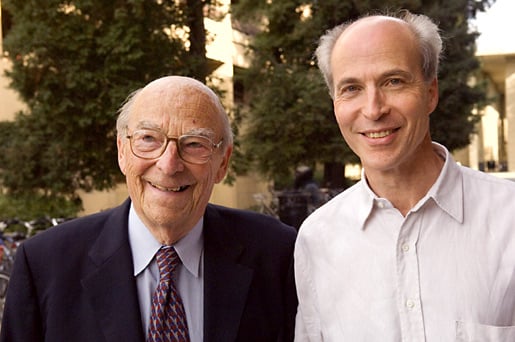
Nobel Laureate Arthur Kornberg (left) with his son Roger
Kornberg, who was awarded the Nobel Prize in Chemistry 2006.
Copyright © Stanford News Service 2006
Photo: Linda A. Cicero
4 (of 7)
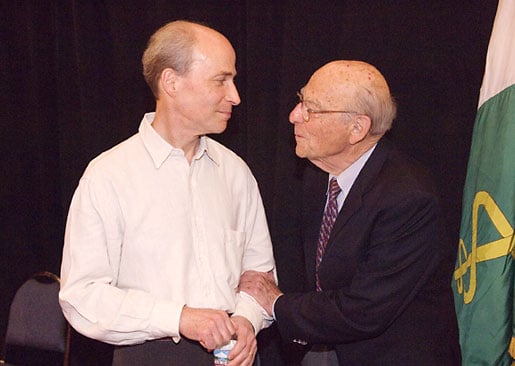
Arthur Kornberg, right, after the press conference for his son, Roger Kornberg, who was
awarded the 2006 Nobel Prize in Chemistry.
Copyright © Stanford News Service 2006
Photo: Linda A. Cicero
5 (of 7)
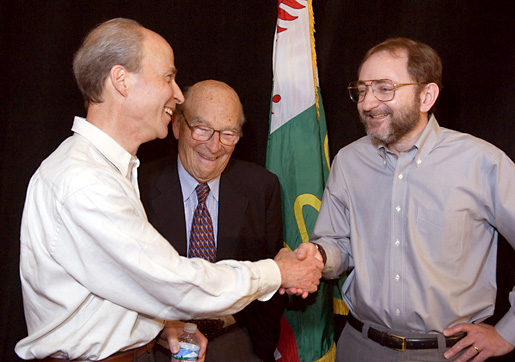
Three Nobel Laureates: from left Roger Kornberg, 2006 Nobel Laureate
in Chemistry, Arthur Kornberg, 1959 Nobel Laureate in Medicine and right, Andrew Z. Fire, Nobel Laureate in Medicine 2006.
Copyright © Stanford News Service 2006
Photo: Linda A. Cicero
6 (of 7)
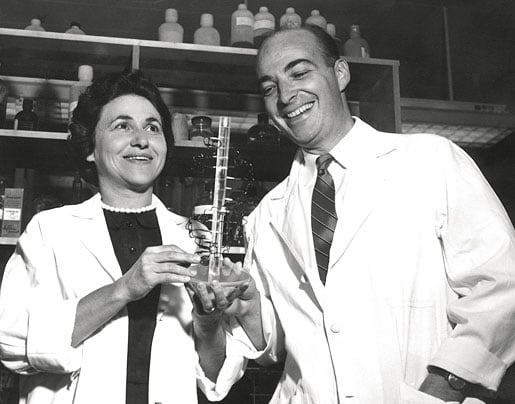
Arthur and Sylvy Kornberg in the Stanford laboratory, ca 1960.
Source: U.S National Library of Medicine, Profiles in Science
Photographer unknown
Courtesy of Arthur Kornberg
Kindly provided by U.S. National Library of Medicine
7 (of 7)
Portrait of Arthur Kornberg. Photo taken in 1959.
Source: U.S National Library of Medicine, Images from the History of Medicine Collection
Photographer unknown
Kindly provided by National Library of Medicine

Photo: Hans Mehlin

Severo Ochoa – Nobel Lecture
Nobel Lecture, December 11, 1959
Enzymatic Synthesis of Ribonucleic Acid
Read the Nobel Lecture
Pdf 257 kB
Arthur Kornberg – Nominations
Severo Ochoa – Nominations
Arthur Kornberg – Other resources
Links to other sites
‘The Arthur Kornberg Papers’ from U.S. National Library of Medicine