Gerald M. Edelman – Nominations
Speed read: Anatomy of a killer
As the workhorses of our internal defence system, we owe an enormous debt to antibodies. Responding to external threats such as disease-causing microorganisms, protein antibody molecules are released by specialized immune cells into the blood stream to disarm the threat. Their mode of attack is target recognition: millions of different molecules can be created, each with a different binding site, which can identify distinctive proteins on their specifically assigned foe with pinpoint accuracy.
A long-standing question in the field was how an almost identical-looking collection of antibody proteins can, at the same time, have the capacity to target specifically any one of an almost infinite range of foreign agents – until their structure was solved by the recipients of 1972 Nobel Prize in Physiology or Medicine. Gerald Edelman and Rodney Porter independently took similar approaches to deciphering their structure, both realizing that the best way in which to grasp the finer aspects of such large molecules was to split them into smaller, more manageable pieces. Their deconstruction methods differed. Porter used a protein-cleaving enzyme that fragmented an antibody molecule into its functional subsections. Edelman’s approach destroyed antibody function by using chemicals to break the bridge-like bonds that keep the constituent protein chains together, his procedure relying on the finding that copious quantities of antibodies are produced by cancerous versions of white blood cells.
Edelman’s and Porter’s methods yielded different perspectives of the general antibody structure, which were later combined to provide a more definitive image. Antibodies are composed of two long, heavy protein chains and two identical shorter, light chains, which combine to form three sections that make up a Y-shaped molecule. At both points at the top of the “Y”, a light chain is paired up with a heavy chain to form the unique binding site for each specific target. A third section links the two heavy chains together to form the stem of the “Y”, a region that doesn’t change from one antibody to another, and which is charged with the task of binding several other key components needed to mount a defence against the intended target.
This Speed read is an element of the multimedia production “Immune Responses”. “Immune Responses” is a part of the AstraZeneca Nobel Medicine Initiative.
Gerald M. Edelman – Interview
Gerald M. Edelman – Nobel Lecture
Nobel Lecture December 12, 1972
Antibody Structure and Molecular Immunology
Read the Nobel Lecture
Pdf 578 kB
Rodney R. Porter – Nobel Lecture
Nobel Lecture December 12, 1972
Structural Studies of Immunoglobulins
Read the Nobel Lecture
Pdf 98 kB
Gerald M. Edelman – Banquet speech
Gerald M. Edelman’s speech at the Nobel Banquet in Stockholm, December 10, 1972
Mr. Prime Minister, Ladies and Gentlemen,
I feel honored and privileged to be with you together with Rodney Porter. In the course of receiving the highest honor of my life, I had two thoughts about human community, both particularly moving to one. The first is of the selfless and spontaneous jubilation of people who are not scientists but who are glad of such occasions as these and the circumstances they celebrate. I have thought of what they must think and I suppose that, surrounded by painful and difficult news of struggle and darkness, they say: “Well, we must be doing something right”. In this way, the Nobel Foundation has made itself a part of the world community, and a part which is justly appreciated.
The second thought is that I am fortunate to have had the opportunity to know directly so many people in the world community of scientists, including people who have occupied this table before me. It is said that most of the scientists who ever existed are alive today. This extension of the community of researchers and the compression of time in our age are probably the reasons for my good fortune.
Science is imagination in the service of the verifiable truth and that service is indeed communal. It cannot be rigidly planned. Rather, it requires freedom and courage and the plural contributions of many different kinds of people who must maintain their individuality while giving to the group.
There is no more satisfying or fortunate way to belong to a community. Being here on this splendid occasion has reminded me more strongly than any event in my experience of this privilege for which I am truly grateful. I am sure that Dr. Porter shares these sentiments.
Thank you.
Gerald M. Edelman – Curriculum Vitae
Curriculum Vitae*
Pdf 134 kB
Bibliography of Dr. Edelman*
Pdf 328 kB
* These curriculum vitae and bibliography were provided by the Laureate in May, 2005.
Copyright © The Nobel Foundation 2005
Gerald M. Edelman – Facts
Gerald M. Edelman – Biographical
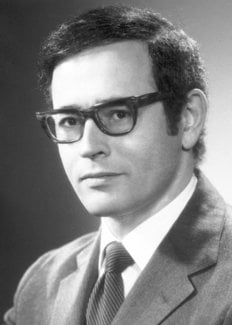
Dr. Gerald M. Edelman was born on July 1, 1929 in New York City to Edward Edelman and Anna Freedman Edelman. His father is a practicing physician in New York.
After his education in New York public schools, Edelman attended Ursinus College in Pennsylvania and received the B.S. degree, magna cum laude, in 1950. He then attended the Medical School of the University of Pennsylvania where he received the M.D. degree in 1954. In the succeeding year, he was a Medical House Officer at the Massachusetts General Hospital. He became a Captain in the U.S. Army Medical Corps in 1955 and practiced general medicine at a Station Hospital connected with the American Hospital in Paris, France. In 1957, he joined the Rockefeller Institute as a graduate fellow in the laboratory of Dr. Henry G. Kunkel.
After receiving the Ph.D. degree in 1960, he remained at the Rockefeller Institute as Assistant Dean of Graduate Studies and started work in his own laboratory. In 1963, he became Associate Dean of Graduate Studies, a position from which he retired in 1966. From that time to the present, he has been a Professor of the Rockefeller University.
Edelman is a member of the National Academy of Sciences, the American Academy of Arts and Sciences, the American Society of Biological Chemists and the American Association of Immunologists, as well as a number of other scientific societies. He was a member of the Biophysics and Biophysical Chemistry Study Section of the National Institutes of Health from 1964 to 1967. Presently, he is an Associate of the Neurosciences Research Program at Massachusetts Institute of Technology, a member of the Board of Governors of the Weizmann Institute of Science and a member of the Advisory Board of the Basel Institute for Immunology.
He has given the Carter-Wallace Lectures at Princeton University in 1965, the National Institutes of Health Biophysics and Bioorganic Chemistry Lectureship at Cornell University in 1971, and delivered the Darwin Centennial Lectures at the Rockefeller University in 1971. In 1972, he was the first Felton Bequest Visiting Professor at the Walter and Eliza Hall Institute for Medical Research in Melbourne, Australia.
Edelman has received the Spencer Morris Award of the University of Pennsylvania in 1954, the Eli Lilly Award in Biological Chemistry given by the American Chemical Society in 1965, and the Annual Alumni Award of Ursinus College in 1969. In addition to his studies of antibody structure, his research interests have included the application of fluorescence spectroscopy and fluorescent probes to the study of proteins and the development of new methods of fractionation of both molecules and cells. His present research interests include work on the primary and three-dimensional structures of proteins, experiments on the structure and function of plant mitogens and studies of the cell surface.
In 1950, Edelman married Maxine M. Morrison. They have two sons, Eric and David and one daughter, Judith.
This autobiography/biography was written at the time of the award and later published in the book series Les Prix Nobel/ Nobel Lectures/The Nobel Prizes. The information is sometimes updated with an addendum submitted by the Laureate.
Addendum, May 2005
Dr. Edelman is Director of The Neurosciences Institute and President of Neurosciences Research Foundation, the publicly supported not-for-profit organization that is the Institute’s parent. Separately, he is Professor at The Scripps Research Institute and Chairman of the Department of Neurobiology at that institution.
Dr. Edelman has made significant research contributions in biophysics, protein chemistry, immunology, cell biology, and neurobiology. His early studies on the structure and diversity of antibodies led to the Nobel Prize for Physiology or Medicine in 1972. He then began research into the mechanisms involved in the regulation of primary cellular processes, particularly the control of cell growth and the development of multicellular organisms. He has focused on cell-cell interactions in early embryonic development and in the formation and function of the nervous system. These studies led to the discovery of cell adhesion molecules (CAMs), which have been found to guide the fundamental processes by which an animal achieves its shape and form, and by which nervous systems are built. One of the most significant insights provided by this work is that the precursor gene for the neural cell adhesion molecule gave rise in evolution to the entire molecular system of adaptive immunity.
Most recently, he and his colleagues have been studying the fundamental cellular processes of transcription and translation in eukaryotic cells. They have developed a method to construct synthetic promoters and have also been able to enhance translation efficiency by constructing internal ribosomal entry sites of a modular composition. These findings have rich implications for the fields of genomics and proteomics.
Dr. Edelman has formulated a detailed theory to explain the development and organization of higher brain functions in terms of a process known as neuronal group selection. This theory was presented in his 1987 volume Neural Darwinism, a widely known work. Dr. Edelman’s continuing work in theoretical neuroscience includes designing new kinds of machines, called recognition automata, that are capable of carrying out tests of the self-consistency of the theory of neuronal group selection and promise to shed new light on the fundamental workings of the human brain. A new, biologically based theory of consciousness extending the theory of neuronal group selection is presented in his 1989 volume The Remembered Present. A subsequent book, Bright Air, Brilliant Fire, published in 1992, continues to explore the implications of neuronal group selection and neural evolution for a modern understanding of the mind and the brain. His book published with Giulio Tononi, entitled A Universe of Consciousness: How Matter Becomes Imagination, presents exciting new data on the neural correlates of conscious experience. In his latest book, published this year, entitled Wider than the Sky: The Phenomenal Gift of Consciousness, Dr. Edelman offers a model of the biology of consciousness.
Dr. Edelman was born in New York City in 1929. He earned his B.S. degree at Ursinus College and an M.D. at the University of Pennsylvania. He spent a year at the Johnson Foundation of Medical Physics, and after a medical house officership at the Massachusetts General Hospital, he served as a captain in the Army Medical Corps. In 1960 he earned his Ph.D. at The Rockefeller Institute (now University). In addition to the Nobel Prize, Dr. Edelman has been the recipient of numerous awards and honors, including many honorary degrees. He is a member of the National Academy of Sciences, the American Philosophical Society, and several foreign societies, including the Academy of Sciences, Institute of France. He is author of over 500 research publications.
Gerald M. Edelman died on 17 May 2014.
Copyright © The Nobel Foundation 2005