Transcript from an interview with Richard J. Roberts
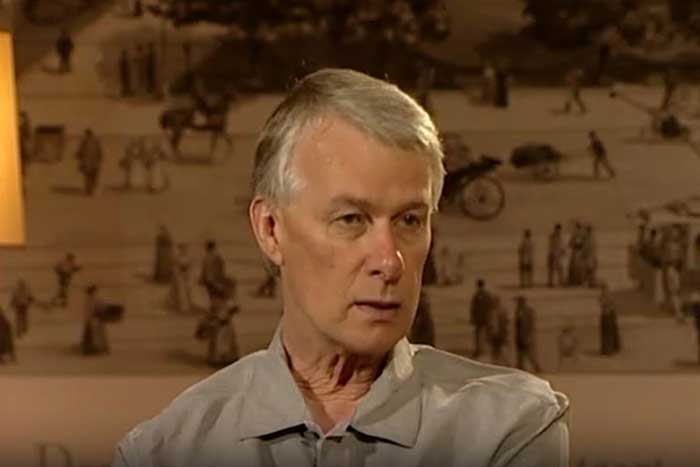
Interview with the 1993 Nobel Laureate in Physiology or Medicine Richard Roberts, at the meeting of Nobel Laureates in Lindau, Germany, July 2007. The interviewer is Adam Smith, Editor-in-Chief of Nobelprize.org.
Richard Roberts welcome. You were the co-recipient with Phil Sharp of the 1993 prize in physiology or medicine for your coincidental discovery of split genes. I’d like to start by just exploring a few themes with you. If I say the word mentorship, what does that conjure up?
Richard Roberts: I think to me it always signifies a Japanese post doc that I had in my first year as a PhD chemist, who was really quite an extraordinary fellow. He had this wonderful ability, not only to tell you what you should be doing but at the end of it you understood why you’d done it and I learnt more chemistry from him I think than from anybody I’ve ever met previously. There was only certain more than from any teachers that I ever had at school or even from my professor or anyone like that in formal courses. He was amazing.
Can you pin down what it was that he …
Richard Roberts: Not really, no. The end product was that you understood why you were doing what you were doing. I think that’s terribly important in science so that if you understood why you did it you can do it again and if all you’ve done is do it, then you may or may not be able to actually do it again.
When you come to look for students, what do you look for in them?
Richard Roberts: Usually enthusiasm I would say as the single most important attribute for me. Most of the people who come to me are smart so I don’t really ever think that that’s going to be an issue but, I really look for people who have this spark of enthusiasm, the passion, because people who are passionate usually work twice as hard as those who are not.
They need to be hardworking?
Richard Roberts: I think in science you have to be hardworking, yes. If you see the competition you realise everybody else in science is absolutely working flat out most of the time and everybody else is pretty smart and so if you want to compete with them then you also have to be pretty smart and to work hard too.
The last of these themes is, how would you describe your ideal lab environment?
Richard Roberts: I think one of the things that I look for in a lab environment is an attitude of cooperation and collaboration. I like to be working with people who it’s fun to collaborate with, not who you think are trying to stab you in the back all the time and not people who are in competitive mode, at least not with you. I think competition is a good thing, but what is not good is competition within the same group, even within the same lab setting. I think it’s fine to compete with people in other institutions and I like the idea of competition where two people may be going at the same problem but going from different angles. I see no benefit in two people going at something from the same angle, but collaboration is absolutely the key.
Are there physical principles you apply to get people in your lab to collaborate?
Richard Roberts: Probably not. None that I can articulate, let’s put it that way. Maybe there are, but none than I can articulate. I always like to make sure that people have their own individual projects that are non-competitive with one another so that if people really are trying to get an answer from their particular project that it’s perfectly ok to talk to everybody else because they’re not competing with the other people.
But do you like a bustling lab or a quiet lab?
Richard Roberts: Both have their place so sometimes it’s very nice that it’s bustling. It’s good to have people in close proximity to one another because then they have to talk and very often talking is the key to success, because sometimes the only time that you really understand why you’re doing something or particularly why you made a mistake is because you’re trying to explain to someone else what you’ve been doing. Then, all of a sudden, you realise you don’t understand it yourself so terribly well. I think this is the advantage of doing research in a university environment, where you’re constantly teaching and so you’re constantly testing your own ideas in a way when you’re trying to explain what you’re doing to other people. Sometimes you get this ‘aha moment’ and you realise that you don’t understand why you were doing what you’ve just been doing. A lot of students are interested in what you’ve been doing and how you made the discovery or what it was that turned the light on from that sort of thing but some of them actually are interested in just very much more general things; how does it affect your family life, those kind of things.
Yes, the work/life balance is always a question. Looking at your own scientific beginnings, you had what, from your autobiography at least, looks like a fairly unremarkable scientific start. Was there a point at which you suddenly geared up and had a moment of realisation?
Richard Roberts: You say ‘unremarkable’, I think if you compare my start with what is possible today it would start to look quite remarkable, because I got interested in chemistry through making fireworks. I just thought fireworks were fantastic. I thoroughly understand why terrorists like a big bomb. There’s something about explosions and bright lights and so on and when I was growing up it was easy to do that. You could buy chemistry sets, you could buy the chemicals you needed to make fireworks very easily, there were books that told you how to make them and a lot of my friends, and I think a number of my fellow laureates also got their interest in science in a very hands on manner; by making fireworks, by making explosives, by doing home chemistry kinds of things and that is something that’s very difficult to do these days. We’ve reached this point in society where we feel we’ve got to protect the kids from anything, we can’t let them do anything dangerous, God forbid they should be doing something where they might lose a finger or an eye or something like that.
They’re not even allowed to take a bus to school.
Richard Roberts: I think we’ve actually done a great disservice to the young scientists or the potential young scientists by not giving them those same opportunities to experiment and do stuff at home. There’s nothing more boring in a chemistry class than watching a teacher do something. Much more fun to do it yourself and especially if you have some leeway to do things that was not in the curriculum and that you just want to do yourself. That was the thing that led me to science I think without a doubt, it’s this hands-on experimental work that I was able to do at home, that you simply can’t do so easily today, much, much more difficult to do anything like that today.
When did the parallel tracks of your home interest in science and your standard educational interest meet?
Richard Roberts: Probably when I went to university. I would say at school I was always, certainly in chemistry, I was always way ahead of anything that was being taught in the classroom because I’d been buying textbooks at home and doing stuff at home. I didn’t find chemistry terribly interesting at school, certainly didn’t care for physics at school. I liked mathematics, I always liked math and in fact math was always my best subject. I was much better at that even than chemistry or anything of that sort, but I had a problem. When I was doing mathematics, when it came to distinguishing between pure and applied mathematics, and it wasn’t until I got to university that I realised applied mathematics was really purely math, and it was just the way you phrase the question and the way you interpreted the question that made it either applied or pure and so then I was ok once I figured that out I was ok. All of my life I’d always thought I was going to be a chemist and my aspirations at school were really to be an industrial chemist. It seemed to me that this was a place where you were going to constantly be able to actually get to the lab bench and do lab work. Then when I started doing my PhD I was fortunate, thanks to this Japanese post doc who really taught me how to do chemistry I got everything I needed for my thesis in the first year. So, after one year as a PhD student I could have easily written my thesis and got the thing but in England, of course, you have to do it for three years. That gave me two years to really go looking around and browsing around and thinking about other things and it was during that time that I discovered molecular biology, through reading, and decided I wanted to be a molecular biologist.
Because you were working on flavonoids?
Richard Roberts: Yes, right. My PhD thesis I was basically given a piece of tree from a Brazilian tree called Machaerium and asked to find out what was in it. We knew that there would be interesting flavonoids, neoflavonoids in it and there were. There were loads and I was lucky. I’ve always been very lucky. One of the compounds, one of the new compounds was a key intermediate in the biosynthesis of these neoflavonoids that my professor had predicted should exist, but it was unstable when it had come out of other things, but in my hands it was stable and so it was the missing intermediate and I had it and he was very happy, so that was nice.
Seven years, then you had freedom to explore. Your move to molecular biology, did you think that you were moving away from chemistry or were you being a chemist who was becoming a molecular biologist?
Richard Roberts: I thought I was moving away from chemistry a little bit but taking advantage of the chemical training. At the time if you wanted to proceed to the frontier of chemistry you had to one of two things. You either had to go theoretical because there was a desperate need for a new theory of organic chemistry. You had the Woodward-Hoffmann rules but you didn’t have a lot else and I didn’t have any good ideas as to what one might do theory wise and the other was to go biological. It was clear that there was a frontier of chemistry that was out there in the biological world and I just found that far more interesting and something that I might actually be able to do.
That took you to Harvard and your work there led really to the job offer from Jim Watson, which seems to have been, from my reading, the seminal event?
Richard Roberts: Yes, maybe. It’s hard to know. When I was a post doc at Harvard I discovered nucleic acids and sequencing and went to Fred Sanger’s lab to learn how to do RNA sequencing. That really gave me an interest in the structure of biological molecules, not structure in the sense of 3D structure, but structure in the sense of knowing exactly what all the atoms were within the molecule. Of course, for DNA or RNA it’s just really what is the sequence of basis and that seems something relatively straightforward that I might be able to understand and do. I got interested in sequencing and methodology for doing the same. I tried to get back to England, I’d originally gone to the US thinking I was just going to spend two years in the US. As soon as I got there I realised having changed fields at two years wasn’t going to be long enough to do anything in a new field and I did two years and then I got appointed as some sort of … I forget what the exact thing was but it was slightly better than post doc. Then I started to look for jobs and I was told there was a nice job in Edinburgh, which I applied for but I never heard anything back from them and then I was offered a job by Jim Watson, came completely out of the blue. I’d spent a lot of time with Mark Ptashne, who was at the time, I guess, either assistant or associate professor at Harvard. I taught him how to do RNA sequencing and we’d become reasonably friendly and he apparently had spoken to Jim and said, There’s this guy Roberts that you should offer a job to. He came up to me in a seminar and said, Jim Watson wants to talk to you, and since I’d never met Jim at the time I said, Oh yes, that’s nice and waited and nothing happened. A couple of weeks later Mark came along and said, Well, you know, Jim says he doesn’t know you so perhaps you could go and introduce yourself, so I trotted off to his office and said, I’m Rich Roberts and he basically opened the conversation saying, We want someone to sequence DNA at Cold Spring Harbor, I’d like it to be you and this was kind of it. I was in his office no more than five minutes and as I was leaving he said, Oh, and by the way, as a formality, you’d probably better come down and give a talk but, don’t worry, you’ve got the job.
Nice but slightly disconcerting.
Richard Roberts: Yes. I was in Jack Strominger’s lab and I went and talked to Jack and I said, Jim just told me he’s offered me a job. I assume he’s talked to you about it, and Jack said, No, it’s the first I’ve heard about. It’s fairly typical of the way that Jim I think still does stuff. He has people who he trusts and talks to and if they tell him they think something is worth doing then he’ll often just follow their advice and do it. Then, at the same time, the biology department at Harvard asked me if I would be interested in a job and they offered me something. So here I was, I had two jobs in hand, as it were, and one I really wanted was back in England but I’d not heard whether I was even being considered, I mean I never even got an acknowledgement for my letter of application so it seemed the thing to do. I had a wife and two kids, I’d better take one of these jobs that was offered me.
What do you think was creating these job offers? Was it primarily the fact that you had RNA sequencing?
Richard Roberts: Yes, completely.
It was having the right technology at the right time that everybody wanted.
Richard Roberts: Yes. I was the first person in the Boston area to be doing the Sanger method of sequencing RNA, so anybody there who wanted to learn how to do it came along and talked to me and I showed them how to do it. I could do something that a lot of other people couldn’t do but lots of people wanted to do.
When you found yourself at Cold Spring Harbor you were then working primarily on sequencing?
Richard Roberts: Yes, when I first went there what Jim wanted was to have SV40 sequenced but as soon as I got there I realised there were two other groups already doing that; Walter Fiers in Belgium was doing it and Sherman Weissman at Yale was doing it and it seemed stupid for a third group to do the same thing. This certainly caused Jim some consternation because this was what he wanted sequenced. Jim always likes competition.
So having a group internally doing it as well is great, yes.
Richard Roberts: But I wouldn’t do that. It just seemed to me a waste of time. If these two other groups were going to get the sequence it was not as though there was any shortage of things to sequence, the entire world was out there made of DNAs, lots of stuff to sequence. But I’d actually, during my last year at Harvard had heard Dan Nathans give a talk about restriction enzymes and particularly about how you could use HindII, actually they called it Endonuclease R at the time, it was a mixture of two enzymes that Ham Smith had discovered and Dan Nathans was using to map DNA.
This gave you the possibility of sequencing DNA?
Richard Roberts: The reason that RNA sequencing had been developed first was because there was small molecules to practice on and in DNA there were no small molecules but these restriction enzymes gave you the opportunity to make some small molecules of DNA. I thought that would be very useful that one could get the small molecules to practice on and I was initially interested in developing methods for sequencing DNA but then the restriction enzymes themselves it turned out that there was not only the one that Ham Smith had found but there were others around too. I got into the idea that one might be able to just use the restriction enzymes as sequencing reagents because wherever they cut they gave you five or six bases at a time and so this might be developed into a sequencing methodology. We started to make restriction enzymes and look for new restriction enzymes and it became slowly clear they weren’t going to be very much use directly for sequencing DNA, useful as intermediary agents to make fragments. They were interesting for mapping and then recombinant DNA came along and so they were useful in that context. They just became general useful reagents for doing much more than sequencing.
You became a big producer of restriction enzymes, indeed which of course led to future things which we’ll talk about. Your discovery of the split gene nature of Adenovirus was something that came quite quickly, and I’d like to just talk about the conceptual side of it. It was, presumably when you joined Watson’s lab, fairly inconceivable that genes were not a continuous stretch. Was the indication there that they were discontinuous prior to your first findings or was it a complete surprise when you started seeing discontinuous sequences?
Richard Roberts: It was a complete surprise and completely against the dogma because Francis Crick had come out with this central dogma DNA makes RNA makes protein and that was based upon everything that we knew about bacteria and bacteriophages where you had a contiguous gene, you had a continuous piece of RNA made from it and you just read the bases off three at a time as codons. It never really occurred to anybody that the arrangement of DNA sequences in eukaryotes would be any different from the arrangement of DNA sequences in prokaryotes. We got involved in this because I was interested in trying to characterise a promoter, the region upstream of the gene that says where the gene should begin. We wanted to know if eukaryotic promoters were different from prokaryotic promoters. There was no inherent reason to think that they would be but nevertheless, until you look and see you’ll never know.
That’s interesting that you chose to look at something that you thought was going to just yield a null result.
Richard Roberts: I wouldn’t say a null result. We thought there might be at least one or two interesting differences but nothing really spectacular. We certainly didn’t think there would be a spectacular difference when we got started.
You were investigating it because you could, there must have been something about the search?
Richard Roberts: I would say we did it because we could. We thought in order to do it you needed to be able to do a little more DNA sequencing than was possible and so in one sense it was pushing technology a little bit and it was also clearly a doable problem. It was something that could be done and it would give you an answer. Either these things were the same or they were different. That was kind of a nice yes/no answer that could come from it. But the methodology for doing it was not straightforward so how you would identify the 5′-end of a message. You knew they had triphosphates at the end so that gave you a handle from an RNA sequence standpoint, here was a special feature, a label if you like that you could look for so that you can in fact find the 5′-end of the RNA. The idea was to then figure out where that was being located on the DNA then just look upstream and that would be the promoter. Adenovirus seemed very nice for that because Adenovirus was a linear virus and we knew that transcription early during infection was coming in from the two ends and that meant that between the end and the start point of the message that’s where the promoter must be. You could just sequence basically the ends of that DNA, which at the time, that was a lot of sequence, people were typically doing just a few nucleotides, nothing quite as long as that.
Anyway we set off to do that, discovered that the amounts of RNA that were present early during infection were simply not enough to get a sufficient amount of the terminal oligonucleotides to actually map the message. We turned our attention to late Adenovirus messages and there we knew that they were making huge amounts of message, essentially once Adenovirus infects and you get a good infection going then they produce almost all Adenovirus message, very, very little cellular message being made. That was nice and then along, while we were during that, caps were discovered, these funny modifications that take place at the 5′-ends of RNAs and so that actually gave you an even better tag with which to look at these messages. When we started to do that we also realised that there was a possibility of doing a more interesting experiment than the just finding the messages and that was we knew that late during Adenovirus infection the genes, there were a whole bunch of genes laid out along the genome and there were at least eight or ten different messages that one expected. The thought was if you could characterise the short oligonucleotides at the very beginning of these messages each one would be different and there were display methodologies that would allow you to actually look at all of these different oligonucleotides at the same time.
You could map?
Richard Roberts: You could see what was happening during the course of infection; which messages were going up, which were going down, actually do the kind of functional genomics people now do on micro erase but this in a much simpler system long before one had thought about all these other kinds of things.
Long before the term functional genomics?
Richard Roberts: We thought this would be a really neat methodology and there might be a nice paper out of that and we started to do those experiments and I had a post doc, Richard Gelinas, who I’d first met when I’d been a post doc at Harvard; he was a student up there and he’d come down to join me. Very talented fellow and this became his post doc project, to do this functional mapping of the Adeno messages. When he did the first experiment, oh, and we dreamt up this nice way to actually select for just these termini, the 5 prime termini, and we set that up and got it going and he did the experiment and instead of seeing eight or ten mRNAs he only saw Ns, he only saw one. I said, Well, you better go back do it again and we looked through his notes and he went back and did it again and got the same result. I told him he must have screwed up the experiment and I would do it and show him how it should be done properly and so I did the experiment, got the same results and of course then I believed it at that point. I guess that was a point at which we knew that there was something interesting and unusual going on, didn’t know what it was, no idea what it was but I would say that was the moment when I knew that there was an interesting finding to be made, whatever it might be.
Still no guess as to what it would be, no?
Richard Roberts: One always has a guess as to what it should be and the guess was based upon the fact that by in vitro biochemistry at that time, RNA polymerase and the eukaryotic RNA polymerase that Bob Roeder had been working on was not a terribly good polymerase unless you gave it a primer. If you gave it a short RNA primer then it worked pretty well as a polymerase but if you were asking it to make things de novo it really couldn’t do it terribly well, it was rather poor. We had the idea that perhaps what we were looking at was the end of the primer and that the same primer was being used for all adenovirus mRNAs and perhaps it was just folding differently at different points on the genome. This became my favourite hypothesis as to what was going on and was ultimately the hypothesis that we ended up testing when we did the key experiment. But in the meantime we were just trying to get good biochemical evidence to prove that what we were looking at was real and not some artefact as everybody wanted to tell us, it was all an artefact of course because it just didn’t’ make any sense, everybody knew how you made RNA, you’ve got an RNA polymerase just gets in there and does stuff. We spent almost a year, I would say, gathering more and more evidence in favour of the idea that all of these messages had the same 5′-end but we really couldn’t prove it to anyone’s satisfaction. Biochemistry is not always a good way to convince people of what’s going on. People like a visualisation of some description.
It’s a bit abstract, yes.
Richard Roberts: It requires an act of faith almost, that the biochemistry’s being done properly and it’s not always easy to convince people, especially when something goes against dogma. If you’re doing your biochemistry and everybody accepts the basic premises of how things work and the biochemistry says sure that’s clearly how it works, then it’s much easier to accept it, but we were saying something that completely went against the dogma.
Something had to be wrong?
Richard Roberts: Something had to be wrong, yes, and it was us. Anyway, we spent about a year trying to really come up with a good experiment and then one morning early in March of 1977 we’d gotten into the habit of every Saturday morning we would sit and have a postmortem on what had gone wrong the week before and why we hadn’t had the success that we were hoping for and then dream up the next set of experiments. I remember this one Saturday morning Richard was up at the blackboard and was writing out some horrendously complicated set of experiments we were going to do and I really wasn’t paying as much attention as I should and all of a sudden it struck me what we should do. I said, Sit down, and I rubbed off all his scribblings and drew out this experiment that I thought would be a nice experiment to do. The only problem with it was it was an electron microscopy experiment and neither of us were electron microscopists but fortunately we had a couple of colleagues down the hall, Tom Broker and Louise Chow who were just superb electron microscopists, just as good as they come. After I’d drawn out the experiment, Richard said, Yes, that would be a great experiment if it works. We went down and talked to them and said, If we make the reagents could you do the experiment? and they said, Sure. Didn’t know it would work but it looked as though it should, no-one had quite done it that way before. We made the reagents and on the Tuesday morning they did the experiment and the very first molecule they looked at in EM looked exactly the way I’d drawn it up on the blackboard, with one difference that it was folded a little more than we’d expected it to be. Then they looked at some more and they also turned out to be folded in the same way and we realised that this piece of RNA that was at the 5′-end of the messages was actually itself split into two pieces and so the experiment told us really two things; one was that the 5′-ends of the RNA clearly were coded somewhere quite differently from the main body but that this piece of the 5′-end itself was composed of two parts. Once you could do that you could begin to map exactly where everything was being coded.
That itself told you that there was coding in different places?
Richard Roberts: Yes. It just all confirmed the biochemistry, absolutely confirmed the biochemistry but it provided the visualisation that was needed. The thing is normally you do an electron microscopy experiment and everyone says but it’s just one molecule, there’s an awful lot of molecules in a mixture and not just the one that you happen to see on the electron micrograph. We had both things. We had the electron microscopy and the biochemistry already done so we didn’t really have to convince anybody of too much after that.
Just going back to the conceptualisation, those must have been heady days? It was quite a long period during which you were playing with this idea that you were really going to smash the dogma. Exciting to have that internal discussion; you must have longed to talk about it.
Richard Roberts: Oh, but I talked to everybody about it.
I see.
Richard Roberts: I can’t shut up once … I think the reason a lot of people do science is when you come across something interesting you want to go and tell everybody about it. There’s nothing better than that.
What about the often talked of fear of being scooped?
Richard Roberts: Never crossed my mind.
That’s nice. Do you think that was different days or is that just the way you are?
Richard Roberts: It’s the way I am, I think.
In fact, after the fact one knows you were in competition with Phil Sharp who was coming up with the same stuff.
Richard Roberts: Not really. I went to Phil Sharp’s office probably two months before the final discovery was made. I explained my ideas on the blackboard to him and he never said a word about it and didn’t immediately then go and do the experiment that we ended up doing. It was interesting because whenever you’re really going against dogma and breaking dogma, in general people just don’t believe you. It’s not that everyone was saying, Oh wow, great, let’s go and see if we can beat him to it. I think they just didn’t believe it. They didn’t believe it was possible and probably thought I was full of shit. During that time, it turned out Richard Gelinas was the person who actually needed the most encouragement because he was getting quite discouraged, because he’d do experiment after experiment and we couldn’t quite nail it. He was, on a number of occasions, all for packing up and the only thing that kept him going was the fact, I’d say, I know we’ve got a really big discovery here and this is going to be the make-or-break great experiment, great discovery. I was, in a way, a little like a cheerleader every Saturday morning to make sure that he got up the energy to do the experiments the next day.
Good that you were. It opened up a whole world. It opened up RNA editing, it opened up alternative splicing and then 15 years later you were awarded the Nobel Prize. Do you think it took 15 years because that world had to develop in order for the real importance of the dogma smashing idea to come through?
Richard Roberts: No. I think everybody accepted immediately that it was all correct, that was never an issue. Phil Sharp won every prize going in the intervening time because he got nominated for every prize going and I didn’t.
Ok. It took its time but everybody knew the importance?
Richard Roberts: Yes.
Then your lab continued along the previous track of making restriction enzymes?
Richard Roberts: We continued that on a smallish scale. We followed through on the splicing event. Because my interest had mainly been in sequencing and sequences, we wanted to know what were the sequences that were required in order to be able to do this. What were the sequences at the intronics on junction? In between the bits that were going to be spliced out, what were the sequences? There must be some sequence there, specific sequence, that the protein machinery would recognise to do the splicing. We set out to try to do that and that led us, ultimately, to sequence the whole Adenovirus genome. That became a project all in itself to do the Adeno sequence and then the other thing, we were trying to recapitulate the reaction in vitro by setting up an in vitro splicing system. That turned out to be a lot more difficult and complicated than we had thought and we were in competition then, we didn’t really realise it at the time, with Tom Maniatis’ group and we picked one, we picked the /- – -/ promoter as a way of making transcripts in vitro and he picked the promoter from another phage, SB6. It turned out he’d made a better choice than we did because his promoter made really nice discreet transcripts that had a single starting point whereas the /- – -/ promoter seemed to give two or three different starting points and that proved too confusing. We couldn’t then get the nice clean transcripts that we needed to set up the in vitro transcription splicing system. He won out on that one and there were a bunch of discoveries came from that and we also spent so much time doing the Adeno sequencing that that kind of distracted a little bit from the in vitro splicing work.
Yes indeed. Then, some time later, in fact just before the award of the Nobel Prize, you moved from Cold Spring Harbor to New England Biolabs, you moved into the industry. A small company but industry. What prompted that move?
Richard Roberts: I’d done everything that was possible at Cold Spring Harbor. I was assistant director for research there, overseeing the research operation and frankly I’d done everything that I could do at Cold Spring Harbor, I mean short of becoming director, and Jim showed no signs of stepping down and if he had wouldn’t have picked me anyway. He and I always had a somewhat testy relationship, shall we say.
From the very beginning?
Richard Roberts: Yes, pretty much from the very beginning. As soon as I said I wasn’t going to sequence SV40 DNA, which he’d hired me for.
That was like day one.
Richard Roberts: Yes, right. He was not completely happy, shall we say about that.
In retrospect he must have been happy that he had you there?
Richard Roberts: I don’t know. You’d have to ask him that. Anyway, I’d been thinking about doing something other than Cold Spring Harbor. One of the things, it occurred to me that with the advances in DNA sequencing technology that there was a lot of DNA sequencing, that it would be fun to do and I was thinking of setting up a DNA sequencing company. I talked to a couple of people about this, one of whom I think was seriously trying to recruit me. Then Biolabs heard that I was thinking of leaving Cold Spring Harbor and going to industry and they said, If you’re going to go to industry, why don’t you come up and join us? We talked about it a little bit and they made me an offer that I think was just too good to turn down and plus, you know, I always had a great love for this company. I’d helped set them up back in 1975 and I’d been their chief consultant all the way through, and I really admired the philosophy of the owner and I admired the way the company had done and they were doing good research up there so it seemed to me a good move.
Did the environment you found at New England Biolabs meet your expectations?
Richard Roberts: Oh absolutely. I’d known the company since 1975 and so I knew exactly what I was going into and yes, it was very nice. In retrospect I wish I’d moved there earlier.
Do you spend most of your time there running commercial operations?
Richard Roberts: I have as little as possible to do with the commerce. I’m chief scientific officer, which means I oversee the research that goes on there. My responsibilities are all for research, for bringing new ideas into the company, for bringing in research directions that we’re going to go into and then I do my own research.
What’s the overall remit for research at the company?
Richard Roberts: The way in which it was originally set up is anybody who came in as a researcher was expected to spend one third of their time doing something that would be useful to the company. That’s pretty broadly defined actually and then two-thirds of the time they could do whatever they want. That ended up mainly selecting for people who were interested in projects related to what was good for the company. Obviously restriction enzymes; more than half our business is selling restriction enzymes and anything connected with that is useful for the company. We sell DNA polymerases, anything connected with that is useful and a bunch of other kinds of reagents but the majority of the people who go there and enjoy being there enjoy the fact that they can do both pretty basic research as well as applied research and can lead to the prosperity of the company.
It seems remarkably generous allowing two-thirds. Google are often proud of promoting the fact that they give 30% of peoples’ time to off the wall projects as they call them. How do your researchers get funding?
Richard Roberts: From the company.
From the company. All of it’s from the company?
Richard Roberts: Some people have grants. There’s a mechanism in the US called Small Business Grants, SBIRs, we have a few of those. We’ve also in the past we have a big programme in parasitology, working on filariasis, and this was a deliberate programme set up a long time ago when we were reasonably profitable and wanted to put some money back into a humanitarian project. I organised a small conference. We got the people to tell us about the key diseases that World Health Organisation was interested in and we picked one. We ended up picking the one where we thought molecular biology could be helpful and where there was very little government funding. Over the last 22-23 years we’ve been working in the area of filariasis and recently had quite a big breakthrough, two or three years ago, in which we and a bunch of other groups discovered that there’s a little endosymbiotic bacteria called Wolbachia that lives inside the worm that causes filariasis and if you can kill the bacteria, you kill the worm. This means that if you could get the right sort of antibiotic into that bacterium then you should be able to get rid of the worm and kill the worm that causes filariasis.
And the breakthrough that you made?
Richard Roberts: What we were doing at the time, we had a group who were busy, this was not me personally, it was another group, were busy looking at the mRNAs that were present. They were basically doing an EST project to look at the mRNAs that were being made inside the worm and when they started to analyse these discovered that some of the sequences looked as though they were bacterial and were not eukaryotic. When they followed that through they were able to show that indeed there was a bacterial genome inside there and then by normal cell biological processes you could show there was a bacterium growing inside this worm.
How big is the outfit at New England Biolabs?
Richard Roberts: New England Biolabs is now about 240-250 people, something like that. We have a little over maybe 110 who are doing research.
Are they able to build up independent groups?
Richard Roberts: Yes. What we do is when we hire a scientist we give them a post doc and a technician and then if they want to get a larger group than that occasionally, if they’re doing something that’s especially product oriented, maybe we’ll put another person into their lab to help out on that or they can apply for SBIR grants and enlarge the group that way, but usually we try to encourage people to set up collaborations, one group with another, and expand the manpower that way.
Do people stay?
Richard Roberts: People don’t like to leave New England Biolabs. It’s very difficult to get them to go. It’s a wonderful working environment, terrific working environment; a very different company. The reason is most people set up a company because the owner wants to become wealthy, the owner wants to be the next Bill Gates and Don Comb, who is the guy who started New England Biolabs, doesn’t have those same sort of ambitions; he loves research. You used to go to him and say, I’ve got this wonderful idea for a product, we can make millions and he’d say, Yes, ok, but you’d go and say, Hey we’ve got this great result in the lab today and he’d be all over you. This was what he wanted to know about. He set up the company with the idea of trying to make the money specifically to support research and using the products of the company to support research. He’s not poor but he’s not ostentatiously wealthy in the way that CEOs of most companies or owners of most companies are.
You had a tremendous success as a chemist moving into molecular biology. What do you think molecular biology needs now? What do you look for when you’re recruiting to New England Biolabs these days?
Richard Roberts: I’ve always looked for enthusiasm and passion.
But in terms of disciplines?
Richard Roberts: There are a couple of areas that we’re expanding into at the moment. One is the field of RNA biology. I’m a firm believer that RNA is doing an awful lot more inside cells than we know about at the moment. One of the problems with RNA is it’s not that easy to work with. You can degrade it rather easily. We know that they’re huge numbers of transcripts being made within the human genome that we really don’t know what they do and we’re completely unaware of what they’re doing. In bacteria we know of plenty of small RNAs that are made, some of which are doing unusual things, but in bacteria in general we don’t know a lot about what RNA is doing there. I’m talking about RNA outside of the normal coding RNA. I think RNA is doing an awful lot that we don’t know about. I feel there are some really big discoveries to be made there.
But in the way that for instance cell biology now has some need for instance for systems engineers, some people would say so, other people would say that cell biology has no need for systems engineers but it’s a debating point. Is there something that molecular biology, do you think, needs from some outside discipline to help it advance?
Richard Roberts: I would put it a little differently. I would say that whatever field you’re in you can always benefit from outside disciplines. People who move from one field to another always come at the new field with a different underlying philosophy of how to do science and that’s a good thing. People, when you move from one field to another it’s very easy to ask stupid questions and not be made to feel stupid because people will say, Oh well, they weren’t trained in the discipline so they don’t know any better than to ask that question, and it’s often the stupid questions that really allow you to make progress because then when people are trying to answer them they suddenly realise they don’t really know the answer to some of these stupid questions. Then you can go ahead and provide the answers and sometimes they’re not what you expect.
Perhaps that’s a nice end point, the thought of recruiting a few stupid people to New England Biolabs.
Richard Roberts: No, no, no. You want smart people from different fields so this is a good thing to do. Stupid people in general don’t help you all that much.
Ok. Thank you very much indeed for taking the time to speak to us.
Richard Roberts: Good, thank you.
Did you find any typos in this text? We would appreciate your assistance in identifying any errors and to let us know. Thank you for taking the time to report the errors by sending us an e-mail.
Phillip A. Sharp – Photo gallery

Phillip A. Sharp receiving his Nobel Prize from H.M. King Carl XVI Gustaf of Sweden at the Stockholm Concert Hall on 10 December 1993.
Nobel Foundation. Photo: Lars Åström

Phillip A. Sharp after receiving his Nobel Prize from H.M. King Carl XVI Gustaf of Sweden at the Stockholm Concert Hall on 10 December 1993.
Nobel Foundation. Photo: Lars Åström

All Nobel Laureates assembled at the Nobel Prize award ceremony in the Stockholm Concert Hall on 10 December 1993. From left: Physics Laureates Russell A. Hulse and Joseph H. Taylor Jr, Chemistry Laureates Kary B. Mullis and Michael Smith, Medicine Laureates Richard J. Roberts and Phillip A. Sharp, Literature Laureate Toni Morrison and Laureates in Economic Sciences Robert W. Fogel and Douglass C. North.
Photo from the Lars Åström archive

Phillip A. Sharp proceeds into the Blue Hall of the Stockholm City Hall for the Nobel Banquet, 10 December 1993.
Photo from the Lars Åström archive

Phillip A. Sharp showing the poster for the Nobel Prize in Physiology or Medicine 1993.
Photo from the Lars Åström archive

Phillip A. Sharp demonstrating his discovery during a press conference, December 1993.
Photo from the Lars Åström archive

All 1993 Nobel Prize laureates assembled at the Swedish Academy during Nobel Week, December 1993. From left, back row: Richard J. Roberts, Michael Smith, Phillip A. Sharp, Russell A. Hulse, Joseph H. Taylor Jr. and Douglass C. North. Front row: Kary B. Mullis, Toni Morrison and Robert W. Fogel.
Photo from the Lars Åström archive

1993 Nobel Prize laureates assembled: Kary B. Mullis, Russell A. Hulse, Joseph H. Taylor Jr., Douglass C. North, Robert W. Fogel and Michael Smith.
Nobel Foundation. Photo: Lars Åström

Group photo of the 1993 Nobel Laureates, assembled at the Nobel Foundation, December 1993. From left: Chemistry Laureate Kary B. Mullis, Medicine Laureate Phillip A. Sharp, Physics Laureate Russell A. Hulse, Medicine Laureate Michael Smith, Peace Prize Laureates Nelson Mandela and Frederik Willem de Klerk, Medicine Laureate Richard J. Roberts, Laureate in Economic Sciences Robert W. Fogel, Literature Laureate Toni Morrison, Physics Laureate Joseph H. Taylor Jr. and Laureate in Economic Sciences Douglass C. North.
© Nobel Foundation. Photo: Boo Jonsson
Richard J. Roberts – Photo gallery

Richard J. Roberts receiving his Nobel Prize from H.M. King Carl XVI Gustaf of Sweden at the Stockholm Concert Hall on 10 December 1993.
Nobel Foundation. Photo: Lars Åström
All Nobel Laureates assembled at the Nobel Prize award ceremony in the Stockholm Concert Hall on 10 December 1993. From left: Physics Laureates Russell A. Hulse and Joseph H. Taylor Jr, Chemistry Laureates Kary B. Mullis and Michael Smith, Medicine Laureates Richard J. Roberts and Phillip A. Sharp, Literature Laureate Toni Morrison and Laureates in Economic Sciences Robert W. Fogel and Douglass C. North.
Photo from the Lars Åström archive
All 1993 Nobel Prize laureates assembled at the Swedish Academy during Nobel Week, December 1993. From left, back row: Richard J. Roberts, Michael Smith, Phillip A. Sharp, Russell A. Hulse, Joseph H. Taylor Jr. and Douglass C. North. Front row: Kary B. Mullis, Toni Morrison and Robert W. Fogel.
Photo from the Lars Åström archive
1993 Nobel Prize laureates assembled: Kary B. Mullis, Russell A. Hulse, Joseph H. Taylor Jr., Douglass C. North, Robert W. Fogel and Michael Smith.
Nobel Foundation. Photo: Lars Åström
Group photo of the 1993 Nobel Laureates, assembled at the Nobel Foundation, December 1993. From left: Chemistry Laureate Kary B. Mullis, Medicine Laureate Phillip A. Sharp, Physics Laureate Russell A. Hulse, Medicine Laureate Michael Smith, Peace Prize Laureates Nelson Mandela and Frederik Willem de Klerk, Medicine Laureate Richard J. Roberts, Laureate in Economic Sciences Robert W. Fogel, Literature Laureate Toni Morrison, Physics Laureate Joseph H. Taylor Jr. and Laureate in Economic Sciences Douglass C. North.
© Nobel Foundation. Photo: Boo Jonsson
The Nobel Prize in Physiology or Medicine 1993
Richard J. Roberts – Other resources
Links to other sites
Q&A with Sir Richard John Roberts from New England Biolabs
Article from Cold Spring Harbor Laboratory
Richard J. Roberts – Interview, October 2017
“I like to see things that have never been seen before”
Here, Richard Roberts is interviewed about everything from his love of discovery to his biggest influences – and reveals a determined, curiosity-driven character. The subject of ageing also came up, which is rather fitting since Roberts joined the Nobel Prize Dialogue Seoul to discuss ‘The Age to Come’ in conversation with Nobel Laureates.
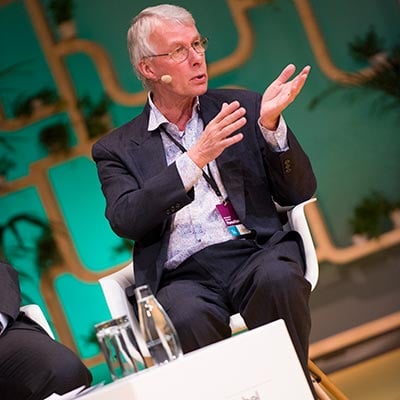
Richard Roberts at Nobel Week Dialogue 2017.
Let’s start by taking a step back in time: where does your passion for science come from?
“When I was 11 years old, my father gave me a chemistry set for Christmas and that was what really got me into experimental science. I quickly went through all the experiments and, after doing some reading at the local library, I found out that I had all the ingredients necessary to make gunpowder! I discovered fireworks, explosives and I just loved it. Later, when I was doing my PhD at Sheffield University, I read a book in the library called The Thread of Life by John Kendrew. By the time I finished that book, I knew I had to be a molecular biologist. And the rest is history!”
What do you particularly enjoy about science?
“I like to see things that have never been seen before. Any time there’s a discovery – doesn’t matter if it’s a big or a small one – I find it absolutely thrilling. I had exactly the same feeling when I was kid and I used to go caving in the local limestone caves. I loved finding a passage that no one had ever been in before. The love of discovery is what drives me today. Actually, I think there’s some defect in my brain that’s causing my constant curiosity!”
Are there people who inspired you and influenced the way you think and work?
“My great hero was Frederick Sanger [awarded the Nobel Prize in Chemistry, 1958 and 1980]. I spent some time in his lab and it was eye-opening to meet a man who was so focused, accomplished and an excellent scientist, but at the same time a delightful, modest and lovely man who was interested in humanity and did not try to complicate things. He was very much a role model.”
You, too, have made ground-breaking scientific discoveries. But have you ever doubted your work or yourself?
“Not really, to be very honest. I think if anything I’ve erred in the other direction – I’m always convinced I’m right! Whenever people tell me I’m wasting my time, or that I’m wrong, it only makes me more determined. It is, in a way, something that drives me. I do recognise, however, that I am getting older. I don’t remember as much as I used to. And sometimes I question myself more than I ever used to. It’s just a sign of ageing.”
Speaking of ageing – what do you think are the biggest challenges and opportunities of a steadily ageing global population?
“One of the problems is how one manages to support an ageing population as you reduce the proportion of young people in the population, who are usually the economic drivers. One needs to find ways to ensure that the ageing population is looked after. Plus, as you get older you’re more susceptible to diseases that end up being quite costly in terms of keeping old people alive. So, for me, one of the biggest challenges of ageing is how we persuade governments to put in place rules and regulations that allow people to end their life when they feel that they’ve had enough. It’s a politically charged subject. Some countries in Europe, notably the Netherlands, are really leading the way in taking a very civilized view towards ageing.”
For you, what are the best, and the worst, aspects of getting older?
“Because I’ve won the Nobel Prize, I still get invited to do lots of interesting things, so age hasn’t really been a problem. If anything, people tend to listen to me a little more than they used to. It’s nice to have this bully pulpit where people will listen to you, but it does mean that you’ve got to be rather more careful about what you say! What’s worst about getting older is probably the recognition of a slow decline in bodily and mental function.”
How can we encourage the next generation to study science?
“I think you have to let them do experiments themselves – give them the opportunity to do something interesting and exciting. Currently, we expect the kids to sit and listen to somebody else explaining experiments, instead of encouraging them to get in the lab – not just to do the experiments that somebody else thought would be good for them to do, but let them really experiment themselves. We can encourage interest in science by offering hands-on experiences showing what it’s actually like to do an experiment and get a result.”
What impact has the Nobel Prize had on your life and work?
“It opened up a series of doors that I could walk through – or not, if I chose not to. I ended up being the director of company that’s involved in trying to fix spinal cord injuries. If I didn’t have a Nobel Prize, I would not have been invited to do that. It’s turned out to be an interesting experience and one I ultimately hope is going to help spinal cord injury patients. It’s things like that which have been really beneficial to me as a Nobel Prize winner – and hopefully beneficial to others, too.”
First published 26 October 2017
Did you find any typos in this text? We would appreciate your assistance in identifying any errors and to let us know. Thank you for taking the time to report the errors by sending us an e-mail.
Richard J. Roberts – Interview
Interview, October 2017
Richard Roberts at Nobel Week Dialogue 2017.
Photo: Niklas Elmehed
Photo: Niklas Elmehed“I like to see things that have never been seen before”
Here, Richard Roberts is interviewed about everything from his love of discovery to his biggest influences – and reveals a determined, curiosity-driven character.
Interview with Professors Richard Roberts and Hamilton Smith by Professors Sture Forsén and Nils Ringertz at the meeting of Nobel Laureates in Lindau, Germany, June 2000.
Professors Hamilton and Roberts talk about the announcement of the Human Genome Project;
the number of genes in the human genome (5:24); ‘Proteomics’ (7:16); and biomedical benefits and consequences following the HGP (17:53).
Interview transcript
Three days ago, there was a major announcement, a major event in science, you could say, a joint announcement by groups in the United States and the United Kingdom about, I would say, a high-quality DNA sequence of the entire human genome and the significance of this event was underlined by the fact that two heads of state, Bill Clinton and Tony Blair, had joined the press conference. We are happy to have here among us two Nobel Laureates in Physiology or Medicine, Professor or Doctor Richard Roberts and Hamilton Smith who have been involved in various capacity in the human genome project. In fact, one of you was actually present at the White House during this press conference. Would you like to take it on from here?
Hamilton Smith: I’m actually an employee of Celera Genomics, which is a company in Rockville Maryland that has been single-handedly determining the human genome sequence in what many have called a race with the rest of the world, with the public efforts which carried on in the United States, England, Germany and Japan and I think some other countries. The White House ceremony was an attempt to get a cooperation between the public effort and the private effort, not a collaboration but a cooperation where we would agree to not say bad things about each other’s approaches or data or personalities and that we would try to do joint publications in a scientific journal, sometime near the end of the year 2000. Not papers that have joint authorship between the groups but separate publications where we present our accomplishments. I think it’s been a very good thing actually to do this, it takes the focus of the press coverage away from the warring parties and gets it back to what’s really important, namely getting the sequence and getting it out to the public.
The ceremony itself, President Clinton gave a short talk of about 4-5 minutes and then, by a TV hook-up in England, Tony Blair came on and said a few words in his best oratorical style and then President Clinton introduced briefly Francis Collins, who’s head of the public effort in the US and of course there were words said about the DoE part of the effort and there were nice things said all over the place. It was really a pretty good show and then Craig Venter was the last speaker. I was wondering when he went up to the microphones, whether there was anything left to be said but Craig, I think, handled this situation extremely well and got across how Celera fits into this accomplishment. So, we had a press conference afterwards. I think it was not only a truce between the public and private efforts but also an announcement that each of the groups had achieved their goals. The public human genome project announced that they had completed a working draft of the genome which represents about a 90% coverage of the genome but without a complete assembling of the genome and Celera announced that they had a 99% random coverage of the genome with an assembly of those sequences, so that genes are laid down linearly along the chromosomes.
Now that we have two independent groups who have come to an agreement about the general structure of the human genome, maybe you are able to answer the question, how many genes are there in the human genome. It’s a question you get when you lecture in this field and I’ve heard widely varying figures so, now if you get the question, what would your answer be?
Hamilton Smith: I think at this moment we still are in considerable doubt, but at Celera we’re also sequencing the mouse genome which will be complete sometime before the end of the year, to the extent that we can compare the mouse sequence to the human sequence. The protein coding regions of the mouse and human are sufficiently similar that they can be aligned, whereas the so called junk DNA, the 97% of the genome which doesn’t code for …
Richard Roberts: You’re talking about this stuff I discovered, are you?
Hamilton Smith: Yes, something like that.
Richard Roberts: The junk.
Hamilton Smith: Yes, the junk.
Hamilton Smith: … is more dissimilar, so it should be possible to simply read the two genomes in six frames and with high probability overlap the protein coding regions and get a fairly precise count of how many genes are present and that’s really the strategy that we’re pursuing. We have the mouse sequence, or we will have the mouse sequence and we’re the only ones in the world that will have it, so I think Celera will have the most accurate annotation.
Because people are betting on the number and there is a need for an authoritative answer to this question from the gambling point of view and from the human centred views that we entertain. To drive these large projects, the human genome project, obviously there have been precursors, people have got news from physics now that they are enormous projects, big physics and you now have big biology coming around, so once the human genome project has been completed, how will we proceed? I think we would agree that the most important thing now is to find out how the genome functions and we now enter then a type of research where we want to study the ultimate products, the proteins. Since there are many ways in which you can process the information from the DNA and the genome, at the RNA level, there are many more proteins to be found. This field of studying the proteins made in biological systems is called proteomics, so do you see any such big proteomics coming along and what can be done in terms of technology to speed up the analysis of the much larger number of proteins than the number of genes?
Hamilton Smith: I mean, I can say pretty much what we are planning at Celera. Celera I think is unique in its ability to do very large scale surveys. We don’t like really doing anything unless we can do 100,000 a day of whatever it is, so this is a way Craig Venter thinks and it allows us to do things that can’t be done easily in the university setting or in most other companies. What we’re planning of course is to move into proteomics using new instrumentation from PE Bio systems, mass spectrometers that can analyse tens of thousands of samples per day of protein. The plan would be to, the big interest initially I think is to see the spectrum of proteins that are being made in specific tissues, normal or diseased tissues, cancer, whatever. The plan would be to separate these proteins from say a cancer tissue on two-dimensional gels and then each single protein spot on the gel would be analysed in the mass spectrometer. Essentially hit by a laser blown into fragments of the protein which would then be matched with the genomic sequence and by computer, one should be able to predict the protein peptide spectrum that you would get for each of the genes in the human genome. Let’s say there are 50,000, so that we would get a virtually instantaneous identification of the particular gene product for each of the spots and we could say then that a given tissue is expressing certain genes and we form a database of this kind of information and again we sell that to our subscribers. This is sort of a first step of something that we can easily see ahead that we could produce this. I don’t know where we’re going beyond that but maybe Rich could.
Richard Roberts: The real problem with proteomics is that much of the technology that you need to relate function back to the gene is not in place at the moment, so one issue is well what is being expressed, how much is being expressed if we look at particular tissues, if we look at the brain, if we look at skin, if we look at liver, what kinds of proteins are taking place? At the moment we are able to look at what messenger RNAs are taking place, but we know also from other experiments that the amount of protein very often does not match the level of RNA, so we need both to be able to look at RNA and to look at the protein. One way to look at the protein is to use the kind of technology that Ham just talked about.
You made a point in one of the sessions at this meeting that once you study microbial genomes and there is a project called the minimal genome project which tries to define what’s the minimum number of genes. Wouldn’t such a system be the most suitable in finding out the function of various genes, because the human with this much larger genome and many genes is incredibly more complex?
Richard Roberts: Right. I think there are two separate issues, one issue relates to what is it that really makes life, what do you need, what is the minimum set of instructions that you need to make a living cell? And one way to do that is to take the very smallest cell that we know that is free living, as Clyde Hutchison is doing, and try to remove the genes that look as though they’re not necessary, get down to the minimum set, understand that in completion. Then one will at least know what is the minimum thing you need for life but that’s likely to be less than 500 genes and those 500 genes are a small set of what is present in a human cell. So, I think what will come from say the minimal genome project will be a working definition of kind of what is the minimum of life but there’s so much more to life than that. We need to know what is the precise biochemical function of each of the gene products, what reactions does it catalyse? That is something that for most proteins is not easy to do and we’re working ourselves at the moment on a bunch of proteins that are present in every organism for which the genome has been sequenced so far.
We think that this particular protein transfers methyl groups from S-Adenosyl methionine onto something, but we don’t know what and it’s not easy to find out, it’s not easy to prove that. But it is an interesting protein, it’s present in every genome but we don’t know what it does, no-one has stumbled upon it by genetics or by biochemistry yet, to know what it does and there are many such proteins. In the human genome, there are going to be thousands of these proteins for which we need to define function so what we need is to find high throughput ways, fast ways in which we can get clues to function. One high throughput way is to use computation to try to do that, so you look through the protein sequences, you try to find the little protein sequence motifs that in other proteins we know interact with ATP or they interact with DNA or they’re RNA binding proteins or whatever, so this can give you a clue, but you need to do the biochemistry afterwards to show that the clues that were given were correct or not and we don’t have good methods for doing that at the moment.
Hamilton Smith: Another approach to the minimal genome is the synthetic approach which I think is intriguing, creating “life” in the laboratory. The idea there would be again working with the mycoplasma genitalium is sort of the basic tools or parts for it. Having some idea from the other studies as to what genes are essential, one could actually make a synthetic chromosome that contains the set of proteins that have been identified as essential and then put that synthetic chromosome into a cell from which the natural chromosome has been removed and then see if you get something that will grow in the laboratory. Of course it probably won’t work the first time, maybe not the 100th time either, it could be somewhere to cloning Dolly and in the beginning you had to do hundreds of them before you got a successful attempt. But it would be a spectacular event if one could create a new genome.
Richard Roberts: I guess, when you start to think about the real importance of microbiological research, within the context of the human genome, the methodology that will need to be developed to understand how something as simple as mycoplasma genitalium work is going to methodology that can be applied to the human genome. So if we can learn to do this thing properly and if we can learn to do it in a fast manner for the small bacterial genomes, where in principle everything is a lot easier, we should be able to apply that methodology to these much more complicated systems too and in the meantime of course, we will find out much about what is really important in order to make life. What is it about these proteins and these genes that really makes something living as opposed to just a collection of chemicals in a test tube.
If we look at the biomedical benefits of the DNA sequence of the human genome, I’m sure when Jim Watson went to congress, he had many ideas on what the benefits would be and tried to convince the congress and I noticed also that Bill Clinton mentioned cancer, the cure of cancer would be something that would be following after the sequencing. How do you see the immediate consequences in the biomedical field of our knowledge of the human genome sequence?
Hamilton Smith: I don’t think I can foresee all of the benefits or consequences, we’re going to have to work into it gradually, but I it seems clear that it would facilitate much of the work that’s going on. A lot of work over the past few years has gone into hunting for genes in the genome and sub-cloning them and so on and so forth. This should short circuit all of that, I mean you should be able to in many cases find a gene or several duplications of the gene in the genome and proceed from that sort of jumpstart. I think an example would be, there are several groups of proteins that have demonstrated therapeutic benefits, for example the interferons and already we have an example by the genome sequencing of a new interferon which was previously not detected. With the whole genome you can look and often find members of a protein group that you didn’t know about, so these are new potential products. We could discover new epogen type proteins as well or growth factors that can stimulate certain tissues simply by analogy to ones that are already known.
Will it be possible to sequence a genome of individuals in the short time, in such a short time that it would be important in medical practice, in designing the therapy one is planning for a certain disease?
Hamilton Smith: Not with current technology, it’s too expensive. Eventually I think that we will need some sort of a physical method for single molecule sequencing. Once that arrives, we might be able to tackle the whole individual, but one of the big areas of effort now is large scale genotyping using various arrays of genes. My dream would be to be able to take a single drop of blood from an individual and within a few hours, determine 100,000 single nucleotide polymorphism mutations in that individual, I shouldn’t say mutations but indifferences in that person’s genome. In other words develop an immediate genotypical profile for an individual that could be used in judging what treatments would be best for that individual or what possible genetic diseases that person might encounter in life. I think that’s coming, probably in the near future.
Richard Roberts: I guess the real point that you’re getting at here is that one would like to take individuals and get some idea of their genetic makeup. One way to do that is to get the complete DNA sequence, but in fact you can get a lot of information without looking at the complete DNA sequence because as a result of these things called single nucleotide polymorphisms, we know that approximately every 300 bases or so, along with human genome, there is a region that varies, quite often from one individual to another. By just looking at those regions, in essence just sampling a one three hundredth of the genome instead of looking at the whole thing, one can actually tell a lot about the genetic propensity of various people.
For instance, we know that there are genes that if they go wrong, if they have some particular polymorphism, they have one sequence as opposed to another, that that leads to problems and the first classic example of this was sickle cell haemoglobin where we knew that a single base change in the DNA sequence for haemoglobin rendered the haemoglobin not quite so effective. This was a mutation that had been well kept within the human population in Africa because when you had heterozygous for this condition, when you had one sickle cell gene and one normal gene, you had resistance to malaria which, if you live in Africa, this is quite an important thing to have. That has been maintained in the population, even though the selection no longer applies among blacks who have moved from Africa into the US or into England or into Western Europe and they maintain this mutation because evolution is slow, it takes a long time for it to get out of, and there are many diseases for which this kind of thing is true.
You mentioned the probability of finding an SNP /- – -/ that the human genomes that have been sequenced a body, say a single group and then the sphere group have been different and can you already now see evidence of SNPs if you compare your sequences with each other?
Richard Roberts: Yes.
They shouldn’t be entirely equivalent, I would imagine.
Richard Roberts: No, basically what’s happened so far is that the main sequence that’s come from Celera is from one individual. There are other individuals who are being sequenced at Celera at a level sufficient to identify single nucleotide polymorphisms. The public human genome project, they have sequenced many individuals, a much larger number than Celera have been dealing with and so there are single nucleotide polymorphisms that are apparent within their data already and there is in fact something called the SNIP consortium which are a group of labs who are specifically looking for single nucleotide polymorphisms. These have been funded by both government agencies and by commercial companies and this data is all being placed in the public domain, so the answer is we know of a lot of snips already but we don’t know enough to do a complete genotype on someone.
Hamilton Smith: Nor do we know which of those snips really are clinically relevant, I mean the large proportion of them are probably pretty neutral changes. We don’t know how many would be medically significant or genetically significant.
Richard Roberts: But this is what will come out of the next stage of the human genome project where one tries to assign function and identify the genes, because many of these we know that these are important for this disease or for that, we will probably find homologs of some of these genes and we don’t know whether they’re important yet, so that will need to be tested. In many ways, we’re really at the beginning of the human genome project, not at the end, so even though we have announced we’ve gotten through this first stage, it very much is a beginning. Biology has undergone this revolution in the last few years where it’s gone from being really an observational science, in which people have been looking at phenomenon and trying to understand them and trying to figure out what was going on, to become a hard science like chemistry or physics where we can really now look at a complete genome and put some bounds on the problem. If we want to explain how a small bacterium works, we can say we’ve found there are 4,000 genes or 5,000 genes, we need to explain this organism in term of these 5,000 genes, if we’re going to do a genetic experiment in which we change one of these genes and we know what to look for, we know we have to look and see what happens to all of the other genes, in order to begin to understand. I think we’re very much at the start of biology, which is a wonderfully exciting time for us, you know I mean this is the time I would love to be a graduate student again, this is the time to be a graduate because there are many discoveries to make, many more Nobel Prizes coming out of this field.
Hamilton Smith: In science, one tends to go from simple to complex and then hopefully back to simple again. We’re in the complex phase right now.
But now, if you are a graduate student today looking for what to do during a career in biology and you see these large enterprises doing all the sequencing, so all the sequences will be available, you can’t get the PhD out of sequencing anything as an individual.
Richard Roberts: We would hope not.
So your supervisor buys a licence maybe, to have the detailed sequence for a certain genome, so does that leave the individual graduate student then with trying to define the role of specific proteins or signalling systems?
Richard Roberts: That’s certainly one possibility. Basically what you have is this enormous textbook, except that instead of being a textbook with diagrams and clear headings telling you what everything is, you’ve got a textbook, it’s full of words but we don’t know what the headings are and we don’t know how to put in the diagrams to explain how this little bit relates to this little bit. This is for the graduate student to start to work out.
Hamilton Smith: Each gene with an unknown function is a PhD degree, if you can figure it out.
Did you find any typos in this text? We would appreciate your assistance in identifying any errors and to let us know. Thank you for taking the time to report the errors by sending us an e-mail.
Richard J. Roberts – Nobel Lecture
Richard J. Roberts held his Nobel Lecture on 8 December 1993, at Karolinska Institutet, Stockholm. He was presented by Ralf Pettersson, Member of the Nobel Committee for Physiology or Medicine.
Richard J. Roberts held his Nobel Lecture on 8 December 1993, at Karolinska Institutet, Stockholm. He was presented by Ralf Pettersson, Member of the Nobel Committee for Physiology or Medicine.
Read the Nobel Lecture
Pdf 617 kB
Phillip A. Sharp – Nobel Lecture
Phillip A. Sharp held his Nobel Lecture on 8 December 1993, at Karolinska Institutet, Stockholm. He was presented by Ralf Pettersson, Member of the Nobel Committee for Physiology or Medicine.
Phillip A. Sharp held his Nobel Lecture on 8 December 1993, at Karolinska Institutet, Stockholm. He was presented by Ralf Pettersson, Member of the Nobel Committee for Physiology or Medicine.
Read the Nobel Lecture
Pdf 980 kB
Phillip A. Sharp – Interview
Interview with Professor Phillip Sharp by Joanna Rose, science writer, 4 December 2001.
Professor Sharp talks about pleasant places in his life; how curiosity has directed his life (1:55); the Nobel Prize and the work behind it (4:23); the Human Genome Project and split genes (5:10); the next big challenge in biology (8:05); the work with his company Biogen (10:34); and his thoughts about genomics research (13:45).
Interview transcript
Professor Phillip Sharp, welcome to Stockholm and to this Nobel interview and I think that we will start from the beginning.
Phillip Sharp: It’s always a good place to start.
You start your autobiography writing these words “A sense of place was and remains an important part of my life” and I wanted just to ask you what did you mean by this sentence.
Phillip Sharp: I mean by the sentence that I have always found that I am comfortable in identifying myself with certain special places. I grew up on a farm in Kentucky, a family farm, a small farm, and I identify with that place. I go back every year and it’s always relaxing and home. I worked at MIT for 30 years almost and it’s an outstanding institution, does tremendous research and education and I’ve been in the same office all that time. It’s a place, I go there, it’s one of those pleasant places that I have. So, I tend to identify with certain places and enjoy working there.
But MIT’s very far away from a farm.
Phillip Sharp: Very far away from the farm and very different backgrounds, very different places and histories, but both special in the sense that one place it’s special, that was my place and then at MIT it’s a special place to do science and engineering. It’s a spectacular research institute.
So how come you did this big step from the farm to this institute?
Phillip Sharp: It was a step driven by curiosity. I clearly did not want to spend my life being a farmer. I enjoyed the time when I was young, but it wasn’t intellectually stimulating and the world was very confined and as I looked out on the world and thought about what I would like to do, I would like to continue learning and science gave me the opportunity to continue learning, even today. As I flew across the Atlantic Ocean I was taking research papers written by colleagues in the field and learning from them and it’s just terribly enjoyable being able to understand in detail how other people think and how problems unfold and adding your own little bit to it and creating something new and that’s a wonderful life. It’s just an enjoyable way to spend one’s time.
When you look backwards can you see when one could, for the first time, see a Nobel Prize winner in the future in you?
Phillip Sharp: Oh, I had no idea about a Nobel Prize. When I was about 10 or 11, I started getting fascinated about science and mathematics and the area of study that I excelled at, other people admired my ability to do it and then as I rose through science and at each stage did well and moved to MIT I knew I was in a research community that was absolutely at the forefront of what was going on in the world and I had great colleagues in my environment to talk to about, you know, cutting edge research and there I began to do research that I knew was important. Now, there’s many, many great scientists out there who cannot be blessed by a Nobel Prize; there just aren’t enough around and never did I think I was going to necessarily see a Nobel Prize but I knew I was doing very good science and enjoyed that and that’s what life is about, it’s doing good science. If you’re a scientist that’s what you want to do and have people appreciate it. It’s wonderful when people appreciate it.
Yes, and this was genetics that you were in? You were two that got the prize, Richard Roberts.
Phillip Sharp: Rich Roberts and his group worked at Cold Spring Harbor and my group worked at MIT and in parallel we made this discovery of the split gene structure.
So you worked day and night? Was it the big race there?
Phillip Sharp: We worked day and night. We didn’t actually know at the time we were both on the same thing. It was at the end when we started to talk to people about this new discovery that we realised that there was another lab who was talking about a new discovery too and as we got together and compared our results it was clear that we had come to similar conclusions at about the same time.
The last announcement about HUGO, the human genome project, also revealed that we have much less genes that you were hoping for?
Phillip Sharp: I mean from a biologist’s point of view the fewer the better because we would like to understand how those genes function in the physiology of what makes us work as a human being and the estimate at the end of the day was that there are 35,000 genes.
Instead of 100?
Phillip Sharp: I use the term estimate because of this mosaic gene split structure, this split gene structure, it’s very difficult to identify those little bits of information that are genes.
Hidden in the garbage?
Phillip Sharp: They may be hidden in the garbage. There could be many other genes but even with the genes we know, because of this split gene structure, that a gene is split up into 10 or 20 different pieces, we now know that as the gene is expressed, different pieces of that gene can be joined together to make the protein, and this gives you the ability to use combinations in different cells in the body. For example, there’s been recently described the gene in the brain of a fruit fly, a simple fruit fly, one gene, and that gene has the ability to be expressed in 38,000 different proteins.
Because of the split genes?
Phillip Sharp: The split genes and alternative splicing, 38,000. There’s more variations in the way that gene can be expressed than there are genes in the whole genome. When we look at 35,000 genes we know more than half of them are alternatively spliced. We look at a complexity that’s much larger than 35,000. We’re looking at complexities of hundreds of thousands of possible variations in gene expression that could give rise to the complexity that you see in the different cells and different functions of our bodies. So, though we have what is thought to be 35,000 genes, we know that those 35,000 genes can generate a great deal more complexity than just 35,000 genes. But, even with 35,000 genes, if you take one here and one there and one there and one there and mix them in different combinations at different times you can make an enormously complex machine. So, we have a lot to understand yet in biology. The genome is not the end of biology. The genome is actually just the beginning of biology. It is going to set us on a whole new plane or rate of discovery that will make it fascinating for decades to come.
So what is the next challenge in biology do you think?
Phillip Sharp: The next challenge in biology. Well, there’s so many challenges, and so little time. The challenges of how we are formed. We’re making great progress on how development of a complex organism such as ourselves, with skin and hair and all these other different tissues develop from the 35,000 genes. We’re going to understand that and that’s going to underwrite a lot of development of new drugs and treatment for diseases but then we look at the real challenge and ultimate challenge. There’s nothing that a human biologist would like to study more than the brain, the human brain. It’s a fascinating organ.
So this is a new field you’re moving into?
Phillip Sharp: It’s a new field I’m moving into and I’m leading the development of institute at MIT but if you think about that as an area of science first you’ve got the biology and physiology and how the brain works. I mean that’s a fascinating substance unto itself but then as we understand more about how the brain functions and what’s the physiology and part of emotion and intuition and all these other things. It has implications for culture, it has implications for communication, it has implication for education, it has implications for economics. It’s just a wonderful interface between biology and the rest of society and culture. So I see, as one of the great challenges of the future, developing a more complete understanding of how the brain functions and how we modify it by our educational cultural experiences and use that to do creativity and that’s a fascinating field and I think young people are going to flock to it, it’s going to change us, the way we view ourselves, it’s going to change the way we view culture and history. It’s a wonderful field and I’m hoping by taking the responsibility of being director of a new institute at MIT to expand that field at MIT and get a lot of bright young people working on it and enthusiastically making progress.
You’re also involved in a biotech firm since very long time ago. Biogen.
Phillip Sharp: Biogen. I was very fortunate early on. I entered science just at the time of recombinant DNA so the early stages of my career recombinant DNA developed that I assume in my research programme the manipulation of DNA and this was a new tool and frequently when a new tool arrives in science it changes science and it certainly was the case for recombinant DNA. It gave us the ability to take DNA from different species and put them together.
When was it?
Phillip Sharp: It was in the 1975-76-77 period in which that technology really became quite widely spread. I’d learned about it in the early 1970s and participated in it but then in 1976-77 we knew we had this technology, we knew we could make new pharmaceuticals and that they would benefit man and a group of scientists, myself and Wally Gilbert out of the US, Charles Weissmann and Bernard Mach out of Switzerland, Heinz Schaller and Peter Hofschneider out of Germany and Ken Murray and Brian Hartley out of England all got together and stared a company with a bunch of capitalists who gave us money to do it and the company’s called Biogen and it’s still a very significant biotech company. It’s located in Boston and there are some remarkable things that Biogen’s done. It holds the intellectual property patents for hepatitis B vaccine and most of the people in Europe and in the US and many parts of the world have been vaccinated with that vaccine. It holds the patent for alpha interferon and it’s one of the major treatments for hepatic infections from hepatitis B and C and it’s really changed a lot of people’s lives and it now is selling the major drug for multiple sclerosis called avonex. The first type of drug made interferon and several companies have it and Biogen’s the market leader, but it’s changed people’s lives because it gives a significant fraction of people better control of that disease, which is a horrible disease. I’ve been fortunate to being able to touch many people’s lives by having participated in developing a technology and then helping translate it into the private sector and then have it used to improve the quality of people’s lives around the world. So that’s been a great experience and I’ve learned a lot from that experience and how business works, how societies work and all those sorts of things and it was a tremendous time in science.
In the context of genomic research there has been quite large criticism against commercialisation of science. What do you think about that?
Phillip Sharp: In the genomics research there’s been this specific issue that we have human genome sequence and do we patent it and do we patent specific parts of it, how assessable to the scientific community around the world is this sequence going to be and I think the scientific community has come down on the side strongly that it will be available and that people will be able to do research with it. The other side is that to develop a pharmaceutical requires easily between $400 and $800 million.
From the basic research to the product?
Phillip Sharp: From the basic research to the approval for sales. Now those two numbers just appeared in the press in the US from a news study and it’s not important to go through the details; they’re both very large numbers and to be able to husband those resources, apply them and get new drugs requires the ability to use patents to recover those investments because you make the investments long before you actually sale. Now, I’m not justifying the industry. It’s a very profitable industry, there’s no question about, highly profitable industry but in addition it does deliver drugs, right, and most of the drugs that we use today, almost all of them without exception, they have been developed through that mechanism and I’m confident people will not make those types of investments without being able to patent and recover their investment with some profit after they make it. Now, societies are going to debate just what the amount of profits reasonable and how long those patents should be used for creating a monopoly but there have to be some mechanism to allow recovery of those costs.
So this will be the future of biotechnology?
Phillip Sharp: I mean that’s the way pharmaceuticals have been structured for the last decades and in biotechnology it will also be the case. Biotechnology is predicated on new science, new things happening so fast that large organisations find it difficult to incorporate those new things and I think the addition of the genome sequence and our abilities to use new ways of studying cells and physiology is going to mean that there’s going to be a continual rapid advance in biological science creating many opportunities and therefore biotech will continue to be a thriving subpart of the pharmaceutical world for at least a decade or more and will bring us new treatments for diseases and infections and other things.
So we can be optimistic about that?
Phillip Sharp: We can be optimistic. I’m the eternal optimist.
Thank you very much for this interview Professor Phillip Sharp.
Phillip Sharp: Thank you.
Did you find any typos in this text? We would appreciate your assistance in identifying any errors and to let us know. Thank you for taking the time to report the errors by sending us an e-mail.