Henri Marie La Fontaine (April 22, 1854-May 14, 1943) was born in Brussels …
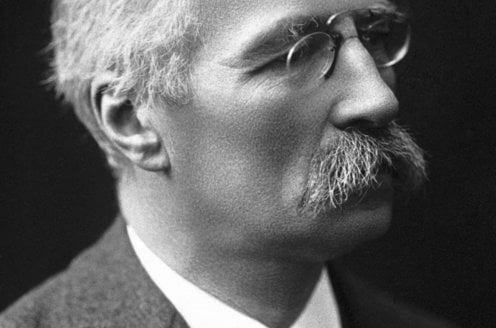
Henri La Fontaine was awarded the Nobel Peace Prize for his unparalleled contribution to the organisation of peaceful internationalism.
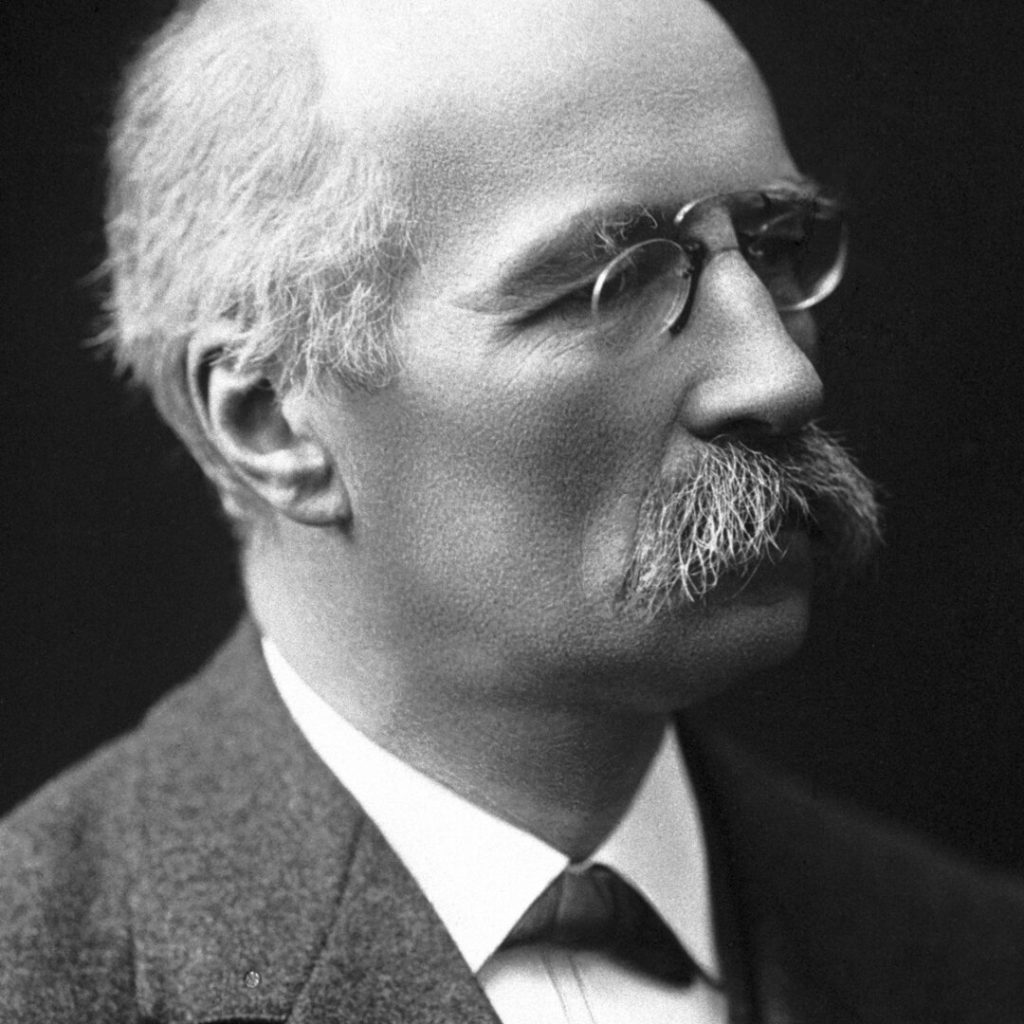
Full name: Henri La Fontaine
Born: 22 April 1854, Brussels, Belgium
Died: 14 May 1943, Brussels, Belgium
Date awarded: 10 December 1913
Henri La Fontaine was the first socialist to be awarded the Nobel Peace Prize. A scholar of international law and member of the Belgian parliament, he made his greatest contribution as an activist in the international peace movement. He established an institute that gathered documentation on international activities from around the world. In 1910 he organised a world conference for international organisations, with the purpose of creating an “intellectual parliament” for humanity. La Fontaine served as president of the International Peace Bureau from 1907 until his death. When he was awarded the Nobel Peace Prize in 1913, he was widely regarded as the leader of the European peace movement.
“There is no one who has contributed more to the organization of peaceful internationalism, and his outstanding talent for administration has been invaluable to the peace movement.”
Ragnvald Moe, Presentation speech, 10 December 1913.
Speaking at a peace conference in Sweden in 1910, La Fontaine emphasised that he was both a socialist and peace advocate. He believed that peace would first be achieved through socialism. He was a fierce critic of the capitalist system, in which conservatives controlled the schools and press, and he saw militarism and capitalism as inextricably linked to one another. La Fontaine viewed the Permanent Court of Arbitration in The Hague as the starting point for a pan-global organisation, an international parliament.
“Our party colleague has received the Nobel Prize. This decision must be welcomed by struggling workers throughout the world.”
Headline in the Swedish newspaper Social-Demokraten, December 1913.
La Fontaine was a man of many pursuits. As a member of the Belgian parliament, he was deeply involved in issues of social and foreign policy. He also worked actively to promote women’s rights. In 1895 he established a library institute whose purpose was to compile documentation on international activities and organisations throughout the world. Most of his peace prize award money was invested in this institute. La Fontaine used his involvement in the Esperanto movement and the Freemasons to further promote peace and understanding. He was also passionately interested in music and mountain climbing.
“Henry La Fontaine is the true leader of the peace movement in Europe.”
Ragnvald Moe, Presentation speech, 10 December 1913.
Disclaimer: Every effort has been made by the publisher to credit organisations and individuals with regard to the supply of photographs. Please notify the publishers regarding corrections.
Henri Marie La Fontaine (April 22, 1854-May 14, 1943) was born in Brussels …

1 (of 5) Henri La Fontaine and Ludwig Quidde at the opening session of the XXIIIrd Universal Peace Congress in the Reichstag Room, Berlin, 1924.
Mundaneum. Public domain, via Wikimedia Commons. Photography Continental Photo, Berlin.

2 (of 5) Henri La Fontaine and his wife Mathilde Lhoest in the dining room of their house on the Vergote Square, 1932.
Photo: Mundaneum. Public domain, via Wikimedia Commons

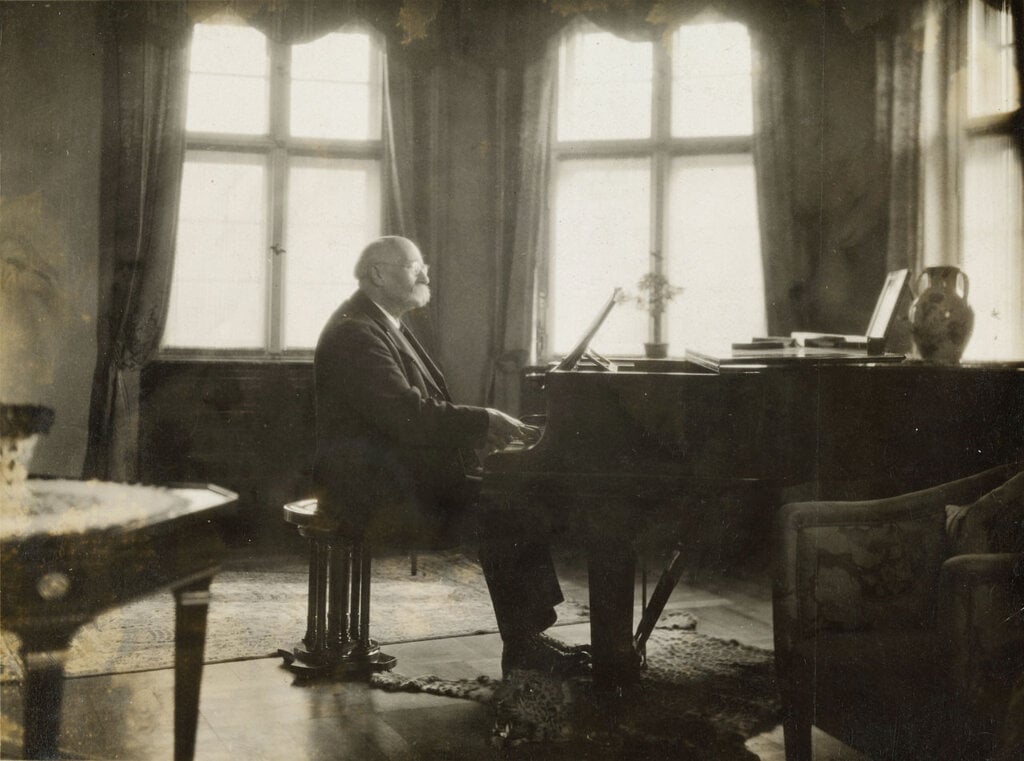
3 (of 5) Henri La Fontaine at the piano, 1930.
Photo: Mundaneum. Public domain, via Wikimedia Commons

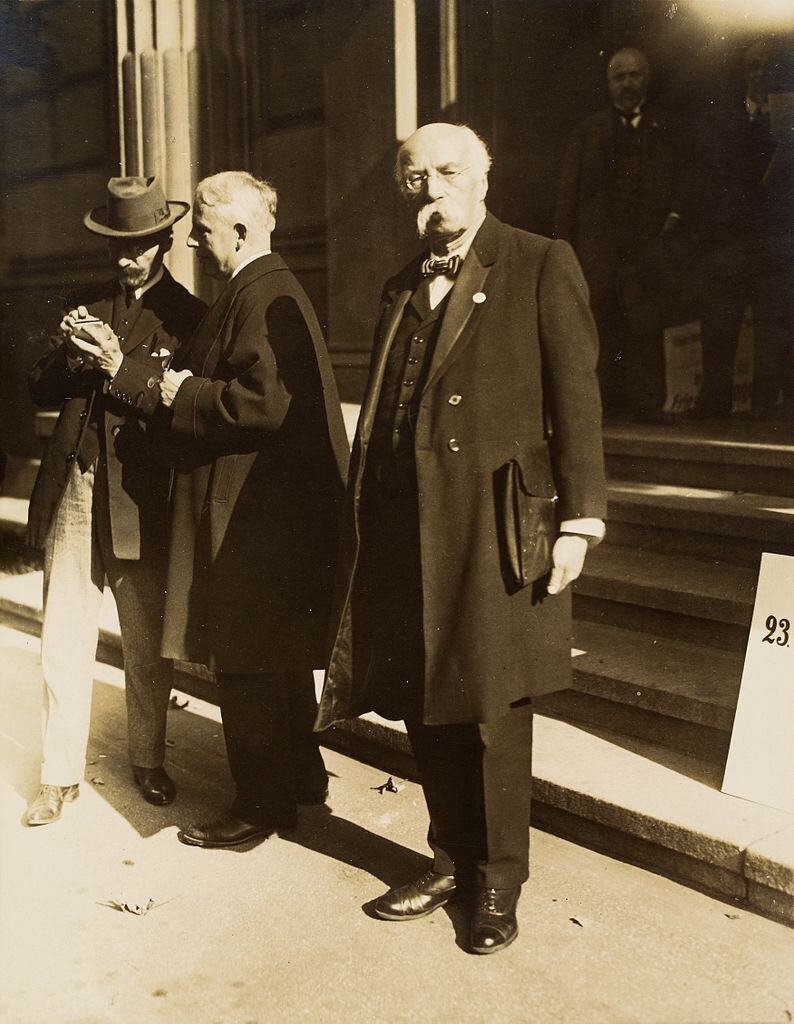
4 (of 5) Henri La Fontaine in front of the Reichstag room in Berlin, where the XXIIIrd Universal Peace Congress was held, 1924.
Photo: R. Horlemann. Mundaneum. Public domain, via Wikimedia Commons

5 (of 5) World Peace Congress in Munich 1907: Bertha von Suttner (seated row, second from left), Ludwig Quidde (next to the right), Frédéric Passy (next to the right), Henri La Fontaine (to her right) and A. H. Fried (standing row, third from the right).
Photographer unknown. Public domain, via Wikimedia Commons.
Henri La Fontaine did not deliver a Nobel Lecture.
On Henri La Fonatione from UIA.org
Presentation Speech by Ragnvald Moe*, Secretary to the Nobel Committee, on December 10, 1913
Henri La Fontaine is the true leader of the popular peace movement in Europe. Since 1907 he has been president of the International Peace Bureau in Bern. He is also a prominent member of the Interparliamentary Union1. La Fontaine was born on April 22, 1854, in Brussels, where he is counsel at the Court of Appeal and a professor of international law. He entered the Senate in 1895 and has been working for the cause of peace since 1889. La Fontaine is also a member of the Brussels City Council, a member sponsored by the Socialist Party. He is one of the best informed men working for peace, and his initiative and energy have done much to promote the international peace movement, particularly in the interparliamentary and peace conferences of recent years, where he has contributed to the practical organization of the movement and to the framing of international law. In 1899, for example, his activities included participation in a Peace Congress in Oslo. In 1895 he founded the International Institute of Bibliography and [later] the Central Office of International Associations2. La Fontaine has also been very active in the literary field, an example being his great documentary work on arbitration cases from 1794 to 19003. There is no one who has contributed more to the organization of peaceful internationalism, and his outstanding talent for administration has been invaluable to the peace movement. La Fontaine belongs to the moderate wing of the Socialist Party; he is the first Social Democrat to receive the Nobel Peace Prize.
The laureate did not deliver a Nobel lecture.
* At the award ceremony in the Norwegian Nobel Institute on December 10, 1913, Mr. Løvland, chairman of the Nobel Committee and at this time president of the Norwegian Parliament, welcomed the audience and announced the Nobel Prizewinner for 1912 (Elihu Root) and for 1913 (Henri La Fontaine). Neither laureate was present. Mr. Moe then spoke on both laureates and their contributions to peace. The second part of his speech, that on Mr. La Fontaine, is given here. The translation is based on the Norwegian reporting of it in the Oslo Morgenposten of December 11, 1913.
1. In effect founded in 1888 but formally constituted in 1889, the Union is composed of parliamentarians from the various nations who discuss problems of international relations and law, and of peace, promoting their solution through governmental channels; at this time it was primarily interested in encouraging arbitration of international disputes.
2. The creation of both the Institute in 1895 and the Central Office twelve years later must be credited to the initiative of two Belgian internationalists: La Fontaine and his friend Paul Otlet.
3. Pasicrisie internationale: Histoire documentaire des arbitrages internationaux, 1794-1900 (1902).
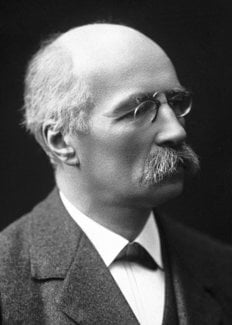
Henri Marie La Fontaine (April 22, 1854-May 14, 1943) was born in Brussels. A professor of international law, a senator in the Belgian legislature for thirty-six years, a renowned bibliographer, a man of wide-ranging cultural achievements, he was noted, most of all, for his fervent and total internationalism.
In 1877 at the age of twenty-three, La Fontaine registered as counsel with the Brussels Court of Appeal after reading law at the Free University of Brussels, from which he later received a doctorate in law. For the next sixteen years, he practiced law, becoming one of Belgium’s leading jurists; wrote a technical work on the rights and duties of contractors of public works (1885) and collaborated on another concerning counterfeiting (1888); began his long work in the cause of peace; and participated in liberal reform causes.
His interest in reform eventually led him into politics. A socialist, La Fontaine wrote for the movement, spoke at meetings, joined in founding La Justice, a socialist paper. Elected to the Belgian Senate as a Socialist, he represented Hainaut from 1895 to 1898, Liège from 1900 to 1932, and Brabant from 1935 to 1936. He was secretary of the Senate for thirteen years (1907-1919) and a vice-president for fourteen years: third vice-president (1919-1921), second vice-president (1921-1922), and first vice-president (1923-1932).
Throughout his career in the Senate he showed an abiding interest in education, labor, and foreign affairs. As a freshman senator, he introduced a bill to reform primary education and in his last year in the Senate spoke on the budget for public instruction. In labor legislation, he submitted a bill on mine inspection in 1897 and in 1926 supported the adoption of the eight-hour day and forty-hour week. In foreign affairs, he spoke almost every year on the foreign affairs budget, asked the Belgian government to demand arbitration between the combatants of the Boer War (1901), introduced a bill approving the treaty of obligatory arbitration with Italy (1911), and gave his legislative support to the League of Nations, the establishment of an economic union with Luxembourg, the Locarno Pacts, the Kellogg-Briand Pact, disarmament, and the legal means of settling international disputes.
La Fontaine was a member of the Belgian delegation to the Paris Peace Conference in 1919 and a delegate to the First Assembly of the League of Nations in 1920-1921. To those deliberations he brought his uncompromising internationalism. For example, during a plenary meeting that was considering Article 16 of the Covenant – the article which provided that members of the League must unite in diplomatic pressure, sanctions, or, if necessary, armed force to prevent a resort to aggressive war in breach of the Covenant – he spoke against an amendment releasing from commitment those countries which deemed themselves endangered should they take part in sanctions, saying: «Belgium thinks that however great the peril which a country might have to undergo under the system which we seek to establish here, that country ought to do its duty. It was thus that Belgium understood her obligations in 1914… We fully admit that, in circumstances of this nature, powerful countries may take certain measures, but in our opinion it would be impossible, on the pretext that they would suffer more than others, for some countries to hold aloof from the sacred task of defending justice, even at the peril of their own existence. ‹Fais ce que dois, advienne que pourra.› »1
Ideas for some of the auxiliary bodies of the League of Nations and of such affiliated bodies as the Institute of Intellectual Cooperation may have been influenced by La Fontaine’s plan for an international intellectual union, along with which he proposed the creation of international agencies that logically follow from the acceptance of the international idea – among them, a university, a library, a language, a parliament, a court, a bank, and clearing houses for labor, trade, immigration, and statistical information 2.
La Fontaine entered the organized peace movement when Hodgson Pratt, the British pacifist, came to Belgium in the early 1880’s to establish a branch of his International Arbitration and Peace Association. Becoming the secretary-general of the Société belge de l’arbitrage et de la paix in 1889, La Fontaine thereafter participated actively in virtually all of the peace congresses held in the next twenty-five years. In 1907, he succeeded Fredrik Bajer (one of the two Nobel Peace laureates for 1908) as president of the International Peace Bureau (winner of the 1910 Peace Prize), an organization he helped to found and whose titular head he remained until his death.
La Fontaine became a member of the Interparliamentary Union as soon as he attained eligibility by virtue of being elected to a national legislature. To La Fontaine the Union was an embryo world parliament, the precursor of a world government. An enthusiastic member, he was chairman of its Juridical Committee prior to World War I and a member of two of its important commissions – that on preparation of a model world parliament and that on drafting a model treaty of arbitration.
In the two decades between 1894 and 1915, La Fontaine’s literary efforts were prodigious, with much of his more important work associated with internationalism. The Manuel des lois de la paix: Code de l’arbritrage (1894) was approved by the International Peace Congress held at Antwerp. Published in 1902, the immense volume, Pasicrisie internationale: Histoire documentaire des arbitrages internationaux, 1794-1900, is a source book of 368 documents on arbitration, including agreements, rules of procedure, and case decisions, printed in whole or in part in their original languages. A complementary work, Histoire sommaire et chronologique des arbitrages internationaux, 1794-1900, provides commentary on Pasicrisie. His exhaustive and carefully edited Bibliographie de la paix et de l’arbitrage international, containing 2,222 entries, appeared in 1904. The Great Solution: Magnissima Charta (1916) offers a set of principles for organized international relations, not for a «World State» which he considered many years away, and sketches a «constitution» embodying the necessary institutions that would fit the times while preventing future wars. In «International Judicature» (1915) he outlines the essentials for a supreme court of the world. Not that he was very optimistic at this time. From Washington, D.C., where he lived following his flight to England and then to the United States after the German invasion of Belgium in 1914, he wrote in a private letter: «The peoples are not awake…[There are dangers] which will render a world organization impossible. I foresee the renewal of…the secret bargaining behind closed doors. Peoples will be as before, the sheep sent to the slaughterhouses or to the meadows as it pleases the shepherds. International institutions ought to be, as the national ones in democratic countries, established by the peoples and for the peoples.» 3
In the period before World War I, La Fontaine inaugurated an ambitious bibliographical scheme. In 1895, in collaboration with Paul Otlet, he established the Institut international de bibliographie. This «House of Documentation», as it came to be called, was a vast informational retrieval scheme, in which he proposed to file, index, and provide information for retrieval on anything of note published anywhere in the world. With the help of a subsidy from the Belgian government, he went some distance in bringing his plan into reality, for the House developed a methodology of universal classification and produced some reference works, particularly bibliographies of social sciences and peace.
From the work of the Institute came the idea for the Union of International Associations, which he founded with Paul Otlet in 1907, and, as secretary-general, directed thereafter. Still located in Brussels, the Union was granted consultative status with the Economic and Social Council of the United Nations in 1951 and with UNESCO in 1952. As the «only centre in the world devoted to documentation, research and promotion of international organizations, particularly the voluntary (nongovernmental) variety»4 and as the publisher of The Yearbook of International Organizations, the first of which appeared in 1909, and of a host of reference works of proceedings, documents, bibliographies, directories, and calendars of meetings of international organizations, it carries on in a sophisticated manner the embryonic conceptions of its founder.
Throughout his life La Fontaine was concerned with education. He occupied the chair of international law from 1893 to 1940, first at the Université Nouvelle, a branch of the Free University of Brussels, and then at the Institut des Hautes Études after the branch merged with the University following World War I. He taught courses on the elements of international law and on the evolution of the judicial structures of the world, and, as occasion required, offered courses of lectures on various subjects – among them, disarmament, the League of Nations, international misunderstandings, world federation, the law in relation to political and moral crises in the world.
A zealous reformer, La Fontaine was a leading spokesman for women’s rights. He was appointed secretary of a technical school for young women in 1878; he wrote La Femme et le barreau in 1901, taking an advanced position on the place of women in the legal profession; and for some time he was president of the Association for the Professional Education of Women.
La Fontaine’s talents and energy led him to explore many interests. A mountaineer, he wrote about climbing, compiled an international bibliography of «Alpinism», and served as president of the Club alpin belge. He translated portions of Wagner’s operas, published essays on American libraries and the status of American women, founded the review La Vie internationale, lectured to adult education classes on modern movements in the arts, served on the Brussels City Council from 1904 to 1908, and even, in his young manhood, produced a volume of poetry.
Henri La Fontaine lived to see his native Belgium invaded once again but not to see it liberated, for he died in 1943.
Selected Bibliography
«Activité parlementaire de M. Henri La Fontaine, Sénateur de 1895 à 1898, de 1900 à 1932 et de 1935 à 1936.» A sixteen-page reference list in typescript of bills introduced, bills discussed, and special speeches delivered by La Fontaine, prepared by the Services d’étude et de documentation du sénat de Belgique.
«The Award of the Nobel Peace Prize to Senator Henri La Fontaine», in American Journal of International Law, 8 (January, 1914) 137-138.
Davis, Hayne, «Henri La Fontaine», in Among the World’s Peace-Makers: An Epitome of the Interparliamentary Union with Sketches of Eminent Members of This International House of Representatives, pp. 118-126. New York, Progressive Publishing Co., [1906?]
«Enseignement de Monsieur Henri La Fontaine.» A two-page list in typescript of courses taught and lectures delivered as professor of international law from 1898 to 1940. Prepared by J. Vanderlinden, Faculté de Droit, Université Libre de Bruxelles.
«Essai de bibliographie de M. Henri La Fontaine, ancien vice-président du sénat de Belgique.» A nine-page list in typescript, prepared by the Services d’étude et de documentation du sénat de Belgique.
La Fontaine, Henri, Bibliographie de la paix et de l’arbitrage international. Tome premier: Mouvement pacifique. Bruxelles, Institut international de bibliographie, 1904.
La Fontaine, Henri, Des droits et obligations des entrepreneurs de travaux publics nationaux, provinciaux, et communaux. Bruxelles, Ferdinand Larcier, 1885.
La Fontaine, Henri, La Femme et le barreau. Rapport à la Fédération des avocats belges; assemblée générale ordinaire du samedi 27 avril 1901, à Charleroi. Bruxelles, Ferdinand Larcier, 1901
La Fontaine, Henri, The Great Solution: Magnissima Charta. Boston, World Peace Foundation, 1916.
La Fontaine, Henri, Histoire sommarie et chronologique des arbitrages internationaux (1794-1900). Bruxelles, Bureau de la Revue de droit international et de législation comparée, 1902.
La Fontaine, Henri, «International Judicature» Judicial Settlement of International Disputes, No. 22. Baltimore, American Society for Judicial Settlement of International Disputes, 1915.
La Fontaine, Henri, Manuel des lois de la paix: Code de l’arbitrage. Congrès international de la paix, 1894, Anvers. Bruxelles, Lombaerts, 1894.
La Fontaine, Henri, Pasicrisie internationale: Histoire documentaire des arbitrages internationaux, 1794-1900. Bern, Stämpfli, 1902.
La Fontaine, Henri, et Paul Otlet, L’État actuel des questions bibliographiques et l’organisation internationale de la documentation. Bruxelles, 1908.
Moi (pseudonyme de Henri La Fontaine), Premières rimes. Bruxelles, Ferdinand Larcier, 1886.
Olin, X., et Henri La Fontaine, Traité de contrefaçons. Bruxelles, Ferdinand Larcier, 1888.
* The editor wishes to acknowledge his debt to Professor J. Vanderlinden, Faculté de Droit, Université Libre de Bruxelles, for his kindness in collecting research information on which much of this biographical notice is based.
1. Quoted by William E. Rappard, The Quest for Peace since the World War (Cambridge, Mass.: Harvard University Press, 1940), pp. 227-228, from Records of the First Assembly, Plenary Meetings, p. 409.
2. Noted by Mortimer Lipsky, The Quest for Peace: The Story of the Nobel Award (New York: A.S. Barnes, 1966), pp. 57-58.
3. Letter to David Starr Jordan, president of Stanford University, dated December 29, 1916. Archives of the Hoover Institution of War, Revolution, and Peace, Stanford University.
4. Yearbook of International Organizations, 1968-1969 edition, p. 1023.
This autobiography/biography was written at the time of the award and first published in the book series Les Prix Nobel. It was later edited and republished in Nobel Lectures. To cite this document, always state the source as shown above.
The Nobel Foundation's copyright has expired.