Edgar Algernon Robert Cecil, British lawyer, parliamentarian and cabinet minister, one of the architects of the League of Nations and its faithful defender, was the distinguished son of the third Marquess of Salisbury …
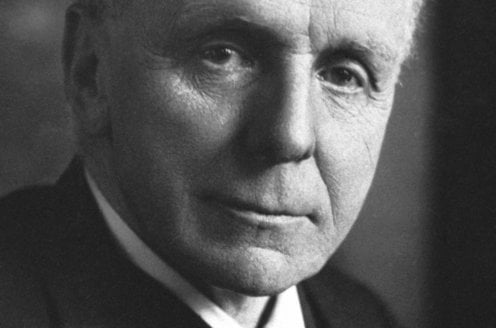
Lord Robert Cecil was awarded the Nobel Peace Prize for his tireless efforts in support of the League of Nations, disarmament and peace.
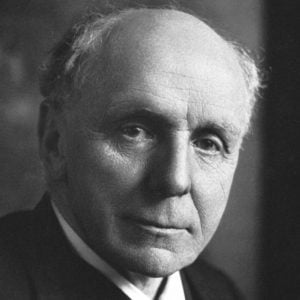
Full name: Edgar Algernon Robert Gascoyne-Cecil, 1st Viscount Cecil of Chelwood
Born: 14 September 1864, London, United Kingdom
Died: 24 November 1958, Tunbridge Wells, United Kingdom
Date awarded: 18 November 1937
Robert Cecil, a British politician, diplomat and peace activist, played a leading role in the development of the League of Nations, the forerunner to today’s United Nations. In 1919 Cecil took part in founding the League of Nations Union, a British peace organisation with wide public appeal that was influential in British foreign policy during the inter-war period. In 1935 he led the campaign to mobilise support for the League of Nations through a public referendum. Cecil was also one of the leaders of the International Peace Campaign (IPC), an international peace organisation that sought disarmament and expanded powers for the League of Nations.
”Are we going to permit uncontrolled nationalism to dominate civilized Europe, or are we going to say that the European countries are really part of one community with a common interest in international peace?”
Lord Robert Cecil, Nobel Lecture, 1 June 1938.
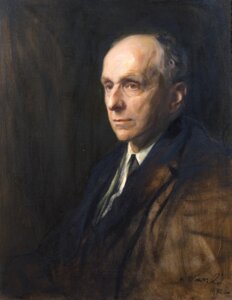
In 1935 the League of Nations Union, led by Lord Cecil, organised a referendum in which over 38 percent of British voters participated. The results showed that over 16 million people supported continued British membership in the League of Nations. Close to 10 million people were in favour of the League using economic sanctions against aggressor nations, while 6.7 million supported military action. The referendum influenced the British government’s decision to implement an oil boycott of Mussolini’s regime after Italy’s attack on Ethiopia in 1935, but to Cecil’s great disappointment, this policy was quickly abandoned.
| Sanction From the Latin “sanctio” meaning to make holy. A form of punishment carried out against a state that violates international law. |
”Lord Cecil’s incomparable work on behalf of the League of Nations, Disarmament and Peace generally, is of course known to you. That work is in a true sense unique.”
Norman Angell, Letter to the Nobel Committee, 18 January 1935.
When the British government abandoned sanctions against Italy and began an intensive rearmament, Lord Cecil decided to actively oppose the decision. The result was a new peace organisation with broad-based political participation from several nations. Along with like-minded Frenchmen, he founded the International Peace Campaign (IPC) in 1935 to seek disarmament and collective security measures. The IPC received substantial financial support from the Norwegian Nobel Committee. The two Norwegian professors who nominated Cecil for the Nobel Peace Prize were both IPC members.
”Particularly in Italy, Lord Cecil has become the target of extreme dislike, and he is most certainly counted as one of the most distinctive enemies that the fascist foreign policy must contend with.”
Wilhelm Keilhau, Adviser’s report to the Norwegian Nobel Committee, 1937.
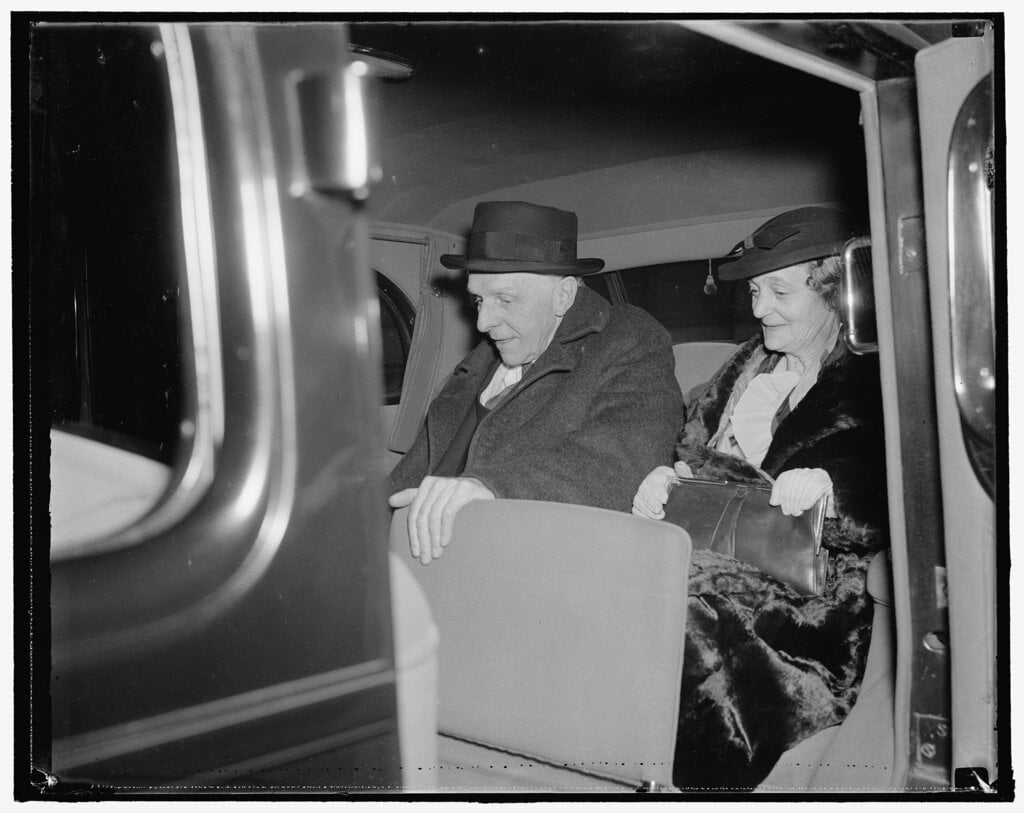
Edgar Algernon Robert Cecil, British lawyer, parliamentarian and cabinet minister, one of the architects of the League of Nations and its faithful defender, was the distinguished son of the third Marquess of Salisbury …
Disclaimer: Every effort has been made by the publisher to credit organisations and individuals with regard to the supply of photographs. Please notify the publishers regarding corrections.
Spartacus Educational – Robert Cecil
On Lord Robert Cecil from University of Birmingham
Presentation Speech by Christian Lous Lange*, member of the Nobel Committee, on December 10, 1937
Three statesmen who occupied leading positions during the World War were so deeply struck by the deprivation of human life and economic resources, by the futility of war as a social institution, and by its amorality, that they became convinced pacifists and throughout the rest of their lives spared no effort to prevent such a calamity from ever again overtaking mankind.
Two of the three are dead: Woodrow Wilson and Aristide Briand. The Nobel Committee has already honored them both with the Alfred Nobel Prize. Today the Committee takes pleasure in presenting the prize to the third, Viscount Cecil of Chelwood, perhaps better known by his original name, Lord Robert Cecil.
It can perhaps be said of Wilson and Briand that they had some points of contact with pacifist ideas: Wilson in his religious, puritan tradition; Briand in the radical socialism of his youth.
I doubt very much whether any parallel can be found in the case of Lord Cecil, either in his traditions or in his background, or in his prewar career. I am more inclined to believe that his revulsion to war was aroused only and entirely through his intimate contact with the war and his experiences as under-secretary of state for foreign affairs and minister of blockade1, and that it was these which first led him to consider the problem of the abolition of war, and so to devote all his efforts to bring nearer the solution which to him appeared to be the right one.
Think of his background and traditions! The Cecil family is one of the oldest and most distinguished among the English landed aristocracy. His father, the Marquess of Salisbury, was for nearly twenty years the leader of the Conservative Party, and for most of this time prime minister2. In foreign affairs he accepted the legacy of Disraeli3 and continued Britain’s imperialist policy. In his early twenties the young Lord Robert Cecil became a private secretary to his father, at that time prime minister and foreign secretary. He fully shared his father’s political and High Church views. It seems highly improbable that, either in Hatfield or in the circles in which Lord Robert moved in London, pacifism should at any time have been discussed, except perhaps with a shrug of the shoulders, for serious, realistic men cannot afford the luxury of such childish dreams!
Being a younger son, Lord Robert decided to earn a living by following a legal career. He developed into a skilled advocate, and in due course became a Queen’s Counsel. In 1906, when he was in his early forties, he was elected to Parliament and took his place on the Conservative benches, under the leadership of his cousin Arthur Balfour4. Although his rise to prominence was not rapid, his reputation grew steadily and he won recognition as an able orator and jurist. But in 1915 when Asquith5, under the pressure of war, formed a coalition government, Cecil became under-secretary of state at the Foreign Office under Sir Edward Grey6. The following year, when Lloyd George7 succeeded in overthrowing his chief and created his war ministry with a program of «war to the bitter end», Cecil became minister of blockade, one of the most exposed positions in the government.
It was in the course of these war years, and especially during his collaboration with the wise and admirable Edward Grey, that Cecil first encountered the problem of pacifism. It presented itself in the special guise which it had at that time assumed – the question of a «League of Nations». The idea was old, but during the war it acquired a distinctive form, and Cecil had a large share in its shaping. He toiled over the question and no doubt had many a struggle with it before he could clearly grasp all its implications and consider himself fully and confidently master of the problem.
It is fascinating to follow Cecil’s evolution as a pacifist and internationalist during the two decades between his wartime conversion and the present day. I deliberately use the religious term «conversion», for clearly Lord Cecil is of a fundamentally religious temperament – of the High Church Episcopalian stamp. Listening to him speak from the rostrum is often like listening to a venerable bishop preaching the revealed truth. But he also has other strings to his bow in addition to that of the preacher’s; he is a skillful lawyer, a quick-witted debater, and, when the occasion demands, a shrewd tactician. His tall, now somewhat bowed figure is imposing. But, even when he jests and smiles, one can always sense an underlying earnestness of purpose. The conversion from his youthful indifference to the problem of peace, to the profound conviction of its central importance which he now holds in maturity has been perhaps the most momentous experience of his life.
What inhibitions and innate prejudices has he not had to conquer! For no man can ever completely cast off the influences of childhood and youth. The twenty years during which Cecil has fought for pacifism and for the League of Nations are marked by many instances when these inhibitions have emerged to lead him to a self-contradictory position. There is much truth in what a witty Irishman has said of him: «Lord Robert stands with one foot in the Middle Ages and the other in the League of Nations.»
But he has been true to his newfound conviction. That is the important thing. And this fact redounds doubly to his credit, precisely because he has had to resolve this conflict within himself.
If we examine his purely intellectual attitude toward the League of Nations problem, we cannot but marvel at the clarity with which he formulated the essential points of his program at the very outset, and at the consistency with which he has adhered to them despite storm and stress.
On November 12, 1918, the day following the Armistice, he spoke at the University of Birmingham about plans for a League of Nations. He rejoiced that the war was over and that victory had been won. But he strongly emphasized the responsibility which the victory imposed on the victors. This responsibility was to construct a lasting peace and to create an instrument for international cooperation which might safeguard the permanence of peace. He called upon the Allies to resist any temptation to exploit their victory to gain mastery for themselves, and appealed to them to create instead a League of Nations for all nations – a league of independent nations, not a superstate.
The principal foundation of this new League was not to be legal institutions such as courts of law or arbitration. These should be only the auxiliaries, the practical instruments sustaining the dynamic force upon which the League of Nations should rest: a vigilant and informed public opinion that would demand a peaceful solution of disputes by legal judgment or arbitration if possible, but in any case by negotiation and mediation. And this public opinion should be given every chance to speak out whenever dispute arose.
The crux of the whole system was therefore that the states should agree not to resort to arms, not to «go to war», as the new expression had it, but to bind themselves to delay and discussion under the watchful eye of public opinion. Cecil foresaw that governments would reserve the right to insist on unanimity in all decisions, that they would not relinquish their «liberum veto». But, he said, «Since the important thing is to secure delay and open discussion – that is to say, time to enable public opinion to act, and information to instruct it – this is not a serious objection to the proposal.» Here speaks an English parliamentarian who knows that such a system has preserved his country from revolution and has vouchsafed its peaceful development for well-nigh three centuries. He hopes that other nations will follow suit.
If a nation should break its promise by failing to delay action, thus preventing negotiation, or by going to war before allowing a reasonable respite, then the other nations must employ military and economic sanctions against it. Lord Robert, the minister of blockade during the war, attached particular weight to the economic weapon. He spoke of disarmament as a necessary measure, but at that time this decisive component of the system still lay in the back of his mind.
Rather, he strongly emphasized the importance of harmonious international cooperation which he, in complete accord with the ideas of his close friend General Smuts8, wished to entrust to the League of Nations in order to make the latter a permanent and working instrument.
And so, even then, we already have a clear formulation of Cecil’s concept of the League of Nations’ organization and of its possibilities. In the period which followed, he returned to these essential points again and again.
The first problem was to secure the acceptance of the Covenant of the new League by all the nations. He was in complete agreement with Wilson’s conviction that the Covenant must form an integral part of the Peace Treaty itself. This was undoubtedly right. It would have been politically and psychologically unwise to leave the Covenant to be dealt with at some international conference specially called to establish the League. In that event we should not, in all probability, have got a League at all, certainly not a satisfactory one. But it was a high price to pay, for serious complications and setbacks followed. Unfortunately, we seldom get anything for nothing, and nowhere is this more true than in politics.
I shall not expatiate on Cecil’s role in the drafting of the Covenant. Suffice it to say that he played a decisive part both as lawyer and as politician. I will only add in passing that his Conservative tradition came into play on just one occasion. He insisted that only the great powers should be represented in the Council of the League, its most important organ, especially with respect to political questions. He saw the League as a development and continuation of the old European Concert. But he soon allowed himself to be persuaded that this would be wrong, and he has since completely abandoned this view.
During the first three years of the League’s existence, from 1920 to 1923, Cecil figured prominently in its activities. He had left Lloyd George’s ministry immediately after the war and was not among the British delegates to these three assemblies. But General Smuts, who had become his close friend, asked him to represent South Africa in the Assembly. This was indeed fortunate, for he could act with a great measure of freedom. I wonder whether these three years were not among the happiest in Lord Cecil’s political and international career.
It was quite clear to him from the very beginning that the League was not a perfect or immutable instrument. It had to be nursed, developed, and made to grow, both quantitatively in its membership and qualitatively in the efficiency of its operation. Lord Cecil stood in those early years at the head of the progressive wing of the League. It is interesting to observe how he systematically took up the points from the program outlined in his Birmingham speech of 1918 and tried to put them into practice.
Above all, he wanted to order the League’s work in such a way that it would be pursued in the full light of publicity so that it could be followed, stimulated, and criticized by public opinion and by that most important disseminator of public opinion, the press. With the support of delegates from some of the smaller powers – not least, I am glad to say, the Nordic states, foremost among whose representatives were Hjalmar Branting and Fridtjof Nansen – he forced through the resolution that the Assembly should meet annually; that it should be a fundamental rule that the meetings, both plenary and in committee, should be held in public. Lastly, and most important of all, he managed to introduce something of an innovation in international politics: the Assembly’s sessions were to begin each year with a general debate. This is a formal debate based on the secretary-general’s annual report, but any subject whatsoever of an international character can be brought to discussion. The Assembly thus became a free tribune.
It is true that not always, indeed too seldom, does a debate lead to genuine understanding based on an exchange of views, with questions and answers; all too often the general debate deteriorates, as is also sometimes the case with debates on the speech from the Throne in our Parliament, to a series of unrelated declarations on various questions. But there have been times when the Assembly has suddenly been ignited by a spark which has brought real fire into the debate.
It was Cecil who, on the third day of the First Assembly, November 17, 1920, opened the general debate. His speech9 was truly notable and I should like to cite some of the points he made. He talked first and at length of the necessity to rouse public opinion to work with, for, and through the League. It was then that he coined a phrase which became not only a slogan but indeed a program: «Publicity is the very lifeblood of the League of Nations.»
But he then went on to speak of the fundamental moral principles which must govern the work of the League. The words he uttered are remarkable coming from a Conservative politician from one of the great powers; Unfortunately they were also prophetic: «Do not let us be afraid of our power. Let us go on from strength to strength. It is not by doing too much that the League is in any danger. The one danger that threatens the League is that it may gradually sink down into a position of respectable mediocrity and useless complication with the diplomatic machinery of the world… We must be ready to take a bold line in the great work of reconciliation and pacification that lies before us.»
He concluded his speech with a few personal words which no one who heard them is likely to forget. «I stand before you as a substitute of General Smuts. Think of that! General Smuts not so many years ago was one of the most redoubtable and successful commanders of the forces of the Boer nation when they were in arms against the British Empire, and I was the son of the Prime Minister who conducted the war on behalf of the British Empire. And yet it now comes about that the General of the Boers goes to the son of the British Prime Minister and asks him to appear before the Assembly of the League of Nations as the best exponent of the General’s views on international subjects. How has that result come about? Not by timidity, not by shrinking from a bold action, but by a great act of trust in the Boer people, an act which, I do not hesitate to say, at the moment seemed to me rash and perhaps premature, but which has more than justified itself by its results.» (He is, of course, referring to Campbell-Bannerman’s10 dissolution in 1906 of the emergency government imposed on South Africa after the war, and the granting of self-rule as a Dominion.)
«Surely», Cecil continued, «that is an example to us… Do not let us shrink from even strong measures of pacification and reconciliation. Believe me, they will justify themselves in the future. I will say to this Assembly with all the emphasis at my command, let their motto be: ‹Be just and fear not.› »
It would take much too long to review here Lord Robert’s work in and for the League of Nations. Let us recall just one or two facts.
The League had in 1920 set up a Permanent Court of International Justice, in accordance with Article 14 of the Covenant, and the first panel of judges was named in 1921. Cecil took an active part in this work and, when it was completed, he reminded the League of the other «article of promise» in the Covenant, Article 8, which requires that disarmament be carried out by means of international agreements. «Disarmament», he said, «is the next great cause with which the League must concern itself.»
And to this cause he devoted great effort. He explored avenues which he thought might provide a short cut, but which sometimes turned out to be blind alleys. But at no time did he lose sight of the goal.
For ten years after joining the new Conservative government under Stanley Baldwin11 in 1923, he was the United Kingdom delegate both in the Council and in the Assembly, although with some interruptions, as for instance during the first Labor government in 1924, «the year of the Geneva Protocol»12. His official position now tied his hands and he no longer possessed the freedom of action which he had enjoyed as representative of his friend and ally General Smuts. He was not always able to sit on the disarmament commissions. It is no secret that he sometimes thought of leaving the Conservative Party, but the bonds which tied him to the party of his forebears proved too strong. He remained in its ranks, representing the British Empire – for example, on the preparatory disarmament commission charged with the study of the technical aspects of the disarmament problem.
Many times during those years he watched with dismay the undermining of the League by the policy supported by certain governments, including his own, which was reducing the League to that «respectable mediocrity» which was, as he had said in his first speech in the Assembly, what he feared most.
The weak policy of the great powers toward Japan in 1931-1932 was a step in this undermining policy, and the last time Cecil attended the Assembly in September, 1932, he delivered a memorable and dynamic speech on the question of disarmament, describing it as a touchstone for the will to peace. If disarmament were once carried through, he said, the international atmosphere would suddenly be transformed. The nations would have cast their ultimate vote for peace. If, on the other hand, they rejected disarmament, the world would sink back into the state of prewar days.
I am inclined to believe that Cecil intended this remarkable speech to mark his farewell to the policy of his party at home. In the House of Lords, where he had sat since he had become Viscount Cecil of Chelwood in 1923, he now took his place on the nonparty cross-benches. There he joined company with the bishops who, of course, hold themselves aloof from party allegiances.
He was again a free man.
Archimedes has said: «Give me a place to stand outside the earth and I will move the earth.»
From the very first, Cecil has worked to obtain a platform outside the League in order to keep it moving. That platform he has sought and found in public opinion. His initiative helped to establish the League of Nations Union13 in Great Britain, an influential organization which has some impressive achievements to its credit. Cecil remains its president to this day.
England’s example has been followed in most other countries. Cecil has also been president of the International Federation of the League of Nations Societies14 for two years, the presidency of this organization changing in rotation.
The bitter disappointments of recent years have in no way succeeded in cooling Cecil’s ardor. He has been the main instigator of two big attempts to mobilize public opinion in the fight against war and international anarchy.
The first of these was national in character, the so-called «Peace Ballot» of 1934, an unofficial referendum to sound public opinion on the League of Nations. Cecil had planned the program, directed publicity, and was himself an active participant. The optimists had hoped to receive four to five million replies to the five questions put. In actual fact no less than eleven and a half million questionnaires were returned, and it transpired that an overwhelming majority, eleven million, were in favor of the League of Nations, ten and a half million for disarmament, ten million for the use of economic sanctions against an aggressor, 6,780,000 for military sanctions.
The most valuable result of this endeavor was that not only those who had cast their votes but many others besides were led to consider the problem of peace and its solution through the medium of the League of Nations. At the same time public opinion had unmistakably expressed itself in favor of the League of Nations; so when the Baldwin government proclaimed a general election at a time when the Ethiopian crisis was becoming increasingly grave, it was forced to declare itself firmly in favor of the «collective system». We know, unfortunately, that once the election was over and once the government had won its victory, it retreated from the consequences: it chose to abandon the sanctions and to embark instead upon the most gigantic rearmament program that our time has known.
It is common knowledge that this was a painful blow to Lord Cecil. He was now seventy years old; anyone in his position might have been tempted to give up, and a private speech of his suggests that he had come close to losing his fighting spirit.
It is thus all the more admirable that he nevertheless decided to launch a new venture. He had shown that he had the support of British public opinion. Now he took on the difficult task of mobilizing international opinion: together with the French politician Pierre Cot he planned the International Peace Campaign15. It was, so to speak, a «quand même» from the old man.
The movement has achieved considerable success. The support which this new organization has obtained – ranging from conservatives like Cecil himself, his friend Lord Lytton, and other prominent conservatives all over the world, through liberals, radicals, the cooperative movement, and other nonpolitical groups, to socialists and communists – shows how alert public opinion has actually become to the danger of another war. It is the dictators’ menacing attack upon world peace in Africa, Spain, and the Far East which has created the need for concentration. Unfortunately the membership of the Campaign is not as comprehensive as one would have wished, for no one living under the dictatorships can give it open support.
The International Peace Campaign does not seek to compete with any of the existing organizations; its object is to unite them in a common front to promote concentrated action. Its program is therefore very moderate. It works for the maintenance of what some years ago was thought to be a lasting basis for international cooperation and peace. It demands, for the strengthening of the «collective system», only two, but two very important, reforms, which in any case already form an integral part of the program set out in the League of Nations Covenant: international disarmament and «establishment within the framework of the League of Nations of effective machinery for remedying international conditions which might lead to war»16.
It is admirable and yet at the same time sad to note that Lord Cecil’s last great effort is not only generally consistent with but practically follows word for word the thoughts expressed in his speech at the University of Birmingham nearly twenty years ago. Admirable, because it underlines the unity and continuity in his lifelong work for peace; sad, because it shows that, in the fearful winter which we are experiencing in our international life, it is unhappily necessary to rebuild everything from the ground up. The stone of Sisyphus!
But to the winner of the Nobel Peace Prize this year, Lord Cecil of Chelwood, I think we should address the lines of a Danish poet about the hero Sisyphus:
Not the deed fulfilled, but tireless exertion
Shall hear you, O Man, into the ranks of the Heroes.
* Mr. Lange, former secretary-general of the Interparliamentary Bureau and himself a co-recipient of the Peace Prize for 1921, delivered this speech on December 10, 1937, in the auditorium of the Nobel Institute in Oslo. Because of important prior commitments, the laureate was unable to be present at the ceremony. This translation is based on the text in Norwegian in Les Prix Nobel en 1937.
1. Respectively, in 1915-1916 and in 1916-1918.
2. Robert Arthur Talbot Gascoyne-Cecil (1830-1903), prime minister (1885-1886; 1886-1892; 1895-1902).
3. Benjamin Disraeli (1804-1881), prime minister (1868; 1874-1880).
4. Arthur James Balfour (1848-1930), who had been Conservative prime minister (1902-1905) and who was in 1906 the leader of the Opposition.
5. Herbert Henry Asquith (1852-1928), prime minister (1908-1916).
6. Sir Edward Grey (1862-1933), foreign secretary (1905-1916).
7. David Lloyd George (1863-1945), prime minister (1916-1922).
8. Jan Christiaan Smuts (1870-1950), South African statesman and soldier, prime minister (1919-1924).
9. Original text in League of Nations: The Records of the First Assembly Plenary Meetings, Geneva, 1920, pp. 93-99.
10. Sir Henry Campbell-Bannerman (1836-1908), British statesman, prime minister (1905-1908).
11. Stanley Baldwin (1867-1947), prime minister (1923-1924; 1924-1929; 1935-1937).
12. The Geneva Protocol condemned wars of aggression and made provision for arbitration, security, and disarmament but was dropped by the League after its rejection in 1925 by the newly elected Conservative government of Great Britain.
13. Founded in 1915, with headquarters in London; Cecil was president from 1923 to 1945.
14. Founded in 1919, with headquarters in Geneva.
15. Founded in March, 1936, in London, with headquarters later established in Geneva; Cot and Cecil were its official presidents.
16. Cecil, A Great Experiment, p. 285.
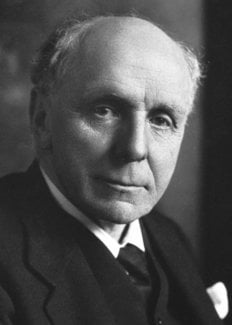
Edgar Algernon Robert Cecil (September 14, 1864-November 24, 1958) British lawyer, parliamentarian and cabinet minister, one of the architects of the League of Nations and its faithful defender, was the distinguished son of the third Marquess of Salisbury, that remarkable man who occupied, in the course of his career, the highest offices in the land: the foreign ministry under Disraeli, the prime ministry three times (1885, 1886-1892, and 1895-1902).
The education which Robert absorbed at home until he was thirteen was superior and far more interesting, he writes in his autobiography, than his four years at Eton. He enjoyed his undergraduate days at Oxford where he won renown as a debater, and after several terms of reading law, he was called to the Bar in 1887, at the age of twenty-three. Of his marriage to Lady Eleanor Lambton two years later he was fond of saying that it was the cleverest thing he had ever done1.
From 1887 to 1906, Cecil’s career was a legal one, involving most of the forms of common law, occasional efforts in Chancery, and a steadily increasing parliamentary practice. He also collaborated in writing Principles of Commercial Law.
From the law, Cecil turned to politics. As a Conservative, he represented East Marylebone in the House of Commons from 1906 to 1910, lost two elections in the next year, and then won as an Independent Conservative in 1911 as member for the Hitchin Division of Hertfordshire, remaining in the Commons until 1923.
Fifty years old at the outbreak of World War I, Cecil went to work for the Red Cross, but with the formation of the coalition government in 1915, he became undersecretary for foreign affairs for a year, served as minister of blockade from 1916 to 1918, being responsible for devising procedures to bring economic and commercial pressure against the enemy, and early in 1918 became assistant secretary of state for foreign affairs.
The «third phase»2 of Cecil’s public career – his absorption in the maintenance of peace – began in 1916. Appalled by the war’s destruction of life, property, and human values, he became convinced that civilization could survive only if it could invent an international system that would insure peace. In September, 1916, he circulated a memorandum making proposals for the avoidance of war, which he says was the «first document from which sprang British official advocacy of the League of Nations»3.
From the inception of the League to its demise in 1946, a span of almost thirty years, Cecil’s public life was almost totally devoted to the League. At the Paris Peace Conference, he was the British representative in charge of negotiations for a League of Nations; from 1920 through 1922, he represented the Dominion of South Africa in the League Assembly; in 1923 he made a five-week tour of the United States, explaining the League to American audiences; from 1923 to 1924, with the title of Lord Privy Seal, and from 1924 to 1927, with that of Chancellor of the Duchy of Lancaster, he was the minister responsible, under the jurisdiction of the Foreign Secretary, for British activities in League affairs.
In 1927, dissatisfied with the attitude of the British cabinet toward the League, he resigned from governmental office and thereafter, although an official delegate to the League as late as 1932, worked independently to mobilize public opinion in support of the League. He was president of the British League of Nations Union from 1923 to 1945, and joint founder and president, with a French Jurist, of the International Peace Campaign, known in France as Rassemblement universel pour la paix. Among his publications during this period were The Way of Peace (1928), a collection of lectures on the League; A Great Experiment (1941), a personalized account of his relationship to the League of Nations; All the Way (1949), a more complete autobiography.
Lord Robert’s career brought him many honors. He was created first Viscount of Chelwood in 1923 and made a Companion of Honour in 1956, was elected chancellor of Birmingham University (1918-1944) and rector of the University of Aberdeen (1924-1927), was given the Peace Award of the Woodrow Wilson Foundation in 1924 and the Nobel Peace Prize in 1937, was presented with honorary degrees by the Universities of Edinburgh, Oxford, Cambridge, Manchester, Liverpool, St. Andrews, Aberdeen, Princeton, Columbia, and Athens.
In the spring of 1946 he participated in the final meetings of the League at Geneva, ending his speech with the sentence: «The League is dead; long live the United Nations!» He was eighty-one. He lived for thirteen more years, occasionally occupying his place in the House of Lords, and supporting international efforts for peace through his honorary life presidency of the United Nations Association.
| Selected Bibliography |
| Bachofen, Maja, Lord Robert Cecil und der Völkerbund. Zurich, 1959. |
| Carlton, David, «Disarmament with Guarantees: Lord Cecil, 1922-1927», in Disarmament and Arms Control, 3 (1965, no. 2) 143-164. |
| Cecil, Lord Robert, All the Way [an autobiography]. London, Hodder & Stoughton, 1949. |
| Cecil, Lord Robert, «American Addresses», League of Nations, 5 (1922, no. 6) 401-460. [A publication of the World Peace Foundation, Boston.] |
| Cecil, Lord Robert, An Emergency Policy. London and New York, Hutchinson, 1948. |
| Cecil, Lord Robert, A Great Experiment: An Autobiography. New York, Oxford University Press, 1941. |
| Cecil, Lord Robert, International Arbitration [the Burge Memorial Lecture]. Oxford, Clarendon Press, 1928. |
| Cecil, Lord Robert, «The League as a Road to Peace», in The Intelligent Man’s Way to Prevent War, ed. by L. Woolf. London, Gollancz, 1933. |
| Cecil, Lord Robert, The Moral Basis of the League of Nations [the Essex Hall Lecture]. London, Lindsey Press, 1923. |
| Cecil, Lord Robert, The New Outlook. London, Allen & Unwin, 1919. |
| Cecil, Lord Robert, Peace and Pacifism [the Romanes Lecture]. Oxford, Clarendon Press, 1938. |
| Cecil, Lord Robert, The Way of Peace: Essays and Addresses. London, Allen, 1928. [Reissued, Port Washington, N.Y., Kennikat Press, 1968.] |
| Cecil, Lord Robert, and Joseph Hurst, The Principles of Commercial Law. London, Stevens & Haynes, 1891. |
| Crewe, Marquess of, «Lord Cecil and the League», The Fortnightly, 155 [n.s. 149] (March, 1941) 209-218. |
| Obituary, the (London) Times (November 25, 1958) 13. |
1. Cecil, A Great Experiment, p. 19.
2. Cecil, All the Way, pp. 142, 239.
This autobiography/biography was written at the time of the award and first published in the book series Les Prix Nobel. It was later edited and republished in Nobel Lectures. To cite this document, always state the source as shown above.
Nobel Lecture*, June 1, 1938
When I received the information that the Nobel Committee of the Norwegian Parliament had done me the great honour of awarding me the Nobel Peace Prize for 1937, I learned that, by the Statutes of the prize, I was to have the opportunity and duty of giving a lecture within six months of the award; and I am now here to discharge that obligation. In the first place, let me express once again my warmest gratitude to the Nobel Committee for the award. At any time I should have received it with great gratification; but coming, as it did, at a time when all workers for peace needed the utmost encouragement, it was doubly acceptable.
I heard of it when I was in New York, and the news happened to arrive at the very time when the Columbia University was kind enough to give me an honorary degree. The result was that the coincidence of these two events secured for them both a very large measure of publicity which, I trust, was to the advantage of the cause of peace. Certainly, it gave me an opportunity of explaining to many journalists and others the principles of the cause for which I was working and in respect of which the award was made.
I owe also a deep debt of gratitude to those who, in your country, have confirmed the decision of the Nobel Committee and expressed their approval of it. In particular, I trust I may be allowed to express my deep obligation to their Majesties, the King and Queen of Norway, for their kindness in being present today and on the day of the solemnity on the tenth of December.
If I may be allowed to say so, the close connection between the British Royal Family and that of Norway makes their Majesties’ action the more gratifying to a British citizen like myself.
I also wish to express my thanks to my old friend, Dr. Lange, who was good enough, on that occasion, to pronounce an oration about myself which I found deeply interesting, though far too flattering. As to much of what he said, I can only say that I hope – though I do not believe – that I deserve it.
One comment I should, however, like to make. He was good enough to emphasize that at the time I began working for the League and for peace, I belonged to what he called an “old aristocratic and Conservative family”, and he intimated that he thought it added to my merit that, coming from such surroundings, I should have taken up the cause of peace. May I just say this: I was brought up from my earliest youth to believe in the enormous importance of peace. I have often heard my father, the late Lord Salisbury, say that, though he did not see how it was possible under the then existing circumstances to avoid wars altogether, yet he had never been able to satisfy himself that they were in principle morally defensible.
Indeed, particularly in the latter part of his life, he made more than one speech in which he expressed the hope that, by some international combination, wars could in the future be prevented. He did not hesitate to express his belief that some such organization as we have since then attempted and erected in the League of Nations might furnish the solution of what he conceived to be the terrific evil of war. For instance, in 1897, in a speech in which he had been defending the concert or, as he preferred to call it, the Federation of Europe, he went on to say:
“This Federation of Europe is the embryo of the only possible structure of Europe which can save civilization from the desolating effects of a disastrous war. You notice that on all sides the instruments of destruction, the piling up of arms, is becoming greater; the instruments of death are more active and more numerous, and they are improved with every year; and each nation is bound for its own safety’s sake to take part in this competition. The one hope that we have to prevent this competition from ending in a terrible effort of mutual destruction which will be fatal to Christian civilization – the only hope we have is that the Powers may gradually be brought together in a friendly spirit on all questions of difference which may arise, until at last they shall be welded in some international constitution which shall give to the world, as a result of their great strength, a long spell of unfettered and prosperous trade and continued peace.”
I think my audience will agree with me that that is rather a remarkable prophecy of what actually happened and what we are trying to bring about at the present time.
You will notice that the speaker referred more than once to the danger that threatened civilization. I am afraid there is no doubt that that danger still continues. He referred to the armaments race which no one could avoid taking part in and which was, in itself, a great danger to peace. That also is unhappily true: ten times more true now than it was in his days.
He finally referred to an international constitution which was, on the one hand, to satisfy the unsatisfied longings of different nations, and on the other, by its great strength, to prevent them from destroying civilization by war.
I thought it right just to say those few words of comment on Dr. Lange’s speech. But apart from that I have, I need not say, nothing but gratitude to him and to the people of Norway.
And this is by no means the first occurrence for which I owe a debt of gratitude to the Norwegian people. Indeed, it was my good fortune, during the early stages of the League of Nations, to cooperate closely with one of the greatest Norwegians of modern times – I mean, of course, Dr. Nansen1. Many are the occasions on which his clear-sighted courage pointed the way by which the Geneva institution might best achieve peace. Indeed, his influence on the Assembly of the League was very remarkable. Representing, as he did, a state which, though it had very many claims to the respect of mankind, yet certainly was not militarily one of the most powerful nations in Europe, he nevertheless had far more influence than some of those who represented more powerful countries. I have felt, during the last few years, how deeply we have missed his inspiring leadership.
Nor did he stand alone. During the earlier years of the League we were fortunate in having many statesmen of outstanding ability who were convinced supporters of international cooperation under the League Covenant. In my own country there was the late Lord Balfour, who was at the zenith of his reputation as a national and international statesman and whose singularly acute intellect enabled him, on many occasions, to perceive the practical way of advance. Then there was Aristide Briand – a man of immense personal charm and eloquence, profoundly devoted to peace, who at the end of his life achieved in his own country a position of unrivaled authority in foreign affairs. Nor must I forget Dr. Stresemann who, though he was not long at Geneva, yet impressed his personality very remarkably on his colleagues in that institution. Then, too, there was your neighbour, Dr. Branting – a solid pillar for peace, who had that most valuable of all gifts, that of inspiring confidence. And finally – for I must not detain you with a long list of names – let me mention one who is still with us and is still in the forefront of the struggle for international peace and good order; I mean the very distinguished President of Czechoslovakia, Dr. Eduard Benes, a profound lover of peace and a man of infinite resource2.
I could easily extend this list of names by adding to them those who are still taking an active part at Geneva. But to do so might perhaps become invidious. It is enough to say that under the leadership of those great men the first ten years of the League of Nations was a period of almost unbroken prosperity. The League moved from strength to strength. It established its organization and its Secretariat – a very remarkable achievement which has worked extremely well. Then, too, came the Permanent Court of International Justice, which has also been a very marked success and which, I trust, will establish ultimately the rule of law in all international affairs. And at Geneva there was created a network of standing committees to deal with all sorts and kinds of social and humanitarian subjects, ranging from finance and transportation to opium and the white slave traffic.
I must not take up your time in recounting all the many achievements of those early years. I need not remind you of the great work done in non-contentious matters, except that I would just like to mention two – slavery, where a great step forward was taken in order to extirpate that great evil amongst human affairs; and the protection of racial, linguistic, and religious minorities in various countries. In Europe a great deal was done. And the reason I mention these is because they are two of many subjects in which Dr. Nansen did such remarkable work for the cause of humanity.
Still less need I recall the many spectacular successes in settling international disputes. When the history of the League comes to be written with impartiality, I think these ten years will stand out as perhaps the most remarkable period of international progress that, up till now, the world has ever seen.
In 1932 when the Disarmament Conference3, after many years of preparation, at last assembled, it really looked as if we were approaching something like stabilized conditions in the world. I am still convinced that with a little more courage and foresight, particularly among those who were directing the policy of the so-called Great Powers, we might have achieved a limitation of international armaments, with all the enormously beneficial consequences which that would have given us. And may I, as a personal matter, remind you in this connection of the work of a man who has perhaps been too much forgotten – I mean my friend Henri de Jouvenel4, who did very remarkable work for disarmament in its early stages. No doubt the work has not succeeded; but I like to believe that it has not been altogether lost. We have laid a foundation on which, ultimately, we may build something in the nature of reform. And I am perfectly satisfied that the attempt to limit and reduce armaments by international action must be resumed and the sooner the better, if the world is to be saved from a fresh and bloody disaster.
When one comes to try and analyse why the League succeeded so well in its first ten years of existence, no doubt the chief reason must be found in the immense horror which the War of 1914 had created amongst the human race. Almost all those engaged in the work at Geneva had personal knowledge of the vast slaughter and destruction which the war had produced. Many had been face to face with what looked like a vivid danger of relapse into barbarism in their own countries, and there was a tremendous urge to discover some effective prevention of future wars. It was under the impulse of these feelings that we worked in those days and that we made our appeal, not in vain, for the support of the public opinion of the world.
In my own country, and perhaps in some others, the workers for the League of Nations are sometimes reproached with attaching too much importance to collective security and the forcible prevention of war. That only shows how short people’s memories are in political affairs. As a matter of fact, during the first ten years of the League very little was said about these subjects. We dwelt on the social and humanitarian sides of the League. We urged disarmament and treaty revision. Great reliance – particularly in England – was placed not upon forcible action but upon public opinion. We preached – and, I am glad to say, preached successfully – the enormous importance of publicity in the actions of the League, so that the world might know not only what was being done but why it was being done at Geneva. We attached perhaps even too great importance to the conception that no nation would be so rash or so wicked as to set itself against the public opinion of the world. And it was not till we found, in the Manchurian dispute5, that there was at any rate one nation which seemed to be utterly regardless of such considerations that we began to advocate the utilization of those other weapons which the League had placed in the hands of the peace-loving nations of the world.
Unfortunately, the Manchurian crisis arose at a time when those nations who might have been expected to have perceived most clearly the necessity of preventing aggression were themselves in a condition of great internal difficulties owing to the financial crisis of those days. You may perhaps remember that we in England were in a grave political crisis arising from economic conditions, and that crisis was only solved ultimately by the abandonment of the gold standard. And perhaps it was inevitable in such circumstances that our people should take little interest in any foreign questions.
It was partly for these reasons, no doubt, that the conquest of Manchuria and the other northern provinces of China came to be consummated, and all the ambitious statesmen of the world were given an object lesson of how, in spite of the League and in spite of the Covenant, the old military policies could be successfully carried out.
And may I venture to emphasize at this point a lesson which must never be forgotten: how much one problem in international affairs affects the whole conduct of those affairs. It was no doubt the failure of the League to check aggression in the Far East which first struck a blow at the whole system which we were trying to establish and which facilitated even greater attacks on international security.
The Italian invasion of Abyssinia6 which followed was, perhaps, even more indefensible internationally than the invasion of China by Japan, and unhappily it was equally successful. Here, there was no excuse for the peace-loving powers. They had unquestionably the strength and the opportunity to have stopped that defiance of the principles of the supremacy of law in international affairs, and they declined to use them.
I need not remind you of the very distressing events which have followed these two great breaches in the barrier against war, which were made by Japan and Italy. We have seen their consequences in the forcible reoccupation of the Rhineland provinces7, the intervention by many nations in the affairs of Spain8, and the absorption of Austria by Germany9. And last, and perhaps more serious, the renewed and more intense invasion of China10.
We see the world as it is now, after these defeats of the League, and we can compare it with what it was six or seven years ago. The comparison is certainly depressing; the contrast is terrible. And we have not yet reached a time when we can estimate the full material losses and human suffering which have been the direct result of the ambitions of one set of powers and the weakness of the others. Nor is there any purpose in attempting to do so. Let us, rather, examine where we now stand and what steps we ought to take in order to strengthen the international system and thrust back again the forces of reaction.
In the first place, let us admit that the first ten years of the League were in a sense unnatural. The horror of war to which I have already alluded was necessarily far more vivid than it can be expected long to remain. That tremendous argument for peace, the horror of war, was a diminishing asset. Most of us, at that time, were, I think, quite well aware that unless we could get the international system into solidly effective working order in the first ten years, we were likely to have great difficulties in the succeeding period, and so it has proved. In a sense, the so- called failures of the League, of which we hear so much today, were to be expected in the natural course of human events, for in such human events there is always an undulatory action, a period in which the crest of the wave is followed by the trough, and up till late in 1930 or 1931, we were undoubtedly on the crest of the peace wave.
Militarism had been stunned by the disasters which had been brought upon the world in the Great War. One saw not only the terrible suffering the war had caused, but also the fact that even the victors had gained little or no advantage; and, as has often happened before, the overwhelming feeling amongst the peoples of the world was that whatever happened we must never again allow the structure of human society to be so imperilled. But militarism, though stunned, was not dead; it was bound to revive, and it has revived. Its immense traditions, its picturesque features, the attraction of military ritual and even military music and all that goes with it, besides the illusion of strength which military preparations give to those who indulge in them – all these things appeal to great elements of human nature which, I suppose, will always exist and which it is our business to keep in check. Then I must add, myself, that these natural tendencies to glorify material power and strength have been greatly helped by the existence of gigantic organizations in many countries commanding vast financial strength and having at their disposal all the means of modern propaganda. I mean the great armaments undertakings of the world.
There can be little doubt that the armament interests were comparatively quiescent during the earlier years of the League. It was only when they were directly threatened by the effort to limit armaments that they became active in their effort to destroy the institution which was responsible for this attack on their financial prosperity. I do not mean to exaggerate the power of the armament firms, but I have no doubt that they have contributed to the difficulties of the League.
So too, and much more, has the resistance of the old school and old traditions of diplomacy. It is very easy to underrate the resisting power of the diplomatic bureaucracy. It has all the strength given to it by considerable ability; great and long traditions; the belief, carefully fostered, that foreign affairs are a subject on which only those who have long been trained in them can form a safe judgment; and, let me add, the disinterested though mistaken patriotism by which our diplomatic friends are commonly moved. Don’t think that I underrate the very great debt we owe to the old diplomacy. Before the new system came into existence, diplomacy was the only protection we had against war; and its achievements were of the utmost importance and value to the human race. But perhaps it is natural that, with rare exceptions, the whole strength of this very powerful organization has been against the new ideas and new principles at Geneva. The old diplomat liked to move with deliberation, in secret, following well-established traditions and working through what he loved to describe as “the usual channels”. To him, the open debate carried on, not by professional diplomats, but by politicians and statesmen having little regard for the use of the technical phraseology of diplomacy and intent merely on reaching results which would make diplomacy unnecessary, was offensive to all his instincts.
I am anxious not to be thought to be making an attack on the diplomatic profession as such. What I say is equally true of all professionals. Take, for instance, the profession of medicine. Is it not true that if you take its history, it has been opposed to a great number, if not all, of the more valuable discoveries? So it is with the scientific profession. From the days of Galilei up to the present time, the scientific world has been commonly resistant to new ideas. I was reading only the other day the life of Madame Curie11 and was struck by the great difficulties which she and her husband had to meet and overcome before they were able to obtain the assent and approval of the scientific world for their discoveries. And to show at any rate that I am not unfair, I will take my own profession, the profession of the law. I have an immense admiration for our English lawyers and, I doubt not, the same is due to foreign lawyers also. They are great people, very high-minded, but in all the many legal reforms we have carried out in the last century in my country – and they have been very many and very important – I believe it would be true to say that we have found the majority of the lawyers always opposed to each reform. It is not anything particularly wicked, but it is natural that men who have been brought up in a profession believe that the principles in which they have been brought up and which they have been taught to trust are the right principles and that any change in them is hazardous and probably pernicious.
Therefore professional opinion is almost inevitably against changes. It has been the operation of these and similar influences which has brought about, as I fear, a return to the old conception of what is called power diplomacy. To these conceptions, it is not too much to say, the idea of the complete opposition of war and peace was really foreign. That may seem rather a strong observation. Let me explain what I mean. I remember reading in an article by one who utterly rejected the League and all it stood for, that in his view war was merely intensified peace. He regarded the normal condition of international affairs as one of rivalry between the nations, growing ultimately to war. That was, as he saw it, what might be reasonably looked on as the usual condition of international life. No doubt he thought diplomacy was useful in order to postpone the actual outbreak of war as long as possible, but that was the limit of its possibilities. It never could prevent war, and the conception that war could be prevented was mere baseless ideology.
During all the period before 1914, Europe and, in a degree, the whole world lived under the perpetual shadow of war, as we are doing, I am afraid, at the present time. No doubt after it had been going on for a certain time, people became callous. They thought war had been so often avoided that it would continue to be avoided. But nevertheless, all international policy was carried on on the basis that sooner or later war might and probably would have to be faced. This has again become true, and it casts its shadow over every form of human activity. The civil life of every nation is deformed and weakened and obstructed by this threat of war. We are wasting gigantic sums, sums far greater than we have ever wasted before, on preparations for war, because war has again become a very present possibility and, at the same time, its horrors and dangers are enormously greater than they were before 1914. And so the world is spending some three or four thousand million pounds sterling every year on preparations for what we all know will be, if it comes to pass, a tremendous danger to the whole of our civilization, whoever wins and whoever loses. And again we see rising up as the active principle of policy the idea that might is right; that the only thing that counts in international affairs is force; that the virtues of truth and mercy and tolerance are really not virtues at all, but symptoms of the softness and feebleness of human nature; and that the old conception of blood and iron is the only thing that is really true and can really be trusted. Accompanied by and causing this kind of revival of reaction, we see the revival of that extreme form of nationalism which believes not only that your own nation is superior to other nations but that all other nations are degenerate and inferior, and that the only function of the government of each country is to provide for the safety and welfare of that country, without regard to what may happen to other countries, adopting the ancient, pernicious, and devilish text: “Everyone for himself and the devil take the hindmost.”
At present these doctrines have not been accepted by the great majority of the peoples of the world. And even in those countries where they have most acceptance, they are put forward with a certain hesitation and coupled with the advocacy of peace – but, alas, peace based on the triumph of nationalistic ideas.
The great question that must be agitating all our minds now is whether this revival of the old ideas is going to make its way amongst the nations of the world.
Do not let us underrate the danger. It threatens everything we care for. For if it does succeed, it will not only bring us back to 1914 – in itself bad enough – but to something far worse even than that. For instance, it is now apparently part of the normal doctrine of those who advocate this system that no distinction can be made between combatants and non-combatants, and that a perfectly legitimate and indeed necessary method of warfare will be the wholesale destruction of unfortified cities and their inhabitants. No doubt there will be countervailing efforts to prevent such things happening; but there is, at any rate, one section of military thought which believes that the only way to stop the bombardment of the cities belonging to one belligerent will be the bombardment of the cities belonging to the other.
That is an example of the kind of danger that lies before us. I need not dwell on it longer because most of my hearers have no doubt considered it and are fully as much aware of the danger as I am myself. It is more to the purpose to ask whether we can prevent it.
Well, let me say that in my view it is quite certain that we can prevent it. I have myself no doubt on that point at all. The vast majority of the peoples of the world are against war and against aggression. If they make their wishes known and effective, war can be stopped. It all depends on whether they are willing to make the effort necessary for the purpose. For, that it will require an effort, no one who considers the history of the world on these subjects can doubt. Indeed, even lately when much has been done to discourage the hope for peace by international action, we have seen two very recent instances of what courageous cooperative action can accomplish. It is only a few months since, at Nyon, the powers concerned in the Mediterranean met and decided that what was justly called piracy in connection with the conflict in Spain must be brought to an end and that, if it proceeded, each of the powers there represented would take whatever measures were necessary to stop it by force. From that day it has practically disappeared, and one Great Power whom many suspected, rightly or wrongly, of being concerned in the piracy, declared its readiness to join in the effort to put it down12.
Still more recently, we have seen that what appeared to be a serious threat to the integrity and independence of Czechoslovakia was arrested by a stern warning that any action against that country would be met by overwhelming force on the other side13.
It is true that these things were neither of them done through the League, for reasons which I do not myself pretend to understand. But they show, at any rate, that collective effort can produce collective security and that if such effort is not made, it is because the will and the courage to make it are not there. It is therefore still more important than it ever was to realize that the real choice before us in this matter is: are we going to permit uncontrolled nationalism to dominate civilized Europe, or are we going to say that the European countries (I don’t deal with the whole world, but it applies to that, too) are really part of one community with a common interest in international peace?
No doubt there is a good deal that is attractive about the nationalist idea. It has a great history and it has a great deal of appeal to sentiment in itself admirable. But if we examine what it leads to, I do not doubt that we shall all agree that it must be rejected as a guiding principle of the nations of the world. For it necessarily leads to an exaggeration of the authority and dignity of the state to an extent which practically destroys individual action and individual responsibility. Nationalism leads to totalitarianism, and totalitarianism leads to idolatry. It becomes not a principle of politics but a new religion and, let me add, a false religion. It depends partly on a pseudoscientific doctrine of race which leads inevitably to the antithesis of all that we value in Christian morality.
On the other hand, if we accept the view that all nations are interdependent, as individuals in any society are, we get precisely the opposite result. Such a principle leads to friendliness and good neighbourhood and, indeed, it is not too much to say that it leads to everything that we have hitherto understood as progress and civilization.
I hope I have not exaggerated in this antithesis between the two doctrines. The acceptance of the principle of international cooperation is of immense importance for all states. Even the states which are most tempted to believe that they can stand by themselves have very much to gain by such cooperation. And for the smaller states – the weaker states – it is vital to all their hopes of liberty and justice.
It is necessary, when we say all this, to remind ourselves that the difference between uncontrolled nationalism and international cooperation does not necessarily depend on the form of government prevailing in the different states. It depends on the spirit in which those governments operate. There have been autocracies which have shown themselves liberal and just, even to other countries. There have been democracies which have been inspired, apparently, by feelings of bitter hatred for all foreigners.
In some states of society it may even be that a form of dictatorship is necessary. No doubt in the hands of an able man it may possibly be more efficient than a democratic form of administration. But in the end, I am confident that a free government is best for free people. The old phrase, “Government of the people, by the people, for the people”14, represents a true ideal. It is best for the people as a whole. It is even more clearly the best for the development of the individual man and woman. And since in the end, the character and the prosperity of the nation depend on the character of the individuals that compose it, the form of government which best promotes individual development is the best for the people as a whole.
That, at any rate, is the view of the country from which I come. We have a long history of constitutional progress. Many of our conceptions date from a long-past age, some going back even to the time when England was invaded and subjugated by Norse conquerors. They brought us some of the ideas we still have, and then the people of the country contributed theirs. We have gained very much from foreign sources and even from foreign immigration. The modern conception of keeping out all alien immigrants may be an economic necessity, but I am satisfied it is a psychological evil. The democratic principle is just as important in international as in national affairs.
That, then, is what we stand for; and that is one of the great reasons, no doubt, why we support the League of Nations.
I like to think that, in this principle, we had the active help of such a man as your great statesman, Dr. Nansen, and we look – not in vain, I am convinced – to the race to which he belonged to keep alight the torch of freedom and progress.
That these ideas will ultimately triumph, I have no doubt. Nor is it open to question that by the combined efforts of the peace-loving peoples they can be made to triumph now, before Europe has been again plunged into a fresh bloodbath.
May Heaven grant that the statesmen of the world may realize this before it is too late and, by the exertion of the needed courage and prudence, restore again to the position of authority which it had only a few years ago, that great institution for the maintenance of peace on which the future of civilization so largely depends. I mean, of course, the League of Nations.
* The laureate delivered this Nobel lecture in the auditorium of the University of Oslo. The text is taken from Les Prix Nobel en 1937. No title was given to the lecture by the laureate; the one used here comes from the last paragraph of the lecture.
1. Fridtjof Nansen (1861-1930), peace laureate for 1922.
2. Gustav Stresemann (1878-1929), peace co-laureate for 1926. Eduard Benes (1884- 1948), Czech statesman; foreign minister (1918-1935), premier (1921-1922), president (1935-1938; 1939-1945 in exile; 1945-1948). The other names are identified in fns. to Lange’s presentation speech.
3. For details, see Arthur Henderson, peace laureate for 1934, pp.177-203.
4. Henri de Jouvenel (1876-1935), French journalist and statesman, who was long a member of the French delegation to the League.
5. In 1931 Japan invaded Manchuria; in Feb., 1933, the Assembly adopted the investigative report of the Lytton Commission despite its rejection by Japan; in March, 1933, Japan gave notice of her withdrawal from the League.
8. In the Spanish Civil War beginning in July, 1936, Italy and Germany supported the Insurgents, Russia the Loyalists.
10. In 1937, Japan intensified the campaign against China, seizing Peking in July, Shanghai in Nov., and Nanking and Hangchow in Dec.; fighting was going on at the time of this lecture.
11. Marie Sklodowska Curie (1867-1934). Polish-born, French chemist and physicist, Nobel co-laureate in Physics for 1903 and laureate in Chemistry for 1911.
12. In the summer of 1937 unidentified submarines harassed neutral shipping in the Mediterranean suspected of carrying cargoes to the Spanish Loyalists. The Nyon Conference and Agreement of Sept.9, 1937, to which the Mediterranean and Black Sea powers were invited (Germany and Italy declining), adopted a system of patrol zones; thereafter Italy adopted the agreement.
13. A second German-Czech crisis, which developed in the weeks following the laureate’s lecture, ended in the Munich Agreement of Sept.29, 1938.