Cordell Hull was born in a log cabin in Pickett County, Tennessee, the third of the five sons of William and Elizabeth (Riley) Hull. His father was a farmer and subsequently a lumber merchant …
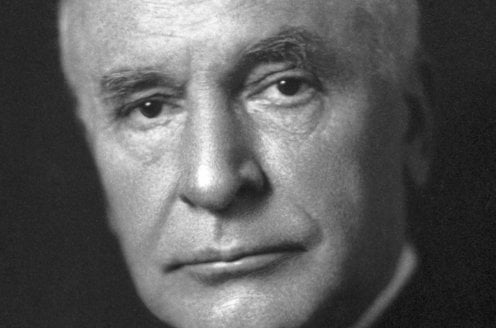
Cordell Hull was awarded the Nobel Peace Prize for his pivotal role in establishing the United Nations.
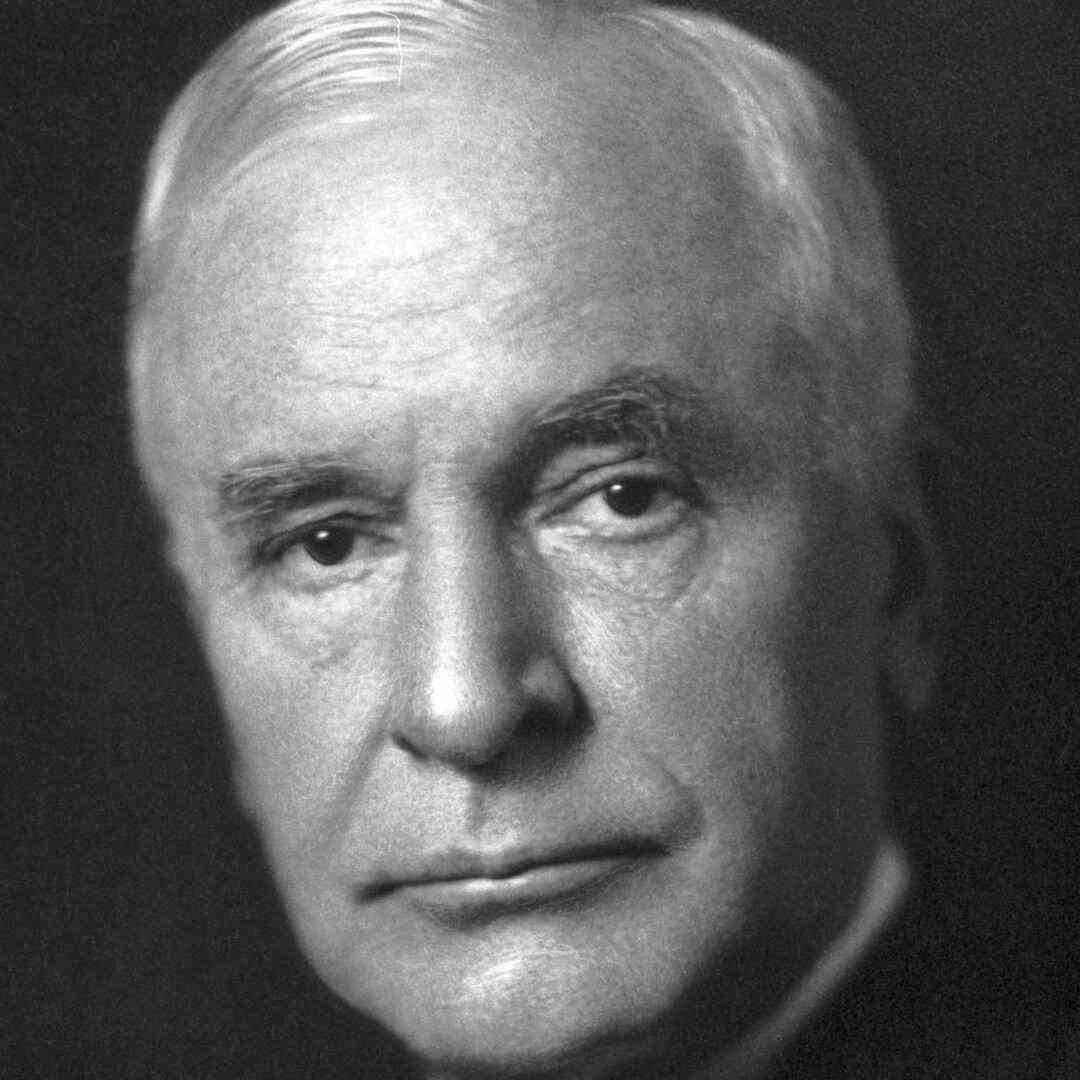
Name: Cordell Hull
Born: 2 October 1871, Olympus, TN, USA
Died: 23 July 1955, Bethesda, MD, USA
Date awarded: 12 November 1945
After the liberation in 1945, the Norwegian Nobel Committee wished to show its support for the fledgling world organisation, the United Nations. Cordell Hull, known as the “father of the United Nations,” was awarded the Nobel Peace Prize for his part in the planning of the UN during the war. This decision was taken in much the same way as the decision in 1920, when US President Woodrow Wilson was awarded the peace prize as the chief architect of the League of Nations, the predecessor to the UN. A lawyer and Democrat, Hull was USA’s secretary of state from 1933 to 1944. He was nominated for the Nobel Peace Prize several times in the late 1930s for his good neighbour policy toward Latin America. He also was lauded for successfully negotiating free trade agreements with various countries.
“Father of the United Nations, Roosevelt called him.”
Gunnar Jahn, Presentation Speech, 10 December 1945.
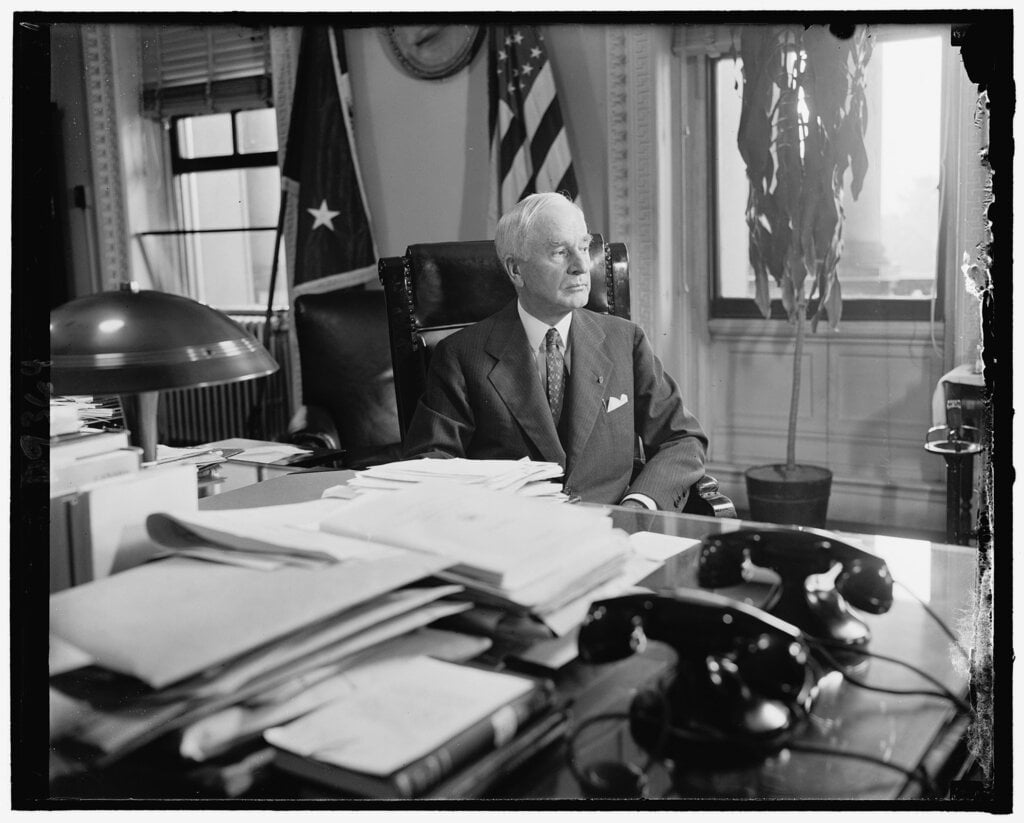
“There can be no real progress towards confidence or peace nor permanent trade recovery while retaliation and bitter trade controversies rage.”
Cordell Hull, Statement, 1931.
By awarding the peace prize to Hull, the Norwegian Nobel Committee sought not only to show its support for the UN, but also to acknowledge a long-time friend of Norway and express its gratitude to the USA, Norway’s main ally against Nazi Germany. The person who was most instrumental in the decision was Professor Jacob Worm-Müller, who submitted the adviser’s report. He cooperated closely with the Norwegian ambassador to the USA. Together they ensured that President Roosevelt’s nomination of Hull was well presented to the Nobel Committee.
Hull was nominated for the Nobel Peace Prize by Halvdan Koht, Norwegian Minister of Foreign Affairs from 1935 to 1941, and adviser to and member of the Norwegian Nobel Committee during the inter-war years. Koht ranked Hull on a par with several other candidates, including Franklin D. Roosevelt, Winston Churchill and Joseph Stalin. Koht’s nomination of Stalin indicates the high regard many Norwegians had for the Soviet Union at the end of the war. This was due to Soviet efforts during the war, especially its liberation of Eastern Finnmark in the northern region of Norway.
Cordell Hull was born in a log cabin in Pickett County, Tennessee, the third of the five sons of William and Elizabeth (Riley) Hull. His father was a farmer and subsequently a lumber merchant …
Disclaimer: Every effort has been made by the publisher to credit organisations and individuals with regard to the supply of photographs. Please notify the publishers regarding corrections.
As the Laureate was unable to be present on the occasion of the award of the Nobel Peace Prize in Oslo, December 10, 1945, the acceptance was read by Mr. Lithgow Osborne, ambassador of the United States to Norway
Your Majesty; Your Royal Highnesses; Your Excellencies, Mr. Chairman and Members of the Nobel Committee of the Storting.
I have the honor to accept, on behalf of my distinguished fellow-citizen, Mr. Cordell Hull, former Secretary of State and Father of the UNO, the Nobel Peace Prize for 1945.
I have been requested by Mr. Hull to read – on this occasion – the following message from him to the President and members of the Nobel Committee of the Storting:
As I have already informed you, the present state of my health renders impossible my presence at Oslo on this most memorable occasion. Nothing would have given me greater pleasure and satisfaction. Please let me assure you, however, that the keen disappointment and regret which I feel in this regard serve only to enhance my profound appreciation of the great honor which you have done me; and my sincere gratitude for your generous action.
The Nobel Peace Prize has come to occupy a very special place in the thoughts – and emotions of forward-looking humanity. It has become a supreme mark of distinction in the field of effort directed toward the attainment of man’s highest aspiration – the establishment of enduring peace based on justice and fair-dealing for all. I am proud to join the company of those whom you have thus far so honored. The problem of peace is uppermost today/ in the hearts and minds of all of us, as the world emerges from the staggering ordeal of the most widespread and cruel war of all the ages. That war has brought with it a truly incredible development of means of destruction and a terrifying prospect of rapid and almost limitless development in that direction. Triumphant science and technology are only at the threshold of man’s command over sources of energy so stupendous that, if used for military purposes, they can wipe out our entire civilization. Under the ominous shadow which the second World War and its attendant circumstances have cast on the world, peace has become as essential to civilized existence as the air we breathe is to life itself. There is no greater responsibility resting upon peoples and governments everywhere than to make sure that enduring peace will this time – at long last – be established and maintained. Fortunately, the war has brought with it not alone a stark realization of what another war would mean to the world, but as well the creation of an international agency through which the nations of the world can, if they so desire, make peace a living reality. Within a few weeks the organization for the maintenance of international peace and security, established by the San Francisco Charter, will be formally launched through the convocation of the first General Assembly of the United Nations. I fully realize that the new organization is a human rather than a perfect instrumentality for the attainment of its great objective. As time goes on it will, I am sure, be improved. The Charter is sufficiently flexible to provide for growth and development, in the light of experience and performance, but I am firmly convinced that with all its imperfections the United Nations Organization offers the peace-loving nations of the world, how, a fully workable mechanism which will give them peace, if they want peace. To be sure, no piece of social machinery, however well constructed, can be effective unless there is back of it a will and a determination to make it work. The crucial test for men and for nations today is whether or not they have suffered enough, and have learned enough, to put aside suspicion, prejudice and short-run and narrowly conceived interests and to unite in furtherance of their greatest common interest. That overwhelming and overshadowing common interest is enduring peace, within the frame-work of which man’s newly found powers of science and technology can be used to raise to undreamed of heights the well-being of humanity. Alfred Nobel, were he alive today, would, I am sure, have joined with me in unshakeable faith that this crucial test will be met; that the searing lessons of this latest war and the promise of the United Nations Organization will be the cornerstones of a new edifice of enduring peace and the guideposts of a new era of human progress.
Biography from the Biographical Directory of the United States Congress
Biography from U.S. Deaprtment of State
Cordell Hull did not deliver a Nobel Lecture.
Cordell Hull (October 2, 1871-July 23, 1955) was born in a log cabin in Pickett County, Tennessee, the third of the five sons of William and Elizabeth (Riley) Hull. His father was a farmer and subsequently a lumber merchant. The only one of the five boys who showed an interest in learning, Cordell wanted to be a lawyer. He obtained his elementary school training in a one-room school that his father himself had built in nearby Willow Grove; then for a period of about three years he attended in succession the Montvale Academy at Celina, Tennessee, the Normal School at Bowling Green, Kentucky, and the National Normal University at Lebanon, Ohio. He received a law degree in 1891 after completing a one-year course at Cumberland University at Lebanon, Tennessee.
Not yet twenty, Hull began the practice of law in Celina, but having participated in political campaigning even while a student, decided to run for the state legislature as soon as he came of age. From 1893 to 1897 he was a member of the Tennessee House of Representatives, abandoning politics temporarily to serve as captain of the Fourth Tennessee Regiment in the Spanish-American War. Hull returned to the practice of law, this time in Gainsboro, Tennessee, but in 1903 was appointed judge of the Fifth Judicial District. He held this position until 1907, earning the nickname «Judge», used even by his wife, Rose Frances Whitney, whom he married in 1917.
Elected to Congress from the Fourth Tennessee District in 1907, Hull served as a U.S. representative until 1931, interrupted only by two years as chairman of the Democratic National Committee. In his distinguished career in Congress, Hull was a member of the powerful House Ways and Means Committee for eighteen years, the leader of the movement for low tariffs, the author of the first Federal Income Tax Bill (1913), the Revised Act (1916), and the Federal and State Inheritance Tax Law (1916), as well as the drafter of a resolution providing for the convening of a world trade agreement congress at the end of World War I. He became, in short, a recognized expert in commercial and fiscal policies.
Hull was elected U.S. senator for the 1931-1937 term but resigned upon his appointment as secretary of state by President Franklin D. Roosevelt on March 4, 1933. He was sixty-two. In 1944 when he resigned because of ill health, he had occupied this important post for almost twelve years, the longest tenure in American history.
His debut in this office was not auspicious. He headed the American delegation to the Monetary and Economic Conference in London in July, 1933, a conference which ended in failure despite the parlous state of world prosperity. On the heels of disaster came triumph. In November of that year he headed the American delegation to the seventh Pan-American Conference, held in Montevideo, and there won the trust of the Latin American diplomats, laying the foundation for the «good neighbor» policy among the twenty-one American nations so successfully followed up in the Inter-American Conference for the Maintenance of Peace held in Buenos Aires (1936), the eighth Pan-American Conference in Lima (1938), the second consecutive Meeting of Ministers of Foreign Affairs of the American Republics in Havana (1940).
Meanwhile, given authority through the Trade Agreements Act of 1934, he negotiated reciprocal trade agreements with numerous countries, lowering tariffs and stimulating trade.
Hull was responsive, also, to the problems arising in other parts of the globe. From 1936 on, foreseeing danger to peace in the rise of the dictators, he advocated rearmament, pled for the implementation of a system of collective security, supported aid short of war to the Western democracies, condemned Japanese encroachment into Indo-China, warned all branches of the U.S. military well in advance of the attack on Pearl Harbor to prepare to resist simultaneous, surprise attacks at various points. Although Hull participated in some of the policy making conferences of the Allies, his major effort during the later stages of World War II was that of preparing a blueprint for an international organization dedicated to the maintenance of peace and endowed with sufficient legislative, economic, and military power to achieve it. Although obliged because of the precarious state of his health to resign as secretary of state in late November, 1944, Hull nonetheless served as a member of and senior adviser to the American delegation to the United Nations Conference in San Francisco in 1945.
Hull did not possess the oratorical talent, the stylistic finesse, the brilliant charm, or the impressive personality so frequently characteristic of the politician who makes his way to the front benches. Tall and lean in figure, almost shy in manner, earnest and sincere in thought and deed, Hull had the power that comes to one who is thoroughly convinced of the rightness of his political and economic policies for peace and justice, is capable of defending them against all comers, and unwearying in his efforts to give them practical form.
| Selected Bibliography |
| Buell, Raymond Leslie, The Hull Trade Program and the American System. New York, Foreign Policy Association, 1938. |
| Hinton, Harold B., Cordell Hull: A Biography, with a Foreword by Sumner Welles. London and New York, Hurst & Blackett, 1942. |
| Hull, Cordell. The Hull papers are in the Manuscript Division of the Library of Congress. |
| Hull, Cordell, Addresses and Statements by the Hon. Cordell Hull, Secretary of State of the United States of America, in Connection with His Trip to South America to Attend the Inter-American Conference for the Maintenance of Peace, Held at Buenos Aires, Argentina, Dec. 1-23, 1936. Washington, D.C., U.S. Government Printing Office, 1937. |
| Hull, Cordell, Economic Barriers to Peace: Addresses on the Occasion of the Presentation of the Woodrow Wilson Medal to the Hon. Cordell Hull, N.Y., April 5, 1937. New York, Woodrow Wilson Foundation, 1937. |
| Hull, Cordell, The Memoirs of Cordell Hull. 2 vols. London, Hodder & Stoughton, 1948. |
| Hull, Cordell, The Moscow Conference: Addresses by Cordell Hull before a Joint Meeting of Both Houses of Congress, Nov. l8, 1943. Washington, D.C., U.S. Government Printing Office, 1943. |
| Hull, Cordell, The War and Human Freedom: Address by the Hon. Cordell Hull over AII National Radio Networks, Thurs., July 23, 1942. Washington, D.C., U.S. Government Printing Office, 1942. |
| Pratt, Julius W., Cordell Hull. 2 vols. Vols. XII and XIII of the American Secretaries of State and Their Diplomacy. New York, Cooper Square Publishers, 1964. |
This autobiography/biography was written at the time of the award and first published in the book series Les Prix Nobel. It was later edited and republished in Nobel Lectures. To cite this document, always state the source as shown above.
Presentation Speech by Gunnar Jahn*, Chairman of the Nobel Committee, December 10, 1945
Cordell Hull has devoted his entire life to the stabilization of international relations. Best known to the public are his untiring efforts in the field of commercial policy, efforts inspired by his desire to counteract autarchic tendencies both in the U.S.A. and abroad. Of these efforts, which considerably influenced national policies during the period between the wars and especially at the end of the twenties, he says: «There can be no real progress toward confidence or peace nor permanent trade recovery while retaliations and bitter trade controversies rage.»1 Confidence and peace between nations have constituted his goal in all spheres of his activity. This is the driving spirit behind his fight against isolationism at home, his efforts to create a peace bloc of states on the American continents, and his work for the United Nations Organization.
Cordell Hull was born in 1871 in the state of Tennessee in the United States of America. He passed his law exams as a relatively young man, practiced for some years as an attorney, and later became a judge. But at a very early stage in his career he embarked on a political career in the ranks of the Democratic Party. It is as a politician that he is known and it is to politics that he has devoted all his endeavors from about the age of twenty. Not until 1907, however, did he enter the House of Representatives. Prior to that time it is not easy to discern any clues to his later political attitude in the international field, but his work reveals evidence of the conscientious and meticulous manner in which he attacked problems. A key to his general outlook is provided by some passages in his maiden speech in the House. In this speech he championed compulsory arbitration between workers and employers, supported efficient regulation by the federal government of railway and shipping rates, and opposed the abuse of power by large corporations in certain fields. The same basic outlook can also be detected in his speeches on tax reforms. At that time, the revenues of the federal government were derived from indirect taxation, mostly from tariffs, the United States Supreme Court having declared in 1895 that the introduction of an income tax in 1894 was a breach of the federal constitution
Refusing to accept this judgment, Hull reopened the question of taxation and, after the victory of the Democrats in 1912, managed to secure the introduction of income tax. What interests us, however, is not so much the tax reform itself, as Hull’s argument in its favor. He certainly saw it as a means of increasing federal income, but his first concern was with the effects of this tax as against those of the tariffs. He was convinced that protectionism created monopoly and enriched the few at the expense of the many, and that such a system could not be reconciled with the free competition in which he believed.
We see him here as representative of all that is best in liberalism, a liberalism with a strong social implication. At that time, however, he had not yet given utterance to his international views.
They found expression initially during the First World War. As Hinton, his biographer, says: «Up to this time Hull’s tariff theories had been based on his belief that protection was a domestic evil.»2 By the end of the war his view on economic policy could be expressed as follows: High tariffs are barriers obstructing the development of trade and friendship between nations, thereby becoming barriers also to lasting international peace.
In his great speech to Congress on September 10, 1918, he expressed his view in these words: «Believing as I have that the best antidote against war is the removal of its causes rather than its prevention after the causes once arise, and finding that trade retaliation and discrimination in its more vicious forms have been productive of bitter economic wars which in many cases have developed into wars of force, I introduced the resolution in the House of Representatives during the early part of last year which would provide for the organization of an international trade-agreement congress the objects of which should be to eliminate by mutual agreement all possible methods of retaliation and discrimination in international trade.»3
As early as 1917, he put forward the idea of an international agreement to govern the methods employed in commercial competition. The task of reducing trade restrictions was taken up in the League of Nations and a basis for the work of the following years established at the great world conference in 1927 at Geneva4. The culmination of these efforts was the World Economic Conference in London in 1933 which Hull himself attended, this time as secretary of state. All of us who took part in this work during those years know how every proposal we made encountered resistance time and again from various countries whose attitudes were governed exclusively by the political situation at home. The 1933 conference, as we know, failed to achieve anything. It may be that it was a mistake to lay so much stress on the question of stabilization of currency from the very beginning; it was this which led to Roosevelt’s famous telegram in which he rejected the plan for currency stabilization on the grounds that, as he put it, a nation’s prosperity depends more upon a healthy internal economic structure than it does upon the price of its currency in relation to the price of currencies of other nations. This attitude, which prevailed in the United States and was expressed by Roosevelt in his telegram, brought Hull’s work in this direction to a halt. As has so often been the case in international politics, people could see the difficulties in their own country and had faith in their ability to solve them in isolation from the world. Hull himself in no way subscribed to this view. In a speech given on July 27, 1933, in London, he said: «At this moment the world is still engaged in wild competition, in economic armaments which constantly menace both peace and commerce.» And a little later in the speech he added: «Indispensable and all-important as domestic programs are, they cannot by themselves restore business to the highest levels of permanent recovery.»5
Yet Hull did not give up, even though the London conference was a setback for his ideas. In 1934 he secured the passage of a bill6 empowering the president to lower tariffs by fifty percent and to reduce import restrictions for countries prepared to grant similar concessions to the United States. He was eventually able to conclude no fewer than twenty-seven trade agreements on the basis of this bill.
This law, which was subject to a time limitation, was last renewed in 1945 and authorized the president to reduce tariffs by forty-five percent. This was, of course, after Hull had retired, but it represented nevertheless a victory for his policy.
All of this marks a radical change in the economic policy of the United States; it is an affirmation of England’s policy during the free trade period, taking as a model the Cobden Treaty of 1860 of which the «most-favored nation» clause formed an integral part7. Although the change is partly due to the acceptance of the United States as a creditor nation, it signifies something more profound for Hull: it is his immutable belief that it will clear the way for improved international relations and remove one of the causes of war. It is so typical of the man: if he does not succeed with a frontal assault, then he immediately reconnoiters the flanks. He yields to defeat, but he never accepts it as final, for his belief in the cause is too firmly rooted. And he is realist enough to recognize what is politically feasible at any given time, choosing to accept that rather than await something which may, perhaps, come one day.
I have dwelt at some length on Hull’s work in formulating economic policies since it reveals characteristic traits in his philosophy and method, but in so doing I have anticipated the events of his life.
I had come to his work in the House of Representatives. He became a member of the Senate in 1929, but it was with the election of Roosevelt in 1932 that, as secretary of state8, he first had the opportunity to devote himself entirely to his ideas. Now it is always very difficult to say to what extent ideas and policies derive from the secretary of state and in what measure from the president. And this is even more difficult with a man like Hull, because, as Sumner Welles says: «Cordell Hull is the least selfseeking man I have ever known. One of the striking sidelights on the years of his distinguished statesmanship has been his willingness to stay in the background and to let others take the credit and glory. I know of several outstanding instances where Mr. Hull carefully diverted attention away from his own authorship or able sponsorship of a good plan so that some temperamental foreign government official might acquire merit in the eyes of his constituents at home as father of the proposal. Mr. Hull was content that the good idea should take root and flourish.»9
This is high praise indeed for any man, but still more laudatory when said of a politician, since it is seldom that politicians are eulogized in such terms.
It is impossible, in this brief synopsis, to review Hull’s work in the years following 1932, for this would entail an examination of the United States’ foreign policy during that period.
No foreign minister can have held office in more difficult times. As I have already mentioned, the year in which he took up his appointment heralded the defeat of economic cooperation and the accession of Hitler to power in Germany. Each year brought events that could have driven anyone to despair and that inexorably led toward another world war. Yet Hull never gave up, despite opposition both at home and abroad. If he found one path to the implementation of his ideas blocked, he would try another. If he could not achieve his ideal immediately, he would make the best of the situation and return to the attack when the time was ripe.
Nothing illustrates his approach better than his Pan-American policy and his attitude to the laws of neutrality. The Pan-American policy sponsored by Roosevelt and Hull was launched at the Montevideo Conference of 1933 at which all the American republics were represented. Roosevelt’s «good neighbor policy» was at once the starting point and the goal of a policy which, recognizing the impossibility of embracing the whole world, aimed first and foremost at creating peace and good neighborliness among the nations of the American continents. As Hull said in a private conversation, «We ought to be able to work out a pattern of life which will inspire the whole world to follow our example when the present tumult dies down.»10
At this conference a convention was successfully drafted defining the rights and obligations of each nation. Its most important clause, perhaps, was that which stated that no nation has the right to intervene in the internal or external affairs of any other. This conference was followed by the one in Buenos Aires in 1936 and by the Lima Conference of 1938. One of the achievements of the Buenos Aires Conference was the approval of an agreement for collective security and neutrality in the event of war. When the Lima Conference took place, the outlook in Europe had become more ominous, and a firmer and more somber tone could be discerned in Hull’s speeches which focused on the threat emanating from the totalitarian states. At Lima, Hull did not attain the goal which he sought. The conference certainly represented a victory for the ideals of peace, but little progress was made beyond the point reached in the conferences at Montevideo and Buenos Aires. The chief stumbling block was the stand taken by Argentina who, for several reasons, was unable to commit herself to the same extent as the United States. But to this must be added a circumstance which affected all the Pan-American conferences; namely, the relation of the countries involved to the League of Nations. The South American countries were members, the United States was not; and this fact gave rise to difficulties which prevented the conferences from achieving the desired results. In Europe, these Pan-American conferences have often been looked upon as a form of expanded isolationism, but they should not be so regarded. They are large-scale attempts to realize the ideas of peace by international cooperation wherever this appears to be practical, and to create, as Cordell Hull says, an example which will inspire the whole world.
The struggle on the law of neutrality and the fight against isolationism are so recent as to be fresh in our memories. The original law of neutrality can in one sense be said to serve the idea of peace, and it cannot be denied that isolationism was pacifist in outlook. But while the isolationists regarded peace primarily as peace for the United States, Hull envisaged a more flexible form of neutrality which would permit the United States to cooperate with other countries in maintaining peace, because, as he put it, the United States cannot unilaterally proclaim peace for herself alone. In this as in other declarations he returns again and again to the theme that peace is not to be thought of as a privilege for any particular nation. For him peace means peace among all nations. But he is realist enough to know that it is necessary to struggle to achieve it.
As already mentioned, Hull did not mince his words when discussing relations with the totalitarian states in Europe and, as the war drew nearer, he made his speeches sharper and more intense. Everything within him – his sense of justice, his deep humanism – revolted against what he considered an encroachment upon and a violation of everything that stood for decency. But on the outbreak of war his voice was dominated by that of Roosevelt, who now spoke more strongly than before as the leader of United States’ foreign policy. This had to be, and it is hard for anyone not intimately involved to assess the credit due to Cordell Hull’s work during these years. One can only draw some conclusions from the little that is known: He has devoted every effort to strengthening the forces marshaled against the aggressive powers, but at the same time has worked intensely on the problems which will arise with the coming of peace. The direction these efforts were taking could be discerned in the draft of the six clauses governing the future policy of the four great powers11, adopted at the Moscow Conference of 1943. Moreover, as we now know, he devoted strenuous efforts during the last stage of the war to the resolution of problems associated with the setting up of the new organization «The United Nations». That is his latest contribution. He says himself in the letter of resignation12 which he wrote to Roosevelt on November 21, 1944, after deciding to retire because of ill health: «It is a supreme tragedy to me personally that I am unable to continue making my full contribution to such great international undertakings as the creation of the postwar peace organization, the solution of the many other problems involved in the promotion of international cooperation, and the final development of a full and complete structure of a world order under law.»
To this letter Roosevelt replied13: «Incidentally, when the organization of the United Nations is set up, I shall continue to pray that you as the Father of the United Nations may preside over its first session. That has nothing to do with whether you are Secretary of State or not at that time, but should go to you as the one person in all the world who has done the most to make this great plan for peace an effective fact. In so many different ways you have contributed to friendly relations among nations that even though you may not remain in a position of executive administration, you will continue to help the world with your moral guidance.»
«Father of the United Nations» Roosevelt called him. Hull will assuredly not claim that the organization was his work. For him it was of very little importance whether the credit went to him or to someone else, provided the ideas triumphed. For, despite his great idealism, he has always lived in the world of reality, never doubting that it could be molded to fit the principles of justice. Principles of justice, which in the United States, perhaps more than anywhere else, become the heritage of every individual from his schooldays on, have been the guiding star of his work, the locus where life and creed become one.
It is therefore with the greatest satisfaction that the Nobel Committee of the Norwegian Parliament presents the Peace Prize for 1945 to this great American for his long and indefatigable work for understanding between nations.
* Mr. Jahn delivered this speech in the auditorium of the Nobel Institute in Oslo on the afternoon of December 10, 1945. Since Mr. Hull, the laureate, was unable to be present, Mr. Lithgow Osborne, ambassador of the United States to Norway, accepted the prize in his name. This translation is based on the Norwegian text in Les Prix Nobel en 1945.
1. Statement made by Hull in 1931. Harold B. Hinton, Cordell Hull: A Biography, p. 144.
4. The International Economic Conference (May 4-May 23, 1927).
5. From Hull’s speech on the closing day of the World Monetary and Economic Conference, Hinton, op. cit., p. 159.
6. The Reciprocal Trade Agreements Act (June 12, 1934).
7. The Cobden-Chevalier Treaty (January 23, 1860) provided for reciprocal tariffs between Britain and France.
8. Hull entered the Senate in 1931; he became secretary of state on March 4, 1933, the day Franklin D. Roosevelt was inaugurated as president.
9. Hinton, op.cit., p.v; from Foreword by Sumner Welles (1892-1961), U.S. Undersecretary of state (1937-1943).
11. Drafted by the U.S., the U.S.S.R., and England, but signed also by China.