John Raleigh Mott was born of pioneer stock in Livingston Manor, New York, the third child and only son among four children …
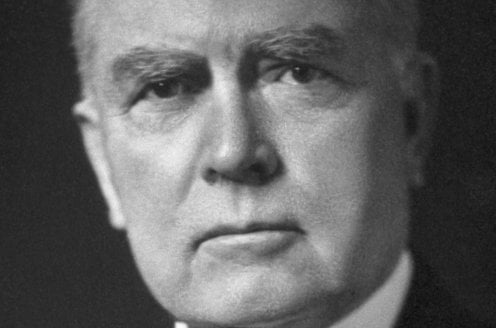
John Raleigh Mott was awarded the Nobel Peace Prize for his contribution to the creation of a peace-promoting religious brotherhood across national boundaries. He shared the prize with Emily Greene Balch.
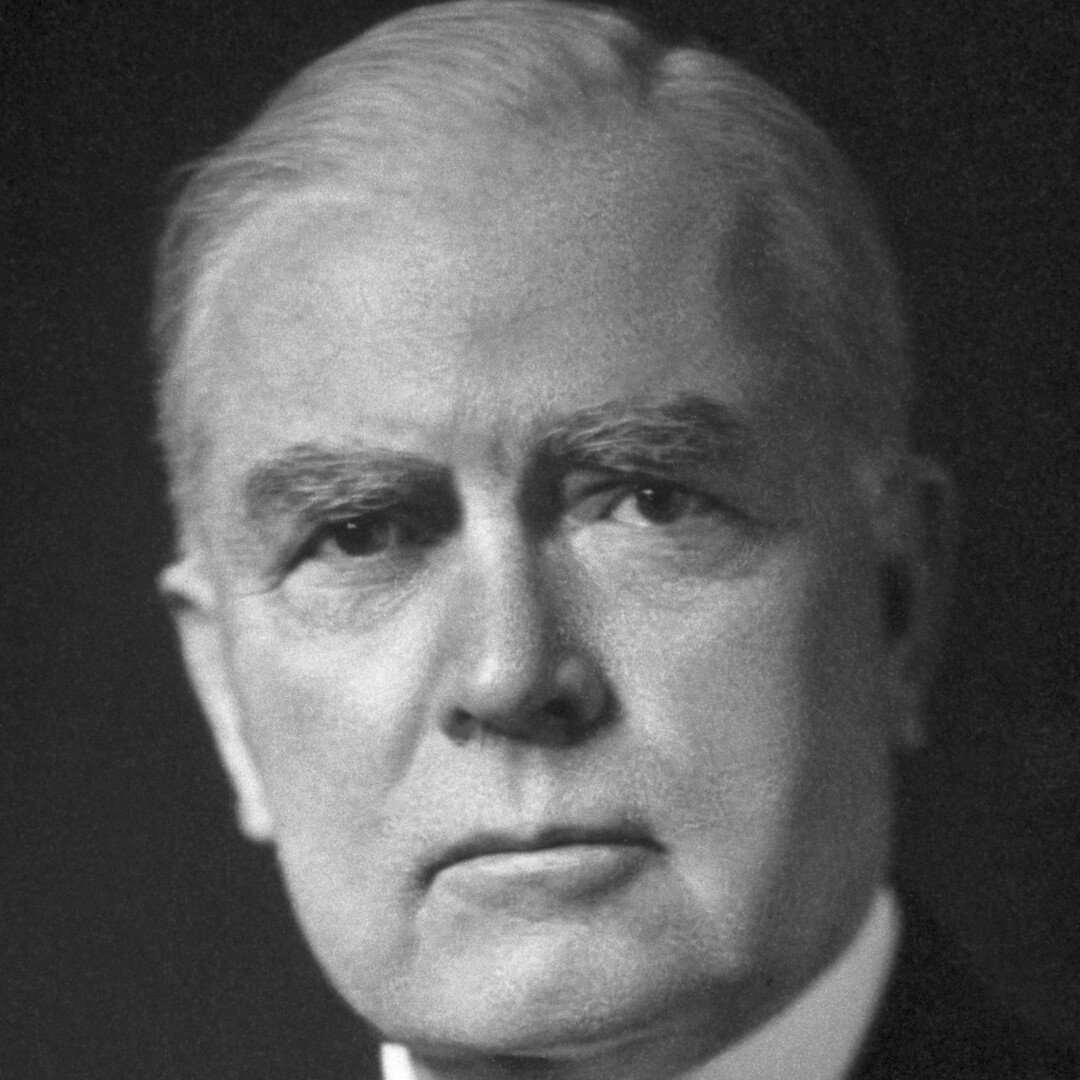
Full name: John Raleigh Mott
Born: 25 May 1865, Livingston Manor, NY, USA
Died: 31 January 1955, USA
Date awarded: 14 November 1946
John Raleigh Mott, director of the Young Men’s Christian Association (YMCA), worked to create a Christian movement across national borders. The selection of Mott as Nobel Peace Prize laureate closely paralleled the decision taken in 1930, when Bishop Nathan Söderblom (Sweden) was awarded the peace prize. At the same time, it indicated that the Committee continued to afford Christian values high esteem after WWII. As a student, Mott felt called to spread the Christian message, subsequently dedicating his life to the YMCA, missionary work and efforts to reunite Christians throughout the world. During WWI and WWII, he spearheaded YMCA relief operations for prisoners of war. In the inter-war years, Mott criticised the oppression of colonised peoples and pioneered efforts in the struggle against racial discrimination.
“I have tried to help weave together all countries, all races of mankind and all the Christian communities.”
John Mott, The New York Times, 20 December 1946.
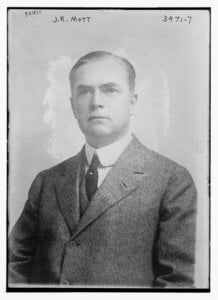
“Perhaps no man has labored more assiduously than you in the promotion of international good-will.”
President Harry S. Truman, The New York Times, 20 December 1946.
The Young Men’s Christian Association (YMCA) was founded in 1844 by George Williams (Great Britain), a young drapers shop employee. He sought to bring together Christians from different churches and social classes in a movement to spread the Christian message and deal with social need within communities. The movement quickly spread throughout Great Britain, the European continent and the USA. In 1855 it was organised into a worldwide association, which established its headquarters in Geneva in 1878. The YMCA provided extensive relief aid to soldiers and prisoners of war during both world wars. It became well-known among young people for its scout movement, which arranges camps for youths from all over the world.
In addition to his efforts as secretary-general and president of the YMCA, Mott directed the World’s Student Christian Federation and the International Missionary Council. Through his work with the student organisation, he built up an international network of Christian students. Mott hoped that some of these potential church and state leaders could be groomed for peace-related activities. At the missionary conferences, Mott called for the protection of colonialised peoples against economic and social injustice. One of the delegates in attendance was Albert Lutuli, who became leader of the black liberation movement in South Africa in the 1950s.
John Raleigh Mott was born of pioneer stock in Livingston Manor, New York, the third child and only son among four children …
Disclaimer: Every effort has been made by the publisher to credit organisations and individuals with regard to the supply of photographs. Please notify the publishers regarding corrections.
On John R. Mott from Boston University
‘Missions and Ecumenism: John R. Mott’ from Christian History Institute
Emily Greene Balch was awarded the Nobel Peace Prize for her lifelong work for the cause of peace. She shared the prize with John Raleigh Mott.
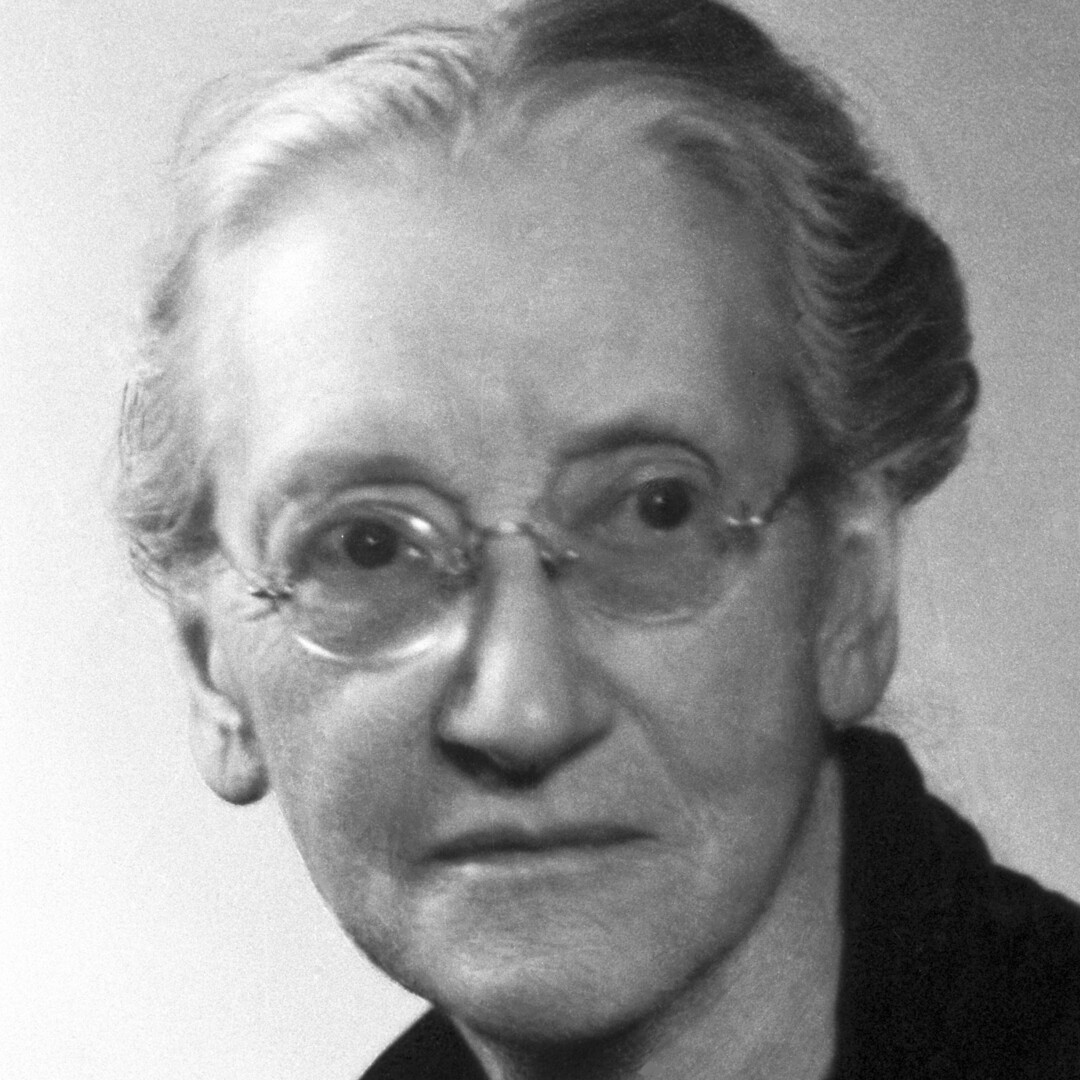
Full name: Emily Greene Balch
Born: 8 January 1867, Jamaica Plain, MA (now Boston, MA), USA
Died: 9 January 1961, Cambridge, MA, USA
Date awarded: 14 November 1946
Emily Greene Balch was awarded the Nobel Peace Prize for her lifelong efforts for disarmament and peace. She did not receive any congratulations from President Truman, as the US government had long viewed her as a dangerous radical. Balch openly declared herself a pacifist early in her career. During WWI, she worked with Jane Addams (1931 peace laureate) to convince state leaders of neutral countries to intervene to terminate the war. When the USA entered the war, Balch was labelled a traitor for her anti-war activities. In the 1930s Emily Greene Balch became president of the Women’s International League for Peace and Freedom. She cautioned against fascism and criticised the Western democracies for not attempting to stop the aggressive policies of Hitler and Mussolini.
“Emily Balch found her answer, for she believed that if we did not vanquish the evil we could not hope to achieve victory for the ideas which she herself had championed for so many years.”
Gunnar Jahn, Presentation Speech, 10 December 1946.
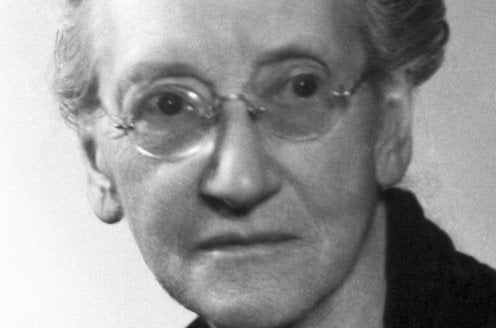
“As the world community develops in peace, it will open up great untapped reservoirs in human nature.”
Emily Greene Balch, Nobel Prize lecture, 7 April 1948.
When WWI broke out, Emily Greene Balch tried to convince the USA to act as mediator between the warring parties. Along with Jane Addams, she participated in the International Congress of Women in The Hague in 1915. After the conference, Balch and other delegates travelled throughout Europe to meet with state leaders and encourage them to seek peace. Balch travelled to the Scandinavian countries, the Netherlands and Russia. In Norway she had an almost two-hour long consultation with the king, and in all the countries the women met with leading politicians. Although they were cordially received, however, the women were not taken seriously.
The Japanese attack on the USA in December 1941 forced pacifist Emily Greene Balch to re-evaluate her views. After painful reflection, she concluded that it was possible to sanction a defensive war and acknowledged that she no longer was an absolute pacifist. As a result, she lost the trust of many members of the US chapter of the Women’s International League for Peace and Freedom. Moreover, she remained out of favour with the US government for her active opposition in 1942 to the internment of US citizens of Japanese heritage.
“… Along with her high hopes for humanity in the long run, she had a strong sense of realism that spared her false expectations.”
Irwin Abrams ‘Nobel Peace Prize and the Laureates’, page 153, Science History Publications/USA 2001.
Emily Greene Balch (January 8, 1867-January 9, 1961) was born in Boston, the daughter of Francis V. and Ellen (Noyes) Balch. Hers was a prosperous family, her father being a successful lawyer, at one time secretary to United States Senator Charles Sumner …
Disclaimer: Every effort has been made by the publisher to credit organisations and individuals with regard to the supply of photographs. Please notify the publishers regarding corrections.
John R. Mott’s Acceptance Speech, on the occasion of the award of the Nobel Peace Prize in Oslo, December 10, 1946
Your Majesty, Your Royal Highnesses, Your Excellencies, Mr. Chairman and members of the Nobel Committee of the Storting and other friends:
I do not trust myself to voice emotions which well-nigh master me in contemplation of the signal honor conferred on me in the granting of the Nobel Peace Award, and of the gracious and generous words of the President. I appreciate deeply the high privilege of being bracketed in this presentation with Miss Emily Balch, in whose distinguished career of international helpfulness I take pride.
As the President has indicated, my life has been a life of travel – for 60 years constantly moving over the wide world on journeys which first and last have taken me to 83 countries, and, what is more significant, to most of them again and again.
In this world-wide effort I have concentrated on successive generations of youth. If I were to add a word it would be a word of abounding hope. The present new generation across the breadth of the world, and whose representatives are planning to assemble here in Norway in the coming summer to take counsel together, I can testify are responsive to the Nobel Peace ideal, and are planning, as no previous generation, for a great united advance in the furtherance of peace and good-will throughout the world.
As the Laureate was unable to be present on the occasion of the award of the Nobel Peace Prize in Oslo, December 10, 1946 the acceptance was read by Gunnar Jahn, Chairman of the Nobel Committee.
I desire to express my grateful appreciation of this great honour and my pleasure in being associated in it today with Dr. John R. Mott and, earlier, with Jane Addams, with that martyr for peace and freedom, Karl von Ossietzky, and with so many others, both the publicly honored and the unknown who have served and are serving the same cause. I am happy in thinking that not I myself but the Womens’ International League for Peace and Freedom, with which I am identified, is the true recipient. Hoping, as I do, that this internationally organized body of women has ahead of it a great opportunity for usefulness in educating people everywhere toward the world-mindedness on which peace must be based with other people, I am hoping that 1946 will mark a turning point in the age-old effort to rid the world of war, to national disarmament, to renunciation of power politics, and to development of international trusteeship, not only for dependent peoples, but for regions and interests which are essentially supranational in character, such as the Polar regions and the main waterways of the world, including the Mediterranean and all the great strategic canals, among them the Panama.
“Emily Greene Balch: The First Quaker Nobel Peace Prize Winner” by Irwin Abrams
On Emily Greene Balch from VCU Libraries
Nobel Lecture*, April 7, 1948
It is natural to try to understand one’s own time and to seek to analyse the forces that move it. The future will be determined in part by happenings that it is impossible to foresee; it will also be influenced by trends that are now existent and observable. We speculate as to what is in store for us. But we not only undergo events, we in part cause them or at least influence their course. We have not only to study them but to act. Especially is this true as regards peace in the future. The question whether the long effort to put an end to war can succeed without another major convulsion challenges not only our minds but our sense of responsibility.
As to judging our own time, and thereby gaining some basis for a judgment of future possibilities, we are doubtless not only too close to it to appraise it but too much formed by it and enclosed within it to do so. Nevertheless, while we wait for the future social historian, we can make some provisional observations.
We seem to distinguish at least certain characteristics of our period. Without attempting to list them all, we note the following:
(A) This is a period of change. Probably people always feel that they are living in a time of transition, but we can hardly be mistaken perhaps in thinking that this is an era of particularly momentous change, rapid and proceeding at an ever quickening rate. This change is traceable to many causes. A major one which no one can overlook is technological and based on inventions and discoveries which have altered the whole basis of production and deeply affected social relations. This great change which began with the inventions of machinery in the late eighteenth century doubtless is not closed with the development of atomic energy. The change from peasant agriculture and handicraft to machinery is a main dividing line in human history.
Another cause of change, one less noticeable but fundamental, is the modern growth of population closely connected with scientific and medical discoveries. It is interesting that the United Nations has set up a special Commission to study this question1.
A third and sufficiently obvious cause of change is the impact of the series of terrible wars that have recently afflicted mankind. The First World War, and especially the latest one, largely swept away what was left in Europe of feudalism and of feudal landlords, especially in Poland, Hungary, and the South East generally. These wars appear also to have given its death blow to colonialism and to imperialism in its colonial form, under which weaker peoples were treated as possessions to be economically exploited. At least we hope that such colonialism is on the way out. What will be the conditions of so-called “satellite countries” we cannot yet know.
These wars also greatly altered the relative standing of the leading countries. The role of Italy and of Austria has diminished as has that of France and Britain; Germany and Japan have suffered catastrophically. Meanwhile Russia and America have increased in stature. The world looks with interest to see what may come out of Asia, with a new India and (one hopes) a new China; and also out of Australia. While Europe is hard hit and lies at the moment almost prostrate, there is on the horizon promise of a long needed integration which, if it succeeds, may mean a new European Epoch in which she will remain “a mother of culture” and no longer be also a “mother of wars”.
In a plastic period like this it seems as though anything could happen. Such a time is hard on those who lack resilience and capacity to readjust themselves, and on those who depend for their inner stability on accustomed conditions and old habits. On the other hand, it has immense appeal for the adventurous. Those who are rooted in the depths that are eternal and unchangeable and who rely on unshakeable principles, face change full of courage, courage based on faith.
(B) A second characteristic of our time is the prevalence of nationalism. This is still spreading, affecting new communities, more peripheral regions and so-called backward peoples. Like all great movements it has its good and its bad sides. As the particularism of the feudal Middle Ages in Europe was outgrown, great national states united men in larger and more reasonably constituted units than those brought together by inheritance and conquest. Politically it was, insofar, a cohesive and constructive force. In its cultural and romantic aspects, also, there is in it much that is precious especially in the fields of literature, art, and folklore in its widest sense. On the other hand, nationalism has proved excessively dangerous in its divisiveness and its self-adulation. It has given us an anarchic world of powerful armed bodies, with traditions steeped in conquest and military glory, and of competing commercial peoples as ruthless in their economic self-seeking as in their wars. It has given us a considerable number of states, each claiming complete and unlimited sovereignty, living side by side without being integrated in any way or under any curb, governed by an uneasy balance of power manipulated by diplomatic maneuvering, based not on principles accepted by all but on reasons of state, recognizing no common religious or ethical control nor any accepted rules of conduct and united by no common purpose. At the same time they are, alas, furnished with vastly increased powers of physical destruction and with the latest and most dreadful of modern weapons – psychological control of men’s minds through the arts of propaganda and “thought control”, by means of censorship and otherwise.
This divided condition of a nationalistic world is in marked contrast to the relative universalism of various earlier historical periods. We recall for instance the eighteenth-century éclaircissement when human reason and gentle manners were exalted and the French language was the joint possession of civilized people.
We recall the universalism of the Christian Middle Ages which recognized one dogma, one authoritative church commanding large revenues, and one language for all who could read and write.
We recall still earlier the period of the great Roman peace, with one classic tradition, one political model, and one literary medium.
The dangers of this divided nationalist world have been experienced, they have been studied and investigated, but it has been easier to see the need of some new way of uniting the peoples than to realize it.
It is, however, easy to exaggerate the degree to which modern peoples are divided and unrelated. Without a common loyalty to either a state or a church they have nevertheless a vast deal in common. This brings us to a new division of our subject – an effort to analyse some of the trends which run like common threads through the unorganised mass of the population of the world.
(1) First let us consider the urge toward liberty. In the shape of revolt from alien domination and of demand for independence this has been a major shaping force in modern history. The desire for liberty has also made itself felt as struggle against domestic tyranny or arbitrary rule.
At the same time, liberty, as a personal ideal, as a revolt against authority in the realm of ideas, has enriched men’s minds and strengthened their character and self-dependence. It has been a great current of fresh air quickening the atmosphere. The sense that freedom, in this sense, is a supreme value for the individual, a necessity for advance and growth, is not shared by all peoples; the acceptance or refusal of this ideal of freedom is perhaps the deepest cleft between the communist and non-communist worlds.
At the same time it is fair to realize that it is not easy to be consistent. “Founding fathers” of the American Republic were able to say that men were born equal and at the same time uphold Negro slavery. Men who are scandalized at the lack of freedom in Russia do not ask themselves how real is liberty among the poor, the weak, and the ignorant in capitalist society. In the same way men who are aghast at what they call “wage slavery” tolerate in their social system the hideous infringement on human personality of a totalitarian police state.
(2) Democracy is a second ideal widely influential throughout our whole modern world. Doubtless the word has different meanings to different people. We say that to the Russians “democratic” means favourable to the Soviet system and that to the Western peoples it means friendly to the parliamentary form of government. There is nevertheless a basic area of common meaning in spite of the fact that each is concerned with a different aspect of one immensely challenging and difficult ideal. They both mean by a democratic system one which serves the interest of all men alike and not that of privileged persons, and one in which the ultimate power is in the hands of the entire population and wielded in their name, a society in which inequities and inequalities are reduced to a minimum. May we not say that this democracy was the aim of both Lenin and Lincoln2, though in different forms and in vastly different settings?
(3) A third ideal that has made its way in the modern world is reliance on reason, especially reason disciplined and enriched by modern science. An eternal basis of human intercommunication is reason. “Come let us reason together.” Modern science, and not least modern psychology, is a powerful solvent of ideas and superstitions and prejudices that keep men apart, and a scientific code has been evolved which is at once a tool and a commandment. It demands honest objectivity, scrupulously clean of any influence except the desire for the truth. (This does not mean of course that all men of science are free from all bias.) One of the most alarming of modern developments has been the rise in Nazi Germany and now, to some extent at least, in Russia, of the belief that political expediency, not truth, must guide research and that loyalty is owed not to truth but to a preaccepted dogma. Yet even so, science is a very real bond.
(4) A fourth element of the one world in which we more and more consciously live is a growing humaneness, a revolt against all avoidable suffering, a new concern for social welfare in all its aspects. This motive has increased in both Christian and non-Christian communities. One of its most striking manifestations was the revolt against chattel slavery and slave trading3 which led to international repudiation of these abuses. Another aspect was the effort to humanize the conditions of labour, at first within the national framework, beginning with the earliest factory legislation in England4, and later internationally, especially through the ILO5 and through trade union action.
It is impossible to do more than allude to the growth of the assistance offered in time of catastrophe and at all times to the poor, the needy, the sick, the delinquent. The Red Cross, the Save the Children work6, in which Scandinavian countries have been so active – these and many other movements constitute strong and sensitive ties which tend to make one society of all the people of the world. It looks as though the systematic assistance proposed in the Marshall Plan to help Europe to recover economically7 after the shock of the war, might be the means of knitting Europe together as it has never been before.
(5) Another thing – men are everywhere becoming less “private-minded”. There is a growing community sense. It is as though the urge which found expression in monasteries and nunneries in the Middle Ages were finding new expression. In the political field this consciousness of the common interest and of the rich possibilities of common action has embodied itself in part in the great movements toward economic democracy, cooperation, democratic socialism, and communism. I am sure we make a great mistake if we underrate the element of unselfish idealism in these historic movements which are today writing history at such a rate.
A dark and terrible side of this sense of community of interests is the fear of a horrible common destiny which in these days of atomic weapons darkens men’s minds all around the globe. Men have a sense of being subject to the same fate, of being all in the same boat. But fear is a poor motive to which to appeal, and I am sure that “peace people” are on a wrong path when they expatiate on the horrors of a new world war. Fear weakens the nerves and distorts the judgment. It is not by fear that mankind must exorcise the demon of destruction and cruelty, but by motives more reasonable, more humane, and more heroic.
(6) Another very interesting trend which it is not easy to classify is the growing repudiation of coercion, especially of violent or physical coercion. This is related to the championship of liberty, especially to respect for the liberty of others; it is related to the growth of compassion and helpfulness, but it is distinct. I think it is not yet rated at its full value and that it is to have a very deep significance.
In this regard there has been an astonishing silent revolution unorganised and spontaneous. Consider as an aspect of this the relation of husband and wife, in which the idea of authority and coercion has given way to the ideal of a relation quite free from these elements. The “Doll’s House” is gone or going8. In the relation of parents and children a parallel change has come about, perhaps even more strikingly. In education, reliance on fear has been abandoned and reliance on rivalry and competition is increasingly repudiated. In the treatment of crime the best practice is directed not toward punishment but toward re-education. In the political structure likewise every effort is made to replace coercion by consent.
The most dramatic exponent of this refusal of violence is the great-souled Indian Gandhi9. He gave his life trying to find ways to oppose domination and coercion without resort to hate or violence.
(7) In listing these tendencies making for a new world, we must not forget developments in the religious or spiritual thinking and feeling of mankind, where also we feel a strong unifying trend. There is a revulsion from dogmatic creeds and from the sectarianism of Protestant Christianity. There is a great interest in comparative religion and a desire to understand faiths other than our own and even to experiment with exotic cults. There is a tolerance which (where it is not mere apathy and indifference) means unwillingness to force one’s belief, however precious it seems to oneself, on others. Where our forbears not so long ago held that those who did not accept the correct faith were bound for literal hell fire, we feel the development of a new spiritual climate. The Christian reads Rabindranath Tagore10, and the Hindu Gandhi reads the Sermon on the Mount, and wise men from every quarter of the globe discuss their differences fraternally and humbly.
I have been much interested in Professor Ernest Hocking’s book Living Religions and a World Faith11, in which he tries to chart the wide, and widening, area of religious agreement across religious frontiers.
(8) I have no idea of making a comprehensive list of unifying tendencies and can barely refer to one of the master qualities of our common human endowment, desire for beauty – desire to perceive and, above all, to create beauty. Art in its myriad forms – music, literature, architecture, sculpture, painting, and handicraft – endows mankind, at least potentially, with common treasures in words or colour or harmonies, which modern technical inventions, from photography to radio, tend to spread without limit.
(9) We have been speaking of forces making for unity mainly on a psychological level. But an influence which is not ideological so much as practical and external is of absolutely prime importance. I refer to the technical advances which are so rapidly and widely remaking the world. Industrialization based on machinery, already referred to as a characteristic of our age, is but one aspect of the revolution that is being wrought by technology. Under modern conditions our physical setting tends towards sameness. More and more we have the same trains and the same airplanes, the same bathrooms and the same picture galleries, the same hospitals, the same food, and the same fashion in clothes. These develop the same habits and with these the same ideas and same mind set. To take a tiny example, a population where everyone has a watch is deeply affected in the way it conducts its activities, economic and social, by this simple fact. Technology gives us the facilities that lessen the barriers of time and distance – the telegraph and cable, the telephone, radio, and the rest. But technology is a tool, not a virtue. It may be used for good or bad ends, and bringing men closer does not make them love one another unless they prove lovable. Multiplying contacts can mean multiplying points of friction.
(10) Dissemination. Under modern conditions the spreading of ideas, of hard-won knowledge, of achieved beauty goes on unceasingly and is largely spontaneous. There is also an endless network of organized cooperation among specialists in every field, through learned societies, technical journals, exhibitions, literary reviews, all of which tends to make accessible to all whatever has been created or learned.
“Movements” too, of all sorts, universalize themselves in the same way by a natural osmosis and by deliberate propaganda.
Considering much that tends toward the unity of mankind, we have noted such matters as liberty, democracy, humaneness, public spirit, repudiation of coercion and violence, spiritual universalism, common cultural treasures, sameness of physical environment and habits, technical control of time and space, and the tendency to universalize both achievements and ideas.
In thinking of trends to unify mankind, we must face squarely, without underrating them, all that tends to the contrary, tends to divide men, to separate and hold them apart, to array them consciously and passionately against one another. Not only democracy and the cult of humaneness mark our age, but also greed, violence, the self-adulation of national and racial groups, the fanaticism of political cults like fascism or nazism, the glorification of might and power for their own sake, the blind reliance on violence as that before which all idealism is but a dissolving mist. All these things we know only too well.
We have lived through the flood time of fascism and of the nazism which ran its meteoric course at a cost to mankind in suffering and waste beyond all computation. These ideas are not yet as dead as they may appear on the surface, as we know.
Totalitarianism is another force that seems still to be gaining ground. It may be due partly to the urge for effective and rapid political techniques and impatience of political democracy with its often provokingly slow and fumbling processes. It may be due largely to cynicism regarding liberalism and individualism in the economic process. It seems, however, to be emphatically on the wrong path.
A most dangerous aspect of totalitarianism is that which is typified in the phrase “the iron curtain”, the endeavour to shut off the contagion of the ideas that are now interpenetrating the rest of the world. It is hard to believe that the natural spread of ideas and experiences can be cut off either totally or for a very long time.
We know so well these things that divide us that it has seemed useful to stop and sort out and examine more especially threads that run through society drawing it together.
We must not be discouraged that the threads of our social texture cross one another. We must remember that nothing can be woven out of threads that all run the same way. This figure of speech can easily be abused – I only want to point out that differences as well as likenesses are inevitable, essential, and desirable. An unchallenged belief or idea is on the way to death and meaninglessness.
That these clashes of ideals and purposes should take the form of war is, however, intolerable. Indeed in the light of all that mankind has achieved and desired it seems almost incomprehensible that it is today so largely occupied in preparing for war in more hideous forms than ever before. Huge sums of money and treasures of human cleverness and industry are invested in inventing new and more ghastly poisons, methods of disseminating diseases and perfecting instruments of destruction instantaneous and almost unlimited.
The attempt to put an end to war is a special and urgent task which we must solve and solve soon. It is a necessary complement to the forces that are bringing men closer together if these are to prevail over those that divide men into hostile camps.
The ideas that men share and the needs that they all feel, need a suitable organ. They need an institutional body to make them effective. The nation created the national state. The world community must create a political expression for itself.
This is the subject of the second part of this discourse.
We come, then, to the second part of this topic, the effort to organize world society.
Many individuals and many movements have directed efforts to this end. They form a considerable part of the whole body of work for peace, though not the whole of it.
The peace movement or the movement to end war has been fed by many springs and has taken many forms. It has been carried on mainly by private unofficial organizations, local, national, and international. I would say that peace workers or pacifists have dealt mainly with two types of issue, the moral or individual, and the political or institutional. As a type of the former we may take those who are now generally known specifically as pacifists. Largely on religious or ethical grounds they repudiate violence and strive to put friendly and constructive activity in its place.
There has been personal refusal of war service on grounds of conscience on a large scale and at great personal cost by thousands of young men called up for military service. While many people fail to understand and certainly do not approve their position, I believe that it has been an invaluable witness to the supremacy of conscience over all other considerations and a very great service to a public too much affected by the conception that might makes right. It is interesting that at the Nuremberg war guilt trials the court refused to accept the principle that a man is absolved from responsibility for an act by the fact that it was ordered by his superiors or his government. This is a legal affirmation of a principle that conscientious objectors maintain in action.
It is to me surprising that the repudiation of the entire theory and practice of conscription has not found expression in a wider and more powerful movement drawing strength from the widespread concern for individual liberty. We are horrified at many slighter infringements of individual freedom, far less terrible than this. But we are so accustomed to conscription that we take it for granted. A practical and political form of opposition to conscription is the proposal, first put forward, so far as I know, by an American woman, Dorothy Detzer, long secretary of the United States Section of the Women’s International League for Peace and Freedom12. She urged something that suggests the Kellogg Pact but is quite specific, namely a multilateral treaty between governments to renounce the use of conscription. A bill to this effect is now in the United States Congress but attracts little attention.
I feel it rather surprising also that refusal of war has never taken the form, on any large scale, of refusal to pay taxes for military use, a refusal which would have involved not only young men but (and mainly) older men and women, holders of property.
Peace work of this first type relies mainly on education. The work done and now being done to educate men’s minds against war and for peace is colossal, and can only be referred to.
Perhaps it is under this head that the Nobel Foundation and the work of Bertha von Suttner13 should be listed; for this the world, and not alone the beneficiaries, must be grateful.
The other type of “peace” activity is political, specifically aiming to affect governmental or other action on concrete issues. For instance, peace organizations criticized the terms of the Peace Treaties made at Versailles and (in America at least) opposed the demand for unconditional surrender in the Second World War.
The Women’s International League for Peace and Freedom (with which I have long been connected) has worked both as an international body and in its national sections from 1915 till now, and I trust will long do so, in the political field of policies affecting peace, though not alone on the political level. Among its strongest supporters have always been Scandinavian women. I am presenting to the Nobel library, if I may, a brief history of this organization, A Venture in Internationalism, a pamphlet now out of print and consequently rare.
The form of work for peace which has most obviously made history is the long continued effort to create some form of world organization which should both prevent wars and foster international cooperation.
The efforts to secure peace by creating a comprehensive organ have been many and varied. One of the most curious was the confederation of certain tribes of Iroquois Indians in America known as “The Six Nations”. One of the earliest was the ancient Amphictyonic Council in Greece. There has been a long series of schemes, each more or less premature and utopian, but each making its own contribution, from those of Sully and William Penn and Kant to Woodrow Wilson and his co-workers and successors14. Wilson did not live to see the League of Nations established, nor did his own country ever join it. At present there is a tendency to underrate its importance. I, for one, would not for a great deal lose out of my life my years in Geneva during the first springtime of the hopes and activities of the League of Nations.
As we know only too well, the, League of Nations, lacking Russia and the United States, was not sufficiently inclusive. Also when the pinch came, different governments proved unready to make the sacrifices or face the risks involved in effective opposition to imperialism in Japan, reaction in Spain, fascism in Italy, or nazism in Germany.
The new institution, the United Nations, has some marked advantages over its predecessors. Its origin was the work, not of a small group of statesmen mainly preoccupied with elaborating the treaties of Versailles and the rest, but was worked out in careful preliminary discussion, first at Dumbarton Oaks, then at San Francisco15, by a comprehensive group of countries which included, this time, the United States and Russia, though not the Axis powers, and which owes an immense debt to President Franklin Roosevelt. It has the experience of the League of Nations to draw upon, and the Second World War offers it useful warnings. With less of a flush of idealism, hopefulness, and confidence than the League of Nations enjoyed in its early days, it is soberer, and Norway has given it in Trygve Lie16 a secretary-general who inspires confidence and hope.
On the other hand, it suffers from handicaps that the League of Nations did not. Most serious of all, unlike the League of Nations, it is called upon to begin its active life before the peace treaties are complete. Germany and Austria and Japan are still occupied. A war settlement is a problem that, as has been said, “evokes all the appetites”. The world is not even technically at peace; an agreement has not yet been reached on the absolutely crucial question of Germany. The United Nations is moreover faced with the necessity for immediate decision and action on several peculiarly poignant and complicated problems in Greece, in Palestine, in Korea, and elsewhere. Still more it operates in a world half wrecked by the destruction of war on an unimagined scale. We are more or less used to famine in India and China (though I suppose it is as painful there as nearer home). Now we see Europe herself hungry, collectively and separately, covered with masses of broken rubble, charred timber, and vast fields that carry white crosses instead of grain. Production and trade are so deeply affected that their reconstruction presents problems which would be almost insuperable even if they were not complicated by political difficulties. At the same time there is extraordinarily bitter ideological and nationalistic opposition between the Soviet Union, with its friends, and the Western democracies, so that two great powers, or blocs of powers, face one another in mutual suspicion and fear.
That the new world organization has done as well as it has under such circumstances is surprising. Indeed the fact that it has actually been set up and is actually functioning is, if you think of it, a miracle.
But its testing time is not yet passed. In the crucial matter of national disarmament and organization of collective security forces, either as constabulary or as military, it has made no obvious progress. In regard to the throat gripping problem of effectively controlling the use of atomic energy it is stalled by what seem on the surface like trivial differences as to how to proceed. The still uglier menaces of bacteriological warfare and other abusive uses of scientific knowledge are not, so far as I know, even under discussion.
This failure to equip itself with force has led to a widespread impatience, and one of the most striking recent developments in the peace field is a widespread and eager demand for actual world government. One must feel great interest in this growing movement. It is doing important service in educating people to the need of limiting national sovereignty – of sacrificing national self-will and national self-determination, as far as may be necessary, for the sake of the will and purpose of the all-inclusive human group.
But this movement has also its very real dangers. Insofar as it leads to depreciation of the United Nations and to the growth of a certain cynicism in regard to it, it must be deplored. My hesitations go further than this, however. I see governments as a peculiar historical type of organization which is not necessarily the last word in human wisdom. We have, I believe, yet much to learn, possibly from China, Russia, India, and from the Montesquieus of the future as to possible political forms. Do not let us force our young and still plastic world organization prematurely into old and rigid molds.
Governments seem to have a bad inheritance behind them. They are dangerous because we personify them and idealize them and because they are tainted with lust for power and with much too great concern for prestige. Above all, they are the final depository of the power of physical coercion which is elsewhere more and more discarded. What is a government? It is what owns and operates armies and navies, and polices and taxes subjects. (As for taxes they are all right as long as they are for right objects and in right measure, and people in general, I suspect, are not taxed nearly enough quite as often as too much.)
Sometimes what is meant by “world government” is a body modelled more or less closely on the Swiss or American pattern, with its executive and legislative branches and its judiciary. Sometimes the idea is a much more modest one, and what is proposed is merely a delegation of strictly limited powers to a central authority with especial view to the control of aggression and prevention of war. There is what seems to me a rather naive hope that the dangerous possibility of having to discipline a nation which refuses to abide by international legislation can be circumvented by directing coercive action against individuals not governments. In 1939 what individual would have been singled out for discipline if not Hitler? And would an attempt to discipline Hitler not have meant fighting a great people in arms?
I admit the critical importance of organizing collective security against violence and aggression, and certainly a highly important function of the United Nations, as of the League of Nations, is to prevent situations out of which “shooting wars” develop, and, finally, to control by collective action aggression by the ill-disposed or wrongly led. Up to date no adequate solution has been achieved. Conceivably possible, conceivably adequate and effective are non-military controls, moral pressure, collective political pressure, collective economic pressure through so-called economic sanctions of many kinds and, finally, organized police methods and armed constabulary forces of a non-military type. Yet such methods are apparently being little studied.
Disarmament, so fundamental to a really peaceful world, certainly does not look near or even nearer than it was.
Yet, important as are the methods of preventing aggression, curbing violence, and creating collective security, which are the special field of the Security Council, I regret that there is not more vivid public interest in the other aspects of world organization, especially in the growth of world cooperation in different fields. This functional approach to world unity seems to hold very great promise. The organization of such cooperation comes not as the expression of a theory but as an answer to felt needs. It is the direction in which the United Nations is making growth spontaneously in response to the pressure of realities and the call to get together on common business that needs to be attended to. The list of the special commissions and other agencies already at work is long and is destined to be longer. Besides those in the field of security, there are those dealing with Labour, Trade, Transportation, Civil Aviation, Communications, International Law, Banking and Money, Human Rights, the Status of Women, Food and Agriculture, Health, Control of Epidemics, Refugees and Displaced Persons, Education, Science and Culture (with innumerable subdivisions), Trusteeship, the enormous question of Population, Statistics, and so on.
Thomas Carlyle used to talk of “organic filaments” and in the cooperative organs of the United Nations we seem to see the time-spirit weaving a web of the peoples and creating, we hope, an unbreakable fabric binding all together by the habit of common work for common ends.
The administrative aspect of the United Nations also seems to have great possibilities of development, and international administration is in this context one form of cooperation.
The administrative function of the United Nations is up to now chiefly exerted in the form of trusteeships17. This idea of political trusteeship is one of the relatively rare inventions in the political field. It is curious that while inventions in the technological field, in the arts of dealing with matter, are so numerous and effective, men are so relatively poor in inventions for dealing with one another. The Greeks gave us public assemblies, the British their representative parliaments and parliamentary government. Switzerland and the United States created federal patterns of government combining centralization with decentralization. But on the whole the list is a meagre one and one of the latest of these, modern propaganda, is a sinister and portentous development of legitimate education of public opinion.
The conception of the public trustee, whether an individual or a body, may prove a fruitful political idea. In the United States, hospitals, colleges, all sorts of undertakings for the public welfare are largely carried on by boards of trustees entrusted with their administration, and they have an honourable record of devotion to their trust. The same man, who, trading in Wall Street, prides himself on his skill in making money, conceives of himself when he finds himself trusted to carry on a public service, as a public servant, and devotes his ability no longer to making money for himself but to the welfare of the park, or the research foundation, or other matter with which he now identifies himself.
But colonies are not the only field for possible international administration. It is greatly to be deplored that aviation, so international by its very nature, has thus far developed along lines of private and competing business. It is a thousand pities that it evolved too early, or world organization too late, for it to grow up from the start as the common business of the peoples of the world. This would have had an enormous influence on the character of war and on its control as well as on international intercourse. Atomic power likewise demands international administration, and it is at least recognized that this is so.
The world of waters, the international waterways of the globe, are as yet unpreempted. Until yesterday Britannia ruled the waves, and her place has not yet been taken in this regard. Why should not the United Nations now create a supreme authority over both the “ocean seas” and the channels and canals, artificial and natural, which are of peculiar importance and create peculiar political problems?
To suggest but one instance, the internationalization of the Dardanelles under properly equipped world authority would take the poison out of one of the “hottest” spots on the political map.
The uninhabited Polar areas are another area that seems peculiarly fitted for international administration under the United Nations. They are now largely unappropriated, and the claimants and rivalries there are continually getting more numerous and more clamorous.
It is to be hoped that at the next General Assembly some government will get these two matters put on the agenda and ask to have two special commissions appointed to study the Polar and maritime problems and make recommendations.
World organization of a functional and not a governmental type is also beginning on the cultural level. If UNESCO18 has not yet fully found itself, that is because the potentialities that lie before it in the field of science, music, art, religion, and education are so vast and as yet so undefined. Here what is wanted is not so much administration as contact, consultation, cooperation.
If UNESCO succeeds, as it well may, in securing the general adoption of a universal auxiliary language, such as the International Language Association is now engaged in selecting and elaborating, it will be the dawn of a new day in literature such as the world has hardly dreamed of. None of the natural languages will be tampered with, reformed, or cut down to a restricted base. But all men who can read and write may command an idiom universally understood. This will not only be an enormous advantage in business, in travel, and in all sorts of practical ways. Far more important will be its service in the world of ideas. Poets and the great writers will have open to them a reading public including not only all European and American peoples but the Chinese, the Arabs, the island peoples, and the people of Africa, who may yet make a great contribution. Music and mathematics already command a universal notation not yet available for the expression of thought. Such a public for the printed and spoken word, comparable to that for music, would give an immense impetus to world literature.
In such a world all war would be civil war, and we must hope that it will grow increasingly inconceivable. It has already become capable of such unlimited destruction and such fearful possibilities of uncontrollable and little understood “chain reactions” of all sorts that it would seem that no one not literally insane could decide to start an atomic war.
I have spoken against fear as a basis for peace. What we ought to fear, especially we Americans, is not that someone may drop atomic bombs on us but that we may allow a world situation to develop in which ordinarily reasonable and humane men, acting as our representatives, may use such weapons in our name. We ought to be resolved beforehand that no provocation, no temptation shall induce us to resort to the last dreadful alternative of war.
May no young man ever again be faced with the choice between violating his conscience by cooperating in competitive mass slaughter or separating himself from those who, endeavouring to serve liberty, democracy, humanity, can find no better way than to conscript young men to kill.
As the world community develops in peace, it will open up great untapped reservoirs in human nature. Like a spring released from pressure would be the response of a generation of young men and women growing up in an atmosphere of friendliness and security, in a world demanding their service, offering them comradeship, calling to all adventurous and forward reaching natures.
We are not asked to subscribe to any utopia or to believe in a perfect world just around the comer. We are asked to be patient with necessarily slow and groping advance on the road forward, and to be ready for each step ahead as it becomes practicable. We are asked to equip ourselves with courage, hope, readiness for hard work, and to cherish large and generous ideals.
* The laureate delivered this lecture in the auditorium of the Norwegian Nobel Institute. The text is taken from Les Prix Nobel en 1947.
1. The Population Commission of the U. N. Economic and Social Council.
2. Nikolai Lenin (1870-1924), key figure in founding U.S.S.R. Abraham Lincoln (1809-1865), president of the U.S. (1861-1865).
3. England abolished slavery in 1833, the U.S. in 1863, Brazil in 1888; other parts of the world by the Berlin Conference (1885), the Brussels Act (1890), and the League of Nations Convention (1926).
5. Recipient of the Peace Prize for 1969.
6. Founded in 1920, the Save the Children International Union became the International Union for Child Welfare in 1946; headquarters are in Geneva.
7. Inaugurated in 1947; see George C. Marshall, recipient of the Peace Prize for 1953.
8. A play by the Norwegian dramatist Henrik Ibsen (1879) about a woman’s rebellion against her fate as a “doll” in her husband’s house.
9. Mohandas Gandhi (1869-1948), Hindu philosopher and statesman.
10. Sir Rabindranath Tagore (1861-1941), Indian poet and philosopher, recipient of the Nobel Prize in Literature for 1913.
11. New York: Macmillan, 1940.
12. Dorothy Detzer (1900- ), social worker at Hull-House (1918-1921); relief worker in Vienna (1921-1922), in Russia (1922-1923); executive secretary since 1925.
13. Recipient of the Peace Prize for 1905.
14. Founded about I 570; the six “nations” were the Mohawk, Oneida, Onondaga, Cayuga, and Seneca tribes, which were later joined by the Tuscarora tribe. Amphictyonic Council: the Delphic Amphictyony, composed of deputies from 12 Greek tribes, originally provided for collective protection of shrines but in 6th century B.C. also provided for collective security against destruction of any of its members. Maximilien de Béthune, duc de Sully (1560-1641), French statesman, proposed a confederation of all Christian nations. William Penn (1644-1718), English Quaker and founder of Pennsylvania, formulated a plan for a diet of states to be concerned mainly with commercial policies. Immanuel Kant (1724-1804), German philosopher, affirms in Perpetual Peace (1795) that only a union of free states can secure permanent peace. Woodrow Wilson (1856-1924), recipient of the Peace Prize for 1919.
15. Preliminary proposals were made by representatives of Great Britain, U.S., and U.S.S.R. at Dumbarton Oaks in September-October, 1944, and endorsed by China; the Charter was written by representatives of 51 nations, meeting in San Francisco, and signed on June 26, 1945.
16. Trygve Lie (1896-1968), Norwegian statesman, secretary-general of the U.N. (1946-1953).
17. The Charter of the U.N. establishes a trusteeship system for the administration of territories placed under it by agreement with member states concerned; the agreement may specify the member country, or any other country, or the U.N. itself as the administering authority; supervision of administration is performed by the Trusteeship Council.
18. United Nations Educational, Scientific, and Cultural Organization, established in 1946 with headquarters in Paris.
Nobel Lecture*, December 13, 1946
There is an irresistible demand to strengthen the leadership of the constructive forces of the world at the present momentous time. This is true because of stupendous, almost unbelievable changes which have taken place in recent years on every continent. Extreme nationalism and Bolshevism have broken up the old world, a new world is in the making. It is literally true that old things are passing away; all things may become new, granted we have wise, unselfish, and determined guides.
The summons has come to wage a better planned, more aggressive, and more triumphant warfare against the age-long enemies of mankind – ignorance, poverty, disease, strife, and sin. Such distinctively qualitative leadership is essential in order that the builders of the new civilization may possess the necessary background, outlook, insight, and grasp to cope successfully with the forces which oppose and disintegrate. How subtle, powerful, and ominous these are in both Orient and Occident!
Such highly qualitative leadership is demanded especially in the realm of the fostering of right international relations. Here the demand is simply irresistible. In a sense the present generation is the first generation which could be truly international and it finds itself poorly prepared. Many, subtle, and baffling are the maladjustments, misunderstandings, with resultant strife and working at cross-purposes. We have nothing less to do than to get inside of whole peoples and change their motives and dispositions.
Moreover, we have come out into an age in which in every land the economic facts and forces are matters of primary and grave concern. It finds us with twentieth-century machinery but with antiquated and inadequate political, social, and religious conceptions and programs. As a result literally millions of men are unemployed, discontented, and embittered.
An insistent demand has come to augment the leadership of the forces of righteousness and unselfishness in order to meet constructively the startling development of divisive influences on every hand. Obviously these alarming manifestations are in evidence in the economic realm. Here we have in mind not simply the obvious – the age-long conflict between the rich and the poor, between the employed and the unemployed – yes, something more alarming, something suggested by the phrases economic imperialism, commercial exploitation, and the unjust use of the natural resources and so-called open spaces of the world. Other of these alarming divisive forces have been in evidence in the international realm and have been accomplishing their deadly work on an overwhelmingly extensive scale in recent years in two world wars. Still other of these divisive manifestations have been in the sphere of race relations. In some respects this has become most serious because most neglected.
Above all, such strengthened leadership is essential and imperatively demanded if the constructive forces of the world are to be ushered into a triumphant stage. Irresistible is the demand on every hand and in every land for men to restudy, rethink, restate, revise and, where necessary, revolutionize programs and plans, and then, at all costs, to put the new and longer programs into effect.
What should today and tomorrow across the breadth of the world characterize the leadership of the forces of righteousness and unselfishness?
It should be a comprehending leadership. It should reveal a vivid awareness of the present expansive, urgent, and dangerous world situation. The leaders must understand its antecedents and background. They must know the real battleground, therefore the forces and factors that oppose, and those that are with us. They must indeed know our world, our time, and our destiny. In discovering the leaders of tomorrow we must become acquainted with the unanswered questions of ambitious youth and the possibilities of human nature. Above all, we must rely upon the superhuman resources.
The leadership so imperatively needed just now must be truly creative. The demand is for thinkers and not mechanical workers. Bishop Gore1, one of the most discerning leaders of his day, summed up our need in an aphorism as apt today as yesterday: “We do not think and we do not pray”; that is, we do not use the principal power at our disposal – the power of thought – and we do not avail ourselves of incomparably our greatest power – the superhuman power of prayer. Well may we heed the injunction of St. Peter to “gird up the loins of your mind”. How essential it is that those who tomorrow are to lead the constructive forces should give diligent heed that the discipline of their lives, the culture of their souls, and the thoroughness of their processes of spiritual discovery and appropriations be such as will enable them to meet the demands of a most exacting age.
The leadership must be statesmanlike. And here let us remind ourselves of the traits of the true statesman – the genuinely Christian statesman. He simply must be a man of vision. He sees what the crowd does not see. He takes in a wider sweep, and he sees before others see. How true it is that where there is no vision the people perish.
The most trustworthy leader is one who adopts and applies guiding principles. He trusts them like the North Star. He follows his principles no matter how many oppose him and no matter how few go with him. This has been the real secret of the wonderful leadership of Mahatma Gandhi2. In the midst of most bewildering conditions he has followed, cost what it might, the guiding principles of non-violence, religious unity, removal of untouchability, and economic independence.
The great statesmen observe relationships – a governing consideration imperatively demanded on the part of leaders in the present bewildering age.
A most highly multiplying trait in point of far-reaching influences is that of ability to discover and use strong men. This trait stands out impressively in Rothschild’s Lincoln, Master of Men3.
Curzon4, one of the eminent administrators of his day, said we rule by the heart. Possibly no trait is more needed in the present time of so much misunderstanding, friction, and strife.
Foresight has been a distinguishing characteristic of all truly great political, religious, and social betterment leaders. Theodore Roosevelt5 had the one motto hanging on his office wall which truly illustrated his life practice: “Nine tenths of wisdom is being wise in time.” You will recall that it was said of Cecil Rhodes, the great African administrators6, that he was always planning what he would do year after next.
Of front line importance among the most contagious and enduring traits of the leaders of nations and of all callings is that of spotless character. How this stands out in the chapter on “Aristides the Just” in Plutarch7. And how the opposite stands out in Lorenzo de’ Medici8 of whom it was said that “he was cultured yet corrupt, wise yet cruel, spending the morning writing a verse in praise of virtue and spending the night in vice”.
Among the qualities most needed among those who aspire to true leadership in the fostering of peace and goodwill among the nations and in overcoming racial and religious antagonism is the cooperative spirit and objective. Elihu Root9 who ever illustrated this trait, emphasized the fact that you can measure the future greatness and influence of a nation by its ability to cooperate with other nations.
As I speak of leadership in these fateful years across the breadth of the world, I would pay a tribute to leaders of Norway. In this connection I would find it difficult to exaggerate my sense of the part borne with such marked courage and wisdom by His Majesty The King10 before, during, and following the momentous days of the war. In common with Christians the world over, I would gratefully acknowledge the heroic and truly Christian guidance and backing afforded by Bishop Berggrav11 and other leaders of the church. Moreover, as I think of the contribution made by Hambro12 and other representatives of Norway in their marked guidance on baffling international questions in other countries, I am vividly reminded of the great international service he rendered during and at the end of the First World War. I would also recognize the splendid service being rendered day by day by your representative Mr. Lie13, with whom I had fellowship only last week, in his indispensable guidance of the vast and complicated activities of the United Nations Organization. Among the contributions of Norway to the insuring of right international relations in the present century, the part taken by the Nobel Peace Committee has been one of unique distinction.
In closing, let me emphasize the all-important point that Jesus Christ summed up the outstanding, unfailing, and abiding secret of all truly great and enduring leadership in the Word: “He who would be greatest among you shall be the servant of all14.” He Himself embodied this truth and became “the Prince Leader of the Faith”, that is, the leader of the leaders.
* Mr. Mott delivered this lecture in the Auditorium of the University of Oslo. The text is taken from Les Prix Nobel en 1946.
1. Charles Gore (1853-1932), Anglican prelate, successively bishop of Worcester, Birmingham, and Oxford.
2. Mohandas Gandhi (1869-1948), Indian philosopher and political leader.
3. Alonzo Rothschild, Lincoln, Master of Men: A Study in Character (New York: Houghton Mifflin, 1906).
4. George Nathaniel Curzon (1859-1925), British statesman; viceroy of India (1899-1905), foreign minister (1919-1924).
5. Theodore Roosevelt (1858-1919), recipient of the Nobel Peace Prize for 1906.
6. Cecil Rhodes (1853-1902), British statesman, prime minister of Cape Colony (1890-1896); financier who made a fortune in Kimberley diamond production.
7. Plutarch, Parallel Lives; Aristides (d.ca.468 B.C.), Athenian statesman and general.
8. Lorenzo de’ Medici (1449-1492), the “Magnificent”, Florentine ruler and patron of the arts.
9. Elihu Root (1845-1937), recipient of the Nobel Peace Prize for 1912.
10. Haakon VII (1872-1957), king of Norway (1905-1957).
11. Eivind Berggrav (1884-1959), successively bishop of Halogalaand and Oslo.
12. Carl Joachim Hambro (1885-1964), Norwegian statesman, president of the Parliament (1926-1940), president of the League of Nations Assembly (1939-1940); member of the Nobel Committee (1939-1963).
13. Trygve Lie (1896-1968), Norwegian statesman, first secretary-general of the U. N. (1946-1953).