Philip J. Noel-Baker was awarded the Nobel Peace Prize for his longstanding contribution to the cause of disarmament and peace.
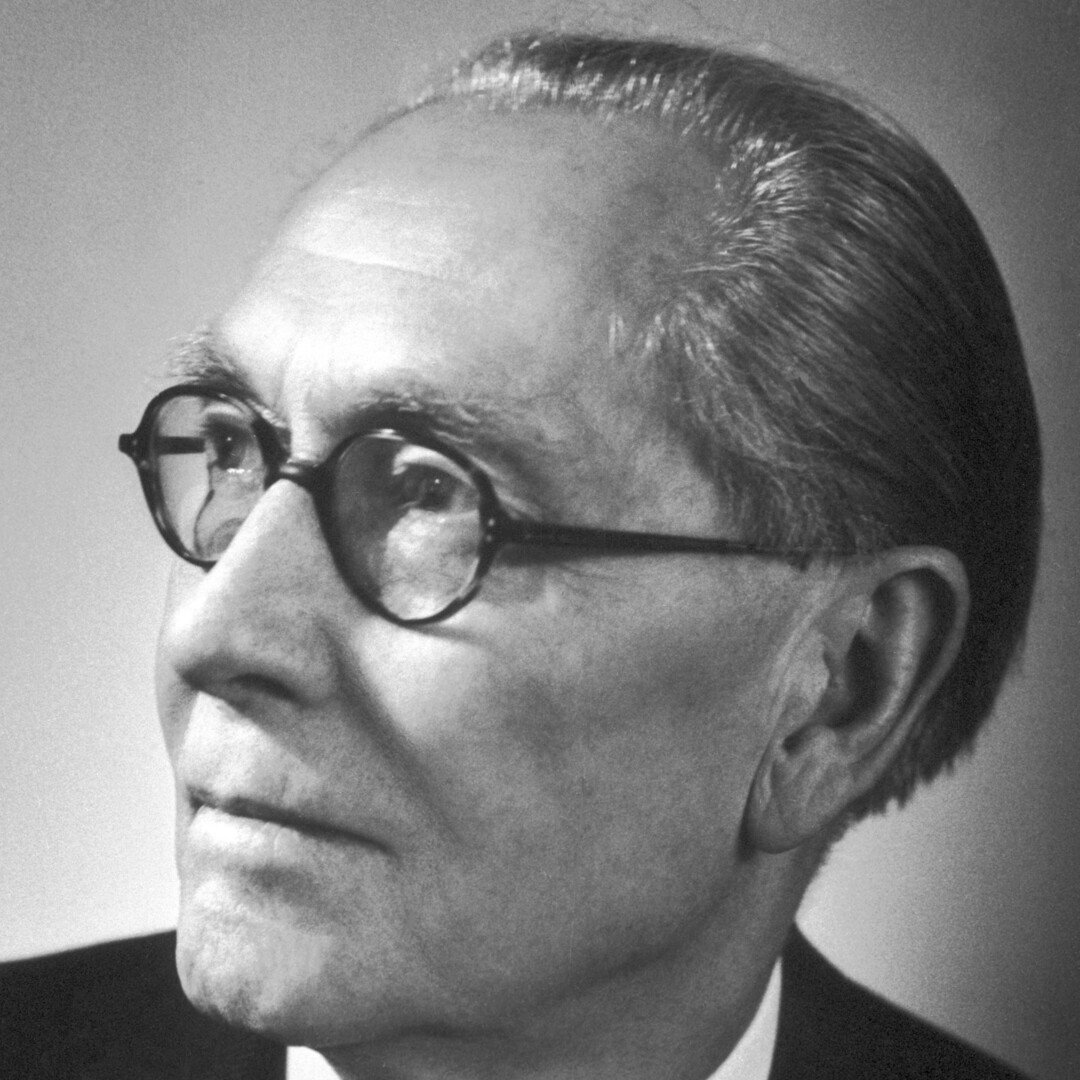
Philip Noel-Baker Photo from the Nobel Foundation archive.
Full name: Philip John Noel-Baker Born: 1 November 1889, London, United Kingdom Died: 8 October 1982, London, United Kingdom Date awarded: 5 November 1959
Internationalist for disarmament
Philip Noel-Baker took part in the Hague Peace Conference of 1907, when the major powers refused to enter into disarmament agreements. When WWI erupted, Noel-Baker was convinced that the arms industry bore a large part of the blame for the outbreak of the war and the bloodbath that ensued. He thus devoted his life to the fight for disarmament. Noel-Baker worked for the League of Nations, along with Nobel Peace Prize laureates Fridtjof Nansen, Normann Angell and Lord Robert Cecil. During and after WWII he was a member of the British government. Noel-Baker helped to formulate the UN Charter, and he worked intensively for the rest of his life to prevent an outbreak of nuclear war between the USA and Soviet Union, which he maintained would eradicate the human race.
“Noel-Baker repeatedly emphasizes that the arms race in itself is one of the main causes of war.”
Gunnar Jahn, Chairman of the Nobel Committee, Presentation Speech, 10 December 1959.
In 1932 Noel-Baker witnessed the failure of the League of Nations Disarmament Conference, while Japan, Italy and Germany conducted an increasingly aggressive policy toward Asia, Africa and Europe. The League of Nations member states were unable to agree on how to stop the belligerent countries. In 1938, when the United Kingdom and France gave Hitler free reign to conquer Czechoslovakia, Noel-Baker, a pacific and Quaker, concluded that fascism had to be met with armed force; otherwise democracy throughout the world would be in jeopardy.
“We have a pack of wolves, the modern weapons, howling at our heels.”
Philip Noel-Baker, Nobel Lecture, 11 December 1959.
After 1945, the nuclear arms race began in earnest between the USA and Soviet Union. Noel-Baker believed that the UN should be given control of all nuclear weaponry, but neither of the superpowers would agree to this. In 1958 Noel-Baker published a book about his pursuit of disarmament from 1919 to the 1950s. His primary message was that the average person should become involved in the fight – and that the USA and Soviet Union must dare to trust the other party’s willingness to disarm. The award of the Nobel Peace Prize to Noel-Baker a year later was met with overwhelming approbation the world over. Not surprisingly, Noel-Baker donated his prize money to disarmament efforts under the auspices of the UN.
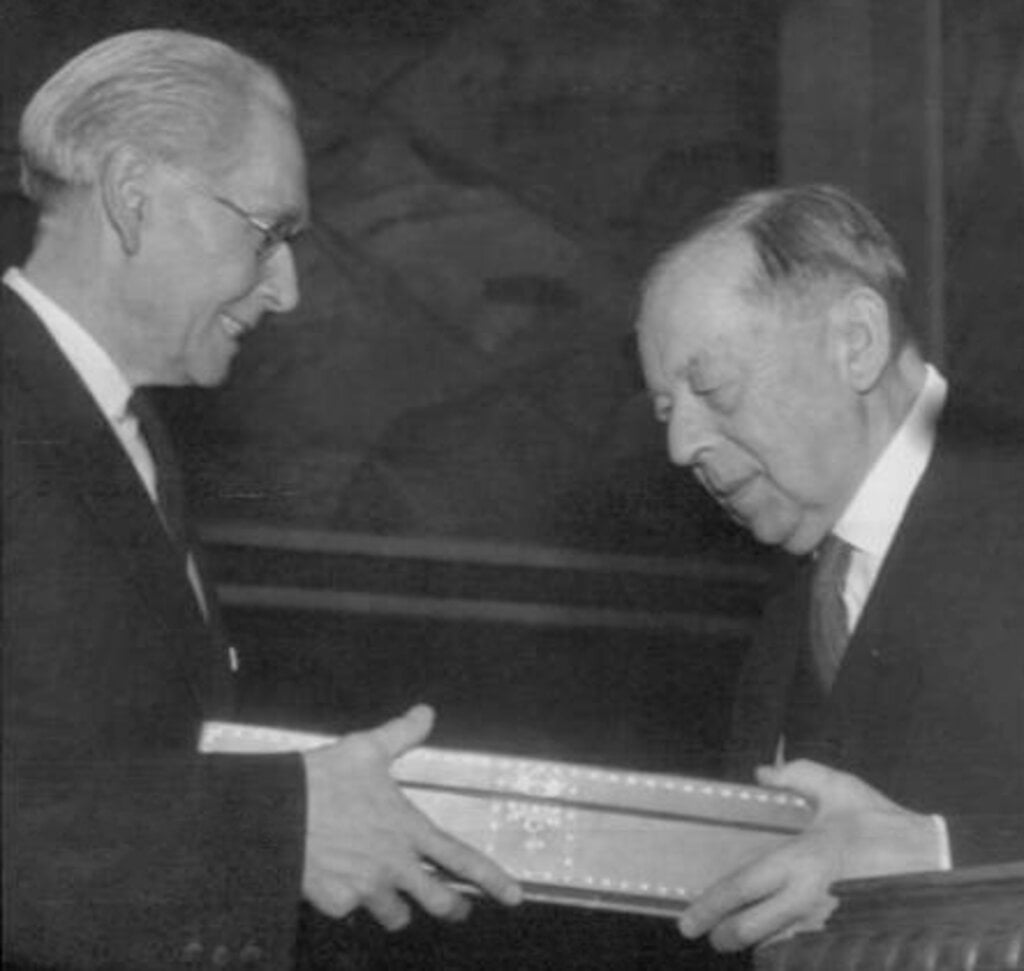
Philip Noel-Baker (left) receiving his medal and diploma from Gunnar Jahn, Chairman of the Nobel Committee, during the Nobel Peace Prize award ceremony in the Auditorium of the University of Oslo on 10 December 1959. Photographer unknown (Svenska Dagbladet), Public domain, via Wikimedia Commons
“The source of the drive that carried him through almost seven decades of peacemaking lay in his Quaker background.”
Irwin Abrams: The Nobel Peace Prize and the laureates, page 184, Science-History Publications/USA.
The Right Honorable Philip John Noel-Baker is a man of strong and steadfast convictions. To a reporter who interviewed him after the Norwegian Nobel Committee announced that he had been awarded the Peace Prize, he said, “War is a damnable, filthy thing and has destroyed civilization after civilization – that is the essence of my belief” …
Disclaimer: Every effort has been made by the publisher to credit organisations and individuals with regard to the supply of photographs. Please notify the publishers regarding corrections.
Philip Noel-Baker – Photo gallery
Swipe left and right to see more photos
1 (of 1)
Philip Noel-Baker receiving his medal and diploma from Gunnar Jahn, Chairman of the Nobel Committee, during the Nobel Peace Prize award ceremony in the Auditorium of the University of Oslo on 10 December 1959.
Photographer unknown (Svenska Dagbladet), Public domain, via Wikimedia Commons
Philip Noel-Baker’s Acceptance Speech, on the occasion of the award of the Nobel Peace Prize in Oslo, December 10, 1959
Your Majesty, Your Royal Highnesses, Mr. Chairman, Your Excellencies, Ladies and Gentlemen:
How can I fulfill what must always be the first duty of every man or woman who stands where I stand now?
Perhaps I can do it most simply, but most adequately, by saying that there is none in the world with whom I would exchange my place today.
There has come to me what I have always counted as the greatest of the honours which men bestow; it has come to me in the lovely capital of a beloved country, mantled now in Christmas snow; it has come by the decision of your Nobel Committee of wise and most distinguished men.
What more could any man or woman ask of Fate?
May I also express my deep gratitude for the generous hospitality with which Your Majesty, and Norway, have received me since I arrived? There is nothing in the world like a Norwegian welcome.
I am much embarrassed by the fact that after so many months as a guest in Norway over so many years, I cannot answer Mr. Gunnar Jahn in the Norwegian tongue. It is true that my friend, Toralv Öksnevad, in a dark hour of the war, not once, but twice and even thrice, made me broadcast in Norwegian to his captive compatriots at home. Desperate things are done in war-time.
But if I tried now, I should have to use the words of Sir Winston Churchill when he spoke to 100 000 Frenchmen in the streets of Paris after the City had been liberated in 1944. “Prenez garde”, he said; “I am about to speak to you in French. It is a formidable undertaking, which will impose a heavy strain upon your friendship for Great Britain”.
How heavy the strain could be, he once showed in an early conversation with General de Gaulle, soon after the General had raised the Free French flag in London. “Mon General”, he is reported to have said, “si vous m’opposerez, je vous liquidaterai”.
My excuse for speaking English now is the reason why I have never been able to learn Norwegian: I have never had the chance to try, for everyone in Norway seems to me to speak English at least as well as, and often rather better, than I do myself.
But it would be easy in any language to extol the merits of the Founder of the Nobel Prize. Alfred Nobel was, by every test, one of the great men of his own day; but the recognition of his greatness is more universal now, than when he died; we know now that he had all the passion and the vision which the world required in his time, and which it still so urgently requires today.
Nobel was a chemist; a leader in a magical new science then forging rapidly ahead; like other scientists and inventors, he discovered, without the slightest premonition on his part that it would be so, that the products of his genious could be used for war.
The General Staffs seized eagerly upon his high explosive, and used them to increase the fire-power, and the offensive power, of their armies and their fleets. Watching this rapid and competitive expansion of the military forces which the Governments maintained, Nobel sought consolation in the hope that his explosives might prove to be the “great deterrent” that would end all war.
But he had a doubt; a doubt that many people feel about our modern “great deterrent” now. He knew he could not be certain that, by increasing the slaughter and the devastation caused by war, his explosives would bring armed conflict to an end.
Before most of his generation, he perceived that, historically, war was already long out-of-date; that science and engineering had destroyed the barriers of time and space; that the Arms Race by creating distrust and fear, must obscure the peoples’ understanding of where their true interests lay; that War, if it should come, might imperil, or indeed destroy, the great achievements, in literature, in medicine, in science, which our Western civilization had begun to show.
With this magnificent conception of human glory in his mind, he devoted his great fortune to promote the pursuit of knowledge, of beauty, and of wisdom, and which should combat what he thought the deadly foolishness of war.
What a superb example to others of his generation; how tragic that these others did not follow where he led!
Suppose that Krupps, and the Hugenberg Konzern, and the Comité des Forges and others had combined with Nobel to use their power to promote the cause of peace: how different the course of history might have been!
But in Scandinavia, at least, Nobel’s victory was complete. I remember, with grateful admiration, how, year by year, Norwegian delegations to the League of Nations, led by Fridtjof Nansen, and with Mr. Hambro, Dr. Christian Lange, Mr. Koht, Dr. Worm-Müller, Ambassador Andvord, Ambassador Skylstad and many other eminent leaders who are gone, came to Geneva to stand with splendid courage for the principles in which Alfred Nobel had believed; how, year by year, their cooperation with the Swedish and the Danish delegations, with Branting and Östen Undén, grew ever closer; how, year by year, the influence of the Scandinavian bloc increased.
If the League of Nations came close to full success, as history will record it did, it owed very much to that cooperation, which Alfred Nobel first inspired.
Now the excitement and the early vision may seem less, but the Scandinavian work still faithfully and persistently goes on; now its doctrines are declared by the leading rulers of the world.
It was President Eisenhower who said that: “Every gun that is made, every warship launched, every rocket fired, signifies, in the final sense, a theft from those who hunger and are not fed, those who are cold and are not clothed. The world in arms is not spending money alone. It is spending the sweat of its labourers, the genius of its scientists, the hopes of its children.”
That was the essence of what Alfred Nobel believed three-quarters of a century ago.
Surely we may hope that this grotesque and tragic paradox may be ended soon.
I have been ten years a Minister of the British Crown, in peace and war; I know the heavy forces of inertia which must be moved, to carry even the smallest of reforms. But I still believe in the saving power of human wisdom. And Norway, to its lovers, is not only a land of romance, of mystery and beauty; it is a land of democratic inspiration and of world-wide hope. May there be born in Norway a great new tidal movement of opinion, with perhaps some modern Nobel, which will bear the nations forward to the salvation they so ardently desire.
Yesterday I tried to express my gratitude for the honor which I have received. Why has it come? [Mr. Gunnar Jahn, in his presentation speech, gave part of the answer.] I have been of all men the most fortunate of all. I was my father’s son. I was close friends with Norman Angell. I spoke with him as a student at Cambridge in the Cambridge Union when he made his first and very brilliant public speech. On August 4, 1914, I was with him in his chambers in the Temple and listened to Big Ben strike midnight as the Horse Artillery thundered along the Embankment to Victoria to entrain for France. And we knew that the guns were already firing, that the First World War had come. When that war was over, fate decreed that I should work for Robert Cecil, for Arthur Henderson, for Fridtjof Nansen1.
I could tell a thousand stories of how Cecil and Henderson helped to create and shape the League of Nations, build up the International Court, develop world cooperation in many spheres; of how they turned the policy of all-round armament reduction from general phrases into practical proposals on which a treaty could be made; of how they built up and led the worldwide body of informed opinion which the major governments could have used in 1932 to carry through a plan of drastic disarmament, if they had had the vision and the nerve that were required; of how, when this great opportunity – the greatest in history – had been wasted, they still battled on for the cause for which they stood.
It was for these great achievements, for their unfaltering courage, that you honored them in days gone by, and I like to think that you are still honoring them today.
And Fridtjof Nansen? To all his friends and colleagues, Nansen was the most gifted and, in all true elements of human greatness, the greatest of great men. He was as great an international statesman as he was a great explorer of the frozen North. Indeed, the best way to understand his international work is to recall how he first won his immense, unprecedented fame.
The whole world still remembers how he crossed the Greenland ice cap when all others had failed; he decided, against the advice of other experts, to force his party through the dangerous drifting ice floes and to land them on the savage, uninhabited eastern coast; once they were ashore, there could be no turning back.
When he set out to reach the Pole, again with every expert voice against him, he called his ship Fram because once he had jammed her in the ice field of the Arctic Ocean, there was only one way which she could travel: Forward; again there could be no possibility of turning back.
When the Fram had accomplished half its journey, it was already farther North than men had ever been; it was certain that in another eighteen months, it would emerge victorious on the other side, with Nansen’s theories proved.
But it would miss the Pole; so Nansen, with Johansen2 – only one companion – set out with dogs and sledges to try to reach it, to return by kayak to Franz Josef Land, and to winter there. He had no wireless; he could never find the Fram again; it was a journey of 1.100 miles, with dangers of many kinds in every mile. Was there ever such courage and such resolution as Nansen showed when he said good-by to Sverdrup3, standing in the moonlight on the glittering ice field beside the Fram?
The Nansen who stormed the diplomatic fortress of Geneva was the Nansen who stormed the barriers of the Polar Sea.
When the Nobel Committee gave him the Nobel Peace Prize in 1922, it was for the “humanitarian” work he did as High Commissioner of the League of Nations. How richly he had earned it! By what he did to help in cleaning up the wreckage left in Europe by the storms of war, he brought the League of Nations a new authority, made it an instrument of reconciliation, a symbol of hope and reconstruction to the peoples of the world.
And his success had long-term results when the United Nations replaced the League: UNRRA, the UN Refugee Organization, which spent hundreds of millions of dollars on the work he had begun; the High Commissioner for Refugees, World Refugee Year, the UN Children’s Fund (UNICEF), UN Technical Assistance and Economic Aid – it is not fantastic to suggest that they all stemmed from his achievements of long ago. And yet – all of this pales into insignificance beside the historical importance of what he did in the strictly political and diplomatic developments of his day.
Nansen believed with passion that the world needed a new international system based not on force but law; he knew, all too intimately, and he hated the inner workings of the power politics and the secret old diplomacy of the past; he threw all his strength and all his courage into battling for the new.
He went to the First Assembly of the League as leader of the Norwegian delegation, his Prime Minister as Number Two sitting by his side. An early episode showed what kind of delegate he was going to be.
He was a member, with Lord Cecil, of a small committee which examined the claim of Albania for admission to the League. Italy, for reasons of power politics which later years made plain, opposed admission; Britain and France gave Italy their support.
But Nansen and Cecil were convinced that Albania was a nation and should come in. They were defeated in the small committee; and Cecil asked Nansen if they should fight the question in the full Assembly.
“Certainly we should”, was Nansen’s quick reply.
“But we shall have all the great powers against us”, Cecil warned him.
“Of course we shall”, said Nansen, as if that were of no account at all.
To him, it was of no account, because he believed their case was right. As spokesman of one of the smallest members of the League, he was more than ready to challenge the powers that had just won the war, when they sought to introduce power politics in the League. And his contemptuous scorn was justified by the event. In the open debate in the full Assembly, Nansen and Cecil, Norway and South Africa, were victors. The great powers were routed, and Albania became a member of the League.
How often was that episode repeated!
Nansen and Cecil secured publicity for the Committees of the Assembly, and later for the Council and Commissions of the League. “Publicity”, said Cecil, “is the lifeblood of the League.” A maxim worth remembering today.
Motta of Switzerland urged that Germany should be invited to join the League; he called down upon his head a Gallic torrent of Ciceronian eloquence from Viviani, the ex-prime minister and the greatest orator of France. It was Nansen who followed Viviani and said that Motta had been right. Years later it was Nansen who persuaded Stresemann and Luther that they must come in4.
In 1923, Mussolini5 used a frontier incident as an excuse to seize the island of Corfu. Greece, in a panic, appealed both to the League and to the Allied Council of Ambassadors in Paris; Cecil, with his own government half against him, upheld the competence of the League; it was Nansen who rallied the Assembly in his support, who organized the smaller nations, answered Mussolini’s threats, spoke up in the Assembly and destroyed the specious arguments of the Fascist delegates6.
“Nansen”, said Cecil, “was a pillar round whom the whole of the representatives assembled gathered in order to enforce what they believed to be right and just.”
Nansen, at that grim Corfu Assembly, beyond all question saved the League, he may well have stopped a war; he rescued Corfu from an unscrupulous aggressor bent on empire building; Venizelos7 told me it was the League’s greatest triumph and that without Nansen it could never have been done.
The mandates, slavery, forced labor, the compulsory jurisdiction of the International Court, collective security, the admission of Russia, the constitutional development of the League – on all these things he was a leader; on all, in Cecil’s phrase “he gave to others something of his courage and determination”; in all, in Cecil’s metaphor, “his ship was still the Fram“. But one issue, above all others, seemed to him most urgently important – disarmament.
Let me end this brief and halting panegyric of Norway’s modern Viking hero with a quotation from what he said in a Nobel speech in 19268.
“The problem of how to get rid of war is the first of all questions, not only in international, but in national politics as well…
If we do not get rid of war, if we do not end it altogether, if we do not reduce and limit armaments, then… we may be very sure that in the future, as in the past, armaments will breed counter-armaments; they will breed alliances and counter-alliances, suspicion and distrust;… they will produce international crises, they will lead at first, perhaps, to small local wars, but in the long run, and inevitably, to a great world war like that we have seen in our own day and generation.
If we retain our armaments, if we do not carry through the work of disarmament which the League of Nations has so successfully begun, war will certainly ensue.”
In 1926 these words were spoken; in 1933, when Nansen spoke no more in Geneva for Norway and for mankind, there came the failure of the Disarmament Conference, the abandonment of the Covenant system, the return to stark power politics, the melancholy sequence of Manchuria, the Chaco, Abyssinia, Spain, Austria, Munich, and the Second World War which Nansen had foreseen9.
And today, thirty-three years later, where do we stand about the arms race, which Nansen thought the supreme issue of the age? The arms race still goes on; but now far more ferocious, far more costly, far more full of perils, than it was then.
What are the perils of the arms race? I take an old and inoffensive illustration – the facts are well-established and the men are gone.
In 1905 the British Admiralty decided to produce a great deterrent, to make it plain that Germany could never win a war and had better drop her challenge to the British fleet. They laid down the Dreadnought, a battleship so powerful that it could sink the whole German Navy without peril to itself. [Even before the Dreadnought was commissioned, a prime minister newly come to power and Lord Balfour, the prime minister of the government which had agreed to its construction, admitted in the House of Commons that the Dreadnought might have been a grave mistake. And so it proved]
It had made obsolete overnight twenty-eight German battleships and armored cruisers. But the Germans built Dreadnoughts in reply; and they made obsolete not twenty-eight but eighty-three British battleships and cruisers that could have taken on even the most powerful vessel in the German fleet. [In 1906 we had an immense margin of thirty-four ships of the line over the German, Austrian, and Italian fleets combined.]
In other words, the Dreadnought was not needed for national defense10. But ten years later, in the Battle of Jutland11, where only Dreadnoughts counted, our margin was only two to one; if our commanders had made mistakes which fortunately they avoided, we might have lost the battle and the war.
Strategically, the Dreadnought was an error of the gravest kind; politically, it was an absolute disaster. It gave enormous power to Tirpitz12 and the elements in Germany who wanted war; year by year, the race in Dreadnoughts led to panics and to counter-panics in Germany and Britain; by 1909 our foreign minister, Lord Grey13, said it had become the most important single factor in increasing European tension and the risk of war.
In 1912 Sir Winston Churchill, then at the Admiralty, and Bethmann- Hollweg, the German chancellor14, both warned their governments that if it were not stopped, it would bring war within two years. Their prediction was fulfilled, almost to the very day.
When the war was over, Lord Grey wrote his famous verdict15: “The enormous growth of armaments in Europe, the sense of insecurity and fear caused by them – it was these that made war inevitable. This is the truest reading of history, the lesson that the present should be learning from the past.”
[It was because they, like all the statesmen who had fought the war, agreed with Lord Grey’s verdict, that Lloyd George and Balfour helped Hughes of the United States16 to make the Washington Naval Treaty of 1922, a treaty that ended an angry and feverish naval race between the U.S., Britain, and Japan by making large reductions in their battleships and aircraft carriers and by establishing the famous ratio 15:15:9. This treaty provided a splendid prelude to the general disarmament agreement which, under the Covenant, the League of Nations was to make.] But, alas, no general disarmament treaty was ever made. When after lengthy preparations, the Disarmament Conference met in 1932, President Hoover17 put forward a proposal for a further cut in navies, with a ratio of 10:10:6; a drastic cut in armies, with the abolition of all tanks and heavy mobile guns; the abolition of all aircraft that could carry bombs – a first – stage plan, designed to lead at later stages to the level of armaments imposed on Germany by the Treaty of Versailles.
That plan was enthusiastically welcomed by Germany, Russia, Italy, and all the middle and smaller powers. I well remember the joy of Dr. Christian Lange18 and his Norwegian colleagues when it was proposed. It might have led the Conference to full success, if Britain had agreed.
Many people in Britain wanted to agree, among them Mr. Baldwin, the deputy prime minister19 and leader of the Conservative Party. Indeed, he wanted to go much further, and to abolish all battleships of over 10.000 tons displacement, all aircraft carriers, and all military aircraft of every kind. This would have meant as well the abolition of the submarine, and with such a lead from the leading naval power, the Conference could not have failed. But there was a conflict in the British Cabinet; Mr. Baldwin was defeated by a narrow margin; a British admiral was allowed to say in the Conference20 that “battleships are more precious than rubies to those who possess them”; by those words he killed the Hoover Plan.
After having been so near success, the Conference failed; the arms race swiftly gained a new momentum; the major governments went back to the sordid principles of power politics; Abyssinia and the Covenant were betrayed; the Second World War came by precisely the process which Nansen and Cecil and Henderson had predicted.
And what happened in the war? What part was played by the battleships for which such great hopes had been destroyed? They were almost useless; while, as Norwegian sailors know as well as we do, the submarines, for the second time in thirty years, almost brought us to our knees.
And today? The arms race has gone on; aircraft have become a deadly menace to surface shipping; the nuclear-powered submarine, the nuclear missile have sealed the doom in any future war of the merchant convoys without which Britain cannot live.
Not only so: in 1906, before the Dreadnought was commissioned, Admiral Lord Fisher, its inventor, could say that it was “absurd to talk of anything endangering our naval supremacy”.
After a half-century of the arms race, in which battleships have played so regrettable a part, we are only third in naval power; we have learnt how a new weapon of great offensive power, introduced by one nation, spreads to other nations and undermines the national defense of the nation which introduced it first; how it stimulates the general arms race and brings new weapons which, in naval warfare, now threaten the very life of nations which depend upon the sea; how, even on the plane of naval armaments alone, at every stage, 1906, 1932, 1955, a treaty of armament reduction and limitation would have been an incomparably better measure of national defense than the launching or maintenance of more powerful vessels for naval war.
But all this is still more true of the other, “modern” means of war. Look at the facts of our present arms race.
Lord Grey thought the competition before 1914 was frenzied madness; before 1939 the pace was hotter still; since 1945 it has been far beyond what anyone could have dreamed of in 1939.
In 1914 the nations had something over five million men in their standing peacetime forces; today they have more than sixteen million. In 1914 they were spending about £500 million a year on preparing for war; today they are spending £40,000 million.
The most significant figure is what we spend on military research; on using scientists of genius to “improve” existing weapons and to develop new ones that are cheaper, more destructive, swifter in delivery than those we have today.
In 193821 Britain spent less than £6 million on military research; in 1953, £100 million; in 1959, £210 million – by official figures, and allowing for the change of prices, more than twenty times what we were spending twenty years ago.
The United States in 1940 spent £5 million on military research – even less than us. In 1958, they spent £1.900 million – nine times our figure; and no doubt the Soviet Union spent even more. The results, in every class of armament, have been revolutionary; Britain is now equipping her land forces with new weapons, from the rifle to tanks that will be transportable by air; France is making bombing aircraft with twice the speed of sound.
But the great changes since 1945 are in the so-called “modern” weapons. The bloodcurdling history of the nuclear bomb is familiar to us all. In 1945 the Hiroshima weapon multiplied by 2.000 the explosive power of the ten ton “blockbuster” which our pilots had dropped on Berlin; it is the yardstick of nuclear armament, so we must remember what it did.
It killed 100.000 people in an instant of time; it crippled, burnt, blinded, riddled with radiation sickness 100.000 more; in 1959 scores of people have died a lingering, hideous death as the result of a bomb dropped fourteen years ago. A city as large as Oslo was utterly destroyed: houses, factories, offices, barracks, docks – nothing remained.
In 1954 the so-called H-bomb – the first primitive, unliftable thermonuclear device – multiplied by almost a thousand the power of the Hiroshima bomb. A British Home Office Manual on Civil Defense tells us that a ten-megaton bomb – ten million tons of Nobel’s high explosive – much smaller than the weapon of 1954 – would wipe out London: total annihilation of the center, and around it an unbroken circle of roaring flame, from which it would be a miracle if anything escaped.
And the pace of the advance in weapons is still increasing. In four years, since the government ceased discussing “comprehensive” disarmament and started seeking for “partial” measures instead, we have seen: the production of the supersonic bomber; the development of the “intermediate” missile, to have a range of 1.200 or 1.500 miles; the intercontinental missile, which may be “operational” by 1961, with the Soviet Union then producing fifteen a month; the adaptation of the H-bomb into weapons which can be carried by a fighter-bomber, and into warheads for the intercontinental missile.
We have seen the introduction of the nuclear-powered submarine, with all its menace, and the Polaris nuclear missile, which may soon be fired from underwater. We have seen the great development of chemical and biological methods of conducting war.
The Pugwash Scientists, so generously helped by Mr. Cyrus Eaton of the United States22, have shown this year that poison gas and “biologicals” may well become weapons for the mass elimination of human life. Goering23 tried a nerve gas, which he called “Tabun”, on a herd of goats; they went mad and massacred each other, before the few survivors died, after hours of agonizing pain.
An American general has told us that our nerve gas is ten times as potent now; others say even more. “Biologicals” may be just as potent, and, if they start a large-scale epidemic, more horrifying still.
No doubt with the best of motives [- I say nothing against the General Staffs – no doubt] the major military governments have kept secret the facts about their chemical and biological work; General Staffs have used euphemistic phrases like the “tactical atomic bomb” or the “low-yield thermonuclear device” – phrases against which the scientists who made these weapons openly revolt.
But it is vital that the citizens of every country should realize the true nature of the present arms race. What are the salient facts?
First, it is by far the most potent factor in the conduct of our international affairs.
Second, it is the strangest paradox in history; every new weapon is produced for national defense; but all experts are agreed that the modern, mass-destruction, instantaneous delivery weapons have destroyed defense.
Third, it is a patent error to speak as though, for an indefinite future, there will be two military “giants”, and no more. If the arms race goes on, in ten years there may be six or even more, and who knows which nation will be the greatest giant.
Fourth, the advance in weapons has already brought us within measurable distance of the sudden, decisive, irreparable knockout blow.
Dr. Ellis Johnson, the head of the Johns Hopkins Operations Analysis Office, which does tactical and strategic studies for the American army, believes that such a crushing attack by Russia on the United States is possible today. Others believe that the United States, with 10.000 megaton bombs and a vast delivery system from land bases and from the sea, will soon be able to knock out Russia, without the danger of reply.
Fifth, military research is not standing still: the highest authorities tell us that weapon “progress” will be as great in the next fifteen years as in the past. The dangers of the weapons will continually increase.
Sixth, we are continually being “conditioned” to their use. Fifty years ago the Hague Conventions codified the laws of war, forbidding gas or other poison, the use of fire bombing from the air, attacks on open towns and civilians, either on land or sea.
Within ten years all these rules had been violated in the First World War. But the Second World War was incomparably more degraded and degrading than the First.
In the First War, we had poison gas – I was at Ypres when the chlorine cloud was first released – a gas wall a hundred feet high and two miles long; I saw the French Colonial Troops flying in terror and throwing away their weapons as they ran; I saw the Canadian soldiers choking to death, with an evil yellow froth oozing from their mouths; we had poison gas, but no gas chambers; we knew the ferocious cruelty that sometimes goes with dare – all heroism, but not the organized sadism of the concentration camp. We had spying and treason and executions, but not the Gestapo’s torture chambers, with the thumbscrew and the rack.
And what is happening to us now, as we prepare for the Third Great War?
When Hitler was exterminating seven million Jews in Poland, we had millions of German prisoners in our hands; we did not kill them; we took no reprisals of any kind. But now governments are constantly asserting that if they or their allies are attacked, they will instantly reply with weapons that will wipe out tens of millions of men and women and little children, who may bear no shadow of personal responsibility for what their government has done.
What is left of the morality on which our Western civilization has been built?
How can we end the arms race?
I start with a forthright proposition: it makes no sense to talk about disarming unless you believe that war, all war, can be abolished. The Western governments declared precisely that in the UN Commission in 1952. “The goal of disarmament”, they said, “is not to regulate, but to prevent war, by making war inherently, as it is constitutionally under the Charter, impossible as a means of settling disputes between nations. To achieve this goal, all states must cooperate to establish an open and substantially disarmed world, in which armed forces and armaments will be reduced to such a point… that no state will be in a condition of armed preparedness to start a war.”24
That was the objective declared by the Western governments eight years ago; it is the objective which Mr. Khruschev declared in the General Assembly in September last25.
Unless there is an iron resolution to make it the supreme object of international policy and to realize it now, I believe all talks about disarmament will fail.
This26 rules out attempts to “limit” war by new laws or understandings about how weapons will be used. I fear we should not get far with the kind of “partial” measures which have been debated for the last four years. Everyone would favor “partial” measures, if they were real, if they created confidence, if nothing better could be done.
Some people honestly believe that small steps will be much easier to take than large ones. They quote proverbs to support their point – the crude English: “Don’t bite off more than you can chew”; the elegant French: “The better is the enemy of the good”; the Russian: “The slower you ride, the further you go”. Well, in Russia I should have thought it would depend on whether you had a pack of wolves howling hungrily at your horse’s heels. We have a pack of wolves, the modern weapons, howling at our heels.
I prefer the words of our great economist and political thinker, John Stuart Mill: “Against a great evil, a small remedy does not produce a small result; it produces no result at all.” Or the saying of Lloyd George: “The most dangerous thing in the world is to try to leap a chasm in two jumps.” There is a great chasm, a great gulf, between the armed world of today and the disarmed world which we must have on some near tomorrow.
I will not discuss the “partial” measures which have been debated in recent years: the “cut-off” of new nuclear weapons; measures against surprise attack; exchange of budgetary information; and the rest – in my view, except as part of a general disarmament treaty, they were almost bound to fail.
I rejoice that, for the present, they have been set aside, that the new Committee of Ten will meet to discuss a “comprehensive” plan for general and complete disarmament, and that its mandate is to prepare detailed proposals within the shortest practicable time27.
Some people say the Committee should work on Mr. Khruschev’s proposals made in the Assembly the other day. Others seem to think that it would be dangerous to start on a Kremlin basis, to appear to let the Kremlin have the lead. They remind me of a Scottish minister of the Kirk, who, after a period of draught, when the crops were withering in the corn fields, was asked by the farmers of his parish to pray to the Almighty to send some rain. “No, no”, he replied, “I cannot do that while the wind is in the East!”
Can we really not negotiate on proposals that come to us from the East? I should have thought that that might be the very moment when we had the greatest prospect of success; that, perhaps, Dr. Christian Lange’s “golden hour of opportunity” had come again. But first, they say, we must know: Is Mr. Khruschev genuinely sincere?
I answer the doubters’ question in three ways. First, perhaps no one knows if Mr. Khruschev is sincere, and we shall never know unless we start a serious negotiation with him without delay. Second, if we do negotiate, we shall know within a week if he is sincere or not; that is certain. Third, if we do not soon start a serious negotiation on the basis of the mandate which the General Assembly has defined, then he may say, and others will believe, that it is we who are not sincere.
The words “general and complete disarmament” are Mr. Khruschev’s; he proposed the elimination of all armaments and all armed forces within four years, leaving nations with militias bearing small arms to maintain order within their states. He proposed as well a general and complete inspection and control, with no reservations or limitations of any kind. In other words, he proposed an ultimate objective, and a timetable of the stages by which it should be reached.
His objective, I repeat, is simply that declared by the Western governments in 1952; and, unless I misread the speeches in the Assembly, there is no one who rejects this as the final purpose now.
Is the timetable too ambitious? Of course, there are dangers in avoidable delay; but four years is very short for so vast and revolutionary a change; in all good faith, it might take six, or eight, or ten; I hope Mr. Khruschev will be elastic about the point, provided real disarmament is being pursued.
In any case, I hope the new Committee of Ten will remember what was said by an American delegate some years ago: that the further you carry disarmament, the easier it becomes; the technical problems grow simpler, the inspection more certain to succeed.
Of course, there must be a first-stage treaty, by which the initial reductions will be made.
In our British United Nations Association Statement we set out what we believe would be a wise first-stage agreement: reductions of manpower army, navy, air force all together – to one or at most 1.5 million men for Russia, China, and America, with lower “ceilings” for other nations; a corresponding reduction of conventional weapons; agreement to abolish, by prescribed measures, all the weapons of mass destruction, including the existing stocks; budgetary reduction and limitation; and of course the appropriate measures of inspection and control.
We believe the first-stage treaty should also make quite clear, at least in principle, the further reductions to be made in stages two and three; the whole negotiation will be far easier if the steps to the ultimate objective are made plain in everybody’s mind.
How practical is this program? Are there vast, unsolved technical problems to be faced? Well, a treaty of general disarmament will be a long and complex document. But, broadly, Salvador de Madariaga’s28 words [spoken in 1932] are true [today]: “Technical difficulties are political objections in uniform”.
And, in fact, nearly all the technical problems of reducing armies, navies; and air forces, of reducing or abolishing conventional armaments, of reducing and limiting military budgets, were already solved long years ago. The London and Washington Naval Treaties29, the Reports of the Disarmament Conference of 1932, Sir Anthony Eden’s Draft Disarmament Convention30 of March, 1933 – these provide model [treaty] clauses from which the Committee of Ten might well begin.
But there is one new technical difficulty to be faced – the clandestine nuclear stock. Suppose the nuclear powers agree to abolish all their A- and H-bombs, how could they be certain a disloyal government, planning to conquer or blackmail the world, would not keep a part – ten percent, twenty percent – of their existing stocks in a lead and concrete hideout that no one could ever find?
“It is now a fact”, said Sir Winston Churchill in the House of Commons, “that a quantity of plutonium, perhaps less than would fill this Box on the table… would suffice to produce weapons which would give indisputable world domination to any great power which was the only one to have it.”31
This has been the crux of the deadlock of recent years. Some governments have argued that the only safeguard is for the nuclear powers to retain a great part of their stocks to act as a deterrent to aggression, that total abolition will only be safe when there is some new Geiger counter, some miraculous new instrument or method that will detect the faintly radioactive H-bomb behind its concrete shield.
But if we wait for this Geiger counter, we may wait for decades, as Mr. Stassen32 said in 1957; or we may wait forever. What happens while we are waiting?
Will France stop making nuclear weapons? Will China, with its vast potential power ? If France and China, then surely Japan, India, Pakistan, Germany, Italy, and others will join the nuclear club – there are now a dozen countries which, within a decade, could mobilize the necessary materials and skills. Simply waiting for a Geiger counter means the gravest risk of all. Is there nothing else that we can do?
Of course there is. We could abolish the “means of delivery”, the military aircraft and the missiles by which nuclear weapons can be used. That is quite easy; Mr. Khruschev has proposed it; there is no problem of control-bombers and missiles could not be made or tested without UN inspectors finding out, nor could troops be given training in their use.
Second, we can agree, as in principle I understand we have agreed, to abolish the land, sea, and air forces without which no government could embark upon aggressive war.
Third, we could set up general and complete control of all the means, including nuclear plants, by which war can be prepared; I discussed this in great detail with Mr. Khruschev and his colleagues, and I am sure that, for real disarmament, they will agree.
These three measures are the real safeguards, far better than any Geiger counter; they would remove the whole temptation to keep a secret nuclear stock. The risk of accepting such a system would be incomparably less than the risk of allowing the arms race to go on.
Disarmament is not a policy by itself; it is part of the general policy of the UN. But it is a vital part of that policy; without it, the UN institutions can never function as they should.
For every nation, it is the safest and most practicable system of defense. Defeatism about the past is a grievous error; the Disarmament Conference of 1932 was not inevitably bound to fail; failure was due to human errors we can plainly see.
Sir Winston Churchill called the Second War “the most unnecessary war in history”. [Defeatism about the past is a grievous error;] defeatism about the future is a crime. The danger is not in trying to do too much, but in trying to do too little. Nansen said here in 1926 that “in the big things of life, it is vitally important to leave no line of retreat… We must destroy the bridges behind us which lead back to the old policy and the old system, both of which are such utter failures.”33
In the age when the atom has been split, the moon encircled, diseases conquered, is disarmament so difficult a matter that it must remain a distant dream? To answer “Yes” is to despair of the future of mankind.
“Politics”, it is said, “is the art of the possible.” How often that weary cliché provides excuse for defeatist surrender, before the real difficulties of a problem have been faced! [Democracy is the art of mobilizing popular opinion in support of reforms that are technically possible and that the people want. Disarmament is technically – I repeat I – far simpler than any other method of national defense. Who doubts that all the peoples want it?]
Nansen was the first to say what others have repeated, that “the difficult is what takes a little while; the impossible is what takes a little longer”. If politics is the art of the possible, statesmanship is the art, in Nansen’s sense, of the impossible; and it is statesmanship that our perplexed and tortured humanity requires today.
But even with statesmanship of that high order, we may have a long and dangerous voyage still before us, full of hazards and, it may be, storms; if at last we are to reach our destination, our ship must be the Fram.
* This lecture was delivered by the laureate in the auditorium of the Nobel Institute. The text is taken from Les Prix Nobel en 1959. Collation with the tape recording of the lecture shows that in delivery the speaker departed from the text at various points, making certain deletions, revisions, and additions. The more important additions have been inserted in brackets within the text itself, and the more significant revisions and deletions noted as they occur. The lecture was given no title; the one supplied here embodies the theme of the lecture.
1. This paragraph in the text reads: “Why has it come? Because I worked for Robert Cecil, for Arthur Henderson, for Fridtjof Nansen.” Angell, Cecil, Henderson, and Nansen were peace laureates for 1933, 1937, 1934, and 1922, respectively.
2. Frederik Hjalmar Johansen (1867-1923), Norwegian explorer who shipped as fireman on the Fram.
3. Otto Neumann Sverdrup (1855-1930), Norwegian seaman and Arctic explorer; captain of the Fram.
4. Giuseppe Motta (1871-1940), president of the Swiss Confederation (1915, 1920, 1927, 1932, 1937), opened the First Assembly of the League. René Raphaël Viviani (1863-1925), French premier (1914-1915), French delegate to the Assembly (1920- 1922), to the Council (1919, 1923). Gustav Stresemann (1878-1929), German foreign minister (1923-1929) and co-recipient of the Nobel Peace Prize for 1926. Hans Luther (1879-1962), German chancellor (1925-1926).
5. Benito Mussolini (1883-1945), Italian Fascist premier (1922-1945).
6. The Italian delegate, Antonio Salandra, raised the question of whether the League should deal with the question while it was also under consideration by the Council of Ambassadors; The incident itself ended when Italy evacuated its troops and Greece apologized.
7. Eleutherios Venizelos (1864-1936), several times Greek premier.
8. See Vol. 1, pp. 189-390.
9. The Disarmament Conference, convened under the auspices of the League of Nations in February, 1932, never fully recovered from Germany’s withdrawal in October, 1933. The League of Nations Covenant included recognition of the need for disarmament, enforcement of international obligations by common action, and settlement of international disputes by peaceable means. Japan attacked China in Manchuria in September, 1931. Bolivia and Paraguay fought the Chaco War (1932-1935) over disputed boundaries in the Chaco region. Italy invaded Abyssinia (Ethiopia) in 1935. The Spanish Civil War (1936-1939), although a domestic struggle, became in effect a battleground for Russia on one side and Germany and Italy on the other. Hitler’s Germany announced the union of Austria and Germany (the Anschluss) in 1938. The Munich Pact of September, 1938, signed by Germany, England, France, and Italy, ceded territory from Czechoslovakia to Germany and destroyed Czech military power. Second World War (1939-1945).
10. In delivery this sentence was omitted.
11. The major naval battle of WWI (May, 1915), fought between the British and the Germans.
12. Alfred von Tirpitz (1849-1930), German admiral and state secretary of the navy (1897-1916).
13. Sir Edward Grey, Viscount Grey of Fallodon (1862-1933), British foreign minister (1905-1916).
14. Winston L. S. Churchill (1874-1965), first lord of the Admiralty (1911-1915). Theobald von Bethmann-Hollweg (1856-1921), German chancellor (1909-1917).
15. Viscount Grey of Fallodon, Twenty-Five Years, 1892-1916 (New York: Stokes, 1925), vol. I, p.90.
16. David Lloyd George (1863-1945), British prime minister (1916-1922). Arthur James Balfour, Earl of Balfour (1848-1930), British prime minister (1902-1905); leading British delegate to Washington Conference (1921-1922). Charles Evans Hughes (1862-1948), U.S. secretary of state (1921-1925).
17. Herbert Clark Hoover (1874-1964), U.S. president (1929-1933).
18. Christian L. Lange (1869-1938), co-recipient of the Nobel Peace Prize for 1921 and member of the Norwegian Nobel Committee (1934-1938); Norwegian delegate to the League (1920-1938).
19. Stanley Baldwin (1867-1947) was later prime minister three times.
20. In delivery, the words “in the Conference” were changed to “in Geneva”.
21. In delivery, the words “In 1936, on the eve of Hitler’s war” were substituted for “In 1938”.
22. The Pugwash Conference on Science and World Affairs, so called because it first met (1957) at Mr. Eaton’s Pugwash estate in Nova Scotia, was financially aided in holding several of its early meetings by Cyrus S.Eaton, a Cleveland industrialist.
23. Hermann Wilhelm Goering (1893-1946), German Nazi leader; president of council for war economy (1940-1945); founded the Gestapo (secret police) in 1933, heading it until 1936.
24. From “Essential Principles for a Disarmament Programme” (as quoted by Noel-Baker in The Arms Race, pp. 12-13), submitted by the U.S. to the new UN Disarmament Commission in April, 1952.
25. Nikita Sergeyevich Khrushchev (1894-1971), Russian Communist premier (1958- 1964). His speech is reported verbatim in UN General Assembly Records, 14th Session: Plenary Meetings, Sept.15-Dec.13, 1959, pp.31-38.
26. In delivery, the words “If that is true, it” were substituted for “This”.
27. A four-power comminiqué of September 7, 1959, addressed to the Secretary-General, stated that agreement had been reached on the creation of a ten-nation disarmament committee composed of France, U.S.S.R., U.S., U.K., Bulgaria, Canada, Czechoslovakia, Italy, Poland, and Rumania. (DC/144, 8 September 1959). The mandate is contained in General Assembly Resolution 1378 (xiv; 20 November 1959, item 70).
28. Salvador de Madariaga (1886- ), Spanish diplomat and writer, known especially for his studies on national and international psychology; in the 1920’s held posts in the League of Nations, including that of director of the Disarmament Section.
29. Treaties limiting naval armaments, signed by France, Great Britain, Italy, Japan, and the U. S. in Washington (1922) and by Japan, Great Britain, and the U.S. in London (1930).
30. Robert Anthony Eden (1897- ), British foreign undersecretary (1931-1933). The British Draft Convention was based on the principle of qualitative disarmament.
31. Hansard, March 1, 1955, col. 1899 – as cited by Noel-Baker in The Arms Race, p. 107.
32. Harold Edward Stassen (1907- ), U.S. statesman; special assistant to President Eisenhower on disarmament questions and U.S. representative on the UN Disarmament Commission (1955-1958).
33. See Vol. I, p. 392.
**Disclaimer
Every effort has been made by the publisher to credit organizations and individuals with regard to the supply of audio files. Please notify the publishers regarding corrections.
Presentation Speech by Gunnar Jahn*, Chairman of the Nobel Committee
Frequently when the storm clouds gather – perhaps for that very reason – the world is made aware of the forces of good, rallying to meet the threatened danger. The dark years of this century in Europe started in 1914 and are still with us. Throughout this span of time, for forty-five years, Philip John Noel-Baker has dedicated his efforts to the service of suffering humanity, whether in time of war or in the intervals between wars. But above all else, his efforts to prevent war breaking out have been tireless and ceaseless.
We saw Philip Noel-Baker as a young man serving in the Quaker Ambulance Unit in France and Italy during the First World War; we saw him, standing at Fridtjof Nansen‘s side during the latter’s great work of relief in Russia and Greece. He continued after the Second World War to try to solve the refugee problem that the war had created. And throughout this time, ever since the armistice of 1918, we have heard him proclaiming the cause of disarmament and peace. What disappointments we have suffered since then; and yet, not for a moment did it occur to Noel-Baker to abandon hope that in the future it would be possible to find a solution to political conflicts, not by arms, but through negotiation.
Philip Noel-Baker is probably today the man who possesses the greatest store of knowledge on the subject of disarmament and who best knows the difficulties involved. In his latest book, published in 1958, The Arms Race, which he has called A Programme for World Disarmament, he has pointed out the way we should go.
We detect in Philip Noel-Baker scarcely a trace of ambition for himself. For him the cause, and it alone, matters. If that can be furthered, it is a matter of indifference to him who gets the credit.
So marked is this selfless and idealistic attitude that it is difficult to explain unless one knows something about the milieu in which he was brought up.
For generations his family has belonged to the Society of Friends, or Quakers. His father, Joseph Allen Baker, was born in Canada, where the family had emigrated from Ireland in 1819. In the late 1870’s Allen Baker was sent by his father to England to take charge of a newly established branch of the family business. There he married the deeply religious Elizabeth Balmer Moscrip. Their son, Philip John, was born in 1889. Allen Baker’s life in England helps to explain the milieu which must have been largely responsible for shaping his son’s character and selfless, constructive attitude to life.
Inspired by the Quakers’ feeling of responsibility for brothers in need and by their eagerness to help, Allen Baker devoted his time to a wide range of welfare activities in the London familiar to us after the end of the nineteenth century. He came into close contact with the London slums, establishing schools and even teaching personally those who could not read and write, as well as working for improved housing, temperance, and better traffic conditions. In the course of time this work led to his becoming a member of the London County Council. From 1900 to 1918 he was a member of Parliament where he was to be found in the radical wing of the Liberal Party. As a politician he devoted most of his time to work for peace. As the fatal year of 1914 loomed ominously near, he was indefatigable in his work to forge links between peace lovers in all countries. With his religious background and approach, he considered it essential that Christians in different countries should unite to oppose war, especially those in Germany and England. Allen Baker’s efforts proved in vain, and 1914 arrived. Instead of giving way to doubts and dismay, he was inspired anew by Woodrow Wilson‘s idea of a League of Nations.
There is little doubt that the influence and inspiration of a cultured and harmonious family life, with father and mother working selflessly to help those in need, inevitably left their mark on the son’s attitude to life.
Philip Noel-Baker had the advantage of an academic education, something his father had lacked all his life. His schooling commenced at a Quaker school in York. In 1906, at the age of seventeen, he studied at Haverford College in Pennsylvania, and from 1908 to 1912 he was an undergraduate at Cambridge University. His major subject was international law, in which he has a degree. He also studied at the Sorbonne and in Munich during the year preceding the First World War. He was Cassel Professor of International Relations at London University from 1924 to 1929.
I have mentioned his education because his academic schooling was to have considerable influence on his later work. In all he has said and written he has never succumbed to the temptation of making a statement that was not well founded on meticulous documentation. He never brushes the arguments of his opponents aside, but submits them to an unbiased examination and criticism. He endeavors to understand those who do not agree with him; he does not censure their views; and only after he has proved that their position is untenable does he deliver judgment.
Noel-Baker was twenty-six years old when the First World War began. As a Quaker he was against taking an active part in the war. He formed the Quakers’ Ambulance Unit and served in it himself behind the front lines in France. In Italy he served with the British Ambulance Unit under Trevelyan1.
Noel-Baker’s entire bent of mind, his upbringing, his experience of war – all these things must inevitably have drawn him, as soon as the war was over, to the work directed at righting some of the wrongs created by the war. Above all he must have felt himself called upon to do everything in his power to prevent any new wars. It was therefore natural that he should seek association with the new international organization, the League of Nations.
Those who never knew the years after the First World War will find it hard to realize how many hopes were pinned to the League of Nations. For the first time an association of states had been formed, an institution whose aim was the prevention of war and the promotion of international cooperation in every possible sphere, especially in welfare, in health, and in the economic area. Many people saw in the League an instrument for creating a new age, even though such countries as Russia, Germany, and the United States were not members. The League, they believed, would realize a hope which most people at that time cherished, the hope that this had been the war to end war.
Soon after the cessation of hostilities, Noel-Baker was posted to the section of the Foreign Office dealing with plans for the League of Nations. In 1919 he accompanied Sir Robert Cecil as his secretary to the peace negotiations in Paris. He assisted in drafting the Covenant of the League of Nations and of the International Labor Organization. Shortly afterwards he was appointed head of the Mandate Section of the League of Nations.
In 1920 an important era in Noel-Baker’s life began. This was the year his work with Fridtjof Nansen started, work which was to last as long as Nansen lived. There is no need for me to mention Nansen’s tremendous humanitarian work in Russia, in Greece, and in Asia Minor. This is known to all of us. But I should like to emphasize that in all this work Noel-Baker participated, not only as a helper, but as Nansen’s friend. I have had the opportunity of going through some of the correspondence between these two men during this period, and it sheds a great deal of light on the contribution made by Noel-Baker. He worked unobtrusively, away from the glare of publicity, continuing to act as Nansen’s adviser during the years the latter represented Norway in the League of Nations. Writing to him in 1927, Nansen says:
My dear Baker, I feel ashamed. I should have written to you long ago to thank you with all my heart for your coming to Geneva and for the splendid help you gave me. You know well enough what it means for me, but it was always like that. I do not know how I could have got on without you. Of course, all I have done in the League has been done with you, and could not have been done without you, at least not in the manner it was achieved. And so it has been from the very beginning and till now. Oh dear friend, how much you have done for me and for the League during many years and how much time you have given to it. I only wish this work for others could give you more personal satisfaction. It is well enough to work unselfishly for high ideals, but still, as we live in this world, it would be gratifying, at least to others, to see the workers get their due.
Here in Norway we are too apt to think of Noel-Baker only as Nansen’s assistant and friend. But this part of his life is only one of many chapters. From the time the letter I have quoted was written and up to the present, more than three decades have passed, years which for Noel-Baker have been filled with unflagging work for disarmament.
Although Noel-Baker spent a comparatively short time as an official of the League of Nations, he continued actively in the work of the League, first as Sir Robert Cecil’s personal adviser at the meetings of the Council and in the Assembly, later in disarmament work as adviser to Arthur Henderson, and finally in the Disarmament Commission from 1931 to 1933. He also followed the work of the League of Nations in other fields.
He has recorded his experiences and his personal views on the major questions under discussion at that time, in his books The Geneva Protocol (1925), Disarmament (1926), The Coolidge Conference (1927), and The Private Manufacture of Armaments (1936).
Which of us today remembers the Geneva Protocol2 and the discussions it aroused? Then, as now, it was the fear of handing over any part of one’s national sovereignty, as well as the misgivings of the experts, that killed the Protocol. The situation at that time was such that the Protocol might have laid the basis for arbitration and confidence, which in turn would have facilitated disarmament. As Noel-Baker himself writes: «Our generation must get rid of the militarization of the world, and above all of Europe, which the preceding generation thrust upon it. It is a deep-rooted and malignant disease for which palliatives do not suffice, and of which civilized society may die if it be not ended.»3
But the Protocol, which was truly a step in the right direction, was quietly shelved and left to molder with other documents, for, then as now, Noel-Baker’s words applied: «Those who believe that international institutions can be made and have been made to work, want now to go forward. Those who doubt it, hesitate.»4 It was the latter who triumphed on this occasion.
In his book Disarmament, Noel-Baker discusses all the aspects of the question and expresses the view that international disarmament lies within the bounds of possibility. Being the realist that he is, however, he devotes considerable space to the difficulties which disarmament will encounter, chief among them being the acceptance of reciprocal control. He says: «It will no doubt be thought by many that such a scheme will never, in fact, be generally accepted, because it would involve a sacrifice of military liberty to which no Government in present-day conditions, can be expected to agree.»5
To those who hold this opinion he replies: «And are there not new overriding interests, which, for all Governments, now that a great new international policy is by their common consent to be adopted, should come before the old shibboleths of freedom and secrecy in military preparation-shibboleths which, so far, be it noted, have failed to bring us security from war?»6
In his book The Private Manufacture of Armaments, Noel-Baker has collected a wealth of material to reveal the role this industry has played. At that time a great many people believed that private ownership of the armaments industry was a material factor in provoking rearmament. They maintained that, once private ownership could be abolished and the armaments industry run by the state, one of the most important reasons for the armaments race would be removed. Developments have shown that the situation has hardly improved with the state as owner. But Noel-Baker’s book points out that the reason the private armaments industry played as important a role as it did, was that it worked hand in glove with the government of the country. Then, as now, it was the policy of the state that proved decisive.
All that Noel-Baker has written reflects his tremendous depth of knowledge, and the soundness, shrewdness, and eminent common sense of his views give his books a value far beyond the age in which they were written.
And yet, it is not through his writing but in his personal activities that Noel-Baker has made his greatest contribution. I do not think it an exaggeration to say that he has had some share in practically all the work that has been carried out to promote international understanding in its widest sense, and this is true of him both as a private individual and as a representative of his country. It would be impossible to do full justice to his manifold activities in this connection without recapitulating in detail important sections of the history of the League of Nations and of international politics during the interwar years, a task that would make my speech interminable.
In 1929 Noel-Baker was elected to the House of Commons as a Labor member, and in the 1930’s he was one of the Labor Party’s foremost spokesmen in advancing the view that England, in her foreign policy, should follow the lines laid down by the League of Nations. This attitude was reflected, as on other occasions, in his bitter resistance to the suggestion that England should abandon her sanctions against Italy after Mussolini’s invasion of Ethiopia7. He was against England’s policy of nonintervention in the Spanish Civil War8, and he criticized the vacillating attitude of the British government toward nazism. He was himself a member of a group, led by Churchill, which tried to organize resistance against Fascist and Nazi encroachment. In order to give moral support to threatened nations, he visited Czechoslovakia as a representative of the Labor Party, and subsequently Finland. In his own country, Noel-Baker helped to found the League of Nations Union and was one of the most active members of the peace movement, which enjoyed tremendous support in the 1930’s.
But in the 1920’s and 1930’s, Noel-Baker’s work was still focused in and around the League of Nations. Few, if any, have done so much to make the League of Nations known, and to get people to understand its significance and to support it. In his excellent little book The League of Nations at Work, published in 1926, he has provided a clear account of the idea behind the League of Nations, its organization and its work, and what it had achieved up to that time. He long sustained a hopeful faith in the League’s importance for the future. He says: «It is fair to hope, then, that in the institutions of the League there is a sound foundation for whatever more complicated system of international government the future may require.»9 But he does not ignore the possibility that such hope may come to nothing: «But there is one doubt about the future of the League which may give pause even to the most hopeful of observers. It is this: Will its institutions be given a real chance to build up their strength before the catastrophe of a new world war sweeps them all away? Will the forces of international cooperation and of mutual confidence which the League is bringing into life be strong enough to hold in check the forces of militarism, hatred, suspicion, and revenge?»10
As we all know, the League of Nations was swept away by nazism and Hitler. There are many today who have forgotten the work of the League of Nations, and there are those who reproach the League for failing to hold in check the storm that was brewing in the 1930’s. This has made them pessimistic and has robbed them of faith in the future. What’s the use? they ask.
Noel-Baker has refused to give way to pessimism and despondency.
Although he was forced to watch so much that he had worked hard for during most of his adult years crumble away before his eyes, he has, since 1945, set out once again to do battle for the selfsame ideals that the League of Nations represented.
In 1942 he had been made a member of Churchill’s government, and in 1945 he served under Attlee11. He was named British representative on the Preparatory Commission of the United Nations Organization. With his wealth of experience from the League of Nations, he exercised considerable influence on the form given to the recommendations which laid the groundwork for the organization of the United Nations and its various sections and of the separate organizations affiliated with it, such as the Food and Agriculture Organization. He also promoted the establishment of the International Refugee Organization (IRO), and submitted proposals for setting up a separate economic commission for Europe12 – to mention some of his more outstanding achievements.
During this period he acted as a member of the British government, but there is no doubt that he was personally responsible to a large extent for the wording and form of many of the proposals, and he must be credited with the fact that they were taken up by the British side.
His work as a member of the British government covers a great deal more than this. It was Noel-Baker who directed negotiations with India, Ireland, and Newfoundland, and it is widely accepted that he was largely responsible for the successful issue of negotiations with India, which probably constituted the most important of these problems.
It would be impossible to go into all the international missions Noel-Baker has had. Let me merely mention that he participated actively in the work of the relief organization UNRRA13, and that he represented the United Kingdom in work in the World Health Organization and in the UN Economic and Social Council.
When Attlee’s government went out of office, Noel-Baker’s work as a representative of his country’s government was at an end. But as a member of the Labor «shadow cabinet» he has played an important role, proving to be one of the leading Opposition speakers on questions of foreign policy. We vividly recall his speech during the debate on the Suez action of 1956, which he strongly condemned, chiefly because the British government had acted on its own without having recourse to the United Nations14.
In 1958 appeared what I think we are justified in calling Noel-Baker’s most important work, The Arms Race. In it he deals with every aspect of the disarmament problem. With its sound and expert reasoning and its carefully supported appraisals of the difficulties to be encountered in any attempt to solve the problem of disarmament, this book makes a profound impression. It is impossible in a few words to give an adequate idea of this work, of the author’s vivid description of the arms race and of the arms of modern times, not only of those which go by the common name of nuclear weapons, but also of chemical and biological weapons.
He traces all the attempts that have been made to reach an agreement on disarmament since the First World War and describes the repeated efforts to find an effective system of control acceptable to all parties. He shows how all these attempts failed because of lack of trust and because no one was willing to accept outside supervision within his own country.
While Noel-Baker is of the opinion that up to 1955 the Soviet attitude was responsible for this failure, he is inclined to think that the West has subsequently proved too adamant in its demands. We should, he maintains, believe that the Soviet Union today is in earnest when it states that it is prepared to disarm.
Disarmament must be complete and must include all kinds of weapons if it is to be effective. In his book Noel-Baker deals with the possibilities that exist for carrying out effective control, and makes a number of definite and concrete proposals, not only for disarmament, but also for mutual control. Instead of dismissing the objections that are made, he counters them with pertinent facts. Above all he believes that we must accept the risk that a control system may not prove to be completely watertight, since this risk is a small one compared to that involved in merely drifting aimlessly along as we are doing today. Noel-Baker emphasizes the importance of developing any system of collective security through the United Nations. Nowhere in this book, or in explaining his views, does he fail to back up his statements with well-founded facts.
Noel-Baker repeatedly emphasizes that the arms race in itself is one of the main causes of war. If one country arms, the confidence of other countries is undermined, and their feeling of being in danger is increased. As a result, they, in their turn, proceed to arm, for no government dare jeopardize its country’s safety by failing to take the necessary precautions which are a direct consequence of its neighbors’ arming to the teeth. In this way the arms race is kept going in every country. Insofar as possible, he uses statistics to show how the tempo of this race has accelerated in recent years.
In view of the tremendous fund of experience he has gained from working with these very problems in the interwar years, it would be naive to believe that Noel-Baker is convinced that the problem of disarmament is easily solved. The main point is that he considers it within the realm of possibility.
As we all know, disarmament today depends primarily on whether West and East can agree to a control system. Noel-Baker believes that the possibility of this coming about is greater today than at any time since 1945. His optimism has been strengthened by conversations he had in 1958 in Moscow with Khrushchev and Mikoyan15. From them he received the impression that they are in earnest when they speak of disarmament. But he says: «Their sincerity can only be tested by offering them the detailed text of a controlled disarmament system that would translate into reality the measures which they say they will accept.»16
Some people have accused Noel-Baker of being too starry-eyed in his attitude to the disarmament problem. To such critics he says: «No one who has closely followed disarmament negotiations since 1919 is likely to be guilty of facile optimism about the prospect of success. But no one who understands the present arms race should be guilty of facile pessimism, which is by far the graver fault. Defeatism about the feasibility of plans for disarmament and ordered peace has been the most calamitous of all the errors made by democratic governments in modern times.»17
There will always be pessimists among us, people filled with misgivings.
These are seldom the people who improve the world. This can be done only if hope and faith stimulate men to new attempts when old attempts fail, and to new ways and means when old ways and means do not succeed.
Philip Noel-Baker is a man cast in this mold. Throughout his life he has been true to the high ideal of the Quakers – to help his fellowmen, without regard to race or creed; he has striven to build a world in which violence and arms are no longer necessary in the struggle for existence, either among men or among nations.
Throughout the years, despite disappointments and setbacks, Philip John Noel-Baker has never admitted defeat, but has looked steadfastly to the future, toward a new and better world.
* Mr. Jahn delivered this speech on December 10, 1959, in the Auditorium of the University of Oslo just before presenting the prize to the laureate, who responded with a brief speech of acceptance. The English translation of Mr. Jahn’s speech used here is, with certain editorial changes and some emendations made after collation with the Norwegian text, that published in Les Prix Nobel en 1959, which also carries the original Norwegian text.
1. George Macaulay Trevelyan (1876-1967), well-known English historian and Cambridge professor, commanded a British ambulance unit in Italy (1915-1918).
2. The Geneva Protocol (1924), condemning aggressive war and providing for security as well as for arbitration in disputes, was dropped by the League of Nations after its rejection by Great Britain in 1925.
11. Clement R. Attlee (1883-1967), British statesman and Labor Party leader; prime minister (1945-1951).
12. The Economic Commission for Europe (which includes all European members of the UN plus the U.S.), was established in 1947 by the UN Economic and Social Council as one of four regional economic commissions, the others being for Asia and the Far East, Latin America, and Africa.
13. United Nations Relief and Rehabilitation Administration (1943-1947 [until 1949 in China]) whose work was taken over by FAO and IRO.
14. Following Egypt’s nationalization of the Suez Canal and an Israeli invasion of Egypt in 1956, troops were sent by Great Britain and France to guarantee free passage through the Canal which, it was claimed, was threatened by the Arab-Israeli hostilities; the troops were removed shortly thereafter when the UN took action.
15. Nikita Sergeyevich Khrushchev (1894-1971) and Anastas Ivanovich Mikoyan (1895- ), Russian Communist leaders, were respectively Soviet premier and first deputy premier in 1958.
16. The Arms Race, p. 562.
17. Ibid.
The Nobel Peace Prize 1959
Philip Noel-Baker – Biographical
The Right Honorable Philip John Noel-Baker (November 1, 1889-1982) is a man of strong and steadfast convictions. To a reporter who interviewed him after the Norwegian Nobel Committee announced that he had been awarded the Peace Prize, he said, «War is a damnable, filthy thing and has destroyed civilization after civilization – that is the essence of my belief.»1
Noel-Baker, who formally joined his wife’s surname with his own in 1943, was reared in an atmosphere of affluence, religious observance, and political activism. He was one of seven children of a Canadian-born Quaker, Joseph Allen Baker, who moved to England to establish what became a profitable machine manufacturing firm. The elder Baker was a pactfist and humanitarian who held a seat on the London County Council from 1895 to 1907 and in the House of Commons from 1905 to 1918.
Noel-Baker excelled in school. After attending Bootham School in York and Haverford College in Pennsylvania – both of them Quaker-affiliated institutions – he took honors in the history tripos in 1910 and in the economics tripos in 1912 at King’s College, Cambridge, and in both 1911 and 1913 was named the Whewell scholar in international law. Before the First World War he also studied for a brief time in Paris and Munich. At Cambridge in 1912, Noel-Baker was president of the debating society and from 1910 to 1912 president of the Cambridge University Athletic Club. A stellar performer in the middle distances, he ran in the Olympic Games held in Stockholm in 1912 and captained the British track team at the 1920 Olympics in Antwerp and at the 1924 Games in Paris.
From 1914 until the present day, Noel-Baker has three times accepted academic posts but has left them to pursue a career in public service. Having completed his M.A., he accepted the post of vice-principal of Ruskin College at Oxford in 1914, but with the onset of the war, he organized and became the commandant of the Friends’ Ambulance Unit attached to the fighting front in France (1914-1915) and subsequently became adjutant of the First British Ambulance Unit for Italy (1915-1918). In France he won the Mons Star (1915); in Italy, the Silver Medal for Military Valor (1917) and the Croce di Guerra (1918 ). In 1915 he met and married a field hospital nurse, Irene Noel, the daughter of a British landowner in Achmetaga, Greece.
Noel-Baker participated in the formation, the administration, and the legislative deliberations of the two great international political organizations of the twentieth century – the League of Nations and the United Nations. In 1918-1919, during the Peace Conference in Paris, he was principal assistant to Lord Robert Cecil on the committee which drafted the League of Nations Covenant; from 1920 to 1922 a member of the Secretariat of the League, being principal assistant to Sir Eric Drummond, first secretary-general of the League; from 1922 to 1924 the private secretary to the British representative on the League’s Council and Assembly. Meanwhile, he also was acting as a valued adviser to Fridtjof Nansen in his prisoner-of-war and refugee work. From 1929 to 1931 he was a member of the British delegation to the Assembly of the League and then for a year an assistant to Arthur Henderson, the chairman of the Disarmament Conference.
For a brief period notable for its scholarly productivity, he returned to academic pursuits. He accepted the invitation issued by the University of London to become the first Sir Ernest Cassell Professor of International Law, occupying this chair from 1924 to 1929. Out of his League experience and further research, he wrote and published The Geneva Protocol f or the Pacifc Settlement of International Disputes (1925), The League of Nations at Work (1926), Disarmament (1926), Disarmament and the Coolidge Conference (1927). From his research for a course of lectures in the summer of 1927 at the Academy of International Law at The Hagué came Le Statut juridique actuel des dominions britanniques dans le domaine du droit international (1928). Except for a year spent as Dodge Lecturer in 1933-1934 at Yale University, Noel-Baker henceforth devoted his life to politics and international affairs.
For four decades Noel-Baker was prominent in the Labor Party. He was unsuccessful in a 1924 contest for a seat in the House of Commons, but from 1929 to 1931 he sat as a member from Coventry, from 1936 to 1950 as a member from Derby, and from 1950 to 1970 from Derby South. He was elected to the National Executive Committee of the Labor Party in 1937 and in 1946 succeeded Harold Laski as chairman of the party.
From 1936 to 1942, Noel-Baker was in the Opposition in the Commons, but accepted the office of Joint Parliamentary Secretary to the Minister of War Transport proffered by Winston Churchill in 1942. In the Attlee government elected in 1945, he was, successively, Minister of State in the Foreign Office (1945-1946), Secretary of State for Air (1946-1947), Secretary of State for Commonwealth Relations (1947-1950), and Minister of Fuel and Power (1950-1951). When the Labor Party lost power, Noel-Baker became a member of the «shadow cabinet », was named vice-chairman of the foreign affairs group of the Parliamentary Labor Party in 1961 and its chairman in 1964.
At the close of World War II, the functions which Noel-Baker discharged in connection with the United Nations were analogous to those he performed for the League of Nations a generation earlier. Having been in charge of British preparatory work for the United Nations beginning in 1944, he helped to draft the Charter of the UN at San Francisco the next year and in 1946 was appointed to membership on the British delegation.
In the formative days of the UN, Noel-Baker was concerned with the selection of a site for UN headquarters (he favored Geneva) and with outlining privileges, restrictions, and responsibilities of members of the UN staff – the ground rules, in a sense, of a world civil service. A delegate to the Food and Agriculture Organization at Quebec in 1945, he helped give viability to that imperilled organization by delineating a compromise between pure research programs on the one hand and relief operations on the other. As the United Kingdom delegate to the Economic and Social Council, he called for an action program to abolish poverty in an affluent world. In the General Assembly, he supported regulation of arms traffic, plans for atomic controls, economic aid for refugees and re-institution of the «Nansen passport», the economic unification of the Allied zones in Germany, and wide-ranging plans for economic development and organization in Europe.
In the decade of the fifties, Noel-Baker returned to his studies on disarmament. He had published a long book in 1936, The Private Manufacture of Armaments. In The Arms Race: A Programme for World Disarmament, published in 1958, he summarizes the results of extensive research combined with «personal experiences which began at the Peace Conference in Paris in 1919». This comprehensive, historical, and analytical study won the Albert Schweitzer Book Prize in 1961.
Although his days of active participation in track have long since passed, Noel-Baker retains the lean look of the athlete and an absorption in athletics. He was commandant of the 1952 British Olympic team and in 1960 became president of the International Council of Sport and Physical Recreation of UNESCO.
Noel-Baker has continued to reside in London since the death of his wife in 1956. For about twenty years he had the pleasure of serving in the House of Commons as a colleague of his only child, Francis Noel-Baker.
Noel-Baker died in 1982.
Selected Bibliography
Baker, Elizabeth B., and Philip John Noel-Baker, J. Allen Baker, Member of Parliament: A Memoir. London, Swarthmore, 1927.
Current Biography, 7 (1946).
The New York Times (November 6, 1959). Announcement of Prize, pp. 1 and 4. «An Athletic Pacifist», p. 4.
Noel-Baker, Philip John, The Arms Race: A Programme for World Disarmament. London, Stevens, 1958.
Noel-Baker, Philip John, Disarmament. London, Hogarth, 1926.
Noel-Baker, Philip John, Disarmament and the Coolidge Conference. London, Leonard and Virginia Woolf, 1927.
Noel-Baker, Philip John, The Geneva Protocol for the Pacific Settlement of International Disputes. London, King, 1925.
Noel-Baker, Philip John, Hawkers of Death: The Private Manufacture and Trade in Arms, London, Labour Party, 1934.
Noel-Baker, Philip John, The League of Nations at Work. London, Nisbet, 1926.
Noel-Baker, Philip John, «A National Air Force No Defence» and «The International Air Police Force», in Challenge to Death, ed. by Storm Jameson. London, Constable, 1934.
Noel-Baker, Philip John, «The Obligatory Jurisdiction of the Permanent Court of International Justice», in The British Year Book of International Law (1925), pp. 68-102.
Noel-Baker, Philip John, «Peace and the Official Mind», in Challenge to Death, ed. by Storm Jameson. London, Constable, 1934.
Noel-Baker, Philip John, The Present Juridical Status of the British Dominions in International Law. London, Longmans, Green, 1929. English version of «Le Statut juridique actuel des dominions britanniques dans le domaine du droit international», in Académie de droit international: Recueil des cours, Tome 4 en 1927, pp. 247-491. Tome 19 de la Collection. Paris, Hachette, 1928.
Noel-Baker, Philip John, The Private Manufacture of Armaments. London, Gollancz 1936.
Noel-Baker, Philip John, «UN, the Atom, the Veto.» Speech at the Plenary Assembly of the United Nations: 25 October, 1946. London, Labour Party, 1946.
Noel-Baker, Philip John, The Way to World Disarmament-Now! London, Union of Democratic Control, 1963.
Russell, Bertrand, «Philip Noel-Baker: A Tribute», in International Relations, 2 (1960) 1-2.
1. New York Times (November 6, 1959), p. 4.
This autobiography/biography was written
at the time of the award and first
published in the book series Les Prix Nobel.
It was later edited and republished in Nobel Lectures. To cite this document, always state the source as shown above.