Chief of his tribe and president-general of the African National Congress, Albert John Lutuli was the leader of ten million black Africans in their nonviolent campaign for civil rights in South Africa …
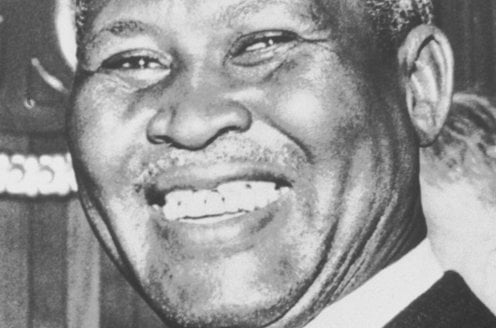
Albert Lutuli was awarded the Nobel Peace Prize for his non-violent struggle against Apartheid in South Africa.
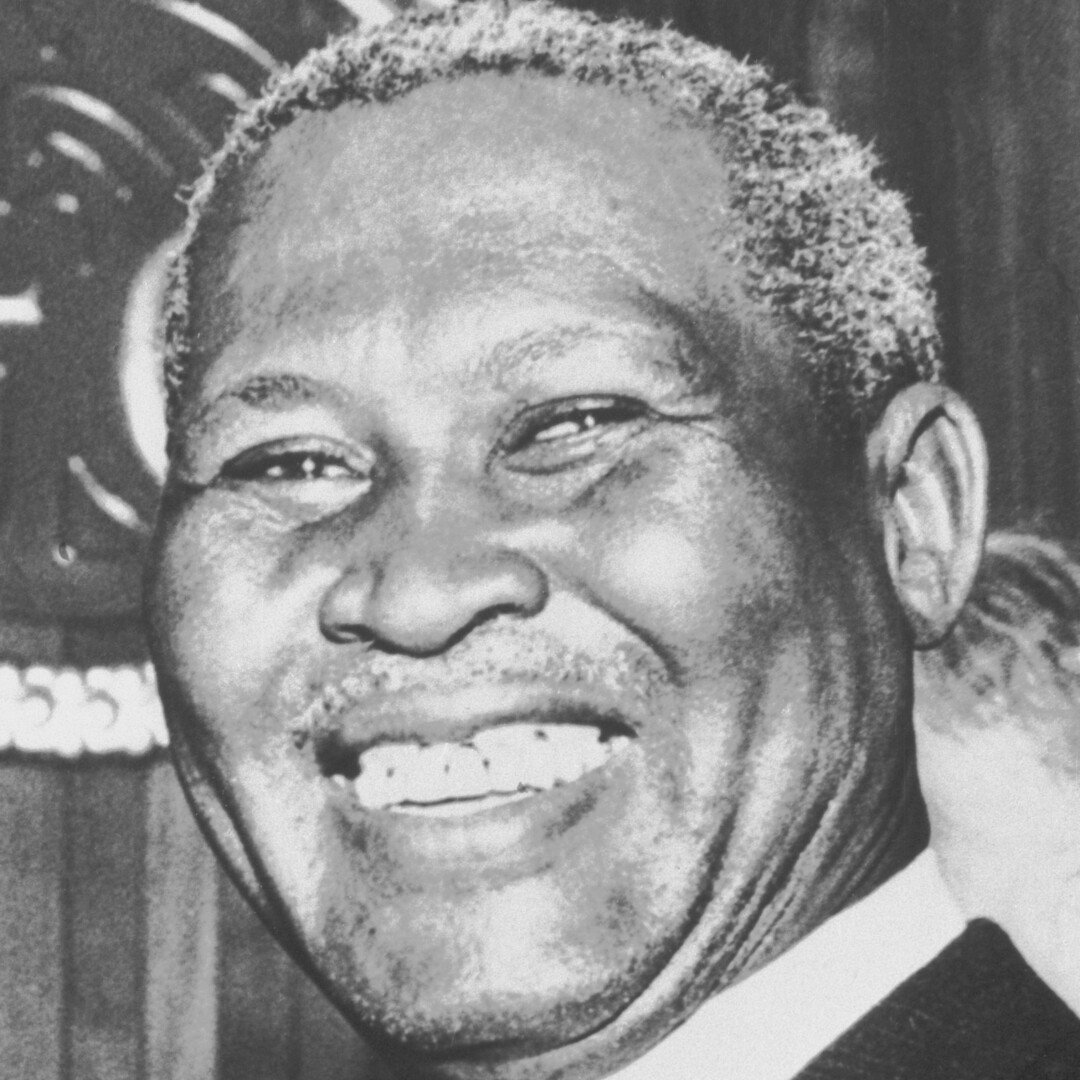
Full name: Albert John Lutuli
Born: 1898, Bulawayo, Southern Rhodesia (now Zimbabwe)
Died: 21 July 1967, Stanger, South Africa
Date awarded: 23 October 1961
At the dawn of the 1960s, European colonial powers loosened their grip on Africa and many Africans gained national independence. But the white minority in South Africa continued to develop its harsh segregationist policy. Zulu Chief Albert Lutuli led the black population in a non-violent campaign against apartheid under the banner of the African National Congress (ANC) liberation movement. In the 1950s, Lutuli helped to organise numerous demonstrations and strikes. For this he was subjected to surveillance, imprisonment and abuse by the apartheid government. The selection of Lutuli as laureate represented an important step in the international effort to ban apartheid. From then on, human rights issues became a major focus of the Norwegian Nobel Committee.
“If the non-white people of South Africa ever lift themselves from their humiliation without resorting to violence and terror, then it will be above all because of the work of Lutuli, their fearless and incorruptible leader who, thanks to his own high ethical standards, has rallied his people in support of this policy …”
Gunnar Jahn, Chairman of the Nobel Committee, Presentation Speech, 10 December 1961.
In March 1960, South African police killed 69 demonstrators who were peacefully protesting the hated Pass Laws in Johannesburg’s Sharpeville township. The laws required all black people to carry a special pass in order to enter “white only” areas of the country. Lutuli denounced the statute by burning his pass in public. The authorities declared a state of emergency to quell the unrest. More than 18,000 people were jailed, and the ANC was banned and forced to go underground. Those in favour of armed revolt gained sway, and Nelson Mandela was elected military leader of the ANC.
| Massacre Term originally meaning slaughterhouse, commonly used today to denote the murder of many people at the same time – a bloodbath. |
“The Nobel Prize must not become a pawn to be used in an international political chess-game, but this is exactly what the Nobel Committee has allowed to happen this year.”
Professor Karl Borgin in the Norwegian journal ‘Farmand’, 16 December 1961.
By awarding the peace prize to Lutuli, the Norwegian Nobel Committee elected for the first time to openly admonish a country’s political leadership. Committee Chairman Gunnar Jahn spoke out against the racist regime in South Africa, giving his support to the struggle to combat apartheid by non-violent means. In this way the committee hoped to help prevent the racial conflict from escalating into a bloody civil war.
Albert Lutuli was the first Nobel Peace Prize laureate to break the Western dress code and accept his prize in a national costume. Instead of the usual black suit he wore the raiment of a Zulu chief, which clearly marked his protest against the South African Government. It also indicated that he still considered himself a leader of his people even though the government had deposed him in his home province. In his Nobel Prize lecture, Lutuli emphasised that it was a Christian duty to use non-violent means to oppose South Africa’s racist regime and to work towards establishing democracy for all ethnic groups, regardless of skin colour.
| Zulu An ethnic group of roughly 8 million people (2005), living primarily in KwaZulu-Natal Province, South Africa. A war-like people before the whites came. The Zulus fought hard against white colonialism in the 1800s. |
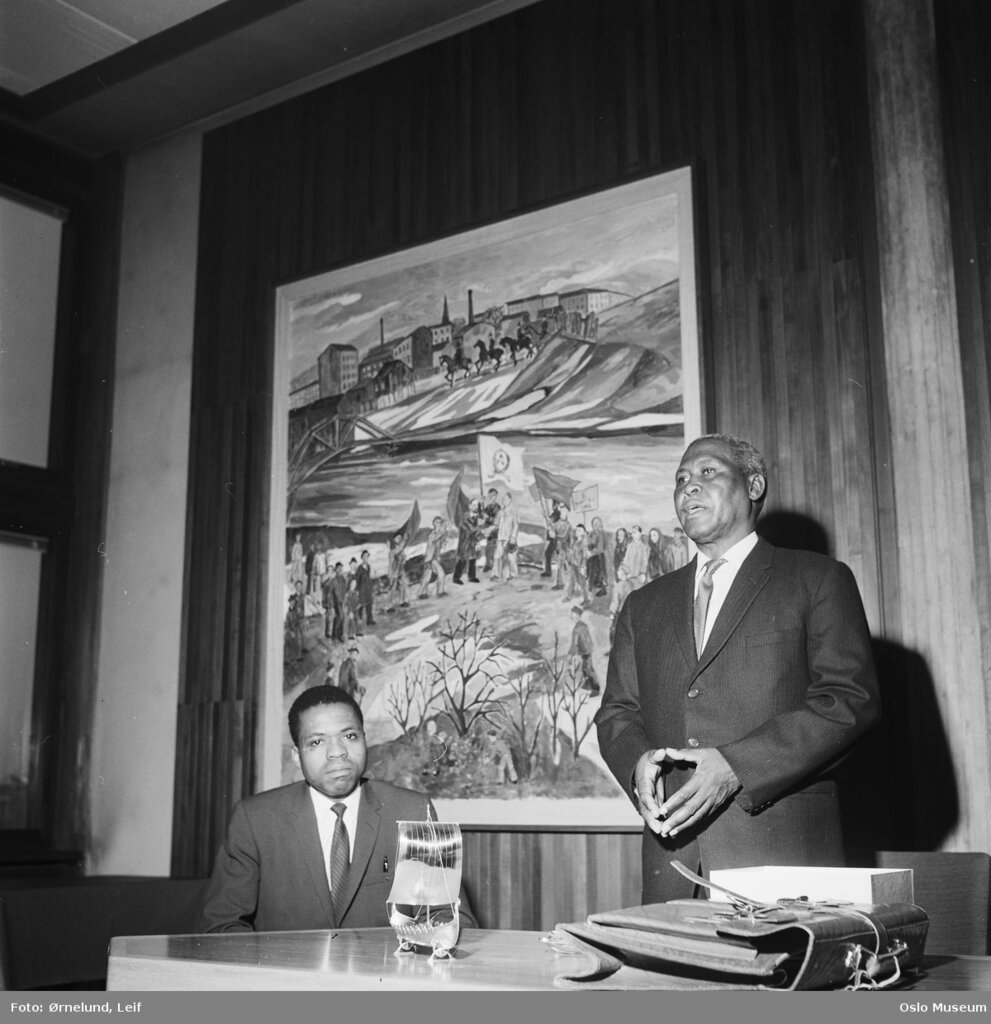
Lutuli’s peace prize was a powerful motivator for the Norwegian anti-apartheid movement. Students, political youth organisations and Christian groups organised a march of over 5,000 people who paid tribute to the peace laureate in front of Oslo City Hall. In the 1960s, anti-apartheid activists began to cooperate more closely, forming the Norwegian Council for Southern Africa in 1967. The organisation followed up Lutuli’s call for a boycott of the apartheid regime and participated in the international solidarity movement for the ANC.
“To remain neutral in a situation where the laws of the land virtually criticized God for having created men of colour was the sort of thing I could not, as a Christian, tolerate.”
Albert Lutuli, Nobel Prize lecture, 11 December 1961.
Chief of his tribe and president-general of the African National Congress, Albert John Lutuli was the leader of ten million black Africans in their nonviolent campaign for civil rights in South Africa …
Disclaimer: Every effort has been made by the publisher to credit organisations and individuals with regard to the supply of photographs. Please notify the publishers regarding corrections.

1 (of 2) Albert Lutuli (right) receives the 1960 Nobel Peace Prize from Gunnar Jahn, chairman of the Norwegian Nobel Peace Prize committee on 10 December 1961.
Photo Bettmann/Getty Images

2 (of 2) Albert Lutuli during a meeting in Folkets Hus, Oslo, 11 December 1961.
Photo: Leif Ørnelund/Oslo Museum. CC BY-SA
Credit: ITN Archive/Reuters
‘Chief Albert John Luthuli’ from South African History Online
Albert Lutuli’s Acceptance Speech, on the occasion of the award of the Nobel Peace Prize in Oslo, December 10, 1961*
Your Majesty, Mr. President, Ladies and Gentlemen, here present!
On an occasion like this words fail one. This is the most important occasion not only in my life, but in that of my dear wife, Nokukhanya, who shares with me this honour. For, friends, her encouragement, not just mere encouragement but active support, made me at times fear that she herself might end in jail one day. She richly shares with me this honour.
I will now, Mr. President, humbly present my speech of acceptance of this great honour. A significant honour which I feel I least deserve, Sir.
I have committed into writing what I have to say, I will proceed to read that.
This year, as in the years before it, mankind has paid for the maintenance of peace the price of many lives. It was in the cause of his activities in the interest of peace that the late Dag Hammarskjöld lost his life. Of his work a great deal has been written, but I wish to take this opportunity to say how much I regret that he is not with us to receive the encouragement of this service he has rendered mankind. I might here pause and interject, friends, to say as I was thinking of this unfortunate occasion that brought about the passing of Dag Hammarskjöld. I remember that many lives have been lost in Africa, starting with Livingstone of old to this day. Lives worthily lost to redeem Africa. It is significant that it was in Africa, my home continent, that he gave his life. How many times his decisions helped to avert a world catastrophe will never be known. But there are many of such occasions, I am sure. But there can be no doubt that he steered the United Nations through one of the most difficult phases in its history. His absence from our midst today should be an enduring lesson for all peace-lovers, and a challenge to the nations of the world to eliminate those conditions in Africa, nay, anywhere, which brought about the tragic and untimely end to his life. This, the devoted Chief Executive of the world.
As you may have heard, when the South African Minister of Interior announced that subject to a number of rather unusual conditions, I would be permitted to come to Oslo for this occasion, conditions, Mr. President, made me literally to continue a bad man in the free Europe. He expressed the view that I did not deserve the Nobel Peace Prize for 1960. Such is the magic of a peace prize, that it has even managed to produce an issue on which I agree with the Government of South Africa. I don’t think there are very many issues on which we agree. Although for different reasons.
It is the greatest honour in the life of any man to be awarded the Nobel Peace Prize, and no one who appreciates its profound significance can escape a feeling of inadequacy, and I do so very deeply, when selected to receive it. In this instance, the feeling is the deeper, not only because these elections are made by a committee by the most eminent citizens of this country, but also because I find it hard to believe that in this distressed and heavily laden world I could be counted among those whose efforts have amounted to a noticeable contribution to the welfare of mankind. I recognize, however, that in my country, South Africa, the spirit of peace is subject to some of the severest tensions known to men. Yes, it is idle to speak of our country as being in peace, because there can be no peace in any part of the world where there are people oppressed. For that reason South Africa has been, and continues to be, the focus of world attention. I therefore regard this award as a recognition of the sacrifice made by many of all races, particularly the African people, who have endured and suffered so much for so long. It can only be on behalf of the people of South Africa, all the people of South Africa, especially the freedom-loving people, that I accept this award, that I acknowledge this honour. I accept it also as an honour not only to South Africa, but for the whole continent of Africa, to this continent, Mother Africa! To all its people, whatever their race, colour or creed might be, and indeed, friends, I like to say, quite long ago my forefathers extended a hand of friendship to people of Europe when they came to that continent. What has happened to the extension of that hand only history can say, and it is not time to speak about that here, but I would like to say, as I receive this prize of peace, that the hand of Africa was extended. It was a hand of friendship, if you read history.
It is an honour for the peace-loving people of the entire world and an encouragement for us all to redouble our efforts in this struggle for peace and friendship, or indeed we do need in this world of ours at the present moment peace and friendship. These are becoming very rare commodities in the world. For my part, I am deeply conscious of the added responsibility which this award entails. I have the feeling that I have been made answerable for the future of the people of South Africa, for if there is no peace for the majority of them there is no peace for any one. As I said it is idle to speak of peace anywhere where there are people still suffering under oppression. I can only pray, friends, that The All Mighty will give me the strength to make my humble contribution to the peaceful solution of South Africa’s, and indeed, the world’s problems, for it is not just South Africa, or Africa, there are other parts of the world where there are tensions, and those places are sorely in need of peace, as we are in my own continent, as we are in my own area of South Africa.
Happily, I am only one among millions who have dedicated their lives to the service of mankind, who have given time, property and life to ensure that all men shall live in peace and happiness, and I like to here say, that there are many in my country who are doing so.
I have already said I have noticed this award on behalf of all freedom-loving peoples who work day and night to make South Africa what it ought to be. It is appropriate, Your Majesty, Mr. President, at this point, to mention the late Alfred Nobel to whom we owe our presence here, and who, by establishing the Nobel Foundation, placed responsibility for the maintenance of peace on the individual. It is so easy sometimes to hide under groups when you do very little for a cause. Here the stress is on the individual, so making peace, no less than war, is the concern of every man and woman on earth, whether they be in Senegal or Berlin, in Washington or in the shattered towns of South Africa. However humble the place, it can make its contribution also, it is expected to make its contribution to peace. It is this call for quality in the late Nobel’s ideals which have won for the Nobel Peace Prize the importance and universal recognition which it enjoys. For indeed it enjoys deservingly this universal recognition. In an age when the outbreak of war would wipe out the entire face of the earth, the ideals of Nobel should not merely be accepted or even admired, they should be lived, with a stress on, they should be lived!
It is so easy to admire a person, to admire what he or she stood for or stands for, and yet shrink from cutting off the mission of the present. The challenge, friends, is for us to live the ideals that Nobel tried to uphold in the world as enshrined in the Nobel Peace Prize and other prizes which he bequeathed to mankind. Scientific inventions, at all conceivable levels should enrich human life, not threaten existence. Science should be the greatest ally, not the worst enemy of mankind. Only so can the world, not only respond to the worthy efforts of Nobel, but also ensure itself against self-destruction. Indeed the challenge is for us to ensure the world from self-destruction. In our contribution to peace we are resolved to end such evils as oppression, white supremacy and race discrimination, all of which are incompatible with world peace and security. There is indeed a threat to peace.
In some quarters it is often doubted whether the situation in South Africa is a threat to peace, it is no doubt that any situation where men have to struggle for their rights is a threat to peace. We are encouraged to know, by the very nature of the award made for 1960 that in our efforts we are serving our fellow men in the world over.
May the day come soon, when the people of the world will rouse themselves, and together effectively stamp out any threat to peace in whatever quarter of the world it may be found. When that day comes, there shall be “peace on earth and goodwill amongst men”, as was announced by the Angels when that great messenger of peace, Our Lord came to earth.
* The prize was reserved in 1960 and distributed in 1961.
Nobel Lecture*, December 11, 1961
In years gone by, some of the greatest men of our century have stood here to receive this award, men whose names and deeds have enriched the pages of human history, men whom future generations will regard as having shaped the world of our time. No one could be left unmoved at being plucked from the village of Groutville1, a name many of you have never heard before and which does not even feature on many maps – to be plucked from banishment in a rural backwater, to be lifted out of the narrow confines of South Africa’s internal politics and placed here in the shadow of these great figures. It is a great honor to me to stand on this rostrum where many of the great men of our times have stood before.
The Nobel Peace Award that has brought me here has for me a threefold significance. On the one hand, it is a tribute to my humble contribution to efforts by democrats on both sides of the color line to find a peaceful solution to the race problem. This contribution is not in any way unique. I did not initiate the struggle to extend the area of human freedom in South Africa; other African patriots – devoted men – did so before me. I also, as a Christian and patriot, could not look on while systematic attempts were made, almost in every department of life, to debase the God-factor in man or to set a limit beyond which the human being in his black form might not strive to serve his Creator to the best of his ability. To remain neutral in a situation where the laws of the land virtually criticized God for having created men of color was the sort of thing I could not, as a Christian, tolerate.
On the other hand, the award is a democratic declaration of solidarity with those who fight to widen the area of liberty in my part of the world. As such, it is the sort of gesture which gives me and millions who think as I do, tremendous encouragement. There are still people in the world today who regard South Africa’s race problem as a simple clash between black and white. Our government has carefully projected this image of the problem before the eyes of the world. This has had two effects. It has confused the real issues at stake in the race crisis. It has given some form of force to the government’s contention that the race problem is a domestic matter for South Africa. This, in turn, has tended to narrow down the area over which our case could be better understood in the world2.
From yet another angle, it is welcome recognition of the role played by the African people during the last fifty years to establish, peacefully, a society in which merit and not race would fix the position of the individual in the life of the nation.
This award could not be for me alone, nor for just South Africa, but for Africa as a whole. Africa presently is most deeply torn with strife and most bitterly stricken with racial conflict. How strange then it is that a man of Africa should be here to receive an award given for service to the cause of peace and brotherhood between men. There has been little peace in Africa in our time. From the northernmost end of our continent, where war has raged for seven years, to the center and to the south there are battles being fought out, some with arms, some without? In my own country, in the year 1960, for which this award is given, there was a state of emergency for many months. At Sharpeville, a small village, in a single afternoon sixtynine people were shot dead and 180 wounded by small arms fire3; and in parts like the Transkei4, a state of emergency is still continuing. Ours is a continent in revolution against oppression. And peace and revolution make uneasy bedfellows. There can be no peace until the forces of oppression are overthrown.
Our continent has been carved up by the great powers; alien governments have been forced upon the African people by military conquest and by economic domination; strivings for nationhood and national dignity have been beaten down by force; traditional economics and ancient customs have been disrupted, and human skills and energy have been harnessed for the advantage of our conquerors. In these times there has been no peace; there could be no brotherhood between men.
But now, the revolutionary stirrings of our continent are setting the past aside. Our people everywhere from north to south of the continent are reclaiming their land, their right to participate in government, their dignity as men, their nationhood. Thus, in the turmoil of revolution, the basis for peace and brotherhood in Africa is being restored by the resurrection of national sovereignty and independence, of equality and the dignity of man.
It should not be difficult for you here in Europe to appreciate this. Your continent passed through a longer series of revolutionary upheavals, in which your age of feudal backwardness gave way to the new age of industrialization, true nationhood, democracy, and rising living standards – the golden age for which men have striven for generations. Your age of revolution, stretching across all the years from the eighteenth century to our own, encompassed some of the bloodiest civil wars in all history. By comparison, the African revolution has swept across three quarters of the continent in less than a decade; its final completion is within sight of our own generation. Again, by comparison with Europe, our African revolution – to our credit – is proving to be orderly, quick, and comparatively bloodless.
This fact of the relative peacefulness of our African revolution is attested to by other observers of eminence. Professor C.W. de Kiewiet, president of the University of Rochester, U.S.A., in a Hoernlé Memorial Lecture for 1960, has this to say: “There has, it is true, been almost no serious violence in the achievement of political self-rule. In that sense there is no revolution in Africa – only reform…”
Professor D.V. Cowen, then professor of comparative law at the University of Cape Town, South Africa, in a Hoernlé Memorial Lecture for 1961, throws light on the nature of our struggle in the following words: “They (the Whites in South Africa) are again fortunate in the very high moral caliber of the non-White inhabitants of South Africa, who compare favorably with any on the whole continent.” Let this never be forgotten by those who so eagerly point a finger of scorn at Africa.
Perhaps, by your standards, our surge to revolutionary reforms is late. If it is so – if we are late in joining the modern age of social enlightenment, late in gaining self-rule, independence, and democracy, it is because in the past the pace has not been set by us. Europe set the pattern for the nineteenth and twentieth-century development of Africa. Only now is our continent coming into its own and recapturing its own fate from foreign rule.
Though I speak of Africa as a single entity, it is divided in many ways by race, language, history, and custom; by political, economic, and ethnic frontiers. But in truth, despite these multiple divisions, Africa has a single common purpose and a single goal – the achievement of its own independence. All Africa, both lands which have won their political victories but have still to overcome the legacy of economic backwardness, and lands like my own whose political battles have still to be waged to their conclusion – all Africa has this single aim: our goal is a united Africa in which the standards of life and liberty are constantly expanding; in which the ancient legacy of illiteracy and disease is swept aside; in which the dignity of man is rescued from beneath the heels of colonialism which have trampled it. This goal, pursued by millions of our people with revolutionary zeal, by means of books, representations, demonstrations, and in some places armed force provoked by the adamancy of white rule, carries the only real promise of peace in Africa. Whatever means have been used, the efforts have gone to end alien rule and race oppression.
There is a paradox in the fact that Africa qualifies for such an award in its age of turmoil and revolution. How great is the paradox and how much greater the honor that an award in support of peace and the brotherhood of man should come to one who is a citizen of a country where the brotherhood of man is an illegal doctrine, outlawed, banned, censured, proscribed and prohibited; where to work, talk, or campaign for the realization in fact and deed of the brotherhood of man is hazardous, punished with banishment, or confinement without trial, or imprisonment; where effective democratic channels to peaceful settlement of the race problem have never existed these 300 years; and where white minority power rests on the most heavily armed and equipped military machine in Africa. This is South Africa.
Even here, where white rule seems determined not to change its mind for the better, the spirit of Africa’s militant struggle for liberty, equality, and independence asserts itself. I, together with thousands of my countrymen have in the course of the struggle for these ideals, been harassed and imprisoned, but we are not deterred in our quest for a new age in which we shall live in peace and in brotherhood.
It is not necessary for me to speak at length about South Africa; its social system, its politics, its economics, and its laws have forced themselves on the attention of the world. It is a museum piece in our time, a hangover from the dark past of mankind, a relic of an age which everywhere else is dead or dying. Here the cult of race superiority and of white supremacy is worshiped like a god. Few white people escape corruption, and many of their children learn to believe that white men are unquestionably superior, efficient, clever, industrious, and capable; that black men are, equally unquestionably, inferior, slothful, stupid, evil, and clumsy. On the basis of the mythology that “the lowest amongst them is higher than the highest amongst us”, it is claimed that white men build everything that is worthwhile in the country – its cities, its industries, its mines, and its agriculture and that they alone are thus fitted and entitled as of right to own and control these things, while black men are only temporary sojourners in these cities, fitted only for menial labor, and unfit to share political power. The prime minister of South Africa, Dr. Verwoerd5, then minister of Bantu Affairs, when explaining his government’s policy on African education had this to say: “There is no place for him (the African) in the European community above the level of certain forms of labor.”
There is little new in this mythology. Every part of Africa which has been subject to white conquest has, at one time or another and in one guise or another, suffered from it, even in its virulent form of the slavery that obtained in Africa up to the nineteenth century. The mitigating feature in the gloom of those far-off days was the shaft of light sunk by Christian missions, a shaft of light to which we owe our initial enlightenment. With successive governments of the time doing little or nothing to ameliorate the harrowing suffering of the black man at the hands of slave drivers, men like Dr. David Livingstone6 and Dr. John Philip7 and other illustrious men of God stood for social justice in the face of overwhelming odds. It is worth noting that the names I have referred to are still anathema to some South Africans. Hence the ghost of slavery lingers on to this day in the form of forced labor that goes on in what are called farm prisons. But the tradition of Livingstone and Philip lives on, perpetuated by a few of their line. It is fair to say that even in present-day conditions, Christian missions have been in the vanguard of initiating social services provided for us. Our progress in this field has been in spite of, and not mainly because of, the government. In this, the church in South Africa, though belatedly, seems to be awakening to a broader mission of the church in its ministry among us. It is beginning to take seriously the words of its Founder who said: “I came that they might have life and have it more abundantly.”8 This is a call to the church in South Africa to help in the all-round development of man in the present, and not only in the hereafter. In this regard, the people of South Africa, especially those who claim to be Christians, would be well advised to take heed of the Conference decisions of the World Council of Churches held at Cottesloe, Johannesburg, in 1960, which gave a clear lead on the mission of the church in our day9. It left no room for doubt about the relevancy of the Christian message in the present issues that confront mankind. I note with gratitude this broader outlook of the World Council of Churches. It has a great meaning and significance for us in Africa.
There is nothing new in South Africa’s apartheid ideas, but South Africa is unique in this: the ideas not only survive in our modern age but are stubbornly defended, extended, and bolstered up by legislation at the time when, in the major part of the world, they are now largely historical and are either being shamefacedly hidden behind concealing formulations or are being steadily scrapped. These ideas survive in South Africa because those who sponsor them profit from them. They provide moral whitewash for the conditions which exist in the country: for the fact that the country is ruled exclusively by a white government elected by an exclusively white electorate which is a privileged minority; for the fact that eighty-seven percent of the land and all the best agricultural land within reach of town, market, and railways are reserved for white ownership and occupation, and now through the recent Group Areas legislation10 nonwhites are losing more land to white greed; for the fact that all skilled and highly paid jobs are for whites only; for the fact that all universities of any academic merit are exclusively preserves of whites; for the fact that the education of every white child costs about £64 per year while that of an African child costs about £9 per year and that of an Indian child or colored child costs about £20 per year; for the fact that white education is universal and compulsory up to the age of sixteen, while education for the nonwhite children is scarce and inadequate; and for the fact that almost one million Africans a year are arrested and jailed or fined for breaches of innumerable pass and permit laws, which do not apply to whites.
I could carry on in this strain and talk on every facet of South African life from the cradle to the grave. But these facts today are becoming known to all the world. A fierce spotlight of world attention has been thrown on them. Try as our government and its apologists will, with honeyed words about “separate development” and eventual “independence” in so-called “Bantu homelands”11, nothing can conceal the reality of South African conditions. I, as a Christian, have always felt that there is one thing above all about “apartheid” or “separate development” that is unforgivable. It seems utterly indifferent to the suffering of individual persons, who lose their land, their homes, their jobs, in the pursuit of what is surely the most terrible dream in the world. This terrible dream is not held on to by a crackpot group on the fringe of society or by Ku Klux Klansmen12, of whom we have a sprinkling. It is the deliberate policy of a government, supported actively by a large part of the white population and tolerated passively by an overwhelming white majority, but now fortunately rejected by an encouraging white minority who have thrown their lot with nonwhites, who are overwhelmingly opposed to so-called separate development.
Thus it is that the golden age of Africa’s independence is also the dark age of South Africa’s decline and retrogression, brought about by men who, when revolutionary changes that entrenched fundamental human rights were taking place in Europe, were closed in on the tip of South Africa – and so missed the wind of progressive change.
In the wake of that decline and retrogression, bitterness between men grows to alarming heights; the economy declines as confidence ebbs away; unemployment rises; government becomes increasingly dictatorial and intolerant of constitutional and legal procedures, increasingly violent and suppressive; there is a constant drive for more policemen, more soldiers, more armaments, banishments without trial, and penal whippings. All the trappings of medieval backwardness and cruelty come to the fore. Education is being reduced to an instrument of subtle indoctrination; slanted and biased reporting in the organs of public information, a creeping censorship, book banning, and blacklisting – all these spread their shadows over the land. This is South Africa today, in the age of Africa’s greatness.
But beneath the surface there is a spirit of defiance. The people of South Africa have never been a docile lot, least of all the African people. We have a long tradition of struggle for our national rights, reaching back to the very beginnings of white settlement and conquest 300 years ago. Our history is one of opposition to domination, of protest and refusal to submit to tyranny. Consider some of our great names: the great warrior and nation builder Shaka, who welded tribes together into the Zulu nation from which I spring; Moshoeshoe, the statesman and nation-builder who fathered the Basuto nation and placed Basutoland beyond the reach of the claws of the South African whites; Hintsa of the Xosas, who chose death rather than surrender his territory to white invaders13. All these and other royal names, as well as other great chieftains, resisted manfully white intrusion. Consider also the sturdiness of the stock that nurtured the foregoing great names. I refer to our forbears, who, in trekking from the north to the southernmost tip of Africa centuries ago, braved rivers that are perennially swollen; hacked their way through treacherous jungle and forest; survived the plagues of the then untamed lethal diseases of a multifarious nature that abounded in Equatorial Africa; and wrested themselves from the gaping mouths of the beasts of prey. They endured it all. They settled in these parts of Africa to build a future worthwhile for us, their offspring. While the social and political conditions have changed and the problems we face are different, we too, their progeny, find ourselves facing a situation where we have to struggle for our very survival as human beings. Although methods of struggle may differ from time to time, the universal human strivings for liberty remain unchanged. We, in our situation, have chosen the path of non-violence of our own volition. Along this path we have organized many heroic campaigns. All the strength of progressive leadership in South Africa, all my life and strength, have been given to the pursuance of this method, in an attempt to avert disaster in the interests of South Africa, and [we] have bravely paid the penalties for it.
It may well be that South Africa’s social system is a monument to racialism and race oppression, but its people are the living testimony to the unconquerable spirit of mankind. Down the years, against seemingly overwhelming odds, they have sought the goal of fuller life and liberty, striving with incredible determination and fortitude for the right to live as men – free men. In this, our country is not unique. Your recent and inspiring history, when the Axis powers overran most European states, is testimony of this unconquerable spirit of mankind. People of Europe formed resistance movements that finally helped to break the power of the combination of Nazism and Fascism, with their creed of race arrogance and Herrenvolk mentality.
Every people has, at one time or another in its history, been plunged into such struggle. But generally the passing of time has seen the barriers to freedom going down, one by one. Not so South Africa. Here the barriers do not go down. Each step we take forward, every achievement we chalk up, is cancelled out by the raising of new and higher barriers to our advance. The color bars do not get weaker; they get stronger. The bitterness of the struggle mounts as liberty comes step by step closer to the freedom fighter’s grasp. All too often the protests and demonstrations of our people have been beaten back by force; but they have never been silenced.
Through all this cruel treatment in the name of law and order, our people, with a few exceptions, have remained nonviolent. If today this peace award is given to South Africa through a black man, it is not because we in South Africa have won our fight for peace and human brotherhood. Far from it. Perhaps we stand farther from victory than any other people in Africa. But nothing which we have suffered at the hands of the government has turned us from our chosen path of disciplined resistance. It is for this, I believe, that this award is given.
How easy it would have been in South Africa for the natural feelings of resentment at white domination to have been turned into feelings of hatred and a desire for revenge against the white community. Here, where every day, in every aspect of life every nonwhite comes up against the ubiquitous sign “Europeans Only” and the equally ubiquitous policeman to enforce it – here it could well be expected that a racialism equal to that of their oppressors would flourish to counter the white arrogance toward blacks. That it has not done so is no accident. It is because, deliberately and advisedly, African leadership for the past fifty years, with the inspiration of the African National Congress, which I had the honor to lead for the last decade or so until it was banned, had set itself steadfastly against racial vaingloriousness. We know that in so doing we passed up opportunities for an easy demagogic appeal to the natural passions of a people denied freedom and liberty; we discarded the chance of an easy and expedient emotional appeal. Our vision has always been that of a nonracial, democratic South Africa which upholds the rights of all who live in our country to remain there as full citizens, with equal rights and responsibilities with all others. For the consummation of this ideal we have labored unflinchingly. We shall continue to labor unflinchingly.
It is this vision which prompted the African National Congress to invite members of other racial groups who believe with us in the brotherhood of man and in the freedom of all people to join with us in establishing a non-racial, democratic South Africa. Thus the African National Congress in its day brought about the Congress Alliance and welcomed the emergence of the Liberal Party and the Progressive Party, who to an encouraging measure support these ideals.
The true patriots of South Africa, for whom I speak, will be satisfied with nothing less than the fullest democratic rights. In government we will not be satisfied with anything less than direct, individual adult suffrage and the right to stand for and be elected to all organs of government. In economic matters we will be satisfied with nothing less than equality of opportunity in every sphere, and the enjoyment by all of those heritages which form the resources of the country, which up to now have been appropriated on a racial “whites only” basis. In culture we will be satisfied with nothing less than the opening of all doors of learning in non-segregated institutions on the sole criterion of ability. In the social sphere we will be satisfied with nothing less than the abolition of all racial bars. We do not demand these things for people of African descent alone. We demand them for all South Africans, white and black. On these principles we are uncompromising. To compromise would be an expediency that is most treacherous to democracy, for in the turn of events, the sweets of economic, political, and social privileges that are a monopoly of only one section of a community turn sour even in the mouths of those who eat them. Thus apartheid in practice is proving to be a monster created by Frankenstein. That is the tragedy of the South African scene.
Many spurious slogans have been invented in our country in an effort to redeem uneasy race relations – “trusteeship”, “separate development”, “race federation” and elsewhere, “partnership”. These are efforts to sidetrack us from the democratic road, mean delaying tactics that fool no one but the unwary. No euphemistic naming will ever hide their hideous nature. We reject these policies because they do not measure up to the best mankind has striven for throughout the ages; they do great offense to man’s sublime aspirations that have remained true in a sea of flux and change down the ages, aspirations of which the United Nations Declaration of Human Rights14 is a culmination. This is what we stand for. This is what we fight for.
In their fight for lasting values, there are many things that have sustained the spirit of the freedom – loving people of South Africa and those in the yet unredeemed parts of Africa where the white man claims resolutely proprietary rights over democracy – a universal heritage. High among them – the things that have sustained us – stand: the magnificent support of the progressive people and governments throughout the world, among whom number the people and government of the country of which I am today guest; our brothers in Africa, especially in the independent African states; organizations who share the outlook we embrace in countries scattered right across the face of the globe; the United Nations Organization jointly and some of its member nations singly. In their defense of peace in the world through actively upholding the quality of man, all these groups have reinforced our undying faith in the unassailable rightness and justness of our cause. To all of them I say: Alone we would have been weak. Our heartfelt appreciation of your acts of support of us we cannot adequately express, nor can we ever forget, now or in the future when victory is behind us and South Africa’s freedom rests in the hands of all her people.
We South Africans, however, equally understand that, much as others might do for us, our freedom cannot come to us as a gift from abroad. Our freedom we must make ourselves. All honest freedom-loving people have dedicated themselves to that task. What we need is the courage that rises with danger.
Whatever may be the future of our freedom efforts, our cause is the cause of the liberation of people who are denied freedom. Only on this basis can the peace of Africa and the world be firmly founded. Our cause is the cause of equality between nations and peoples. Only thus can the brotherhood of man be firmly established. It is encouraging and elating to remind you that, despite her humiliation and torment at the hands of white rule, the spirit of Africa in quest for freedom has been, generally, for peaceful means to the utmost.
If I have dwelt at length on my country’s race problem, it is not as though other countries on our continent do not labor under these problems, but because it is here in the Republic of South Africa that the race problem is most acute. Perhaps in no other country on the continent is white supremacy asserted with greater vigor and determination and a sense of righteousness. This places the opponents of apartheid in the front rank of those who fight white domination.
In bringing my address to a close, let me invite Africa to cast her eyes beyond the past and to some extent the present, with their woes and tribulations, trials and failures, and some successes, and see herself an emerging continent, bursting to freedom through the shell of centuries of serfdom. This is Africa’s age – the dawn of her fulfillment, yes, the moment when she must grapple with destiny to reach the summits of sublimity, saying: Ours was a fight for noble values and worthy ends, and not for lands and the enslavement of man.
Africa is a vital subject matter in the world of today, a focal point of world interest and concern. Could it not be that history has delayed her rebirth for a purpose? The situation confronts her with inescapable challenges, but more importantly with opportunities for service to herself and mankind. She evades the challenges and neglects the opportunities, to her shame, if not her doom. How she sees her destiny is a more vital and rewarding quest than bemoaning her past, with its humiliations and sufferings.
The address could do no more than pose some questions and leave it to the African leaders and peoples to provide satisfying answers and responses by their concern for higher values and by their noble actions that could be
Footprints on the sands of time.
Footprints, that perhaps another,
Sailing o’er life’s solemn main,
A forlorn and shipwrecked brother,
Seeing, shall take heart again.15
Still licking the scars of past wrongs perpetrated on her, could she not be magnanimous and practice no revenge? Her hand of friendship scornfully rejected, her pleas for justice and fair play spurned, should she not nonetheless seek to turn enmity into amity? Though robbed of her lands, her independence, and opportunities – this, oddly enough, often in the name of civilization and even Christianity – should she not see her destiny as being that of making a distinctive contribution to human progress and human relationships with a peculiar new Africa flavor enriched by the diversity of cultures she enjoys, thus building on the summits of present human achievement an edifice that would be one of the finest tributes to the genius of man?
She should see this hour of her fulfillment as a challenge to her to labor on until she is purged of racial domination, and as an opportunity of reassuring the world that her national aspiration lies not in overthrowing white domination to replace it by a black caste but in building a nonracial democracy that shall be a monumental brotherhood, a “brotherly community” with none discriminated against on grounds of race or color.
What of the many pressing and complex political, economic, and cultural problems attendant upon the early years of a newly independent state? These, and others which are the legacy of colonial days, will tax to the limit the statesmanship, ingenuity, altruism, and steadfastness of African leadership and its unbending avowal to democratic tenets in statecraft. To us all, free or not free, the call of the hour is to redeem the name and honor of Mother Africa.
In a strife-torn world, tottering on the brink of complete destruction by man-made nuclear weapons, a free and independent Africa is in the making, in answer to the injunction and challenge of history: “Arise and shine for thy light is come.”16. Acting in concert with other nations, she is man’s last hope for a mediator between the East and West, and is qualified to demand of the great powers to “turn the swords into ploughshares”17 because two-thirds of mankind is hungry and illiterate; to engage human energy, human skill, and human talent in the service of peace, for the alternative is unthinkable – war, destruction, and desolation; and to build a world community which will stand as a lasting monument to the millions of men and women, to such devoted and distinguished world citizens and fighters for peace as the late Dag Hammarskjöld, who have given their lives that we may live in happiness and peace.
Africa’s qualification for this noble task is incontestable, for her own fight has never been and is not now a fight for conquest of land, for accumulation of wealth or domination of peoples, but for the recognition and preservation of the rights of man and the establishment of a truly free world for a free people.
* The laureate delivered this lecture in the Auditorium of the University of Oslo. The occasion saw some “firsts” in Nobel ceremonies: Lutuli was asked to bring his wife to the platform – never before done – and, after much applause at the end of his lecture, he himself sang (in Zulu) the African anthem, “Nkosi Sikelel iAfrika”, being joined by the Africans, present and by others in the audience. The text of his lecture, which he gave in English, is taken from Les Prix Nobel en 1961. A tape of it records many extemporaneous additions made in delivery. In an informal and often humorous opening paragraph not in the prepared text, he thanked the Nobel Committee and Oslo – its people and its mayor – and paid tribute to the “human” King of Norway (Olaf V). His other additions were for the most part repetitions or amplifications of points already made.
1. Groutville, Lutuli’s home village of some 500 population on the Natal coast about fifty miles north of Durban, is the center of the Umvoti Mission Reserve that supports about 5.000 Zulus.
2. In one of his extemporaneous insertions, Lutuli here points out that the race issue in South Africa is not just a “clash of color”, but a “clash of ideas” oppression versus democratic rights for all.
3. The result of police reaction to anti-pass tactics used by the Pan-Africanist Congress, which supported an Africans – only resistance as opposed to the African National Congress idea of working with all races; this action circumvented an ANC anti-pass campaign scheduled for a few days later.
4. In East Cape Province of South Africa.
5. Hendrik Frensch Verwoerd (1901-1966), Nationalist Party leader and prominent advocate of apartheid in the Union of South Africa; native affairs minister (1950-1958); prime minister (1958-1966).
6. David Livingstone (1813-1873), Scottish missionary and explorer in Africa.
7. John Philip (1775-1851), British missionary in South Africa; was influential in gaining rights for the natives but had to abandon his plan for independent native states.
9. Meeting from December 8 to 14, 1960, the Council delegates lived and worked together without regard for the color bar and in their final report included criticism of the Union government’s racial measures.
10. Legislation permitting the division of residential land in South African cities into sections, each for one racial group.
11. Under the apartheid or “separate development” policy, Bantu “homelands” or Bantustans are areas set aside for Africans only, where, the theory goes, they can preserve their own culture and traditions.
12. Founded in 1915 in Georgia, the “modern” Ku Klux Klan, an anti-Negro, anti-Catholic, anti-Semitic organization, reached its peak of power in the U.S. in the mid-twenties; is now moribund.
13. Shaka [also Chaka] (?-1828), the “Black Napoleon”, built the Zulu nation by conquest between 1816 and 1828, when he was assassinated. Moshoeshoe [also Moshesh] (c. 1780-1870) fought off the Zulus and later signed an agreement with the British, under whose protection and guidance Basutoland has been developing self government. Hintsa of the Gcaleka Xosas, a tribal chief, was killed when trying to “escape” the English in 1835.
14. Adopted by the General Assembly on December 10, 1948; for details, see presentation speech for Cassin and his Nobel lecture in 1968, pp. 385-407.
15. From “A Psalm of Life” by Henry Wadsworth Longfellow (1807-1882), American poet.
Presentation Speech by Gunnar Jahn*, Chairman of the Nobel Committee
This year the Nobel Committee of the Norwegian Parliament has awarded two Peace Prizes. The prize for 1960 goes to Albert John Lutuli, and the prize for 1961 is awarded posthumously to Dag Hammarskjöld.
In many respects these two recipients differ widely. Albert John Lutuli’s life and work have been molded by the pattern of the African tribal community and by the influence of Christianity, while Dag Hammarskjöld’s were a product of Western culture. Lutuli’s activities have been, and are, confined to his own country, while Dag Hammarskjöld worked in the international sphere. Yet despite these differences, they had one thing in common: both fought to implant the idea of justice in the individual, in the nation, and among the nations; or we might put it like this: they fought for the ideals expressed in the declaration of human rights embodied in the Charter of the United Nations.
Albert John Lutuli was born in 1898. He comes from a long line of Zulu chiefs, but he was influenced by Christianity in his school days and in his later education, first in the American mission school he attended and afterwards during his training as a teacher. After passing his examination at Adams College in Natal, he became a faculty member of the college, where he taught, among other subjects, the history of the Zulu people. During his seventeen years as a teacher, he took no part in the political life of South Africa.
In 1935 a great change took place in Lutuli’s life when he was called to assume the functions of tribal chief. The choice of a chief must be approved by the state, which pays his salary. It was on the basis of this authority that the government was able to remove him in 1952. His seventeen years as a chief brought him daily contact with the individual members of the tribal community, as well as an active part in the work of the Christian church in South Africa, in India, and in the United States.
Both as a teacher and later as a chief, Lutuli did outstanding work. He took his duties as chief very seriously and in doing so won the affection of his tribe. He endeavored to blend its ancient culture with the precepts of Christianity and to promote its economic welfare in various ways – for example, by introducing new methods of sugar production.
Describing this period of his life, he tells us: “Previous to being a chief I was a school teacher for about seventeen years. In these past thirty years or so, I have striven with tremendous zeal and patience to work for the progress and welfare of my people and for their harmonious relations with other sections of our multiracial society in the Union of South Africa. In this effort I always pursued the path of moderation. Over this great length of time I have, year after year, gladly spent hours of my time with such organizations as the church and its various agencies, such as the Christian Council of South Africa, the Joint Council of Europeans and Africans, and the now defunct Native Representative Council.”1
But it was neither as a teacher, nor as a chief, nor as an active member of various Christian organizations that he took a focal position in what was to be his great effort in the post war years.
The forces that induced Albert John Lutuli to abandon his tranquil educational activities and enter politics were unleashed by the increasing pressure which the ruling white race exerted on members of other races in South Africa. In 1944 he became a member of the African National Congress, an organization founded in 1912. In 1952 he was elected its president, an office he held until the Congress was banned in 1960. It is first and foremost for the work he carried on during these years – from the 1940s to the present – that we honor him today.
To get some idea of Lutuli’s achievements, we must know something of the society in which he worked. The white population of South Africa settled there in the latter half of the seventeenth century. The first settlers were French Huguenots, followed later by Dutch farmers. They cleared the land, and their descendants – the Boers – have lived there ever since. They look upon the country as their fatherland; they have no other. The English settlers, who arrived on the scene at the end of the eighteenth century, maintained close contact with their mother country.
The first natives whom the Dutch pioneers met were Hottentots and Bushmen. The Hottentots have now virtually disappeared as a separate racial entity; but through intermarriage with European and other races they have contributed in large measure to the racial characteristics of those so-called “the colored people”.
When the Boers moved into the interior, they encountered other native tribes, among them the Zulus, whom they fought and conquered. These tribes constitute the largest part of the population of South Africa today. In the course of time other racial elements were added: the Dutch imported a number of Malays from the East Indies as slaves, while the British introduced Indian labor to the sugar plantations. In the nineteenth century two communities took shape: the Boer republics of Transvaal2 and the Orange Free State, and the British colony of South Africa, both ruled by whites. At the turn of the century these two communities fought the Boer War of 1899-1902, from which Britain finally emerged victorious. The ultimate result was that the Union of South Africa was set up as an independent British Dominion in 1901. At that time the outside world heard little about relations between whites and nonwhites.
During the fifty years that have since elapsed, South Africa, in common with so many other countries, has developed from an agricultural community into one in which mining, industry, trade, and other such operations now predominate. As in other such countries, the urban population has increased rapidly.
The present-day population of South Africa is some 14.7 million, of whom only some 3.3 million are white. Of the remainder, 9.6 million are Africans, some 0.4 million Asian (mainly Indians) and 1.4 million of mixed race (the so-called colored people). Of the 9.6 million Africans, some 3.3 million live in the agricultural districts of the whites, a large proportion of them as agricultural workers on white farms; 3.7 million live in the African reservations; and 2.6 million live in the towns.
Although some of these figures are only approximate, they still present a picture of a community whose economy and therefore future are dependent on cooperation between all races. The figures testify to the fact that people of all races have helped to build this community. The whites could never have done it alone. This is an incontestable fact. But what is the position of the nonwhite population?
In this community, nonwhites are denied all right to participate in the government of the state. They are discriminated against legally, economically, and socially. And this discrimination between whites and nonwhites has grown steadily during the postwar years. The aim of those now ruling the country is to draw a line between the two communities – between whites and nonwhites – despite the fact that the march of events has clearly shown that the whole community has been developed by the efforts of all races. I cannot here go into the network of laws and regulations passed in order to maintain the barrier between whites and nonwhites. The purpose of these laws is to restrict and regulate every facet of the life of the nonwhite. He has no vote, he has no part in determining his own status; under the pass system, he is deprived not only of the right to live where he likes but also of the right to choose his employer; he has virtually no redress against police tyranny; he is not entitled to the same schooling or education as the white; and any sexual relation between white and nonwhite entails punishment for both parties. An African Christian is frequently not allowed to worship God under the same roof as a white Christian. In short, nonwhites are treated as a subject race.
Is it surprising then that the nonwhites have protested against such treatment? What is surprising is that the protest has not been accompanied by acts of violence on their part. Their patience is remarkable, their moral strength in the struggle boundless.
It was the discrimination between white and nonwhite that prompted nonwhite Africans in 1912 to establish the African National Congress. Its founders were nonwhite Africans who had obtained a higher education, either abroad or at home, in the days when they still had the opportunity to do so. At first the African National Congress tried to influence political development by means of petitions and deputations to the authorities, but when the attempt proved fruitless and new laws restricting the rights of nonwhites were passed, the African National Congress adopted a more active line, especially after 1949. It was in the mid-1940s that Lutuli began to participate in this work of the African National Congress, of which he became a member in 1944. He was elected to the Committee of the Natal Section in 1945 and in 1951 became president of the Natal Section. In December, 1952, he was elected president of the entire African National Congress, a position he retained until the organization was banned by the government in 1960.
It was during these transitional years of adopting stronger action, based on boycotts, defiance campaigns, and strikes, that Lutuli came to influence so profoundly the African National Congress. He says himself that the Congress never passed any specific resolution to the effect that its struggle was to be pursued by nonviolent means. Actually, however, it has been waged with peaceful means, a policy at all times supported by the Congress administration. Lutuli himself has always been categorically opposed to the use of violence. Within the organization he has had to overcome opposition from two different quarters: from the older members, who supported the more passive approach, and from those members – mainly the younger ones – who wanted to make South Africa an entirely nonwhite state.
As a result of Lutuli’s participation in the more active struggle of the African National Congress, the government presented him with an ultimatum: he must either renounce his position as a chief or give up his seat in the Congress. He refused to comply with either of these alternatives and was immediately deposed as chief, whereupon he issued his significant declaration entitled “The Chief Speaks”, which concludes with the words: “The Road to Freedom is via the Cross.” In his declaration, he says:
“What have been the fruits of my many years of moderation? Has there been any reciprocal tolerance or moderation from the Government, be it Nationalist or United Party? No! On the contrary, the past thirty years have seen the greatest number of Laws restricting our rights and progress until today we have reached a stage where we have almost no rights at all: no adequate land for our occupation, our only asset, cattle, dwindling, no security of homes, no decent and remunerative employment, more restrictions to freedom of movement through passes, curfew regulations, influx control measures; in short, we have witnessed in these years an intensification of our subjection to ensure and protect white supremacy.
It is with this background and with a full sense of responsibility that, under the auspices of the African National Congress (Natal), I have joined my people in the new spirit that moves them today, the spirit that revolts openly and boldly against injustice and expresses itself in a determined and nonviolent manner…
The African National Congress, its nonviolent Passive Resistance Campaign, may be of nuisance value to the Government, but it is not subversive since it does not seek to overthrow the form and machinery of the State but only urges for the inclusion of all sections of the community in a partnership in the Government of the country on the basis of equality.
Laws and conditions that tend to debase human personality – a God-given force – be they brought about by the State or other individuals, must be relentlessly opposed in the spirit of defiance shown by St. Peter when he said to the rulers of his day: Shall we obey God or man? No one can deny that insofar as nonwhites are concerned in the Union of South Africa, laws and conditions that debase human personality abound. Any chief worthy of his position must fight fearlessly against such debasing conditions and laws…
It is inevitable that in working for Freedom some individuals and some families must take the lead and suffer: the Road to Freedom Is via the Cross.”
In 1952, after he had been dismissed from his position as chief and had been elected president of the African National Congress, he was forbidden to leave his home district for two years.3 In 1954 he went to Johannesburg to address a meeting which had been called to protest the forced evacuation of colored people from Sophiatown to Meadowsland. He was refused permission to speak and was banned for another period of two years from leaving his home district.
In 1956, together with 155 other persons, he was arrested and charged with high treason. In 1957 the charge against him and sixty-four others was withdrawn; the rest were all acquitted in 1961. In 1959 Lutuli took part in several mass meetings, but was again subjected to a travel ban, this time for a period of five years. In 1960 there was a large mass demonstration against the pass regulations which led to the events in Sharpeville, where police fired on the crowd, killing and wounding many. A state of emergency was declared and wholesale arrests were made. Lutuli, who had been summoned as a witness in the treason trial, which had dragged on ever since 1956, was among those arrested but was allowed to give evidence in the trial.
During the last year, he has lived at home, debarred from leaving his village and from taking part in any meetings. Moreover, he is now no longer president of the African National Congress, for this organization – as already mentioned – was dissolved by order of the government in April, 1960.
He now lives in his village, deprived of freedom of movement and of the right to speak in open debate, but he still maintains his avowed policy, expressing his views in articles published in the newspaper Post.4 Just before the travel ban was imposed on him in December, 1919 – the year before the Union of South Africa was to celebrate the fiftieth anniversary of its foundation – he wrote a long article entitled “Fifty Years of Union – A Political Review,” which he sent to the South Africa Institute of Race Relations.5 This presents, as far as I know, the clearest and the most complete statement of his position concerning the policy pursued by the government of South Africa.
In this article, his attack on the policies of the South African government is stronger and more detailed than before. This discussion and attack on the policy of apartheid and its plan that the nonwhite community should develop along its own lines is new. He asks: Who has drawn the lines? The answer is: Not those who are to follow them, the nonwhites, but the whites in power. The nonwhites have no rights. There is therefore no reason, he says, for them to rejoice or to participate in the Fiftieth Anniversary celebration. The only thing for the nonwhites to do is to work, each and everyone, with courage and patience, to achieve freedom and democracy for all.
Since he wrote this, South Africa has become a republic and is no longer a member of the British Commonwealth. But this has not improved relations between whites and nonwhites, nor has it altered Lutuli’s attitude in any way. He gives a most concise expression of the view he has always maintained in a letter to Prime Minister Striddom6, in which he says:
“We believe in a community where the white and the nonwhite in South Africa can live in harmony and work for our common fatherland, sharing equally the good things of life which our country can give us in abundance.
We believe in the brotherhood of peoples and in respect for the value of the individual. My congress has never given expression to hatred for any race in South Africa.”
Time and again he has reiterated this, right up to the very present.
His activity has been characterized by a firm and unswerving approach. Never has he succumbed to the temptation to use violent means in the struggle for his people. Nothing has shaken him from this firm resolve, so firmly rooted is his conviction that violence and terror must not be employed. Nor has he ever felt or incited hatred of the white man.
Albert John Lutuli’s fight has been waged within the borders of his own country; but the issues raised go far beyond them. He brings a message to all who work and strive to establish respect for human rights both within nations and between nations.
Well might we ask: will the nonwhites of South Africa, by their suffering, their humiliation, and their patience, show the other nations of the world that human rights can be won without violence, by following a road to which we Europeans are committed both intellectually and emotionally, but which we have all too often abandoned?
If the nonwhite people of South Africa ever lift themselves from their humiliation without resorting to violence and terror, then it will be above all because of the work of Lutuli, their fearless and incorruptible leader who, thanks to his own high ethical standards, has rallied his people in support of this policy, and who throughout his adult life has staked everything and suffered everything without bitterness and without allowing hatred and aggression to replace his abiding love of his fellowmen.
But if the day should come when the struggle of the nonwhites in South Africa to win their freedom degenerates into bloody slaughter, then Lutuli’s voice will be heard no more. But let us remember him then and never forget that his way was unwavering and clear. He would not have had it so.
Let us all rise in silent and respectful tribute to Albert John Lutuli.
* Mr. Jahn delivered this speech on December 10, 1961, in the auditorium of the University of Oslo. At its conclusion he presented the Peace Prize for 1960 (reserved in that year) to Mr. Lutuli, who accepted in a brief speech. The English translation of Mr. Jahn’s speech is, with certain editorial changes and emendations made after collation with the Norwegian text, that is carried in Les Prix Nobel en 1960, which also includes the original Norwegian text.
1. Lutuli, The Road to Freedom is via the Cross (statement made in November, 1952, after his dismissal as chief), in Let My People Go, p. 235.
2. Transvaal was set up as a veer state in 1837; recognized by the British in 1852; organized as the South African Republic in 1886; annexed by the British in 1877; and restored to independence in 1881 under British suzerainty. The Orange Free state, settled by the Boers 1835-1848, was created a free republic in 1854. After the Boer War, both became British crown colonies, with the promise of eventual self-government, which they attained 1905-1907; and both became part of the union of South Africa when it was organized in 1910.
3. Actually, he was banned from the larger centers of the Union and from all public gatherings, but was not restricted to one area.
4. Perhaps a reference to the Golden City Post of Johannesburg.
5. The rest of this paragraph and the four paragraphs that follow it are ommited in the English translation in Les Prix Nobel en 1961
6. Johannes Gerhardus Striddom (1893-1958), Nationalist Party leader; Prime Minister of the Union of South Africa (1954-1988); advocate of apartheid and of the Union’s withdrawal from the British Commonwealth.