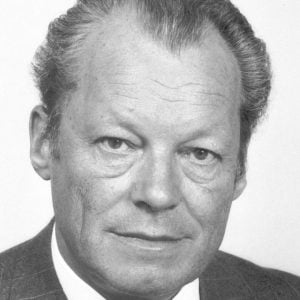
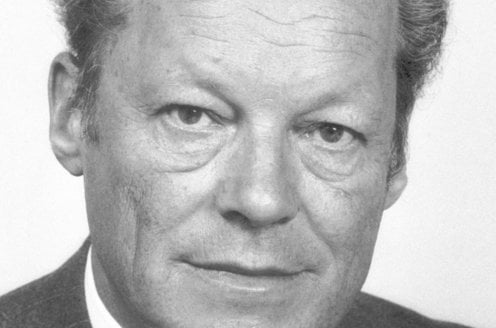
Full name: Willy Brandt Born: 18 December 1913, Lübeck, Germany Died: 8 October 1992, Unkel, Germany Date awarded: 21 October 1971
European bridge-builder
A socialist, Willy Brandt started to take part in illegal anti-Nazi activities in the early 1930s. Forced to leave Germany, he moved to Norway, becoming politically active in the Norwegian Labour Party. When Germany attacked Norway in 1940, he fled to Sweden, where he worked as a journalist for the Norwegian government-in-exile. After the war, Brandt served as mayor of West Berlin, chairman of the Social Democratic Party (SPD) and Chancellor of Germany. Under Brandt’s leadership, West Germany signed a nuclear non-proliferation treaty. He also negotiated a non-aggression pact with the Soviet Union and a treaty with Poland, in which West Germany recognised the new East European borders established in 1945. These agreements helped to reduce tensions between East and West during the Cold War.
”We can see for ourselves that Willy Brandt’s policy of peace has brought thaw to the cold political climate, and this instils hope for a new kind of peace for the frozen earth of Europe.”
Aase Lionæs, Presentation Speech, 10 December 1971.
Brandt devoted great energy to helping German concentration camp prisoner Carl von Ossietzky. As a member of an international support group, Brandt worked diligently to gain the support of the Norwegian labour movement for Ossietzky’s case. He held discussions with the Labour Party leadership and influenced labour leader Martin Tranmæl, who sat on the Norwegian Nobel Committee. There is no doubt that Brandt deserves much of the credit for convincing the Labour Party’s executive board and parliamentary group to nominate Ossietzky for the Nobel Peace Prize.
Defender of West Berlin
As mayor of West Berlin from 1957 to 1966, Brandt achieved international stature. He distinguished himself as a vigorous defender of the city’s interests, when in 1958 he flatly rejected a Soviet proposal to make Berlin a demilitarised zone separate from the Federal Republic of Germany. From 1961 onward, Brandt became a rallying point for all those who protested the building of the Berlin Wall, which made Berlin into a democratic island in the midst of communist East Germany.
”More than anything else, the sight of Willy Brandt kneeling in Warsaw has become a symbol of his Ostpolitik, his will to achieve peace and reconciliation.”
Thorbjørn Jagland, Norwegian Minister of Foreign Affairs, 26 May 2000.
Praise and criticism of the peace prize to Brandt
The Nobel Peace Prize to Brandt was praised by state leaders in both East and West, but it was met with scepticism by the conservative opposition in West Germany. In Norway, the peace prize was drawn into the debate on the EEC. Many opponents of Norwegian EEC membership viewed the selection of Brandt as an attempt by the Norwegian Nobel Committee to strengthen the pro-membership side prior to the public referendum. The torchlight procession for Brandt on 10 December 1971 was thus boycotted by all the political youth organisations, except for the Young Conservatives.
German reunification a step toward European unification
Willy Brandt witnessed the fall of the Berlin Wall in 1989 and the reunification of Germany the following year. Just before his death in 1992, he commented on these historic events with these words: “People who are well disposed to me sometimes suggest that the day on which the Germans united in freedom must have represented the fulfillment of my political life. That line of thought falls too short and too narrow. What I would like to see is the day when all Europe is united.”
”My years in Norway have meant a great deal to me. I learnt to extract concepts such as freedom, justice and solidarity from the ivory tower, free them from a narrow context and place them in an overall social and international perspective.”
Willy Brandt, Speech at the Nobel Banquet, 10 December 1971.
Willy Brandt was born in Lübeck, Germany, in December, 1913. He was educated in Lübeck and in Oslo after escaping Nazi persecution in Germany. After leaving Germany, he continued his work against Nazism through international cooperation and frequent visits to various European countries …
Disclaimer: Every effort has been made by the publisher to credit organisations and individuals with regard to the supply of photographs. Please notify the publishers regarding corrections.
Vortrag des Bundeskanzlers Willy Brandt am 11. Dezember 1971 in Oslo anlässlich der Verleihung des Friedens-Nobelpreises 1971
Friedenspolitik in unserer Zeit
I.
Der Friedens-Nobelpreis 1971 ist einem aktiven Politiker zuerkannt worden; also kann nur sein weitergehendes Bemühen, nicht eine abgeschlossene Leistung gewürdigt worden sein.
Gestern habe ich danksagen dürfen, heute will ich über Friedenspolitik in unserer Zeit sprechen. Über meine Erfahrungen und natürlich darüber, was mein eigenes Land tun kann. Auch über das, was wir in Europa und von Europa aus für die Welt tun können. Es ist wenig genug, wie unsere Ohnmacht angesichts des neuen Krieges zwischen Indien und Pakistan verrät.
Meine Grundsätze will ich gerade jetzt deutlich unterstreichen: Der Krieg darf kein Mittel der Politik sein. Es geht darum, Kriege abzuschaffen, nicht nur, sie zu begrenzen. Kein nationales Interesse lässt sich heute noch von der Gesamtverantwortung für den Frieden trennen. Jede Aussenpolitik muss dieser Einsicht dienen. Als Mittel einer europäischen und weltweiten Sicherheitspolitik hat sie Spannungen abzubauen und die Kommunikation über die Grenzen hinweg zu fördern.
Aussenminister Walter Scheel und ich lassen uns davon leiten, dass es nicht genügt, friedfertige Absichten zu bekunden, sondern dass wir uns aktiv um die Organisation des Friedens zu bemühen haben.
Krieg führen – Frieden halten; unser Sprachgebrauch zeigt an, welche Herausforderung der Frieden ist, sobald wir ihn als eine permanente Aufgabe begreifen.
Wie man dem Krieg wehren kann, ist eine Frage, die zur europäischen Tradition gehört – Europa hat stets Grund genug gehabt, danach zu fragen. Der Politiker, der im täglichen Widerstreit der Interessen der Sache eines gerechten Friedens zu dienen sucht, zehrt von den ideellen Kräften, die die Generationen vor ihm ausgeformt haben. Bewusst oder unbewusst wird er von ihnen geleitet.
Unsere ethischen und sozialen Begriffe sind durch zwei Jahrtausende Christentum vor- und mitgeprägt. Und das heisst – trotz vieler Verirrungen unter dem Feldzeichen des bellum justum, des „gerechten Krieges” – immer wieder neue Versuche und Anstrengungen, um zum Frieden auch auf dieser Welt zu gelangen.
Unsere zweite Quelle ist der Humanismus und die mit ihm verbundene klassische Philosophie. Immanuel Kant verband seine Idee der verfassungs-mässigen Konföderation von Staaten mit einer uns Heutigen sehr deutlichen Fragestellung: Die Menschen werden eines Tages vor der Wahl stehen, entweder sich zu vereinigen unter einem wahren Recht der Völker, oder aber ihre ganze in Jahrtausenden aufgebaute Zivilisation mit ein paar Schlägen wieder zu zerstören; und so wird die Not sie zu dem zwingen, was sie besser längst aus freier Vernunft getan hätten.
Eine dritte starke Quelle ist der Sozialismus mit seinem Streben nach gesellschaftlicher Gerechtigkeit im eigenen Staat und darüber hinaus. Und mit seiner Forderung, dass die Gesetze der Moral nicht nur zwischen einzelnen Bürgern, sondern auch zwischen Völkern und Staaten gelten sollen.
Friedenspolitik ist eine nüchterne Arbeit. Auch ich versuche, mit den Mitteln, die mir zu Gebote stehen, der Vernunft in meinem Lande und in der Welt voranzuhelfen: Jener Vernunft, die uns den Frieden befiehlt, weil der Unfriede ein anderes Wort für die extreme Unvernunft geworden ist. Krieg ist nicht mehr die ultima ratio, sondern die ultima irratio. Auch wenn das noch nicht allgemeine Einsicht ist: Ich begreife eine Politik für den Frieden als wahre Realpolitik dieser Epoche.
Was in Deutschland zwölf Jahre lang in extremer Zuspitzung Realpolitik genannt wurde, hat sich als höllische Chimäre erwiesen. Heute sind wir dabei, mit uns selbst und mit der Welt ein erträgliches Gleichgewicht zu finden. Wenn in der Bilanz meiner politischen Wirksamkeit stehen würde, ich hätte einem neuen Realitätssinn in Deutschland den Weg öffnen helfen, dann hätte sich eine grosse Hoffnung meines Lebens erfüllt.
Ich sage hier wie zuhause: Ein guter Deutscher kann kein Nationalist sein. Ein guter Deutscher weiss, dass er sich einer europäischen Bestimmung nicht versagen kann. Durch Europa kehrt Deutschland heim zu sich selbst und den aufbauenden Kräften seiner Geschichte. Unser Europa, aus der Erfahrung von Leiden und Scheitern geboren, ist der bindende Auftrag der Vernunft.
II.
Unter der Drohung einer Selbstvernichtung der Menschheit ist die Koexistenz zur Frage der Existenz überhaupt geworden. Koexistenz wurde nicht zu einer unter mehreren akzeptablen Möglichkeiten, sondern zur einzigen Chance zu überleben.
Womit hatten wir es in den letzten 25 Jahren in Europa vor allem zu tun? Einmal mit einem imponierenden Wiederaufbau, zum anderen mit fortgesetzten Spannungen. Der Ost-West-Konflikt – dessen Ursachen im Wesentlichen nicht im Westen lagen – hat viele Kräfte gebunden. Ich habe diese Zeit am Schnittpunkt Berlin intensiv miterlebt. Lassen Sie mich gleich hinzufügen: Ich habe meine Aufgabe dort – gerade in den sehr „militanten” Jahren – immer auch in ihrer friedenssichernden Wirkung gesehen. Es war und ist meine Überzeugung: Hätte sich der Westen aus meiner Stadt vertreiben lassen, wäre dies nicht nur ein Unglück für die unmittelbar betroffenen Menschen gewesen, nicht nur ein schwerer Schaden für die Bundesrepublik Deutschland, Westeuropa und die Vereinigten Staaten, sondern es hätten sich daraus mit grosser Wahrscheinlichkeit sehr gefahrvolle Konsequenzen für den Frieden ergeben. So war es nicht nur bei Stalins Blockade 1948, sondern auch nach Chruschtschows Ultimatum 1958.
Ich gehöre nicht zu den Leuten, die behaupten oder gar meinen, sie hätten immer recht gehabt. Mein Lebensweg verlangte, die eigene Position immer wieder zu durchdenken. Doch kann ich sagen, dass ich mich seit meiner Jugend von solchen Grundüberzeugungen habe leiten lassen, die zur guten Nachbarschaft führen sollen – im Innern und nach aussen.
Als Berliner Bürgermeister habe ich erfahren, wie zugespitzte Lagen auf unser Denken einwirken. Ich habe dabei auch gewusst, dass Standhaftigkeit dem Frieden dient.
Über die Krisenjahre 1961 und 1962 ist viel geschrieben worden. Vielleicht kann ich ein paar zusätzliche Hinweise geben. Der Bau der Mauer hatte eine Seite, die am stärksten ins Auge fiel: die absurde Teilung dessen, was vom Gesamtorganismus einer Millionenstadt intakt geblieben war. Mit all den beklagenswerten Folgen, die sich daraus für die Menschen ergaben.
Daneben gab es die weltpolitische Seite dieses tiefen Einschnitts. Die Westmächte standen ohne Schwanken zu ihrem Schutz für West-Berlin. Aber sie fanden sich wohl oder übel damit ab, dass ihr Gegenpart allein über Ost-Berlin verfügte. Kein Viermächte-Status änderte etwas daran, dass die Mauer zur Trennungslinie zwischen den atomar gerüsteten Supermächten geworden war. Und niemand, der Verantwortung trug, hat verlangt, die Westmächte sollten militärische Macht einsetzen und einen Krieg riskieren, um ihren Anteil an einer ursprünglich gemeinsamen Verantwortung zu wahren.
Es gab noch einen anderen Aspekt, den der verbal überspielten Ohnmacht. Die Berufung auf Rechtspositionen, die sich nicht verwirklichen Hessen. Das Planen von Gegenmaßnahmen für jeweils andere Situationen als die, mit denen man es zu tun hatte. In kritischen Lagen war man auf sich selbst gestellt; die Verbalisten hatten einem nichts zu bieten.
Leidenschaftliche Proteste waren berechtigt, auch notwendig, aber sie änderten nichts an der Lage. Die Mauer blieb; man musste mit ihr leben, und ich habe Polizei aufbieten müssen, damit junge Demonstranten nicht in ihr Unglück rannten. Die Behinderung auf den Zufahrtswegen nach Berlin blieben. Der Graben, der Deutschland trennte, von Lübeck bis zur tschechoslovakischen Grenze, blieb und wurde tiefer. Das Spiel mit den Trümpfen, die keine sind, wie Golo Mann formuliert hat, änderte nichts. Man musste die politischen Möglichkeiten neu durchdenken, wenn man für die Menschen etwas erreichen und den Frieden sicherer machen wollte.
Die Kuba-Krise zeigte, dramatischer und mit höherem Einsatz, die Abgrenzung und die sich wandelnden Beziehungen zwischen den Atomgiganten.
Anfang Oktober 1962 besuchte ich John F. Kennedy. Er sprach von der Gefahr, die von gegen die USA gerichteten Raketenbasen ausgehen würde. Ich stand unter dem Eindruck, dass die Gefahr einer Fehlkalkulation nicht auszuschliessen sei; es gab Truppenkonzentrationen um Berlin. Als der Präsident in der Nacht zum 23. Oktober seine bitterernste Kubarede hielt, stellte er zweimal den Zusammenhang mit Berlin her. Ich bestärkte ihn.
Tatsächlich ist damals in unserem Teil der Welt alles ruhig geblieben. Die Kuba-Krise wurde durch verantwortungsbewusste Kaltblütigkeit beigelegt. Dies war eine wichtige Erfahrung und ein Wendepunkt.
Wenige Wochen zuvor hatte ich in Harvard über Koexistenz gesprochen. Von meiner Berliner Erfahrung ausgehend sagte ich, ein realistisches Selbstbewusstsein brauche die Fühlung mit dein politischen und weltanschaulichen Gegner nicht zu fürchten. Die Unsicherheit der Zeit dürfe einen nicht selbst unsicher machen. Was nutze die Tuchfühlung, wenn man nicht bereit sei zu reden! Reden heisse aber doch auch verhandeln, mit der Bereitschaft zum Ausgleich, nicht zu einseitigen Konzessionen. Aktive Friedenspolitik bleibt ein langfristiger Test unserer geistigen und materiellen Lebenskraft.
III.
Der Einsicht in die Abgründe eines globalen Krieges folgte die Erkenntnis, dass Probleme globalen Ausmasses uns bedrängen: Hunger, Bevölkerungsexplosion, Umweltgefahren, Abnahme der natürlichen Vorräte. Diese Dimensionen kann nur ignorieren, wer den Untergang dieser Welt akzeptiert oder gar mit Wollust erwartet.
In unseren Jahren liefern die Gelehrten uns Bücher, die ausgezeichnet sind durch Sachkenntnis und tiefen Ernst. Da geht es nicht mehr nur um die Gegensätze zwischen Ideologien und Gesellschaftssystemen; da geht es um die Zukunft des Menschen, und ob er überhaupt eine Zukunft hat. Da geht es um Aufgaben, die die Grenzen jedes Staates und Kontinents überschreiten. Da wird Politik selber zur Wissenschaft; und diese Wissenschaft ist eine, an der gerade die reichen, die zivilisatorisch überlegenen Mächte gemeinsam teilnehmen müssen; es kann sie kein Staat mehr für sich allein betreiben.
Wir bedürfen des Friedens nicht nur im Sinn eines gewaltlosen Zustandes. Wir bedürfen seiner als Voraussetzung für jene rettende Zusammenarbeit, die ich meine. So wie sie den Frieden voraussetzt, so kann sie auch Frieden schaffen helfen. Denn da, wo rettende Zusammenarbeit ist, da ist Friede, da stellt auch Vertrauen mit der Zeit sich ein. Mein Land ist keine „grosse” Macht mehr und kann es nicht mehr sein. Aber eine wirtschaftliche, wissenschaftliche Macht ist es ja wohl; und ich glaube, ich darf versichern, dass wir alle – worüber sich Regierung und Opposition sonst auch streiten mögen – zu einer solchen Zusammenarbeit bereit sind, jederzeit und überall.
Ich habe von ein paar Aspekten dessen gesprochen, was man heute Friedensforschung nennt. Tatsächlich ist eine neue Qualität der internationalen Politik seit mehr als einem Jahrzehnt erkennbar geworden. Der Kalte Krieg mit seiner sterilen Paradoxie, die Grenzen erstarren zu lassen, ohne die Gefahren des Zusammenstosses zu verhindern, zeigte keinen Ausweg. Man begann, die extremen Gefahren zu kontrollieren, die Spannungen abzubauen. Man lernte in Kuba und Berlin, Konflikte zu beherrschen. De Gaulle und Nixon setzten den Kurs auf Kooperation statt Konfrontation. Breschnew und Kossygin steuerten auf ihre Weise ein neues Verhältnis zum Westen an.
Im kleinen habe ich vor acht Jahren als Regierender Bürgermeister der Erkenntnis gemäss gehandelt, dass kleine Schritte besser sind als keine Schritte. Als Hunderttausende nach Jahren der Trennung ihre Angehörigen zu Weihnachten besuchen konnten, durch Passierscheine, war dies in der Nusschale die Anwendung der Erkenntnis, dass es eine neue, nur scheinbare Paradoxie geben kann, die sich segensreich auswirkt: Durch das Erkennen der Lage, wie sie ist, die Lage zu verbessern.
Von damals und den in Harvard entwickelten Vorstellungen der Koexistenz als Herausforderung, über die Tätigkeit als Aussenminister, die Regierungserklärung vor mehr als zwei Jahren, die Verträge von Moskau, Warschau und Berlin wird man keine Überraschungen auf meinem Weg finden. Keine Illusionen, keine Schaukelpolitik. Ich versuche allerdings zu tun, was ich gesagt habe.
Aktive Koexistenz-Politik darf weder von Furcht noch von Vertrauensseligkeit getragen sein. Ich weiss, dass das westliche Bündnis funktionieren würde; das potentielle Gegenüber wird sich darüber keine Illusionen machen. Aber auch das phantasielose Prinzip ist abzulehnen, nämlich, Staaten unterschiedlicher sozialer und ökonomischer Verfassung könnten nicht ohne ernste Konflikte nebeneinander leben.
Wenn das Nebeneinander organisiert ist, sicher durch Ausschluss von Gewalt für alle, dann muss die Organisierung des Miteinander beginnen. Dieser Wille wäre zum Scheitern verurteilt, wenn in ihm der Hintergedanke eines Kreuzzuges in neuer Form massgebend wäre. Es gibt die Abgrenzung durch die ideologischen Gegensätze, und es wird sie weiter geben. Aber es ist ein Fortschritt, wenn mehr von den Interessen als von der Ideologie gesprochen wird. Es ist ermutigend, wenn Dialoge an die Stelle von Monologen in den Ost-West-Beziehungen treten, um jene Probleme zu lösen, die trotz aller weiterbestehender Gegensätze gemeinsame Interessen berühren.
Gemeinsame Probleme lösen heisst Bindungen und Verbindungen schaffen durch sinnvolle Kooperation der Staaten über die Grenzen der Blöcke hinweg. Dies heisst, Transformation des Konflikts. Dies heisst, wirkliche oder eingebildete Barrieren abtragen bei gegenseitigem friedlichen Risiko. Dies heisst, Vertrauen schaffen durch praktisch funktionierende Regelungen. Und dieses Vertrauen mag dann die neue Basis werden, auf der alte, ungelöste Probleme lösbar werden. Diese Chance zu nutzen, kann die Chance Europas sein in einer Welt, in der erwiesen ist, dass sie nicht allein von Washington, von Moskau – oder von Peking – regiert werden kann.
So unverkennbar gross das Gewicht der Supermächte ist, so unbestreitbar bleibt, dass gleichzeitig weitere Kraftfelder entstehen. Hat es überhaupt Sinn, Zukunftsrechnungen aufzustellen: Dann und dann wird es soundsoviele Grossmächte geben? Unsere Welt steht im Zeichen der Vielzahl und des Wandels. Auch kleine Völker haben ihr Gewicht im grossen Spiel; auch sie können Macht sein auf ihre Art; sie können helfen, sich und anderen; sie können auch sich und andere gefährden.
Das Einrücken der Volksrepublik China in die organisierte Staatengemeinschaft bedeutet nach meinem Verständnis keinen Übergang zur Tripolarität; es gibt mehr weltpolitische Kraftzeritren als zwei oder drei. Aber es hat, von manchem anderen abgesehen, gewiss seine Bedeutung, dass das grosse China Entwicklungsland und Atommacht zugleich ist. Und dass bei den sich immer noch anhäufenden Problemen in der Dritten Welt die Enttäuschung über die Industriestaaten zunimmt.
Europa, das seine ungebrochene Lebenskraft nach dem letzten Krieg bewies, hat seine Zukunft nicht hinter sich. Es wird sich im Westen über die WirtSchaftsgemeinschaft hinaus – im Sinne Jean Monnets – in einer Union zusammenfinden, die auch ein Stück weltpolitischer Verantwortung übernehmen kann, unabhängig von den USA, aber – wie ich sicher bin – fest mit ihnen verbunden. Gleichzeitig gibt es Chancen für gesamteuropäische Kooperation und Friedenssicherung, vielleicht so etwas wie eine europäische Partnerschaft für den Frieden; wenn ich nicht wüsste, welche praktischen und ideellen Hindernisse noch zu überwinden sind, würde ich hier sogar von einem europäischen Friedensbund sprechen.
IV.
Ich bin mir wohl bewusst, dass wir Deutschen in den Annalen des Nobelpreises auf den Gebieten der Chemie und der Physik besser abgeschnitten haben als auf dem des Friedens. Doch sind wir aber auch hier vertreten. Der Krieg hat immer nach dem Frieden gerufen. Auch in meinem Land hat es zumal an mutigen Theoretikern des Friedens nicht gefehlt.
Ich erinnere an den Friedenspreisträger des Jahres 1927, Professor Ludwig Quidde. Von seinen Einsichten als Geschichtsforscher hatte er sich der internationalen Antikriegsbewegung verschrieben und war viele Jahre hindurch der Vorsitzende der Deutschen Friedensgesellschaft. Im ersten Weltkrieg wirkte er für den Bund Neues Vaterland – eine feine Camouflage für Europa – dessen Geschäftsführer der spätere Berliner Bürgermeister Ernst Reuter war und zu dessen ersten Mitgliedern Albert Einstein gehörte. Schon seit 1907 Mitglied des Bayerischen Landtages und dann 1919/20 der Weimarer Nationalversammlung, trat Quidde für Schiedsgerichtsbarkeit und Völkerbund ein. Er hat demokratische Zivilcourage unter Opfern vorgelebt; er starb im Exil.
Äusserlich sichtbarer ist meine Verbindung mit dem ersten deutschen Frie-dens-Nobelpreisträger, mit Gustav Stresemann. Auch er war, als er den Preis empfing, aktiver Politiker. Gewiss, nicht nur nach den Zeitumständen, auch nach dem persönlichen und dem politischen Temperament trennt uns manches, und keine Rückbesinnung, die Würde hat, soll etwas künstlich einebnen. Und doch: Selten kann man etwas leisten ohne Vorgänger. Man muss dafür auch danken können.
Auf den Ersten Weltkrieg war wie auf den Zweiten ein kalter Krieg der Verdächtigungen und Bedrückungen gefolgt. Die Ära des Misstrauens brachte die Völker Europas nicht weiter. Es war Stresemann, der fünf Jahre nach dem Waffenstillstand die Einsicht vertrat und gegen Widerstände drinnen und draussen durchsetzte, dass das Beharren auf längst unterhöhlten Standpunkten unfruchtbar bleiben musste. Er war der Meinung, dass erst eine Sicherheit des Vertrauens wiederhergestellt werden müsse, ehe sich die Dinge zum Besseren wenden könnten. Nicht alle dachten wie er. Viele glaubten, ehe sich nicht manches gebessert habe, dürfe man das Misstrauen nicht aufgeben. Das war und ist ein Problem, damals wie heute. Der damalige Reichsaussenminister war nicht vertrauensselig. Aber er kämpfte – und dafür brauchte auch er Zivilcourage – für eine Politik der Verständigung, für seine Friedenspolitik.
Das Verhältnis, das damals der Krieg am stärksten belastet hatte, war das deutsch-französische. Nirgendwo war der Berg des Misstrauens höher. Stresemann ging dagegen an, und er fand ein Echo auf der anderen Seite, bei demjenigen, mit dem zusammen er den Friedenspreis erhalten sollte, bei Aristide Briand. Was sie gemeinsam und – mit der Hilfe Englands – in Locarno erreichten, hat Stresemann an dieser Stelle so ausgedrückt: „Es ist einmal der Zustand des dauernden Friedens am Rhein, gewährleistet durch feierlichen Verzicht der beiden grossen Nachbarnationen auf Anwendung von Gewalt, gewährleistet durch die Verpflichtung anderer Staaten, demjenigen ihre Macht zu leihen, der entgegen dieser feierlichen Vereinbarung Opfer der Gewalt wird.”
Sie werden verstehen, dass das, was mir diesen Satz so bedeutsam macht, der Begriff des Gewaltverzichts ist. Eine übelwollende Propaganda hat die deutsche Politik damals so missverstanden oder missdeutet, als habe man auf etwas verzichtet, was den Deutschen von Rechts wegen gehörte. In Wirklichkeit verzichtete man auf Gewalt, um den anderen das Gefühl der Sicherheit zu geben und eine Ära des Vertrauens zu eröffnen.
Jener Zustand des dauernden Friedens, von dem Stresemann sprach, er ist dann – wir alle wissen es – von denen wieder umgestossen worden, die insgeheim auf die Gewalt nicht verzichtet hatten. Und doch war, so meine ich, das Werk von Locarno nicht vergeblich. Es hatte Bahnen vorgezeichnet, auf denen andere nach dem abermaligen Krieg gehen konnten.
Ich erinnere an Robert Schuman, so reich an generösen Ideen, auf französischer Seite; an Charles de Gaulle, den Staatsmann, der oft prophetischen Blick bewies; und auf der deutschen Seite an den konservativen und konstruktiven Politiker, Konrad Adenauer. Ihm ist es nicht nur vergönnt gewesen, im hohen Alter die Sehnsucht seines Lebens zu erfüllen und sein Deutschland mit Frankreich zu versöhnen. Er hat auch das Seinige getan, um die Bundesrepublik zu einem ebenbürtigen Mitglied der werdenden Union Westeuropas wie des Atlantischen Bündnisses zu machen. Wie immer wir dies damals im einzelnen beurteilt haben mögen: Ohne das, was im Westen geschaffen wurde, könnten wir nicht tun, was wir heute im Osten erstreben.
Hier, im Verhältnis Deutschlands zu seinen östlichen Nachbarn, gab es nun die stärksten Belastungen, die höchsten Berge des Misstrauens. Hier lag die Aufgabe unserer Zeit. Sie ist noch längst nicht bewältigt. Wir haben erst angefangen damit, aber wir haben es getan und konnten es nur tun auf den Bahnen, die andere vor uns als erste gewagt hatten.
Europäische Friedenspolitik lebt aus dem Geist der Geschichte. Dies klammert die dunkelsten Jahre nicht aus, sondern bezieht sie ausdrücklich ein. In jenen bösen Jahren des Hitlerregimes hat die Verleihung des Friedens-Nobelpreises an Carl von Ossietzky viel bedeutet.
Zusammen mit Quidde war er in der Deutschen Friedensgesellschaft tätig gewesen. Mit seiner scharfen Feder stritt er gegen Militarismus und Nationalismus. 1921 schrieb er: „Es haben viele Nationen miteinander gekämpft, aber geflossen ist nur einerlei Blut: das Blut der Bürger Europas.” Von ihm forderte die Zeit noch mehr als Zivilcourage, sie forderte von ihm das Leben.
Kurz vor der Verleihung versuchte einer der Gewalthaber von dem unbequemen Gefangenen die Zusage zu erpressen, dass er den Preis zurückweisen würde. Dann sollte er befreit, materiell sichergestellt und in Zukunft nicht mehr belästigt werden. Ossietzky sagte Nein – und ging ins Gefängnis zurück. Ich war damals, als 22jähriger, „illegal” in Berlin. Und gerade dort ging mir dies sehr nahe, nachdem ich an der „Kampagne” unmittelbar beteiligt gewesen war.
Mit Carl von Ossietzky hat das Nobel-Komitee einen Verfolgten geehrt, der nicht hierher kommen durfte, um den Preis zu empfangen. Seine Ehrung war ein moralischer Sieg über die damals herrschenden Mächte der Barbarei. Ich möchte dem Nobel-Komitee heute im Namen eines freien Deutschland dafür in aller Form einen späten Dank aussprechen.
Gleichzeitig möchte ich all denen meine Anerkennung sagen und meine Ermutigung geben, die sich um Menschen kümmern, die wegen ihrer Überzeugung gefangen gehalten oder auf andere Weise verfolgt werden.
Den Männern und Frauen des Widerstandes gegen Hitler bin ich gerade auch hier ein Wort tiefen Respekts schuldig. Ich grüsse die ehemalige Résistance in allen Ländern.
Der deutsche Widerstand hat opfervoll für Anstand, Rechtlichkeit und Freiheit gekämpft. Er hat das Deutschland bewahrt, das ich als das meine empfinde und das mir mit der Auferstehung des Rechts und der Freiheit wieder ganz zur Heimat wurde.
Der gestrige Tag hat für mich auch den Sinn, dass er vor aller Welt offenkundig gemacht hat: Deutschland hat sich mit sich selbst versöhnt; es hat zu sich selbst zurückgefunden, so wie der Exilierte die friedlichen und menschlichen Züge seines Vaterlandes wiederentdecken durfte.
V.
Noch als Aussenminister habe ich gesagt, das die Politik unseres Landes sich eindeutig an dem einen Generalnenner Friedenssicherung zu orientieren habe. Der jetzige Bundesaussenminister und ich wissen natürlich, dass Friedenspolitik mehr bedeuten muss, als anderen zu applaudieren. Alle müssen sich fragen, was sie konkret beizutragen haben. Gerade ein Land wie die Bundesrepublik Deutschland durfte nicht im Allgemeinen verharren; sie musste sich zu ihrem spezifischen Beitrag äussern. Antworten, die wir selbst geben konnten, durften wir nicht anderen überlassen. Niemand kann uns dort etwas abnehmen, wo wir aufgrund der realen Lage unersetzbar sind.
Ich habe reale Lage gesagt. Die erkennt man nicht, wenn man der Selbsttäuschung unterliegt oder Politik mit Juristerei verwechselt. Der Kreml ist kein Amtsgericht, sagte Präsident Paasikivi, und das Bild Hesse sich ausweiten, auch auf Washington. Ich wusste, dass die Rechnung für Hitlers Krieg noch offen war. Aber ich war und bin dennoch nicht gesonnen, über die Prinzipien der Menschenrechte und der Selbstbestimmung mit mir handeln zu lassen.
Von der realen Lage ausgehen, das hiess, niemandes territoriale Integrität in Frage zu stellen, sondern die Unverletzlichkeit der Grenzen anzuerkennen. Als wir den vertraglich organisierten Gewaltverzicht vorschlugen und die östlichen Nachbarn aufforderten, uns beim Wort zu nehmen, haben wir an das anknüpfen können, was andere Bundesregierungen vor uns gesagt und wozu sie sich in den Westverträgen verpflichtet hatten. Aus der Logik unserer Politik folgerte, dass die Unantastbarkeit der Grenzen auch für das Verhältnis zum Osten und auch für die beiden Staaten in Deutschland gelten musste, die ihre Zuordnung zu den beiden Bündnissystemen gefunden hatten.
Die Spannung – zwischen Friedenswillen und Selbstbehauptung – der der deutsche Politiker in der Zeit der Konfrontation unterworfen war, führte über leidenschaftliche Auseinandersetzungen zu wesentlichen Klärungen. Unsere West-Ost-Politik hat sich hieraus ergeben. Wir haben das Gebot der Selbstbehauptung ernst genommen, und den Gedanken der nationalen Einheit haben wir nicht verkümmern lassen. Sondern wir sind daran gegangen, auch in unserem nationalen Interesse, unser Verhältnis zu Osteuropa neu zu ordnen. Dies ist keine einfache Folge von Massnahmen und Verträgen, sondern ein breiter und vielgestaltiger Ablauf, der alle möglichen Wege zur Relativierung der Grenzen zu nutzen und neue Wege zu öffnen sucht.
Das Etikett „Ostpolitik” sagt mir nicht zu. Aber wie will man etwas einfangen, was sich als Begriff selbständig gemacht und – wie „Gemütlichkeit” unübersetzbar erscheinend – Eingang in die internationale Terminologie gefunden hat? Das Wort ist vorbelastet. Und es lässt die Fehldeutung zu, als sei es mit der auswärtigen Politik wie mit einer Kommode, bei der man mal die eine, mal die andere Schublade aufzieht. In Wirklichkeit ist es so: Unsere Entspannungspolitik fing im Westen an und bleibt im Westen verankert. Wir wollen und brauchen die Partnerschaft mit dem Westen und die Verständigung mit dein Osten.
Niemand sollte übersehen: Die westeuropäische Einigung, an der wir aktiven Anteil haben, behält für uns Priorität. Das Atlantische Bündnis ist für uns unverzichtbar. Aber nicht nur die allgemeine weltpolitische Entwicklung, sondern auch die besondere Realität der Westverträge erfordern deren Ergänzung durch gute, normale, nach Möglichkeit freundliche Beziehungen zur Sowjetunion und ihren Partnern im Warschauer Pakt. Darin bin ich mir einig mit Präsident Pompidou, mit den Premierministern Heath und Colombo, mit all unseren Freunden und Verbündeten.
Wir werden – weil es für uns selbst, für die Deutschen in den beiden Staaten der einen Nation, von Nutzen ist – unsere Verträge mit der Sowjetunion und der Volksrepublik Polen ratifizieren. Ein entspanntes und ergiebiges Verhältnis auch zu den anderen Staaten des Warschauer Paktes herzustellen, ist ein Ziel der Bundesregierung. Die Beziehungen zur DDR werden, allen Schwierigkeiten zum Trotz, auf dem Boden der Gleichberechtigung geordnet werden, und zwar in der zwischenstaatlich üblichen Form, aber auch in Respekt vor den Rechten und Verantwortlichkeiten der Vier Mächte für Deutschland als Ganzes. Die Verhandlungen der beiden deutschen Seiten zur Ausfüllung des Berlin-Abkommens der Vier Mächte haben gezeigt, dass schwierige Fragen sogar bei nicht zu vereinbarenden Rechtsauffassungen zu regeln sind.
Die Bundesrepublik kennt die Grenzen ihrer Möglichkeiten. Mit dieser Einsicht verbunden ist das Bewusstsein, dass sie durchaus auch Macht hat und eine Macht ist – sie versteht sich mit allen ihren Kräften als eine Friedensmacht. Der Übergang von der klassischen Machtpolitik zur sachlichen Friedenspolitik, die wir verfolgen, muss als der Ziel- und Methodenwechsel von der Durchsetzung zum Ausgleich der Interessen begriffen werden. Dies erfordert Selbstüberwindung, Sachlichkeit und keine weniger sichere Einschätzung politischer Kräfte und Möglichkeiten, als sie die klassische Machtpolitik verlangt. Vom geheiligten Egoismus der Nation soll sie zu einer europäischen und globalen Innenpolitik führen, die sich für ein menschenwürdiges Dasein aller verantwortlich fühlt.
VI.
Wenn ich mich nun einigen Elementen eines möglichen europäischen Friedenspaktes zuwende, so halte ich mich nicht bei institutionellen Vorstellungen auf, die sich auf kürzere Sicht doch nicht verwirklichen lassen. Aber ich bekenne mich nachdrücklich zu den universellen Prinzipien des allgemeinen Völkerrechts, so oft sie auch missachtet werden. Sie haben in den Grundsätzen der Charta der Vereinten Nationen ihren verbindlichen Ausdruck gefunden: Souveränität – territoriale Integrität – Gewaltlosigkeit – Sclbstbestimmungs-recht der Völker – Menschenrechte.
Diese Grundsätze sind unabdingbar, auch wenn es an ihrer Erfüllung so oft mangelt da und dort: das weiss ich. Übrigens gehört es zu den Härten im Leben eines Politikers, besonders eines Regierungschefs, dass er nicht immer alles sagen darf, was er denkt; dass er, um des Friedens willen seinen Gefühlen nicht immer freien Lauf lassen kann.
Ich möchte im übrigen betonen, dass meiner Überzeugung nach die gesamteuropäische Sicherheit und Zusammenarbeit nicht bee inträchtigt wird, wenn die westeuropäische Einigung weiter voranschreitet. Westeuropa mit Einschluss Grossbritanniens, also die sich erweiternde Gemeinschaft, formiert sich nicht als Block gegen den Osten, sondern kann – auch durch die Stärkung ihrer sozialen Komponente – zu einem besonders wichtigen Bauelement einer ausgewogenen europäischen Sicherheit werden. Fester Zusammenhalt im Innern steht nicht im Gegensatz zu grosser Offenheit in der Zusammenarbeit nach aussen.
Weiter will ich sagen: Europa und Amerika sind nicht zu trennen. Sie brauchen einander als selbstbewusste, gleichberechtigte Partner. Unsere Freundschaft wird den Vereinigten Staaten umso mehr gehören, je schwerer dieses grosse Land an seinen Bürden trägt.
Die Punkte, die ich skizziere, gehen realistisch davon aus, dass wir die Welt mit ihren Ordnungen und Gedankenkräften zunächst so nehmen müssen, wie sie heute ist. Wohl wissend, mit wieviel Unvollkommenem wir es zu tun haben, muss trotzdem der Versuch gemacht werden, ein Gebäude des Friedens zu errichten, das gegenüber alten Systemen und Egoismen Bestand haben kann und das sich ausbauen lässt.
Erstens: heisst dies: Unsere gesamteuropäische Politik kann über die jahrhundertealten Identitäten von Nationen und Staaten nicht hinweggehen. Wir müssen vielmehr ein Gleichgewicht zwischen den Staaten und Staatengruppen schaffen und wahren, in dem die Identität und die Sicherheit eines jeden von ihnen geborgen sein kann. Ein solches Gleichgewicht muss aber mehr sein als nur ein ausgewogenes System militärischer Machtmittel.
Zweitens: Wir müssen der Gewalt und der Androhung von Gewalt im Verkehr der Staaten entsagen, endgültig und ohne Ausnahme. Das schliesst die Unverletzlichkeit bestehender Grenzen notwendig ein. Unantastbarkeit der Grenzen kann jedoch nicht heissen, sie als feindliche Barrieren zu zementieren.
Drittens: Über den allgemeinen Gewaltverzicht – sei er bilateral oder multilateral ausgesprochen – hinaus können wir mehr Sicherheit erreichen durch gleichberechtigte europäische Teilnahme an speziellen Vereinbarungen über Rüstungsbegrenzung und Rüstungskontrolle. Über den ausgewogenen Abbau von Truppenstärken in der Mitte Europas muss konkret verhandelt werden.
Viertens: Das Prinzip der Nichteinmischung in die inneren Verhältnisse anderer Staaten muss respektiert werden, aber Nichteinmischung ist nicht genug. Ein Europa des Friedens braucht die Bereitschaft zum Hinhören auf die Argumente des anderen, denn das Ringen der Überzeugungen und Interessen wird weitergehen. Europa braucht Toleranz. Nicht moralische Gleichgültigkeit, sondern Gedankenfreiheit.
Fünftens: Die Zeit ist reif, neue Formen der wirtschaftlichen und technisch-wissenschaftlichen Zusammenarbeit zu entwickeln und eine gesamteuropäische Infrastruktur auszubauen. Und vor allem auch dies: Europa ist als Kulturgemeinschaft gewachsen; es sollte wieder werden, was es war.
Sechstem: Soziale Gerechtigkeit gehört zu den Grundlagen eines dauerhaften Friedens. Materielle Not ist konkrete Unfreiheit. Sie muss, jedenfalls in Europa, durch Evolution überwunden werden.
Siebtens: Europa muss seiner weltweiten Verantwortung gerecht werden. Dies ist Mitverantwortung für den Weltfrieden. Dies hat auch Mitverantwortung für Gerechtigkeit nach aussen zu bedeuten, um Hunger und Elend in der Welt zu überwinden. Friede ist mehr als Abwesenheit von Krieg, obwohl es Völker gibt, die hierfür heute schon dankbar wären. Eine dauerhafte und gerechte Friedensordnung erfordert gleichwertige Entwicklungschancen für alle Völker. Hier geht es nicht um abstrakte Fernziele, sondern um die mögliche Versachlichung der Gegensätze heute. Ich weiss, dass dies manchen, gerade in der jungen Generation, zu wenig ist und dass es vielen überhaupt zu langsam geht. Es ist nicht schädlich, sondern hilfreich, wenn junge Menschen aufbegehren gegen das Missverhältnis zwischen veralteten Strukturen und neuen Möglichkeiten. Wenn sie protestieren gegen den Widerspruch von Schein und Wirklichkeit. Ich halte nichts davon, der Jugend nach dem Mund zu reden. Aber ich werbe um die kritische und verantwortungsbewusste Mitarbeit ihrer unverbrauchten Kräfte.
Wir brauchen Augenmass, Beharrlichkeit und Ausdauer. Wir brauchen natürlich auch Sinn und Kraft für die neuen Dimensionen. Angesichts der Grosse der Aufgaben bedarf es einer gesunden Mischung von Zukunftsglauben und nüchternem Realismus. Kann es im übrigen etwas Wichtigeres geben, als die Organisierung Europas und des Friedens mitzugestalten!
VII.
Der praktischen Politik stellen sich in naher Zukunft zwei Aufgaben: Eine Konferenz über Sicherheit und Zusammenarbeit in Europa und Verhandlungen über die Truppenreduktion. Gleichzeitig müssen die Staaten Europas beginnen, ihre wirtschaftliche, technische und kulturelle Zusammenarbeit zu entwickeln, ungeachtet, ob sie in Blöcken gebunden sind oder nicht, angemessen den grossen Projekten, die zur Entwicklung Europas verwirklicht werden wollen. Und dafür dürfen Staatsgrenzen kein Hindernis sein.
Die Konferenz wird sich mit den Möglichkeiten der Kooperation und gleichzeitig mit Fragen der Sicherheit zu befassen haben. Ich sehe die Möglichkeit, zwischen Ost und West, Nord und Süd in Europa durch wirtschaftliche und andere Verbindungen gemeinsame Interessen und Verpflichtungen zu schaffen, die ein Mehr an Sicherheit für alle entwickeln.
Der Gewaltverzicht muss ein Gesetz werden, das jeder Staat respektiert und das Interventionen ausschliesst. Auf diesem gewiss nicht kurzen Weg können wir zu einem Sicherheitssystem in Europa kommen, das die Blöcke in gewisser Hinsicht überlagert und das, wie die Dinge in der Welt liegen, weder ohne die Vereinigten Staaten noch ohne die Sowjetunion denkbar ist.
Eine ausgewogene Truppenreduktion kann den Weg dahin ebnen. Ich habe das „Signal von Reykjavik” im Frühsommer 1968 mitformuliert und natürlich den Rückschlag nicht vergessen, dessen Zeugen wir kurz danach wurden. Es wird auch jetzt noch ein steiniger Weg sein. Wer die Geschichte der globalen oder regionalen Abkommen verfolgt hat, die in den letzten zehn Jahren vom Genfer Abrüstungsausschuss in mühevoller Arbeit erzielt wurden – Antarktis, Teststop, Weltraum, Nichtverbreitung, Meeresboden, biologische Waffen – fühlt sich jedoch trotz allem ermutigt. Gemeinsam mit anderen finden die Supermächte, bei aller Gegensätzlichkeit, Teilgebiete gemeinsamer Interessen an der Sicherung des Friedens.
Ich fühle mich aus einem besonderen Grunde zusätzlich ermutigt: Im Laufe dieses Jahres habe ich Präsident Nixon und Generalsekretär Breschnew unabhängig voneinander die gleichen Fragen zu einigen Aspekten einer Truppenreduzierung unterbreitet, und ich habe sie von beiden positiv beantwortet bekommen. Auch die Führer der mächtigsten Staaten fragen sich; ob sie mehr Geld für andere als militärische Zwecke freisetzen können.
VIII.
Der Organisierung des Friedens stehen starke Kräfte entgegen. Wir haben erfahren, in welche Barbarei der Mensch zurückfallen kann. Keine Religion, keine Ideologie, keine glanzvolle Entfaltung der Kultur schliesst mit Sicherheit aus, dass aus den seelischen Tiefenschichten der Menschen Hass hervorbrechen und Völker ins Unheil reissen kann. Der Frieden ist so wenig wie die Freiheit ein Urzustand, den wir vorfinden: Wir müssen ihn machen, im wahrsten Sinne des Wortes.
Dazu müssen wir noch mehr wissen über den Ursprung des Unfriedens. Auch hier liegen grosse Aufgaben für die Friedens- und Konfliktforschung. Ich meine: neben vernünftiger Politik ist Lernen in unserer Welt die eigentlich glaubhafte Alternative zur Gewalt.
Als Gegenkraft haben wir auch mit dem sacro egoismo zu rechnen, den grossen geheiligten Egoismen der Gruppen. Wir sehen sie in Europa praktisch noch jeden Tag. Und der ungebändigte Nationalegoismus in den jungen Staaten entfaltet sich so schnell, dass es ihm keine Schwierigkeiten zu bereiten scheint, den jahrhundertelangen Vorsprung der alten Nationen einzuholen.
Ideologien, ihre Verkünder und Gläubigen setzen sich immer wieder über ethische Grundnormen des Zusammenlebens hinweg, weil sie die Menschheit „besser” machen, die Reinheit der Lehre wahren oder andere Lehren überwinden wollen. Zwischen solchen Kräften ist kein dauernder Friede zu stiften. Zur Friedenspolitik gehört, sie zur Einsicht zu bringen, dass weder Staaten noch Ideologien Selbstzweck sind, sondern dass sie dem einzelnen Menschen und seiner sinnvollen Selbstverwirklichung zu dienen haben.
Der Anspruch auf das Absolute bedroht den Menschen. Wer sich im Besitze der ganzen Wahrheit glaubt, wer das Paradies nach seinen Vorstellungen heute und hier haben will, der zerstört nur zu leicht den Boden, auf dem eine menschenwürdige Ordnung wachsen kann. Auch in der Tradition der europäischen Demokratie lebt neben einem humanitären ein doktrinärer Zug, der zur Tyrannis führt; Befreiung wird dann zur Knechtschaft.
Junge Menschen erwarten oft von mir das ungebrochene Ja, das deutliche Nein. Aber mir ist es unmöglich geworden, an eine einzige, an die Wahrheit zu glauben. Also sage ich meinen jungen Freunden und anderen, die es hören wollen: es gibt mehrer Wahrheiten, nicht nur die eine, alles andere ausschliessende Wahrheit. Deshalb glaube ich an die Vielfalt und also an den Zweifel. Er ist produktiv. Er stellt das Bestehende in Frage. Er kann stark genug sein, versteinertes Unrecht aufzubrechen. Der Zweifel hat sich im Widerstand bewiesen. Er ist zäh genug, um Niederlagen zu überdauern und Sieger zu ernüchtern.
Heute wissen wir, wie reich und wie begrenzt zugleich der Mensch in seinen Möglichkeiten ist. Wir kennen ihn in seinen Aggressionen und in seiner Brüderlichkeit. Wir wissen, dass er imstande ist, seine Erfindungen für sein Wohl, aber auch selbstzerstörerisch gegen sich anzuwenden. Nehmen wir Abschied von all den schrecklichen Überforderungen. Ich glaube an tätiges Mitleid und also an die Verantwortung der Menschen. Und an die unbedingte Notwendigkeit des Friedens.
Als demokratischer Sozialist zielen mein Denken und meine Arbeit auf Veränderung. Nicht den Menschen will ich ummodeln, weil man ihn zerstört, wenn man ihn in ein System zwängt; aber ich glaube an die Veränderbarkeit menschlicher Verhältnisse.
In meinem Leben habe ich viele Illusionen wachsen und schwinden sehen. Viel Verwirrung, Eskapismus und Simplifikation. Hier mangelte Verantwortungsbewusstsein, dort fehlte Phantasie. Aber ich habe auch erfahren, was Überzeugungstreue, Standhaftigkeit und Solidarität bedeuten können. Ich weiss, wie sich moralische Stärke gerade in grösster Bedrängnis enfaltet. Manches was totgesagt war, hat sich als lebendig erwiesen.
Alfred Nobel dachte ursprünglich daran, den Friedenspreis nur sechsmal alle fünf Jahre verteilen zu lassen; danach würde er nicht mehr nötig sein. Es hat länger gedauert. Sonst würde ich heute auch keine Gelegenheit gehabt haben, zu Ihnen zu sprechen.
Bertha von Suttner, Friedenspreisträgerin des Jahres 1905, hatte das positive Echo auf ihr Buch „Die Waffen nieder” überschätzt. Ich gehöre noch zu denen, auf die es einen starken Eindruck gemacht hat, und nach allem anderen bekenne ich mich gern auch zu dem naiven Humanismus meiner ganz jungen Jahre.
Aber ich kann nicht aufhören, ohne Sie und mich an die zu erinnern, die in diesem Augenblick im Krieg leben und leiden, vor allem auf dem indischen Subkontinent und in Vietnam. Ich beziehe die Menschen im Nahen Osten und in anderen Krisengebieten mit ein. Mir ist nicht nach dem lauten Appell zumute. Es ist leicht, von anderen Mass, Vernunft, Bescheidung zu fordern. Aber diese Bitte kommt mir aus dem Herzen: Alle, die Macht haben, Krieg zu führen, möchten der Vernunft mächtig sein und Frieden halten.
*Disclaimer
Every effort has been made by the publisher to credit organizations and individuals with regard to the supply of audio files. Please notify the publishers regarding corrections.
Willy Brandt’s Acceptance Speech, on the occasion of the award of the Nobel Peace Prize in Oslo, December 10, 1971 (in German)
Die hohe Ehre der Preisverleihung kann gewiss nur als eine Ermutigung meines politischen Strebens verstanden werden, nicht als ein abschliessendes Urteil. Ich nehme diese Auszeichnung an im Gefühl der Verbundenheit mit allen, an welcher Stelle auch immer, die sich mit der ihnen gegebenen Kraft bemühen, ein Europa des Friedens zu organisieren und europäische Solidarität für den Weltfrieden einzusetzen.
Es wird für mich morgen nicht leicht sein, meine Rede vom machbaren Frieden in Europa zu halten, während in anderen Teilen der Welt Krieg geführt wird und die Gefahr weiterer militärischer Konflikte gegeben ist.
Niemand kann das, wovon heute mir gegenüber die Rede ist, allein vollbringen. So nehme ich den Friedens-Nobelpreis 1971 mit dem Ausdruck bewegten Dankes zugleich im Namen derer entgegen, die mir helfen und geholfen haben.
Ich verstehe diese Stunde auch so, dass wir uns denen nahefühlen, die ihrer Überzeugung wegen Opfer bringen und doch nicht aufhören, für Frieden und Gerechtigkeit zu kämpfen.
Sie werden es richtig auffassen, wenn ich sage, wie sehr mich in diesen Tagen und Wochen gefreut hat, dass viele – nicht nur in meinem Land – dies als etwas begreifen, was sie alle mit angeht. Und wenn ich dies hinzufügen darf: Wieviel es mir bedeutet, dass auf meine Arbeit „im Namen des deutschen Volkes” abgehoben wurde. Dass es mir also vergönnt war, nach den unauslöschlichen Schrecken der Vergangenheit den Namen meines Landes und den Willen zum Frieden in Übereinstimmung gebracht zu sehen.
In diesen Wochen habe ich viele Briefe bekommen, aus allen Teilen der Welt. Von Staatschefs und von Schulkindern. Von glücklichen und von geplagten Menschen. Von einer Verwandten Anne Franks, aus Gefängnissen. Unter den ersten Briefen war der einer Dame, die es nicht leicht gehabt hat. Sie erinnerte mich an die Geschichte vom Indianerjungen, der den Vater fragt, als sie aus dem Kino kommen: Do we never win?
Ja, es ist nicht verwunderlich, dass viele noch heute so fragen. Ich bilde mir nicht ein, für sie gewonnen zu haben. Ich sage nur: Der junge Mann, der seinerzeit verfolgt, nach Norwegen verschlagen aud ausgebürgert wurde, der spricht heute hier nicht nur allgemein für den europäischen Frieden, sondern auch ganz besonders für diejenigen, denen die Vergangenheit hartes Lehrgeld abverlangt hat.
Alfred Nobel, an dessen Todestag wir hier versammelt sind, hat gesagt, es gebe nichts auf der Welt, was man nicht missverstehen oder missbrauchen könne. Sein Vermächtnis sollte dem Missbrauch und auch dem Missverständnis entzogen sein. Verbrüderung der Völker ist trotzdem eine Formel, die uns grasusam darauf hinweist, dass auch Kain und Abel Brüder waren. Dies gilt es bei aller Zuversicht in Erinnerung zu behalten.
Aber Abbau der Spannungen, Zusammenarbeit der Völker, Reduzierung der Truppen und Kontrolle der Rüstungen, Partnerschaft mit den bisher Benachteiligten, gemeinsamer Schutz gegen die Gefahr des gemeinsamen Untergangs – das muss möglich sein, daran müssen wir arbeiten.
Wir sind hier in Fridtjof Nansens Land. Seine Hilfe für Kriegsgefangene, Flüchtlinge, Hungernde bleibt ein grossartiges Beispiel. Auch im übertragenen Sinne gilt seine Mahnung: „Beeilt Euch zu handeln, ehe es zu spät ist zu bereuen.”
Als er daran ging, sein Testament zu machen, soll Alfred Nobel einmal gesagt haben, einem homme d’action würde er nichts hinterlassen, denn dieser würde dadurch in Versuchung kommen, mit dem Arbeiten aufzuhören. Dagegen möchte er „gern Träumern helfen, die es schwer haben, sich im Leben durchzusetzen”. Nun, mir steht kein Urteil darüber zu, ob das Nobel-Komitee die richtige Wahl getroffen hat. Man muss nur wissen: Politisches Träumen kann ich mir kaum noch leisten, und mit der Arbeit möchte ich noch nicht aufhören.
Der Friedens-Nobelpreis ist die höchste, aber auch die am meisten verpflichtende Ehrung, die einem Mann in politischer Verantwortung zuteil werden kann. Ich bedanke mich aufrichtig und will alles tun, um in meiner weiteren Arbeit dem nahezukommen, was viele von mir erwarten.
Willy Brandt’s Acceptance Speech, on the occasion of the award of the Nobel Peace Prize in Oslo, December 10, 1971
(Translation)
The great honour bestowed on me by the awarding of this prize can only, I believe, be understood as an encouragement to my political endeavours, not as a final judgement upon them. I accept this honour with a sense of the common ties linking me to all those, wherever they may be, who are doing their utmost to build a peaceful Europe and to make European solidarity serve the cause of world peace.
It will not be easy for me tomorrow to make my speech about a peace which can be made in Europe, while in other parts of the world war is being waged and danger exists of further military confrontations.
No man can accomplish alone the task spoken of today in my connection. It is, therefore, with profound thanks that I accept the 1971 Nobel Prize for Peace on behalf also of those who are helping and have helped me.
I also feel that at this hour we are conscious of our close links with those who, acting on their beliefs, make sacrifices and still continue the struggle for peace and justice.
You will, I trust, understand when I say how glad I was in these past days and weeks to know that many – and not only in my country – believe this to be a matter which concerns them all; and, if I may say further, how much it means to me that it is my work “on behalf of the German people” which has been acknowledged; that it was granted me, after the unforgettable horrors of the past, to see the name of my country brought together with the will for peace.
In the past few weeks I have received many letters from every part of the world: from heads of state and school children, from happy and tormented people, from a relative of Anne Frank,1 from prisoners. Among the first letters was one from a lady whose life had not been easy and who reminded me of the story of the Red Indian boy asking his father, as they came out of the cinema: “Do we never win?”
Indeed, it’s no wonder that many today are still asking that. I am under no illusion that I have won for them. I say only: The young man who in his time was persecuted, driven into exile in Norway and deprived of his rights as a citizen speaks here today not only in general for the cause of peace in Europe but also most particularly for those from whom the past has exacted a harsh toll.
Alfred Nobel, on the anniversary of whose death we are gathered here, said once that there is nothing in the world which cannot be misunderstood or abused. Nor should his legacy be subject to abuses or misunderstanding. But the brotherhood of peoples is a formula which grimly reminds us that Cain and Abel also were brothers: however confident our hopes, we should never forget this.
But relaxation of tensions, cooperation between peoples, reduction of forces and arms control, partnership with those who have hitherto been the losers, mutual protection against the danger of mutual destruction – this must be possible, and for this we must work.
We are here in Fridtjof Nansen‘s country.2 His help to prisoners of war, refugees and those suffering from hunger and starvation will always be a magnificent example. And in this wider sense, too, his warning holds good: make haste, lest it be too late to rue. When making his will, Alfred Nobel is supposed to have said he would leave nothing to a man of action, for this would tempt him into giving up his work. He would “rather help dreamers, who find it hard to succeed in life”. Well, it’s not for me to judge whether the Nobel Committee has made the right choice; but this much should be known: I can hardly now afford political dreams, and I have no wish to give up my work yet.
The Nobel Prize for Peace is the highest honour, but at the same time the one that imposes the greatest obligations that can be bestowed on any man bearing political responsibility. I thank you sincerely and will do everything I can in my future work to bring nearer to realisation what many expect of me.
1. Anne Frank, Jewish victim of the Holocaust from the Netherlands, whose Diary, published after the war, is world famous.
2. Fridtjof Nansen (1861-1930), Norwegian arctic explorer and diplomat, who received the Nobel Peace Prize in 1922 for his international relief work for refugees.
The Nobel Peace Prize for 1971 has been awarded to a man still active in political life; therefore, it can only have been in appreciation of his continuing endeavors, not of his past achievements.
Yesterday I expressed my gratitude; today I wish to speak about peace policy in our time: about my own experiences and, naturally, about what my own country can do, but also about what we in Europe, and from Europe, can do for the world. It is little enough, as our powerlessness in the face of the new war between India and Pakistan demonstrates.
This is precisely the time for me to clearly emphasize my principles: War must not be a means to achieve political ends. Wars must be eliminated, not merely limited. No national interest can today be isolated from collective responsibility for peace. This fact must be recognized in all foreign relations. As a means of achieving European and worldwide security, therefore, foreign policy must aim to reduce tensions and promote communication beyond frontiers.
Foreign Minister Walter Scheel and I are guided by the principle that it is not enough to pronounce peace-loving intentions but we must also endeavor actively to organize peace.
We wage war – we maintain peace; our use of language shows the challenge of peace when we see it as a permanent task.
How to prevent war is a question which is part of the European tradition – Europe has always had reason enough to ask it. The politician who in the daily conflict of interests tries to serve the cause of equitable peace draws his strength from the moral reserves that have been formed by generations before him. Consciously or not he is guided by them.
Our ethical and social concepts have been shaped by two thousand years of Christianity. And this means that, in spite of many aberrations under the flag of bellum justum, “the just war”, attempts have been made over and over again to achieve peace in this world, too.
Our second source of strength is humanism and classical philosophy. Immanuel Kant postulated his idea of a constitutional confederation of states in words that pose a very distinct question to today’s generations: Man, he said, will one day be faced with the choice of either uniting under a true law of nations or destroying with a few blows the civilization he has built up over thousands of years: then, necessity will compel him to do what he ought better to have done long ago of his own free reason.1
A third strong source is socialism with its aspiration to social justice at home and abroad. And with its insistence that moral laws should find application not only between individual citizens but among nations and states.
Peace policy is a sober task. I, too, try with the means at my command to pave the way for the prevalence of reason in my own country and in the world: that reason which demands that we seek peace because the absence of peace has come to mean extreme lack of reason.
War is no longer the ultima ratio but rather the ultima irratio. Even if this is still not a generally held view, I personally understand a policy for peace as a genuine Realpolitik of this epoch.
Realpolitik, grossly abused in Germany over a period of twelve years, proved to be an infernal chimera. Today we are in the process of finding a tolerable balance between ourselves and with the world. If the balance sheet of my political effectiveness were to say that I have helped to open up the way for a new sense of reality in Germany, then one of the greatest hopes of my life would have been fulfilled.
I say here what I say in Germany: A good German cannot be a nationalist. A good German knows that he cannot refuse a European calling. Through Europe, Germany returns to itself and to the constructive forces of its history. Our Europe, born of the experience of suffering and failure, is the imperative mission of reason.
II.
Under the threat of mankind’s self-destruction, co-existence has become a question of the very existence of man. Co-existence became not one of several acceptable possibilities but the only chance of survival.
What is it that has characterized developments in Europe in the past 25 years? To begin with, an impressive phase of reconstruction, and secondly, continued tension. The East-West conflict – the root causes of which were for the most part not in the West – has bound up many forces. During this period I was deeply involved in Berlin, the intersection of East-West tension. And let me add that I always regarded my task there-particularly in the very “militant” years – as one also of helping to safeguard peace. It was then, and still is, my conviction that if the West had allowed itself to be driven out of my city, that would not only have spelt misfortune for the people directly concerned, not only great harm to the Federal Republic of Germany, Western Europe and the United States, but would most probably have had perilous consequences for peace. That was the case during Stalin’s blockade of 1948, as it was when Khrushchev issued his ultimatum in 1958.2
I am not one of those people who maintain or even feel that they have always been right. My journey through life has always required me to ponder upon my own position. But I can say that ever since my youth I have been guided by those fundamental convictions that are held to lead to good neighbourliness – both at home and abroad.
As Mayor of Berlin I experienced how critical situations influence our thinking. I knew, though, that steadfastness serves the cause of peace.
A great deal has been written about the years of crisis 1961 and 1962.3 Perhaps I may be allowed to add a few more comments on this period. The most striking aspect of the Berlin Wall was the absurd division of what had remained intact of the whole organism of a metropolis, with all the lamentable consequences for the people.
There were also the international implications of this deep incision. The Western Powers unwaveringly stood by their aegis for West Berlin. But, willy-nilly, they accepted the fact that their counterpart held sole control over East Berlin. No Four-Power status did anything to alter the fact that the Wall had become the dividing line between the nuclear superpowers. And no one in a position of responsibility demanded that the Western Powers should use military force and risk a war to preserve their share of what originally was common responsibility.
There is still another aspect – that of impotence disguised by verbalism: taking a stand on legal positions which cannot become a reality and planning counter-measures for contingencies that always differ from the one at hand. At critical times we were left to our own devices; the verbalists had nothing to offer.
Passionate protests were justified and necessary, but they did not alter the situation. The Wall remained; we had to learn to live with it, and I had to call in the police to prevent young demonstrators from running to their ruin. The impediments on the access routes to Berlin remained. The gulf which divided Germany from Lübeck to the Czechoslovakian border also remained and grew deeper. The game with trumps that are none, as Golo Mann4 put it, did not change anything. It was necessary to contemplate the political possibilities anew if the people were to be aided and peace made safer.
The Cuban crisis, on a more dramatic scale and with even more at stake, showed the delimitation and the changing relations between the nuclear giants.
At the beginning of October 1962, I visited John F. Kennedy. He spoke of the danger that would emanate from missile bases aimed at the United States. I was under the impression that the danger of miscalculation could not be ruled out; there were concentrations of troops around Berlin. When, on the evening of October 23rd, President Kennedy delivered his most serious speech on Cuba, he twice mentioned the connection with Berlin. I supported his view. As it turned out, everything in our part of the world remained peaceful. The Cuban crisis was overcome by a sense of responsibility and cool-headedness. This was a significant experience and a turning-point.
A few weeks previously I had spoken at Harvard about co-existence. Judging by my experience in Berlin, I said that realistic self-confidence need not fear contact with the political and ideological antagonist. The uncertainty of the present time must not be permitted to make us uncertain, too. What was the point, I asked, of getting in touch with the other side without being prepared to speak? Speaking surely also meant negotiating and being open to compromise, not unilateral concessions. An active peace policy will remain for a long time to come the test of our intellectual and material vitality.5
III.
After staring into the abyss of a global war we found ourselves beset by problems of global dimensions: hunger, the population explosion, environmental hazards, and the dwindling of natural resources. Only those who accept or even look forward with pleasure to the end of the world can ignore problems of such magnitude.
In our epoch the learned provide us with works that are outstanding for their expertise and deep sincerity. They are no longer merely concerned with the differences between ideologies and social systems. Their concern now is the future of man and whether he has any future at all. They are concerned with problems which extend beyond the borders of individual states and beyond continents. They make a science of politics, and this science is one in which the rich, the more advanced powers must jointly participate. It is one which no country can any longer pursue for itself.
We need peace not only in the sense of the absence of violence; we need it as the basis for that redeeming cooperation I have spoken about. And in the same way that it presupposes peace, it can help to create peace, for where there is redeeming cooperation there is peace; and there mutual confidence will also gradually establish itself. My country is no longer a “great” power, nor can it be. But it is definitely an economic and scientific power, and I feel I can say that we are all prepared for such cooperation, at any time and at any place, however much Government and Opposition may otherwise be in dispute over this question.
I have mentioned a few aspects of what today is called peace research. It is true that a new quality in international politics has been discernible for over ten years now. The Cold War with its sterile paradox of freezing frontiers without eliminating the risk of conflict did not point the way to a solution. So the powers concerned began to keep extreme risks within bounds and to reduce tensions. In Cuba and Berlin they learned how to keep conflicts under control. De Gaulle and Nixon set the course for cooperation rather than confrontation, and Brezhnev and Kosygin began in their own way to steer towards a new relationship with the West.6
On a small scale, my approach eight years ago as the Governing Mayor of Berlin was that small steps are better than no steps at all. When hundreds of thousands of people, after years of separation, were given passes to visit their relatives over Christmas, this, in a nutshell, was the application of the knowledge that there could be a new, only apparent, paradox – and that is improving the situation by recognizing it for what it is.
From that time and the Harvard speech when I developed my concept of co-existence as a challenge, to my activity as Foreign Minister, the government declaration of more than two years ago, and the treaties of Moscow, Warsaw and Berlin, you will meet with no surprises along the course I have taken. There have been no illusions, no see-sawing. But I try to do what I said I would.
An active policy of co-existence should be based neither on fear nor on blind confidence. I know that the Western alliance would function; the potential adversary will have no illusions about this. But we must also discard that unimaginative principle that nations with different social and economic systems cannot live side by side without being in grave conflict.
Once we have got this business of living together organized with the use of force excluded and all living in safety, then we shall have to start work on the organization of cooperation. However, this aim would be doomed from the outset if its ulterior motive were a new kind of crusade. There is and will continue to be the delimitation through ideological differences. But it means progress if we speak more of interests than of ideology. It is encouraging when dialogue takes the place of monologue in East-West relations in the search for solutions to those problems which, in spite of continuing differences, affect common interest.
The solution of mutual problems implies establishing links through meaningful cooperation among states beyond inter-bloc frontiers. This means transforming the conflict; it means doing away with actual or supposed barriers with peaceful risks on both sides. It means building up confidence through practical arrangements. And this confidence may then become the new basis for the solution of long-standing problems. This opportunity can be Europe’s opportunity in a world which, as has been proved, cannot be ruled by Washington or Moscow – or by Peking – alone.
However unmistakably great the strength of the superpowers may be, it is an indisputable fact that other magnetic fields are emerging at the same time. Is there any point at all in drawing up a balance sheet of the future, saying that at such and such a time there will be I don’t know how many superpowers? We are living in a world of the many and of change. Small nations, too, have a part in the big game; they, too, can represent power in their own way; they can be a help to themselves and to others; and they can also be a danger to themselves and to others.
The entry of the People’s Republic of China into the organized system of states is not in my opinion synonymous with a transition to tripolarity; there are more than two or three centers of world power. But apart from other things, there is a certain significance in the fact that huge China is both a developing country and a nuclear power, and that in view of the ever-mounting problems in the Third World, there is growing disappointment with the industrialized countries.
Europe, which after the last war proved that its vitality was unbroken, still has its future ahead of itself. In the West it will grow beyond the European Economic Community and – in the way that Jean Monnet7 sees it – develop into a union which will be able to assume part of the responsibility for world affairs, independently of the United States, but – I am sure – firmly linked with it. At the same time there are opportunities for developing cooperation and safeguarding peace throughout the whole of Europe, perhaps of establishing a kind of European Partnership for Peace; and if I were not aware of the practical and theoretical obstacles that still have to be overcome, I would even speak of a European Union of Peace.
IV.
I realize that in the annals of Nobel Prize history the Germans have been more outstanding for their achievements in the fields of chemistry and physics than for their contribution to peace. Yet in this field, too, we have our representatives. War has always called for peace, and in my country also there has at times been no want of courageous theoreticians of peace.
I recall the Nobel Peace Prize winner of 1927, Professor Ludwig Quidde. The knowledge and discernment which he acquired from his historical studies inspired him to support the international anti-war movement, and for many years he was chairman of the German Peace Society. During the First World War he was an active member of the Bund Neues Vaterland (Federation for the New Fatherland) – a nice camouflage for “Europe” – which could boast of Ernst Reuter, the future Mayor of Berlin, as its secretary-general, and of Albert Einstein as one of its first members. Quidde, who was a member of the Bavarian legislature as early as 1907 and of the Weimar National Assembly in 1919-20, supported the principle of arbitration and was a champion of the League of Nations. Undergoing personal sacrifice, he showed democratic civil courage. He died in exile.
There is a clearer connection between me and the first German winner of the Nobel Peace Prize, Gustave Stresemann. He, too, was still active in politics when he was awarded the prize. True, we differ in some ways, not only owing to the circumstances but also as regards our personal and political temperament, and no worthy reflection on the past should attempt to even them out. And yet, rarely are achievements possible without a model from the past, and we should be able to express our gratitude for this.
The First World War, like the Second, was followed by suspicions and oppressions. The era of mistrust brought the nations of Europe no further. It was Stresemann who, five years after the ceasefire, upheld the view and fought until it was accepted at home and abroad that clinging to positions long since eroded was bound to remain sterile. He was of the opinion that it was first necessary to restore the basis of trust before there could be a turn for the better. Not everybody felt as he did. There were many who thought that the mantle of mistrust should not be discarded until a number of improvements had been made. That was a problem then as it is today. The then Reich Foreign Minister was not blindly confident, but he fought – and for that he, too, needed civil courage – for a policy of conciliation, for his peace policy.
It was France-German relations which then had suffered most under the burden of war. Nowhere else was the mountain of mistrust higher. Stresemann set about removing this, and his appeals were echoed from the other side by the man with whom he was to share the Peace Prize, Aristide Briand. What they achieved together with the help of England in Locarno was expressed by Stresemann in the following words in this very place; “For one thing, it is the state of lasting peace on the Rhine guaranteed by a solemn undertaking by the two great neighboring nations not to use force, guaranteed by the undertaking by other states to come to the assistance of the one who falls victim to force contrary to this solemn agreement”.
You will see that what makes this sentence so important to me is the concept of renunciation of force. Malicious propaganda had at that time misunderstood or misinterpreted German policy as meaning that the Germans had renounced something which was rightfully theirs. But the truth was that we had renounced the use of force so as to give others a feeling of security and open a chapter of mutual trust.
That state of lasting peace which Stresemann spoke about was then, as we all know, again disrupted by those who, inwardly, had not renounced force. And yet I feel that what was achieved in Locarno was not to no avail. It had traced the paths which others were able to follow after yet another war.
I recall Robert Schuman, a man of so many noble ideas, on the French side, and Charles de Gaulle, the statesman who often proved to have a prophetic vision; and on the German side that conservative and constructive politician Konrad Adenauer. Not only was it given to him at an advanced age to see his life-long dream come true and Germany and France reconciled; he also played his part in making the Federal Republic an equal member of the emerging union of Western Europe and of the Atlantic alliance. Whatever our judgment of the details of these developments may have been at the time, it must be said that without the foundation that was built in the West, we would not have been in a position to pursue today’s aims in the East.
It was here, in the relations between Germany and her Eastern neighbors, that the greatest burdens were to be found, the highest mountain of mistrust. Here lay the task of our days. We have not by a long chalk accomplished it; in fact we have only just made a beginning, but we have taken the step in that direction and this we could only do along the paths that others had trodden before us.
European peace policy lives from the spirit of history. This does not exclude the darkest years but explicitly includes them. The award of the Nobel Peace Prize to Carl von Ossietzky during that evil era of the Hitler regime meant a great deal.
Together with Ludwig Quidde he had been active in the German Peace Society. With his sharp pen he struggled against militarism and nationalism. In 1921, he wrote: “Many nations have fought against each other, but the blood that has flowed is of only one kind: the blood of Europe’s citizens”. That era demanded more from him than civil courage, it demanded his life.
Shortly before the presentation was made, one of those in power tried to exact from this uneasy prisoner an assurance that he would refuse the prize. In return he was to be set free, given financial security, and not to be bothered again in the future. Ossietzky refused and went back to prison. At that time I was 22 years old and “illegally” in Berlin just then. I had been directly involved in the “campaign” and was deeply moved when later learned of his decision.
In Carl von Ossietzky the Nobel Committee had honored a man who had been persecuted and who could not come here to receive the prize. That award was a moral victory over the ruling powers of barbarism. Today, in the name of free Germany, I wish to express belated thanks to the Nobel Committee for making that choice. At the same time I wish to express my appreciation and encouragement to those who help people imprisoned or persecuted in other ways on account of their convictions.
Here, in particular, I owe a word of deep respect to those men and women who joined the resistance against Hitler. I greet former members of the resistance movement in all countries.
The German resistance fought and made sacrifices for decency, lawfulness and freedom. It preserved that Germany which I regard as my own and which has again fully become my country after the re-establishment of law and freedom.
What yesterday meant to me was that it demonstrated to the whole world that Germany has come to terms with itself, just like an exile rediscovering the peaceful and human features of his fatherland.
V.
When I was still Foreign Minister, I said that the policy of our country must unequivocally be directed to the safeguarding of peace as its common denominator. The present Foreign Minister and I know, of course, that peace policy must be something more than merely applauding others. Everyone must ask himself what specific contribution he should make. In particular, a country like the Federal Republic of Germany could not remain tied to a vague generality, but had to define a specific contribution. We could not leave to others answers which we could give ourselves. Nobody can relieve us of a task when, owing to the realities of the situation, it is one that only we ourselves can fulfill.
I said the realities of the situation. These we cannot recognize if we are prone to self-deception or if we confuse politics with legal arguments. The Kremlin is no local court, said President Paasikivi,8 and I would extend this metaphor to include Washington. I knew that the bill for Hitler’s war was still unpaid, but I have never been of a mind to negotiate on the principles of human rights and self-determination.
Looking at the matters from the realities of the situation, that meant not questioning any one’s territorial integrity but rather recognizing the inviolability of frontiers. When we proposed a treaty on the renunciation of force and called upon our Eastern neighbors to take us at our word, we were able to build on what other West German governments before us had said and to which they had pledged themselves in the treaties with the Western countries. The logical consequence of our policy was that the inviolability of frontiers also had to apply to our relations with Eastern Europe and to relations between the two states in Germany which had become members of the two alliance systems.
The tension – between the will for peace and self-assertion – which governed the work of the German politician during the period of confrontation led, via passionate disputes, to the clarification of major problems. The result has been our East-West policy. We have taken the dictate of self-assertion seriously, and we have not let the idea of national unity fall into decay. On the contrary, we have set about reorganizing our relationship with Eastern Europe in our own national interest as well. This is not simply a succession of measures and treaties, but an extensive and manifold process designed to use all possible ways of reducing the relative importance of frontiers and of opening up new paths.
I do not like the label Ostpolitik, but how can one take back something that has almost become a byword and, like Gemütlichkeit, apparently untranslatable, and accepted in international terminology? The word is tinged with connotations of the past. And it could lead to misinterpreting foreign policy as if it were a chest of drawers which can be opened at random. In actual fact, our policy of detente began in the West and remains rooted in the West. We want and need both partnership with the West and conciliation with the East.
No one should overlook the fact that Western European unification, in which we are playing an active part, remains our top priority. The Atlantic alliance is indispensable to us. Yet, not only the development of the world situation in general, but also the special reality of the treaties with the West require them to be supplemented by normal and, where possible, friendly relations with the Soviet Union and its partners in the Warsaw Pact. In this I am in agreement with President Pompidou, with Prime Ministers Heath and Colombo, in fact with all our friends and allies.9
Because it will benefit ourselves, the Germany in the two states of the one nation, we shall ratify our treaties with the Soviet Union and the People’s Republic of Poland. One of the Federal Government’s aims is to establish a relaxed and fruitful relationship with the other members of the Warsaw Pact. Our relations with the German Democratic Republic will, in spite of all the difficulties, and respecting the rights and responsibilities of the Four Powers for Germany as a whole, be organized on the basis of equality in the form customary in international relations. The negotiations between the two parts of Germany with a view to filling in the framework provided by the Quadripartite Agreement on Berlin have shown that complicated matters can be settled even where legal views are irreconcilable.
The Federal Republic knows the limits of its possibilities. At the same time, it is conscious that it definitely possesses power and is a power – it regards itself as a power fully in the service of peace. The transition from classical power politics to the business-like peace policy we are pursuing must be understood as the change of objective and method from the imposition to the balancing of interests. This calls for self-conquest, an objective approach and an appraisal of our political strength and possibilities that is in no way less realistic than the classical concept of power politics would demand. This appraisal should lead from sacred national egoism to a European and global domestic policy which feels responsible for ensuring that man everywhere has an existence worthy of human dignity.
VI.
Turning now to a few of the elements that could go to make up a European peace pact, I will not tarry to consider institutional concepts which cannot in any case be put into effect in the short term. But I re-emphasise my faith in the universal principles of general international law, however much they may be disregarded. They found binding expression in the principles of the United Nations Charter: sovereignty – territorial integrity – nonviolence – the right of self-determination of nations – human rights.
These principles are inalienable even though their application is often imperfect – that I know. Incidentally, one of the hardships in the life of the politician, especially the head of the Government, is that he cannot always say what he thinks, that for the sake of peace he cannot always give vent to his feelings.
Moreover, I am convinced that general European security and cooperation will not be impaired by the continued progress of West European unification. Western Europe including Britain, the enlarging Community therefore, is not forming itself into a bloc against Eastern Europe, but it can, by strengthening its social components also, develop into an especially important element in the building of a balanced European system of security. Firmly rooted cohesion internally need not be inconsistent with an outward-looking cooperative approach.
I would also say that Europe and America cannot be separated. They need each other as self-confident, equal partners. The heavier the burden the United States has to carry, the more will that great country be able to rely on our friendship.
The points I am outlining are realistically based on the assumption that we must first of all take the world with its systems and ideologies as it stands today. Knowing full well the degree of imperfection we encounter, we must nonetheless attempt to build a structure of peace which will be more durable than former systems and egoisms, and which can be further improved.
First, this means that our general European policy cannot ignore the centuries old identities of nations and states. In fact, we shall have to establish a balance between states and groups of states in which each will preserve its identity and security. But such a balance must be something more than just a balance of military power.
Second, once and for all and without exception, we must renounce force and the threat of force in relations between states. This includes of necessity the inviolability of existing frontiers. But the integrity of frontiers cannot mean cementing them as barriers between enemies.
Third, beyond a general renunciation of force – whether bilateral or multilateral – we can achieve more security through the equal participation of the nations of Europe in specific agreements on arms limitation and control. There will have to be concrete negotiations on balanced force reductions in Central Europe.
Fourth, the principle of non-interference in the internal affairs of other states must be respected, but non-interference is not enough. A Europe living in peace calls for its members to be willing to listen to the arguments of others, for the struggle of convictions and interests will continue. Europe needs tolerance. It needs freedom of thought, not moral indifference.
Fifth, the time is ripe for the development of new forms of economic, technological and scientific cooperation and for the building up of an all-European infrastructure. And above all: Europe evolved as a cultural community, and it should again become what it was.
Sixth, social security is one of the foundations of lasting peace. Material want is in effect bondage and, in Europe at any rate, it must be overcome by evolution.
Seventh, Europe must live up to its worldwide responsibility. This means co-responsibility for world peace, and it must also mean co-responsibility for justice towards the outside world, so that hunger and misery elsewhere can be overcome. Peace is something more than the absence of war, although some nations would be thankful for that alone today. A durable and equitable peace system requires equal development opportunities for all nations.
Our object in this respect is not to pursue far-off abstract targets but to deal with differences as soberly as possible. I know that to some, especially among the young generation, this is too little, and that to many people the whole process is too slow anyway. It is not harmful but rather helpful when young people revolt against the disproportion between outdated structures and new possibilities, and when they protest against the contradiction of semblance and reality. I do not believe in saying what young people expect me to say, but I appeal to them to use their unspent energies in critical and responsible cooperation with us.
What we need is a sense of proportion, resolution and endurance. And of course, we also need to have an eye for new dimensions and the energy to cope with them. In view of the magnitude of the tasks facing us, we require a healthy mixture of faith in the future and sober realism. Incidentally, can there be anything more important than helping to organize Europe and peace?
VII.
In the field of practical politics there are two tasks not far ahead: a conference on security and cooperation in Europe and negotiations on force reductions. At the same time, irrespective of whether they are members of blocs or not, the nations of Europe must begin to develop economic, technological and cultural cooperation, commensurate with the size of the projects that will need to be implemented in the development of Europe. And in pursuing this objective, national frontiers must be no obstacle.
The conference will have to consider the possibilities of cooperation and, at the same time, questions of security. I perceive the possibility of creating, through economic and other ties between East and West, North and South in Europe, common interests and responsibilities which will produce more security for all.
Renunciation of force must become a law which every state respects and which rules out interference. Along this road, which will certainly not be a short one, we can arrive at a system of security in Europe superimposed on the blocs, as it were; judging by the world situation, that system is feasible neither without the United States nor without the Soviet Union.
Balanced force reductions can pave the way towards that aim. I helped to formulate the “Signal of Reykjavik”10 in the spring of 1968 and naturally I have not forgotten the setback which we all witnessed soon afterwards. The road ahead will continue to be stony. Those who have followed the history of global or regional agreements which the Geneva Disarmament Committee has achieved through painstaking efforts over the past ten years – Antarctic, test ban, space, non-proliferation, seabed, and biological weapons – feel encouraged in spite of everything. Together with others, the superpowers, in spite of all their differences, are finding partial areas of common interest in the safeguarding of peace.
And I feel even more encouraged for a special reason: This year I have put to President Nixon and Mr. Brezhnev separately the same questions on various aspects of force reductions, and received favorable answers from both of them. The leaders of the most powerful nations are also wondering whether they cannot make available more money for other than military purposes.
VIII.
There are strong forces in opposition to the organization of peace. We have witnessed the barbarism into which man can relapse. No religion, no ideology, no glorious cultural evolution can rule out for certain the possibility of hatred breaking out from the innermost depths of the human heart and plunging nations into disaster. Peace, like freedom, is no original state which existed from the start; we shall have to make it, in the truest sense of the word.
To achieve this, we shall have to know more about the origin of conflicts. This is where the institutions of peace and conflict research are faced with huge tasks. As I see it, next to reasonable politics, learning is in our world the true credible alternative to force.
Another opposing force we have to contend with is the sacro egoismo of pressure groups. We still see them in Europe practically everyday, and the unbridled national egoism of young states is developing so quickly that it seems to have no difficulty in catching up with the old nations who have many centuries’ start.
Ideologies, their harbingers and followers over and over again disregard the fundamental ethical principles of co-existence because they want to “improve” mankind, to preserve the purity of their doctrine, or to get the better of other doctrines. It is not possible to sow the seeds of lasting peace between such forces. A policy for peace must make them understand that neither states nor ideologies are ends in themselves but that they are there to serve the individual in his efforts to live and develop his life meaningfully.
The quest for absolute possession is a threat to man. Those who feel they own the entire truth, those who will have the paradise of their dreams here and now, destroy only too easily the ground on which a system allowing for human dignity can grow. The tradition of European democracy, too, knows not only of a humanitarian but also of a doctrinaire trait which leads to tyranny; liberation then becomes slavery.
Young people often expect me to give an unqualified “Yes”, a clear “No”. But it has become impossible for me to believe in one, in the single truth, so I say to my young friends and to others who want to hear it: There are several truths, not merely the one truth which excludes all others. That is why I believe in diversity and hence in doubt. It is productive. It questions existing things. It can be strong enough to smash fossilized injustice. Doubt proved its worth during the resistance. It is tough enough to outlast defeats and to disillusion victors.
Today we know how rich and at the same time how limited man is in his possibilities. We know him in his aggression and in his brotherliness. We know that he is capable of applying his inventions for his own good, but also of using them to destroy himself. Let us drop all these terrible excessive demands. I believe in active compassion and therefore in man’s responsibility. And I believe in the absolute necessity of peace.
As a democratic socialist my thoughts and my work are directed to change. Not that I want to remodel man, for to force him into a system means to destroy him, but I believe in the changeability of human conditions.
During my life I have seen many illusions develop and disappear; much confusion, escapism and simplification. In one place a sense of responsibility was lacking, in another imagination. I have also experienced what faith in one’s convictions, steadfastness and solidarity can mean. I know how moral strength can develop and emerge especially in times of great affliction. Many things declared dead have proved to be alive.
Originally Alfred Nobel thought that he would have his Peace Prize awarded only six times, once every five years, after which it would no longer be necessary. It has in fact lasted longer, otherwise I would not have had the opportunity of addressing you here today.
Bertha von Suttner, who was awarded the prize in 1905, overestimated the favorable response to her book Lay Down Your Arms. I am still one of those who were deeply impressed by the book, and after all else I gladly identify myself with the naive Humanism of my youth.
But I cannot end my speech without reminding you and myself of those who at this moment are living and suffering in war, especially on the Indian subcontinent and in Vietnam. I include also the people living in the Middle East and other areas of crises. I do not feel like making loud appeals, for it is easy to demand moderation, reason and modesty of others. But this plea comes from the bottom of my heart: May all those who possess the power to wage war have the mastery of reason to maintain peace.
1. Immanuel Kant (1724-1804), German philosopher. Brandt refers to his Perpetual Peace (Zum ewigen Frieden), published in 1795.
2. In November 1958 Soviet leader Nikita Khrushchev sent a note to the Western Powers which in effect demanded that they recognize the German Democratic Republic (GDR) within six months or else they would be forced out of Berlin.
3. On 13 August 1961 the East German authorities erected the Berlin Wall to prevent further flight of their citizens to the West. The Cuban Crisis began with the discovery by the United States in October 1962 that the Soviets were constructing in Cuba launching pads for nuclear missiles.
4. Golo Mann, German-Swiss historian, son of Thomas Mann.
5. See Brandt, Peace, pp. 17-20, for excerpts from his lectures given at Harvard University, October 2-3, 1962.
6. Leonid Brezhnev succeeded Nikita Khrushchev as Soviet leader in 1964. Alexei Kosygin’s position was the equivalent of prime minister.
7. The French statesman Jean Monnet helped develop the European Economic Community.
8. Juho Kusti Paasikivi, President of Finland 1946-1956.
9. The Western European statesmen in office in 1971 whom Brandt mention were President Georges Jean Raymond Pompidou of France, Prime Minister Edward Heath of Great Britain and Prime Minister Emilio Colombo of Italy.
10. The NATO ministers, meeting in Reykjavik in June 1968, adopted a resolution looking toward discussions for détente with the Soviet Union, but in August the armies of the Soviet Union and the other Warsaw Pact powers invaded Czechoslovakia to put down the liberalizing movement.
Award ceremony speech
Excerpt from the Prize Award Ceremony and Banquet in Oslo
The 1971 Nobel Peace Prize was awarded to Willy Brandt.
The solemn Prize Award Ceremony took place on December 10 in the assembly hall of the University of Oslo. Their Majesties the King and Queen of Norway honored the ceremony with their presence. Mr. Willy Brandt was in attendance. The Nobel Foundation was represented by professor Otto Frostman. After the opening of the ceremony with the «Egmond ouverture» by Ludwig van Beethoven, rendered by an orchestra conducted by Mr. Öivind Bergh, the following speech was made by the President of the Nobel Committee, Mrs. Aase Lionæs, in honor of the 1971 Laureate, Mr. Willy Brandt:
Your Royal Highnesses, ladies and gentlemen.
A new war is casting its shadow on the Nobel Prize Award Ceremony.
The fields once blessed by richer harvests through the research in wheat by the Laureate of last year’s Nobel Peace Prize, Normann Borlaug, are now bomb craters of death.
Two developing countries that are in desperate need of peace to rise from poverty, India and Pakistan, are now at war.
The degree to which politicians worldwide have closed their eyes and hardened their hearts to the new afflictions imposed on the innocent victims of war in these countries is appalling.
Against this dark background, we double our thanks to those that work hard for peace.
Our thoughts today focus mainly on someone who is no longer with us: Dr. Ralph Bunche.
Ralph Bunche was awarded the Nobel Peace Prize in 1950 for his contribution to the armistice between Israel and the Arab states. Dr. Bunche was a noble and faithful advocate of peace throughout his long life – of peace between races and peace between peoples. He has been one of UN:s most unselfish servants for 25 years.
He will always be remembered with profound gratitude by the Nobel Committee of the Norwegian Storting (Parliament).
Seventy years have now passed since the first award of the Nobel Peace Prize. In 1901, the prize was shared between the Swiss Henri Dunant and the Frenchman Frédéric Passy. Henri Dunant’s compassionate work for prisoners of war and people disabled in war lead, as is well known, to the foundation of the Red Cross in 1864 and the establishment of the Geneva convention. And Frédéric Passy’s pioneer work for volontary arbitration in international conflicts resulted, among other things, in the institution of the Interparliamentary Union in 1889.
At this milestone, it seems natural to stop for a moment to think of the man who, through his exceptional will, laid the foundation for the Nobel Prizes, the most glorious of all international marks of honour.
Many have wondered why Alfred Nobel, whose main research area was chemistry, would give one fifth of his estate for the founding of a peace prize.
The suggested reasons for this have also been many. Maybe he was influenced by the peace ideals of the English poet Shelley or maybe, more likely, it was his close friendship with the peace advocate Bertha von Suttner that lead him in this direction. In a letter to her, Nobel discusses the possibility of organized work for world peace, a rather remarkable idea at the time and, as it turned out, also a profetic one. He writes: «The best solution would be a treaty, whereby all governments commit themselves to jointly defend one another in case of an attack. This would subsequently lead to partial demobilization.»
With the creation of the UN in 1945, this vision of Nobel’s became one of the fundamental principles in the organization’s Charter.
Many attempts have been made during these 70 years to realize Nobel’s dream of peace.
This year, the Nobel Committee of the Norwegian Storting have chosen to give the Peace Prize to a man for whom the ideal of peace has been a guiding-star throughout his active political career – Federal Chancellor Willy Brandt.
Willy Brandt is the fourth German citizen who has been awarded the Nobel Peace Prize. We remember his predecessors:
Willy Brandt was born in Lübeck in 1913. His early youth coincides with one of the most tragic periods in the modern history of Germany, the advance of Nazism and the atroceous violations by the Hitler dictatorship of human dignity, first in Germany but later also in many other European countries.
The pattern of Willy Brandt’s life was formed by his resistance to the Nazi regime violations. Already in 1933, at the early age of 19, he came to Norway as a political refugee. In Norway, he spent seven important years of his youth as an active journalist.
Brandt shared his time between work, studies and intensive efforts to help the victims of Nazism, both those that were refugees outside Germany and those that were held captive in German concentration camps.
On November 23 of 1936, the Nobel Committee of the Norwegian Storting decided to award the Peace Prize to the German pacifist Carl von Ossietzky. Ossietzky was a journalist with «die Weltbühne», a periodical in which he repudiated the German mobilization without compromise. Ossietzky was arrested already the night of the Parliament fire. After that, he spent five long years of suffering and humiliation as Hitler’s prisoner in the concentration camps of Papenburg-Esterwegen.
In 1946, Albert Einstein wrote the following on the subject of Ossietzky having been awarded the Peace Prize: «The bestowal of an honour of this magnitude on this simple marture will be forever meriting for the Nobel Committee of the Norwegian Parliament.»
The candidature of Ossietzky was discussed all over the world. One of the contributions in this discussion came from Heinrich Mann, who wrote the following:
«Ossi, who can no longer speak or write, has still had the good fortune of having the world’s conscience emerging for a moment and witnessing on his behalf, and the language that was spoken was his name.»
In remembering the award of the Nobel Peace Prize to Ossietzky in 1936, we shall not forget the hard work of the young German refugee Willy Brandt in support of Ossietzky’s candidature.
When Ossietzky was finally elected for the prize, he did not let his fears stand in the way. Imprisoned and marked by death, he resisted Göring’s pressure to renounce the prize.
When the war reached Norway in 1940, Willy Brandt, as many others, was forced to leave the country. As Hitler-Germany had deprived Willy Brandt of his German citizenship, the Norwegian Parliament granted him Norwegian citizenship while he was a refugee in Sweden. In Sweden, Willy Brandt continued his work for democracy in Germany and for the freedom of Norway. There is hardly any other Norwegian journalist, who has written so many articles and so many books on Norway’s struggle for freedom as Willy Brandt. Among the many publications, I can mention but a few: The war in Norway, Norway continues its struggles, The struggle of the University of Oslo, Norway’s way to freedom and many, many more articles and lectures to create the necessary understanding in Sweden for the struggle for freedom in the occupied Norway during the first years of the war.
Our country is deeply indebted to Willy Brandt for his deeds during these evil years.
With the coming of peace in the spring of 1945, Willy Brandt was offered prominent positions in Norway and Germany, as well as in other countries. After one year as a Norwegian press attaché in Berlin, he chose to make his living in his native country, a country in ruins suffering from total defeat.
With Germany at a zero position, economically and morally, Willy Brandt wanted to be part of the building of a democratic Germany together with other freedom-loving people.
What we remember best of Willy Brandt’s work in Germany during the first post-war years is his courageous work for the freedom of Berlin. And Norway’s and other countries’ concern for Berlin’s struggle for freedom might be related to a feeling that defeat for Berlin would also mean defeat for peace in Europe.
Willy Brandt wrote in his book «My way to Berlin»: «If we had given up Berlin, world peace would be even more fragile today. Keeping the peace is essential, but it is not less important to secure freedom and contribute to the breakthrough of justice ».
The self-control and the courage, which I suspect was often a courage of despair, that Willy Brandt displayed in critical situations when he was the mayor of Berlin – a city under great political pressure and great unrest and with the erection of the «Wall» in 1961 – saved Berlin from the risk of a catastrophy of great dimensions.
After Berlin, Willy Brandt left for Bonn and the Bundestag (Parliament). He became the leader of the Social Democratic Party and was the party’s candidate for Chancellor in 1961, 1965 and 1969.
In 1966, the political situation in Germany led to a coalition government between the two major parties, the Christian Democrats and the Social Democrats. In this government, Willy Brandt served as Foreign Secretary and Vice Chancellor.
And it is from this new and wider political perspective that he is able to take the international initiatives on behalf of his government that led towards the present hope of international détente. This possibility of renewal and a more distinct formulation of Germany’s foreign policy goals became, of course, even greater in 1969 when Brandt was made Federal Chancellor.
It was the beginning of a new chapter in Brandt’s life and in the history of Germany.
As is well known, the 1969 election lead to a new coalition government in Germany, this time between the Social Democrats and the Free Democrats. The declaration of this new government, with Brandt as Chancellor and Walter Scheel as Foreign Secretary, made it clear that the government wanted to pursue a policy characterized by continuity as well as by renewal. On the area of foreign policy, this resulted in an intensification of the previously pursued policy as well as in new signals.
When the Federal Republic was formed in 1949, Konrad Adenauer became its first Chancellor. Adenauer stated, in his first Government Declaration, that West Germany belonged with the West European countries. From this evaluation of the international situation, the Federal Republic sought organized economic and military co-operation with Western Europe.
Also many West European countries had expressed their will to look to the future rather than to the past, to reach out across the narrow and dangerous boundaries of nationalism in order to build a peaceful co-existence that would also include Germany.
It was this policy of peace that helped Germany out of its isolation and the associated dangers and that led to the Rome Treaty and the birth of the European Community, EEC, in 1958.
As Head of Government, Willy Brandt has not deviated from the principles of extending West European co-operation. On the contrary, he has added a new dimension to it, by stressing that a strong and co-operating Western Europe is a prerequisite to achieve a change from confrontation to co-operation between Eastern Europe and Western Europe.
As is well known, there was a stagnation within the European Community from the beginning of the sixties when it came to its efforts of enlarging the Community.
At the EEC summit meeting in the Hague in 1969, Brandt submitted a declaration of enlargement of the Community, which has been of great importance. This initiative by Germany was the starting-point for renewed negotiations about enlargement of the EEC. On November 6, 1970, the Chancellor said the following with reference to Germany’s contribution to the summit meeting in the Hague in the German Bundestag: «The Federal Republic of Germany has been a mainstay in the efforts to strengthen and increase West European unity and co-operation. And the new progress that is being made can again be related to German initiatives.»
On October 28, 1969, at the Government Declaration parliamentary debate, Brandt said the following: «The North Atlantic Treaty Organization, which has stood the test for twenty years, is the organization that vouches for our security also in the future. The firm unity of the Treaty is a prerequisite for solidary efforts for détente in Europe.»
Based on the strength and unity of West European economic and political co-operation, and with the support of the 15 NATO member countries, Willy Brandt’s government now took up a more active policy of détente towards the Soviet Union and other East European countries.
The Nobel Committee expressed the following in its reflection to award Willy Brandt the Peace Prize: «The Nobel Committee has placed importance on the concrete initiatives that can lead to such a détente that Willy Brandt took when he was Foreign Secretary of the Federal Republic of Germany, from 1966, and when he was its Chancellor, from 1969.»
These concrete initiatives are specified in 4 clauses in the Government Declaration of October 28, 1969.
Clause 1 deals with efforts to be taken to deepen and enlarge the European Economic Community and strengthen the political co-operation within it.
Clause 2 speaks of a non-violence agreement with the Soviet Union.
Clause 3 expresses the will to initiate talks with Poland with a view to normalizing the relations with this country.
Clause 4 contains a declaration that the Government wishes to sign a non-proliferation treaty. The Government signed a non-proliferation treaty already during its first year.
With this first step, Brandt’s government paved the way for a meaningful dialogue between East and West.
With his expeditious mode of action, he contributed to the clarity of and the trust in the Federal Republic’s will for détente. A policy of détente to successfully bring the peoples of Europe together requires both parties to step out of the trenches of the cold war. Brandt wrote in a book entitled «After the victory», published in Stockholm 1944: «The day will come when the absolute hatred of war will be forgotten. On this day, there will be a Europe for all Europeans.»
Brandt’s East European policy is an attempt to bury hatred and seek reconciliation across the mass graves of the war. How important it was for him personally to carry out this task of reconciliation is demonstrated by his kneeling by the Jewish memorial in the former ghetto of Warsaw.
The first concrete result of Brandt’s efforts for relaxation in Germany’s relations with the Soviet Union was the signing of a non-violence agreement in Moscow on August 12, 1970. In this agreement, it is established that all controversal issues shall be solved in a peaceful manner, and that peace only can be secured if both countries refrain from violating each other’s borders. Both countries declared that they do not have territorial claims on other countries and that they would respect the integrity of all other countries within their present boundaries. The agreement also contained mutual wishes for more economic, technical and cultural co-operation.
The Federal Republic also confirmed in a letter from Foreign Secretary Walter Scheel to Foreign Secretary Gromyko that the agreement did not conflict with the political objectives of the Federal Republic of Germany, which were to act for a peaceful order in Europe that would make it possible for the German peoples to reunite through the right of self-determination.
At the signing of this agreement, Willy Brandt made a televised speech to the German people, in which he referred to the Government Declaration:
«Our national interests do not allow us to stand between East and West. Our country needs West European co-operation and understanding as well as the understanding of Eastern Europe. The German people needs peace in the full sense of the word, also with the Soviet Union and all peoples of Eastern Europe.» And he continued: «This has been and is our guiding rule, and it is this work for peace which is served by the agreement.»
On December 7, 1970, shortly after the signing of the Moscow agreement, an agreement for normalizing the relations with Poland was signed. The most important part of this agreement was the Federal Republic’s recognition of the western border of Poland, i.e., the Oder-Neisse line. Furthermore, it was agreed that the two countries would have no territorial claims on each other.
A German wish, that people of German descent who lived in Poland would be able to leave Poland at their own discretion, was not dealt with in the agreement but nevertheless accepted.
In a speech made in Warsaw to the German people, Brandt said among other things:
«I am well aware of the fact that this is a difficult journey. It will be of importance for a future in peace. The Warsaw Agreement shall be the symbolic end of sufferings and sacrifices of an evil past. It shall build a bridge between countries and peoples. It shall open a way that leads to the reunion of families that live apart and to borders that separate less than before.»
A condition by the government of the Federal Republic for submitting the two agreements to the parliament for ratification was, however, that an agreement be made between the four occupying powers to secure the connection of West Berlin to the Federal Republic of Germany.
This condition seems to have been fulfilled by the Four-Power Agreement that was made on September 3 of this year. In this general agreement, the four occupying powers agree to refrain from threats to use instruments of force in Berlin and to solve all problems in a peaceful manner.
Movements between West Berlin and the Federal Republic have been facilitated, and the possibilities for the inhabitants of West Berlin to travel to East Berlin and the DDR are greater. The fact that the inhabitants of West Berlin will be able to visit their families behind «the Wall» is, from a humane point of view, of course one of the most important achievements. The agreements put a final end to an era where West Berlin was the place for confrontations between East and West; confrontations that have caused political crises and near-war conditions.
Brandt made the following statement when interviewed by «Die Zeit» in November this year:
«Of course, the Berlin agreements cannot solve all long-term problems for the city. This will only be possible when we have come substantially closer to a European peace order. «The Wall» is still there, but it is less impenetrable.»
It is the four problem areas that I have tried to outline here that are the essence of Willy Brandt’s policy of co-operation and détente. This policy of his might pave the way for further initiatives to reduce tension in Europe. Willy Brandt himself mentions in an interview that there is hope for a mutual reduction in military forces as well as for de-escalation of armament in Europe, especially in Central Europe.
Let us hope that a development in this direction in Europe will lay the foundations for a global order of peace.
Last year, the Soviet Russian author and winner of the Nobel Prize in Literature, Alexander Solzjenitsyn, sent a letter to the Swedish Academy for the Prize Award Ceremonies, in which he says:
«… However, I cannot disregard the fact that the award of the Nobel Peace Prize takes place on the Human Rights’ Day. The Nobel Prize winners cannot avoid the responsibility of this coincidence.»
Willy Brandt’s peace plan for Europe is the evidence that such responsibility exists. His work for peace means possibilities for peoples of all countries to lead a dignified life without fear. What people want is to live in a Europe without separating walls and borders guarded by rockets, a Europe where – using the words of Henrik Wergeland – the branch of a rose bush is enough to designate a border.
Willy Brandt’s peace work has had a difficult starting-point. We have experienced one of the most barbaric wars in history. We are in the midst of a devastating war in Southeast Asia. Peoples of the Middle East are arming themselves against each other. There are preparations for war in India and Pakistan where thousands of children already are dying of hunger and millions of hands are clasped in prayer for a meal. The only thing in abundance in these impoverished countries seems to be weapons. This brings to mind the following words by Franklin Roosevelt: «What we need more than an end to wars is an end to the beginning of all wars.»
I see a hope for the future in giving this year’s Peace Prize to an active politician on the international arena. As such, he has a greater responsibility as well as greater possibilities of making a contribution that can subsequently bear the longed for fruits of peace. We can see for ourselves that Willy Brandt’s policy of peace has brought thaw to the cold political climate, and this instills hopes for a new kind of peace for the frozen earth of Europe.
Achieving peace and keeping it is not a simple one-time operation. Plenty of sceptics and kill-joys will remind us about that. The struggle for peace is a continuous process – it is a project that has to be worked at every day, over and over again.
But people cannot live without hope and belief. Therefore, we shall hope and therefore we shall believe that Willy Brandt’s gesture of reconciliation across the borders of old enemies will be interpreted in the spirit it was made.
If these hopes are fulfilled, Willy Brandt will live on in our history as the great Peace and Reconciliation Chancellor of Germany.
Book titles, as well as quotations from some of the books referred to, are translated literally from Norwegian in connection with the translation of the speech, which is the reason why they, most likely, are not identical with the actual titles and contents of books published in the English language.
Willy Brandt – Facts
The Nobel Peace Prize 1971
Titles, data and places given above refer to the time of the award.