Desmond Tutu was awarded the Nobel Peace Prize for his role as a unifying leader figure in the non-violent campaign against Apartheid in South Africa.
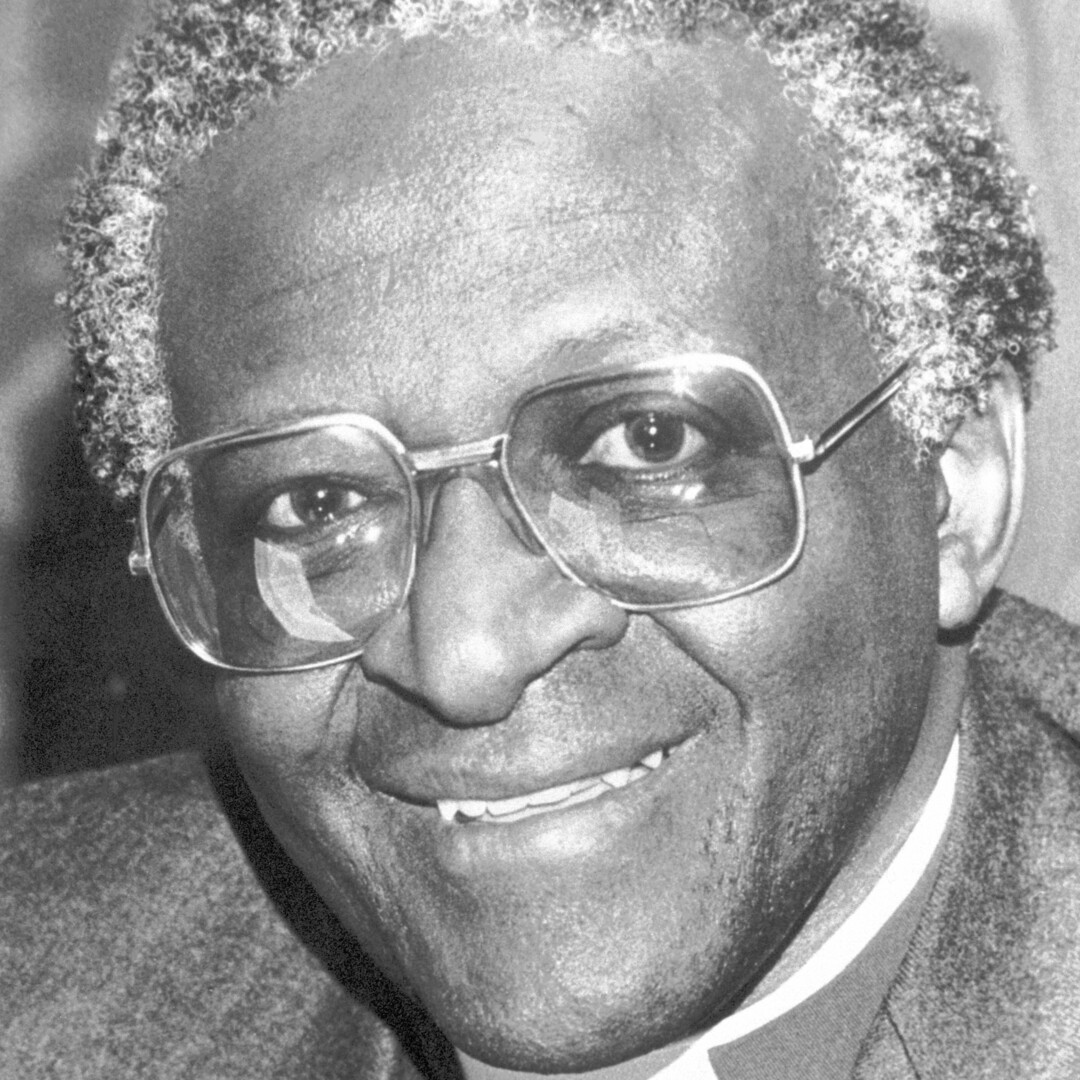
Desmond Tutu Photo from the Nobel Foundation archive.
Full name: Desmond Mpilo Tutu Born: 7 October 1931, Klerksdorp, South Africa Died: 26 December 2021, Cape Town, South Africa Date awarded: 5 October 2018
Non-violent opposition to racism
The brutal oppression of the black majority in South Africa continued after liberation leader Albert Lutuli received the Nobel Peace Prize for 1960. In response, the ANC took to arms, while bishop Desmond Tutu held fast to Lutuli’s belief in non-violent opposition to racism. Tutu was one of the foremost voices calling on the international community to impose economic, political and cultural sanctions on the apartheid regime. As South Africa’s first black bishop, Tutu became a unifying figure in the struggle against apartheid. At home and abroad, he preached that blacks and whites were all God’s children and were created to live together as equals. Drawing on his wit and oratorical skills, he promoted dialogue, forgiveness and reconciliation as an alternative to the bloodshed of civil war.
ANC African National Congress. National liberation movement founded in South Africa in 1912 to promote democracy and the equitable distribution of land and property. Banned by the authorities in 1960. Won the first free elections in South Africa in 1994 with Nelson Mandela as ANC leader.
“Racial discrimination used and defended as a political system is totally incompatible with human civilization. This year’s Peace Prize is therefore an attempt to awaken consciences. It is, and has to be, an illusion that privileged groups can maintain their position through repression.”
Egil Aarvik, Presentation speech, 10 December 1984.
The Soweto massacre – an assault on South Africa’s black majority
In June 1976, black schoolchildren gathered to protest the introduction of Afrikaans as the language of instruction in the schools in Soweto outside Johannesburg. The police opened fire on the demonstrators, killing over 500 young people. The massacre raised an international outcry and led to greater support for the ANC. Thousands of black youths crossed the border into Angola and Mozambique for training as guerrilla soldiers.
“Tutu played a major role in facilitating peace, reconciliation, and national reconstruction in South Africa.”
Encyclopedia of Africa, Volume 4, 1997.
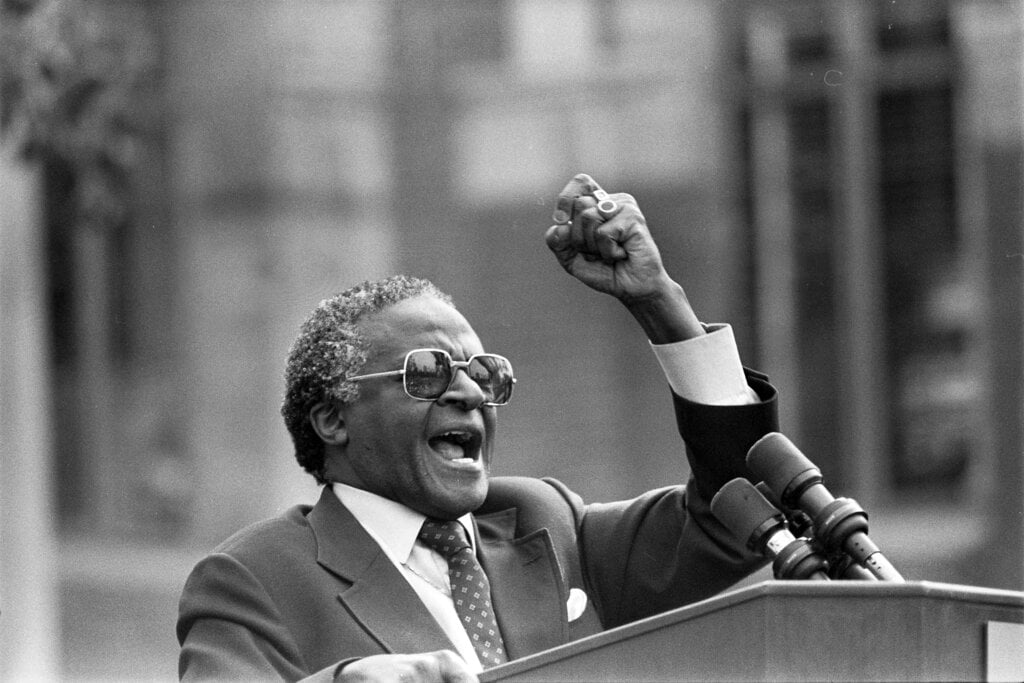
South African Anglican Bishop Desmond Tutu making a speech in Los Angeles, California, 22 January 1986. Photo: Thomas Kelsey, Los Angeles Times, CC BY 4.0 , via Wikimedia Commons. Source: UCLA Library
Tutu’s contribution to reconciliation in South Africa
In 1995, Desmond Tutu was appointed head of the South African Truth and Reconciliation Commission. The commission was charged with investigating claims of human rights violations under the apartheid regime from 1960 to 1994. It also processed applications for amnesty and established regulations for victim’s compensation. According to the commission’s final report, 30,000 cases of serious violations of human rights were registered, including murder, abduction, torture and physical assault. More than 7,000 persons applied for amnesty, and compensation claims for some NOK 4.5 billion were filed.
Tutu condemns Israel
“Have the Jews forgotten their own history?” asked Bishop Tutu after a visit to the Middle East in 2002. He strongly criticised Israel’s occupation of the Palestinian territories. He felt that the Palestinians’ freedom of movement was restricted in a degrading manner reminiscent of the apartheid system in South Africa. Tutu stated that Israel would never achieve security by oppressing another people. He condemned all use of weapons, demanded an Israeli withdrawal, and called for the establishment of a Palestinian state.
The Desmond Tutu Peace Centre in Cape Town
In the autumn of 1994, the cornerstone was laid for the Desmond Tutu Peace Centre in Cape Town, South Africa. The centre’s aim is to share with new generations the experience gleaned from the non-violent struggle against apartheid and subsequent reconciliation efforts. In addition to a library and an archive, a peace museum and a leadership academy will be built.
Bishop Desmond Tutu was born in 1931 in Klerksdorp, Transvaal. His father was a teacher, and he himself was educated at Johannesburg Bantu High School. After leaving school he trained first as a teacher at Pretoria Bantu Normal College and in 1954 he graduated from the University of South Africa. After three years as a high school teacher he began to study theology …
Disclaimer: Every effort has been made by the publisher to credit organisations and individuals with regard to the supply of photographs. Please notify the publishers regarding corrections.
Desmond Tutu – Nobel Symposia
At the Nobel Centennial Symposia, held on 8 December 2001 in Oslo, Norway, Desmond Tutu delivered this speech.
Before I left South Africa, a land I love passionately, we had an emergency meeting of the Executive Committee of the South African Council of Churches with the leaders of our member churches. We called the meeting because of the deepening crisis in our land, which has claimed nearly 200 lives this year alone. We visited some of the trouble-spots on the Witwatersrand. I went with others to the East Rand. We visited the home of an old lady. She told us that she looked after her grandson and the children of neighbors while their parents were at work. One day the police chased some pupils who had been boycotting classes, but they disappeared between the township houses. The police drove down the old lady’s street. She was sitting at the back of the house in her kitchen, whilst her charges were playing in the front of the house in the yard. Her daughter rushed into the house, calling out to her to come quickly. The old lady dashed out of the kitchen into the living room. Her grandson had fallen just inside the door, dead. He had been shot in the back by the police. He was 6 years old. A few weeks later, a white mother, trying to register her black servant for work, drove through a black township. Black rioters stoned her car and killed her baby of a few months old, the first white casualty of the current unrest in South Africa. Such deaths are two too many. These are part of the high cost of apartheid.
Everyday in a squatter camp near Cape Town, called K.T.C., the authorities have been demolishing flimsy plastic shelters which black mothers have erected because they were taking their marriage vows seriously. They have been reduced to sitting on soaking mattresses, with their household effects strewn round their feet, and whimpering babies on their laps, in the cold Cape winter rain. Everyday the authorities have carried out these callous demolitions. What heinous crime have these women committed, to be hounded like criminals in this manner? All they have wanted is to be with their husbands, the fathers of their children. Everywhere else in the world they would be highly commended, but in South Africa, a land which claims to be Christian, and which boasts a public holiday called Family Day, these gallant women are treated so inhumanely, and yet all they want is to have a decent and stable family life. Unfortunately, in the land of their birth, it is a criminal offence for them to live happily with their husbands and the fathers of their children. Black family life is thus being undermined, not accidentally, but by deliberate Government policy. It is part of the price human beings, God’s children, are called to pay for apartheid. An unacceptable price.
I come from a beautiful land, richly endowed by God with wonderful natural resources, wide expanses, rolling mountains, singing birds, bright shining stars out of blue skies, with radiant sunshine, golden sunshine. There is enough of the good things that come from God’s bounty, there is enough for everyone, but apartheid has confirmed some in their selfishness, causing them to grasp greedily a disproportionate share, the lion’s share, because of their power. They have taken 87 of the land, though being only about 20 of our population. The rest have had to make do with the remaining 13. Apartheid has decreed the politics of exclusion. 73 of the population is excluded from any meaningful participation in the political decision-making processes of the land of their birth. The new constitution, making provision of three chambers, for whites, coloreds, and Indians, mentions blacks only once, and thereafter ignores them completely. Thus this new constitution, lauded in parts of the West as a step in the right direction, entrenches racism and ethnicity. The constitutional committees are composed in the ratio of 4 whites to 2 coloreds and 1 Indian. 0 black. 2 + 1 can never equal, let alone be more than, 4. Hence this constitution perpetuates by law and entrenches white minority rule. Blacks are expected to exercise their political ambitions in unviable, poverty-stricken, arid, bantustan homelands, ghettoes of misery, inexhaustible reservoirs of cheap black labor, bantustans into which South Africa is being balkanized. Blacks are systematically being stripped of their South African citizenship and being turned into aliens in the land of their birth. This is apartheid’s final solution, just as Nazism had its final solution for the Jews in Hitler’s Aryan madness. The South African Government is smart. Aliens can claim but very few rights, least of all political rights.
In pursuance of apartheid’s ideological racist dream, over 3.000.000 of God’s children have been uprooted from their homes, which have been demolished, whilst they have then been dumped in the bantustan homeland resettlement camps. I say dumped advisedly: only things or rubbish is dumped, not human beings. Apartheid has, however, ensured that God’s children, just because they are black, should be treated as if they were things, and not as of infinite value as being created in the image of God. These dumping grounds are far from where work and food can be procured easily. Children starve, suffer from the often irreversible consequences of malnutrition – this happens to them not accidentally, but by deliberate Government policy. They starve in a land that could be the bread basket of Africa, a land that normally is a net exporter of food.
The father leaves his family in the bantustan homeland, there eking out a miserable existence, whilst he, if he is lucky, goes to the so-called white man’s town as a migrant, to live an unnatural life in a single sex hostel for 11 months of the year, being prey there to prostitution, drunkenness, and worse. This migratory labor policy is declared Government policy, and has been condemned, even by the white Dutch Reformed Church,1 not noted for being quick to criticize the Government, as a cancer in our society. This cancer, eating away at the vitals of black family life, is deliberate Government policy. It is part of the cost of apartheid, exorbitant in terms of human suffering.
Apartheid has spawned discriminatory education, such as Bantu Education, education for serfdom, ensuring that the Government spends only about one tenth on one black child per annum for education what it spends on a white child. It is education that is decidedly separate and unequal. It is to be wantonly wasteful of human resources, because so many of God’s children are prevented, by deliberate Government policy, from attaining to their fullest potential. South Africa is paying a heavy price already for this iniquitous policy because there is a desperate shortage of skilled manpower, a direct result of the short-sighted schemes of the racist regime. It is a moral universe that we inhabit, and good and right equity matter in the universe of the God we worship. And so, in this matter, the South African Government and its supporters are being properly hoisted with their own petard.
Apartheid is upheld by a phalanx of iniquitous laws, such as the Population Registration Act, which decrees that all South Africans must be classified ethnically, and duly registered according to these race categories. Many times, in the same family one child has been classified white whilst another, with a slightly darker hue, has been classified colored, with all the horrible consequences for the latter of being shut out from membership of a greatly privileged caste. There have, as a result, been several child suicides. This is too high a price to pay for racial purity, for it is doubtful whether any end, however desirable, can justify such a means. There are laws, such as the Prohibition of Mixed Marriages Act, which regard marriages between a white and a person of another race as illegal. Race becomes an impediment to a valid marriage. Two persons who have fallen in love are prevented by race from consummating their love in the marriage bond. Something beautiful is made to be sordid and ugly. The Immorality Act decrees that fornication and adultery are illegal if they happen between a white and one of another race. The police are reduced to the level of peeping Toms to catch couples red-handed. Many whites have committed suicide rather than face the disastrous consequences that follow in the train of even just being charged under this law. The cost is too great and intolerable.
Such an evil system, totally indefensible by normally acceptable methods, relies on a whole phalanx of draconian laws such as the security legislation which is almost peculiar to South Africa. There are the laws which permit the indefinite detention of persons whom the Minister of Law and Order has decided are a threat to the security of the State. They are detained at his pleasure, in solitary confinement, without access to their family, their own doctor, or a lawyer. That is severe punishment when the evidence apparently available to the Minister has not been tested in an open court – perhaps it could stand up to such rigorous scrutiny, perhaps not; we are never to know. It is a far too convenient device for a repressive regime, and the minister would have to be extra special not to succumb to the temptation to circumvent the awkward process of testing his evidence in an open court, and thus he lets his power under the law to be open to the abuse where he is both judge and prosecutor. Many, too many, have died mysteriously in detention. All this is too costly in terms of human lives. The minister is able, too, to place people under banning orders without being subjected to the annoyance of the checks and balances of due process. A banned person for 3 or 5 years becomes a non-person, who cannot be quoted during the period of her banning order. She cannot attend a gathering, which means more than one other person. Two persons together talking to a banned person are a gathering! She cannot attend the wedding or funeral of even her own child without special permission. She must be at home from 6:00 PM of one day to 6:00 AM of the next and on all public holidays, and from 6:00 PM on Fridays until 6:00 AM on Mondays for 3 years. She cannot go on holiday outside the magisterial area to which she has been confined. She cannot go to the cinema, nor to a picnic. That is severe punishment, inflicted without the evidence allegedly justifying it being made available to the banned person, nor having it scrutinized in a court of law. It is a serious erosion and violation of basic human rights, of which blacks have precious few in the land of their birth. They do not enjoy the rights of freedom of movement and association. They do not enjoy freedom of security of tenure, the right to participate in the making of decisions that affect their lives. In short, this land, richly endowed in so many ways, is sadly lacking in justice.
Once a Zambian and a South African, it is said, were talking. The Zambian then boasted about their Minister of Naval Affairs. The South African asked, “But you have no navy, no access to the sea. How then can you have a Minister of Naval Affairs?” The Zambian retorted, “Well, in South Africa you have a Minister of Justice, don’t you?”
It is against this system that our people have sought to protest peacefully since 1912 at least, with the founding of the African National Congress. They have used the conventional methods of peaceful protest – petitions, demonstrations, deputations, and even a passive resistance campaign. A tribute to our people’s commitment to peaceful change is the fact that the only South Africans to win the Nobel Peace Prize are both black. Our people are peace-loving to a fault. The response of the authorities has been an escalating intransigence and violence, the violence of police dogs, tear gas, detention without trial, exile, and even death. Our people protested peacefully against the Pass Laws in 1960, and 69 of them were killed on March 21, 1960, at Sharpeville, many shot in the back running away. Our children protested against inferior education, singing songs and displaying placards and marching peacefully. Many in 1976, on June 16th and subsequent times, were killed or imprisoned. Over 500 people died in that uprising. Many children went into exile. The whereabouts of many are unknown to their parents. At present, to protest that self-same discriminatory education, and the exclusion of blacks from the new constitutional dispensation, the sham local black government, rising unemployment, increased rents and General Sales Tax, our people have boycotted and demonstrated. They have staged a successful two-day stay away. Over 150 people have been killed. It is far too high a price to pay. There has been little revulsion or outrage at this wanton destruction of human life in the West. In parenthesis, can somebody please explain to me something that has puzzled me. When a priest goes missing and is subsequently found dead, the media in the West carry his story in very extensive coverage.2 I am glad that the death of one person can cause so much concern. But in the self-same week when this priest is found dead, the South African Police kill 24 blacks who had been participating in the protest, and 6.000 blacks are sacked for being similarly involved, and you are lucky to get that much coverage. Are we being told something I do not want to believe, that we blacks are expendable and that blood is thicker than water, that when it comes to the crunch, you cannot trust whites, that they will club together against us? I don’t want to believe that is the message being conveyed to us.
Be that as it may, we see before us a land bereft of much justice, and therefore without peace and security. Unrest is endemic, and will remain an unchanging feature of the South African scene until apartheid, the root cause of it all, is finally dismantled. At this time, the Army is being quartered on the civilian population. There is a civil war being waged. South Africans are on either side. When the African National Congress and the Pan-Africanist Congress3 were banned in 1960, they declared that they had no option but to carry out the armed struggle. We in the South African Council of Church have said we are opposed to all forms of violence – that of a repressive and unjust system, and that of those who seek to overthrow that system. However, we have added that we understand those who say they have had to adopt what is a last resort for them. Violence is not being introduced into the South African situation de novo from outside by those who are called terrorists or freedom fighters, depending on whether you are oppressed or an oppressor. The South African situation is violent already, and the primary violence is that of apartheid, the violence of forced population removals, of inferior education, of detention without trial, of the migratory labor system, etc.
There is war on the border of our country. South African faces fellow South African. South African soldiers are fighting against Namibians who oppose the illegal occupation of their country by South Africa, which has sought to extend its repressive system of apartheid, unjust and exploitative.
There is no peace in Southern Africa. There is no peace because there is no justice. There can be no real peace and security until there be first justice enjoyed by all the inhabitants of that beautiful land. The Bible knows nothing about peace without justice, for that would be crying “peace, peace, where there is no peace”. God’s Shalom, peace, involves inevitably righteousness, justice, wholeness, fullness of life, participation in decision-making, goodness, laughter, joy, compassion, sharing and reconciliation.
I have spoken extensively about South Africa, first because it is the land I know best, but because it is also a microcosm of the world and an example of what is to be found in other lands in differing degree – when there is injustice, invariably peace becomes a casualty. In El Salvador, in Nicaragua, and elsewhere in Latin America, there have been repressive regimes which have aroused opposition in those countries. Fellow citizens are pitted against one another, sometimes attracting the unhelpful attention and interest of outside powers, who want to extend their spheres of influence. We see this in the Middle East, in Korea, in the Philippines, in Kampuchea, in Vietnam, in Ulster, in Afghanistan, in Mozambique, in Angola, in Zimbabwe, behind the Iron Curtain.
Because there is global insecurity, nations are engaged in a mad arms race, spending billions of dollars wastefully on instruments of destruction, when millions are starving. And yet, just a fraction of what is expended so obscenely on defense budgets would make the difference in enabling God’s children to fill their stomachs, be educated, and given the chance to lead fulfilled and happy lives. We have the capacity to feed ourselves several times over, but we are daily haunted by the spectacle of the gaunt dregs of humanity shuffling along in endless queues, with bowls to collect what the charity of the world has provided, too little too late. When will we learn, when will the people of the world get up and say, Enough is enough. God created us for fellowship. God created us so that we should form the human family, existing together because we were made for one another. We are not made for an exclusive self-sufficiency but for interdependence, and we break the law of our being at our peril. When will we learn that an escalated arms race merely escalates global insecurity? We are now much closer to a nuclear holocaust than when our technology and our spending were less.
Unless we work assiduously so that all of God’s children, our brothers and sisters, members of our one human family, all will enjoy basic human rights, the right to a fulfilled life, the right of movement, of work, the freedom to be fully human, with a humanity measured by nothing less than the humanity of Jesus Christ Himself, then we are on the road inexorably to self-destruction, we are not far from global suicide; and yet it could be so different.
When will we learn that human beings are of infinite value because they have been created in the image of God, and that it is a blasphemy to treat them as if they were less than this and to do so ultimately recoils on those who do this? In dehumanizing others, they are themselves dehumanized. Perhaps oppression dehumanizes the oppressor as much as, if not more than, the oppressed. They need each other to become truly free, to become human. We can be human only in fellowship, in community, in koinonia, in peace.
Let us work to be peacemakers, those given a wonderful share in Our Lord’s ministry of reconciliation. If we want peace, so we have been told, let us work for justice. Let us beat our swords into ploughshares.
God calls us to be fellow workers with Him, so that we can extend His Kingdom of Shalom, of justice, of goodness, of compassion, of caring, of sharing, of laughter, joy and reconciliation, so that the kingdoms of this world will become the Kingdom of our God and of His Christ, and He shall reign forever and ever. Amen. Then there will be a fulfillment of the wonderful vision in the Revelation of St. John the Divine (Rev. 6:9ff):
9. After this I beheld, and lo, a great multitude, which no man could number, of all nations and kindreds and people and tongues, stood before the throne and before the Lamb, clothed with white robes, and palms in their hands,
10. And cried with a loud voice saying, “Salvation to our God, who sitteth upon the throne, and unto the Lamb”.
11. And all the angels stood round about the throne, and about the elders and the four beasts, and fell before the throne on their faces, and worshipped God
12. saying, “Amen; Blessing and glory and wisdom and thanksgiving and honor and power and might, be unto our God forever and ever. Amen”.
* The lecture is reprinted in Tutu’s Rainbow People of God as “Apartheid’s ‘Final Solution'”, using a phrase from the address.
1 The white Dutch Reformed Church was the principal church of the Afrikaner ruling minority.
2. Tutu refers to a recent event in Poland, when Father Jerzy Popieluszko was murdered by the Secret Police in October 1984.
3. The African National Congress (ANC), established in 1912, of which the Nobel laureate Albert Lutuli had been President-General, wanted a racially just South Africa of blacks and whites. The “Africanists” split off to establish the Pan-Africanist Congress (PAC), which wanted government “of the African, by the African, for the African”.
Desmond Tutu – Interview
Interview, September 2007
Interview with Desmond Tutu by freelance journalist Marika Griehsel in Gothenburg, Sweden, 28 September 2007.
Desmond Tutu talks about what makes a good leader, how the Nobel Peace Prize helped the struggle against apartheid in South Africa (08:15), and the key to overcoming present and future conflicts (21:13).
Desmond Tutu – Documentary
The 1984 Nobel Peace Prize Laureate, Bishop Desmond Tutu, returned to his native South Africa on 18 October to a rapturous and emotional reception by his supporters, both black and white. Bishop Tutu went straight to his office, where he was welcomed by leading white anti-apartheid campaigner Beyers Naude. Speaking at the press conference later in the day, Bishop Tutu said there could be no real peace where there was injustice, and that violence was not the way to achieve peace.
Credit: ITN Archive/Reuters
Desmond Tutu – Photo gallery
Desmond Tutu receiving his Nobel Peace Prize medal and diploma from Egil Aarvik, Chairman of the Norwegian Nobel Committee at the award ceremony at the Oslo City Hall, 10 December 1984.
Photo: John Myhre/Bride Lane Library/Popperfoto via Getty Images/Getty Images
Desmond Tutu at the Nobel Centennial 2001, a conference titled ”The Conflicts of the 20th Century and the Solutions for the 21st Century”, in Oslo, Norway.
At the Nobel Peace Prize award ceremony on 10 December 2001 where Kofi Annan and the United Nations were awarded the 2001 peace prize, many previous laureates were present. From left: Joseph Rotblat, Jody Williams, José Ramos-Horta, Adolfo Pérez Esquivel, Lech Wałęsa, Desmond Tutu, John Hume, David Trimble, Elie Wiesel, Norman Borlaug, Rigoberta Menchu Tum and Mairead Corrigan. The remaining are representatives for peace prize awarded organisations.
Nobel Laureate Desmond Tutu, with Nobel Laureate
Adolfo Pérez Esquivel just behind him, leading a peace march in Porto Alegre, Brazil, 22 February 2006.
Photo and copyright: Sean Hawkey, 2006
Kindly provided by Sean Hawkey
Desmond Tutu – Prize presentation
Watch a video clip of Desmond Tutu receiving his Nobel Peace Prize medal and diploma during the Nobel Peace Prize Award Ceremony at the Oslo City Hall in Norway, 10 December 1984.
Desmond Tutu – Curriculum Vitae
Born: 7th October 1931, Klerksdorp, Transvaal.
Parents: Father was a school teacher. Mother relatively uneducated.
1945-1950 High School Education – Johannesburg Bantu High School, Western Native Township up to Matric.
1951-1953 Teachers Diploma at Pretoria Bantu Normal College.
1954-BA (UNISA)
1954-Teacher at Johannesburg Bantu High School.
1955-1958 Teacher at Munsieville High School, Krugersdorp.
1958-1960 St. Peters Theological College, Rosettenville, Johannesburg for Ordination Training. Licentiate in Theology
1960- Ordained as Deacon, Johannesburg, served title in Benoni Location.
1961- Ordained Priest.
1962-1965 Part-time curate, St Alban’s (lived with family at Golder’s Green, London).
1965- B.D. Hon. (London).
1966- M.Th (London) lived in Blechingley, Surrey, part-time curate St Mary’s.
1967-1969 Joined Staff of Federal Theological Seminary, Alice, Cape. Chaplain – University of Fort Hare.
1970-1972 Lecturer, Department of Theology, U.B.L.S. Roma, Lesotho.
1972-1975 Associate Director, Theological Education Fund of the World Council of Churches based in Bromley, Kent. Lived in Grove Park, London and was Honorary curate of St Augustine’s.
1975-1976 Dean of Johannesburg.
1976-1978 Bishop of Lesotho.
1978-1985 General Secretary, South African Council of Churches.
1985- date Bishop of Johannesburg.
Conferences
“Salvation Today” Conference in Bangkok, Thailand.
All Africa Conference of Churches General Assembly, Lusaka
Anglican Consultative Council – Port of Spain
Lambeth Conference, Canterbury.
WCC 5th Assembly in 1975, Nairobi
WCC 6th Assembly in 1983, Vancouver.
Awards/Writings
Elected Fellow of King’s College, London (1978).
Honorary Doctorate of Divinity from General Theological Seminary, USA (May, 1978).
Honorary Doctorate of Civil Law from Kent University, England (July 1978).
Honorary Doctorate of Laws from Harvard, USA (June 1979).
Prix d’Athene (Onassis Foundation) (1980).
Honorary Doctorate of Theology from Ruhr University, Bochum (November 1981).
Honorary Doctorate of Sacred Theology – Columbia University (Aug 1982).
Author of “Hope and Suffering” (Sept 1983).
Author of several articles and reviews. Author of “Crying in the Wilderness”.
Designated member of International Social Prospects Academy (1983 Nov).
The Family of Man Gold Medal Award (1983 December).
Honorary Doctorate of Humane Letters – St Paul’s College, Lawrenceville (1984 January).
Honorary Doctorate of Law from Claremont Graduate School (1984 May).
Honorary Doctorate of Sacred Theology from Dickinson College (1984 May).
Martin Luther King Jr. Humanitarian Award of Annual Black American Heroes and Heroines Day – U.S.A. (1984 May).
Honorary Doctorate of Divinity from Aberdeen University, Scotland (July, 1984).
Doctor of Human Letters, Howard University – U.S.A. (1984).
Nobel Peace Prize – Oslo, Norway (1984).
This CV was written at the time of
the award and later published in the book series Les
Prix Nobel/Nobel
Lectures. The information is sometimes updated with an addendum submitted
by the Laureate. To cite this document, always state the source as shown above.
Desmond Tutu died on 26 December 2021.
Desmond Tutu – Acceptance Speech
Desmond Tutu held his Acceptance Speech on 10 December 1984, in the Oslo City Hall, Norway. Before the speech, Desmond Tutu and his relatives and colleagues delivered a traditional song.