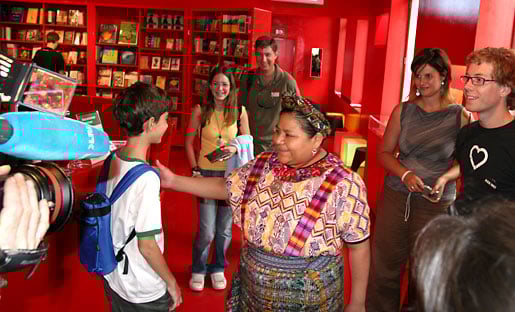
Interview with the 1992 Nobel Peace Prize laureate Rigoberta Menchú Tum on 6 November 2014 in Stockholm, Sweden.
Rigoberta Menchú Tum answers the following questions (the links below lead to clip on YouTube): 00:23 What has the prize meant for your role as a peace maker? 02:30 How did you receive the news about your prize? 05:25 What was your first reaction when you received the call? 10:59 Could you tell us about the Nobel Peace Women Initiative? 15:20 What is your definition of peace? 17:15 What advice would you like to share with a young peace maker? 20:30 What good characteristics do you think our future leaders should have?
Rigoberta Menchú Tum – Speed read
Rigoberta Menchú Tum was awarded the Nobel Peace Prize for her struggle for social justice and reconciliation based on respect for the rights of indigenous peoples.
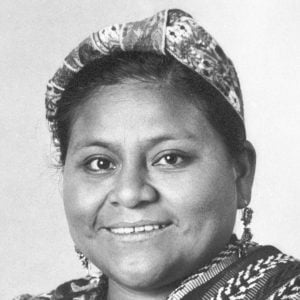
Rigoberta Menchú Tum Photo from the Nobel Foundation archive.
Full name: Rigoberta Menchú Tum Born: 9 January 1959, Aldea Chimel, Guatemala Date awarded: 16 October 1992
Promoting the rights of indigenous peoples
1992 marked the 500th anniversary of Columbus’ arrival in the Americas. That same year, Rigoberta Menchú, a Mayan leader from Guatemala, was awarded the Nobel Peace Prize for her campaign for the rights of indigenous peoples. Her candidacy was initially launched by indigenous organisations to draw attention to the fact that European discovery of the Americas had brought death and destruction to the people already living there. Rigoberta Menchú grew up in a country characterised by extreme violence. Both parents and one of her brothers were killed by the army in its pursuit of genuine or alleged communists. After fleeing to Mexico in the early 1980s, Menchú encountered European groups working for human rights in Latin America. From the late 1980s she actively promoted reconciliation with the authorities to bring an end to the civil war in Guatemala.
”Today, Rigoberta Menchú stands out as a vivid symbol of peace and reconciliation across ethnic, cultural and social dividing lines, in her own country, on the American continent, and in the world.”
The Norwegian Nobel Committee, Announcement, 1992.
Human rights Rights that apply to all persons regardless of gender, race, ethnicity, religious affiliation or nationality. The most important are the rights enshrined in the UN Declaration of Human Rights, adopted in 1948.
”I wish that a conscious sense of peace and a feeling of human solidarity would develop in all peoples, which would open new relationships of respect and equality for the next millennium, to be ruled by fraternity and not by cruel conflicts.”
Rigoberta Menchú Tum, Nobel Prize lecture, 10 December 1992.
Rigoberta Menchú’s father was a peasant leader who tried to prevent Guatemalan estate owners from appropriating land belonging to indigenous people. Menchú accompanied her father on his visits to villages to encourage resistance. The army labelled all opposed to the regime as communist. One of Menchú’s brothers was captured, tortured and killed publicly as a warning to villagers. In 1980 her father died in a fire when he and other activists occupied the Spanish embassy in Guatemala City to draw world attention to the oppression of the Mayan people. That same year, Menchú’s mother was raped and mutilated, ultimately dying from her injuries.
Communism From the Latin “communitas” meaning community. Based on the teachings of Marx that argued workers were destined to be united in a world free of exploitation and oppression. After the Russian Revolution of 1917, used by those who agreed with Lenin that a violent revolution against capitalism was the only means of achieving this goal.
Rigoberta Menchú flees Guatemala
In the early 1980s, civil war was raging in Guatemala. Both left-wing radicals and indigenous groups revolted against the government’s oppression. The army labelled all rebels as communists. Rigoberta Menchú lost both of her parents and one of her brothers in this struggle. She herself organised strikes and demonstrations and was wanted by the authorities. Finally she was forced to flee the country, seeking refuge in Mexico along with thousands of others from Guatemala.
Criticism of Rigoberta Menchú
Rigoberta Menchú’s peace prize was met with widespread support, although the Guatemalan government was reluctant to extend its congratulations. Menchú herself was appointed UN ambassador for indigenous populations. A US researcher has raised doubts about the details in Rigoberta Menchú’s life story. While not opposed to her selection as Nobel Peace Prize laureate, he claimed she was more closely affiliated with a communist guerilla group than she was willing to admit. Regardless, Menchú has become a symbol of success to native peoples of the Western Hemisphere. Her achievements encourage all indigenous women to hold their heads higher.
”… Whatever the facts of her particular life, the prize was intended to dramatize the historical debt owed to the native people of the Western Hemisphere. The prize was also intended to encourage peace talks in her homeland of Guatemala.”
David Stoll: ‘Rigoberta Menchú and the Story of All Poor Guatemalans’, page ix, Westview Press 1999.
Rigoberta Menchú was born on January 9, 1959 to a poor Indian peasant family and raised in the Quiche branch of the Maya culture. In her early years she helped with the family farm work, either in the northern highlands where her family lived, or on the Pacific coast, where both adults and children went to pick coffee on the big plantations …
Disclaimer: Every effort has been made by the publisher to credit organisations and individuals with regard to the supply of photographs. Please notify the publishers regarding corrections.
Rigoberta Menchú Tum – Prize presentation
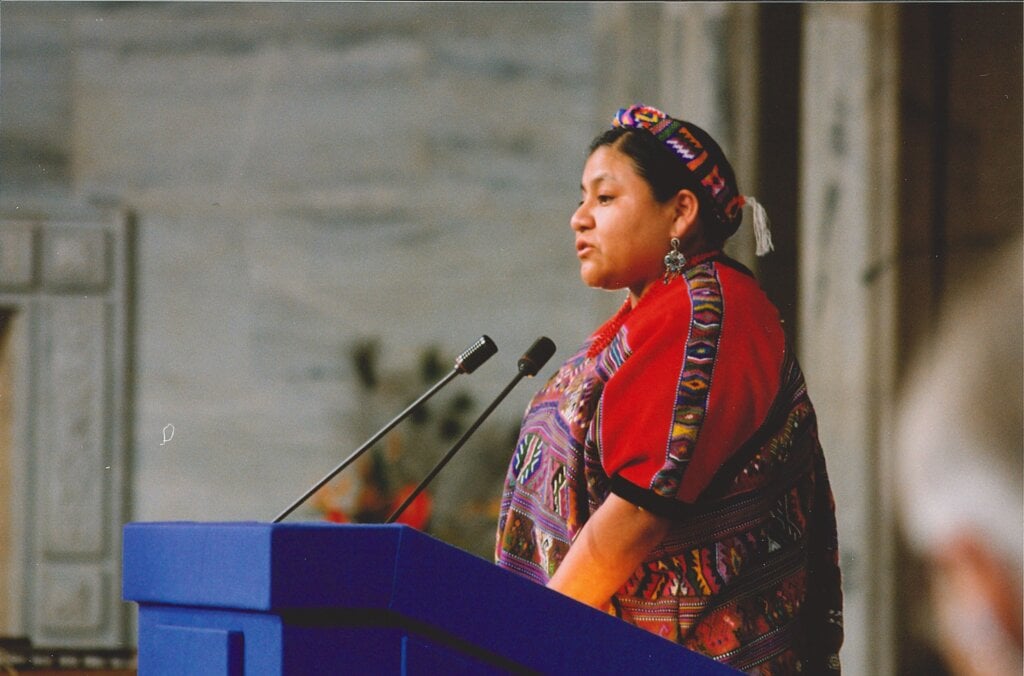
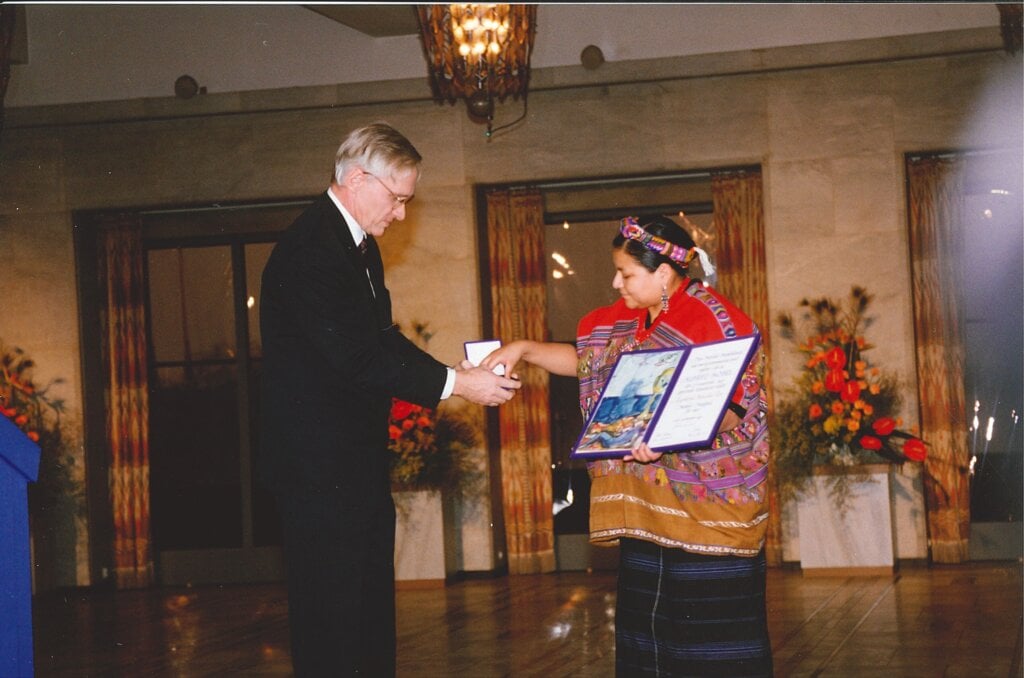
Watch a video clip of Rigoberta Menchú Tum receiving her Nobel Peace Prize medal and diploma during the Nobel Peace Prize award ceremony at the Oslo City Hall in Norway, 10 December 1992.
At the Nobel Centennial Symposia, held on 6 December 2001 in Oslo, Norway, Rigoberta Menchú Tum delivered this speech.
Interpreter’s note This is a live recording of members of AIIC, the International Association of Conference Interpreters, interpreting simultaneously at the Nobel Centennial Symposia. It is not intended to be a literal or definitive translation of the proceedings.
Your Majesties, the King and Queen of Norway, The Honorable Members of the Nobel Peace Committee, Your Excellency, the Prime Minister, Your Excellencies, Members of the Government and the Diplomatic Corps, Dear Guatemalan countrymen and women, Ladies and Gentlemen,
I feel a deep emotion and pride for the honor of having been awarded the Nobel Peace Prize for 1992. A deep personal feeling and pride for my country and its very ancient culture. For the values of the community and the people to which I belong, for the love of my country, of Mother Nature. Whoever understands this respects life and encourages the struggle that aims at such objectives.
I consider this Prize, not as a reward to me personally, but rather as one of the greatest conquests in the struggle for peace, for Human Rights and for the rights of the indigenous people, who, for 500 years, have been split, fragmented, as well as the victims of genocides, repression and discrimination.
Please allow me to convey to you all, what this Prize means to me.
In my opinion, the Nobel Peace Prize calls upon us to act in accordance with what it represents, and the great significance it has worldwide. In addition to being a priceless treasure, it is an instrument with which to fight for peace, for justice, for the rights of those who suffer the abysmal economical, social, cultural and political inequalities, typical of the order of the world in which we live, and where the transformation into a new world based on the values of the human being, is the expectation of the majority of those who live on this planet.
This Nobel Prize represents a standard bearer that encourages us to continue denouncing the violation of Human Rights, committed against the people in Guatemala, in America and in the world, and to perform a positive role in respect of the pressing task in my country, which is to achieve peace with social justice.
The Nobel Prize is a symbol of peace, and of the efforts to build up a real democracy. It will stimulate the civil sectors so that through a solid national unity, these may contribute to the process of negotiations that seek peace, reflecting the general feeling – although at times not possible to express because of fear – of Guatemalan society: to establish political and legal grounds that will give irreversible impulses to a solution to what initiated the internal armed conflict.
There is no doubt whatsoever that it constitutes a sign of hope in the struggle of the indigenous people in the entire Continent.
It is also a tribute to the Central-American people who are still searching for their stability, for the structuring of their future, and the path for their development and integration, based on civil democracy and mutual respect.
The importance of this Nobel Prize has been demonstrated by all the congratulations received from everywhere, from Heads of Government – practically all the American Presidents – to the organizations of the indigenous people and of Human Rights, from all over the world. In fact, what they see in this Nobel Peace Prize is not only a reward and a recognition of a single person, but a starting point for the hard struggle towards the achievement of that revindication which is yet to be fulfilled.
As a contrast, and paradoxically, it was actually in my own country where I met, on the part of some people, the strongest objections, reserve and indifference, for the award of the Nobel Peace Prize to this Quiché Indian. Perhaps because in Latin America, it is precisely in Guatemala where the discrimination towards the indigenous, towards women, and the repression of the longing for justice and peace, are more deeply rooted in certain social and political sectors.
Under present circumstances, in this disordered and complex world, the decision of the Norwegian Nobel Peace Prize Committee to award this honorable distinction to me, reflects the awareness of the fact that, in this way, courage and strength is given to the struggle of peace, reconciliation and justice; to the struggle against racism, cultural discrimination, and hence contributes to the achievement of harmonious co-existence between our people.
With deep pain, on one side, but with satisfaction on the other, I have to inform you that the Nobel Peace Prize 1992 will have to remain temporarily in Mexico City, in watchful waiting for peace in Guatemala. Because there are no political conditions in my country that would indicate or make me foresee a prompt and just solution. The satisfaction and gratitude are due to the fact that Mexico, our brother neighbor country, that has been so dedicated and interested, that has made such great efforts in respect of the negotiations that are being conducted to achieve peace, that has received and admitted so many refugees and exiled Guatemalans, has given us a place in the Museo del Templo Mayor (the cradle of the ancient Aztecs) so that the Nobel Prize may remain there, until peaceful and safe conditions are established in Guatemala to place it here, in the land of the Quetzal.1
When evaluating the overall significance of the award of the Peace Prize, I would like to say some words on behalf of all those whose voice cannot be heard or who have been repressed for having spoken their opinions, of all those who have been marginalized, who have been discriminated, who live in poverty, in need, of all those who are the victims of repression and violation of human rights. Those who, nevertheless, have endured through centuries, who have not lost their conscience, determination, and hope.
Please allow me, ladies and gentlemen, to say some words about my country and the civilization of the Mayas. The Maya people developed and spread geographically through some 300,000 square km; they occupied parts of the South of Mexico, Belize, Guatemala, as well as Honduras and El Salvador; they developed a very rich civilization in the area of political organization, as well as in social and economic fields; they were great scientists in the fields of mathematics, astronomy, agriculture, architecture and engineering; they were great artists in the fields of sculpture, painting, weaving and carving.
The Mayas discovered the zero value in mathematics, at about the same time that it was discovered in India and later passed on to the Arabs. Their astronomic forecasts based on mathematical calculations and scientific observations were amazing, and still are. They prepared a calendar more accurate than the Gregorian, and in the field of medicine they performed intracranial surgical operations.
One of the Maya books, which escaped destruction by the conquistadores, known as The Codex of Dresden, contains the results of an investigation on eclipses as well a table of 69 dates, in which solar eclipse occur in a lapse of 33 years.
Today, it is important to emphasize the deep respect that the Maya civilization had towards life and nature in general.
Who can predict what other great scientific conquests and developments these people could have achieved, if they had not been conquered by blood and fire, and subjected to an ethnocide that affected nearly 50 million people in the course of 500 years.
I would describe the meaning of this Nobel Peace prize, in the first place as a tribute to the Indian people who have been sacrificed and have disappeared because they aimed at a more dignified and just life with fraternity and understanding among human beings. To those who are no longer alive to keep up the hope for a change in the situation in respect of poverty and marginalization of the Indians, of those who have been banished, of the helpless in Guatemala as well as in the entire American Continent.
This growing concern is comforting, even though it comes 500 years later, to the suffering, the discrimination, the oppression and the exploitation that our peoples have been exposed to, but who, thanks to their own cosmovision – and concept of life, have managed to withstand and finally see some promising prospects. How those roots, that were to be eradicated, now begin to grow with strength, hope and visions of the future!
It also represents a sign of the growing international interest for, and understanding of the original Rights of the People, of the future of more than 60 million Indians that live in our Americas, and their outcry because of the 500 years of oppression that they have endured. For the genocide beyond comparison that they have had to suffer throughout this epoch, and from which other countries and the elite of the Americas have profited and taken advantage.
Let there be freedom for the Indians, wherever they may be in the American Continent or elsewhere in the world, because while they are alive, a glow of hope will be alive as well as a true concept of life.
The expressions of great happiness by the Indian Organizations in the entire Continent and the worldwide congratulations received for the award of the Nobel Peace Prize, clearly indicate the great importance of this decision. It is the recognition of the European debt to the American indigenous people; it is an appeal to the conscience of Humanity so that those conditions of marginalization that condemned them to colonialism and exploitation may be eradicated; it is a cry for life, peace, justice, equality and fraternity between human beings.
The peculiarities of the vision of the Indian people are expressed according to the way in which they are related to each other. First, between human beings, through communication. Second, with the earth, as with our mother, because she gives us our lives and is not mere merchandise. Third, with nature, because we are an integral part of it, and not its owners.
To us Mother Earth is not only a source of economic riches that give us the maize, which is our life, but she also provides so many other things that the privileged ones of today strive for. The Earth is the root and the source of our culture. She keeps our memories, she receives our ancestors and she, therefore, demands that we honor her and return to her, with tenderness and respect, those goods that she gives us. We have to take care of her so that our children and grandchildren may continue to benefit from her. If the world does not learn now to show respect to nature, what kind of future will the new generations have?
From these basic features derive behavior, rights and obligations in the American Continent, for the indigenous people as well as for the non-indigenous, whether they be racially mixed, blacks, whites or Asian. The whole society has an obligation to show mutual respect, to learn from each other and to share material and scientific achievements, in the most convenient way. The indigenous peoples never had, and still do not have, the place that they should have occupied in the progress and benefits of science and technology, although they represented an important basis for this development.
If the indigenous civilization and the European civilizations could have made exchanges in a peaceful and harmonious manner, without destruction, exploitation, discrimination and poverty, they could, no doubt, have achieved greater and more valuable conquests for Humanity.
Let us not forget that when the Europeans came to America, there were flourishing and strong civilization there. One cannot talk about a “discovery of America”, because one discovers that which one does not known about, or that which is hidden. But America and its native civilizations had discovered themselves long before the fall of the Roman Empire and Medieval Europe. The significance of its cultures forms part of the heritage of humanity and continues to astonish the learned.
I think it is necessary that the indigenous peoples, of which I am a member, should contribute their science and knowledge to human development, because we have enormous potential and we could combine our very ancient heritage with the achievements of European civilization as well as with civilizations in other parts of the world.
But this contribution, that to our understanding is a recovery of the natural and cultural heritage, must take place based on a rational and consensual basis in respect of the right to make use of knowledge and natural resources, with guarantees for equality between Government and society.
We the indigenous are willing to combine tradition with modernism, but not at any cost. We will not tolerate or permit that our future be planned as possible guardians of ethno-touristic projects on a continental level.
At a time when the commemoration of the Fifth Centenary of the arrival of Columbus in America has repercussions all over the world, the revival of hope for the oppressed indigenous peoples demands that we reassert our existence to the world and the value of our cultural identity. It demands that we endeavor to actively participate in the decisions that concern our destiny, in the building-up of our countries/nations. Should we, in spite of all, not be taken into consideration, there are factors that guarantee our future: struggle and endurance; courage; the decision to maintain our traditions that have been exposed to so many perils and sufferings; solidarity towards our struggle on the part of numerous countries, governments, organizations and citizens of the world.
That is why I dream of the day when the relationship between the indigenous peoples and other peoples is strengthened; when they can combine their potentialities and their capabilities and contribute to make life on this planet less unequal, a better distribution of the scientific and cultural treasures accumulated by Humanity, flourishing in peace and justice.
Today, in the 47th period of sessions of the General Assembly, the United nations (UN) will proclaim 1993 as the International Year of the World’s Indigenous People, in the presence of well-known chiefs of the organizations of the Indian people and of the coordination of the Continental Movement of Indigenous, Blacks and Popular Resistance. They will all formally participate in the opening of the working sessions in order to make 1993 a year of specific actions to truly place the indigenous peoples within their national contexts and to make them part of mutual international agreements.
The achievement of the International Year of the World’s Indigenous People and the progress represented by the preparation of the project for the Universal Declaration, are the result of the participation of numerous Indian brothers, nongovernmental organizations and the successful efforts of the experts in the Working group, in addition to the comprehensiveness shown by many countries in the United Nations.
We hope that the formulation of the project in respect of the Declaration on the Rights of the indigenous People will examine and go deeply into the existing difficulty reality that we, the Indo-Americans, experience.2
Our people will have a year dedicated to the problems that afflict them and, in this respect, are now getting ready to carry out different activities with the purpose of presenting proposals and putting pressure on action plans. All this will be conducted in the most reasonable way and with the most convincing and justified arguments for the elimination of racism, oppression, discrimination and the exploitation of those who have been dragged into poverty and oblivion. Also for “the condemned of the earth”, the award of the Nobel Peace Prize represents a recognition, an encouragement and an objective for the future.
I wish that a conscious sense of peace and a feeling of human solidarity would develop in all peoples, which would open new relationships of respect and equality for the next millennium, to be ruled by fraternity and not by cruel conflicts.
Opinion is being formed everywhere today, that in spite of wars and violence, calls upon the entire human race to protect its historical values and to form unity in diversity. And this calls upon us all to reflect upon the incorporation of important elements of change and transformation in all aspects of life on earth, in the search for specific and definite solutions to the deep ethical crisis that afflicts Humanity. This will, no doubt have decisive influence on the structure of the future.
There is a possibility that some centers of political and economic power, some statesmen and intellectuals, have not yet managed to see the advantages of the active participation of the indigenous peoples in all the fields of human activity. However, the movement initiated by different political and intellectual “Amerindians” will finally convince them that, from an objective point of view, we are a constituent part of the historical alternatives that are being discussed at the international level.
Ladies and gentlemen, allow me to say some candid words about my country.
The attention that this Nobel Peace Prize has focused on Guatemala, should imply that the violation of the human rights is no longer ignored internationally. It will also honor all those who died in the struggle for social equality and justice in my country.
It is known throughout the world that the Guatemalan people, as a result of their struggle, succeeded in achieving, in October 1944, a period of democracy where institutionality and human rights were the main philosophies. At that time, Guatemala was an exception in the American Continent, because of its struggle for complete national sovereignty. However, in 1954, a conspiracy that associated the traditional national power centers, inheritors of colonialism, with powerful foreign interests, overthrew the democratic regime as a result of an armed invasion, thereby re-imposing the old system of oppression which has characterized the history of my country.3
The economic, social and political subjection that derived from the Cold War, was what initiated the internal armed conflict. The repression against the organizations of the people, the democratic parties and the intellectuals, started in Guatemala long before the war started. Let us not forget that.
In the attempt to crush rebellion, dictatorships have committed the greatest atrocities. They have leveled villages, and murdered thousands of peasants particularly Indians, hundreds of trade union workers and students, outstanding intellectuals and politicians, priests and nuns. Through this systematic persecution in the name of the safety of the nation, one million peasants were removed by force from their lands; 100,000 had to seek refuge in the neighboring countries. In Guatemala, there are today almost 100,000 orphans and more than 40,000 widows. The practice of “disappeared” politicians was invented in Guatemala, as a government policy.
As you know, I am myself a survivor of a massacred family.
The country collapsed into a crisis never seen before and the changes in the world forced and encouraged the military forces to permit a political opening that consisted in the preparation of a new Constitution, in an expansion of the political field, and in the transfer of the government to civil sectors. We have had this new regime for eight years and in certain fields there have been some openings of importance.
However, in spite of these openings, repression and violation of human rights persists in the middle of an economic crisis, that is becoming more and more acute, to the extent that 84% of the population is today considered as poor, and some 60% are considered as very poor. Impunity and terror continue to prevent people from freely expressing their needs and vital demands. The internal armed conflict still exists.
The political life in my country has lately centered around the search for a political solution to the global crisis and the armed conflict that has existed in Guatemala since 1962. This process was initiated by the Agreement signed in this City of Oslo, between the Comisión Nacional de Reconciliación with government mandate, and the Unidad Revolucionaria Nacional Guatemalteca (URNG) as a necessary step to introduce to Guatemala the spirit of the Agreement of Esquipulas.4
As a result of this Agreement and conversations between the URNG and different sectors of Guatemalan society, direct negotiations were initiated under the government of President Serrano, between the government and the guerrillas, as a result of which three agreements have already been signed. However, the subject of Human Rights has taken a long time, because this subject constitutes the core of the Guatemalan problems, and around this core important differences have arisen. Nevertheless, there has been considerable progress.
The process of negotiations aims at reaching agreements in order to establish the basis for a real democracy in Guatemala and for an end to the war. As far as I understand, with the goodwill of the parties concerned and the active participation of the civil sectors, adapting to a great national unity, the phase of purposes and intentions could be left behind so that Guatemala could be pulled out of the crossroads that seem to have become eternal.
Dialogues and political negotiations are, no doubt, adequate means to solve these problems, in order to respond in a specific way to the vital and urgent needs for life and for the implementation of democracy for the Guatemalan people. However, I am convinced that if the diverse social sectors which integrate Guatemalan society find bases of unity, respecting their natural differences, they would together find a solution to those problems and therefore resolve the causes which initiated the war which prevails in Guatemala.
Other civil sectors as well as the international community must demand that the negotiations between the Government and the URNG surpass the period in which they are finding themselves in discussing Human Rights and move ahead as soon as possible to a verifiable agreement with the United Nations. It is necessary to point out, here in Oslo, that the issue of Human Rights in Guatemala constitutes, at present, the most urgent problem that has to be solved. My statement is neither incidental nor unjustified.
As has been ascertained by international institutions, such as The United Nations Commission on Human Rights, The Interamerican Commission of Human Rights and many other humanitarian organizations, Guatemala is one of the countries in America with the largest number of violations of these rights, and the largest number of cases of impunity where security forces are generally involved. It is imperative that the repression and persecution of the people and the Indians be stopped. The compulsory mobilization and integration of young people into the Patrols of Civil Self Defense, which principally affects the Indian people, must also be stopped.
Democracy in Guatemala must be built-up as soon as possible. It is necessary that Human Rights agreements be fully complied with, i.e. an end to racism; guaranteed freedom to organize and to move within all sectors of the country. In short, it is imperative to open all fields to the multi-ethnic civil society with all its rights, to demilitarize the country and establish the basis for its development, so that it can be pulled out of today’s underdevelopment and poverty.
Among the most bitter dramas that a great percentage of the population has to endure, is the forced exodus. Which means, to be forced by military units and persecution to abandon their villages, their Mother Earth, where their ancestors rest, their environment, the nature that gave them life and the growth of their communities, all of which constituted a coherent system of social organization and functional democracy.
The case of the displaced and of refugees in Guatemala is heartbreaking; some of them are condemned to live in exile in other countries, but the great majority live in exile in their own country. They are forced to wander from place to place, to live in ravines and inhospitable places, some not recognized as Guatemalan citizens, but all of them are condemned to poverty and hunger. There cannot be a true democracy as long as this problem is not satisfactorily solved and these people are reinstated on their lands and in their villages.
In the new Guatemalan society, there must be a fundamental reorganization in the matter of land ownership, to allow for the development of the agricultural potential, as well as for the return of the land to the legitimate owners. This process of reorganization must be carried out with the greatest respect for nature, in order to protect her and return to her, her strength and capability to generate life.
No less characteristic of a democracy is social justice. This demands a solution to the frightening statistics on infant mortality, of malnutrition, lack of education, analphabetism, wages insufficient to sustain life. These problems have a growing and painful impact on the Guatemalan population and imply no prospects and no hope.
Among the features that characterize society today, is that of the role of women, although female emancipation has not, in fact, been fully achieved so far by any country in the world.
The historical development in Guatemala reflects now the need and the irreversibility of the active contribution of women to the configuration of the new Guatemalan social order, of which, I humbly believe, the Indian women already are a clear testimony. This Nobel Peace Prize is a recognition to those who have been, and still are in most parts of the world, the most exploited of the exploited; the most discriminated of the discriminated, the most marginalized of the marginalized, but still those who produce life and riches.
Democracy, development and modernization of a country are impossible and incongruous without the solution of these problems.
In Guatemala, it is just as important to recognize the Identity and the Rights of the Indigenous Peoples, that have been ignored and despised not only during the colonial period, but also during the Republic. It is not possible to conceive a democratic Guatemala, free and independent, without the indigenous identity shaping its character into all aspects of national existence.
It will undoubtedly be something new, a completely new experience, with features that, at the moment, we cannot describe. But it will authentically respond to history and the characteristics of the real Guatemalan nationality. The true profile that has been distorted for such a long time.
This urgency of this vital need, are the issues that urge me, at this moment, from this rostrum, to urge national opinion and the international community, to show a more active interest in Guatemala.
Taking into consideration that in connection with my role as a Nobel Prize Winner, in the process of negotiations for peace in Guatemala many possibilities have been handled, but now I think that this role is more likely to be the role of a promotor of peace, of national unity, for the protection of the rights of the indigenous peoples. In such a way, that I may take initiatives in accordance with the needs, and thereby prevent the Peace Prize from becoming a piece of paper that has been pigeonholed.
I call upon all the social and ethnic sectors that constitute the people of Guatemala to participate actively in the efforts to find a peaceful solution to the armed conflict, to build-up a sound unity between the “ladinos,”5 the blacks and the Indians, all of whom must create within their diverse groups, a “Guatemality”.
Along these same lines, I invite the international community to contribute with specific actions so that the parties involved may overcome the differences that at this stage keep negotiations in a wait-and-see state, so that they will succeed, first of all, in signing an agreement on Human Rights. And then, to re-initiate the rounds of negotiation and identify those issues on which to compromise, to allow for the Peace Agreement to be signed and immediately ratified, because I have no doubt that this will bring about great relief in the prevailing situation in Guatemala.
My opinion is also that the UN should have a more direct participation, which would go further than playing the role of observer, and could help substantially to move the process ahead.
Ladies and gentlemen, the fact that. I have given preference to the American Continent, and in particular to my country, does not mean that I do not have an important place in my mind and in my heart for the concern of other peoples of the world and their constant struggle in the defense of peace, of the right to a life and all its inalienable rights. The majority of us who are gathered here today, constitute an example of the above, and along these lines I would humbly extend to you my gratitude.
Many things have changed in these last years. There have been great changes of worldwide character. The East-West confrontation has ceased to exist and the Cold War has come to an end. These changes, the exact forms of which cannot yet be predicted, have left gaps that the people of the world have known how to make use of in order to come forward, struggle and win national terrain and international recognition.
Today, we must fight for a better world, without poverty, without racism, with peace in the Middle East and in Southeast Asia, to where I address a plea for the liberation of Mrs. Aung San Suu Kyi, winner of the Nobel Peace Prize 1991; for a just and peaceful solution, in the Balkans; for the end of the apartheid in South Africa; for the stability in Nicaragua, that the Peace Agreement in El Salvador be observed; for the re-establishment of democracy in Haiti; for the complete sovereignty of Panama; because all of these constitute the highest aims for justice in the international situation.
A world at peace that could provide consistency, interrelations and concordance in respect of the economic, social and cultural structures of the societies would indeed have deep roots and a robust influence.
We have in our mind the deepest felt demands of the entire human race, when we strive for peaceful co-existence and the preservation of the environment. The struggle we fight purifies and shapes the future.
Our history is a living history, that has throbbed, withstood and survived many centuries of sacrifice. Now it comes forward again with strength. The seeds, dormant for such a long time, break out today with some uncertainty, although they germinate in a world that is at present characterized by confusion and uncertainty.
There is no doubt that this process will be long and complex, but it is no Utopia and we, the Indians, we have new confidence in its implementation.
The peoples of Guatemala will mobilize and will be aware of their strength in building up a worthy future. They are preparing themselves to sow the future, to free themselves from atavisms, to rediscover their heritage. To build a country with a genuine national identity. To start a new life.
By combining all the shades and nuances of the “ladinos”, the “garífunas”6 and Indians in the Guatemalan ethnic mosaic, we must interlace a number of colors without introducing contradictions, without becoming grotesque nor antagonistic, but we must give them brightness and a superior quality, just the way our weavers weave a typical huipil blouse, brilliantly composed, a gift to Humanity.
Thank you very much.
1. The government and the guerrillas signed a peace agreement in December 1996, but Rigoberta’s Nobel medal and diploma still remain at the Museo del Templo Mayor in Mexico City. The Qetzal is the national bird of Guatemala.
2. The reference is to the Declaration on Rights of Persons Belonging to National, Ethnic, Religious and Linguistic Minorities, which was adopted by the General Assembly of the United Nations on December 18, 1992. The Working Group was the Working Group on Indigenous Populations of the Subcommission on Prevention of Discrimination and Protection of Minorities.
3. The revolution of 1944 brought to power the presidential regime of Dr. Juan José Arévalo, who instituted democratic and social reforms. His successor, Jacobo Arbenz Guzmán, was considered to be pro-communists by the government of President Dwight D. Eisenhower of the United States, which ordered the CIA to cooperate with right-wing and military forces in an armed invasion which overthrew the Arbenz government in 1954. The ensuing period of repression led to the civil war which lasted from 1962 to 1996.
4. This agreement between the governmental National Commission for Reconciliation and the guerrilla Guatemalan National Revolutionary Unity was signed at Oslo in March 1990. It was a further step in the efforts of the two Guatemalan parties to end their armed conflict, a process in which the government of Guatemala was participating along with El Salvador, Honduras, Costa Rica and Nicaragua. The five presidents had made several attempts to agree on measures to end the civil wars in Central American countries, one of their summits having taken place in Esquipulas, Guatemala, in 1986. President Oscar Arias Sánchez of Costa Rica took a leading role in these negotiations, which were finally successful in the multilateral agreement signed in August 1987. For his contribution Arias received the Nobel Peace prize that year. See the previous volume in this series, Nobel Lectures. Peace, 1981-1990, pp. 181-182.
5. The ladinos are of Spanish and Indian descent.
6. The garifunas are a tiny ethnic group on the Atlantic coast, of African-Carib descent.
Rigoberta Menchú Tum – Photo gallery
Nobel Committee Chairman Francis Sejersted presenting the Nobel Prize medal and diploma to Rigoberta Menchú Tum at the Nobel Peace Prize award ceremony at the Oslo City Hall in Norway, 10 December 1992.
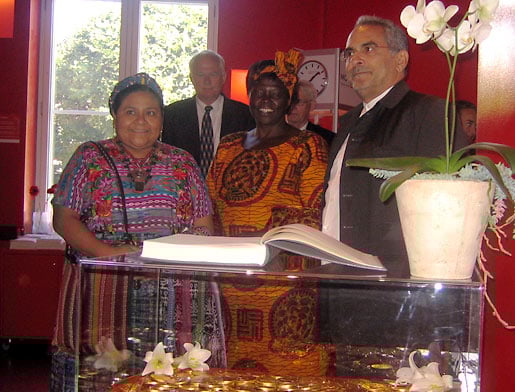
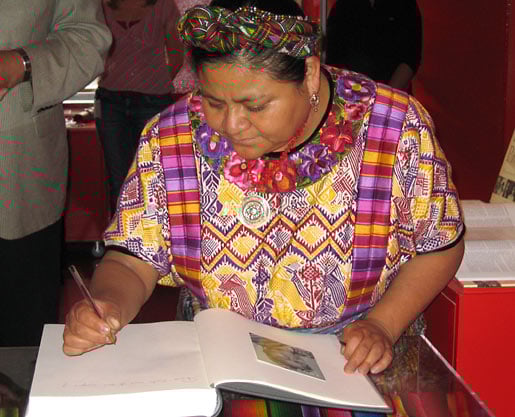
Three Nobel Peace Prize Laureates waiting to sign the guest book during their visit to the Nobel Peace Center in September 2006 (from left: Rigoberta Menchú Tum, Wangari Maathai and José Ramos-Horta).
Rigoberta Menchú Tum attending the Nobel Centennial 2001, a conference titled ”The Conflicts of the 20th Century and the Solutions for the 21st Century” in Oslo, Norway, December 2001.
Nobel Peace Prize laureates at the Nobel Centennial 2001, a conference titled ”The Conflicts of the 20th Century and the Solutions for the 21st Century”. From left: Oscar Arias Sánchez, Norman Borlaug, Joseph Rotblat, Rigoberta Menchu, Adolfo Pérez Esquivel, (photographer Micheline Pelletier), John Hume and Mairead Corrigan.
At the Nobel Peace Prize award ceremony on 10 December 2001 where Kofi Annan and the United Nations were awarded the 2001 peace prize, many previous laureates were present. From left: Joseph Rotblat, Jody Williams, José Ramos-Horta, Adolfo Pérez Esquivel, Lech Wałęsa, Desmond Tutu, John Hume, David Trimble, Elie Wiesel, Norman Borlaug, Rigoberta Menchu Tum and Mairead Corrigan. The remaining are representatives for peace prize awarded organisations.
Acceptance and Nobel Lecture, December 10, 1992 (in Spanish)
Honorables señores del Comité Nobel de la Paz, Sus majestades los Reyes de Noruega, Excelentísima señora Primer Ministro, Excelentísimos miembros de gobiernos y del Cuerpo Diplomático, Apreciables compatriotas guatemaltecos, Señoras y señores.
Me llena de emoción y orgullo la distinción que se me hace al otorgarme el Premio Nobel de la Paz 1992. Emoción personal y orgullo por mi Patria de cultura milenaria. Por los valores de la comunidad del pueblo al que pertenezco, por el amor a mi tierra, a la madre naturaleza. Quien entiende esta relación, respeta la vida y exalta la lucha que se hace por esos objetivos.
Considero este Premio, no como un galardón hacia mí en lo personal, sino como una de las conquistas más grandes de la lucha por la paz, por los derechos humanos y por los derechos de los pueblos indígenas, que a lo largo de estos 500 años han sido divididos y fragmentados y han sufrido el genocidio, la represión y la discriminación.
Permítanme expresarles todo lo que para mí significa este Premio.
En mi opinión, el Premio Nobel nos convoca a actuar en función de lo que representa y en función de su gran trascendencia mundial. Es, además de una inapreciable presea, un instrumento de lucha por la paz, por la justicia, por los derechos de los que sufren las abismales desigualdades económicas, sociales, culturales y políticas, propias del orden mundial en que vivirnos, y cuya transformación en un nuevo mundo basado en los valores de la persona humana, es la expectativa de la gran mayoría de seres que habitamos este planeta.
Este Premio Nobel significa un portaestandarte para proseguir con la denuncia de la vioiación de los Derechos Humanos, que se cometen contra los pueblos en Guatemala, en América y en el mundo, y para desempeñar un papel positivo en la tarea que más urge en mi país, que es el logro de la paz con justicia social.
El Premio Nobel es un emblema de la Paz y del trabajo en la construcción de una verdadera democracia. Estimulará a los sectores civiles para que, en una sólida unidad nacional, aporten en el proceso de negociaciones en busca de la paz, reflejando el sentir generalizado – aunque algunas veces no expresado por el temor – de la sociedad guatemalteca; el de sentar las bases políticas y jurídicas para darle impulso irreversible a la solución de las causas que dieron origen al conflicto armado interno.
Sin duda alguna, constituye una señal de esperanza para las luchas de los pueblos indígenas en todo el Continente.
También es un homenaje para los pueblos centroamericanos que aún buscan su estabilidad, la conformación de su futuro y el sendero de su desarrollo e integración sobre la base de la democracia civil y el respeto mutuo.
El significado que tiene este Premio Nobel lo demuestran los mensajes de felicitación que llegaron de todas partes, desde jefes de Estado – casi todos los Presidentes de América – hasta las Organizaciones Indígenas y de Derechos Humanos, de todas partes del mundo. De hecho, ellos ven en este Premio Nobel no solamente un galardón y un reconocimiento a una persona, sino un punto de partida de arduas luchas por el logro de esas reivindicaciones que están todavía por cumplirse.
En contraste, paradójicamente, fue precisamente en mi país donde encontré de parte de algunos las mayores objeciones, reservas e indiferencia respecto al otorgamiento del Nobel a esta india quiché. Tal vez porque, en América, sea precisamente en Guatemala en donde la discriminación hacia el indígena, hacia la mujer y la resistencia hacia los anhelos de justicia y paz, se encuentran más arraigadas en ciertos sectores sociales y políticos.
En las actuales circunstancias de este mundo convulso y complejo, la decisión del Comité Noruego del Premio Nobel de la Paz de otorgarme esta honorable distinción, refleja la conciencia de que por ese medio se está dando un gran aliento a los esfuerzos de paz, reconciliación y justicia; a la lucha contra el racismo, la discriminación cultural, para contribuir al logro de la convivencia armónica entre nuestros pueblos.
Con profundo dolor, por una parte, pero con satisfacción por otra, hago del conocimiento de ustedes, que temporalmente el Premio Nobel de la Paz 1992 tendrá que permanecer en la Ciudad de México, en vigilia por la paz en Guatemala. Porque no hay condiciones políticas en mi país que permitan avizorar una pronta y justa solución. La satisfacción y reconocimiento provienen del hecho de que México, nuestro hermano país vecino, que tanto interés y esfuerzo ha puesto en las negociaciones que se realizan para lograr la paz y ha acogido a los refugiados y exiliados guatemaltecos, nos ha otorgado un lugar en el Museo del Templo Mayor (cuna de la memoria milenaria de los Aztecas) para que el Premio Nobel resida, en tanto se crean las condiciones de paz y seguridad para ubicarlo en Guatemala, la tierra del Quetzal.
Al valorar en todo lo que significa el otorgamiento del Premio Nobel, quiero decir algunas palabras en representación de aquellos que no pueden hacer llegar su voz o son reprimidos por expresarla en forma de opinión, de los marginados, de los discriminados, de los que viven en la pobreza, en la miseria, víctimas de la represión y de la violación a los derechos humanos. Sin embargo, ellos que han resistido por siglos, no han perdido la conciencia, la determinación, la esperanza.
Permítanme, señoras y señores, decirles algunas palabras sobre mi país y la Civilización Maya. Los Pueblos Mayas se desarrollaron geográficamente en una extensión de 300 mil kilómetros cuadrados; ocuparon lugares en el Sur de México, Belice, Guatemala y partes de Honduras y El Salvador; desarrollaron una civilización muy rica en los campos de la organización política, en lo social y económico; fueron grandes científicos en lo concerniente a las matemáticas, la astronomía, la agricultura, la arquitectura y la ingeniería; y grandes artistas en la escultura, la pintura, el tejido y el tallado.
Los Mayas descubrieron la categoría matemática CERO, casi al mismo tiempo que ésta fue descubierta en la India y después trasladada a los árabes. Sus previsiones astronómicas basadas en cálculos matemáticos y observaciones científicas, son asombrosos todavía ahora. Elaboraron un calendario más exacto que el Gregoriano, y en la medicina practicaron operaciones quirúrgicas intracraneanas.
En uno de los libros Mayas que escaparon de la destrucción conquistadora, conocido como Códice de Dresden, aparecen los resultados de la investigación acerca de los eclipses y contiene una tabla de 69 fechas, en las cuales ocurren eclipses solares en un lapso de 33 años.
Es importante destacar hoy el respeto profundo de la civilización Maya hacia la vida y la naturaleza en general.
¿Quién puede predecir qué otras grandes conquistas científicas y qué desarrollo habrían logrado alcanzar esos pueblos, si no hubieran sido conquistados a sangre y fuego, objetos del etnocidio, que alcanzó casi 50 millones de personas en 50 años?
Este Premio Nobel lo interpreto primero como un homenaje a los pueblos indígenas sacrificados y desaparecidos por la aspiración de una vida más digna, justa, libre, de fraternidad y comprensión entre los humanos. Los que ya no están vivos para albergar la esperanza de un cambio de la situación de pobreza y marginación de los indígenas, relegados y desamparados en Guatemala y en todo el continente americano.
Reconforta esta creciente atención, aunque llegue 500 años más tarde, hacia el sufrimiento, la discriminación, la opresión y explotación que nuestros pueblos han sufrido, pero que gracias a su propia cosmovisión y concepción de la vida han logrado resistir y finalmente ver con perspectivas promisorias. Cómo, de aquellas raíces que se quisieron erradicar, germinan ahora con pujanza, esperanzas y representaciones para el futuro.
Implica también una manifestación del progresivo interés y comprensión internacional por los Derechos los Pueblos originarios, por el futuro de los más de 60 millones de indígenas que habitan nuestra América y su fragor de protesta por los 500 años de opresión que han soportado. Por el genocidio incomparable que han sufrido en toda esta época, del que otros países y las élites en America se han favorecido y aprovechado.
¡Libertad para los indios donde quieran que estén en América y en el mundo, porque mientras vivan vivirá un brillo de esperanza y un pensar original de la vida!
Las manifestaciones de júbilo de las Organizaciones Indígenas de todo el continente y las congratulaciones mundiales recibidas por el otorgamiento del Premio Nobel de la Paz, expresan claramente la trascendencia de esta decisión. Es el reconocimiento de una deuda de Europa para con los pueblos indígenas americanos; es un llamado a la conciencia de la Humanidad para que se erradiquen las condiciones de marginación que los condenó al coloniaje y a la explotación de los no indígenas; y es un clamor por la vida, la paz, la justicia, la igualdad y hermandad entre los seres humanos.
La particularidad de la visión de los pueblos indígenas se manifiesta en las formas de relacionarse. Primero, entre los seres humanos, de manera comunitaria. Segundo, con la tierra, como nuestra madre, porque nos da la vida y no es sólo una mercancía. Tercero, con la naturaleza; pues somos partes integrales de ella y no sus dueños.
La madre tierra es para nosotros, no solamente fuente de riqueza económica que nos da el maíz, que es nuestra vida, sino proporciona tantas cosas que ambicionan los privilegiados de hoy. La tierra es raíz y fuente de nuestra cultura. Ella contiene nuestra memoria, ella acoge a nuestros antepasados y requiere por lo tanto también que nosotros la honremos y le devolvamos con ternura y respeto los bienes que nos brinda. Hay que cuidar y guardar la madre tierra para que nuestros hijos y nuestros nietos sigan percibiendo sus beneficios. Si el mundo no aprende ahora a respetar la naturaleza ¿qué futuro tendrán las nuevas generaciones?
De estos rasgos fundamentales se derivan comportamientos, derechos y obligaciones en el continente americano, tanto para los indígenas como para los no indígenas, sean estos mestizos, negros, blancos o asiáticos. Toda la sociedad tiene la obligación de respetarse mutuamente, de aprender los unos de los otros y de compartir las conquistas materiales y científicas, según su propia conveniencia. Los indígenas jamás han tenido, ni tienen, el lugar que les corresponde en los avances y los beneficios de la ciencia y la tecnología, no obstante que han sido base importante de ellos.
Las civilizaciones indígenas y las civilizaciones europeas de haber tenido intercambios de manera pacífica y armoniosa, sin que mediara la destrucción, explotación, discriminación y miseria, seguramente habrían logrado una conjunción con mayores y más valiosas conquistas para la Humanidad.
No debemos olvidar que cuando los europeos llegaron a América, florecían civilizaciones pujantes. No se puede hablar de descubrimiento de América, porque se descubre lo que se ignora o se encuentra oculto. Pero América y sus civilizaciones nativas se habían descubierto a sí mismas mucho antes de la caída del Imperio Romano y del Medioevo europeo. Los alcances de sus culturas forman parte del patrimonio de la Humanidad y siguen asombrando a sus estudiosos.
Pienso que es necesario que los pueblos indígenas, de los que soy una de sus miembros, aporten su ciencia y sus conocimientos al desarrollo de los humanos, porque tenemos enormes potenciales para ello, intercalando nuestras herencias milenarias con los avances de la civilización en Europa y otras regiones del mundo.
Pero ese apolle, que nosotros emendemos como un rescate del patrimonio natural y cultural, debe de ser en tanto que actores de una planificación racional y consensúa! del usufructo de los conocimientos y recursos naturales, con garantías de igualdad ante el Estado y la sociedad.
Los indígenas estamos dispuestos a combinar tradición con modernidad, pero no a cualquier precio. No consentiremos que el futuro se nos plantee como posibles guardias de proyectos etnoturísticos a escala continental.
En un momento de resonancia mundial en torno a la conmemoración del V Centenario de la llegada de Cristobal Colón a tierras americanas, el despertar de los pueblos indígenas oprimidos nos exige reafirmar ante el mundo nuestra existencia y la validez de nuestra identidad cultural. Nos exige que luchemos para participar activamente en la decisión de nuestro destino, en la construcción de nuestros estados-naciones. Si con ello no somos tomados en cuenta, hay factores que garantizan nuestro futuro: la lucha y la resistencia; las reservas de ánimo; la decisión de mantener nuestras tradiciones puestas a prueba por tantas dificultades, obstáculos y sufrimientos; la solidaridad para con nuestras luchas por parte de muchos países, gobiernos, organizaciones y ciudadanos del orbe.
Por eso sueño con el día en que la interrelación respetuosa justa entre los pueblos indígenas y otros pueblos se fortalezca, sumando potencialidades y capacidades que contribuyan a hacer la vida en este planeta menos desigual, más distributiva de los tesoros científicos y culturales acumulados por la Humanidad, floreciente de paz y justicia.
Creo que esto es posible en la práctica y no solamente en la teoría. Pienso que esto es posible en Guatemala y en muchos otros países que se encuentran sumidos en el atraso, el racismo, la descriminación y el subdesarrollo.
El día de hoy, en el 47 período de sesiones de la Asamblea General, la Organización de Naciones Unidas – ONU – inaugura 1993 como Año Internacional de los Pueblos Indios, en presencia de destacados dirigentes de las organizaciones de los pueblos indígenas y de la coordinación del Movimiento Continental de Resistencia Indígena, Negra y Popular, que participarán protocolariamente en la apertura de labores a fin de exigir que 1993 sea un año con acciones concretas para darle verdaderamente su lugar a los pueblos indígenas en sus contextos nacionales y en el concierto internacional.
La conquista del Año Internacional de los Pueblos Indígenas y los avances que représenta la elaboración del proyecto de Declaración Universal son producto de la participación de numerosos hermanos indígenas, organizaciones no gubernamentales y la gestión éxitosa de los expertos del Grupo de Trabajo asi como la comprensión de varios estados en el seno de la Organización de las Naciones Unidas.
Esperamos que la formulación del proyecto de Declaración sobre los Derechos de los Pueblos Indígenas examine y profundice en la contradicción existente entre los avances en materia de derecho internacional y la difícil realidad que en la práctica vivimos los indoamericanos.
Nuestros pueblos tendrán un año dedicado a los problemas que los aquejan y, para ello, se aprestan a llevar a cabo actividades con el objetivo de hacer planteamientos y presionar, mediante las más razonables formas y las argumentaciones más valederas y justas, para la eliminación del racismo, la opresión, la discriminación y la explotación que los ha sumido en la miseria y en el olvido. Para los condenados de la tierra también la adjudicación del Premio Nobel representa un reconocimiento, un aliciente y un objetivo.
Desearía que se desarrollara en todos los pueblos un consciente sentido de paz y el sentimiento de solidaridad humana, que puedan abrir nuevas relaciones de respeto e igualdad para el próximo milenio, que deberá ser de fraternidad y no de conflictos cruentos.
En todas partes se está conformando una opinión sobre un fenómeno de actualidad, que a pesar de que se expresa entre guerras y violencia, le plantea a la Humanidad entera la defensa de su validez histórica: la unidad en la diversidad. Y que nos llama a la reflexión para incorporar importantes elementos de cambio y transformación en todos los aspectos de la vida del mundo, en busca de soluciones específicas y concretas a la profunda crisis ética que aqueja a la Humanidad. Esto sin duda tendrá influencias determinantes en la conformación del futuro.
Es posible que algunos centros de poder político y económico, algunos estadistas e intelectuales, todavía no alcancen a comprender el despertar y la configuración promisoria que significa la participación activa de los pueblos indígenas en todos los terrenos de la actividad humana, pero el movimiento amplio y plural desencadenado por las diferentes expresiones políticas e intelectuales amerindias terminará por convencerlos que objetivamente somos parte constituyente de las alternativas históricas que se están gestando a nivel mundial.
Señoras y señores, unas francas palabras sobre mi país.
La atención que con este Premio Nobel de la Paz se centra en Guatemala deberá permitir que internacionalmente se deje de ignorar la violación a los derechos humanos y honrará a todos aquellos que murieron luchando por la igualdad social y la justicia en mi país.
El mundo conoce que el pueblo guatemalteco, mediante su lucha, logró conquistar en octubre de 1944 un periodo de democracia, en que la institucionalidad y los derechos humanos fueron su filosofía esencial. En esa época, Guatemala fue excepcional en el continente americano en su lucha por alcanzar la plena soberanía nacional. Pero en 1954, en una confabulación que unió a los tradicionales centros de poder nacionales, herederos del coloniaje, con poderosos intereses extranjeros, el régimen democrático fue derrocado a través de una invasión armada e impuso de nuevo el viejo sistema de opresión que ha caracterizado la historia de mi país.
La sujeción política, económica y social que se derivó de ese producto de la guerra fría dio origen al conflicto armado interno. La represión contra las organizaciones populares, los partidos democráticos, los intelectuales empezó en Guatemala mucho antes de que se iniciara la guerra. No lo olvidemos.
En el intento de sofocar la rebelión, las dictaduras cometieron las más grandes atrocidades. Se arrasaron aldeas, se asesinaron decenas de miles de campesinos, principalmente indígenas, centenas de sindicalistas y estudiantes, numerosos periodistas por dar a conocer la información, connotados intelectuales y políticos, religiosos y religiosas. Por medio de la persecución sistemática, en aras de la doctrina de seguridad del Estado, se forzó al desplazamiento de un millón de campesinos; a la búsqueda del refugio por parte de 100 mil más en países vecinos. Hay en Guatemala casi 100 mil huérfanos y más de 40 mil viudas. En Guatemala se inventó, como política de Estado, la práctica de los desaparecidos políticos.
Como ustedes saben, yo misma soy sobreviviente de una familia masacrada.
El país se desplomó en una crisis sin precedentes y los cambios en el mundo obligaron e incitaron a los militares a permitir una apertura política que consistió en la elaboración de una nueva Constitución, en una ampliación del juego político y el traspaso del gobierno a sectores civiles. Llevamos ocho años de este nuevo régimen, en el que los sectores populares y medios se han abierto espacios importantes.
No obstante en los espacios abiertos persiste la represión y la violación a los derechos humanos en medio de una crisis económica, que se ha agudizado a tal punto, que el 84% de la población es considerada como pobre y alrededor del 60% como muy pobre. La impunidad y el terror continúan impidiendo la libre manifestación del pueblo por sus necesidades y demandas vitales. Perdura el conflicto armado interno.
La vida política de mi país ha girado en este último tiempo en torno a la búsqueda de una solución política a la crisis global y al conflicto armado que vive Guatemala desde 1962. Este proceso tuvo su origen en el Acuerdo suscrito en esta misma capital, Oslo, entre la Comisión Nacional de Reconciliación con mandato gubernamental, y la Unidad Revolucionaria Nacional Guatemalteca, como un paso necesario para introducir a Guatemala en el espíritu del Acuerdo de Esquipulas.
Como consecuencia de este Acuerdo, después de la realización de conversaciones entre la URNG y diversos sectores de la sociedad guatemalteca, se iniciaron durante el régimen del Presidente Serrano negociaciones directas entre el gobierno y la guerrilla, resultado de las cuales han sido ya firmados tres acuerdos. Sin embargo, el tema de los Derechos Humanos ha ocupado bastante tiempo, porque constituye un tema eje de la problemática guatemalteca y alrededor del cual han surgido importantes diferencias. No obstante, se ha avanzado considerablemente también en el mismo.
El proceso de negociaciones busca acuerdos para establecer las bases de una democratización verdadera y la finalización de la guerra. Entiendo que con la buena voluntad de las partes y la participación activa de los sectores civiles, conformando una gran unidad nacional, se podrá rebasar la etapa de los propósitos y sacar a Guatemala de esa encrucijada histórica que ya nos parace eternizarse.
El diálogo y la negociación política son, sin duda, requisitos adecuados para que estos problemas se resuelvan y así ofrecer respuestas valederas y concretas a necesidades vitales y urgentes para la vida y democratización de nuestro pueblo guatemalteco. Pues, estoy convencida de que si los diversos sectores sociales que integran la sociedad guatemalteca encuentran bases de unidad, respetando sus diferencias naturales, podían hallar conjuntamente una solución a estos problemas y así resolver las causas que condujeron a la guerra que vive Guatemala.
Tanto los sectores civiles guatemaltecos como la comunidad internacional debemos exigir que las negociaciones entre el Gobierno y la URNG sobrepasen el periodo en que se encuentran en la discusión de los Derechos Humanos, y lleguen tan pronto como sea posible, a un acuerdo verificable por la Organización de las Naciones Unidas. Es necesario destacar aquí, en Oslo, que la situación de los Derechos Humanos en Guatemala constituye hoy por hoy el más urgente problema a resolver. Y mi afirmación no es ni casual ni gratuita.
Tal como lo han constatado instituciones internacionales como la Comisión de Derechos Humanos de la ONU, la Comisión Interamericana de Derechos Humanos y otros numerosos organismos humanitarios, Guatemala es uno de los países de América donde se comete el mayor número de violaciones a esos derechos, con la mayor impunidad, y en lo que generalmente están comprometidas de una u otra forma las fuerzas de seguridad. Es imprescindible que la represión y persecución que sufren los sectores populares e indígenas cesen. Que se ponga fin al reclutamiento forzado de jóvenes y a la integración forzada de las Patrullas de Autodefensa Civil, que afecta principalmente a los indígenas.
Urge construir una democracia en Guatemala. Es necesario lograr que se observen los derechos humanos en toda su gama: poner fin al racismo; garantizar la libre organización y locomoción de todos los sectores de la población. En definitiva, es imprescindible abrir el campo a la sociedad civil multiétnica, con todos sus derechos, desmilitarizar el país y sentar las bases para su desarrollo, a fin de sacarlo del atraso y la miseria en que se vive actualmente.
Uno de los más amargos dramas que puedan soportar porcentajes cuantiosos de población es el éxodo forzado. El verse obligados por la fuerza militar y la persecución a abandonar sus poblados, su madre tierra, el sitio de reposo de sus antepasados, su ambiente, la naturaleza que les dio la vida y la diseminación de sus comunidades, que constituyen un coherente sistema de organización social y de democracia funcional.
El caso de los desplazados y refugiados en Guatemala es desgarrador, una parte de ellos condenada al exilio en otros países y la gran mayoría al exilio en su propio país. Forzados a deambular de un lugar para otro, a vivir en barrancos y lugares inhóspitos, algunos desconocidos como ciudadanos guatemaltecos y todos condenados a la miseria y al hambre. No puede haber una democracia verdadera si este problema no se resuelve satisfactoriamente, reintegrando a esta población a sus tierras y poblados.
En la nueva sociedad guatemalteca una reorganización de la tenencia de la tierra es fundamental, para que permita tanto el desarrollo de las potencialidades agrícolas como la restitución a sus legítimos dueños de tierras comunales despojadas. Sin olvidar que este proceso reorganizador debe hacerse con el mayor respeto por la naturaleza, para preservarla y devolverle su vigor y capacidad de generar vida.
No menos distintiva de una democracia es la justicia social. Ella exige la solución de los aterradores índices de mortalidad infantil, de desnutrición, de falta de educación, de analfabetismo, de salarios de exterminio. Estos problemas aquejan creciente y dolorosamente a la población guatemalteca, sin perspectivas ni esperanza.
Entre los rasgos que caracterizan a la sociedad actual está el papel de la mujer, sin que por ello la emancipación de la mujer haya sido conquistada plenamente en ningún país del mundo.
El desarrollo histórico de Guatemala refleja ahora la necesidad y la irreversibilidad de la contribución activa de la mujer en la configuración del nuevo orden social guatemalteco y, modestamente, pienso que las mujeres indígenas somos ya un claro testimonio de ello. Este Premio Nobel es un reconocimiento a quienes han sido, y todavía lo son en la mayor parte del mundo, las más explotadas de los explotados; las más discriminadas de los discriminados; las más marginadas de los marginados y, sin embargo, productoras de vida de conocimiento, de expresión y de riqueza.
La democracia, el desarrollo y la modernización de un país se hacen imposibles e incongruentes sin la solución de estos problemas.
Igualmente importante es el reconocimiento en Guatemala de la Identidad y los Derechos de los Pueblos Indígenas, que han sido ignorados y despreciados no sólo en el período colonial, sino en la era republicana. No se puede concebir una Guatemala democrática, libre y soberana, sin que la identidad indígena perfile su fisonomía en todos los aspectos de la existencia nacional.
Será indudablemente algo nuevo, inédito, con una fisonomía que en este momento no podemos formular. Pero responderá auténticamente a la Historia y a las características que debe comprender una verdadera nacionalidad guatemalteca. A su perfil verdadero, por tanto tiempo desfigurado.
Esta urgencia y esta vital necesidad, son las que me conducen en este momento, en esta tribuna, a plantear a la opinión nacional y a la comunidad internacional interesarse más activamente en Guatemala.
Tomando en consideración que en relación a mi papel como Premio Nobel en el proceso de negociaciones por la paz en Guatemala se han manejado un abanico de posibilidades, pienso que éste es más bien el de promotora de la paz, la unidad nacional, de la defensa de los derechos indígenas. De tal manera que pueda tomar iniciativas acordes a las que se vayan presentando, evitando de esta manera encasillar el Premio Nobel en un papel.
Convoco a todos los sectores sociales y étnicos que componen el pueblo de Guatemala a participar activamente en los esfuerzos por encontrar una solución pacífica al conflicto armado, forjando una sólida unidad entre los pueblos ladino, negro e indígena, que deben de formar en su diversidad la guatemalidad.
Con ese mismo sentido, yo invito a la comunidad internacional a contribuir con acciones concretas a que las partes superen las diferencias que en este momento mantienen las negociaciones en una situación de expectativa, y así se logre, primero, firmar un acuerdo sobre Derechos Humanos. Para que luego se reanuden las rondas de negociación y se encuentren los puntos de compromiso que permitan que este acuerdo de Paz sea firmado y que la verificación del mismo se haga inmediatamente, pues no me cabe la menor duda de que ésto traería un alivio substancial a la situación existente en Guatemala.
Según mi opinión, también una participación más directa de las Naciones Unidas, que fuera más allá de un papel de observador, podría ayudar stancialmente al proceso a salir del paso.
Señoras y señores, el hecho de que me haya referido preferencialmente a América, y en especial a mi país, no significa que no ocupe un lugar importante en mi mente y corazón la preocupación que viven otros pueblos del mundo en su incesante lucha por defender la paz, el derecho a la vida y todos sus derechos inalienables. La pluralidad de los que nos encontramos reunidos este día es un ejemplo de ello y en tal sentido les doy humildemente las gracias en nombre propio.
Muchas cosas han cambiado en estos años. Grandes transformaciones de carácter mundial han tenido lugar. Dejó de existir la confrontación Este-Oeste y se terminó la Guerra Fría. Estas transformaciones, cuyas modalidades definitivas no se pueden predecir, han dejado vacíos que pueblos del mundo han sabido aprovechar para emerger, luchar y ganar espacios nacionales y reconocimiento internacional.
En la actualidad, luchar por un mundo mejor, sin miseria, sin racismo, con paz en el Oriente Medio y el Sudoeste Asiático, a donde dirijo mi plegaria para la liberación de la señora Aung San Suu Kyi, Premio Nobel de la Paz 1991; por una solución justa y pacífica para los Balcanes; por el fin del apartheid en el Sur de Africa; por la estabilidad en Nicaragua; por el cumplimiento de los Acuerdos de Paz en El Salvador; por el restablecimiento de la democracia en Haití; por la plena soberanía de Panamá; por que todo ello constituye las más altas aspiraciones de justicia en la situación internacional.
Un mundo en paz que le dé coherencia, interrelación y concordancia a las estructuras económicas, sociales y culturales de las sociedades. Que tenga raíces profundas y una proyección robusta.
Tenemos en nuestra mente las demandas más sentidas de la Humanidad entera, cuando propugnamos por la convivencia pacífica y la preservación del medio ambiente.
La lucha que libramos acrisola y modela el porvenir.
Nuestra historia es una historia viva, que ha palpitado, resistido y sobrevivido siglos de sacrificios. Ahora resurge con vigor. Las semillas, durante tanto tiempo adormecidas, brotan hoy con certidumbre, no obstante que germinan en un mundo que se caracteriza actualmente por el desconcierto y la imprecisión.
Sin duda que será un proceso complejo y prolongado, pero no es una utopía y nosotros los indígenas tenemos ahora confianza en su realización. Sobre todo, si quienes añoramos la paz y nos esforzamos porque se respeten los derechos humanos en todas partes del mundo donde se violan, y nos oponemos al racismo, encaminamos nuestro empeño en la práctica con entrega y vehemencia.
El Pueblo de Guatemala se moviliza y está consciente de sus fuerzas para construir un futuro digno. Se prepara para sembrar el futuro, para liberarse de sus atavismos, para redescubrirse a sí mismo. Para construir un país con una auténtica identidad nacional. Para comenzar a vivir.
Combinando lodos los matices ladinos, garítunas e indígenas del mosaico étnico de Guatemala debemos entrelazar cantidad de colores, sin entrar en contradicción, sin que sean grotescos y antagónicos, dándoles brillo y una calidad superior, como saben tejer nuestros artesanos. Un güipil genialmente integrado, una ofrenda a la Humanidad.