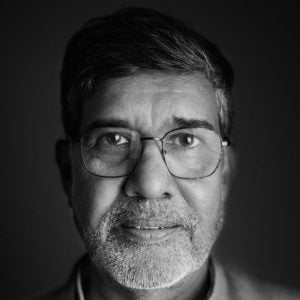
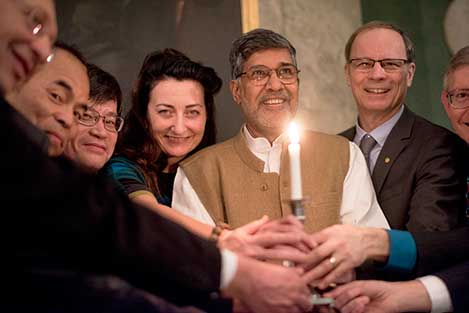
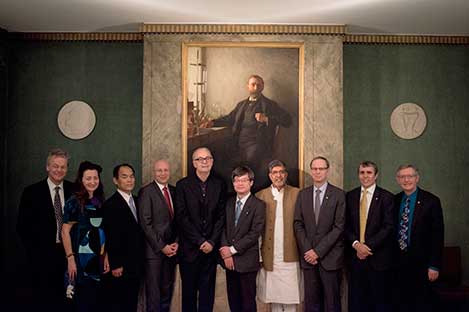
Kailash Satyarthi was awarded the Nobel Peace Prize, jointly with Malala Yousafzai, for his struggle against the suppression of children and young people and for the right of all children to education.
Full name: Kailash Satyarthi Born: 11 January 1954, Vidisha, India Date awarded: 10 October 2014
The children’s rights activist
For decades India’s Kailash Satyarthi has waged a battle against child labour. Through awareness-raising and information campaigns, raids and rescue missions, his organisation Bachpan Bachao Andolan (Save Childhood Movement) has helped tens of thousands of children to escape from forced labour and into education. Satyarthi has put the fight against child labour and for education on the global agenda. In the late 1990s he led the Global March Against Child Labour, a campaign which led to the ILO’s Convention 182 on the Worst Forms of Child Labour. Satyarthi has set up the “Good Weave” labelling scheme for the South Asian carpet industry, which shows that the products have not been made by children. Despite death threats and the murder of two colleagues, he continues the fight for children’s rights.
”The real meaning of freedom can be realised only once child labour is completely eliminated and every child receives free, compulsory and quality education.”
“The Norwegian Nobel Committee has decided that the Nobel Peace Prize for 2014 is to be awarded to Kailash Satyarthi and Malala Yousafzay for their struggle against the suppression of children and young people and for the right of all children to education. Children must go to school and not be financially exploited. (…) Showing great personal courage, Kailash Satyarthi, maintaining Gandhi’s tradition, has headed various forms of protests and demonstrations, all peaceful, focusing on the grave exploitation of children for financial gain. He has also contributed to the development of important international conventions on children’s rights.”
Gandhi never received the Nobel Peace Prize, but his philosophy has inspired many peace laureates. In its announcement, the Norwegian Nobel Committee emphasised Satyarthi’s non-violent activism. His methods include marches, mass mobilisation and information campaigns. He takes direct, physical action through raids and rescue missions, where he brings child labourers out of factories. When aggressive opponents try to stop him, he – like Gandhi – sticks to the principle of non-violence. In this way he changes attitudes, influences public authorities, raises the awareness of consumers and helps children out of forced labour.
”Those who continue to buy goods made by child labour are responsible for the perpetuation of child slavery.”
Kailash Satyarthi, New Delhi, 11 August 2013.
Child labour
ILO defines child labour as work which deprives children of their childhood, dignity and right to education, and which is harmful to their physical and mental development. In the most extreme form of child labour, children are treated as slaves, separated from their families and exposed to serious hazards. According to ILO, there were 168 million child labourers worldwide in 2012, down from 246 million in 2000. The use of child labour is falling, but it is happening slowly and unevenly. Article 32 of the UN Convention of the Rights of the Child states that children have a right to be protected from economic exploitation.
Two sides of the same cause?
The Nobel Peace Prize to Kailash Satyarthi and Malala Yousafzai is an award both for human rights and humanitarian work. With this prize the Norwegian Nobel Committee wishes to build a bridge between nations, religions and generations. Kailash Satyarthi is a 60-year-old Hindu from India, while Malala Yousafzai is a 17-year-old Muslim from Pakistan. The two Nobel Peace Prize laureates work in different arenas, but are bound together in the fight for children’s rights and the goal of enabling every child to go to school. Both are supporters of non-violence, even in the face of threats and attacks by their opponents.
Kailash Satyarthi (born on January 11, 1954) is a human rights activist from India who has been at the forefront of the global movement to end child slavery and exploitation since 1980, when he gave up a lucrative career as an electrical engineer to initiate a crusade against child servitude …
Disclaimer: Every effort has been made by the publisher to credit organisations and individuals with regard to the supply of photographs. Please notify the publishers regarding corrections.
Malala Yousafzai – Speed read
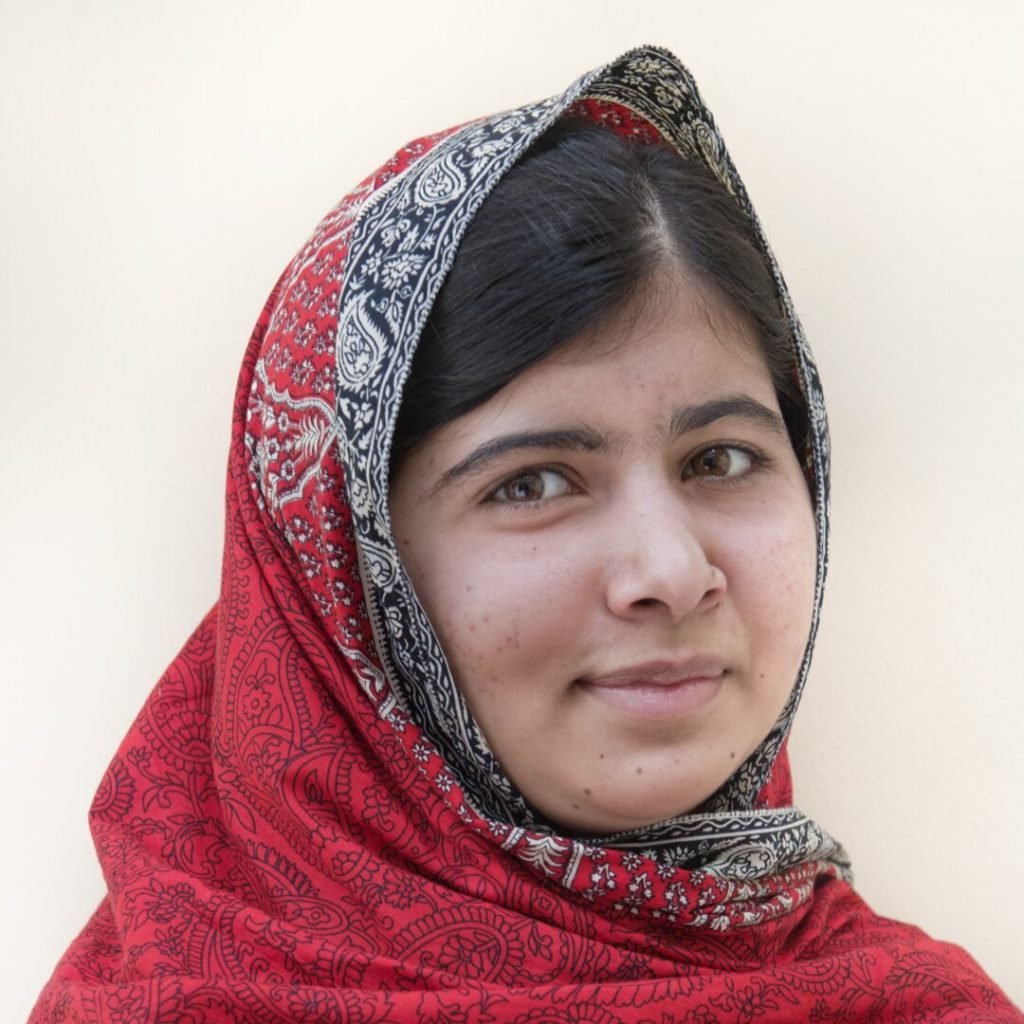
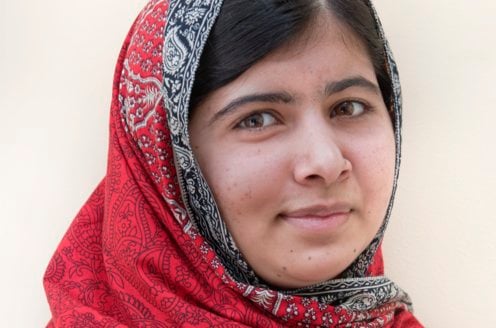
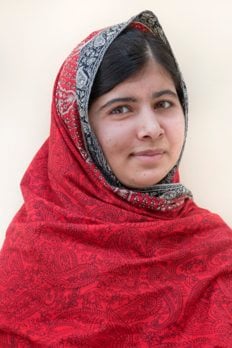
Malala Yousafzai was awarded the Nobel Peace Prize, jointly with Kailash Satyarthi, for her struggle against the suppression of children and young people and for the right of all children to education.
Malala Yousafzai Photo: K. Opprann
Full name: Malala Yousafzai Born: 12 July 1997, Mingora, Pakistan Date awarded: 10 October 2014
“Pens are mightier than weapons”
Malala Yousafzai comes from the Swat Valley in Pakistan. In 2009 the Taliban decreed that all girls’ schools should be closed or there would be consequences. Malala continued to go to school. She started to blog about girls’ right to education, and became known as one who defied the school ban. On 9 October 2012 she was shot by the Taliban, but survived. She has not allowed threats to silence her and is a global voice as she continues to campaign for the right of girls to education. The Malala Fund helps to provide schooling for girls in Pakistan, Nigeria, Jordan and Kenya. Her message has been that children’s right to education is the foundation for peace, and an important measure in the fight against extremism. Aged just 17, Malala is the youngest ever Nobel Prize laureate.
“The extremists are afraid of books and pens. The power of education frightens them.”
Malala Yousafzai, speech at the United Nations, 12 July 2013.
“The Norwegian Nobel Committee has decided that the Nobel Peace Prize for 2014 is to be awarded to Kailash Satyarthi and Malala Yousafzai for their struggle against the suppression of children and young people and for the right of all children to education. (…) Despite her youth, Malala Yousafzai has already fought for several years for the right of girls to education, and has shown by example that children and young people, too, can contribute to improving their own situations. This she has done under the most dangerous circumstances. Through her heroic struggle she has become a leading spokesperson for girls’ rights to education.”
Malala has become the very symbol of girls’ right to education. At the age of 11 she became known for her blog on the BBC’s Urdu service and attracted international media attention. The world was appalled by the attempt to assassinate her in 2012, but Malala recovered and forgave her attacker. Political leaders and celebrities have paid tribute to the Pakistani schoolgirl and have endorsed her message that every child is entitled to go to school. The campaign “I am Malala” was launched to promote her cause. On Malala’s 16th birthday, 12 July 2013, she addressed the UN, which responded by naming the day “Malala Day”.
“Education is education. We should learn everything and then choose which path to follow. Education is neither Eastern nor Western, it is human.”
Malala Yousafzai, in her book I Am Malala: The Girl Who Stood Up for Education and Was Shot by the Taliban.
Education is a human right
Articles 28 and 29 of the UN Convention on the Rights of the Child state that all children are entitled to an education. Education should aim to develop the child’s personality, talents, physical and mental capacities and be of good quality. UNESCO says that, worldwide, 57 million children do not go to school, over half of them girls. As many as 130 million children spend years at school without ever learning to read or write. Education helps to reduce child mortality, improves health, increases an understanding of democracy, results in higher wages and promotes economic growth.
UN convention on the rights of the child Adopted in 1959 to give children particular protection so that they can grow up safely, no matter where in the world they live. Children shall be ensured access to food, shelter and education, and shall be protected from participation in child labour.
UNESCO United Nations Educational, Scientific and Cultural Organisation. Founded in 1946. Noted especially for its efforts to promote literacy.
“I raise my voice not so that I can shout, but so that those without a voice can be heard.”
Malala Yousafzai, speech at the United Nations, 12 July 2013.
Two sides of the same cause?
The Nobel Peace Prize to Kailash Satyarthi and Malala Yousafzai is an award both for human rights and humanitarian work. With this prize the Norwegian Nobel Committee wishes to build a bridge between nations, religions and generations. Kailash Satyarthi is a 60-year-old Hindu from India, while Malala Yousafzai is a 17-year-old Muslim from Pakistan. The two peace prize laureates work in different arenas, but are bound together in the fight for children’s rights and the goal of enabling every child to go to school. Both are supporters of non-violence, even in the face of threats and attacks by their opponents.
Malala Yousafzai was born on July 12, 1997, in Mingora, the largest city in the Swat Valley in what is now the Khyber Pakhtunkhwa Province of Pakistan …
“When my world suddenly changed, my priorities changed too. I had two options. One was to remain silent and wait to be killed. And the second was to speak up and then be killed.”
In her Nobel Prize lecture Malala Yousafzai spoke up for every child’s right to go to school. Read the lecture here
Disclaimer: Every effort has been made by the publisher to credit organisations and individuals with regard to the supply of photographs. Please notify the publishers regarding corrections.
Malala Yousafzai – Facts
Malala Yousafzai – Biographical
Malala Yousafzai was born on July 12, 1997, in Mingora, the largest city in the Swat Valley in what is now the Khyber Pakhtunkhwa Province of Pakistan. She is the daughter of Ziauddin and Tor Pekai Yousafzai and has two younger brothers.
At a very young age, Malala developed a thirst for knowledge. For years her father, a passionate education advocate himself, ran a learning institution in the city, and school was a big part of Malala’s family. She later wrote that her father told her stories about how she would toddle into classes even before she could talk and acted as if she were the teacher.
In 2007, when Malala was ten years old, the situation in the Swat Valley rapidly changed for her family and community. The Taliban began to control the Swat Valley and quickly became the dominant socio-political force throughout much of northwestern Pakistan. Girls were banned from attending school, and cultural activities like dancing and watching television were prohibited. Suicide attacks were widespread, and the group made its opposition to a proper education for girls a cornerstone of its terror campaign. By the end of 2008, the Taliban had destroyed some 400 schools.
Determined to go to school and with a firm belief in her right to an education, Malala stood up to the Taliban. Alongside her father, Malala quickly became a critic of their tactics. “How dare the Taliban take away my basic right to education?” she once said on Pakistani TV.
In early 2009, Malala started to blog anonymously on the Urdu language site of the British Broadcasting Corporation (BBC). She wrote about life in the Swat Valley under Taliban rule, and about her desire to go to school. Using the name “Gul Makai,” she described being forced to stay at home, and she questioned the motives of the Taliban.
Malala was 11 years old when she wrote her first BBC diary entry. Under the blog heading “I am afraid,” she described her fear of a full-blown war in her beautiful Swat Valley, and her nightmares about being afraid to go to school because of the Taliban.
Pakistan’s war with the Taliban was fast approaching, and on May 5, 2009, Malala became an internally displaced person (IDP), after having been forced to leave her home and seek safety hundreds of miles away.
On her return, after weeks of being away from Swat, Malala once again used the media and continued her public campaign for her right to go to school. Her voice grew louder, and over the course of the next three years, she and her father became known throughout Pakistan for their determination to give Pakistani girls access to a free quality education. Her activism resulted in a nomination for the International Children’s Peace Prize in 2011. That same year, she was awarded Pakistan’s National Youth Peace Prize. But, not everyone supported and welcomed her campaign to bring about change in Swat. On the morning of October 9, 2012, 15-year-old Malala Yousafzai was shot by the Taliban.
Seated on a bus heading home from school, Malala was talking with her friends about schoolwork. Two members of the Taliban stopped the bus. A young bearded Talib asked for Malala by name, and fired three shots at her. One of the bullets entered and exited her head and lodged in her shoulder. Malala was seriously wounded. That same day, she was airlifted to a Pakistani military hospital in Peshawar and four days later to an intensive care unit in Birmingham, England.
Once she was in the United Kingdom, Malala was taken out of a medically induced coma. Though she would require multiple surgeries, including repair of a facial nerve to fix the paralyzed left side of her face, she had suffered no major brain damage. In March 2013, after weeks of treatment and therapy, Malala was able to begin attending school in Birmingham.
After the shooting, her incredible recovery and return to school resulted in a global outpouring of support for Malala. On July 12, 2013, her 16th birthday, Malala visited New York and spoke at the United Nations. Later that year, she published her first book, an autobiography entitled “I Am Malala: The Girl Who Stood Up for Education and Was Shot by the Taliban.” On October 10, 2013, in acknowledgement of her work, the European Parliament awarded Malala the prestigious Sakharov Prize for Freedom of Thought.
In 2014, through the Malala Fund, the organization she co-founded with her father, Malala traveled to Jordan to meet Syrian refugees, to Kenya to meet young female students, and finally to northern Nigeria for her 17th birthday. In Nigeria, she spoke out in support of the abducted girls who were kidnapped earlier that year by Boko Haram, a terrorist group which, like the Taliban, tries to stop girls from going to school.
In October 2014, Malala, along with Indian children’s rights activist Kailash Satyarthi, was named a Nobel Peace Prize winner. At age 17, she became the youngest person to receive this prize. Accepting the award, Malala reaffirmed that “This award is not just for me. It is for those forgotten children who want education. It is for those frightened children who want peace. It is for those voiceless children who want change.”
Today, the Malala Fund has become an organization that, through education, empowers girls to achieve their potential and become confident and strong leaders in their own countries. Funding education projects in six countries and working with international leaders, the Malala Fund joins with local partners to invest in innovative solutions on the ground and advocates globally for quality secondary education for all girls.
Currently residing in Birmingham, Malala is an active proponent of education as a fundamental social and economic right. Through the Malala Fund and with her own voice, Malala Yousafzai remains a staunch advocate for the power of education and for girls to become agents of change in their communities.
This autobiography/biography was written
at the time of the award and later published in the book series Les
Prix Nobel/Nobel Lectures/The Nobel Prizes. The information is sometimes updated with an addendum submitted
by the Laureate.
Malala Yousafzai – Photo gallery
Swipe left and right to see more photos
1 (of 6)
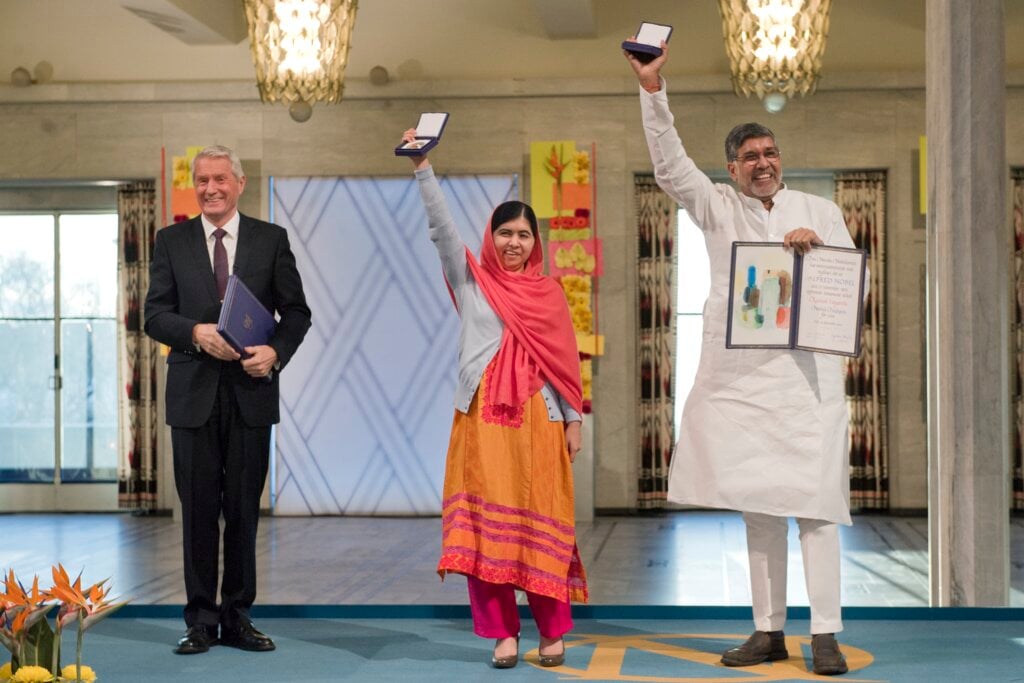
Nobel Peace Prize Laureates Malala Yousafzai and Kailash Satyarthi at the Nobel Peace Prize Award Ceremony at the Oslo City Hall in Norway, 10 December 2014. To the far left: Thorbjørn Jagland, Chairman of the Norwegian Nobel Committee.
2 (of 6)
Malala Yousafzai and Kailash Satyarthi showing their Nobel medals and diplomas during the Nobel Peace Prize Award Ceremony at the Oslo City Hall in Norway, 10 December 2014.
3 (of 6)
Malala Yousafzai's message in the guestbook of the Norwegian Nobel Institute in Oslo, Norway. She wrote it during her visit there on 9 December 2014.
Photo: The Norwegian Nobel Institute
Swipe left and right to see more photos
4 (of 6)
Malala Yousafzai and Kailash Satyarthi during a visit to the Norwegian Nobel Committee, 10 December 2014.
5 (of 6)
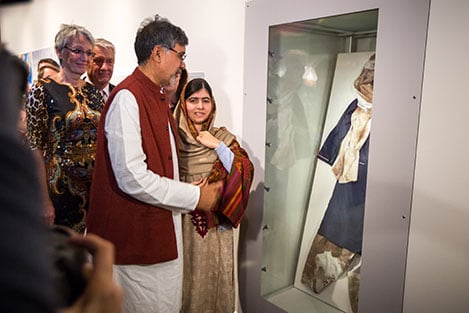
Kailash Satyarthi and Malala Yousafzai at the opening of the exhibition "Malala and Kailash" at the Nobel Peace Center in Oslo, Norway on 11 December 2014.
6 (of 6)
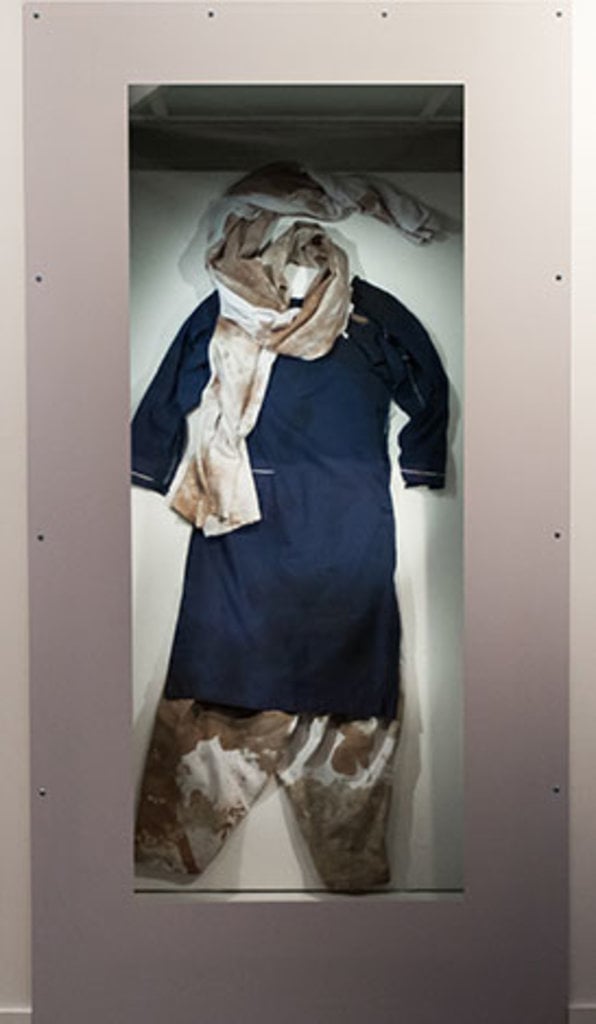
The school uniform Malala Yousafzai wore when she was shot in the head by a Taliban gunman in October 2012 shown at the exhibition "Malala and Kailash" at the Nobel Peace Center in Oslo.
1 (of 7)
Nobel Peace Prize Laureates Malala Yousafzai and Kailash Satyarthi at the Nobel Peace Prize Award Ceremony at the Oslo City Hall in Norway, 10 December 2014. To the far left: Thorbjørn Jagland, Chairman of the Norwegian Nobel Committee.
2 (of 7)
Malala Yousafzai and Kailash Satyarthi showing their Nobel medals and diplomas during the Nobel Peace Prize Award Ceremony at the Oslo City Hall in Norway, 10 December 2014.
4 (of 7)
Kailash Satyarthi and Malala Yousafzai at the opening of the exhibition "Malala and Kailash" at the Nobel Peace Center in Oslo, Norway on 11 December 2014.
7 (of 7)
Like many Nobel Laureates before him, Kailash Satyarthi autographs a chair at Bistro Nobel at the Nobel Museum in Stockholm, 12 December 2014.
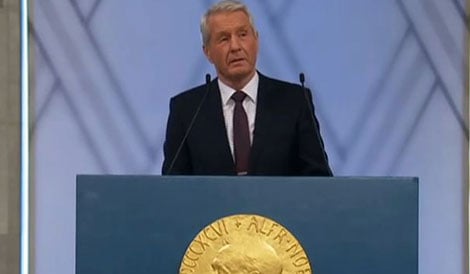
Presentation Speech by Thorbjørn Jagland, Chairman of the Norwegian Nobel Committee, Oslo, 10 December 2014.
Thorbjørn Jagland, Chairman of the Norwegian Nobel Committee, delivering the Presentation Speech at the Nobel Peace Prize Award Ceremony.
Your Majesties, Your Royal Highnesses, Excellencies, Ladies and Gentlemen,
A conscience exists in the world which extends beyond all national boundaries, and is independent of religion, culture and social adherence: it states that children have a right to childhood; they have a right to go to school instead of being forced to work. They are not to start life as the slaves of others.
This “world conscience” can find no better expression than through Kailash Satyarthi and Malala Yousafzai.
Dear Nobel Prize Laureates,
A stronger expression of Alfred Nobel’s appeal for fraternity between nations would be difficult to find except through you two.
We are honoured to have you here.
Congratulations!
The road to democracy and freedom is paved with knowledge.
Taliban and IS dislike knowledge because they know that it is an important condition for freedom. Attendance at school, especially by girls, deprives Taliban, IS, Boko Haram and similar movements of power.
But nothing should be further from Islam than using suicide bombs against their co-religionists or shooting at a young girl whose only demand was to be allowed to go to school.
Violence and repression can not be justified in any religion. Islam, Christianity, Judaism, Hinduism and Buddhism protect life and can not be used to take lives.
The two whom we honour here today stand very firm on this point. They live according to a principle Mahatma Gandhi gave expression to. He said: “There are many purposes I would have died for. There are no purposes I would have killed for”.
Satyarthi and Yousafzai are precisely the people whom Alfred Nobel in his will calls “champions of peace”.
This they are not only behind a desk, but in practice.
Your Majesties, Your Royal Highnesses, ladies and gentlemen,
Kailash Sathyarthi’s vision is quite simply to put an end to child labour. Since he abandoned a promising career as an electrical engineer in 1980, this has been Sathyarthi’s overriding aim. He has worked at several different levels to achieve it. At grass-root level he has achieved the release of some 80,000 children, sometimes in very dramatic circumstances. He has often been brutally attacked. It takes little fantasy to imagine the reaction when he and his co-workers go into worn-down factory premises round about in India to set the children free. Powerful interests have profited from child labour. They do not give up without a struggle. Satyarthi himself has adhered to non-violence.
The child labourers are not infrequently recruited by kidnapping, but are often also hired out by parents who cannot manage their debts. Enslavement to debt remains very widespread, not only in India but also in many other countries.
Satyarthi insists that it is not poverty that leads to child labour. Child labour maintains poverty, carrying it on from generation to generation
School attendance releases people from poverty.
Satyarthi has developed a model for how liberated children can be rehabilitated and provided with education. They must be provided with a basic education to enable them to some extent to function as normal citizens rather than as slaves. He has set up a number of different organizations which work both in India and internationally to fulfil children’s rights. Bachpan Bachao Andolan is perhaps his most important instrument, taking direct action to set children free.
Satyarthi’s struggle is marked by great inventiveness. Rugmark, established in 1994 (now Goodweave), is a striking example. It is an international consortium of representatives of countries which export and import rugs. We can all by simple means check that a rug has not been made by child labourers. A network of inspectors has been set up to ensure that the system works. The children get to go to school, and the adult workers earn a fair wage.
Exporters and importers pay a small fee to keep up this system of inspections and controls. Efforts are in hand to spread the scheme to other products often made by child labour, such as knitted goods and sports gear.
On the 17th of January 1998, Satyarthi embarked on his biggest project: The Global March Against Child Labour. Seven million children and adults took part in this march, which entered many different countries and regions. The march wound up at the ILO headquarters in Geneva. The following year the ILO convention against the worst forms of child labour was unanimously adopted. The convention has currently been ratified by 172 countries. No ILO convention has been ratified more quickly. ILO conventions 138 and 182, and the UN “Convention on the Rights of the Child”, now form the basis of the world-wide struggle against child labour and for education.
Much nevertheless remains to be done. There are roughly 60 million child labourers in India alone, most of them in farming. If the country were to ratify the two ILO conventions, that would be a big step in the right direction.
There are currently 168 million child labourers worldwide. In the year 2000, the figure was 78 million higher. In this, as in so many other areas, things are thus moving in the right direction, and often much faster than we think. Satyarthi indeed believes that child labour can be more or less eliminated in his own lifetime.
Everyone here shares that hope.
Your Majesties, Your Royal Highnesses, ladies and gentlemen,
Malala Yousafzai is far and away the youngest Peace Prize Laureate of all time. Her story has nevertheless become known practically all over the world. When she was 11 or 12 she began under a pseudonym to write a blog for the BBC about what it was like to live in the Swat valley in northwest Pakistan, under heavy pressure from the Taliban and with only ambivalent support from the Pakistani authorities. The schools periodically had to close, especially girls’ schools.
Malala Yousafzai’s vision was clear right from the start. Girls had a self-evident right to education.
Her courage is almost indescribable. We all know what happened on the 9th of October 2012, when Malala was 15. A gunman climbed into the school bus and asked for Malala. He fired three shots at her, injuring her most severely. Her life was saved, and she decided to continue her struggle for girls’ education, although Taliban have made no secret of their intention to try again.
Pakistan’s population numbers nearly 200 million. One quarter are between 5 and 16 years old. The nation’s constitution guarantees all these children free and compulsory education. But nearly half the 52 million do not go to school; a large majority of them are girls. And it is not just Taliban that seeks to keep the girls away from school. The authorities do so, too, having built schools without walls, without running water, and without toilets. And at least as important: indoctrination is sometimes more important than the skills and knowledge needed in order to cope in a modern world. The teachers, too, often lack the minimum qualifications needed.
Pakistani authorities have praised the award of the Peace Prize to Malala Yousafzai. The best gift they could give her would be dramatic improvements to the country’s education system.
That would benefit the whole of Pakistan.
Few things provide a larger economic and social yield than investments in girls’ education.
This logic applies all over the world. By placing the individual person at the centre of all politics, one will soon see that those “excluded” are not a burden and a threat, but an enormous unused resource. Here in Europe, too, such logic would work wonders. The problem here is not that children and adolescents receive no education or are obliged to work. Far too many find no use for their education or find no opportunities for work.
We need to leave this negative situation and instead give the younger generation the hope which is probably our strongest defence against extremism.
Young people must be able to see into the future instead of being trapped by dark thoughts and dark forces.
Ladies and gentlemen,
While it is in the nature of extremism to create enemies and frightening images, and to divide the world into us and them, the laureates show us something else:
A young girl and a somewhat older man, one from Pakistan and one from India, one Muslim, the other Hindu; both symbols of what the world needs: more unity. Fraternity between the nations!
The Laureates have underlined that if the prize can contribute to bringing Indians and Pakistanis, two people so near to one another and yet so distant, closer to one another, this would add an extra dimension to the prize.
We share this hope.
Ladies and gentlemen,
We need people like Satyarthi and Yousafzai to show that it helps to fight.
Few if any of us have had greater courage to live according to Mahatma Gandhi’s principle that “I accept only one tyrant in the world, and that is the still small voice within me”.
We others have perhaps become too accustomed to following the voices of others, pouring into our heads through the social media. We often forget to listen to our own voice, the one that talks to us about justice.
Freedom and justice have never been ceremonial. The world never progressed thanks to coldly calculating people. It advanced thanks to the efforts of people with warm hearts.
Your Majesties, ladies and gentlemen,
We live in an age in which the world, despite all the violence and extremism we see around us, is marked by an increasing humanity.
The author James Baldwin put it like this: “The people that once walked in darkness are no longer prepared to do so”.
This has become an irrevocable part of our common awareness.
Persons like Kailash Satiarthi and Malala Yousafzai have brought us there.
They show that it helps to resist. Even under the most difficult conditions.
Dear Nobel Prize Laureates,
You will for all the future form part of the row of gold that forms our Nobel history – the row of campaigning people. People who have created the “global conscience” of which we can all be the bearers – the call for freedom and justice.
The most important thing of all is to have children and young people set free!
Nobelforedrag av Malala Yousafzai, Oslo, 10. desember, 2014.
Bismillah hir rahman ir rahim.
I Guds den nådefulle og mest velgjørendes navn.
Deres Majesteter, ærede medlemmer av Den norske Nobelkomiteen, kjære søstre og brødre. Dagen i dag er en svært lykkelig dag for meg. Jeg er beæret over at Nobelkomiteen har valgt meg som mottaker av denne prestisjefylte prisen.
Jeg vil takke dere alle for deres vedvarende støtte og kjærlighet. Jeg er takknemlig for alle brevene og kortene som jeg fortsatt mottar fra hele verden. Å lese de varme og oppmuntrende ordene fra dere både styrker og inspirerer meg.
Jeg vil takke mine foreldre for deres uforbeholdne kjærlighet. Jeg vil takke faren min for at han ikke vingeklippet meg og lot meg fly. Jeg vil takke moren min for at hun har inspirert meg til å bli tålmodig og til å alltid si sannheten – noe vi er overbevist om er islams egentlige budskap.
Jeg er stolt over å være den første pashtuner, den første pakistaner og den første ungdommen som mottar denne prisen. Jeg er ganske sikker på at jeg også er den første mottakeren av Nobels fredspris som fortsatt kjemper sammen med sine yngre brødre. Jeg vil at det skal bli fred over alt, men det er noe mine brødre og jeg fortsatt jobber med.
Jeg er også beæret over å motta denne prisen sammen med Kailash Satyarthi, som har vært en forkjemper barns rettigheter over lang tid. Faktisk dobbelt så lenge som jeg har levd. Jeg er også glad for at vi kan stå sammen og vise verden at en inder og en pakistaner kan forenes i fred og i arbeidet for barns rettigheter.
Kjære brødre og søstre, jeg er oppkalt etter pashtunernes egen Jeanne d’Arc og store inspirasjonskilde, Malalai av Maiwand. Ordet Malala betyr “sorgtynget”, “trist”, men for å tilføre det litt lykke brukte bestefaren min alltid å kalle meg Malala – Verdens lykkeligste jente og i dag er jeg veldig lykkelig over at vi står her sammen for en viktig sak.
Denne prisen går ikke bare til meg. Den går til de glemte barna som ønsker seg utdanning. Den går til de redde barna som ønsker seg fred. Den går til de stemmeløse barna som ønsker seg endring.
Jeg er her for å forsvare deres rettigheter, være deres stemme … dette er ikke en tid for å synes synd på dem. Dette er en tid for å handle slik at dette blir den siste gangen vi opplever at et barn blir fratatt retten til utdanning.
Jeg har oppdaget at folk beskriver meg på mange ulike måter.
Noen kaller meg jenta som ble skutt av Taliban
Noen kaller meg jenta som kjempet for sine rettigheter
Og enkelte kaller meg en “Nobelprisvinner” nå
Slik jeg ser det, er jeg bare en engasjert og egenrådig person som ønsker at alle barn skal få god utdanning, at det skal være like rettigheter for kvinner og menn og at det skal bli fred over hele kloden.
Utdanning er en av livets velsignelser—og en av livets nødvendigheter. Det er noe jeg har erfart i løpet av de 17 årene jeg har levd. I mitt hjem i Swat-dalen i det nordlige Pakistan elsket jeg å gå på skolen og lære meg nye ting. Jeg husker at jeg og venninnene mine dekorerte hendene våre med hennamaling ved spesielle anledninger. I stedet for å tegne blomster og mønstre, malte vi matematiske formler og ligninger på hendene våre.
Vi tørstet etter utdanning fordi vår fremtid lå nettopp der, i det klasserommet. Vi brukte å sitte og lese og lære ting sammen. Vi elsket våre rene og fine skoleuniformer og vi satt der og drømte store drømmer. Vi ønsket å gjøre våre foreldre stolte og bevise at vi kunne utmerke oss i våre studier og oppnå ting som enkelte mener det bare er gutter kan oppnå.
Men tingene forandret seg. Da jeg var ti, ble Swat, som var et vakkert sted og et turistmål, plutselig til et sted for terrorisme. Over 400 skoler ble ødelagt. Jenter ble forhindret i å gå på skole. Kvinner ble pisket. Uskyldige mennesker ble drept. Alle led under dette og våre vakre drømmer ble til mareritt.
Utdanning gikk fra å være en rettighet til å bli en forbrytelse.
Men da min verden plutselig forandret seg, forandret også mine prioriteringer seg.
Jeg hadde to alternativer, det ene var å tie og vente på å bli drept. Det andre var å ta til motmæle og så bli drept. Jeg valgte det andre alternativet. Jeg bestemte meg for å ta til motmæle.
Terroristene forsøkte å stanse oss og de angrep meg og vennene mine 9. oktober 2012, men kulene deres kunne ikke vinne.
Vi overlevde. Og siden den dagen har stemmene våre blitt stadig sterkere.
Når jeg forteller historien min er det ikke fordi den er unik, men fordi den ikke er det.
Den er historien til mange jenter.
I dag forteller jeg deres historie også. Her i Oslo har jeg med meg noen av mine søstre som deler denne historien med meg, venner fra Pakistan, Nigeria og Syria. Mine modige søstre Shazia og Kainat Riaz som også ble skutt den dagen i Swat-dalen sammen med meg. Det var også en traumatisk opplevelse for dem. Det samme gjelder for min søster Kainat Somro fra Pakistan, som ble utsatt for ekstrem vold og misbruk, broren hennes ble til og med drept, men hun bukket ikke under.
Andre jenter som er sammen med meg her har jeg truffet under kampanjen for Malala-fondet, og de er nå blitt som søstre for meg. Min modige 16 år gamle søster Mezon fra Syria, som bor i en flyktningeleir i Jordan og som går fra telt til telt for å hjelpe jenter og gutter som ønsker å lære. Og min søster Amina, fra det nordlige Nigeria, hvor Boko Haram truer og kidnapper jenter bare fordi de ønsker å gå på skole.
Selv om jeg står foran dere her som én jente, én person – 1.57 m høy når jeg går med høye hæler – er jeg ikke én stemme, jeg er mange.
Jeg er Shazia.
Jeg er Kainat Riaz.
Jeg er Kainat Somro.
Jeg er Mezon.
Jeg er Amina. Jeg er alle disse 66 millioner jentene som ikke går på skole.
Folk spør meg ofte hvorfor det spesielt viktig at jenter får utdanning. Svaret mitt er alltid det samme.
Det jeg har lært av de to første kapitlene i den Hellige Koranen er ordet Iqra, som betyr “les” og ordet nun wal-qalam, som betyr “med pennen”
Derfor sier jeg det samme her som jeg sa i FN i fjor, nemlig at “Ett barn, én lærer, én penn og én bok kan forandre verden.”
I dag ser vi at det er rask fremgang, modernisering og utvikling i den ene halvdelen av verden, mens det samtidig er land hvor millioner av mennesker fortsatt lider under gamle problemer som sult, fattigdom, urettferdighet og konflikter.
I 2014 har vi markert hundreårsjubileet for starten av første verdenskrig, men vi har fremdeles ikke tatt full lærdom av tapet av flere millioner menneskeliv for hundre år siden.
Det er fortsatt konflikter hvor flere hundre tusen uskyldige mennesker har mistet livet. Mange familier er blitt flyktninger i Syria, Gaza og Irak. Det finnes fortsatt jenter som ikke har frihet til å gå på skole i det nordlige Nigeria. I Pakistan og Afghanistan ser vi at uskyldige mennesker blir drept i selvmordsangrep og bombeeksplosjoner.
Mange barn i Afrika får ikke mulighet til å gå på skole på grunn av fattigdom.
Mange barn i India og Pakistan er fratatt retten til skolegang på grunn av sosiale tabuer, eller fordi de er tvunget inn i barnearbeid eller fordi jenter er tvunget inn i barneekteskap.
En av mine gode skolevenninner som er like gammel som meg, var en gang i tiden en modig og selvsikker jente, som drømte om å bli lege. Men denne drømmen ble det aldri noe av. Da hun var 12 ble hun tvunget til å gifte seg og hun fikk raskt en sønn i en alder av bare 14 år, mens hun selv var et barn. Jeg vet at venninnen min ville ha blitt en veldig dyktig lege.
Men det gikk ikke … fordi hun var jente.
Hennes historie er grunnen til at jeg gir prispengene for Nobelprisen til Malala-fondet, som bidrar til god utdanning for jenter rundt om i verden og som oppfordrer verdens ledere til å hjelpe jenter som meg, Mezun og Amina. Det første stedet disse pengene vil gå til er det stedet hvor jeg har hjertet mitt, til å bygge skoler i Pakistan – og spesielt mitt hjemsted Swat og Shangla.
I min landsby er det fortsatt ingen ungdomsskole eller videregående skole for jenter. Jeg ønsker å bygge en slik skole for at mine venner skal kunne skaffe seg en utdanning – og dermed få muligheten til å oppfylle sine drømmer.
Det er der jeg vil begynne, men det stopper ikke der. Jeg vil fortsette denne kampen inntil jeg ser at alle barn går på skole. Jeg føler meg mye sterkere etter at jeg ble utsatt for dette angrepet, fordi jeg vet at ingen kan stoppe meg, eller oss, for nå er vi flere millioner som kjemper sammen.
Kjære brødre og søstre, oppe på denne scenen har det stått sterke mennesker som har skapt endring, som Martin Luther King og Nelson Mandela, Mor Teresa og Aung San Suu Kyi. Jeg håper de skrittene Kailash Satyarthi og jeg har tatt så langt og vil ta videre på denne reisen også vil føre til endring – varig endring.
Mitt store håp er at dette er siste gangen vi er nødt til å kjempe for utdanning for våre barn. Vi vil at alle skal stå sammen og støtte oss i vår kamp slik at vi kan få løst dette én gang for alle.
Som jeg sa har vi allerede tatt mange skritt i riktig retning. Nå er tiden inne for å ta et sprang.
Tiden i dag skal ikke brukes til å fortelle verdens ledere hvor viktig utdanning er – det vet de allerede – deres egne barn går på gode skoler. Nå er tiden inne for å mane dem til handling.
Vi ber verdens ledere om å stå sammen for å gi utdanning høyeste prioritet.
For femten år siden vedtok verdens ledere et sett av globale målsetninger, nemlig tusenårsmålene for utvikling. I årene etter har vi sett en viss fremgang. Antall barn som ikke går på skole er blitt halvert. Verden har imidlertid bare hatt fokus på å bygge ut barneskoler, og fremskrittet har ikke nådd ut til alle.
Neste år, i 2015, skal representanter fra hele verden møtes i FN for å vedta det neste settet av målsetninger, målsetninger for en bærekraftig utvikling. Der vil verdens ambisjoner for kommende generasjoner bli fastlagt. Lederne må benytte denne anledningen til å garantere at alle verdens barn skal få gratis kvalitetsutdanning som dekker både grunnskole, ungdomsskole og videregående skole.
Noen vil si at dette er upraktisk, eller for dyrt eller for vanskelig, eller til og med umulig. Men det er på tide at verden tenker større.
Kjære brødre og søstre, den såkalte voksne verden kan kanskje forstå det, men vi som barn kan ikke forstå det. Hvordan kan det ha seg at de landene som vi kaller “sterke” er så flinke til å skape krig, men så dårlige til å skape fred? Hvordan kan det ha seg at det er så enkelt å gi bort våpen, men så vanskelig å gi bort bøker? Hvordan kan det ha seg at det er så enkelt å bygge stridsvogner, men så vanskelig å bygge skoler?
Nå lever vi i den moderne tidsalderen, det 21. århundre, og vi tror alle at ingenting er umulig. Vi kan reise til månen og snart kan vi kanskje lande på Mars. I dette 21. århundre må vi være fast bestemt på at kvalitetsudanning til alle også vil bli en realitet.
Så la oss skape likhet, rettferdighet og fred for alle. Vi må alle bidra, ikke bare politikerne og verdens ledere, men også du og jeg. Det er vår plikt.
Så vi må sette i gang med å jobbe … og ikke vente.
Jeg oppfordrer også alle andre barn rundt om i verden til å reise seg for kjempe.
Kjære søstre og brødre, la oss bli den første generasjonen som bestemmer seg for å bli den siste.
De tomme klasserommene, den tapte barndommen, det bortkastede potensialet – måtte disse tingene ta slutt med oss.
La dette bli siste gangen en gutt eller jente tilbringer barndommen sin på en fabrikk.
La dette bli siste gangen en jente tvinges inn i et barneekteskap.
La dette bli siste gangen et uskyldig barn mister livet i en krig.
La dette bli siste gangen et klasserom står tomt.
La dette bli siste gangen en jente får høre at utdanning er en forbrytelse og ikke en rettighet.
La dette bli siste gangen et barn ikke går på skole.
Honouring Malala Yousafzai’s own wish, the school uniform she wore when she was shot in the head by a Taliban gunman in October 2012, became part of the 2014 Nobel Peace Prize exhibition ‘Malala and Kailash’ at the Nobel Peace Center in Oslo, Norway. Here, Malala answers the question “What does this school uniform mean to you?”
At the Nobel Peace Center in Oslo, Norway, Malala Yousafzai answers the question “How do you believe the Nobel Peace Prize will affect your work?”
Geir Lundestad, Director of the Norwegian Nobel Institute and Permanent Secretary of the Norwegian Nobel Committee, lectures on the reasons for awarding the 2014 Nobel Peace Prize to Kailash Satyarthi and Malala Yousafzai at the Nobel Peace Center, 11 October 2014.
Thorbjørn Jagland, leader of the Norwegian Nobel Committee, lectures (in Norwegian) on the 2014 Nobel Peace Prize at the Nobel Peace Center, 11 October 2014.