Pragmatist by nature, disciplined, cosmopolitan, committed to his country, Juan Manuel Santos has been an effective leader throughout his life …
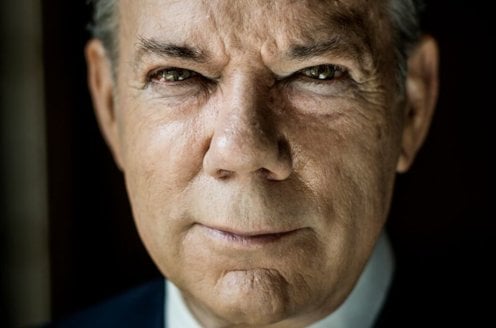
Juan Manuel Santos was awarded the Nobel Peace Prize for his resolute efforts to bring Colombia’s 50-year-long civil war to an end.
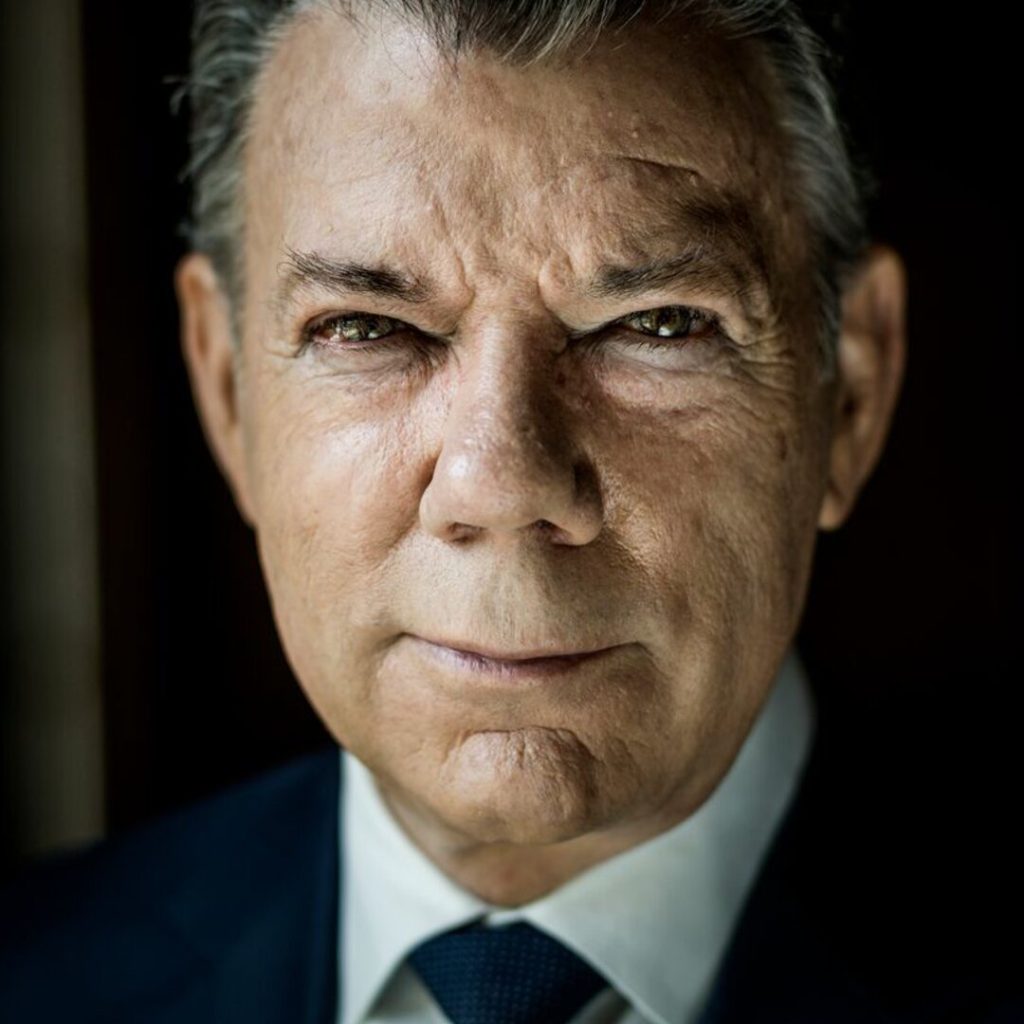
Full name: Juan Manuel Santos
Born: 10 August 1951, Bogotá, Colombia
Date awarded: 7 October 2016
President Juan Manuel Santos was awarded the 2016 Nobel Peace Prize for his efforts to bring Colombia’s civil war to an end. Lasting for over 50 years, the war has cost at least 220,000 lives and displaced almost 6 million people. The award is also a tribute to the Colombian people, who have never stopped hoping for peace. The civil war’s victims have participated actively in the peace process and testified to abuses on all sides. In August 2016 the government and FARC signed a controversial peace agreement, which was rejected by a narrow margin in a later referendum. But the Nobel Committee stated that the peace process was not dead, as “the referendum was not a vote for or against peace”. The award is intended to encourage the parties to continue the peace process.
“I accept it, not on my behalf, but on behalf of all Colombians, especially the millions of victims who have suffered for more than 50 years.”
– Juan Manuel Santos, 7 October 2016
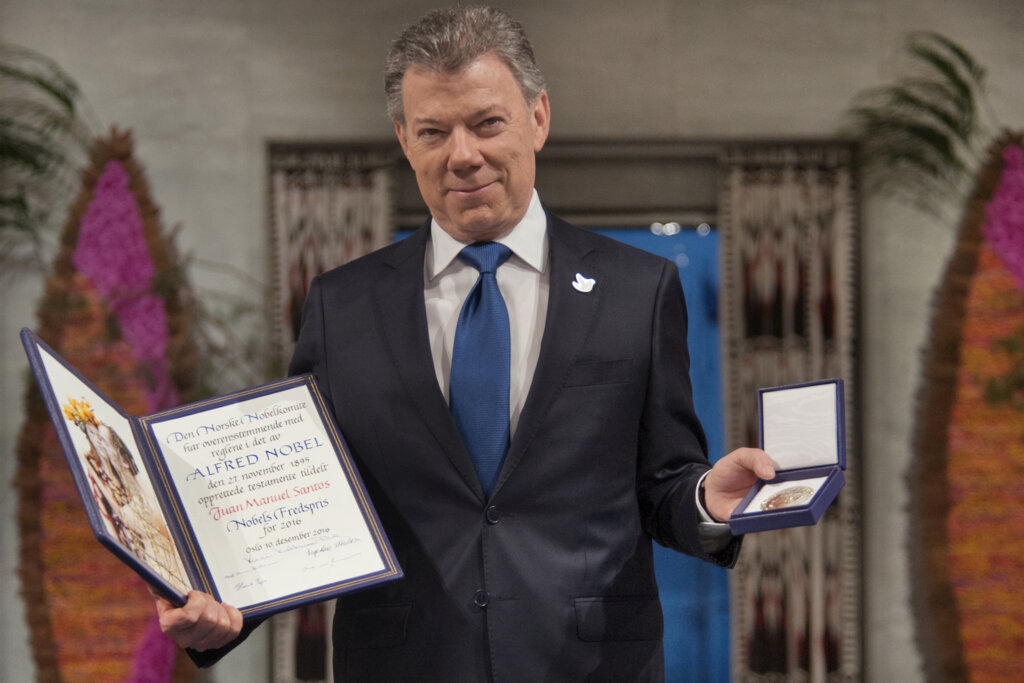
Juan Manuel Santos comes from an influential family in Bogota. After studying economics and public administration in the UK and USA, he started his career as head of Colombia’s largest newspaper. His first ministerial position came in 1991, and he served as defence minister before becoming president. Santos campaigned on a platform of security for Colombia’s citizens. After becoming president in 2010 he held secret meetings with the FARC guerrillas. These meetings turned into formal negotiations, which was highly controversial. But Santos has made it clear that he will continue working for peace until his last day in office.
Colombia’s history is marked by civil war and recurring conflicts between liberals and conservatives. A political assassination in 1948 sparked off the period called La Violencia (the violence) – an undeclared civil war. Several left-wing guerrilla groups were formed in the 1960s, the oldest and largest of them is FARC. Since the 1970s, Colombia has been a major exporter of cocaine to North America. Both guerrilla and so-called paramilitary groups have funded their operations through the production and sale of narcotics. The violence has diminished in recent years, and there have been several attempts at peace negotiations.
President Santos and FARC started official peace negotiations in August 2012. Four years later they signed a peace deal. For the first time, the victims played an important role in the negotiations, leading to agreement on land reform, victim compensation and punishment for the guilty. Nevertheless, the prospect of FARC participating in national politics and some abuses going unpunished was hard for many to accept. A referendum, held on 2 October 2016, rejected the peace deal by a narrow margin. Since then, Santos and FARC have upheld the ceasefire and called for a broader national dialogue to continue the peace process.
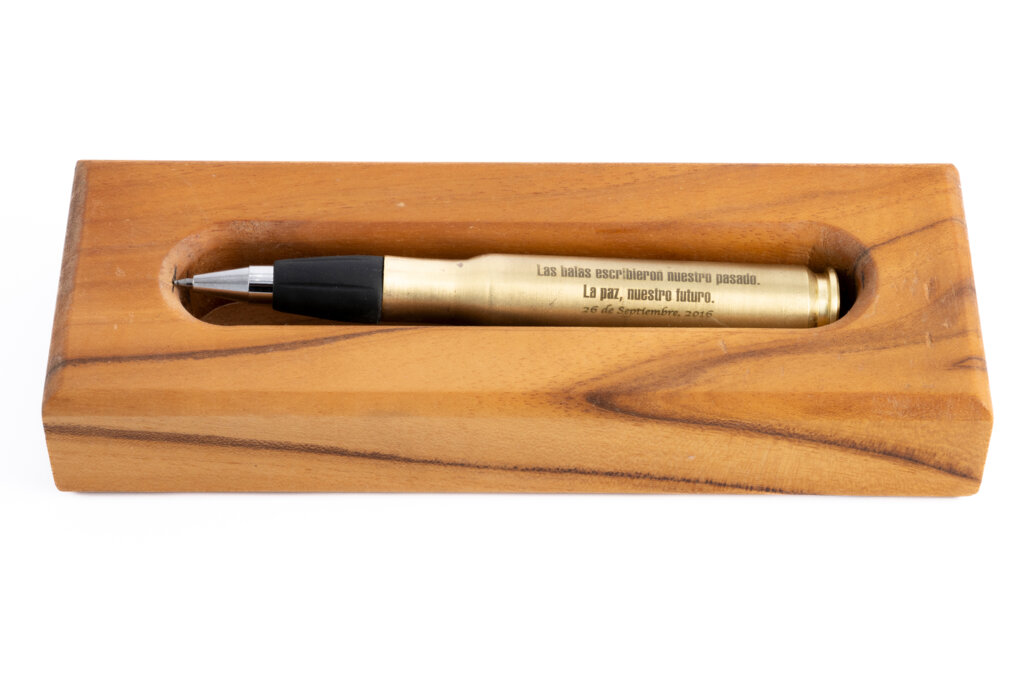
This peace prize meets two of the criteria in Alfred Nobel’s will: disarmament and fraternity. The negotiations in Colombia paved the way for the disarming of guerrilla forces and the reconciliation process. The decision to award the prize to Santos alone has been criticised, but the Nobel Committee emphasised that he took the initiative and bore much of the responsibility for the process. The Nobel Peace Prize has rewarded negotiators many times before. In 1936, Carlos Saavedra Lamas was awarded the prize for the peace agreement between Bolivia and Paraguay. Other negotiators include Oscar Arias Sánchez, Bishop Belo and José Ramos-Horta.
Pragmatist by nature, disciplined, cosmopolitan, committed to his country, Juan Manuel Santos has been an effective leader throughout his life …
Disclaimer: Every effort has been made by the publisher to credit organisations and individuals with regard to the supply of photographs. Please notify the publishers regarding corrections.
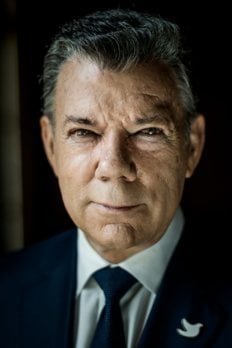
Pragmatist by nature, disciplined, cosmopolitan, committed to his country, Juan Manuel Santos has been an effective leader throughout his life. He was effective when it was time to wage war against illegal armed groups and he was even more effective in seeking and obtaining, against all odds, a peace agreement with Latin America’s oldest and largest insurgency, the FARC.
Santos belongs to one of Colombia’s most influential and traditional families. His great-great-grandfather’s siblings fiercely fought against Spanish troops in the early part of the 19th century and they were a determining factor in helping secure Colombian independence. His great-uncle, Eduardo Santos, was president of Colombia in the late 1930s. His grandfather was a renowned journalist, as were his father and his uncle, who for decades ran Colombia’s main newspaper El Tiempo, which belonged to their family.
He could probably have found his destiny in journalism, for obvious reasons, or perhaps in economics, which he studied at the University of Kansas and later at the London School of Economics and Harvard University. But Santos had a calling in his heart since a very early age, a bigger ambition: to make a mark in his country, to make a real difference and be able to transform realities. Perhaps for this reason he joined the Navy as a cadet at Colombia’s Naval Academy. Later on, after a decade of working as Colombian representative before the International Coffee Organisation in London, and after having completed a Nieman Fellowship at Harvard, and having worked as a columnist and deputy publisher at El Tiempo, where he won the prestigious King of Spain Award for Journalism, he decided to step aside and start his life in politics at the age of 40.
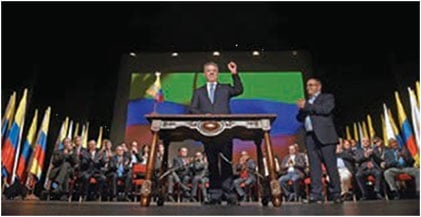
In the early 1990s, he was Colombia’s first minister of trade. He opened the economy and negotiated ambitious trade deals with several countries in Latin America and also began building ties to Asia. He was the last “designee” to the presidency, an office that was later replaced with the vice-presidency in Colombia’s constitution. He founded the Good Government Foundation which supported best practices in public governance and promoted the application of the Third Way, a political philosophy he learned from British sociologist Anthony Giddens and which states that “the market should go as far as possible, and the State as far as necessary.” This means achieving a balance between a liberal economy and government interventions to guarantee fundamental social issues such as equality, security and justice.
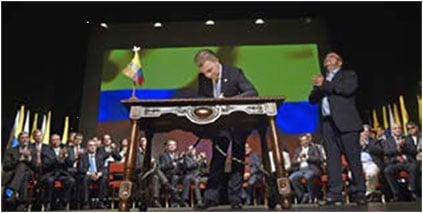
He was finance minister in the early 2000s and faced one of the country’s worst economic crises in the previous 70 years. While minister of defence between 2006 and 2009, he delivered the most severe blows in the history to the guerrillas, but always having peace as his ultimate objective. He achieved this through audacious strategic and tactical changes he made in the Armed Forces, and always guided by the respect of International Humanitarian Law.
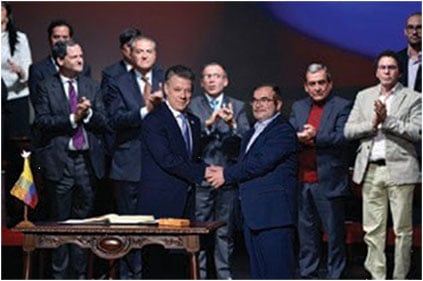
Santos assumed the presidency in 2010, and then was re-elected in 2014. From the beginning, he surprised most Colombians who had known him as a security hawk. In his inaugural address, he said one of his top priorities would be to seek peace through dialogue as long as he found a willing counterpart at the table. He did so and for six years he led tough, complex negotiations with the FARC that required chess skills and steely determination. The process, which was held in Havana, Cuba was finally completed successfully in late 2016, effectively putting and end to a 52-year internal armed conflict in Colombia.
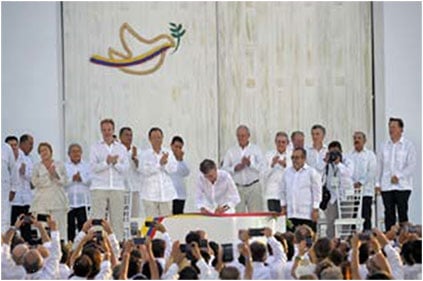
Juan Manuel Santos, who is considered a statesman internationally, has summed up his recent experience with a short yet powerful phrase: “It is far more difficult to make peace than it is to wage war, I know it because I have done both.” Fortunately for Colombia and for the world, he prevailed. He achieved what many Colombians had yearned for decades: persuade the guerrillas to trade their weapons for ballots, and violence for democracy, so that Colombia can advance without the burden of war toward the realisation of its maximum potential.
* This text is a slightly edited excerpt from Being Nobel – Nobel Peace Laureates and the Courageous Pursuit of Peace by Livia Malcangio, released by Editorial Planeta, Bogotá, in February 2017.
This autobiography/biography was written at the time of the award and later published in the book series Les Prix Nobel/ Nobel Lectures/The Nobel Prizes. The information is sometimes updated with an addendum submitted by the Laureate.
© THE NOBEL FOUNDATION, STOCKHOLM, 2016
General permission is granted for the publication in newspapers in any language. Publication in periodicals or books, or in digital or electronic forms, otherwise than in summary, requires the consent of the Foundation. On all publications in full or in major parts the above underlined copyright notice must be applied.
Presentation Speech by Kaci Kullmann Five, Chair of the Norwegian Nobel Committee, presented by Berit Reiss-Andersen, deputy chair of the Committee, Oslo, 10 December 2016.
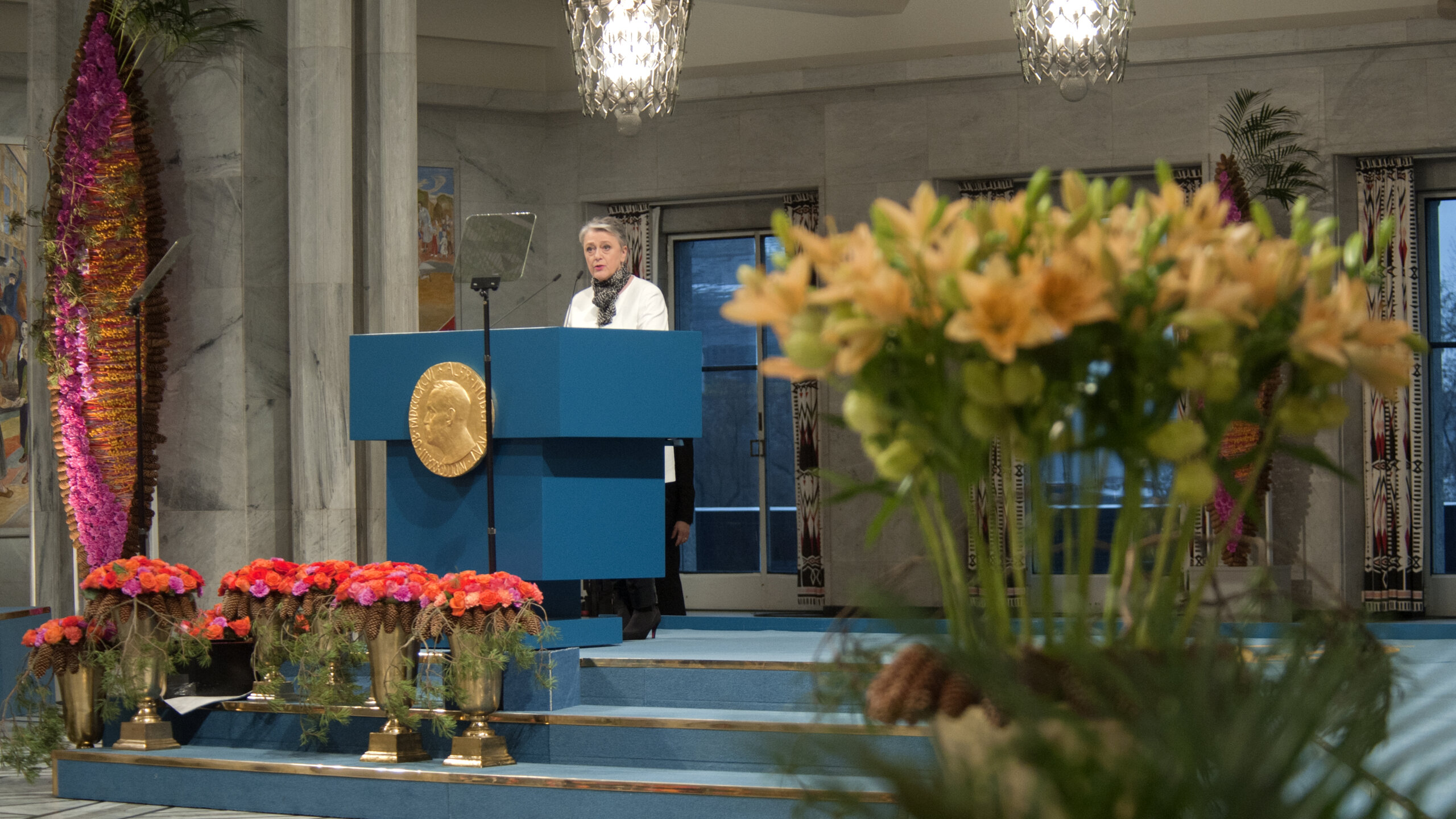
Berit Reiss-Andersen, deputy chair of the Norwegian Nobel Committee, delivering the presentation speech.
© The Nobel Foundation. Photo: Ken Opprann
Your Majesties, Your Royal Highnesses, Mr. President, Your Excellencies, Distinguished Guests, Ladies and Gentlemen,
The Norwegian Nobel Committee has decided to award the Nobel Peace Prize for 2016 to Colombia’s President Juan Manuel Santos for his resolute and courageous efforts to bring to an end the country’s more than 50-year-long civil war. The award has been made to President Santos alone. But it is also intended as a tribute to the Colombian people – a people who despite great hardships and countless injustices have never given up hope of a just peace. Many groups and individuals have contributed to the peace process and deserve our thanks and tribute today, including tireless negotiators, facilitators, diplomats, politicians and, of course, leaders from the government and the FARC guerrillas. Our tribute is paid, not least, to the representatives of the civil war’s victims, several of whom are present here today. They carry their own painful stories, yet manage to represent other victims as well. We salute all these strong, fearless individuals, and offer them our respectful gratitude.
The armed conflict between the Colombian authorities, the FARC and ELN revolutionary guerrilla groups and various paramilitary groups is the longest civil war in our time. The human and material cost of the conflict is almost inconceivable and very difficult to measure. Numbers give only a vague, albeit horrifying, impression of the extent of the suffering and the war’s impact on daily life for several generations of Colombians.
Since the first military confrontations in May 1964 and until the mutual ceasefire entered into force this summer, more than 222 000 Colombians have lost their lives as a direct consequence of the conflict. Four of every five persons killed were civilian non-combatants. In addition, somewhere between five and seven million Colombians were forced to flee their homes. Many have lived ever since as displaced persons in their own country.
In 2013, an investigative report was presented by the Colombian National Center for Historical Memory. The report shows that nearly 2 000 massacres of civilians have taken place in Colombia since the early 1980s. Allegedly, more than 1 000 of these mass killings were carried out by paramilitary groups who fought the rebels, almost 350 by FARC or ELN guerrillas, and close to 300 by Colombian security forces. The rebel guerrillas, for their part, were responsible for a majority of the many kidnappings that terrorised the Colombian people from 1995 to 2005. In that decade an average of one kidnapping took place every eight hours. The guerrillas used the kidnappings and the ever-expanding drug trade to finance their warfare. Colombia has long been the world’s biggest producer of cocaine. The social and health effects of drug trafficking is a tragedy in its own right, with consequences far beyond Colombia’s borders.
Now, at last, it looks as though this terrible conflict will soon be history.
Mr. President, you initiated the negotiations that culminated in the peace accord between the Colombian government and the FARC guerrillas earlier this autumn. This was an initiative that required considerable political courage and great perseverance. The initiative was grounded in a conviction that negotiations were the only path to creating a better future for your people. After a narrow majority of voters opposed the accord in the referendum held on 2 October, you made it clear that you would in no way give up, but would pursue your efforts to end the civil war with undiminished vigour. Like many others, you realised that the Colombian people had not voted “No” to peace, but to the accord submitted to them. In this critical situation, you issued an invitation to participate in a broad-based national dialogue with a view to reaching an agreement that could also win the support of its critics. The accord has now been renegotiated. While the second agreement has also been subject to criticism, several contentious points in the first accord have been amended and the groundwork has been laid for a historic national compromise. You have been a driving force throughout this peace process.
Mr. President, when the referendum results were announced, many observers felt that it would be premature to award you the Nobel Peace Prize this year. They recommended that the Norwegian Nobel Committee wait another year to see whether the peace process would eventually succeed in bringing about true peace. The Committee, however, saw things differently. In our view, there was no time to lose. On the contrary, the peace process was in danger of collapsing and needed all the international support it could get. Moreover, we were deeply convinced that you Mr. President, as Colombia’s head of state, were the one to continue to move the peace process forward. Developments in the weeks since the announcement of this year’s Peace Prize have in no way weakened our conviction in this respect.
In awarding the Nobel Peace Prize for 2016 to President Juan Manuel Santos the Norwegian Nobel Committee sought to encourage him and all those working to achieve peace, reconciliation and justice in Colombia not to give up. Political compromises seldom strike a perfect balance. Peace accords are especially hard to balance. Nonetheless, it is our sincere hope that the renegotiated accord that has now been signed by the parties and ratified by the Congress is a solution that can ensure the Colombian people peace and positive development.
Mr. President, after the referendum you emphasised that you would continue to work for peace until your very last day in office, “because that’s the way to leave a better country to our children”. Children under the age of 15 account for 23 per cent of Colombia’s population, or more than 11 million people. Kindling a spark of hope in the eyes of these 11 million children and their loved ones is the best possible investment towards a peaceful future for your people.
Ladies and gentlemen, the history of the Nobel Peace Prize shows that there are many roads to peace. By awarding this year’s Peace Prize to President Juan Manuel Santos, the Norwegian Nobel Committee wishes to honour him and all those who have helped stake out what can be called the Colombian road to peace.
This road has three distinctive features that can serve to inspire similar processes in other countries.
One is the will to face up to unpleasant, painful facts in order to lay the foundation for national reconciliation. For too long, victims’ memories of abuses, killings and other crimes were either a taboo — or a source of continuing conflict and enmity between the parties. The population’s growing desire for peace could never have been satisfied without breaking this vicious cycle. Two important steps in the right direction were taken with the establishment of Colombia’s National Center of Historical Memory and the publication in 2013 of the centre’s investigative report “Basta Ya!” – “Enough Already!” – which documented in detail the magnitude of the civil war’s atrocities.
When you, Mr President, was presented with the report, you stated that it represented “a first window towards the truth that we owe to the victims of this country”.
The second distinctive feature of the Colombian road to peace is the participation of the victims and their representatives. The negotiations between the government and the FARC were ground-breaking because they gave the victims’ representatives the opportunity to testify about their dreadful experiences in the presence of the parties concerned – and to confront perpetrators on all sides of the conflict. Inspired in part by South Africa’s peace and reconciliation process, the parties have recognised that a lasting peace arrangement must safeguard the rights and dignity of the victims while ensuring that the truth becomes known and that the perpetrators are held accountable and admit their guilt.
In this connection, I wish to commend FARC guerrilla leader Rodrigo Londoño for so clearly, and unreservedly, expressing regret for the suffering that the FARC has inflicted on the civilian population and asking the Colombian people for forgiveness. This is an example to be followed.
The third distinctive feature of this peace process is the fact that the parties have engaged critics of the process by inviting them to join in a broad-based national dialogue. This was particularly the case after the referendum, when President Santos reached out to those who had voted “No”. Simultaneously, the leader of the FARC gave assurance that the organisation would continue negotiating and “use only words as weapons to build towards the future”.
I venture to believe that this means the national reconciliation process is already well underway. There is still, however, a long way to go. After more than 50 years of bitter conflict, true reconciliation does not happen overnight. Overcoming deep-seated distrust and a sense of exclusion is a huge task. We therefore encourage all sides in Colombia to carry on the national dialogue and continue on the road to reconciliation.
Ladies and gentlemen, Alfred Nobel’s will refers to three different types of peace work that qualify for the Nobel Peace Prize: contributions to fraternity between nations, to the abolition or reduction of standing armies, or to the holding and promotion of peace congresses. All these forms of peace work are represented in this year’s Peace Prize.
The peace process has already helped to foster fraternity between different parts of the population in Colombia. The civil war has also been a source of tension between Colombia and other countries in the region. Ending the civil war once and for all could strengthen fraternity not only in Colombia but also across national borders in the Americas.
This year’s Peace Prize also pertains greatly to the abolition or reduction of standing armies – meaning disarmament and arms control. Around 7 000 FARC soldiers are to be disarmed. The surrender and destruction of the weapons will be overseen by the United Nations. Hopefully, a similar negotiated disarmament agreement with the ELN guerrilla will soon be in place as well. Even though the obtained disarmament so far applies primarily to the FARC guerrillas, it is the Committee’s hope that the peace accord will also enable the government to reduce its military expenditure and thereby release funds that can be spent on building peace and welfare in Colombia.
And lastly, the long and intense talks that the Colombian government has held with the FARC guerrillas and the victims’ representatives, assisted by international facilitators such as Cuba and Norway, have in many ways served as a continual national peace congress.
The award of the Peace Prize to President Santos thus absolutely fulfils the criteria and the spirit of Alfred Nobel’s will.
The more than 50-year armed conflict in Colombia is complex, and the country faces a magnitude of problems that must be solved. This will take time, making it even more important to get to work quickly. Only when peace has been restored will it be possible to give priority to education and other important services to assure positive, sustainable development. It is the Norwegian Nobel Committee’s hope that, in the years to come, the Colombian people will be able to reap the benefits of the ongoing peace and reconciliation process so that the country can effectively address major challenges such as poverty, social injustice and drug-related crime.
Mr. President, by awarding you this year’s Peace Prize, the Norwegian Nobel Committee wished to commend you on the results already achieved in the peace process. But it also sought to strengthen you and those around you in the difficult situation that arose after the referendum. It is with relief and satisfaction that we now note that your stated ambition of travelling to Oslo with a new peace accord in hand has been fulfilled. Perhaps the Nobel Peace Prize has contributed positively by giving you and the peace process a little push forward in these critical weeks. It is the Committee’s hope that it will also serve as an inspiration to all Colombians, as they now begin implementing the accord and building a just and lasting peace.
Ladies and gentlemen, seeking forgiveness for atrocities and suffering on the scale we have seen in Colombia is asking a great deal. No one can demand that a victim forgive his or her assailant. But by opening up memories, by having victims and perpetrators alike tell their stories, a foundation is also laid for reconciliation. This is what philosophers have called “the work of memory”. It is a painful process, yet at the same time it is a process that makes it possible to leave the pain behind and join forces in building a better future. This year’s Peace Prize diploma, which is reproduced in the programme in front of you, addresses this very issue: “The motif may look like a kiss,” the artist Willibald Storn has said, “but for me this picture is about forgiveness.”
In closing, I would like to quote another Nobel Peace Prize laureate, Archbishop Desmond Tutu, whose words bear direct relevance to the current situation in Colombia: “Forgiving and being reconciled to our enemies or our loved ones are not about pretending that things are other than they are. … True reconciliation exposes the awfulness, the abuse, the hurt, the truth. … It is a risky undertaking but in the end it is worthwhile, because in the end only an honest confrontation with reality can bring real healing.”
Nobel Lecture by Juan Manuel Santos, Oslo, 10 December 2016.
Your Majesties; Your Royal Highnesses; distinguished members of the Norwegian Nobel Committee; dear fellow citizens of Colombia; citizens of the world; ladies and gentlemen,
Six years ago, it was hard for we Colombians to imagine an end to a war that had lasted half a century. To the great majority of us, peace seemed an impossible dream – and for good reason. Very few of us – hardly anybody – could recall a memory of a country at peace.
Today, after six years of serious and often intense, difficult negotiations, I stand before you and the world and announce with deep humility and gratitude that the Colombian people, with assistance from our friends around the world, are turning the impossible into the possible.
A war that has brought so much suffering and despair to communities all across our beautiful land has finally come to an end.
Like life itself, peace is a process with many surprises. Just two months ago, people in Colombia and indeed in the whole world, were shocked to learn that, in a plebiscite called to ratify the peace agreement with the FARC guerrillas, there were slightly more “No” votes than “Yes” votes.
This outcome was completely unexpected.
A flame of hope had been lit in Cartagena a week earlier, when we signed the agreement in the presence of world leaders, and now that flame appeared to be suddenly snuffed out.
Many of us in Colombia recalled a passage from One Hundred Years of Solitude, the great masterpiece of our Nobel Prize laureate Gabriel García Márquez, which seemed to illustrate the moment we were living:
“It was as if God had decided to put to the test every capacity for surprise and was keeping the inhabitants of Macondo in a permanent alteration between excitement and disappointment, doubt and revelation, to such an extreme that no one knew for certain where the limits of reality lay.”
We felt that we ourselves were inhabitants of Macondo, a place that was not only magical but also contradictory.
As Head of State, I sought to understand the significance of this unexpected setback and called at once for a broad national dialogue to seek unity and reconciliation.
I was determined to turn this setback into a chance to develop the widest possible consensus for reaching a new agreement.
I devoted myself to listening to the concerns and recommendations of those who had voted “No”, of those who had voted “Yes”, and of the majority who did not vote at all – with the aim of achieving a new and improved agreement, an agreement that all of Colombia could stand behind.
Not even four days had passed after the surprising plebiscite when the Norwegian Committee announced an equally surprising award of the Nobel Peace Prize.
I must confess to you that this news came as if it were a gift from heaven. At a time when our ship felt adrift, the Nobel Prize was the tailwind that helped us to reach our destination: the port of peace!
Thank you; thank you very much for this vote of confidence and faith in the future of my country.
Today, distinguished members of the Norwegian Nobel Committee, I come to tell you – and, through you, the international community – that we achieved our goal. We reached our port.
Today, we have a new agreement for ending the armed conflict with the FARC, which incorporates the majority of the proposals we received.
This new agreement was signed two weeks ago, and it was endorsed last week by our Congress, by an overwhelming majority, so that it can be incorporated into our laws. The long-awaited process of implementation has begun, with the invaluable support of the United Nations.
With this new agreement, the oldest and last armed conflict in the Western Hemisphere has ended.
This agreement – as set forth by Alfred Nobel in his will – marks the beginning of the dismantling of an army – this time, an irregular army – and its conversion into a legal political movement.
With this agreement, we can say that the American continent – from Alaska to Patagonia – is a land in peace.
And we can now ask the bold question: if war can come to an end in one hemisphere, why not one day in both hemispheres? Perhaps more than ever before, we can now dare to imagine a world without war.
The impossible is becoming possible.
*****
Alfred Nobel, the great visionary whose legacy gathers us here today on the 120th anniversary of his death, once wrote that war is “the horror of horrors, the greatest of all crimes.”
War must never be considered, under any circumstance, an end in itself. It is merely a means, but a means that we must always strive to avert.
I have served as a leader in times of war – to defend the freedom and the rights of the Colombian people – and I have served as a leader in times of making peace.
Allow me to tell you, from my own experience, that it is much harder to make peace than to wage war.
When it is absolutely necessary, we must be prepared to fight, and it was my duty – as Defence Minister and as President – to fight illegal armed groups in my country.
When the roads to peace were closed, I fought these groups with effectiveness and determination
But it is foolish to believe that the end of any conflict must be the elimination of the enemy.
A final victory through force, when nonviolent alternatives exist, is none other than the defeat of the human spirit.
Seeking victory through force alone, pursuing the utter destruction of the enemy, waging war to the last breath, means failing to recognize your opponent as a human being like yourself, someone with whom you can hold a dialogue with.
Dialogue…based on respect for the dignity of all. That was our recourse in Colombia. And that is why I have the honour to be here today, sharing what we have learned through our hard-won experience.
Our first and most vital step was to cease thinking of the guerrillas as our bitter enemies, and to see them instead simply as adversaries.
General Álvaro Valencia Tovar – a former Commander of the Colombian Army, a historian and humanist – taught me this distinction.
He said that the word “enemy” gives a sense of a passionate struggle and a connotation of hate, unfit for military honour.
Humanizing war does not just mean limiting its cruelty but also recognizing your opponent as an equal, as a human being.
Historians estimate that up to 187 million people died during the 20th century alone because of war. 187 million! Each one of them a precious human life, loved by their families and dear ones. Tragically, the death toll keeps climbing in this new century.
It is time to remember the haunting question sung by my fellow Nobel laureate Bob Dylan that touched so many youthful hearts in the Sixties, including mine:
“How many deaths will it take ’till he knows that too many people have died? The answer, my friend, is blowin’ in the wind”.
*****
When people asked me whether I aspired to win the Nobel Peace Prize, I always answered that, for me, the actual prize was peace in Colombia. Because that is the real prize: peace for my country!
And that peace does not belong to a president or a government, but to all the Colombian people, because we must build it together.
That is why I receive this prize on behalf of nearly 50 million Colombians – my fellow countrymen and women – who finally see the end of more than a half-century nightmare that has only brought pain, misery and backwardness to our country.
And I receive this prize – above all – on behalf of the victims, the more than 8 million victims and displaced people whose lives have been devastated by the armed conflict, and the more than 220,000 women, men and children who, to our shame, have been killed in this war.
I am told by scholars that the Colombian peace process is the first in the world that has placed the victims and their rights at the center of the solution.
This negotiation has been conducted with a heavy emphasis on human rights. And that is something that makes us feel truly proud.
Victims want justice, but most of all they want to know the truth, and they – in a spirit of generosity – desire that no new victims should suffer as they did.
Professor Ronald Heifetz, founder of the Center for Public Leadership at the Kennedy School of Government at Harvard University, from which I graduated, once gave me a wise piece of advice:
“Whenever you feel discouraged, tired, pessimistic, talk with the victims. They will give you the push and strength to keep you going.”
And it has been just this way. Whenever I had the chance, I listened to the victims of this war and heard their heartbreaking stories. Some of them are here with us today, reminding us why it is so important to build a stable and lasting peace.
Leyner Palacios is one of them. On May 2, 2002, a homemade mortar launched by the FARC, in the middle of a combat with the paramilitaries, landed on the church in his town, Bojayá, where its inhabitants had sought refuge.
Nearly eighty women, men and children – most of the victims were children! – died. In a matter of seconds, Leyner lost 32 relatives, including his parents and three younger brothers.
The FARC has asked for forgiveness for this atrocity, and Leyner, who is now a community leader, has forgiven them.
That is the great paradox I have found: while many who have not suffered the conflict in their own flesh are reluctant to accept peace, the victims are the ones who are most willing to forgive, to reconcile, and to face the future with a heart free of hate.
This peace prize belongs as well to those men and women who, with enormous patience and endurance, negotiated during all these years in Havana. They have reached an agreement that can be offered today as a model for the resolution of armed conflicts that have yet to be resolved around the world.
And here I am referring not only to the Government negotiators but also to the FARC negotiators – my adversaries –, who have demonstrated a great will for peace. I want to praise their willingness to embrace peace, to reach peace, because without it, the process would have failed.
In the same spirit, I dedicate this prize to the heroes of the Colombian Armed Forces, who have never ceased to protect the Colombian people, and who truly understood that the actual victory of any soldier or any police officer is peace itself.
And I wish to include a special acknowledgment – with all the gratitude in my heart – for my family: for my wife and my children, whose support and love throughout this task helped lessen the burden.
Finally, I also share this prize with the international community who, with generosity and unanimous enthusiasm, backed this peace process from the very beginning.
Let me also take this opportunity to convey my very special thanks to the people of Norway for your peaceful character and your extraordinary spirit of solidarity. It was because of these virtues that you were entrusted by Alfred Nobel to promote peace in the world. I must say you have done your job with great effectiveness for my country.
Norway and Cuba, in their role as guarantors; Chile and Venezuela, as witnesses; the United States and the European Union, with their special envoys; all the countries in Latin America and the Caribbean; even China and Russia… they all have reasons to take pride in this achievement.
The Kroc Institute for International Peace Studies at the University of Notre Dame in the United States has concluded, based on careful studies of the 34 agreements signed in the world to end armed conflicts in the past three decades, that this peace agreement in Colombia is the most complete and comprehensive ever reached.
As such, the Colombian peace agreement is a ray of hope in a world troubled by so many conflicts and so much intolerance.
It proves that what, at first, seems impossible, through perseverance may become possible even in Syria or Yemen or South Sudan.
The key, in the words of the English poet Tennyson, is “to strive, to seek, to find, and not to yield.”
*****
A few lessons can be learned from Colombia’s peace process and I would like to share them with the world:
You must properly prepare yourself and seek advice, studying the failures of peace attempts in your own country and learning from other peace processes, their successes and their problems.
The agenda for the negotiation should be focussed and specific, aimed at solving the issues directly related to the armed conflict, rather than attempting to address all the problems faced by the nation.
Negotiations should be carried out with discretion and confidentiality in order to prevent them from turning into a media circus.
Sometimes it is necessary to both fight and talk at the same time if you want to arrive at peace – a lesson I took from another Nobel laureate, Yitzhak Rabin.
You must also be willing to make difficult, bold and oftentimes unpopular decisions in order to reach your final goal.
In my case, this meant reaching out to the governments of neighbouring countries with whom I had and continue to have deep ideological differences.
Regional support is indispensable in the political resolution of any asymmetric war. Fortunately, today all the countries in the region are allies in the search for peace, the noblest purpose any society can have.
We also achieved a very important objective: agreement on a model of transitional justice that enables us to secure a maximum of justice without sacrificing peace.
I have no doubt this model will be one of the greatest legacies of the Colombian peace process.
*****
Ladies and gentlemen: there is one less war in the world, and it is the war in Colombia!
This is, precisely, what we are celebrating today in Oslo, the same city that hosted the launch of the public phase of the negotiations with the FARC in October 2012.
And I must say that I feel honoured and humbled to join the line of the brave and inspiring men and women who, ever since 1901, have received this most prestigious of prizes.
The peace process in Colombia – I say this with deep gratitude – is a fortunate synthesis of all what we have learned from them.
Peace efforts in the Middle East, in Central America, in South Africa, in Northern Ireland, whose architects have all received this award, showed us the way to move forward in a process specially designed for Colombia.
We also took up the legacy of Nobel laureates Jody Williams and the International Campaign to Ban Landmines.
After Afghanistan, Colombia holds the shameful record of having the most mines and the most victims of mines in the world. We are resolutely committed to have our territory free of mines by 2021.
We have received the support of other Nobel laureates such as the European Union and President Barack Obama, who have also committed their countries to support the critical process of the implementation phase in Colombia.
*****
And I feel that I must take this opportunity to reiterate the call I have been making to the world since the Summit of the Americas in Cartagena in 2012, which led to a special session of the General Assembly of the United Nations in April this year.
I am referring to the urgent need to rethink the world War on Drugs, a war where Colombia has been the country that has paid the highest cost in deaths and sacrifices.
We have moral authority to state that, after decades of fighting against drug trafficking, the world has still been unable to control this scourge that fuels violence and corruption throughout our global community.
The peace agreement with the FARC includes their commitment to cut all ties with the drug business, and to actively contribute to fighting it.
But drug trafficking is a global problem that demands a global solution resulting from an undeniable reality: The War on Drugs has not been won, and is not being won.
It makes no sense to imprison a peasant who grows marijuana, when nowadays, for example, its cultivation and use are legal in eight states of the United States.
The manner in which this war against drugs is being waged is equally or perhaps even more harmful than all the wars the world is fighting today, combined. It is time to change our strategy.
*****
In Colombia, we have also been inspired by the initiatives of Malala, the youngest Nobel Laureate, because we know that only by developing minds, through education, can we transform reality.
We are the result of our thoughts; the thoughts that create our words; the words that shape our actions.
That is why we must change from within. We must replace the culture of violence with a culture of peace and coexistence; we must change the culture of exclusion into a culture of inclusion and tolerance.
And in that vein of coexistence, we have also learned from former U.S. Vice President Al Gore and the Intergovernmental Panel on Climate Change and their determination to preserve the planet.
It is quite comforting to be able to say that the end of the conflict in Colombia, the most biodiverse country per square kilometre in the world, will yield high environmental dividends.
By replacing illicit crops with legal ones, deforestation spurred by coca leaf growing will certainly diminish. And millions of barrels of oil will no longer be spilled in our rivers and seas because of attacks against our oil infrastructure.
We can say, in summary, that the Colombian peace process that you are recognising today in Oslo is the synthesis and result of many positive efforts made throughout history and all over the world, efforts that have been valued and distinguished by this Nobel Committee.
Dear friends,
In a world where citizens are making the most crucial decisions – for themselves and for their nations – out of fear and despair, we must make the certainty of hope possible.
In a world where wars and conflicts are fuelled by hatred and prejudice, we must find the path of forgiveness and reconciliation.
In a world where borders are increasingly closed to immigrants, where minorities are attacked and people deemed different are excluded, we must be able to coexist with diversity and appreciate the way it can enrich our societies.
We are human beings after all. For those of us who are believers, we are all God’s children. We are part of this magnificent adventure of being alive and populating this planet.
At our core, there are no inherent differences: not the colour of our skin; nor our religious beliefs; nor our political ideologies, nor our sexual preferences. All these are simply facets of humanity’s diversity.
Let’s awaken the creative capacity for goodness, for building peace, that live within each soul.
In the end, we are one people and one race; of every colour, of every belief, of every preference.
The name of this one people is the world. The name of this one race is humanity.
If we truly understand this, if we make it part of our individual and collective awareness, then we will cut the very root of conflicts and wars.
In 1982 – 34 years ago – the efforts to find peace through dialogue began in Colombia.
That same year, in Stockholm, Gabriel García Márquez, who was my ally in the pursuit of peace, received the Nobel Prize in Literature, and spoke about “a new and sweeping utopia of life, (…) where the races condemned to one hundred years of solitude will have, at last and forever, a second opportunity on earth.”
Today, Colombia – my beloved country – is living that second opportunity; and I thank you, members of the Norwegian Nobel Committee, because, on this occasion, you have not only awarded a prize to peace: you helped make it possible!
The sun of peace finally shines in the heavens of Colombia.
May its light shine upon the whole world!
Copyright © The Nobel Foundation 2016
Listen to the call when Olav Njølstad, Secretary of the Norwegian Nobel Committee, delivers the news to Colombian President Juan Manuel Santos that he has been awarded the 2016 Nobel Peace Prize.
Telephone interview with Juan Manuel Santos following the announcement of the 2016 Nobel Peace Prize. The interviewer is Adam Smith, Chief Scientific Officer of Nobel Media.
Juan Manuel Santos: Hello.
Adam Smith: Good morning President Santos. My name is Adam Smith representing Nobelprize.org, the official website of the Nobel Prize in Stockholm. On behalf of all here we would like to congratulate you on the award of the Nobel Peace Prize.
JMS: Thank you so much, thank you so much. I receive this with great emotion, and this is something that will forever be important for my country and for the people who have suffered with the war. This is a great, great recognition for my country and with all humbleness I receive it. I am terribly grateful.
AS: Thank you. The Nobel Committee have been explicit in their official statement in stating that the award is meant also to pay tribute to the Colombian people. I imagine that is something you would echo.
JMS: Of course, of course. The Colombian people and especially the victims, is something for us very important and I receive this award in their name; the Colombian people who have suffered so much with this war, 52 years of war. And especially the victims, the millions of victims that have suffered with the war that we are on the verge of ending.
AS: And what message do you hope the award will send?
JMS: The message is we have to persevere until we reach the end, we reach the end of this war. We are very, very close. We just need to push a bit further, to persevere, and this is going to be a great stimulus to reach that end, and to start the construction of peace in Colombia. This is something that all the Colombian people will receive with emotion and specially the victims will be very happy because I think it’s in their name that this award is given.
AS: Given all the obstacles on the road to peace, may I just ask what keeps you going in your personal determination to achieve a peaceful end.
JMS: Well, it’s simply a matter of believing in a cause and there is no better cause for any society, for any country, than living in Peace. Something that unfortunately Colombians have not been able to have for three generations. I think this is the moment, the conditions are right and we just simply have to persevere. And this has been my strength, what has given me the stimulus to persevere, the good causes. This is the best cause that any person can try to achieve, peace for his country.
AS: Thank you. And lastly, news of your Nobel Prize will be broadcast around the world today. Is there anything that you’d like to ask people to do to help you in your quest for a peaceful end to Colombia’s civil war?
JMS: Thank you. Simply to say that we are very, very close to achieving peace. I think the other group that we are fighting today, we’re very close also to having peace with this other group. The two groups that we are negotiating with will receive this as a stimulus from the whole world that we have to reach an agreement very soon. We reached an agreement with the first group, the second group we’re very close. Simply that we have to continue until we reach the end.
AS: And people around the world who are also hoping for this peaceful end, can they do anything to help you?
JMS: Well, the international community has been so supportive. To continue the support and to continue to say that the whole world expects the Colombian people to reach, and especially the parties involved, to reach an agreement very soon. We are now … Also there are some people who have not been supporting the government in this peace process. We are talking to them, as a matter of fact we started talks with them just a couple of days ago and I hope that they understand how important to also contribute to support this process because the peace would be much stronger and much more durable if it is supported by every single Colombian.
AS: Thank you very much indeed. Thank you for sharing your thoughts with us and taking the time to speak with us, and once again may we offer our congratulations to you all and to the Colombian people.
JMS: Thank you. Thank you from the bottom of my heart and in the name of all the Colombians, especially the victims. Thank you very, very much.
Did you find any typos in this text? We would appreciate your assistance in identifying any errors and to let us know. Thank you for taking the time to report the errors by sending us an e-mail.
President Juan Manuel Santos’ page at the Colombian Government
Watch Colombian President Juan Manuel Santos receiving the Nobel Prize medal and diploma during the Nobel Peace Prize Award Ceremony at the Oslo City Hall in Norway, 10 December 2016.
Watch the Nobel Peace Prize Award Ceremony at the Oslo City Hall in Norway, 10 December 2016.
Presentation Speech by Kaci Kullmann Five, Chair of the Norwegian Nobel Committee
Nobel Lecture by Juan Manuel Santos