Hendrik A. Lorentz – Photo gallery
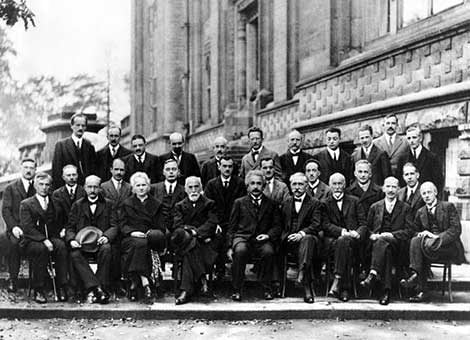
The fifth Solvay International Conference on Electrons and Photons, was held in October 1927. Prominent physicists from all the world met to discuss the newly formulated quantum theory. 17 of the 29 participants were or became Nobel Laureates. Back row, left to right: Auguste Piccard, Émile Henriot, Paul Ehrenfest, Édouard Herzen, Théophile de Donder, Erwin Schrödinger, Jules-Émile Verschaffelt, Wolfgang Pauli, Werner Heisenberg, Ralph Howard Fowler, Léon Brillouin. Middle row, left to right: Peter Debye, Martin Knudsen, William Lawrence Bragg, Hendrik Anthony Kramers, Paul Dirac, Arthur Compton, Louis de Broglie, Max Born, Niels Bohr. Front row, left to right: Irving Langmuir, Max Planck, Marie Skłodowska Curie, Hendrik Lorentz, Albert Einstein, Paul Langevin, Charles-Eugène Guye, Charles Thomson Rees Wilson, Owen Willans Richardson.
Photo: Benjamin Couprie, Institut International de Physique Solvay, Brussels, Belgium. Public domain via Wikimedia Commons

Albert Einstein (left) and Hendrik A. Lorentz (right), outside the home of Paul Ehrenfest, Leiden, 1921.
Source: Museum Boerhaave, Leiden Public domain via Wikimedia Commons
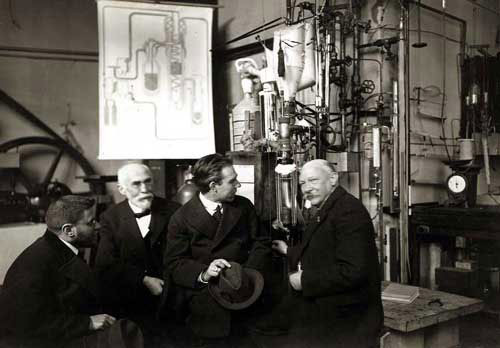
The Cryogenics Laboratory in Leiden, 1919. From left: Paul Ehrenfest, Hendrik Lorentz, 1922 Nobel Laureate in Physics Niels Bohr and 1913 Nobel Laureate in Physics Heike Kamerlingh Onnes.
Photographer unknown Public domain via Wikimedia Commons
Pieter Zeeman – Nominations
Hendrik A. Lorentz – Nominations
Hendrik A. Lorentz – Banquet speech
Hendrik A. Lorentz’ speech at the Nobel Banquet in Stockholm, December 10, 1902 (in German)
Königliche Hoheiten,
Meine Herren!
Gestatten Sie mir, für die hohe mir heute erwiesene Ehre meinen wärmsten und herzlichsten Dank auszusprechen, und Ihnen zu sagen, dass ich auf die mir zum Teil gewordene Anerkennung den grössten Wert lege, weil sie mir von Ihrer Akademie der Wissenschaften verliehen wurde, die unter ihre Mitglieder so viele hervorragende Vertreter der physikalischen und mathematischen Wissenschaften zählt. Die Bedeutung derselben wird für mich noch in ganz besonderer Weise dadurch erhöht, dass es mir vergönnt war, dieselbe aus den Händen Seiner Majestät des Königs zu empfangen, eines Fürsten, der in hoher und edler Gesinnung allen Zweigen menschlichen Wissens ein warmes Interesse entgegenträgt, und dessen Name überall, wo Wissenschaft gepflegt und geliebt wird, mit Ehrfurcht und Bewunderung genannt wird. Dass mein Freund Prof. Zeeman das gleiche Vorrecht nicht gemessen kann, ist das einzige, was für mich diesen schönen Tag verschleiert. Wäre er auch hier, so würde meine Freude eine vollkommene sein; nur würde sich bei mir noch immer das Gefühl des Zweifels, ob ich denn den Nobelpreis auch wirklich verdient habe, hineinmischen. Zum Glück weiss ich, dass ich denselben nicht nur als Belohnung, sondern auch, und zwar in erster Linie, als Ermutigung auffassen darf. Wir kennen alle die Stunden und Tage, wo wir vergebens mit unlösbaren Rätseln ringen, wo uns das, was wir haben erreichen können, so klein und das Unerreichbare so unendlich gross erscheint. In solchen dunklen Zeiten werde ich mich an dem Lichtstrahl, der heute auf meinen Weg geworfen wurde, erquicken.
Von ganzem Herzen danke ich Prof. Hasselberg für die freundlichen Worte, die er zu mir gesprochen hat, ihm und vielen anderen Herren für die Liebenswürdigkeit, mit der sie mir während der kurzen Zeit meines Aufenthaltes in Stockholm entgegengekommen sind. Dass die Wissenschaft an und für sich kein Vaterland kennt, dass alle ihre Diener, welcher Nation sie auch angehören mögen, ihr gleich lieb sind, das tritt bei einem Feste wie dem heutigen vor aller Welt zu Tage. Für den einzelnen Forscher jedoch bleibt die Heimat immer wie das elterliche Haus, dem er seine Bildung zu verdanken hat und in dem seine Kräfte sich haben entwicklen können, und wenn er dieselbe verlassen hat, so ist es ihm wohltuend, sich unter nahen Verwandten zu befinden. Jetzt, da die herzliche Aufnahme, die ich hier gefunden habe, dieses Gefühl in mir erregt hat, kann ich nicht unterlassen, der vielen Beziehungen zu gedenken, die in verflossenen Zeiten zwischen Schweden und Holland bestanden haben. Viel brauche ich davon nicht zu reden, da sie auch hier wohlbekannt sind; Prof. Wrangel in Lund hat ein Buch darüber geschrieben, das von einer Leidener Dame ins Holländische übersetzt worden ist. Ich will nur sagen, dass wir, wenn wir auf der Strasse zwischen Leiden und Haarlem fahren, uns den Landsitz “Hartekamp” zeigen, wo Ihr grosser Naturforscher Linné seinen berühmten “Hortus Cliffortianus” bearbeitete, und dass wir in Leiden noch immer stolz darauf sind, dass in alter Zeit so viele hervorragende Schweden unsere Universität besucht und ihre Blüte erhöht haben.
Das alles hat sich jetzt geändert, und Ihre Landsleute brauchen nicht mehr in Holland zu suchen, was sie in dem eigenen Lande in vollem Masse finden können. Was aber geblieben ist, das ist die Freude, die wir in Holland an der schönen Entwicklung der schwedischen Wissenschaft haben. Ich erlaube mir, für die Zukunft derselben, für das wissenschaftliche Wirken und Schaffen der Schweden die herzlichsten Wünsche auszusprechen.
The Nobel Foundation's copyright has expired.Pieter Zeeman – Photo gallery
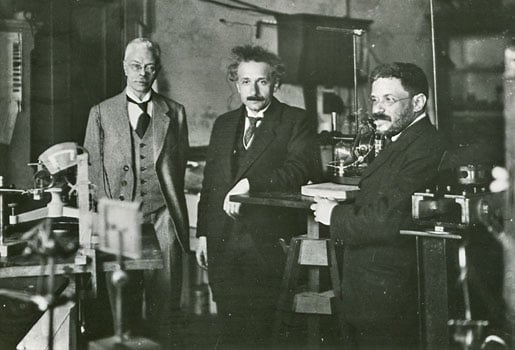
Albert Einstein visiting Pieter Zeeman (left) in Amsterdam, with his friend Paul Ehrenfest (right), ca 1920.
Public domain via Wikimedia Commons Photographer unknown
Pieter Zeeman – Nobel Lecture
Nobel Lecture, May 2, 1903
Light Radiation in a Magnetic Field
As Professor Lorentz told you last December, immediately after hearing of the great and very honourable distinction awarded to us, we set to work to see how best to co-ordinate our two lectures. To my great regret I was unable to be present here for Professor Lorentz’s lecture, but he was able to report to you on present electron theory from his viewpoint, only briefly touching on the experimental investigations which have occupied me in recent years. I hope that you will allow me therefore to emphasize these experimental investigations. Two fields of physics, light and magnetism, are combined in the subject of today’s lecture, whose history dates only from the days of Michael Faraday. The wonderful discovery of the connection between light and magnetism, which he made in 1845, was the reward for an investigation carried out with indefatigable patience and tenacity. Today we call this connection the magnetic rotation of the polarization plane. Faraday succeeded in showing that the plane in which light oscillations take place, is rotated as soon as light passes through special magnetizable bodies along the lines of force. Faraday himself called his discovery the magnetization of light and the illumination of magnetic lines of force. His contempories did not understand this name, which perhaps corresponded more to what he was searching for than to what he found. Throughout his life his hopes, desires and yearnings led him to make repeated investigations into the connection between light, magnetism, and electricity.
The last experiment recorded in Faraday’s laboratory notebook and ostensibly the last in his life, gives an indication of the extent to which his spirit was still occupied with the boundary region of possible phenomena.
It was on March 12, 1862, in the laboratory of the Royal Institution that Faraday carried out this experiment. The notes in his notebook, although not quite clear, leave no doubt that he was attempting to demonstrate by means of a spectroscope that magnetism has a direct effect on a light source. The result was however absolutely negative, and Faraday writes in his notebook “not the slightest effect demonstrable either with polarized or unpolarized light”.
Perhaps it was because of this observation that Maxwell, at a meeting of the British Association in Liverpool on September 15, 1870, said of the light-radiating particles in a flame “that no force in nature can alter even very slightly either their mass or their period of oscillation”, a statement which, coming from the mouth of the founder of the electromagnetic light theory and spoken with such intensity, must really surprise present-day physicists.
It was not simply out of a spirit of contradiction that I exposed a light source to magnetic forces. The idea came to me during an investigation of the effect discovered by Kerr on light reflected by magnetic mirrors.
When it is a question of splitting up the light of a luminous gas into very fine detail, the simple glass prism of Newton and Frauenhofer is of no use, and the physicist has recourse to the excellent aid which we owe to Rowland: the concave grating. Most physics institutes possess this polished metal mirror with a very large number of grooves, say 50,000 over a width of 10 cm scratched on by means of a diamond. A beam of compound light is no longer reflected by the lined surface in the ordinary way; instead each special kind of light follows its own path.
Of course the light source must be very restricted for the large number of beams corresponding to the various kinds of light to appear separately. This is ensured by placing the light source behind an opaque screen with a linear slit. The spectral image produced can be observed, and from the location and intensity of the linear-slit images we can determine how the different kinds of light in the light being studied are distributed on the basis of the period of oscillation and intensity. A further main advantage of Rowland’s grating is that it is now no longer scratched on plane surfaces, but on spherical concave surfaces with a radius of say 3 metres, so that real images are produced of luminous lines without the need for the insertion of lenses. Moreover, photography has made it possible to fix these images and now provides us with a permanent record of each observed spectrum, which can be measured out at any time.
When we study the well-known Bunsen sodium flame by means of Rowland’s grating, we see a spectrum consisting mainly of two separate sharp yellow lines, which in our grating lie about I mm from each other. We see that sodium radiation consists of two kinds of light, the periods of oscillation of which differ only very slightly (1 in 1000) from each other. We confined our attention exclusively to one of these two lines.
I must ask you now to go with me into the Physics Institute of Leiden University. In August, 1896, I exposed the sodium flame to large magnetic forces by placing it between the poles of a strong electromagnet. Again I studied the radiation of the flame by means of Rowland’s mirror, the observations being made in the direction perpendicular to the lines of force. Each line, which in the absence of the effect of the magnetic forces was very sharply defined, was now broadened. This indicated that not only the original oscillations, but also others with greater and again others with smaller periods of oscillation were being radiated by the flame. The change was however very small. In an easily produced magnetic field it corresponded to a thirtieth of the distance between the two sodium lines, say two tenths of an Angstrom, a unit of measure whose name will always recall to physicists the meritorious work done by the father of my esteemed colleague.
Had we really succeeded therefore in altering the period of vibration, which Maxwell, as I have just noted, held to be impossible? Or were there some disturbing circumstances from one or more factors which distorted the result? Several of such might be mentioned.
We doubted the result. We studied the light source in the direction of the magnetic force, we perforated the poles of the magnet; but even in the direction of the magnetic lines of force we found that our result was confirmed. We also studied the reverse phenomenon, the absorption of light in sodium vapour, and this too satisfied our expectations. We then asked, do different substances behave in different ways? What happens when the magnetic force is raised to the maximum attainable values? How do different lines of the same substance behave? But before these questions could be answered, theory took over.
I was in fact able to verify experimentally some conclusions which followed from the theory of optical and electrical phenomena of my esteemed teacher and friend Professor Lorentz. This theory assumes that all bodies contain small electrically charged mass particles, “electrons”, and that all electrical and optical processes are based on the position and motion of these “electrons”. Light oscillations result from the vibration of the “electrons”. On the basis of Lorentz’s theory, if we limit ourselves to a single spectral line, it suffices to assume that each atom (or molecule) contains a single moving electron.
Now if this electron is displaced from its equilibrium position, a force that is directly proportional to the displacement restores it like a pendulum to its position of rest. In this model the electrons are represented by the red balls and the direction of the magnetic force by the arrows. Now all oscillatory movements of such an electron can be conceived of as being split up into force, and two circular oscillations perpendicular to this direction rotating in opposite directions. In the absence of a magnetic field the period of all these oscillations is the same. But as soon as the electron is exposed to the effect of a magnetic field, its motion changes. According to well-known electrodynamic laws, an electron moving in a magnetic field is acted upon by a force which runs perpendicular to the direction of motion of the electron and to the direction of the magnetic field, and whose magnitude is easily determined. Here the rectilinear oscillation is not changed by the magnetic field, the period remains the same; on the other hand the two circular oscillations are subjected to new forces which, running parallel with the radius, either increase or decrease the original central force. In the first case the period of oscillation is reduced, in the second it is increased.
Now it is easy to determine the light motion to which this type of motion of the electrons will lead.
Let us consider first what happens in a direction running perpendicular to the lines of force. To the three electron motions there correspond three electrical oscillations, or in terms of the electromagnetic light theory three light oscillations of different periods. Thus the light source will emit three-colour light instead of the original one-colour light. Therefore, instead of the single non-polarized spectral line we shall see three separate lines when we place the light source in a magnetic field. The different directions of oscillation of the electrons affect the polarization state of the emitted light. The light of the middle component oscillates in parallel with, and that of the outer components perpendicular to the lines of force.
I will presently show you as an illustration a line which actually displays this behaviour postulated by Prof. Lorentz’s theory.
But let us first consider the rays which run parallel with the lines of force. For this purpose I will rotate the model so that the arrow points in your direction. The opposite circular oscillations of the electrons excite two circularly polarized rays rotating in opposite directions, one having a longer and the other a shorter period of oscillation than the original spectral line. The original spectral line splits up under the action of the magnetic field into two components which are circularly polarized in opposite directions. The light source emits two-colour light.
I would now like to project for you two enlargements of photographs taken with the aid of Rowland’s grating.* The lines are cadmium lines. In the first half of the picture you can see the unchanged line, and in the second rectilinear oscillations occurring in the direction of the magnetic lines of half the line changed by magnetic forces, the so-called triplet, which we see in the direction perpendicular to the lines of force.
Secondly I will project for you a cadmium line observed in the direction of the lines of force. The first half of the picture shows the unchanged line, and the second half the double line or doublet produced by the magnetic forces.
You see how beautifully the consequences following from Prof. Lorentz’s theory were confirmed by observation in these cases. I should point out, however, that at first some difficulty was experienced in observing the phenomena predicted by the theory, owing to the extreme smallness of the variations in the period of oscillation.
I have just said that the change was extremely small; but it could be said that it was unexpectedly large. The magnetic cleavage of the spectral lines is dependent on the size of the charge of the electron, or, more accurately, on the ratio between the mass and the charge of the electron. Let us see what the observations teach us. When Prof. Lorentz published his theory in 1895, no data were available from which to estimate the ratio between the mass and the charge of the light-exciting particles, and in this theory the ratio was left undefined. We can now calculate this ratio from the magnitude of the magnetic splitting of the spectral lines: it is 107 c.g.s. units per gram, a colossal number even for the physicist, since it is 1,000 times as great as the similar number which was known from electrolysis phenomena in the case of hydrogen atoms. This makes it most probable for the physicist that in the luminous particles only ca. 1/1000th of the atom oscillates, and that the main mass of the atom remains virtually stationary. The oscillating electrons and the electrolysis ions were found to be not identical with each other; if they had been, the splitting of the spectral lines would have been only one thousandth of that observed, and then I should not have had the honour of addressing you in Stockholm today.
A further question must also be answered here and now, namely, are the oscillating particles positively or negatively charged?
We observed the doublet in the direction of the magnetic lines of force and studied the sign of the polarization. Then I suddenly resolved the problem: the oscillating electrons are negatively charged. We now know that cathode rays, which can occur in tubes filled with highly rarefied gases, are negative particles with the same high charge/mass ratio. We can conclude that that which vibrates in the light source is the same as that which travels in cathode rays.
We can hardly avoid recalling the two titles of Faraday’s basic work: “Magnetization of light”, “Illumination of lines of force” They appear to us to be almost prophesies, because we have now seen that light can in fact be magnetized, and according to Prof. Arrhenius’s theory we have in nature itself, in the northern lights, an example of illumination of the magnetic lines of force of the Earth by the electrons escaping from the sun.
Nature gives us all, including Prof. Lorentz, surprises. It was very quickly found that there are many exceptions to the rule of splitting of the lines only into triplets. The French physicist Cornu was perhaps the first to observe that, contrary to the elementary theory, in some cases splitting into four lines, a quadruplet, occurs. In other cases splitting into five, six or even nine lines can be observed. In the line-rich spectrum of iron we find a whole selection of different forms. Very soon a number of physicists were working in the extended field; I need only name Becquerel, Cotton, Michelson, Preston, Righi, Runge, and Paschen. If I had more time at my disposal, I would gladly deal in greater detail with the work of the last-mentioned investigators. For the present, however, I must confine myself to projecting a cadmium line for you, which is split up into four lines, and negatives of a mercury line which has split up into nine components, and for which I am grateful to Prof. Runge. But despite this very complicated splitting-up, even when larger aids are used, the division into three groups of oscillations, two perpendicular to and one parallel with the lines of force, assumed in Lorentz’s elementary theory, remains valid, as this photograph of the nonet shows.
It was natural that, soon after I had succeeded in splitting up lines, I should also study how the different lines behave in this respect. I was soon able to show by investigating the zinc lines that there are great differences in the splitting-up of different lines of a substance. Particularly great differences were found in lines belonging to different series, the discovery of which we owe to the lucid investigations of your countryman Prof. Rydberg, and in particular Professors Kayser and Runge.
I found very great differences in the lines of the different series, and it appeared that the splitting-up, contrary to the postulations of the elementary theory, expressed in the scale of oscillation frequencies, is not the same for all lines in the same magnetic field. We can conclude from this on the basis of Lorentz’s theory that the charge/mass ratio is not the same for all electrons.
I would now like to talk about three separate phenomena, first a phenomenon which I have not been able to observe, secondly phenomena which I have hardly been able to verify, and thirdly a surprising phenomenon.
All the results which have been discussed so far have related to line spectra; but in the case of many bodies we also know of the existence of band spectra. Here a difference is found : the band spectrum displayed by iodine vapour or bromine vapour as an absorption medium at low temperatures, remains unchanged in a magnetic field; I personally have been unable to bring about any change in the extremely accurate images which Prof. Hasselberg has given us of the absorption spectra of bromine and iodine vapour, even with the strongest magnetic fields.
We are indebted to Prof. Voigt in Göttingen for a comprehensive theory of magneto-optical phenomena. The triplet you have seen today was absolutely symmetrical, as postulated in the elementary theory. Now on the basis of his theory Prof. Voigt was able to predict that as a result of the action of weak magnetic forces asymmetry should occur. According to him, the two external components should have different light intensities and be at different distances from the centre line. In the case of iron, zinc, and cadmium lines I was able to observe both asymmetries; because of their extreme smallness, however, I cannot demonstrate the phenomena in the projector.
However, another phenomenon, which will give you some idea of the scope of Voigt’s theory, is more striking. In this phenomenon Faraday’s magnetic rotation of the polarization plane and the magnetic splitting of the spectral lines, are intimately connected with each other.
The rotation of the polarization plane is extraordinarily small in all gases, thus also in sodium vapour. As Macaluso and Corbino found, it is only in the case of those colours which lie close to an absorption band of the vapour that the rotation is very great, of the order of 180°, and the rotation takes place in the positive direction, the direction of the current exciting the magnet.
What about the rotation inside the absorption band?
Prof. Voigt was able to predict that in the case of highly rarefied vapours the rotation must be negative in the zone between the two components of the doublet, i.e. opposite in direction to that outside the band, and also very great. I had the pleasure of confirming this theoretical finding in experiments on sodium vapour. Provided that the vapour is highly rarefied, the rotation in very strong fields between the lines of the doublet can rise to -400°.
To give you some idea of the distribution of the rotations, I will show you two negatives connected with this investigation.
The magnetic field is not set up.
The two dark vertical lines are the absorption lines of sodium vapour, the well-known D-lines. The reason why they are so broad is that the vapour was very dense. The horizontal bands are interference bands, which were produced by means of a special device. They indicate the points where the direction of oscillation is the same. The directions of oscillation in each of the successive bands differ by 180°.
Now as soon as the magnetic field is set up we get the image now being projected. On each side of each of the D-lines the bands bend upwards, the more so the smaller the distance, because the rotation in the vicinity of the bands grows very rapidly and reaches almost 180° in the immediate neighbourhood of the bands. Within the bands a blurred band only is visible.
The phenomenon becomes far clearer once the vapour is highly rarefied. The bands bounding the components rise as before. At the same time, however, the inner band becomes detached; it has fallen, the rotation is negative. In our third image the rotation in the case of one of the D-lines is about -90°, in the other everything is more blurred, the rotation is about -180°.
Summarizing briefly the results of the tests described in the light of Lorentz’s theory, it can be stated that firm support has been found for the assertion that electricity occurs at thousands of points where we at most conjectured that it was present. Innumerable electrical particles oscillate in every flame and light source. We can in fact assume that every heat source is filled with electrons which will continue to oscillate ceaselessly and indefinitely.
All these electrons leave their impression on the emitted rays. We can hope that experimental study of the radiation phenomena, which are exposed to various influences, but in particular to the effect of magnetism, will provide us with useful data concerning a new field, that of atomistic astronomy, as Lodge called it, populated with atoms and electrons instead of planets and worlds.
I count myself fortunate to be able to contribute to this work; and the great interest which the Royal Swedish Academy of Sciences has shown in my work and the recognition that it has paid to my past successes, convince me that I am not on the wrong track.
* A number of lantern slides were projected in the course of the lecture.
The Nobel Foundation's copyright has expired.Hendrik A. Lorentz – Nobel Lecture
Nobel Lecture, December 11, 1902
The Theory of Electrons and the Propagation of Light
When Professor Zeeman and I received the news of the great honour of the high distinction awarded to us, we immediately began to consider how we could best divide our roles with respect to our addresses. Professor Zeeman was first to have described the phenomenon discovered by him, given the explanation of it, and given an outline of his later experimental work. My task should have been to consider rather more deeply our present-day knowledge of electricity, in particular the so-called electron theory.
I am more sorry than I can say that Professor Zeeman has been prevented by illness from undertaking the journey to Stockholm, and that therefore you will now only be able to hear the second half of our programme. I hope you will excuse me if under these circumstances I say only a little about the main theme, Zeeman’s fine discovery. A short description of it, however, might well precede my further thoughts.
As is well known to you, Faraday even in his day discovered that magnetic forces can have an effect on the propagation of light. He showed in fact that in suitable conditions the vibrations of a beam of polarized light can be made to rotate by such forces. Many years later Kerr found that such a beam of light also undergoes similar changes when it is simply reflected from the polished pole of a magnet. However, it remained for Zeeman’s talent to show that a magnetic field affects not only the propagation and reflection of light but also the processes in which the beam of light originates, that is to say that the rays emitted by a light source assume different properties if this source is placed in the gap between a magnetic north and south pole. The difference is shown in the spectral resolution of the light, when one is working with the type of light source whose spectrum consists of single bright lines – that is, with a coloured flame, an electrical spark, or a Geissler tube. To have a specific case before your eyes, imagine that my hands are the two poles, only much closer together than I am holding them now, and that the light source is between these poles, that is to say in the space immediately in front of me. Now if the spectrum of the light which shines on a point directly opposite me is investigated, there can be observed, instead of a single spectral line such as can be seen under normal circumstances, a three-fold line, or triplet, whose components admittedly are separated from each other by a very small distance. Since each position in the spectrum corresponds to a specific frequency of light, we can also say that instead of light of one frequency the source is, under the influence of the magnetic field, emitting light of three different frequencies. If the spectrum consists of more than one line, then you can imagine that each line is resolved into a triplet. I must, however, add that the situation is not always as simple as this, and many spectral lines resolve into more than three components.
Before turning to the theory, I should like to remark that thanks to the speedy publication of research and the consequent lively exchange of views between scientists much progress must be considered as the result of a great deal of joint effort. Since it is expected of me, I am going to talk principally of my own ideas and the way in which I have come to them. I do beg of you, however, not to lose sight of the fact that many other physicists, not all of whom I can name in this short space of time, have arrived at the same or very similar conclusions.
The theory of which I am going to give an account represents the physical world as consisting of three separate things, composed of three types of building material: first ordinary tangible or ponderable matter, second electrons, and third ether. I shall have very little to say about ponderable matter, but so much the more about ether and electrons. I hope it will not be too much for your patience.
As far as the ether – that bearer of light which fills the whole universe – is concerned, after Faraday’s discovery which I have already mentioned and also independently of it, many attempts were made to exploit the ether in the theory of electricity also. Edlund went so far as to identify the electric fluid with the ether, ascribing to a positively charged body an excess of ether and to a negatively charged one a deficiency of ether. He considered this medium as a liquid, subject to the Archimedean principle, and in this way succeeded in imputing all electrostatic effects to the mutual repulsion of particles of ether.
There was also a place in his theory for the electrodynamic attraction and repulsion between two metallic wires with electrical current flowing in them. Indeed, he formed a most remarkable conception of these effects. He explained them by the condition that the mutual repulsion of two particles of ether needs a certain time to be propagated from the one to the other; it was in fact an axiom with him that everything which occurs in Nature takes a certain length of time, however short this may be. This idea, which has been fully developed in our present-day views, is found also in the work of other older physicists. I need only mention Gauss, of whom we know that he did not follow this up only because he lacked a clear picture of the propagation. Such a picture, he wrote to Wilhelm Weber, would be the virtual keystone of a theory of electrodynamics.
The way pioneered by Edlund, in which the distinction between ether and electricity was completely swept aside, was incapable of leading to a satisfactory synthesis of optical and electrical phenomena. Lorenz at Copenhagen came nearer the goal. You know, however, that the true founders of our present views on this subject were Clerk Maxwell and Hertz. In that Maxwell developed further and constructed a basis for the ideas put forward by Faraday, he was the creator of the electromagnetic theory of light, which is undoubtedly well known to you in its broad outline. He taught us that light vibrations are changes of state of the same nature as electric currents. We can also say that electrical forces which change direction extremely rapidly – many billions of times a second – are present in every beam of light. If you imagine a tiny particle in the path of a sunbeam, something like the familiar dust motes in the air, only considerably smaller, and if you also imagine that this particle is electrically charged, then you must also suppose that it is set into a rapid quivering movement by the light vibrations.
Immediately after Maxwell I named Hertz, that great German physicist, who, if he had not been snatched from us too soon, would certainly have been among the very first of those whom your Academy would have considered in fulfilling your annual task. Who does not know the brilliant experiments by which he confirmed the conclusions that Maxwell had drawn from his equations? Whoever has once seen these and learnt to understand and admire them can no longer be in any doubt that the features of the electromagnetic waves to be observed in them differ from light beams only in their greater wavelength.
The result of these and other investigations into the waves propagated in the ether culminate in the realization that there exists in Nature a whole range of electromagnetic waves, which, however different their wavelengths may be, are basically all of the same nature. Beginning with Hertz’s “rays of electrical force”, we next come to the shortest waves caused by electromagnetic apparatus and then, after jumping a gap, to the dark thermal rays. We traverse the spectrum far into the ultraviolet range, come across another gap, and may then put X-rays, as extremely short violent electromagnetic disturbances of the ether, at the end of the range. At the beginning of the range, even before the Hertzian waves, belong the waves used in wireless telegraphy, whose propagation was established last summer from the southwest tip of England to as far as the Gulf of Finland.
Although it was principally Hertz’s experiments that turned the basic idea of Maxwell’s theory into the common property of all scientists, it had been possible to start earlier with some optimism on the task of applying this theory to special problems in optics. We will begin with the simple phenomenon of the refraction of light. It has been known since the time of Huygens that this is connected with the unequal rate of propagation of the beams of light in different substances. How does it come about, however, that the speed of light in solid, liquid, and gaseous substances differs from its speed in the ether of empty space, so that it has its own value for each of these ponderable substances; and how can it be explained that these values, and hence also the refractive index, vary from one colour to another?
In dealing with these questions it appeared once more, as in many other cases, that much can be retained even from a theory which has had to be abandoned. In the older theory of undulation, which considered the ether as an elastic medium, there was already talk of tiny particles contained in ponderable substances which could be set in motion by light vibrations. The explanation of the chemical and heating action of light was sought in this transmission of motion, and a theory of colour dispersion had been based on the hypothesis that transparent substances, such as glass and water, also contained particles which were set into co-vibration under the influence of a beam of light. A successor to Maxwell now has merely to translate this conception of co-vibrating particles into the language of the electromagnetic theory of light.
Now what must these particles be like if they can be moved by the pulsating electrical forces of a beam of light? The simplest and most obvious answer was: they must be electrically charged. Then they will behave in exactly the same way as the tiny charged dust motes that we spoke of before, except that the particles in glass and water must be represented, not as floating freely, but as being bound to certain equilibrium positions, about which they can vibrate.
This idea of small charged particles was otherwise by no means new; as long as 25 years ago the phenomena of electrolysis were being explained by ascribing positive charges to the metallic atoms in a solution of a salt, and negative charges to the other components of the salt molecule. This laid the foundation of modern electrochemistry, which was to develop so rapidly once Prof. Arrhenius had expressed the bold idea of progressive dissociation of the electrolyte with increasing dilution.
We will return to the propagation of light in ponderable matter. The covibrating particles must, we concluded, be electrically charged; so we can conveniently call them “electrons”, the name that was introduced later by Johnstone Stoney. The exact manner in which this co-vibration takes place, and what reaction it has on the processes in the ether, could be investigated with the aid of the well-known laws of electromagnetism. The result consisted of formulae for the velocity of propagation and the refractive indices, in their dependence on the one hand on the vibration period – i.e. on the colour of the light – and on the other hand on the nature and number of the electrons.
You will forgive me if I do not quote the rather complicated equations, and only give some account of their significance. In the first place, as regards the dependence of the refractive index on vibration period – that is, colour dispersion: in the prismatic spectrum and in rainbows we see a demonstration of the fact that the electrons in glass and water possess a certain mass; consequently they do not follow the vibrations of light of different colours with the same readiness.
Secondly, if attention is focussed on the influence of the greater or smaller number of particles in a certain space an equation can be found which puts us in a position to give the approximate change in the refractive index with increasing or decreasing density of the body – thus, for example, it is possible to calculate the refractive index of water vapour from that of water. This equation agrees fairly well with the results of experiments.
When I drew up these formulae I did not know that Lorenz at Copenhagen had already arrived at exactly the same result, even though he started from different viewpoints, independent of the electromagnetic theory of light. The equation has therefore often been referred to as the formula of Lorenz and Lorentz.
This formula is accompanied by another which makes it possible to deduce the refractive index of a chemical compound from its composition, admittedly only in rough approximation as was possible earlier with the aid of certain empirical formulae.
The fact that such a connection between the refraction of light and the chemical composition does exist at all is of great importance in the electromagnetic theory of light. It shows us that the power of refraction is not one of those properties of matter which are completely transformed by the action of chemical combination. The relative positions of, and type of bond between, the atoms are not of primary importance as concerns the speed of propagation in a compound. Only the number of atoms of carbon, hydrogen, etc. is of importance; each atom plays its part in the refraction of light, unaffected by the behaviour of the others. In the face of these results we find it hard to imagine that the forces which bind an electron to its equilibrium position and on the intensity of which depends the velocity of light are generated by a certain number of neighbouring atoms. We conclude rather that the electron, together with whatever it is bound to, has its place within a single atom; hence, electrons are smaller than atoms.
Permit me now to draw your attention to the ether. Since we learnt to consider this as the transmitter not only of optical but also of electromagnetic phenomena, the problem of its nature became more pressing than ever. Must we imagine the ether as an elastic medium of very low density, composed of atoms which are very small compared with ordinary ones? Is it perhaps an incompressible, frictionless fluid, which moves in accordance with the equations of hydrodynamics, and in which therefore there may be various turbulent motions? Or must we think of it as a kind of jelly, half liquid, half solid?
Clearly, we should be nearer the answers to these questions if it were possible to experiment on the ether in the same way as on liquid or gaseous matter. If we could enclose a certain quantity of this medium in a vessel and compress it by the action of a piston, or let it flow into another vessel, we should already have achieved a great deal. That would mean displacing the ether by means of a body set in motion. Unfortunately, all the experiments undertaken on these lines have been unsuccessful; the ether always slips through our fingers. Imagine an ordinary barometer, which we tilt so that the mercury rises to the top, filling the tube completely. The ether which was originally above the mercury must be somewhere; it must have either passed through the glass or been absorbed into the metal, and that without any force that we can measure having acted upon it. Experiments of this type show that bodies of normal dimensions, as far as we can tell, are completely permeable to the ether. Does this apply equally to much larger bodies, or could we hope to displace the ether by means of some sort of very-large, very-fast moving piston? Fortunately, Nature performs this experiment on a large scale. After all, in its annual journey round the sun the earth travels through space at a speed more than a thousand times greater than that of an express train. We might expect that in these circumstances there would be an end to the immobility of the ether; the earth would push it away in front of itself, and the ether would flow to the rear of the planet, either along its surface or at a certain distance from it, so as to occupy the space which the earth has just vacated. Astronomical observation of the positions of the heavenly bodies gives a sharp means of determining whether this is in fact the case; movements of the ether would assuredly influence the course of the beams of light in some way.
Once again we get a negative answer to our question whether the ether moves. The direction in which we observe a star certainly differs from the true direction as a result of the movement of the earth – this is the so-called aberration of light. However, by far the simplest explanation of this phenomenon is to assume that the whole earth is completely permeable to the ether and can move through it without dragging it at all. This hypothesis was first expressed by Fresnel and can hardly be contested at present.
If we wish to give an account of the significance of this result, we have one more thing to consider. Thanks to the investigations of Van der Waals and other physicists, we know fairly accurately how great a part of the space occupied by a body is in fact filled by its molecules. In fairly dense substances this fraction is so large that we have difficulty in imagining the earth to be of such loose molecular structure that the ether can flow almost completely freely through the spaces between the molecules. Rather are we constrained to take the view that each individual molecule is permeable. The simplest thing is to suggest further that the same is true of each atom, and this leads us to the idea that an atom is in the last resort some sort of local modification of the omnipresent ether, a modification which can shift from place to place without the medium itself altering its position. Having reached this point, we can consider the ether as a substance of a completely distinctive nature, completely different from all ponderable matter. With regard to its inner constitution, in the present state of our knowledge it is very difficult for us to give an adequate picture of it.
I hardly need to mention that, quite apart from this question of constitution, it will always be important to come to a closer understanding of the transmission of apparent distant actions through the ether by demonstrating how a liquid, for example, can produce similar effects. Here I am thinking in particular of the experiments of Prof. Bjerknes in Christiania* on transmitted hydrodynamic forces and of his imitation of electrical phenomena with pulsating spheres.
I come now to an important question which is very closely connected with the immobility of the ether. You know that in the determination of the velocity of sound in the open air, the effect of the wind makes itself felt. If this is blowing towards the observer, the required quantity will increase with the wind speed, and with the wind in the opposite direction the figure will be reduced by the same amount. If, then, a moving transparent body, such as flowing water, carries along with it in its entirety the ether it contains, then optical phenomena should behave in much the same way as the acoustical phenomena in these experiments. Consider for example the case in which water is flowing along a tube and a beam of light is propagated within this water in the direction of flow. If everything that is involved in the light vibrations is subject to the flowing movement, then the propagation of light in the flowing water will in relation to the latter behave in exactly the same way as in still water. The velocity of propagation relative to the wall of the tube can be found by adding the velocity of propagation in the water to the rate of flow of the water, just as, if a ball is rolling along the deck of a ship in the direction in which it is travelling, the ball moves relative to an observer on the shore at the sum of two speeds – the speed of the ship and the speed at which the ball is rolling on it. According to this hypothesis the water would drag the light waves at the full rate of its own flow.
We come to a quite different conclusion if we assume, as we now must, that the ether contained in the flowing water is itself stationary. As the light is partly propagated through this ether, it is easy to see that the propagation of the light beams, for example to the right, must take place more slowly than it would if the ether itself were moving to the right. The waves are certainly carried along by the water, but only at a certain fraction of its rate of flow. Fresnel has already demonstrated the size of this fraction; it depends on the refractive index of the substance – the value for water, for example, being 0.44. By accepting this figure it is possible to explain various phenomena connected with aberration. Moreover, Fresnel deduced it from a theoretical standpoint which, however ingenious it may be, we can now no longer accept as valid.
In 1851 Fizeau settled the question by his famous experiment in which he compared the propagation of light in water flowing in the direction of the beam of light with its propagation in water flowing in the opposite direction. The result of these experiments, afterwards repeated with the same result by Michelson and Morley, was in complete agreement with the values assumed by Fresnel for the drag coefficient.
There now arose the question of whether it is possible to deduce this value from the new theory of light. To this end it was necessary first of all to develop a theory of electromagnetic phenomena in moving substances, with the assumption that the ether does not partake of their motion. To find a starting-point for such a theory, I once again had recourse to electrons. I was of the opinion that these must be permeable to the ether and that each must be the centre of an electric and also, when in motion, of a magnetic field. For conditions in the ether I introduced the equations which have been generally accepted since the work of Hertz and Heaviside. Finally I added certain assumptions about the force acting on an electron, as follows: this force is always due to the ether in the immediate vicinity of the electron and is therefore affected directly by the state of this ether and indirectly by the charge and velocity of the other electrons which have brought about this state. Furthermore, the force depends on the charge and speed of the particle which is being acted upon; these values determine as it were the sensitivity of the electron to the action due to the ether. In working out these ideas I used methods deriving from Maxwell and partly also relied on the work of Hertz. Thus I arrived at the drag coefficient accepted by Fresnel, and was able to explain in a fairly simple way most of the optical phenomena in moving bodies.
At the same time, a start was made on a general theory which ascribed all electromagnetic processes taking place in ponderable substances to electrons. In this theory an electrical charge is conceived as being a surplus of positive or negative electrons, but a current in a metallic wire is considered to be a genuine progression of these particles, to which is ascribed a certain mobility in conductors, whereas in non-conductors they are bound to certain equilibrium positions, about which, as has already been said, they can vibrate. In a certain sense this theory represents a return to the earlier idea that we were dealing with two electrical substances, except that now, in accordance with Maxwell’s ideas, we have to do with actions which are transmitted through ether and are propagated from point to point at the velocity of light. Since the nature and manner of this transmission can be followed up in all its details, the demand that Gauss made for a theory of electrodynamics is fulfilled. I cannot spend any more time on these matters, but would like to mention that Wiechert at Göttingen and Larmor at Cambridge have produced very similar results, and that Prof. Poincaré has also contributed much to the development and evaluation of the theory.
I must also pass over many phenomena investigated in recent years, in which the concept of electrons has proved a useful guide, in order not to stray too far from the theory of the Zeeman effect.
When Prof. Zeeman made his discovery, the electron theory was complete in its main features and in a position to interpret the new phenomenon. A man who has peopled the whole world with electrons and made them covibrate with light will not scruple to assume that it is also electrons which vibrate within the particles of an incandescent substance and bring about the emission of light. An oscillating electron constitutes, as it were, a minute Hertzian vibrator; its effect on the surrounding ether is much the same as the effect we have when we take hold of the end of a stretched cord and set up the familiar motion waves in the rope by moving it to and fro. As for the force which causes a change in the vibrations in a magnetic field, this is basically the force, the manifestations of which were first observed by Oersted, when he discovered the effect of a current on a compass needle.
I will leave the explanation of triplets to Prof. Zeeman. I will confine myself to remarking that it is the negative electrons which oscillate, and that from the distance between the components into which the spectral line is resolved the ratio between the numerical value of the charge and the mass of these particles can be deduced. The results are in gratifying agreement with those which have been found in other contexts. The same or similar values for the ratio mentioned above have been found for the negative particles with which we are concerned in cathode rays.
A noteworthy aspect is the enormous size of the charge of these particles compared with their mass. A numerical example will give you some idea of this. Imagine that we had two iron spheres, each with a radius of one metre, situated ten metres apart, and that we gave each of them a surplus of our negative electrons of such a size that the mass of this surplus was the millionth part of a milligram. The spheres would then repel each other with a force equivalent to a weight of more than 80,000 kilograms and would therefore be able to reach a speed of many metres per second. I need hardly say that we are far from being able to make an experiment on this scale; we are not in a position to bring such a large number of electrons of one certain kind together on one body. If it were possible, we could carry out many interesting experiments which we can now only imagine. For instance, we could demonstrate the Zeeman effect on a simple pendulum. This can easily be made to swing in a circle, and if the bob is given an electrical charge the vertical component of the earth’s magnetic field somewhat alters the period of rotation, which is increased in one direction and reduced in the other. With the charges which we have at our disposal this difference is completely imperceptible, and Prof. Zeeman himself would be unable to observe the Zeeman effect on a pendulum.
Let us now turn from the relative sizes of charge and mass to their absolute values. We can at least give an estimate of these. If we combine the results to which Zeeman’s experiments lead with those which can be deduced from the colour dispersion of gases, on the hypothesis that it is the same type of electrons which is under consideration in both cases, we come to the conclusion that the charge of an electron is of the same order of size as the charge of an electrolytic ion. The mass, however, is much smaller – about one eight-hundredth part of that of a hydrogen atom. J.J. Thomson at Cambridge has confirmed this result by a completely different method. At present we are not concerned with the exact value; the principal thing is that, as we have remarked before, the electron is very small compared with the atom. The latter is a composite structure, which can contain many electrons, some mobile, some fixed; perhaps it bears electrical charges which are not concentrated at single points but distributed in some other way.
Of the other magneto-optical phenomena I will only describe one in any greater detail. Soon after Zeeman had published his discovery the Russian physicists Egorov and Georgievsky found that a sodium flame situated between the poles of an electromagnet emitted partially polarized light – i.e., in its beams vibrations in a certain direction were present with a greater intensity than vibrations in the direction perpendicular to this. To describe this phenomena to you more exactly and at the same time to make clear how it is to be explained, I ask you to imagine once more that my hands are opposing magnetic poles and that the sodium flame is placed between them. Now if you were exactly opposite me, you would observe that the vertical electrical vibrations have a greater intensity than the horizontal ones.
This is connected with the fact that the flame has a certain thickness and that the beams emitted by the back half are partly swallowed up again as they pass through the front half. In accordance with a familiar rule, this absorption effect is strongest when all the incandescent particles in the flame are vibrating with the same period. It diminishes, and the flame therefore becomes brighter, as soon as this uniformity of the period of vibration is disturbed in any way. Now the magnetic field does this, in that instead of one common period of vibration it causes several to come into play. However, the increase in illuminating power brought about in this way is restricted to the vertical vibrations in the flame that we are imagining. The horizontal vibrations of the electrons, from right to left and back again, are – it follows from the principles of the theory – not at all influenced by the magnetic field.
The conclusion therefore is that of the vibrations emitted only the vertical ones and not the horizontal ones are reinforced, which is the cause of the phenomenon we have observed.
I may add that this phenomenon is one of those magneto-optical effects which are most easily observed. The explanation given can also be put to the proof by the use of two flames instead of one, and an investigation of the absorption to which the light of the rear one is subject in the front one which has been situated between the magnetic poles.
Now that I have come to absorption, I must also consider the masterly and important theoretical considerations to which Prof. Voigt at Göttingen has been led by Zeeman’s discovery. His theory differs from mine in that he always has in mind, not the emission of light, but its absorption. He explains the so-called inverse Zeeman effect – that is, the phenomenon that, when a strong white light is transmitted through the flame situated between the poles, instead of an absorption stripe we get a triplet of dark lines. On the basis of the parallelism between absorption and emission, it is possible to work back from this inverse phenomenon to the direct one.
Voigt does not refer to vibrating electrons; he is content to add appropriately chosen new terms to the equations which represent propagation in an absorbent medium. This method throws into relief the connection between the Zeeman effect and the rotation of the direction of vibration which was discovered by Faraday, and has other advantages, namely when vapours of rather high density, with correspondingly wider spectral lines, are concerned. Professor Zeeman will be able to give you an example of the effects of Voigt’s theory.
However, any one who sets himself the task of drawing conclusions about the nature of the vibrations of electrons from these observations will, I think, prefer to choose the emission from very rarefied gases as an object of study. Here the radiation from the single molecules or atoms, undimmed by their effects on each other, is mirrored by the sharp lines in the spectrum. I followed this course in my later research, but came across considerable difficulties due to the fact that although the simple triplet frequently appears, in many cases there is resolution into more than three lines. This is a stumblingblock in the way of the theory. At all events it is easy to draw some general rules about the state of polarization of the light beams corresponding to the different components – i.e., the shape and direction of their vibrations, but unfortunately I have hardly got any further.
As long as we have to deal only with resolution into three components, it is sufficient explanation to assume that each incandescent atom contains a single electron which can vibrate round its equilibrium position in all directions in the same way. This simple theory however leaves us high and dry as soon as the spectral lines split into more than three components in the magnetic field. It is obvious then that we must imagine atoms of more complicated structure, which are provided with electrical charges, and the parts of which are capable of making small vibrations, rather like the parts of an elastic resonant body. When I investigated the theory of such movements, which can be done without much difficulty, it became evident that such an arbitrary system would in general show no Zeeman effect at all.
However, no mathematical theory is necessary to perceive this and to find the condition necessary to bring about such an effect. Imagine a light source which shows a Zeeman triplet under the influence of a magnetic field. The three lines naturally cannot appear unless three types of vibration with slightly different periods are present in the particles of the light source. These periods however can only be different if the directions of movement or the shapes of the path in the three cases are not the same. We will say in short that we are dealing with three different vibration patterns, each with its own frequency, in the light source.
We will now gradually reduce the intensity of the magnetic field and finally let it disappear. As long as even a weak field is present, the three lines persist, only they draw nearer each other; the three vibration patterns thus always exist, but their frequencies approach a common limiting value, the frequency of the unresolved spectral line. In this way we come to suppose that even when we observe the latter, the three patterns of movement still exist, though without distinguishing themselves from each other by their frequency as is the case in a magnetic field. It can be expressed thus: the spectral line is already three-fold before the magnetic force comes into play, and this force has nothing else to do except, as it were, to push apart the three lines which originally coincided.
The same applies to a four-, five- or six-fold line, and you may rest assured that a spectral line will never resolve into six components unless, before the magnetic field is set up, each incandescent particle can vibrate in six different ways, that is, with exactly the same frequency.
Herein lies one necessary condition which is not quite so easy to fulfil. I could add a second condition for the appearance of clear-cut components of the spectral lines, but the one I have described should suffice to show that in the further development of the theory we cannot give free rein to our imagination. Instead, we are fairly limited in the choice of hypotheses. A suitable model of a vibrating atom would be an elastic spherical shell with a uniformly distributed electrical charge, whose surface is divided by nodal lines into a greater or lesser number of fields vibrating in different directions. However, I will not linger over the phenomena which appear in such models, for I fear I might wander too far from reality along these paths.
I have tried to delineate in broad outline how much – or it would be better to say, how little – the electron theory has achieved in the explanation of the new magneto-optical phenomena. If I were now to give an account of the experimental work, it would become clear that the experiments have made more considerable advances. The research workers have already made a start on comparing the different spectral lines of a chemical element with each other, with respect to their magnetic resolution, and on investigating the connection between this resolution and the regular relationships existing in spectra.
In this country, where the father of my worthy colleague Angstrom, and Prof. Thalén have worked, and where Prof. Hasselberg continued his observations and measurements with indefatigable diligence, I hardly need to say how wonderful and rich a world these investigations into spectra have opened up to us. A world whose laws we are beginning to understand. It has become apparent that many line spectra are constructed according to a definite type; the lines are arranged in certain series, and in such a way that each series consists of lines which are distributed over the spectrum in accordance with a fairly simple law, and moreover there are relationships between the one series and the next. These relationships, in the clarification of which Prof. Rydberg and the German physicists Kayser and Runge have been particularly prominent, suggest a connection between the magnetic resolution of lines belonging to the same series. Such a connection has now in fact been confirmed. Runge and Paschen have found, in their investigation of the Zeeman effect in mercury, that all the lines of one series are resolved in exactly the same way.
I am convinced that the theory will only make significant progress when it also turns its attention not simply to one single spectral line but to all the lines of a chemical element. When once we succeed in building a theoretical foundation for the structure of spectra, then and not before then will we be able to grasp successfully the more complicated forms of the Zeeman effect. It would be better to say: in the future, research into the regular relationships in the spectra and into the Zeeman effect must go hand in hand; thus they will be able to lead some day to a theory of light emission, the achievement of which is one of the greatest aims of present-day physics.
The electron theory also presents an enormous field of study outside the realm of magneto-optical phenomena. For one thing, the free-moving electrons, with which we are concerned in cathode rays and in some types of Becquerel rays, give rise to many interesting problems. I will single out only the important question of the so-called apparent mass of these particles. A definite magnetic field in the surrounding ether – and hence also a certain amount of energy in this medium – are inextricably connected with every movement of an electron; we can therefore never set an electron in motion without simultaneously imparting energy to the ether. To do this a great amount of work is necessary, and we must employ a greater force than if it were not necessary to set up this magnetic field. Calculation shows that the force required is the same as would be needed if the mass were somewhat greater than it is in reality. In other words, if we determine the mass in the usual way from the phenomena, we get the true mass increased by an amount which we can call the apparent, or electromagnetic, mass. The two together form the effective mass which determines the phenomena.
Now the investigations published by Kaufmann and Abraham in the past year have shown that the apparent mass is by no means to be discounted. It certainly forms a considerable part of the effective mass, and there is a possibility that in the end we shall have to ascribe apparent mass only and never true mass at all to electrons.
The peculiar thing about this apparent mass is, moreover, that it is not constant, but depends on the velocity; consequently the study of the motion of the electron differs in many ways from ordinary dynamics.
It is hard to say if it will ever be possible to examine further with any success the question of the nature of an electron, which the research I have mentioned has already touched on. Meanwhile, even without ascertaining this, we can continue to test the basic assumptions of the theory in practice, and to draw from the properties of ponderable matter conclusions about the electrons it contains. The conductivity of electricity and heat by metals, thermoelectricity, permanent and temporary magnets, heat radiation and absorption, the optical, electrical and magnetic properties of crystals – all these aspects promise us a rich harvest. And even farther fields are opening up to our view. If it is true, as had been concluded from optical experiments, that the dimensions of a ponderable body undergo a slight alteration as soon as it moves through the motionless ether, we must conclude that molecular forces are transmitted through the ether in a way similar to electrical effects, and that leads to the idea that these forces are basically of an electromagnetic nature and the material particles among which they exist are composed of electrons – or, at least, the electrical charges of these particles are not something accidental but something very significant, also where molecular forces are concerned.
Thus we hope that the electron hypothesis, as it is being taken up in widely different sectors of physics, will lead to a general theory embracing many aspects of physics and also of chemistry. Perhaps it will be itself completely transformed on the long journey; however, there can hardly be any doubt that our hypotheses about the connection of widely differing phenomena with electromagnetism will prove correct, and that hence, in so far as it relates to the nature of ponderable matter, that general theory will be an electrochemical one, as Berzelius already dimly foresaw and as he tried to demonstrate with the resources at his disposal.
This is admittedly a prospect of the distant future, and the individual scientist can scarcely hope to make any significant contribution to its achievement. As far as I am concerned, I would count myself fortunate if it fell to me, encouraged and spurred on as I am by the high distinction awarded to me by your Academy, to play a modest part in the solution of the problems which next present themselves to us.
I close with the warmest thanks for the attention with which you have listened to me.
The Nobel Foundation's copyright has expired.
Pieter Zeeman – Other resources
Links to other sites
Biography from Nationale bibliotheek van Nederland (in Dutch)